India AI in Financial Trading Market Size & Growth Rate
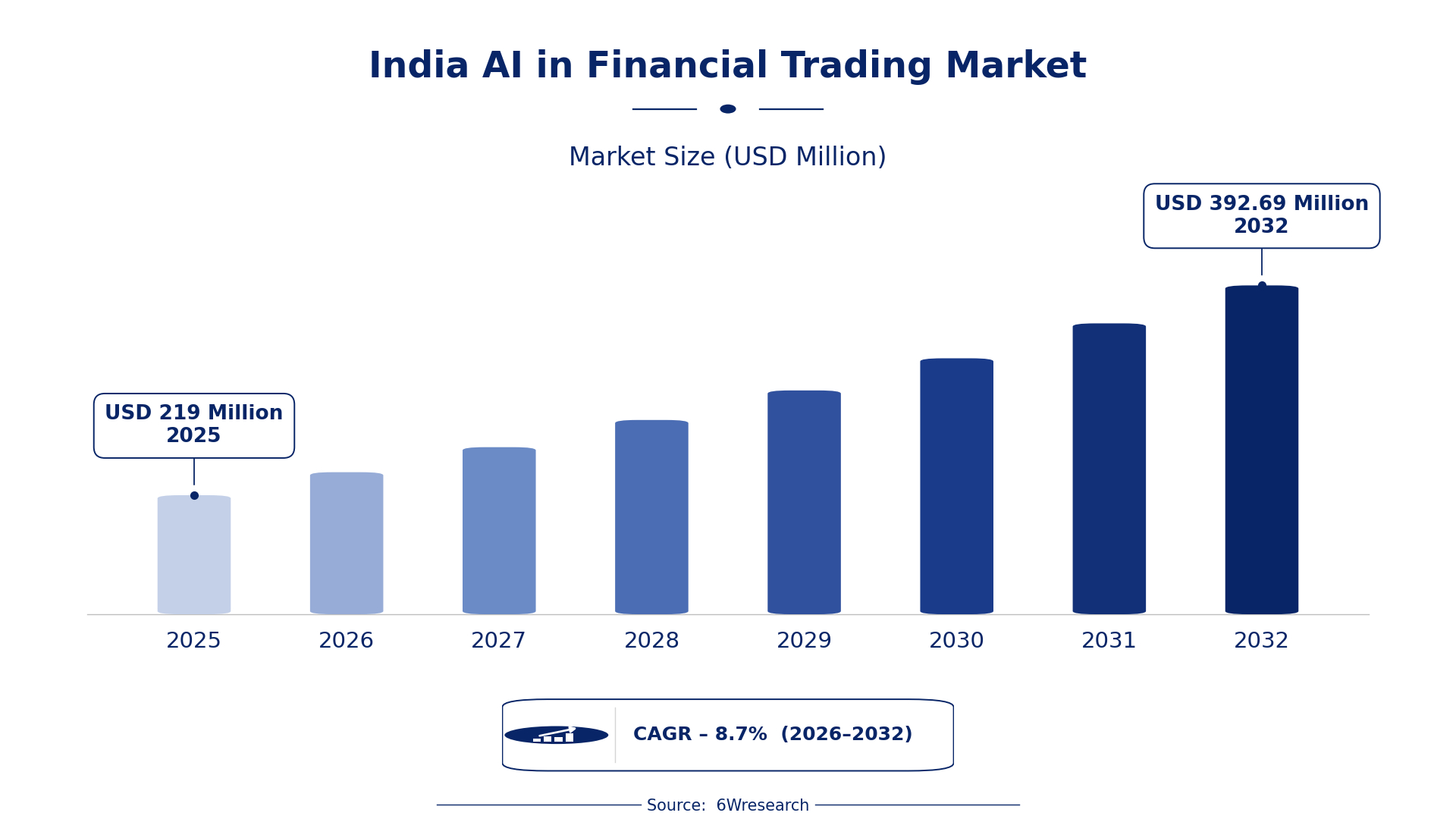
According to 6Wresearch internal database and industry insights, the India AI in Financial Trading Market was valued at USD 219.0 million in 2025 and is projected to reach USD 392.69 million by 2032, growing at a CAGR of approximately 8.7% during 2026–2032.
India AI in Financial Trading Market Highlights
| Report Metric | Details |
| Report Name | India AI in Financial Trading Market |
| Market Size 2025 | USD 219.0 million |
| Market Size 2032 | USD 392.69 million |
| Absolute Growth 2025–2032 | USD 173.69 million |
| CAGR 2026–2032 | 8.7% |
| Peak Annual Growth | 11.1% in 2029 |
| Forecast Period | 2026–2032 |
| Historical Data | 2022–2025 |
| Base Year | 2025 |
| Leading Trading Type, 2025 | Algorithmic Trading (38% share) |
| Leading AI Engine Type, 2025 | Deep Learning Algorithms (49% share) |
| Leading Distribution Channel, 2025 | Direct Fintech Vendors (52% share) |
| Leading End User, 2025 | Institutional Traders (55% share) |
| Fastest-Growing Trading Type | Sentiment-Based Trading (10.4% CAGR) |
| Fastest-Growing AI Engine Type | NLP Analysis (10.3% CAGR) |
| Fastest-Growing End User | Quantitative Analysts (10.1% CAGR) |
| Growing Sector | Fintech Sector |
| Key End Users | Institutional Traders, Quantitative Analysts, Hedge Funds, Individual Traders |
India AI in Financial Trading Market Year-wise Growth Rate and Key Drivers (2022–2032)
This graph illustrates the annual growth rates of the market from 2022 to 2032, highlighting a steady upward trajectory and projected market expansion over the forecast period.
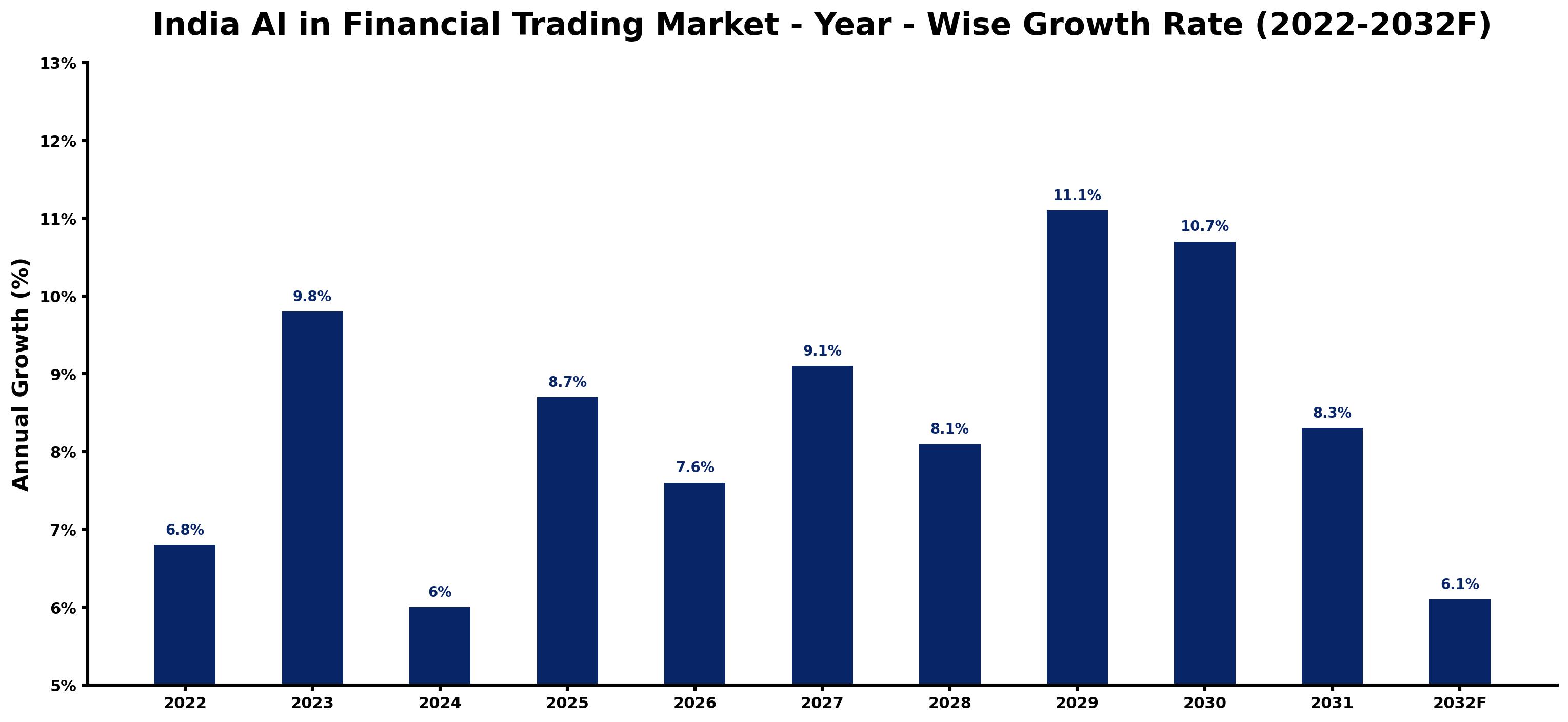
Each row of the following table gives one year's estimated growth and the event or demand shift that explains it.
| Year | Estimated Annual Growth (%) | Market Rationale |
| 2022 | 6.8 | The market showed steady growth, reflecting increased interest in AI applications for trading. |
| 2023 | 9.8 | Growth accelerated due to the implementation of AI for market surveillance by the National Stock Exchange. |
| 2024 | 6.0 | A slowdown occurred as algorithmic trading strategies matured, stabilising demand for AI solutions. |
| 2025 | 8.7 | Demand surged again as fintech investments reached $30 billion, driving AI adoption in trading. |
| 2026 | 7.6 | Growth slowed as the market adjusted to regulatory guidelines established by the Securities and Exchange Board of India. |
| 2027 | 9.1 | The market rebounded with rising interest in sentiment-based trading strategies among institutional traders. |
| 2028 | 8.1 | A slowdown was noted as the market stabilised following rapid previous growth in AI technologies. |
| 2029 | 11.1 | The peak growth year saw advancements in AI-driven trading efficiency and accuracy. |
| 2030 | 10.7 | Growth slowed as the market began to consolidate and adapt to evolving technologies. |
| 2031 | 8.3 | A further slowdown was observed as the market matured and competition intensified. |
| 2032 | 6.1 | Growth continued to slow as the market reached a more stable phase of AI integration. |
Note: Market size estimations and growth projections presented in this report are based on 6Wresearch's proprietary forecasting methodology, utilizing the latest available industry data, government publications, and primary research inputs.
India AI in Financial Trading Market Synopsis
AI in Financial Trading in India refers to the use of artificial intelligence technologies to analyse market data and execute trades. It involves machine learning algorithms that predict market trends and automate trading processes. The India AI in Financial Trading Market is experiencing growth driven by significant demand from domestic and international users, particularly in the fintech sector. In 2023, the Reserve Bank of India launched a framework for fintech innovation, which is further driving AI adoption. With over 1,000 fintech startups focusing on AI applications, the market is expected to expand significantly in the coming years.
Market Dynamics Impact Analysis (2026–2032)
| Factor | Type | Impact | Primary Segment Affected |
| Increased algorithmic trading adoption | Driver | High | Algorithmic Trading |
| Growing institutional interest in AI tools | Driver | High | Institutional Traders |
| Investment exceeding $30 billion in fintech | Opportunity | High | Algorithmic Trading |
| Rising demand for sentiment analysis tools | Opportunity | Medium | Sentiment-Based Trading |
| Regulatory challenges from the Securities and Exchange Board of India | Restraint | High | High-Frequency Trading |
| Limited access to advanced AI technologies for smaller firms | Restraint | Medium | Algorithmic Trading |
| Buyers face challenges in adapting to new regulations | Challenge | High | Institutional Traders |
| Suppliers struggle with rapid technological changes | Challenge | Medium | Algorithmic Trading |
Evaluation of Drivers in India AI in Financial Trading Market (2026–2032)
Below mentioned are some major drivers and their influence on market dynamics.
| Drivers | Primary Segment Affected | Why It Matters (Evidence) |
| Growing reliance on algorithmic trading strategies | Algorithmic Trading | More than 50% of trades in India are executed using these strategies, increasing demand for AI solutions. |
| Increased institutional investment in AI tools | Institutional Traders | AI-driven sentiment analysis tools are utilised by over 30% of institutional traders, boosting demand. |
| Expansion of fintech investments | Algorithmic Trading | The fintech sector in India is expected to attract investments exceeding $30 billion by 2025, driving AI adoption. |
| Advancements in deep learning models | Deep Learning Algorithms | Deep learning models have shown a 70% accuracy in predicting stock movements, improving trading strategies. |
| Support from government initiatives | Algorithmic Trading | The Digital India initiative promotes AI adoption in financial services, encouraging innovation and investment. |
The AI in Financial Trading market in India is expanding as end-use demand from fintech companies rises. More than 50% of trades are executed using algorithmic strategies, which boosts the need for AI solutions. Institutional traders increasingly rely on AI-driven sentiment analysis tools, with over 30% adopting these technologies. The fintech sector is projected to attract investments exceeding $30 billion by 2025, driving further AI integration.
Evaluation of Restraints in India AI in Financial Trading Market
The table below lists the restraints and the evidence behind each.
| Market Restraint | Primary Segment Affected | Why It Matters (Evidence) |
| Regulatory challenges from the Securities and Exchange Board of India | High-Frequency Trading | These regulations can complicate the implementation of AI technologies for trading, affecting operational efficiency. |
| Limited access to advanced AI technologies for smaller firms | Algorithmic Trading | Smaller firms often lack the resources to invest in sophisticated AI solutions, limiting their competitiveness. |
| High costs associated with AI integration | Sentiment-Based Trading | The initial investment required for AI technologies can deter some traders from adopting these solutions. |
| Data privacy concerns affecting AI deployment | Algorithmic Trading | Strict data protection regulations can hinder the use of AI in trading, impacting market growth. |
| Talent shortages in AI and finance sectors | Institutional Traders | A lack of skilled professionals limits the ability to fully utilise AI technologies in trading. |
India AI in Financial Trading Market Challenges
Over 50% of trades in India rely on algorithmic trading strategies, yet many buyers struggle with outdated technology, leading to inefficiencies and delayed execution times. Regulatory hurdles persist as the Securities and Exchange Board of India has established guidelines for AI in trading, which can slow down innovation for fintech startups. Buyers face challenges in accessing advanced AI tools, as only 30% of institutional traders currently utilise AI-driven sentiment analysis, limiting their competitive edge. The competitive environment is intensifying, with over 1,000 fintech startups competing for market share, making it difficult for established players to maintain profitability.
Trends in the India AI in Financial Trading Market
Buyers and suppliers in the India AI in Financial Trading Market are adjusting to the following trends.
- Increase in Algorithmic Trading Adoption: Institutional traders are increasingly adopting algorithmic trading strategies, with over 50% of trades executed this way. This shift reflects a growing reliance on technology to improve trading efficiency.
- Rise of Sentiment-Based Trading: Sentiment-based trading is gaining traction, with AI tools analysing market sentiment to inform decisions. More than 30% of institutional traders are now using these tools to refine their strategies.
- Surge in Fintech Investments: The fintech sector is experiencing unprecedented growth, with investments expected to exceed $30 billion by 2025. This surge is driving demand for AI applications in financial trading.
- Advancements in Deep Learning Models: Deep learning algorithms are becoming essential in trading, achieving 70% accuracy in predicting stock movements. This trend is reshaping how traders approach market analysis.
Investment Opportunities in the India AI in Financial Trading Market
The following opportunities in the India AI in Financial Trading Market pair current demand with a clear way in.
- Right Timing for AI Adoption: With the fintech sector projected to surpass $30 billion in investments by 2025, there is a strong opportunity for AI solution providers to penetrate the market, particularly in Tier-1 cities.
- Development of AI-Driven Trading Solutions: The demand for AI-driven trading solutions is on the rise, especially among institutional traders. Companies can concentrate on developing advanced algorithms and analytics tools to satisfy this need.
- Addressing the AI Talent Gap: With a talent shortage in AI and finance, there is an opportunity to invest in training and development programmes. Collaborating with educational institutions can help bridge this gap.
- Entry through Strategic Partnerships: Forming partnerships with local fintech startups can offer a pathway for entering the Indian market. This strategy can facilitate access to resources and regulatory insights.
Government Initiatives in the India AI in Financial Trading Market
The 'Fintech Regulatory Sandbox' launched by the Reserve Bank of India in 2020 encourages innovation in financial services. This initiative allows startups to test AI applications under regulatory supervision, creating a supportive environment for AI in trading. In 2021, the Ministry of Electronics and Information Technology introduced the 'National Strategy on Artificial Intelligence' to promote AI development across sectors, including finance. This strategy aims to improve the country's AI capabilities and drive growth in the fintech sector.
In 2023, the Indian government announced a $1 billion fund to support AI research and development in the financial sector. The Reserve Bank of India oversees this fund, which aims to promote innovation and competitiveness in AI applications. Additionally, the Securities and Exchange Board of India updated its guidelines in 2022 to include provisions for the use of AI in trading. These guidelines improve market efficiency and transparency, ensuring a conducive environment for AI integration.
Future Insight of the India AI in Financial Trading Market
The AI in Financial Trading market in India will transform by 2032, influenced by advancements in machine learning and a surge in fintech investments. The Reserve Bank of India's fintech innovation framework will facilitate broader AI adoption, enhancing trading efficiency. By 2025, the fintech sector is set to attract investments surpassing $30 billion, fueling growth and technological advancements. Research at institutions like the Indian Institute of Technology will drive innovations that improve predictive accuracy and optimise trading strategies.
Market Segmentation Analysis
The report offers a comprehensive study of the following market segments and their leading categories in the market.
By Trading Type – Algorithmic Trading Dominated, Sentiment-Based Trading Expected to Grow Fastest
According to Shubham Padhi, Research Analyst at 6Wresearch, Algorithmic Trading took a 38% share of trading type in 2025, more than any other category. Algorithmic trading dominates the market share in India because it is widely adopted by institutional traders who rely on algorithms for efficient trade execution. This method is crucial, with over 50% of trades in the country executed using these strategies. Sentiment-Based Trading is projected to grow fastest, at a CAGR of 10.4% during 2026–2032. Sentiment-based trading is rapidly expanding as institutional traders increasingly adopt sentiment analysis tools, with over 30% currently using them. This trend reflects a significant shift towards integrating market sentiment into trading decisions, indicating a broader industry evolution. Suppliers should enhance their offerings to meet the rising demand for sentiment-based trading solutions.
By AI Engine Type – Deep Learning Algorithms Dominated, NLP Analysis Expected to Grow Fastest
Deep Learning Algorithms held a 49% share of the India AI in Financial Trading Market by ai engine type in 2025. Deep learning algorithms lead the market share in AI for financial trading, as they are vital for analysing complex financial data and improving predictive accuracy. Their proven effectiveness, achieving a 70% accuracy rate in stock movement predictions, reinforces their dominance. The quickest growth will come from NLP Analysis, forecast to expand at a CAGR of 10.3% between 2026 and 2032. NLP analysis is the fastest-growing segment, as traders seek to quickly interpret news and reports to inform their decisions. This technology is becoming essential for gaining insights into market sentiment and trends. Buyers should invest in NLP capabilities to maintain a competitive edge in trading.
By Distribution Channel – Direct Fintech Vendors Dominated and Is Expected to Record the Fastest Growth
Direct Fintech Vendors accounted for a 52% market share by distribution channel in 2025. Direct fintech vendors capture the largest market share by providing tailored solutions directly to traders, ensuring seamless integration of technology into trading practices. This direct approach fosters strong relationships with clients, enhancing trust and loyalty. Direct Fintech Vendors are also forecast to expand faster than any other category, at a CAGR of 10.9% over 2026–2032. Direct fintech vendors are also the fastest-growing segment, as their ability to deliver customised solutions aligns with the increasing demand for specialised tools in trading. Their proactive engagement with clients positions them well to adapt to market changes. Suppliers must focus on direct engagement strategies to capture the growing interest in bespoke AI solutions.
By End User – Institutional Traders Dominated, Quantitative Analysts Expected to Grow Fastest
The largest end user category in 2025 was Institutional Traders, with a 55% share of total revenue. Institutional traders hold the largest market share, utilising advanced tools powered by AI for extensive trading operations that handle significant transaction volumes. Their reliance on sophisticated analytics underscores the essential role of AI in their trading strategies. Quantitative Analysts are set to record the highest CAGR in this split, 10.1% over 2026–2032. Quantitative analysts are the fastest-growing user group, increasingly depending on AI for data analysis and strategy formulation. This trend highlights the rising importance of data-driven decision-making within the trading sector. Suppliers should tailor their products to address the specific needs of quantitative analysts, who are becoming pivotal in the trading landscape.
Key Attractiveness of the Report
- 10 Years of Market Numbers
- Historical Data Starting from 2022 to 2025
- Base Year 2025
- Forecast Data until 2032
- Key Performance Indicators Impacting the Market
- Major Upcoming Developments and Projects
Key Highlights of the Report:
- India AI in Financial Trading Market Outlook
- Market Size of India AI in Financial Trading Market, 2025
- Forecast of India AI in Financial Trading Market, 2032
- Historical Data and Forecast of India AI in Financial Trading Revenues & Volume for the Period 2022 - 2032F
- India AI in Financial Trading Market Trend Evolution
- India AI in Financial Trading Market Drivers and Challenges
- India AI in Financial Trading Price Trends
- India AI in Financial Trading Porter's Five Forces
- India AI in Financial Trading Industry Life Cycle
- Historical Data and Forecast of India AI in Financial Trading Market Revenues & Volume By Trading Type for the Period 2022 - 2032F
- Historical Data and Forecast of India AI in Financial Trading Market Revenues & Volume By High-Frequency Trading for the Period 2022 - 2032F
- Historical Data and Forecast of India AI in Financial Trading Market Revenues & Volume By Algorithmic Trading for the Period 2022 - 2032F
- Historical Data and Forecast of India AI in Financial Trading Market Revenues & Volume By Sentiment-Based Trading for the Period 2022 - 2032F
- Historical Data and Forecast of India AI in Financial Trading Market Revenues & Volume By Crypto Trading Bots for the Period 2022 - 2032F
- Historical Data and Forecast of India AI in Financial Trading Market Revenues & Volume By AI Engine Type for the Period 2022 - 2032F
- Historical Data and Forecast of India AI in Financial Trading Market Revenues & Volume By Deep Learning Algorithms for the Period 2022 - 2032F
- Historical Data and Forecast of India AI in Financial Trading Market Revenues & Volume By Predictive Models for the Period 2022 - 2032F
- Historical Data and Forecast of India AI in Financial Trading Market Revenues & Volume By NLP Analysis for the Period 2022 - 2032F
- Historical Data and Forecast of India AI in Financial Trading Market Revenues & Volume By Autonomous Agents for the Period 2022 - 2032F
- Historical Data and Forecast of India AI in Financial Trading Market Revenues & Volume By Distribution Channel for the Period 2022 - 2032F
- Historical Data and Forecast of India AI in Financial Trading Market Revenues & Volume By Direct Fintech Vendors for the Period 2022 - 2032F
- Historical Data and Forecast of India AI in Financial Trading Market Revenues & Volume By Cloud Platforms for the Period 2022 - 2032F
- Historical Data and Forecast of India AI in Financial Trading Market Revenues & Volume By Market Data Platforms for the Period 2022 - 2032F
- Historical Data and Forecast of India AI in Financial Trading Market Revenues & Volume By Crypto Exchange APIs for the Period 2022 - 2032F
- Historical Data and Forecast of India AI in Financial Trading Market Revenues & Volume By End User for the Period 2022 - 2032F
- Historical Data and Forecast of India AI in Financial Trading Market Revenues & Volume By Institutional Traders for the Period 2022 - 2032F
- Historical Data and Forecast of India AI in Financial Trading Market Revenues & Volume By Quantitative Analysts for the Period 2022 - 2032F
- Historical Data and Forecast of India AI in Financial Trading Market Revenues & Volume By Hedge Funds for the Period 2022 - 2032F
- Historical Data and Forecast of India AI in Financial Trading Market Revenues & Volume By Individual Traders for the Period 2022 - 2032F
- India AI in Financial Trading Import Export Trade Statistics
- Market Opportunity Assessment By Trading Type
- Market Opportunity Assessment By AI Engine Type
- Market Opportunity Assessment By Distribution Channel
- Market Opportunity Assessment By End User
- India AI in Financial Trading Top Companies Market Share
- India AI in Financial Trading Competitive Benchmarking By Technical and Operational Parameters
- India AI in Financial Trading Company Profiles
- India AI in Financial Trading Key Strategic Recommendations
Market Covered
Segments analysed in this report are listed below.
By Trading Type
- High-Frequency Trading
- Algorithmic Trading
- Sentiment-Based Trading
- Crypto Trading Bots
By AI Engine Type
- Deep Learning Algorithms
- Predictive Models
- NLP Analysis
- Autonomous Agents
By Distribution Channel
- Direct Fintech Vendors
- Cloud Platforms
- Market Data Platforms
- Crypto Exchange APIs
By End User
- Institutional Traders
- Quantitative Analysts
- Hedge Funds
- Individual Traders































