India AI in Industrial Automation Market Size & Growth Rate
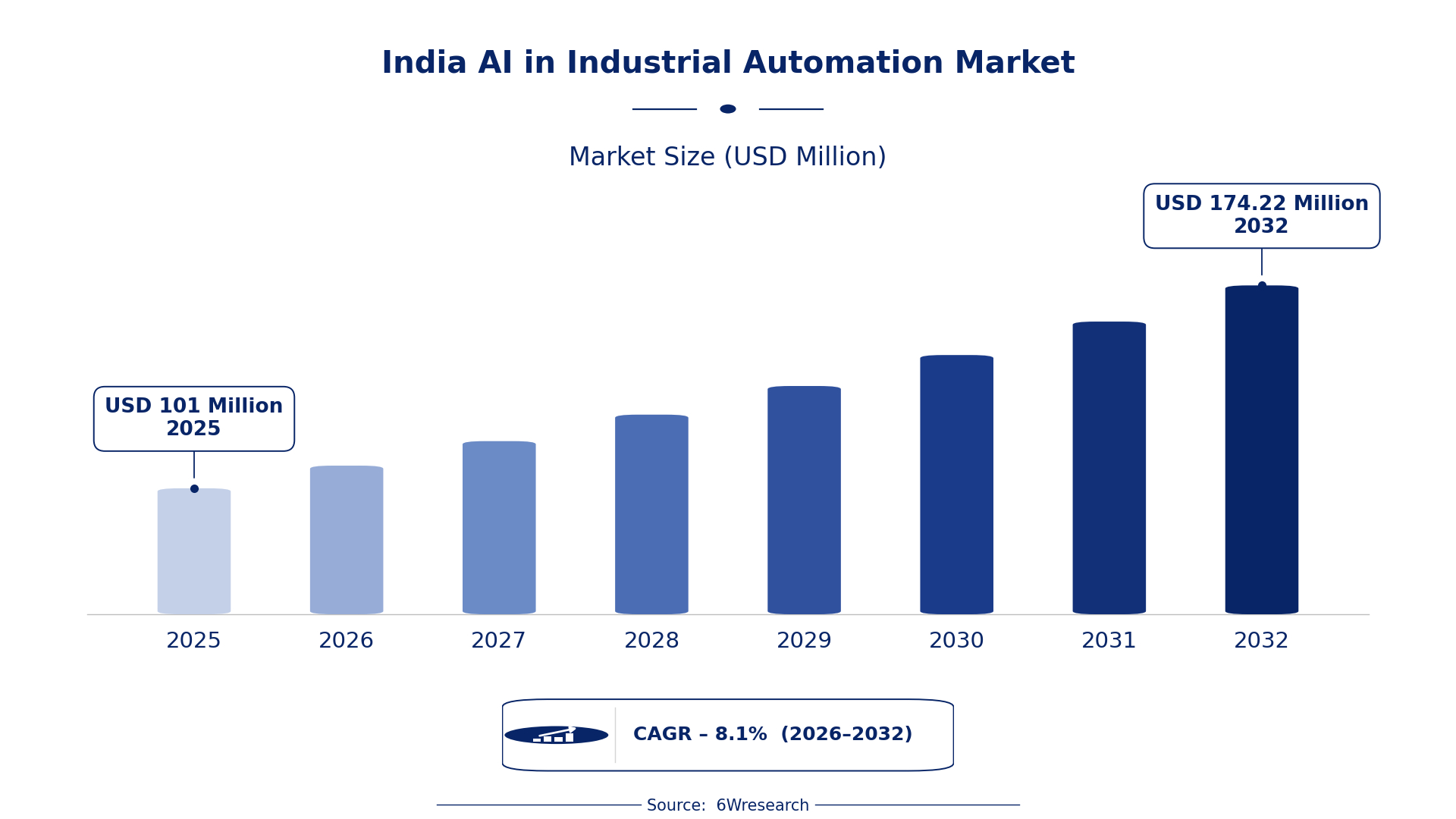
According to 6Wresearch internal database and industry insights, the India AI in Industrial Automation Market was valued at USD 101.0 million in 2025 and is projected to reach USD 174.22 million by 2032, growing at a CAGR of approximately 8.1% during 2026–2032.
India AI in Industrial Automation Market Highlights
| Report Metric | Details |
| Report Name | India AI in Industrial Automation Market |
| Market Size 2025 | USD 101.0 million |
| Market Size 2032 | USD 174.22 million |
| Absolute Growth 2025–2032 | USD 73.22 million |
| CAGR 2026–2032 | 8.1% |
| Peak Annual Growth | 10.3% in 2026 |
| Forecast Period | 2026–2032 |
| Historical Data | 2022–2025 |
| Base Year | 2025 |
| Leading Industry Area, 2025 | Process Automation (45% share) |
| Leading AI Use Case, 2025 | Sensor-based AI (43% share) |
| Leading Distribution Channel, 2025 | Automation Vendors (46% share) |
| Leading End User, 2025 | Manufacturing Plants (37% share) |
| Fastest-Growing Industry Area | Predictive Maintenance (10.8% CAGR) |
| Fastest-Growing AI Use Case | Vision AI (10.6% CAGR) |
| Fastest-Growing Distribution Channel | B2B Energy Integrators (9.6% CAGR) |
| Fastest-Growing End User | Smart Factory Managers (10.7% CAGR) |
| Growing Sector | Manufacturing |
| Key End Users | Manufacturing Plants, Assembly Line Operators, Smart Factory Managers, Heavy Machinery Manufacturers |
India AI in Industrial Automation Market Year-wise Growth Rate and Key Drivers (2022–2032)
This graph illustrates the annual growth rates of the market from 2022 to 2032, highlighting a steady upward trajectory and projected market expansion over the forecast period.
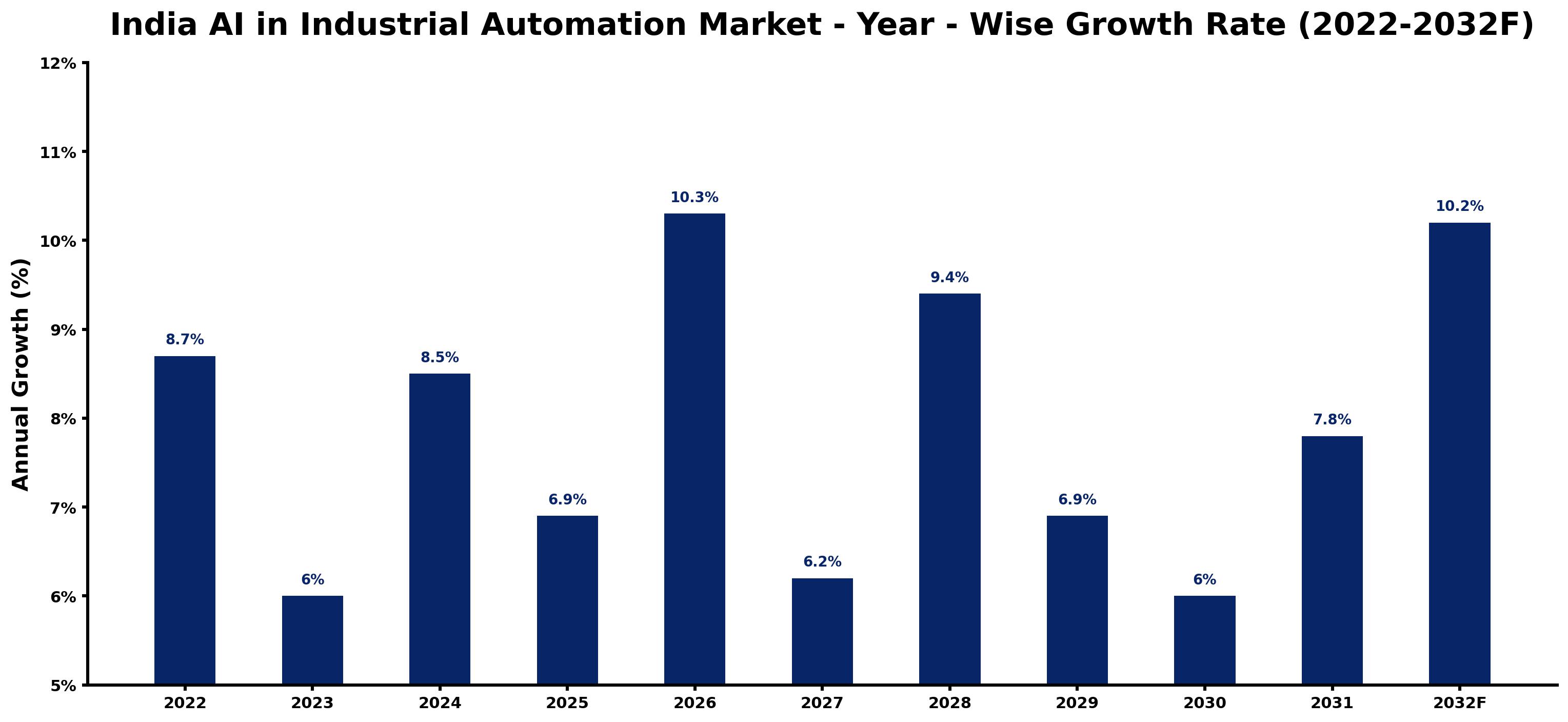
Each row of the following table gives one year's estimated growth and the event or demand shift that explains it.
| Year | Estimated Annual Growth (%) | Market Rationale |
| 2022 | 8.7 | The market experienced strong growth due to rising adoption of AI technologies in manufacturing. |
| 2023 | 6.0 | Growth slowed as companies adjusted to new technologies and integration challenges. |
| 2024 | 8.5 | Demand increased as manufacturers sought efficiency improvements through AI solutions. |
| 2025 | 6.9 | Growth slowed again as the market matured and competition intensified. |
| 2026 | 10.3 | A surge in investment under the 'Digital India Initiative' drove rapid growth. |
| 2027 | 6.2 | Growth slowed as the market faced challenges in technology implementation. |
| 2028 | 9.4 | Increased focus on AI-driven quality inspection boosted demand. |
| 2029 | 6.9 | Growth slowed as manufacturers consolidated their AI investments and strategies. |
| 2030 | 6.0 | The market stabilised with steady demand for AI solutions in manufacturing. |
| 2031 | 7.8 | Growth accelerated as new AI applications emerged in industrial settings. |
| 2032 | 10.2 | A strong push for smart manufacturing initiatives will drive further growth. |
Note: Market size estimations and growth projections presented in this report are based on 6Wresearch's proprietary forecasting methodology, utilizing the latest available industry data, government publications, and primary research inputs.
India AI in Industrial Automation Market Synopsis
AI in Industrial Automation Market in India encompasses the use of artificial intelligence technologies to enhance industrial processes. This includes optimising operations, improving quality control, and enabling predictive maintenance. The market is expanding swiftly due to the integration of AI technologies in over 1,500 manufacturing plants, bolstered by initiatives like 'Make in India'.
Market Dynamics Impact Analysis (2026–2032)
| Factor | Type | Impact | Primary Segment Affected |
| Rising investment in AI technologies for manufacturing processes | Driver | High | Process Automation |
| Increased demand for predictive maintenance solutions to reduce downtime | Driver | High | Predictive Maintenance |
| Growing need for energy optimization solutions in industrial operations | Opportunity | High | Energy Optimization |
| Expanding market for AI-driven quality inspection in manufacturing | Opportunity | High | Quality Inspection |
| Challenges in integrating AI with existing manufacturing systems | Restraint | Medium | Process Automation |
| High initial costs associated with AI implementation in factories | Restraint | Medium | Predictive Maintenance |
| Limited availability of skilled workforce for AI technologies | Challenge | High | Quality Inspection |
| Slow adoption rates among smaller manufacturing plants | Challenge | Medium | Energy Optimization |
Evaluation of Drivers in India AI in Industrial Automation Market (2026–2032)
The factors lifting demand, and the evidence behind each, are summarised below.
| Drivers | Primary Segment Affected | Why It Matters (Evidence) |
| Increased investment in smart manufacturing technologies | Process Automation | Investment in smart manufacturing technologies is driving demand for AI solutions, particularly under the 'Digital India' initiative. |
| Growing need for predictive maintenance to improve efficiency | Predictive Maintenance | AI-driven predictive maintenance can reduce maintenance costs by up to 30%, prompting manufacturers to adopt these solutions. |
| Demand for energy optimization solutions to cut costs | Energy Optimization | AI solutions in energy optimization can lead to a 20% reduction in energy costs, encouraging adoption among industries. |
| Expansion of AI applications in quality inspection processes | Quality Inspection | The adoption of ISO 9001 standards in AI-driven quality inspection processes is increasing, leading to higher demand. |
| Rise in automation vendors providing AI solutions | Automation Vendors | Automation vendors are expanding their offerings, increasing the availability of AI technologies for manufacturers. |
Market growth in India for AI in Industrial Automation rests on increased investment in smart manufacturing technologies, growing demand for predictive maintenance, and the need for energy optimization solutions. The push for AI adoption is clear, with over 1,500 manufacturing plants integrating these technologies. As a result, manufacturers are experiencing enhanced operational efficiency, with AI-driven predictive maintenance reducing costs by up to 30%. The rise in ISO 9001 standards for quality inspection processes is further stimulating demand for AI solutions, while automation vendors are expanding their offerings, making these technologies more accessible to manufacturers.
Evaluation of Restraints in India AI in Industrial Automation Market
The following restraints limit how fast demand can grow.
| Market Restraint | Primary Segment Affected | Why It Matters (Evidence) |
| Integration challenges with existing manufacturing systems | Process Automation | Many manufacturers face difficulties integrating AI with legacy systems, delaying implementation. |
| High initial costs associated with AI implementation | Predictive Maintenance | The substantial upfront investment required for AI technologies can deter smaller manufacturers from adoption. |
| Limited availability of skilled workforce for AI technologies | Quality Inspection | A shortage of trained professionals in AI technologies hinders the effective implementation of solutions. |
| Slow adoption rates among smaller manufacturing plants | Energy Optimization | Smaller plants often lack the resources to invest in advanced AI technologies, limiting market growth. |
| Concerns over data privacy and security in AI applications | Process Automation | Manufacturers are cautious about data privacy issues, which can slow down AI adoption. |
India AI in Industrial Automation Market Challenges
High initial costs slow the India AI in Industrial Automation market, as many producers struggle to allocate funds for advanced technologies. The average investment for AI integration can exceed ₹1 crore, which limits the ability of manufacturers to adopt these innovations. Technological disparities further complicate matters, with many producers lacking access to the latest AI tools, resulting in delayed operational efficiency. Supply chain issues exacerbate these challenges, as over 30% of producers report delays in procuring AI technology, which ultimately disrupts their production timelines. Regulatory compliance adds another hurdle, with new standards taking up to six months to meet, hindering timely implementation for buyers.
Trends in the India AI in Industrial Automation Market
The trends below show where the India AI in Industrial Automation Market is heading.
- Shift from Traditional to AI-Driven Quality Inspection: Manufacturing plants are increasingly adopting AI-driven quality inspection processes, improving product compliance. As of 2023, over 1,500 plants have integrated these technologies, enhancing operational efficiency.
- Transition from Manual to Automated Predictive Maintenance: Since 2021, manufacturers have shifted towards automated predictive maintenance, reducing downtime and costs. AI-driven solutions can decrease maintenance costs by up to 30%, making them attractive to plant managers.
- Emergence of Energy Optimization Solutions: The focus on energy efficiency has led to the rise of AI solutions for energy optimisation in industries. AI-driven systems can achieve a 20% reduction in energy costs, appealing to manufacturers.
- Prioritisation of Smart Manufacturing Initiatives: The 'Make in India' initiative has prioritised smart manufacturing, driving AI adoption across sectors. The market is projected to grow, with an installed base of over 50,000 industrial robots by 2025.
Investment Opportunities in the India AI in Industrial Automation Market
Investors looking at the India AI in Industrial Automation Market should consider the following areas.
- Supply of AI-Driven Predictive Maintenance Solutions: There is a growing need for predictive maintenance solutions in manufacturing, with potential cost reductions of up to 30%. Targeting manufacturing plants can yield substantial returns as they adopt these technologies.
- Investment in Energy Optimization Technologies: With industries seeking to cut energy costs, there is a gap for AI solutions that can reduce energy consumption by 20%. B2B energy integrators are key buyers for these technologies.
- Development of AI-Driven Quality Inspection Systems: The demand for AI-driven quality inspection is rising, particularly among manufacturing plants. Investing in these systems can meet the needs of a growing market, with ISO 9001 standards driving adoption.
- Expansion of Automation Vendor Offerings: Automation vendors are expanding their AI offerings, creating opportunities for suppliers to partner with them. Engaging in joint ventures can facilitate entry into this growing market.
Government Initiatives in the India AI in Industrial Automation Market
The 'National Policy on Electronics 2020' promotes AI in manufacturing, aiming to boost local production and innovation. This policy introduces clear guidelines for AI integration in industrial processes, ensuring compliance with standards and encouraging investment. The government has set a target to increase local production of electronics, which will directly benefit AI in Industrial Automation by creating a supportive environment for technology adoption.
The 'Digital India Initiative' has allocated ₹8,000 crore for enhancing digital infrastructure, including AI technologies. The Ministry of Electronics and Information Technology oversees this initiative, which aims to improve access to AI solutions for manufacturers and support their integration into operations. This funding is expected to enhance the capabilities of local manufacturers, enabling them to adopt advanced AI technologies more effectively.
Future Insight of the India AI in Industrial Automation Market
The India AI in Industrial Automation market is set to evolve significantly by 2032, influenced by key developments. The 'National AI Strategy' aims to position India as a global leader in AI, bolstering local manufacturing capabilities. By 2025, the installed base of industrial robots is expected to exceed 50,000 units, enhancing production efficiency. The 'Skill India' initiative will equip the workforce with crucial AI skills, driving innovation across various sectors. AI-driven predictive maintenance can reduce maintenance costs by up to 30%, benefiting both producers and buyers.
Market Segmentation Analysis
The analysis below covers each segmentation, its leading category in 2025 and its fastest-growing category through 2032.
By Industry Area – Process Automation Dominated, Predictive Maintenance Expected to Grow Fastest
According to Shubham Padhi, Research Analyst at 6Wresearch, with a 45% revenue share in 2025, Process Automation was the largest industry area category. Process Automation holds the largest share as it streamlines operations in over 1,500 manufacturing plants throughout India. This segment is essential for improving efficiency and productivity, making it a cornerstone for manufacturers aiming to remain competitive in the market. Over 2026–2032, Predictive Maintenance is expected to post the fastest growth, at a CAGR of 10.8%. Predictive Maintenance is witnessing rapid growth due to its ability to significantly reduce downtime and maintenance costs, with potential savings of up to 30%. This focus on cost efficiency will likely drive further adoption among industrial operators, reinforcing its market position. Suppliers should prioritise solutions that enhance predictive maintenance capabilities to meet the increasing demand.
By AI Use Case – Sensor-based AI Dominated, Vision AI Expected to Grow Fastest
Sensor-based AI took a 43% share of ai use case in 2025, more than any other category. Sensor-based AI commands the largest market share, being vital for real-time data collection and analysis in various industrial settings. Its extensive application across manufacturing processes ensures that operations remain efficient and informed, solidifying its leading position. Vision AI is set to record the highest CAGR in this split, 10.6% over 2026–2032. Vision AI is the fastest-growing use case, primarily due to its effectiveness in automated quality checks and defect detection, which are crucial for maintaining high product standards. This trend indicates a shift towards more automated quality assurance processes in the industry. Buyers should consider investing in Vision AI technologies to enhance quality control and operational efficiency.
By Distribution Channel – Automation Vendors Dominated, B2B Energy Integrators Expected to Grow Fastest
In 2025, Automation Vendors led the distribution channel split with a 46% share. Automation Vendors dominate the market share as they provide essential technology and solutions for AI implementation in industrial settings. Their established relationships with manufacturers facilitate the integration of AI into existing processes, ensuring widespread adoption. B2B Energy Integrators are projected to grow fastest, at a CAGR of 9.6% during 2026–2032. B2B Energy Integrators are the fastest-growing channel, utilising AI to optimise energy management solutions, which is increasingly important as industries seek to reduce costs and improve sustainability. This growth reflects a shift towards more energy-efficient practices in industrial operations. Suppliers must develop partnerships with B2B Energy Integrators to tap into the expanding market for energy optimisation solutions.
By End User – Manufacturing Plants Dominated, Smart Factory Managers Expected to Grow Fastest
Manufacturing Plants accounted for a 37% market share by end user in 2025. Manufacturing Plants represent the largest share of the market, as they are the primary users of AI technologies aimed at improving operational efficiency. Their significant workforce of over 50 million people drives the demand for advanced automation solutions, reinforcing their leading position. The quickest growth will come from Smart Factory Managers, forecast to expand at a CAGR of 10.7% between 2026 and 2032. Smart Factory Managers are the fastest-growing end user group, utilising AI to manage and optimise smart factory operations effectively. This trend highlights the increasing importance of AI in the evolution of manufacturing towards smarter, more connected environments. Manufacturers should focus on equipping Smart Factory Managers with the necessary AI tools to enhance productivity and operational control.
Key Attractiveness of the Report
- 10 Years of Market Numbers
- Historical Data Starting from 2022 to 2025
- Base Year 2025
- Forecast Data until 2032
- Key Performance Indicators Impacting the Market
- Major Upcoming Developments and Projects
Key Highlights of the Report:
- India AI in Industrial Automation Market Outlook
- Market Size of India AI in Industrial Automation Market, 2025
- Forecast of India AI in Industrial Automation Market, 2032
- Historical Data and Forecast of India AI in Industrial Automation Revenues & Volume for the Period 2022 - 2032F
- India AI in Industrial Automation Market Trend Evolution
- India AI in Industrial Automation Market Drivers and Challenges
- India AI in Industrial Automation Price Trends
- India AI in Industrial Automation Porter's Five Forces
- India AI in Industrial Automation Industry Life Cycle
- Historical Data and Forecast of India AI in Industrial Automation Market Revenues & Volume By Industry Area for the Period 2022 - 2032F
- Historical Data and Forecast of India AI in Industrial Automation Market Revenues & Volume By Predictive Maintenance for the Period 2022 - 2032F
- Historical Data and Forecast of India AI in Industrial Automation Market Revenues & Volume By Quality Inspection for the Period 2022 - 2032F
- Historical Data and Forecast of India AI in Industrial Automation Market Revenues & Volume By Energy Optimization for the Period 2022 - 2032F
- Historical Data and Forecast of India AI in Industrial Automation Market Revenues & Volume By Process Automation for the Period 2022 - 2032F
- Historical Data and Forecast of India AI in Industrial Automation Market Revenues & Volume By AI Use Case for the Period 2022 - 2032F
- Historical Data and Forecast of India AI in Industrial Automation Market Revenues & Volume By Sensor-based AI for the Period 2022 - 2032F
- Historical Data and Forecast of India AI in Industrial Automation Market Revenues & Volume By Vision AI for the Period 2022 - 2032F
- Historical Data and Forecast of India AI in Industrial Automation Market Revenues & Volume By ML-Controlled Systems for the Period 2022 - 2032F
- Historical Data and Forecast of India AI in Industrial Automation Market Revenues & Volume By Autonomous Controllers for the Period 2022 - 2032F
- Historical Data and Forecast of India AI in Industrial Automation Market Revenues & Volume By Distribution Channel for the Period 2022 - 2032F
- Historical Data and Forecast of India AI in Industrial Automation Market Revenues & Volume By Automation Vendors for the Period 2022 - 2032F
- Historical Data and Forecast of India AI in Industrial Automation Market Revenues & Volume By Robotics OEMs for the Period 2022 - 2032F
- Historical Data and Forecast of India AI in Industrial Automation Market Revenues & Volume By B2B Energy Integrators for the Period 2022 - 2032F
- Historical Data and Forecast of India AI in Industrial Automation Market Revenues & Volume By Direct Industry Sales for the Period 2022 - 2032F
- Historical Data and Forecast of India AI in Industrial Automation Market Revenues & Volume By End User for the Period 2022 - 2032F
- Historical Data and Forecast of India AI in Industrial Automation Market Revenues & Volume By Manufacturing Plants for the Period 2022 - 2032F
- Historical Data and Forecast of India AI in Industrial Automation Market Revenues & Volume By Assembly Line Operators for the Period 2022 - 2032F
- Historical Data and Forecast of India AI in Industrial Automation Market Revenues & Volume By Smart Factory Managers for the Period 2022 - 2032F
- Historical Data and Forecast of India AI in Industrial Automation Market Revenues & Volume By Heavy Machinery Manufacturers for the Period 2022 - 2032F
- India AI in Industrial Automation Import Export Trade Statistics
- Market Opportunity Assessment By Industry Area
- Market Opportunity Assessment By AI Use Case
- Market Opportunity Assessment By Distribution Channel
- Market Opportunity Assessment By End User
- India AI in Industrial Automation Top Companies Market Share
- India AI in Industrial Automation Competitive Benchmarking By Technical and Operational Parameters
- India AI in Industrial Automation Company Profiles
- India AI in Industrial Automation Key Strategic Recommendations
Market Covered
This report examines the market across the segments below.
By Industry Area
- Predictive Maintenance
- Quality Inspection
- Energy Optimization
- Process Automation
By AI Use Case
- Sensor-based AI
- Vision AI
- ML-Controlled Systems
- Autonomous Controllers
By Distribution Channel
- Automation Vendors
- Robotics OEMs
- B2B Energy Integrators
- Direct Industry Sales
By End User
- Manufacturing Plants
- Assembly Line Operators
- Smart Factory Managers
- Heavy Machinery Manufacturers































