India AI in Telehealth Market Size & Growth Rate
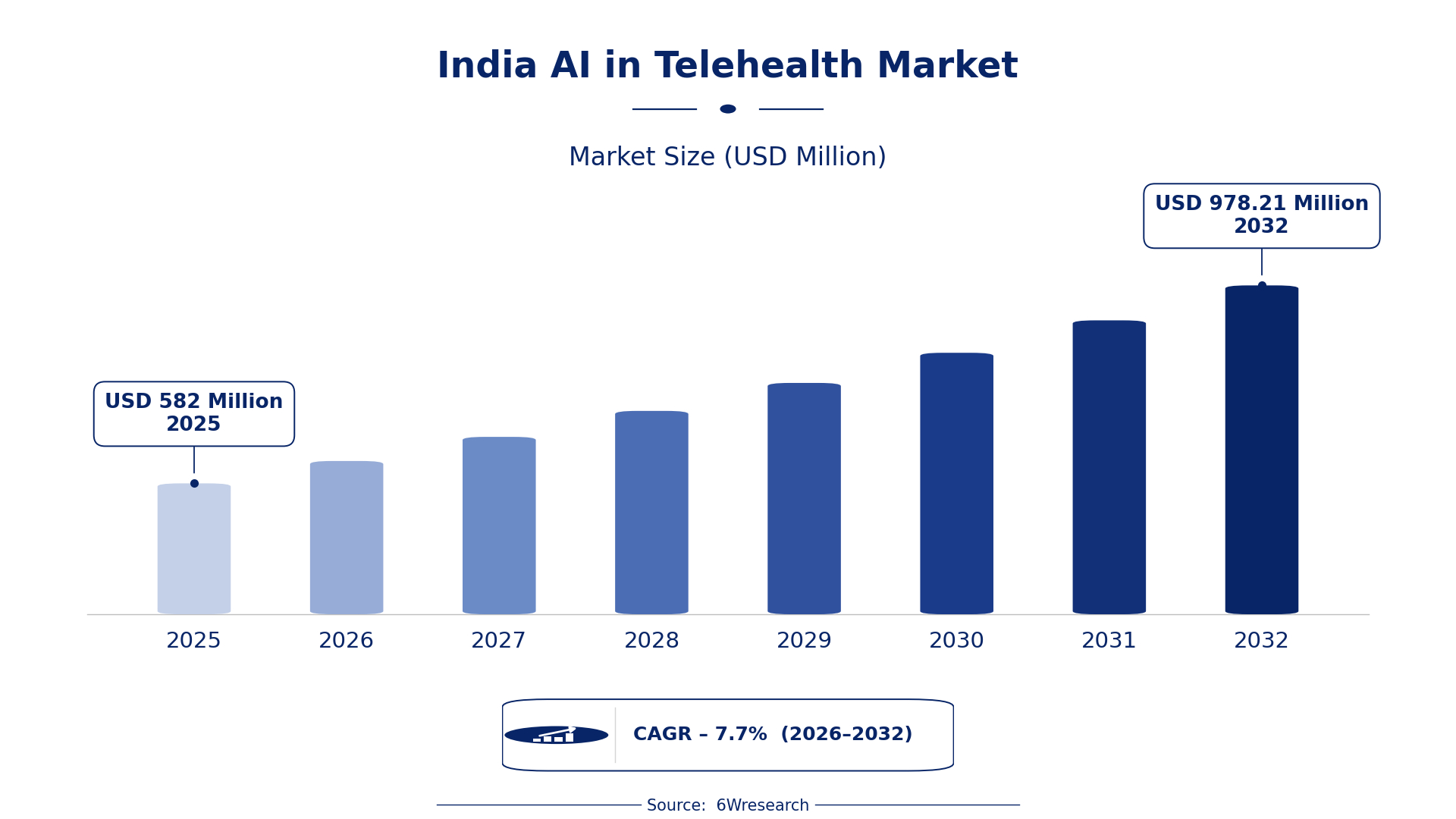
According to 6Wresearch internal database and industry insights, the India AI in Telehealth Market was valued at USD 582.0 million in 2025 and is projected to reach USD 978.21 million by 2032, growing at a CAGR of approximately 7.7% during 2026–2032.
India AI in Telehealth Market Highlights
| Report Metric | Details |
| Report Name | India AI in Telehealth Market |
| Market Size 2025 | USD 582.0 million |
| Market Size 2032 | USD 978.21 million |
| Absolute Growth 2025–2032 | USD 396.21 million |
| CAGR 2026–2032 | 7.7% |
| Peak Annual Growth | 9.8% in 2028 |
| Forecast Period | 2026–2032 |
| Historical Data | 2022–2025 |
| Base Year | 2025 |
| Leading Service Type, 2025 | Virtual Consultations (37% share) |
| Leading AI Application, 2025 | Chatbots & NLP (44% share) |
| Leading Distribution Channel, 2025 | Digital Health Platforms (36% share) |
| Leading End User, 2025 | Remote Patients (49% share) |
| Fastest-Growing Service Type | Mental Health (10.0% CAGR) |
| Fastest-Growing Distribution Channel | Telehealth App Stores (8.8% CAGR) |
| Fastest-Growing End User | Chronic Care Providers (9.1% CAGR) |
| Growing Sector | Chatbots & NLP |
| Key End Users | Remote Patients, Chronic Care Providers, Teletherapy Centers, Online Clinics |
India AI in Telehealth Market Year-wise Growth Rate and Key Drivers (2022–2032)
This graph illustrates the annual growth rates of the market from 2022 to 2032, highlighting a steady upward trajectory and projected market expansion over the forecast period.
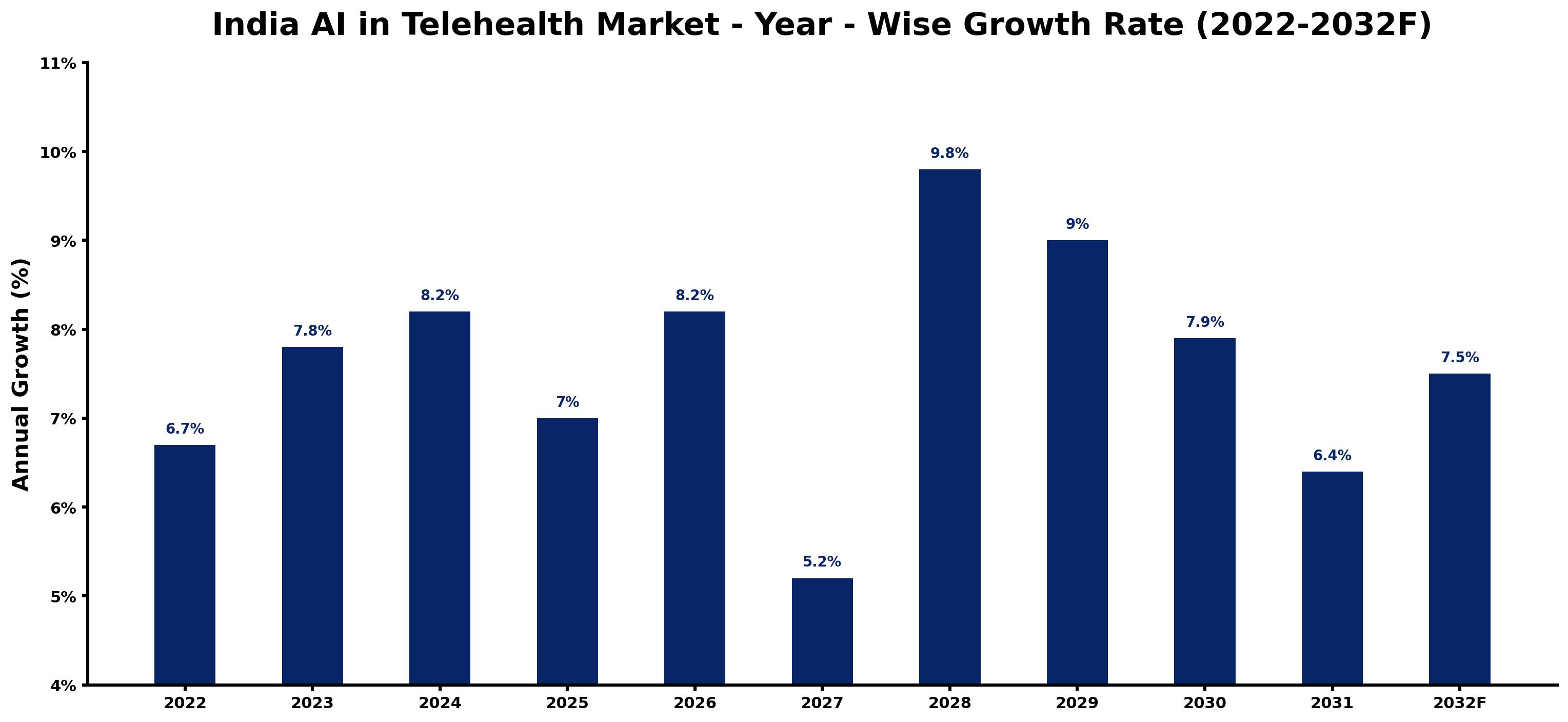
Each row of the following table gives one year's estimated growth and the event or demand shift that explains it.
| Year | Estimated Annual Growth (%) | Market Rationale |
| 2022 | 6.7 | Telehealth solutions were widely adopted by healthcare providers, responding to increased demand for healthcare access. |
| 2023 | 7.8 | The National Digital Health Mission promoted digital health infrastructure, boosting telehealth services across India. |
| 2024 | 8.2 | Growth accelerated as more patients opted for virtual consultations over traditional visits, reflecting changing preferences. |
| 2025 | 7.0 | The market experienced a slowdown as providers adjusted to evolving patient needs and technology integration. |
| 2026 | 8.2 | Increased adoption of remote monitoring devices improved patient care management, enhancing service delivery. |
| 2027 | 5.2 | Growth slowed as the market stabilised after rapid expansion, influenced by regulatory adjustments. |
| 2028 | 9.8 | The introduction of advanced AI applications drove higher demand for telehealth services, improving efficiency. |
| 2029 | 9.0 | Growth slowed slightly as competition intensified among telehealth platforms, impacting pricing strategies. |
| 2030 | 7.9 | The market continued to expand as chronic care providers increasingly utilised telehealth for patient management. |
| 2031 | 6.4 | A further slowdown was noted as the market reached a more mature phase, reflecting market dynamics. |
| 2032 | 7.5 | Growth is expected to rise again as digital health initiatives gain traction, enhancing service accessibility. |
Note: Market size estimations and growth projections presented in this report are based on 6Wresearch's proprietary forecasting methodology, utilizing the latest available industry data, government publications, and primary research inputs.
India AI in Telehealth Market Synopsis
The AI in Telehealth Market in India integrates artificial intelligence technologies into remote healthcare services. This technology streamlines processes through virtual consultations, remote monitoring, and mental health support. The AI in Telehealth Market is expanding due to rising healthcare demand and initiatives like the National Digital Health Mission. Over 60% of healthcare providers have adopted telehealth solutions, reflecting a marked shift in service delivery. The Indian population, projected to reach 1.5 billion by 2030, further propels this market's growth.
Market Dynamics Impact Analysis (2026–2032)
| Factor | Type | Impact | Primary Segment Affected |
| Increasing adoption of AI technologies for patient management | Driver | High | Remote Monitoring |
| Growing preference for virtual consultations among patients | Driver | High | Virtual Consultations |
| Rising demand for mental health services | Opportunity | High | Mental Health |
| Expansion of digital health platforms across urban areas | Opportunity | Medium | Digital Health Platforms |
| Regulatory challenges in implementing AI solutions | Restraint | High | Virtual Consultations |
| Limited awareness among healthcare providers about telehealth benefits | Restraint | Medium | Virtual Consultations |
| Integration of AI in telehealth faces data privacy concerns | Challenge | High | Virtual Consultations |
| Infrastructure limitations in rural areas hinder telehealth access | Challenge | Medium | Remote Patients |
Evaluation of Drivers in India AI in Telehealth Market (2026–2032)
The main growth drivers and the segments they affect most are set out below.
| Drivers | Primary Segment Affected | Why It Matters (Evidence) |
| Increased healthcare access through telehealth solutions | Remote Monitoring | Over 80% of patients prefer virtual consultations for non-emergency cases, leading to higher adoption rates. |
| Support from the National Digital Health Mission | Virtual Consultations | The mission aims to improve digital health infrastructure, facilitating wider telehealth service adoption with a budget of 1,500 crore INR. |
| Rising need for mental health support | Mental Health | Teletherapy centers have seen a 200% increase in patient registrations since 2021, reflecting growing demand for mental health services. |
| Integration of AI technologies in healthcare | Predictive Scheduling | AI-driven predictive scheduling is being tested in major metropolitan hospitals, improving service efficiency and patient management. |
| Expansion of digital health platforms | Digital Health Platforms | Telehealth platforms are now integrated with over 100 hospitals in major cities, increasing service availability. |
Growth across the AI in Telehealth market in India is anchored in rising healthcare access, increasing demand for mental health support, and the integration of AI technologies. Over 80% of patients prefer virtual consultations for non-emergency cases, driving demand for remote monitoring solutions. The integration of AI technologies is being tested in major metropolitan hospitals, improving service efficiency and patient management. Teletherapy centres have seen a 200% increase in patient registrations since 2021, indicating a shift towards mental health support. The expansion of digital health platforms is facilitating wider adoption of telehealth services, improving overall patient care.
Evaluation of Restraints in India AI in Telehealth Market
The key brakes on demand, and where they bite hardest, are shown below.
| Market Restraint | Primary Segment Affected | Why It Matters (Evidence) |
| Regulatory challenges in implementing AI solutions | Virtual Consultations | AI applications in telehealth are regulated under the Digital Information Security in Health Care Act, complicating deployment and compliance. |
| Limited awareness among healthcare providers about telehealth benefits | Virtual Consultations | Many providers remain unaware of the advantages of telehealth, hindering widespread adoption and integration. |
| Concerns regarding patient data privacy | Remote Monitoring | The Digital Information Security in Health Care Act raises concerns about data handling in telehealth, affecting provider confidence. |
| Infrastructure limitations in rural areas hinder telehealth access | Remote Patients | Rural areas often lack the necessary internet connectivity for effective telehealth services, limiting patient reach. |
| High initial investment costs for telehealth technologies | Digital Health Platforms | Many healthcare providers find it challenging to invest in the required technology for telehealth, impacting service expansion. |
India AI in Telehealth Market Challenges
The AI in Telehealth market in India faces regulatory challenges that delay the rollout of new technologies, costing healthcare providers up to 30% of their operational efficiency. Compliance with the Digital Information Security in Health Care Act requires substantial investment in cybersecurity measures, which can consume nearly 15% of a smaller clinic's budget. Intense price competition among telehealth platforms forces providers to reduce service fees, impacting their ability to invest in quality improvements and innovation. A shortage of skilled professionals in AI technologies hampers hospitals' ability to effectively implement these solutions, resulting in longer wait times for patients seeking virtual consultations.
Trends in the India AI in Telehealth Market
Buyers and suppliers in the India AI in Telehealth Market are adjusting to the following trends.
- Shift towards Remote Patient Monitoring: India is increasingly adopting remote patient monitoring solutions, especially in urban areas. Telehealth services have been implemented in over 500 districts, improving healthcare access for millions.
- Rise of AI-driven Mental Health Solutions: The integration of AI in mental health services has surged since 2021, with teletherapy centers reporting a 200% increase in patient registrations. This trend highlights the growing acceptance of digital mental health support in India.
- Expansion of Digital Health Platforms: Digital health platforms are becoming integral to telehealth services, with over 100 hospitals now integrated. This expansion is vital for managing patient data and improving service delivery across the country.
- Increased Focus on Data Security Regulations: The enactment of the Digital Information Security in Health Care Act in 2020 has heightened focus on data privacy in telehealth. This regulation is essential for ensuring patient trust in digital health services.
Investment Opportunities in the India AI in Telehealth Market
Some of the investment opportunities in the India AI in Telehealth Market are mentioned below.
- Growing Demand for Mental Health Services: With a 200% increase in patient registrations at teletherapy centres since 2021, there is a strong opportunity to invest in mental health solutions. Targeting urban areas can yield high returns for investors.
- Expansion of Digital Health Platforms: The current push for digital health solutions presents an opportunity to supply advanced telehealth technologies. Collaborating with healthcare providers can improve service delivery in major cities across India.
- Investment in Remote Monitoring Devices: As remote monitoring becomes essential for chronic care management, suppliers can meet this demand by providing advanced devices. Focusing on urban healthcare facilities will be advantageous for new entrants.
- Integration of AI in Telehealth Services: The integration of AI technologies in telehealth is a key opportunity for investment. Collaborating with healthcare providers in metropolitan areas can facilitate entry into the growing market.
Government Initiatives in the India AI in Telehealth Market
The National Digital Health Mission, launched by the Ministry of Health and Family Welfare in 2020, aims to create a digital health framework in India. This initiative is designed to improve telehealth services by enhancing infrastructure and accessibility. The government allocated 1,500 crore INR for digital health initiatives in 2022, supporting the development of telehealth platforms and services. Additionally, the Telemedicine Practice Guidelines issued in 2020 regulate telehealth services, ensuring quality and safety for patients and providers alike. These measures collectively strengthen the operational framework for telehealth in India.
The Ayushman Bharat Digital Mission, initiated in 2021, focuses on integrating digital health services across the country with a budget of 1,500 crore INR. This mission enables healthcare providers to access necessary resources for implementing telehealth solutions. The National Health Authority is actively promoting the use of digital health platforms, ensuring that telehealth services are accessible to a wider population. By facilitating partnerships between public and private sectors, the mission enhances the overall quality of healthcare delivery in India.
Future Insight of the India AI in Telehealth Market
By 2032, buyers and suppliers in the AI in Telehealth market in India can expect a robust digital health ecosystem, driven by the National Digital Health Mission's comprehensive initiatives. The integration of AI technologies will facilitate better patient monitoring and management across healthcare settings. Telehealth adoption is anticipated to reach 50% by 2025, significantly enhancing access for patients. The development of standards by the Bureau of Indian Standards will ensure consistent quality in telehealth services, fostering greater confidence among users.
Market Segmentation Analysis
The analysis below covers each segmentation, its leading category in 2025 and its fastest-growing category through 2032.
By Service Type – Virtual Consultations Dominated, Mental Health Expected to Grow Fastest
According to Shubham Padhi, Research Analyst at 6Wresearch, Virtual Consultations held a 37% share of the India AI in Telehealth Market by service type in 2025. Virtual consultations lead the market share as they are extensively utilised for remote doctor-patient interactions, making healthcare more accessible to a broader audience. With over 80% of patients preferring virtual consultations for non-emergency cases, this segment is crucial for the telehealth sector's growth in India. Mental Health is set to record the highest CAGR in this split, 10.0% over 2026–2032. The mental health segment is experiencing rapid growth due to the increasing demand for remote therapy and support, as shown by a 200% rise in patient registrations at teletherapy centres since 2021. This heightened awareness of mental health will likely sustain the growth momentum of this segment. Suppliers should enhance their virtual consultation offerings to meet the rising demand and improve patient access.
By AI Application – Chatbots & NLP Dominated and Is Expected to Record the Fastest Growth
In 2025, Chatbots & NLP led the ai application split with a 44% share. Chatbots and NLP command the largest share as they are widely employed for patient interaction and information retrieval, streamlining communication within telehealth services. Their integration into various platforms ensures timely responses and support for patients, highlighting their significance in the market. Chatbots & NLP is also forecast to expand faster than any other category, at a CAGR of 9.1% over 2026–2032. The growth of chatbots and NLP is set to accelerate as they are increasingly adopted across telehealth platforms, enhancing user experience and operational efficiency. This synergy between AI applications and service delivery will reinforce their leading position in the market. Buyers should prioritise solutions that incorporate chatbots and NLP to improve patient engagement and operational efficiency.
By Distribution Channel – Digital Health Platforms Dominated, Telehealth App Stores Expected to Grow Fastest
Digital Health Platforms accounted for a 36% market share by distribution channel in 2025. Digital health platforms dominate the market share as they are essential for delivering telehealth services and managing patient data, facilitating seamless interactions between patients and healthcare providers. Their widespread adoption across over 100 hospitals in major cities underscores their critical role in the telehealth ecosystem. Over 2026–2032, Telehealth App Stores are expected to post the fastest growth, at a CAGR of 8.8%. Telehealth app stores are emerging as the primary distribution channel for telehealth applications, driven by a growing number of users seeking convenient access to healthcare solutions. As more patients turn to mobile platforms for healthcare, this segment is poised for rapid growth. Suppliers should invest in app store strategies to maximise the visibility and accessibility of their telehealth solutions.
By End User – Remote Patients Dominated, Chronic Care Providers Expected to Grow Fastest
With a 49% revenue share in 2025, Remote Patients was the largest end user category. Remote patients represent the largest share of users benefiting from telehealth services, as they require accessible healthcare solutions without the need for physical visits. The projected increase in India's population to 1.5 billion by 2030 will further amplify the demand for remote healthcare options. The quickest growth will come from Chronic Care Providers, forecast to expand at a CAGR of 9.1% between 2026 and 2032. Chronic care providers are witnessing notable growth as they increasingly rely on telehealth for ongoing patient management, particularly in urban areas where chronic conditions are prevalent. This trend indicates a shift towards more integrated care models that leverage telehealth solutions. Suppliers should tailor their offerings to address the specific needs of chronic care providers to capture this expanding segment.
Key Attractiveness of the Report
- 10 Years of Market Numbers
- Historical Data Starting from 2022 to 2025
- Base Year 2025
- Forecast Data until 2032
- Key Performance Indicators Impacting the Market
- Major Upcoming Developments and Projects
Key Highlights of the Report:
- India AI in Telehealth Market Outlook
- Market Size of India AI in Telehealth Market, 2025
- Forecast of India AI in Telehealth Market, 2032
- Historical Data and Forecast of India AI in Telehealth Revenues & Volume for the Period 2022 - 2032F
- India AI in Telehealth Market Trend Evolution
- India AI in Telehealth Market Drivers and Challenges
- India AI in Telehealth Price Trends
- India AI in Telehealth Porter's Five Forces
- India AI in Telehealth Industry Life Cycle
- Historical Data and Forecast of India AI in Telehealth Market Revenues & Volume By Service Type for the Period 2022 - 2032F
- Historical Data and Forecast of India AI in Telehealth Market Revenues & Volume By Virtual Consultations for the Period 2022 - 2032F
- Historical Data and Forecast of India AI in Telehealth Market Revenues & Volume By Remote Monitoring for the Period 2022 - 2032F
- Historical Data and Forecast of India AI in Telehealth Market Revenues & Volume By Mental Health for the Period 2022 - 2032F
- Historical Data and Forecast of India AI in Telehealth Market Revenues & Volume By Appointment Triage for the Period 2022 - 2032F
- Historical Data and Forecast of India AI in Telehealth Market Revenues & Volume By AI Application for the Period 2022 - 2032F
- Historical Data and Forecast of India AI in Telehealth Market Revenues & Volume By Chatbots & NLP for the Period 2022 - 2032F
- Historical Data and Forecast of India AI in Telehealth Market Revenues & Volume By Real-Time Data AI for the Period 2022 - 2032F
- Historical Data and Forecast of India AI in Telehealth Market Revenues & Volume By Emotion AI for the Period 2022 - 2032F
- Historical Data and Forecast of India AI in Telehealth Market Revenues & Volume By Predictive Scheduling for the Period 2022 - 2032F
- Historical Data and Forecast of India AI in Telehealth Market Revenues & Volume By Distribution Channel for the Period 2022 - 2032F
- Historical Data and Forecast of India AI in Telehealth Market Revenues & Volume By Telehealth App Stores for the Period 2022 - 2032F
- Historical Data and Forecast of India AI in Telehealth Market Revenues & Volume By Wearable Device Vendors for the Period 2022 - 2032F
- Historical Data and Forecast of India AI in Telehealth Market Revenues & Volume By Digital Health Platforms for the Period 2022 - 2032F
- Historical Data and Forecast of India AI in Telehealth Market Revenues & Volume By Healthcare Portals for the Period 2022 - 2032F
- Historical Data and Forecast of India AI in Telehealth Market Revenues & Volume By End User for the Period 2022 - 2032F
- Historical Data and Forecast of India AI in Telehealth Market Revenues & Volume By Remote Patients for the Period 2022 - 2032F
- Historical Data and Forecast of India AI in Telehealth Market Revenues & Volume By Chronic Care Providers for the Period 2022 - 2032F
- Historical Data and Forecast of India AI in Telehealth Market Revenues & Volume By Teletherapy Centers for the Period 2022 - 2032F
- Historical Data and Forecast of India AI in Telehealth Market Revenues & Volume By Online Clinics for the Period 2022 - 2032F
- India AI in Telehealth Import Export Trade Statistics
- Market Opportunity Assessment By Service Type
- Market Opportunity Assessment By AI Application
- Market Opportunity Assessment By Distribution Channel
- Market Opportunity Assessment By End User
- India AI in Telehealth Top Companies Market Share
- India AI in Telehealth Competitive Benchmarking By Technical and Operational Parameters
- India AI in Telehealth Company Profiles
- India AI in Telehealth Key Strategic Recommendations
Market Covered
The report offers an extensive study of the following market segments.
By Service Type
- Virtual Consultations
- Remote Monitoring
- Mental Health
- Appointment Triage
By AI Application
- Chatbots & NLP
- Real-Time Data AI
- Emotion AI
- Predictive Scheduling
By Distribution Channel
- Telehealth App Stores
- Wearable Device Vendors
- Digital Health Platforms
- Healthcare Portals
By End User
- Remote Patients
- Chronic Care Providers
- Teletherapy Centers
- Online Clinics































