India Hydrogenation Catalyst Market Size & Growth Rate
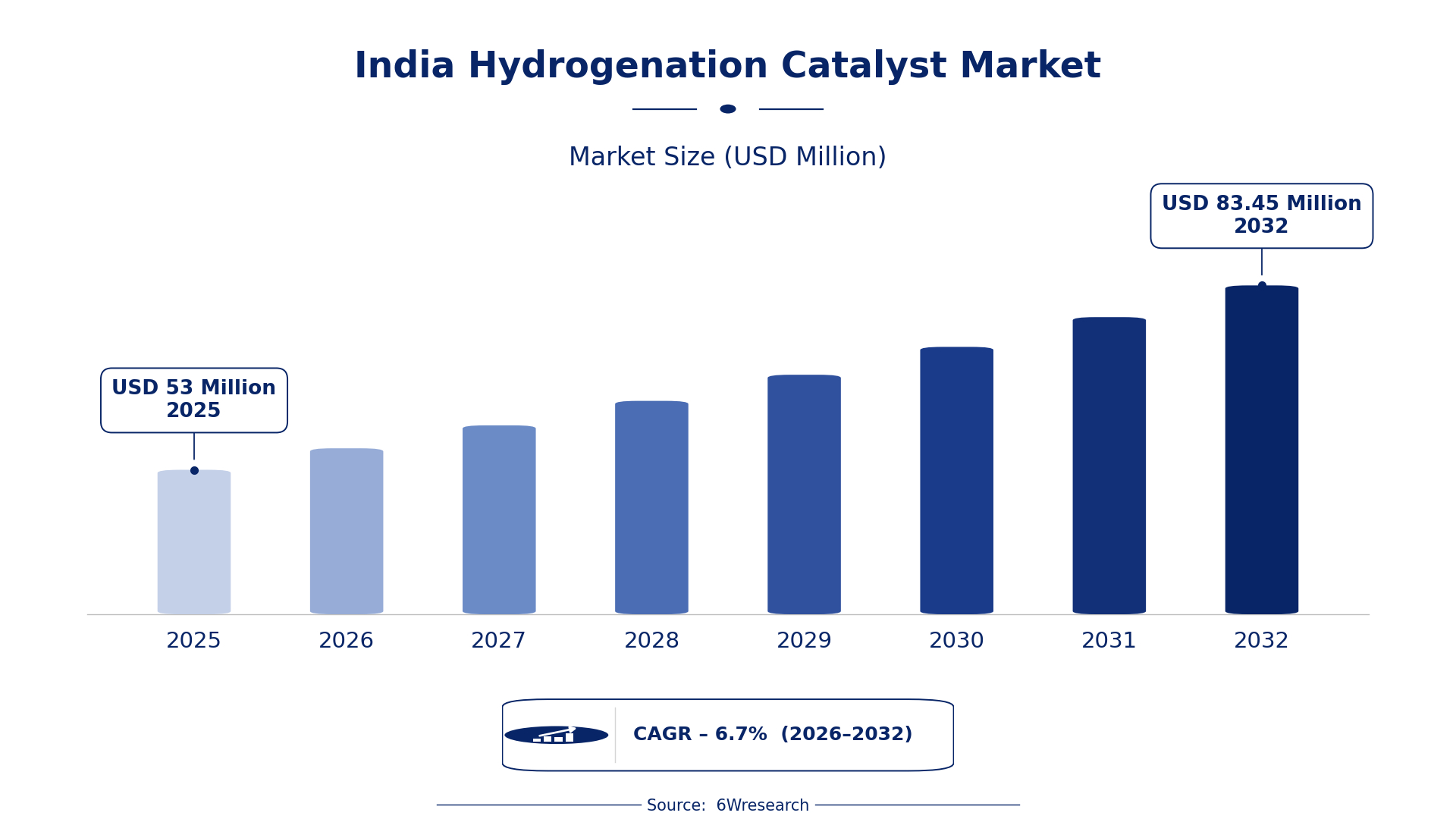
According to 6Wresearch internal database and industry insights, the India Hydrogenation Catalyst Market was valued at USD 53.0 million in 2025 and is projected to reach USD 83.45 million by 2032, growing at a CAGR of approximately 6.7% during 2026–2032.
India Hydrogenation Catalyst Market Highlights
| Report Metric | Details |
| Report Name | India Hydrogenation Catalyst Market |
| Market Size 2025 | USD 53.0 million |
| Market Size 2032 | USD 83.45 million |
| Absolute Growth 2025–2032 | USD 30.45 million |
| CAGR 2026–2032 | 6.7% |
| Peak Annual Growth | 9.2% in 2030 |
| Forecast Period | 2026–2032 |
| Historical Data | 2022–2025 |
| Base Year | 2025 |
| Leading Catalyst Type, 2025 | Heterogeneous Catalysts (43% share) |
| Leading Metal Used, 2025 | Nickel/Copper (48% share) |
| Leading Application Use, 2025 | Oil Refining (39% share) |
| Leading End User, 2025 | Petrochemical Refineries (41% share) |
| Fastest-Growing Catalyst Type | Bimetallic Catalysts (8.5% CAGR) |
| Fastest-Growing Metal Used | Palladium/Platinum (9.2% CAGR) |
| Fastest-Growing Application Use | Fine Chemicals (8.5% CAGR) |
| Fastest-Growing End User | Specialty Chemical Makers (9.5% CAGR) |
| Growing Sector | specialty chemicals |
| Key End Users | petrochemical refineries, pharmaceutical manufacturers, specialty chemical makers, agrochemical companies |
India Hydrogenation Catalyst Market Year-wise Growth Rate and Key Drivers (2022–2032)
This graph illustrates the annual growth rates of the market from 2022 to 2032, highlighting a steady upward trajectory and projected market expansion over the forecast period.
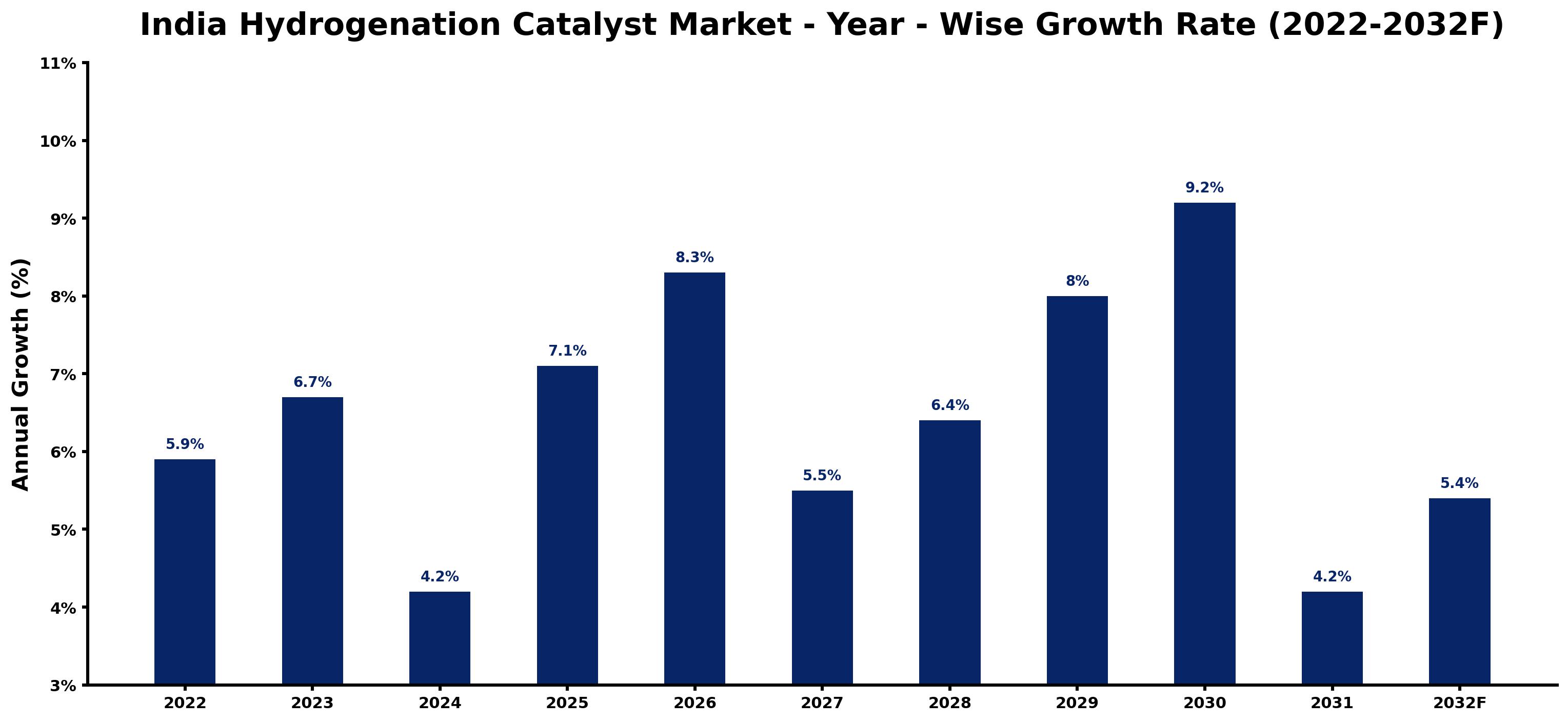
Each row of the following table gives one year's estimated growth and the event or demand shift that explains it.
| Year | Estimated Annual Growth (%) | Market Rationale |
| 2022 | 5.9 | The market showed steady demand from the petrochemical sector, maintaining production levels. |
| 2023 | 6.7 | Increased activity in oil refining led to a higher demand for hydrogenation catalysts. |
| 2024 | 4.2 | A slowdown in growth occurred as the specialty chemicals sector faced temporary challenges. |
| 2025 | 7.1 | The market rebounded with stronger demand from pharmaceutical synthesis and oil refining. |
| 2026 | 8.3 | The introduction of new biofuel standards will spur growth in catalyst applications. |
| 2027 | 5.5 | Demand is projected to stabilise due to adjustments in the petrochemical industry. |
| 2028 | 6.4 | A rise in fine chemicals production will contribute to renewed demand for catalysts. |
| 2029 | 8.0 | Increased investments in specialty chemicals will drive higher consumption of hydrogenation catalysts. |
| 2030 | 9.2 | The market is expected to peak as demand surges from biofuel production initiatives. |
| 2031 | 4.2 | Growth is projected to slow as the market stabilises after reaching its peak. |
| 2032 | 5.4 | Demand will increase again due to ongoing expansions in the pharmaceutical sector. |
Note: Market size estimations and growth projections presented in this report are based on 6Wresearch's proprietary forecasting methodology, utilizing the latest available industry data, government publications, and primary research inputs.
India Hydrogenation Catalyst Market Synopsis
Hydrogenation catalysts in India play a crucial role in facilitating the hydrogenation process, primarily composed of metals such as palladium and platinum. These catalysts are vital for organic synthesis, oil refining, and pharmaceutical applications. The India Hydrogenation Catalyst Market is growing due to increased demand from the petrochemical and pharmaceutical sectors, driven by initiatives like the National Chemical Policy and the Make in India programme. The expansion of the specialty chemicals market is also contributing to the rising need for hydrogenation catalysts.
Market Dynamics Impact Analysis (2026–2032)
| Factor | Type | Impact | Primary Segment Affected |
| Rising production in the oil refining sector | Driver | High | Oil Refining |
| Growth in pharmaceutical synthesis applications | Driver | High | Pharmaceutical Synthesis |
| Increasing demand for specialty chemicals | Opportunity | High | Fine Chemicals |
| Expansion of biofuel production initiatives | Opportunity | Medium | Organic Synthesis |
| Fluctuations in raw material prices | Restraint | High | Heterogeneous Catalysts |
| Regulatory challenges in chemical manufacturing | Restraint | Medium | Supported Catalysts |
| Limited availability of skilled workforce | Challenge | High | Bimetallic Catalysts |
| Dependence on imported raw materials | Challenge | Medium | Palladium/Platinum |
Evaluation of Drivers in India Hydrogenation Catalyst Market (2026–2032)
Key forces behind demand, with the segment each one moves most, are listed below.
| Drivers | Primary Segment Affected | Why It Matters (Evidence) |
| Increased oil refining capacity | Oil Refining | India's oil refining capacity is around 250 million tons per year, leading to higher catalyst demand. |
| Growth in pharmaceutical industry | Pharmaceutical Synthesis | The pharmaceutical industry in India is expected to grow to $65 billion by 2024, increasing catalyst usage. |
| Expansion of specialty chemicals market | Fine Chemicals | The specialty chemicals sector is projected to reach $80 billion by 2025, driving catalyst requirements. |
| Government support for biofuel production | Organic Synthesis | The National Biofuel Policy aims for 20% blending of biofuels by 2025, boosting catalyst demand. |
| Rising demand for biodiesel production | Supported Catalysts | Hydrogenation catalysts are essential for producing biodiesel from vegetable oils, increasing market demand. |
The Hydrogenation Catalyst market in India is on the rise as the expansion of oil refining capacity, growth in the pharmaceutical industry, and support for biofuel production fuel demand. With an oil refining capacity of approximately 250 million tons per year, catalyst usage is set to increase. The pharmaceutical industry is anticipated to reach $65 billion by 2024, further driving the need for hydrogenation catalysts. The growing specialty chemicals market adds to the increasing consumption of catalysts.
Evaluation of Restraints in India Hydrogenation Catalyst Market
The key brakes on demand, and where they bite hardest, are shown below.
| Market Restraint | Primary Segment Affected | Why It Matters (Evidence) |
| Fluctuations in raw material prices | Heterogeneous Catalysts | Rising costs of metals like palladium and platinum can affect catalyst pricing and availability. |
| Regulatory challenges in chemical manufacturing | Supported Catalysts | Strict regulations can delay production processes and increase compliance costs for manufacturers. |
| Limited availability of skilled workforce | Bimetallic Catalysts | A shortage of skilled professionals hampers the development and production of advanced catalysts. |
| Dependence on imported raw materials | Palladium/Platinum | A leading supplier on imports for critical metals can disrupt supply chains and increase costs. |
| Market volatility affecting investment | Fine Chemicals | Economic fluctuations may deter investment in new catalyst technologies and production facilities. |
India Hydrogenation Catalyst Market Challenges
The India Hydrogenation Catalyst Market encounters several practical challenges, with cost being a primary concern. High production costs, mainly due to the use of precious metals like palladium and platinum, raise prices for buyers in the pharmaceutical and specialty chemicals sectors, affecting their operational budgets. Skills shortages in advanced catalyst manufacturing restrict suppliers' capacity to fulfil orders, resulting in delays for downstream users who depend on timely product availability. Technological gaps in catalyst development hinder local suppliers, causing them to lag behind global competitors and lose market share. Intense competition from imported catalysts pressures local producers to lower prices, squeezing profit margins for manufacturers.
Trends in the India Hydrogenation Catalyst Market
Several trends are reshaping the India Hydrogenation Catalyst Market; the most important are set out below.
- Shift towards Biofuel Production: India is increasingly focusing on biofuel production, with the National Biofuel Policy targeting 20% blending by 2025. This shift is creating a growing market for hydrogenation catalysts, particularly in biodiesel production.
- Growing Adoption of Bimetallic Catalysts: Since 2026, there has been a noticeable increase in the use of bimetallic catalysts in complex reactions. This trend is supported by advancements in catalyst technology, leading to improved performance in chemical processes.
- Expansion of Specialty Chemicals Sector: The specialty chemicals sector is experiencing significant growth, reflecting a shift in market dynamics. This growth is driving increased demand for hydrogenation catalysts, particularly in fine chemicals and agrochemicals.
- Increased Focus on Sustainability: The Indian government has launched initiatives promoting sustainable practices in chemical manufacturing, influencing market trends. The National Chemical Policy aims to enhance sustainability in the chemical sector, encouraging the use of eco-friendly hydrogenation catalysts.
Investment Opportunities in the India Hydrogenation Catalyst Market
Below are the investment opportunities with the strongest case in the India Hydrogenation Catalyst Market.
- Investment in Biofuel Production: The biofuel market is expected to grow significantly, targeting 20% blending by 2025. This presents an opportunity for suppliers to invest in hydrogenation catalysts for biodiesel production, particularly for agrochemical companies.
- Supply of Specialty Chemicals Catalysts: With the specialty chemicals market expanding, there is a gap in catalyst supply. Investors can target specialty chemical makers, focusing on high-performance catalysts for organic synthesis.
- Collaboration for Catalyst Development: Partnering with local manufacturers can facilitate entry into the hydrogenation catalyst market. Targeting petrochemical refineries can enhance production capabilities and meet growing demand.
- Expansion into Fine Chemicals: The fine chemicals market is growing, driven by increasing pharmaceutical needs. Suppliers can focus on providing advanced hydrogenation catalysts to drug manufacturers, capitalising on the projected growth.
Government Initiatives in the India Hydrogenation Catalyst Market
The National Chemical Policy 2021 aims to enhance the competitiveness of the chemical industry by focusing on sustainability and innovation. This policy builds on previous frameworks and aims to boost the production of hydrogenation catalysts. It encourages manufacturers to adopt eco-friendly practices and invest in advanced technologies, aligning with global standards. The policy supports the growth of the chemical sector, which contributes around 3% to the GDP. The Make in India initiative promotes domestic manufacturing, targeting a $300 billion chemical industry by 2025.
In 2023, the Indian government allocated $1 billion for research in chemical technologies, overseen by the Ministry of Chemicals and Fertilizers. This funding supports the development of innovative catalyst solutions, enhancing production capabilities for hydrogenation catalysts and promoting industry growth. The Pradhan Mantri Formalization of Micro Food Processing Enterprises Scheme also provides financial assistance and training to small-scale chemical manufacturers, helping them improve their production processes.
Future Insight of the India Hydrogenation Catalyst Market
Several forward-looking factors should support the India Hydrogenation Catalyst Market over the coming years. The government's 'Make in India' initiative aims to strengthen domestic manufacturing capabilities, which will benefit local buyers. Research funding of $1 billion allocated in 2023 is expected to drive advancements in catalyst technology, fostering innovation. The pharmaceutical industry is projected to grow to $65 billion by 2024, creating new opportunities for suppliers. The National Chemical Policy aims to boost the chemical sector's growth by 2025, further increasing demand for hydrogenation catalysts.
Market Segmentation Analysis
Each segment group is reviewed below, with the leader by share and the fastest grower by CAGR.
By Catalyst Type – Heterogeneous Catalysts Dominated, Bimetallic Catalysts Expected to Grow Fastest
According to Bhawna Singh, Assistant Manager at 6Wresearch, Heterogeneous Catalysts held a 43% share of the India Hydrogenation Catalyst Market by catalyst type in 2025. Heterogeneous catalysts dominate the market share in India because they are extensively used in industrial applications, particularly in oil refining and petrochemical sectors. Their ease of separation and reuse makes them highly favoured by manufacturers, ensuring a robust installed base. Bimetallic Catalysts are projected to grow fastest, at a CAGR of 8.5% during 2026–2032. Bimetallic catalysts are witnessing rapid growth as they deliver superior performance in complex reactions, particularly within the fine chemicals sector. This surge is driven by the industry's need for more efficient catalytic solutions to meet evolving production demands. Suppliers should prioritise the development of bimetallic catalysts to capture emerging opportunities in the hydrogenation catalyst market.
By Metal Used – Nickel/Copper Dominated, Palladium/Platinum Expected to Grow Fastest
Nickel/Copper took a 48% share of metal used in 2025, more than any other category. Nickel and copper are the preferred metals in the hydrogenation catalyst market due to their extensive use in bulk chemical processes, providing cost-effective solutions for manufacturers. Their affordability and efficiency solidify their position as the leading choice in India. The quickest growth will come from Palladium/Platinum, forecast to expand at a CAGR of 9.2% between 2026 and 2032. Palladium and platinum are gaining traction for high-value applications, especially in pharmaceuticals and fine chemicals, which is driving their rapid growth. This trend underscores the industry's shift towards advanced chemical processes that necessitate these premium metals. Buyers should invest in palladium and platinum catalysts to enhance their production capabilities in high-value sectors.
By Application Use – Oil Refining Dominated, Fine Chemicals Expected to Grow Fastest
Oil Refining accounted for a 39% market share by application use in 2025. Oil refining commands the largest market share as hydrogenation catalysts are vital for processes like hydrocracking and hydrotreating, essential for producing high-quality fuels. The extensive scale of refining operations in India reinforces this segment's leading position. Over 2026–2032, Fine Chemicals are expected to post the fastest growth, at a CAGR of 8.5%. Fine chemicals are experiencing the fastest growth due to their importance in synthesising specialty chemicals and intermediates, driven by the expanding specialty chemicals sector. This growth signals a shift towards more refined and sophisticated chemical production. Suppliers must adapt to the increasing demand for fine chemicals by providing tailored hydrogenation catalyst solutions.
By End User – Petrochemical Refineries Dominated, Specialty Chemical Makers Expected to Grow Fastest
In 2025, Petrochemical Refineries led the end user split with a 41% share. Petrochemical refineries are the largest consumers of hydrogenation catalysts, utilising them to improve product quality in refining operations. The scale and complexity of these refineries ensure a significant market share for this end-user segment. Specialty Chemical Makers are set to record the highest CAGR in this split, 9.5% over 2026–2032. Specialty chemical makers are increasingly adopting hydrogenation catalysts for complex formulations, reflecting the growing demand for specialty chemicals across various sectors. This trend indicates a shift towards more intricate and advanced chemical processes. Manufacturers should focus on targeting specialty chemical makers to capitalise on the expanding market for advanced hydrogenation applications.
Key Attractiveness of the Report
- 10 Years of Market Numbers
- Historical Data Starting from 2022 to 2025
- Base Year 2025
- Forecast Data until 2032
- Key Performance Indicators Impacting the Market
- Major Upcoming Developments and Projects
Key Highlights of the Report:
- India Hydrogenation Catalyst Market Outlook
- Market Size of India Hydrogenation Catalyst Market, 2025
- Forecast of India Hydrogenation Catalyst Market, 2032
- Historical Data and Forecast of India Hydrogenation Catalyst Revenues & Volume for the Period 2022 - 2032F
- India Hydrogenation Catalyst Market Trend Evolution
- India Hydrogenation Catalyst Market Drivers and Challenges
- India Hydrogenation Catalyst Price Trends
- India Hydrogenation Catalyst Porter's Five Forces
- India Hydrogenation Catalyst Industry Life Cycle
- Historical Data and Forecast of India Hydrogenation Catalyst Market Revenues & Volume By Catalyst Type for the Period 2022 - 2032F
- Historical Data and Forecast of India Hydrogenation Catalyst Market Revenues & Volume By Homogeneous Catalysts for the Period 2022 - 2032F
- Historical Data and Forecast of India Hydrogenation Catalyst Market Revenues & Volume By Heterogeneous Catalysts for the Period 2022 - 2032F
- Historical Data and Forecast of India Hydrogenation Catalyst Market Revenues & Volume By Supported Catalysts for the Period 2022 - 2032F
- Historical Data and Forecast of India Hydrogenation Catalyst Market Revenues & Volume By Bimetallic Catalysts for the Period 2022 - 2032F
- Historical Data and Forecast of India Hydrogenation Catalyst Market Revenues & Volume By Metal Used for the Period 2022 - 2032F
- Historical Data and Forecast of India Hydrogenation Catalyst Market Revenues & Volume By Palladium/Platinum for the Period 2022 - 2032F
- Historical Data and Forecast of India Hydrogenation Catalyst Market Revenues & Volume By Nickel/Copper for the Period 2022 - 2032F
- Historical Data and Forecast of India Hydrogenation Catalyst Market Revenues & Volume By Activated Carbon Base for the Period 2022 - 2032F
- Historical Data and Forecast of India Hydrogenation Catalyst Market Revenues & Volume By Dual Metal Mix for the Period 2022 - 2032F
- Historical Data and Forecast of India Hydrogenation Catalyst Market Revenues & Volume By Application Use for the Period 2022 - 2032F
- Historical Data and Forecast of India Hydrogenation Catalyst Market Revenues & Volume By Organic Synthesis for the Period 2022 - 2032F
- Historical Data and Forecast of India Hydrogenation Catalyst Market Revenues & Volume By Oil Refining for the Period 2022 - 2032F
- Historical Data and Forecast of India Hydrogenation Catalyst Market Revenues & Volume By Pharmaceutical Synthesis for the Period 2022 - 2032F
- Historical Data and Forecast of India Hydrogenation Catalyst Market Revenues & Volume By Fine Chemicals for the Period 2022 - 2032F
- Historical Data and Forecast of India Hydrogenation Catalyst Market Revenues & Volume By End User for the Period 2022 - 2032F
- Historical Data and Forecast of India Hydrogenation Catalyst Market Revenues & Volume By Specialty Chemical Makers for the Period 2022 - 2032F
- Historical Data and Forecast of India Hydrogenation Catalyst Market Revenues & Volume By Petrochemical Refineries for the Period 2022 - 2032F
- Historical Data and Forecast of India Hydrogenation Catalyst Market Revenues & Volume By Drug Manufacturers for the Period 2022 - 2032F
- Historical Data and Forecast of India Hydrogenation Catalyst Market Revenues & Volume By Agrochemical Companies for the Period 2022 - 2032F
- India Hydrogenation Catalyst Import Export Trade Statistics
- Market Opportunity Assessment By Catalyst Type
- Market Opportunity Assessment By Metal Used
- Market Opportunity Assessment By Application Use
- Market Opportunity Assessment By End User
- India Hydrogenation Catalyst Top Companies Market Share
- India Hydrogenation Catalyst Competitive Benchmarking By Technical and Operational Parameters
- India Hydrogenation Catalyst Company Profiles
- India Hydrogenation Catalyst Key Strategic Recommendations
Market Covered
Segments analysed in this report are listed below.
By Catalyst Type
- Homogeneous Catalysts
- Heterogeneous Catalysts
- Supported Catalysts
- Bimetallic Catalysts
By Metal Used
- Palladium/Platinum
- Nickel/Copper
- Activated Carbon Base
- Dual Metal Mix
By Application Use
- Organic Synthesis
- Oil Refining
- Pharmaceutical Synthesis
- Fine Chemicals
By End User
- Specialty Chemical Makers
- Petrochemical Refineries
- Drug Manufacturers
- Agrochemical Companies































