India Hydroponics Substrate Market Size & Growth Rate

According to 6Wresearch internal database and industry insights, the India Hydroponics Substrate Market was valued at USD 229.0 million in 2025 and is projected to reach USD 346.61 million by 2032, growing at a CAGR of approximately 6.1% during 2026–2032.
India Hydroponics Substrate Market Highlights
| Report Metric | Details |
| Report Name | India Hydroponics Substrate Market |
| Market Size 2025 | USD 229.0 million |
| Market Size 2032 | USD 346.61 million |
| Absolute Growth 2025–2032 | USD 117.61 million |
| CAGR 2026–2032 | 6.1% |
| Peak Annual Growth | 8.4% in 2030 |
| Forecast Period | 2026–2032 |
| Historical Data | 2022–2025 |
| Base Year | 2025 |
| Leading Substrate Type, 2025 | Coco Coir (38% share) |
| Leading Material Composition, 2025 | Coconut Husk Fiber (40% share) |
| Leading Reusability Factor, 2025 | High (41% share) |
| Leading End User, 2025 | Commercial Greenhouses (45% share) |
| Fastest-Growing Substrate Type | Perlite (8.0% CAGR) |
| Fastest-Growing Reusability Factor | Medium (7.4% CAGR) |
| Fastest-Growing End User | Sustainable Growers (7.5% CAGR) |
| Growing Sector | Commercial Greenhouses |
| Key End Users | Sustainable Growers, Commercial Greenhouses, DIY Indoor Growers |
India Hydroponics Substrate Market Year-wise Growth Rate and Key Drivers (2022–2032)
This graph illustrates the annual growth rates of the market from 2022 to 2032, highlighting a steady upward trajectory and projected market expansion over the forecast period.
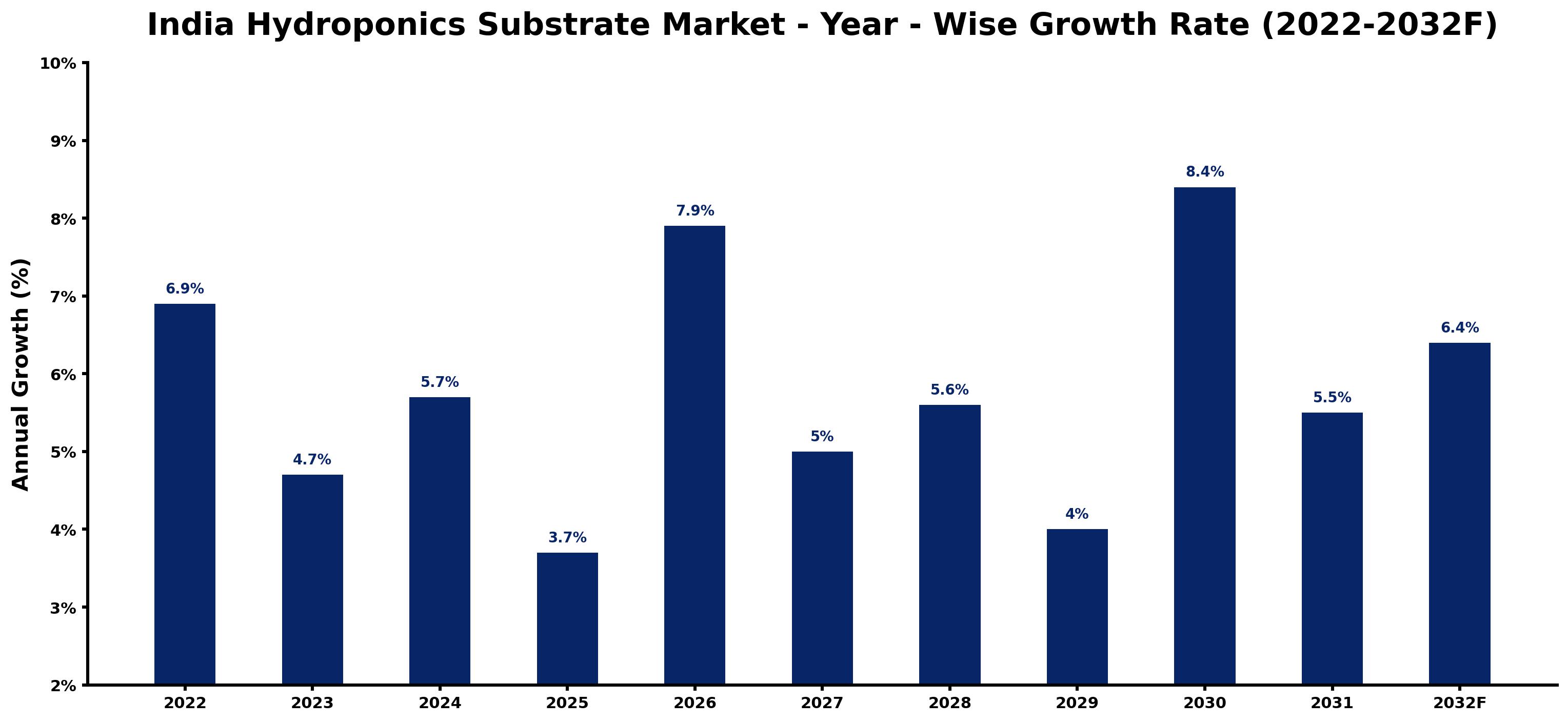
The table below sets out the estimated growth rate for each year and the main factor behind it.
| Year | Estimated Annual Growth (%) | Market Rationale |
| 2022 | 6.9 | The market showed strong growth due to rising interest in sustainable agriculture practices. |
| 2023 | 4.7 | Growth slowed as the market adjusted to increased supply chain challenges. |
| 2024 | 5.7 | Demand accelerated with more urban gardeners adopting hydroponics techniques. |
| 2025 | 3.7 | Growth slowed again as market conditions stabilised after previous fluctuations. |
| 2026 | 7.9 | The market rebounded with increased investments in hydroponic systems and equipment. |
| 2027 | 5.0 | Growth slowed as the market faced challenges in scaling production efficiently. |
| 2028 | 5.6 | Demand rose again as sustainable practices gained traction among growers. |
| 2029 | 4.0 | Growth decelerated as market dynamics normalised after rapid expansions. |
| 2030 | 8.4 | The market peaked due to heightened interest in hydroponics and supportive government initiatives. |
| 2031 | 5.5 | Growth slowed as the market began to stabilise after reaching its peak. |
| 2032 | 6.4 | Demand is expected to rise again as awareness of hydroponics continues to spread. |
Note: Market size estimations and growth projections presented in this report are based on 6Wresearch's proprietary forecasting methodology, utilizing the latest available industry data, government publications, and primary research inputs.
India Hydroponics Substrate Market Synopsis
Hydroponics Substrate in India serves as a growing medium for soilless agriculture, primarily composed of materials like coco coir and rockwool. These substrates provide essential support for plant roots, delivering vital nutrients and moisture. The Hydroponics Substrate Market is on an upward trajectory, fuelled by the rise in urban gardening and the expansion of commercial greenhouse operations. With more than 30% of urban gardeners embracing hydroponics, the push for sustainable farming practices is propelling market growth. Government initiatives, such as the Pradhan Mantri Krishi Sinchai Yojana, further reinforce this trend.
Market Dynamics Impact Analysis (2026–2032)
| Factor | Type | Impact | Primary Segment Affected |
| Increasing urban gardening initiatives drive demand for hydroponics substrates. | Driver | High | Coco Coir |
| Growing commercial greenhouse operations require efficient growing mediums. | Driver | High | Rockwool |
| Rising interest in sustainable agriculture creates opportunities for innovative substrates. | Opportunity | High | Perlite |
| The expanding DIY indoor gardening segment seeks eco-friendly solutions. | Opportunity | Medium | Clay Pellets |
| High initial investment costs deter small-scale growers from adopting hydroponics. | Restraint | High | Coco Coir |
| Limited awareness of hydroponics techniques restricts market growth in rural areas. | Restraint | Medium | Rockwool |
| Hydroponics Substrate Market in India faces challenges from inconsistent quality standards. | Challenge | High | Perlite |
| Supply chain disruptions impact the availability of key substrate materials. | Challenge | Medium | Clay Pellets |
Evaluation of Drivers in India Hydroponics Substrate Market (2026–2032)
Key forces behind demand, with the segment each one moves most, are listed below.
| Drivers | Primary Segment Affected | Why It Matters (Evidence) |
| Rising urban gardening initiatives boost demand for hydroponics substrates, with over 30% of urban gardeners adopting these techniques. | Coco Coir | This trend encourages more purchases of substrates that support sustainable practices. |
| The growth of commercial greenhouse operations increases the need for reliable substrates, particularly for Rockwool. | Rockwool | This demand leads to higher purchases of efficient growing mediums. |
| The National Horticulture Mission promotes hydroponics, driving interest in substrates like Perlite. | Perlite | This initiative drives more investments in modern farming techniques. |
| The DIY indoor gardening trend is expanding, with consumers seeking sustainable solutions like Clay Pellets. | Clay Pellets | This shift results in increased sales of lightweight and reusable substrates. |
| The Bureau of Indian Standards' guidelines for hydroponics substrates ensure quality, boosting confidence among buyers. | Coco Coir | This assurance leads to higher market demand for certified substrates. |
Over 30% of urban gardeners are adopting hydroponics techniques, driving demand for various substrates. The growing interest in sustainable agriculture is prompting investments in high-quality materials. The expansion of DIY gardening is increasing the need for lightweight and reusable substrates. As buyers gain confidence from quality standards, the market is expected to see a notable uptick in purchases.
Evaluation of Restraints in India Hydroponics Substrate Market
The following restraints limit how fast demand can grow.
| Market Restraint | Primary Segment Affected | Why It Matters (Evidence) |
| High initial investment costs deter small-scale growers from adopting hydroponics, limiting market reach. | Coco Coir | This challenge affects the ability of new growers to enter the market. |
| Limited awareness of hydroponics techniques restricts market growth in rural areas, impacting potential buyer engagement. | Rockwool | This issue prevents wider adoption of hydroponics in less urbanised regions. |
| Inconsistent quality standards for substrates create uncertainty among buyers, affecting purchasing decisions. | Perlite | This inconsistency can lead to reluctance in investing in hydroponic systems. |
| Supply chain disruptions impact the availability of key substrate materials, delaying project timelines. | Clay Pellets | This challenge affects both producers and buyers in meeting demand. |
| Regulatory hurdles in obtaining necessary certifications slow down market entry for new products. | Coco Coir | This can limit the variety of substrates available to consumers. |
India Hydroponics Substrate Market Challenges
Buyers in the India hydroponics substrate market encounter considerable supply challenges, particularly concerning rockwool, which is crucial for commercial greenhouses in Maharashtra. This shortage can disrupt planting schedules and elevate costs by up to 20% for producers reliant on this substrate. Regulatory complexities stemming from the Bureau of Indian Standards' guidelines introduced in 2021 complicate compliance for new entrants, risking fines or delays in product launches. Competition from traditional agriculture pressures buyers to negotiate lower prices, potentially shrinking profit margins by as much as 15%, which affects overall profitability.
Trends in the India Hydroponics Substrate Market
Below mentioned are some of the trends shaping the India Hydroponics Substrate Market growth.
- Shift towards Sustainable Practices in Urban Gardening: Maharashtra is experiencing a shift towards sustainable practices in urban gardening, with over 30% of urban gardeners adopting hydroponics techniques. This trend is encouraging the use of eco-friendly substrates like coco coir, which are essential for these practices.
- Commercial Greenhouses Increasingly Adopt Hydroponics: Commercial greenhouses are increasingly adopting hydroponics in Karnataka, where demand for efficient growing mediums is rising. The market for hydroponics substrates is expected to grow as these facilities expand their operations, contributing to a more sustainable agricultural framework.
- Government Support for Hydroponics Grows: The Pradhan Mantri Krishi Sinchai Yojana is promoting hydroponics as a sustainable farming method, with a budget of ₹2,000 crores. This initiative is driving investments in hydroponic systems across India, boosting overall market growth.
- Rising Interest in DIY Hydroponic Systems: Over 30% of urban gardeners are adopting hydroponics techniques, leading to increased demand for substrates. This trend is particularly strong among DIY indoor growers seeking sustainable gardening solutions, creating new opportunities for suppliers.
Investment Opportunities in the India Hydroponics Substrate Market
Several openings in the India Hydroponics Substrate Market merit attention from investors.
- Collaborate with Local Growers for Hydroponics: Now is an ideal time to partner with local growers in Maharashtra to supply hydroponics substrates, as demand is on the rise. The commercial greenhouse sector is expanding, creating a need for reliable products.
- Invest in Sustainable Substrate Production: With the growing interest in sustainable agriculture, investing in the production of eco-friendly substrates is timely. Sustainable growers are seeking high-quality materials to support their operations, presenting a significant opportunity.
- Expand Offerings in Urban Areas: Urban areas are increasingly adopting hydroponics, providing opportunities to supply substrates to DIY indoor growers. Engaging with local gardening communities can facilitate market entry and enhance brand visibility.
- Utilise Government Initiatives for Growth: The Hydroponics Subsidy Scheme offers financial assistance to farmers adopting hydroponic systems. Suppliers can benefit by aligning their products with this government support, which encourages wider adoption of hydroponics.
Government Initiatives in the India Hydroponics Substrate Market
The Pradhan Mantri Krishi Sinchai Yojana, initiated in 2021, promotes hydroponics with a budget of ₹2,000 crores, enabling farmers to adopt modern irrigation techniques. This scheme increases the accessibility of hydroponics systems and encourages investment in necessary infrastructure. Additionally, the Bureau of Indian Standards published IS 17489:2022, establishing quality standards for hydroponic substrates, ensuring safety and efficacy for producers and buyers alike. These measures support the growth of the hydroponics sector in India.
The Hydroponics Subsidy Scheme, launched in 2023, provides financial assistance to farmers adopting hydroponic systems. This program enables growers to invest in necessary equipment and infrastructure. Furthermore, the Agricultural Technology Management Agency has updated its guidelines to include hydroponics, facilitating access to resources for farmers. These initiatives promote the adoption of modern farming practices and support the overall growth of the hydroponics sector in India.
Future Insight of the India Hydroponics Substrate Market
The India hydroponics substrate market is set to evolve by 2032, supported by increased government initiatives like the Pradhan Mantri Krishi Sinchai Yojana. A growing awareness of sustainable practices among 70% of the population will drive demand for hydroponics systems. Advances in substrate technology, including improved aeration materials, will enhance crop yields and attract more buyers. The subsidy program for hydroponics equipment launched in 2022 is expected to reduce entry costs, encouraging new producers to enter the market and expand offerings.
Market Segmentation Analysis
The analysis below covers each segmentation, its leading category in 2025 and its fastest-growing category through 2032.
By Substrate Type – Coco Coir Dominated, Perlite Expected to Grow Fastest
According to Bhawna Singh, Assistant Manager at 6Wresearch, Coco Coir held a 38% share of the India Hydroponics Substrate Market by substrate type in 2025. Coco coir holds the largest market share due to its excellent water retention and aeration properties, making it a preferred choice for many hydroponic systems. Its widespread use in commercial greenhouse operations, particularly in Maharashtra, solidifies its position as the leading substrate. Perlite is projected to grow fastest, at a CAGR of 8.0% during 2026–2032. Perlite is experiencing rapid growth as it is increasingly recognised for its aeration and drainage capabilities in hydroponic systems. The rising trend of urban gardening, with over 30% of urban gardeners adopting hydroponics techniques, fuels the demand for this substrate. Suppliers should focus on promoting the benefits of perlite to capitalise on its growing popularity among urban gardeners.
By Material Composition – Coconut Husk Fiber Dominated and Is Expected to Record the Fastest Growth
Coconut Husk Fiber took a 40% share of material composition in 2025, more than any other category. Coconut husk fiber is the leading substrate in the India Hydroponics Substrate Market due to its widespread availability and cost-effectiveness. It is a primary component in coco coir substrates, essential for supporting plant growth in various hydroponic systems. Coconut Husk Fiber is also forecast to expand faster than any other category, at a CAGR of 8.0% over 2026–2032. The growth of coconut husk fiber is propelled by increasing awareness of sustainable farming practices among urban gardeners and commercial growers. With over 30% of urban gardeners adopting hydroponics techniques, this trend is expected to strengthen its market position. Suppliers should focus on promoting coconut husk fiber as a sustainable choice to attract environmentally conscious buyers.
By Reusability Factor – High Dominated, Medium Expected to Grow Fastest
High accounted for a 41% market share by reusability factor in 2025. High reusability substrates dominate the market as they appeal to both commercial growers and sustainable agriculture advocates. Their ability to be reused multiple times reduces costs and waste, making them a preferred choice in hydroponics. The quickest growth will come from Medium, forecast to expand at a CAGR of 7.4% between 2026 and 2032. Medium reusability substrates are experiencing rapid growth as they cater to a segment of growers seeking balance between cost and sustainability. As the market for hydroponics expands, this segment is likely to gain traction among new users. Suppliers must highlight the reusability of their products to attract buyers looking for cost-effective and sustainable hydroponics solutions.
By End User – Commercial Greenhouses Dominated, Sustainable Growers Expected to Grow Fastest
With a 45% revenue share in 2025, Commercial Greenhouses was the largest end user category. Commercial greenhouses dominate the India Hydroponics Substrate Market because they require effective substrates for large-scale production. These operations, particularly prevalent in Maharashtra, rely on hydroponics substrates to maximise crop yields and efficiency. Over 2026–2032, Sustainable Growers are expected to post the fastest growth, at a CAGR of 7.5%. Sustainable growers are experiencing the highest growth rate as they increasingly embrace eco-friendly agricultural methods. The government's initiatives, including subsidies for hydroponics equipment, are accelerating this segment's adoption and expansion. Suppliers need to focus on developing products that align with the eco-friendly goals of sustainable growers to capitalise on this growing market.
Key Attractiveness of the Report
- 10 Years of Market Numbers
- Historical Data Starting from 2022 to 2025
- Base Year 2025
- Forecast Data until 2032
- Key Performance Indicators Impacting the Market
- Major Upcoming Developments and Projects
Key Highlights of the Report:
- India Hydroponics Substrate Market Outlook
- Market Size of India Hydroponics Substrate Market, 2025
- Forecast of India Hydroponics Substrate Market, 2032
- Historical Data and Forecast of India Hydroponics Substrate Revenues & Volume for the Period 2022 - 2032F
- India Hydroponics Substrate Market Trend Evolution
- India Hydroponics Substrate Market Drivers and Challenges
- India Hydroponics Substrate Price Trends
- India Hydroponics Substrate Porter's Five Forces
- India Hydroponics Substrate Industry Life Cycle
- Historical Data and Forecast of India Hydroponics Substrate Market Revenues & Volume By Substrate Type for the Period 2022 - 2032F
- Historical Data and Forecast of India Hydroponics Substrate Market Revenues & Volume By Coco Coir for the Period 2022 - 2032F
- Historical Data and Forecast of India Hydroponics Substrate Market Revenues & Volume By Rockwool for the Period 2022 - 2032F
- Historical Data and Forecast of India Hydroponics Substrate Market Revenues & Volume By Perlite for the Period 2022 - 2032F
- Historical Data and Forecast of India Hydroponics Substrate Market Revenues & Volume By Clay Pellets for the Period 2022 - 2032F
- Historical Data and Forecast of India Hydroponics Substrate Market Revenues & Volume By Material Composition for the Period 2022 - 2032F
- Historical Data and Forecast of India Hydroponics Substrate Market Revenues & Volume By Coconut Husk Fiber for the Period 2022 - 2032F
- Historical Data and Forecast of India Hydroponics Substrate Market Revenues & Volume By Mineral Fiber for the Period 2022 - 2032F
- Historical Data and Forecast of India Hydroponics Substrate Market Revenues & Volume By Volcanic Glass for the Period 2022 - 2032F
- Historical Data and Forecast of India Hydroponics Substrate Market Revenues & Volume By Expanded Clay Aggregate for the Period 2022 - 2032F
- Historical Data and Forecast of India Hydroponics Substrate Market Revenues & Volume By Reusability Factor for the Period 2022 - 2032F
- Historical Data and Forecast of India Hydroponics Substrate Market Revenues & Volume By High for the Period 2022 - 2032F
- Historical Data and Forecast of India Hydroponics Substrate Market Revenues & Volume By Medium for the Period 2022 - 2032F
- Historical Data and Forecast of India Hydroponics Substrate Market Revenues & Volume By High for the Period 2022 - 2032F
- Historical Data and Forecast of India Hydroponics Substrate Market Revenues & Volume By Reusable for the Period 2022 - 2032F
- Historical Data and Forecast of India Hydroponics Substrate Market Revenues & Volume By End User for the Period 2022 - 2032F
- Historical Data and Forecast of India Hydroponics Substrate Market Revenues & Volume By Sustainable Growers for the Period 2022 - 2032F
- Historical Data and Forecast of India Hydroponics Substrate Market Revenues & Volume By Commercial Greenhouses for the Period 2022 - 2032F
- Historical Data and Forecast of India Hydroponics Substrate Market Revenues & Volume By DIY Indoor Growers for the Period 2022 - 2032F
- Historical Data and Forecast of India Hydroponics Substrate Market Revenues & Volume By Hydroponic Equipment Retail for the Period 2022 - 2032F
- India Hydroponics Substrate Import Export Trade Statistics
- Market Opportunity Assessment By Substrate Type
- Market Opportunity Assessment By Material Composition
- Market Opportunity Assessment By Reusability Factor
- Market Opportunity Assessment By End User
- India Hydroponics Substrate Top Companies Market Share
- India Hydroponics Substrate Competitive Benchmarking By Technical and Operational Parameters
- India Hydroponics Substrate Company Profiles
- India Hydroponics Substrate Key Strategic Recommendations
Market Covered
Segments analysed in this report are listed below.
By Substrate Type
- Coco Coir
- Rockwool
- Perlite
- Clay Pellets
By Material Composition
- Coconut Husk Fiber
- Mineral Fiber
- Volcanic Glass
- Expanded Clay Aggregate
By Reusability Factor
- High
- Medium
- Reusable
By End User
- Sustainable Growers
- Commercial Greenhouses
- DIY Indoor Growers
- Hydroponic Equipment Retail































