India Hyperthyroidism Drugs Market Size & Growth Rate
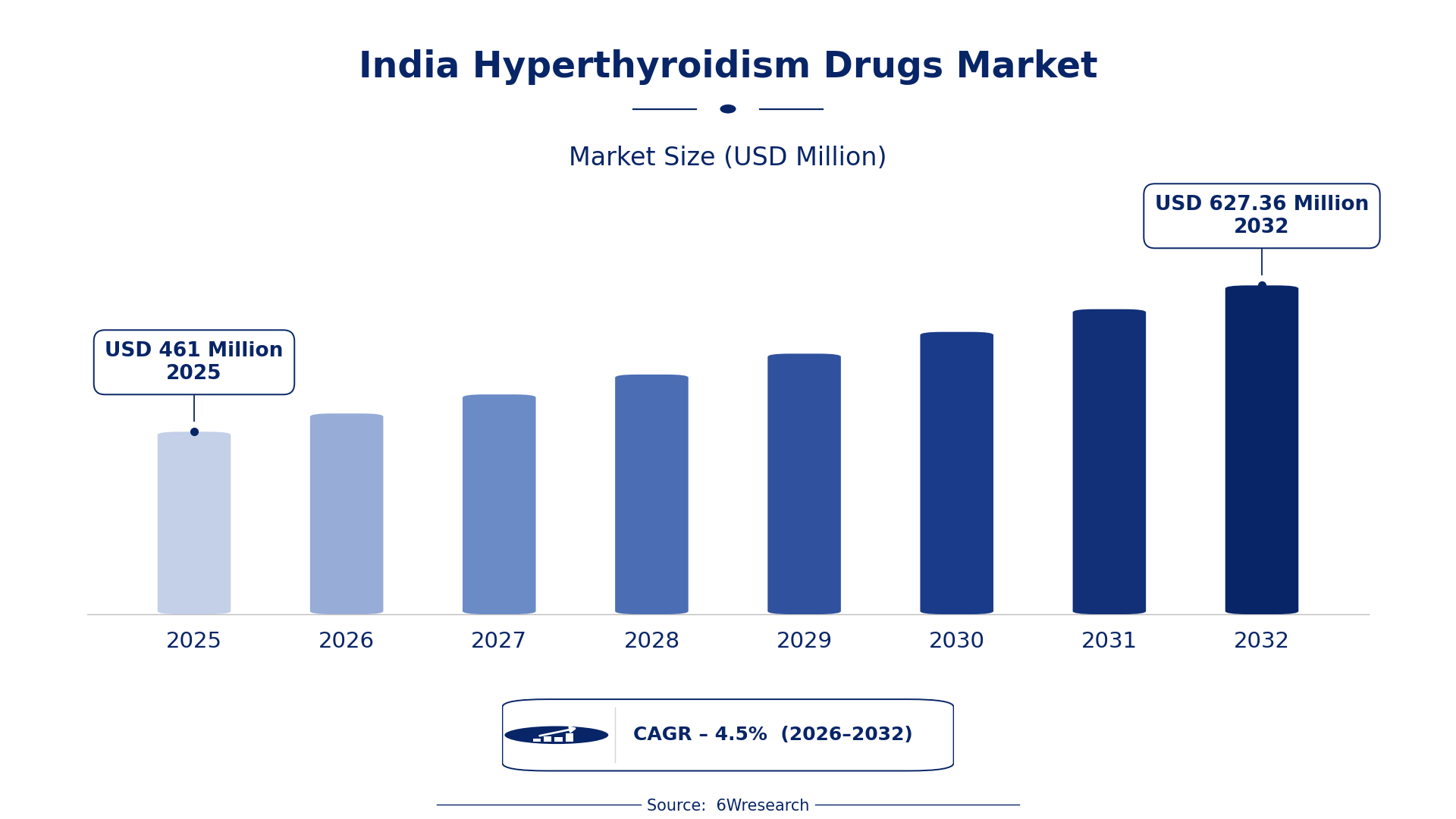
According to 6Wresearch internal database and industry insights, the India Hyperthyroidism Drugs Market was valued at USD 461.0 million in 2025 and is projected to reach USD 627.36 million by 2032, growing at a CAGR of approximately 4.5% during 2026–2032.
India Hyperthyroidism Drugs Market Highlights
| Report Metric | Details |
| Report Name | India Hyperthyroidism Drugs Market |
| Market Size 2025 | USD 461.0 million |
| Market Size 2032 | USD 627.36 million |
| Absolute Growth 2025–2032 | USD 166.36 million |
| CAGR 2026–2032 | 4.5% |
| Peak Annual Growth | 7.0% in 2027 |
| Forecast Period | 2026–2032 |
| Historical Data | 2022–2025 |
| Base Year | 2025 |
| Leading Drug Type, 2025 | Antithyroid Drugs (41% share) |
| Leading Mechanism of Action, 2025 | Thyroid Hormone Suppression (47% share) |
| Leading Formulation, 2025 | Tablets (41% share) |
| Leading End User, 2025 | Endocrinologists (44% share) |
| Fastest-Growing Drug Type | Radioactive Iodine (6.9% CAGR) |
| Fastest-Growing Mechanism of Action | Thyroid Tissue Ablation (6.2% CAGR) |
| Fastest-Growing Formulation | Oral Capsule (6.9% CAGR) |
| Fastest-Growing End User | General Physicians (5.7% CAGR) |
| Growing Sector | Endocrinology |
| Key End Users | Endocrinologists, General Physicians, Oncology Departments |
India Hyperthyroidism Drugs Market Year-wise Growth Rate and Key Drivers (2022–2032)
This graph illustrates the annual growth rates of the market from 2022 to 2032, highlighting a steady upward trajectory and projected market expansion over the forecast period.
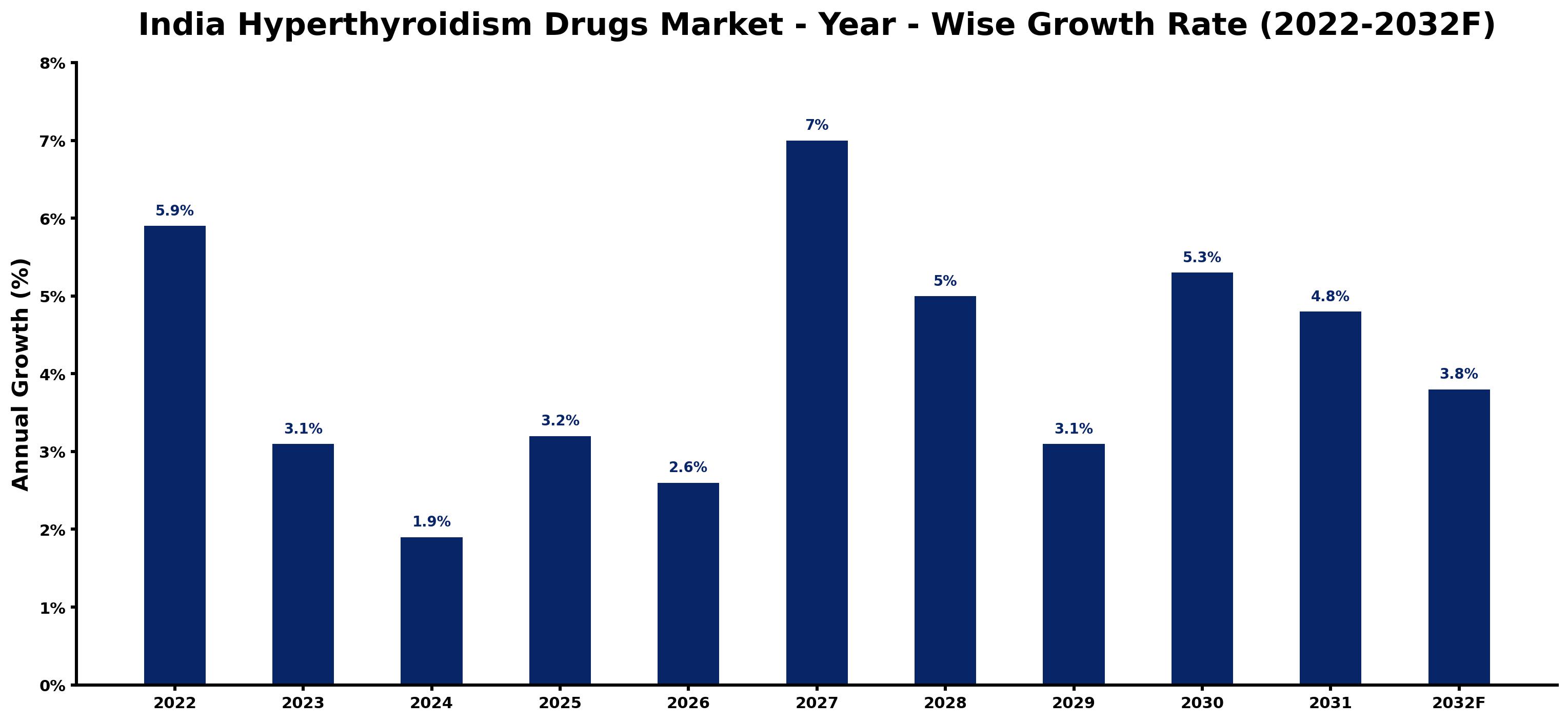
The table below sets out the estimated growth rate for each year and the main factor behind it.
| Year | Estimated Annual Growth (%) | Market Rationale |
| 2022 | 5.9 | The market experienced strong demand due to increased awareness of thyroid health through the Thyroid Health Program. |
| 2023 | 3.1 | Growth slowed as awareness campaigns reached saturation in urban areas, limiting new patient engagement. |
| 2024 | 1.9 | Demand continued to slow as healthcare providers faced resource constraints in rural regions. |
| 2025 | 3.2 | A resurgence in growth occurred with new initiatives to improve access to treatment in underserved areas. |
| 2026 | 2.6 | Growth is expected to slow again as the market adjusts to updated regulatory guidelines for antithyroid drugs. |
| 2027 | 7.0 | A peak in growth will be driven by heightened awareness and new treatment options from recent healthcare initiatives. |
| 2028 | 5.0 | The market is projected to experience a slowdown as competition intensifies among healthcare providers for patient engagement. |
| 2029 | 3.1 | Demand is expected to slow as healthcare budgets face tighter constraints in urban regions, affecting treatment availability. |
| 2030 | 5.3 | Growth will rebound with new funding initiatives for thyroid health awareness targeting rural populations. |
| 2031 | 4.8 | A slight slowdown is projected as the market stabilises after rapid growth from increased treatment access. |
| 2032 | 3.8 | The market will continue to grow, driven by ongoing public health initiatives and improved treatment options. |
Note: Market size estimations and growth projections presented in this report are based on 6Wresearch's proprietary forecasting methodology, utilizing the latest available industry data, government publications, and primary research inputs.
India Hyperthyroidism Drugs Market Synopsis
Hyperthyroidism drugs in India are primarily antithyroid medications used to manage hyperthyroidism by reducing thyroid hormone production. These drugs are synthesized through various chemical processes and are essential in treating conditions like Graves' disease. The India Hyperthyroidism Drugs Market is growing due to a large population and increasing prevalence of thyroid disorders, with around 3-5% of the population affected. Initiatives like the Thyroid Health Program are improving awareness and access to treatment, driving demand from healthcare providers and hospitals.
Market Dynamics Impact Analysis (2026–2032)
| Factor | Type | Impact | Primary Segment Affected |
| Increasing prevalence of hyperthyroidism among the population | Driver | High | Antithyroid Drugs |
| Government initiatives promoting thyroid health awareness | Driver | High | Radioactive Iodine |
| Growing demand for effective treatment options in rural areas | Opportunity | High | Endocrinologists |
| Rising investments in healthcare infrastructure | Opportunity | High | General Physicians |
| Limited access to healthcare in rural regions | Restraint | High | Beta Blockers |
| Regulatory challenges in drug approvals | Restraint | Medium | Antithyroid Drugs |
| Healthcare providers face resource constraints | Challenge | High | Endocrinologists |
| Competition among pharmaceutical manufacturers is intensifying | Challenge | Medium | General Physicians |
Evaluation of Drivers in India Hyperthyroidism Drugs Market (2026–2032)
The table below links each growth driver to the segment it affects and the evidence for it.
| Drivers | Primary Segment Affected | Why It Matters (Evidence) |
| High prevalence of thyroid disorders | Antithyroid Drugs | Approximately 3-5% of India's population is affected, leading to increased prescriptions. |
| Support from healthcare initiatives | Radioactive Iodine | Government programs boost awareness and treatment access, increasing demand for therapies. |
| Investment in healthcare facilities | Endocrinologists | Hospitals are expanding endocrinology departments to manage rising patient numbers effectively. |
| Growing public health campaigns | General Physicians | Awareness programs by the Indian Thyroid Society drive more patients to seek treatment options. |
| Research funding for thyroid disorders | Beta Blockers | The Indian Council of Medical Research supports studies that promote effective management of symptoms. |
Approximately 3-5% of the population is affected, leading to heightened demand for antithyroid drugs. Support from awareness campaigns is driving more patients to seek treatment options. Hospitals are expanding endocrinology departments, increasing the availability of therapies. Research funding is promoting effective management of symptoms, further boosting demand for beta blockers.
Evaluation of Restraints in India Hyperthyroidism Drugs Market
The following restraints limit how fast demand can grow.
| Market Restraint | Primary Segment Affected | Why It Matters (Evidence) |
| Limited access to healthcare in rural areas | Beta Blockers | Many rural patients struggle to access necessary treatments, limiting market growth. |
| Regulatory challenges in drug approvals | Antithyroid Drugs | Strict guidelines can delay the introduction of new therapies into the market. |
| Resource constraints among healthcare providers | Endocrinologists | Providers often lack the necessary resources to meet increasing patient demands. |
| Intense competition among pharmaceutical manufacturers | General Physicians | Competition can lead to price wars, affecting profitability for providers. |
| Awareness levels vary across regions | Radioactive Iodine | Inconsistent awareness limits patient engagement and treatment uptake in various areas. |
India Hyperthyroidism Drugs Market Challenges
Buyers and suppliers in the India hyperthyroidism drugs market face significant technological challenges, as many manufacturers still use outdated production methods that delay drug availability. This issue arises from a lack of investment in modern manufacturing technologies, which leads to delays for hospitals requiring timely access to treatments. A shortage of skilled professionals complicates the situation, as limited expertise in complex formulations results in inconsistent product quality, affecting patient outcomes. Intense competition among local manufacturers drives prices down, forcing suppliers to compromise on quality, which ultimately jeopardises patient care.
Trends in the India Hyperthyroidism Drugs Market
Four trends stand out in the India Hyperthyroidism Drugs Market.
- Integration of Thyroid Health in Public Health Programs: The National Program for Prevention and Control of Diabetes has started to incorporate thyroid health as a focus area. This integration promotes comprehensive care for patients with endocrine disorders, improving treatment outcomes.
- Increased Focus on Rural Healthcare Access: In 2021, the Thyroid Health Program was launched to enhance access to thyroid treatment in rural areas. This initiative aims to raise awareness and provide better healthcare facilities, addressing unmet needs.
- Growth in Telemedicine for Thyroid Care: The rise of telemedicine has changed how patients access thyroid care, particularly in remote areas. This shift enables timely consultations and follow-ups, improving patient management.
- Expansion of Endocrinology Departments: Recently, hospitals have been expanding their endocrinology departments to accommodate the growing patient base. This expansion is crucial for improving treatment availability and patient care.
Investment Opportunities in the India Hyperthyroidism Drugs Market
Below are the investment opportunities with the strongest case in the India Hyperthyroidism Drugs Market.
- Investment in Rural Healthcare Infrastructure: The market gap for improved healthcare facilities in rural areas is clear, with over 1.4 billion people needing better access. Collaborating with local governments can enhance treatment availability and patient engagement.
- Development of New Treatment Options: The demand for effective treatment options is increasing, especially in underserved regions. Partnering with research institutions can lead to new therapies that address unmet needs, boosting treatment availability.
- Focus on Patient Education Programs: There is a considerable opportunity to invest in patient education programs, particularly aimed at rural populations. Such initiatives can raise awareness and improve treatment adherence, leading to better health outcomes.
- Enhancement of Diagnostic Facilities: The need for advanced diagnostic facilities is on the rise, particularly in urban areas. Investing in state-of-the-art diagnostic tools can facilitate early detection and management of thyroid disorders.
Government Initiatives in the India Hyperthyroidism Drugs Market
The 'Thyroid Health Program' launched by the National Health Mission in 2021 aims to improve awareness and treatment access for thyroid disorders, specifically targeting rural populations. This program strengthens the capacity of healthcare providers to diagnose and treat hyperthyroidism effectively. Additionally, the 'Endocrine Disorders Management Plan' approved by the Ministry of Health and Family Welfare in 2022 allocated USD 30 million to enhance diagnosis and treatment facilities across India, benefiting both healthcare providers and patients.
In 2023, the Indian Council of Medical Research initiated a nationwide survey on thyroid disorders to collect data for better healthcare planning. This survey aims to inform future healthcare policies and improve treatment strategies for hyperthyroidism. The Drug Regulatory Authority updated the guidelines for antithyroid drugs in 2020 to ensure safety and efficacy in treatments, allowing healthcare providers to offer reliable therapies.
Future Insight of the India Hyperthyroidism Drugs Market
The India hyperthyroidism drugs market will undergo significant changes by 2032, driven by advancements in drug formulation technologies and increased government support for healthcare initiatives. Awareness campaigns from the National Health Mission are expected to improve early diagnosis rates, expanding the patient base needing treatment. Research funding from the Indian Council of Medical Research will promote innovation in drug development. By 2032, approximately 5% of the population may be diagnosed with hyperthyroidism, resulting in heightened demand for effective antithyroid medications.
Market Segmentation Analysis
The analysis below covers each segmentation, its leading category in 2025 and its fastest-growing category through 2032.
By Drug Type – Antithyroid Drugs Dominated, Radioactive Iodine Expected to Grow Fastest
According to Bhawna Singh, Assistant Manager at 6Wresearch, Antithyroid Drugs held a 41% share of the India Hyperthyroidism Drugs Market by drug type in 2025. Antithyroid drugs hold the largest market share as they are the primary treatment for hyperthyroidism, especially for conditions like Graves' disease. Their extensive prescription across India, particularly through healthcare providers, underscores their critical role in managing thyroid disorders. The quickest growth will come from Radioactive Iodine, forecast to expand at a CAGR of 6.9% between 2026 and 2032. Radioactive iodine is experiencing rapid growth due to its effectiveness in thyroid tissue ablation, with increasing awareness among healthcare professionals and patients driving its adoption. The support from the Indian Council of Medical Research for thyroid research further accelerates this segment's expansion. Suppliers should focus on enhancing the availability of radioactive iodine treatments to meet the growing demand in the market.
By Mechanism of Action – Thyroid Hormone Suppression Dominated, Thyroid Tissue Ablation Expected to Grow Fastest
In 2025, Thyroid Hormone Suppression led the mechanism of action split with a 47% share. Thyroid hormone suppression is the leading mechanism of action, essential for the effective management of hyperthyroidism and ensuring patient adherence to treatment regimens. Its widespread adoption in clinical practice reinforces its dominant market position. Thyroid Tissue Ablation is projected to grow fastest, at a CAGR of 6.2% during 2026–2032. Thyroid tissue ablation is emerging as a preferred treatment method, particularly as more endocrinologists advocate for it in specific patient cases. The increasing prevalence of hyperthyroidism in India further fuels interest in this approach. Healthcare providers must remain updated on advancements in thyroid tissue ablation techniques to optimise patient treatment options.
By Formulation – Tablets Dominated, Oral Capsule Expected to Grow Fastest
With a 41% revenue share in 2025, Tablets was the largest formulation category. Tablets dominate the formulation segment as they are the most common method for administering hyperthyroidism drugs, making them a preferred choice among healthcare professionals. Their established presence ensures a strong market share, particularly in outpatient settings. Over 2026–2032, Oral Capsule is expected to post the fastest growth, at a CAGR of 6.9%. Oral capsules are gaining traction rapidly as a formulation option, appealing to patients seeking alternatives to traditional tablets. Their convenience and ease of administration are significant factors contributing to their increasing popularity among healthcare providers. Pharmaceutical companies should explore expanding their product lines to include oral capsules to cater to the rising number of patients preferring this formulation.
By End User – Endocrinologists Dominated, General Physicians Expected to Grow Fastest
Endocrinologists took a 44% share of end user in 2025, more than any other category. Endocrinologists are the primary specialists prescribing hyperthyroidism medications, which grants them a substantial market share due to their expertise in managing thyroid disorders. Their focused approach ensures patients receive tailored treatments, leading to improved health outcomes. General Physicians are set to record the highest CAGR in this split, 5.7% over 2026–2032. General physicians are increasingly becoming the first point of contact for patients with hyperthyroidism, resulting in a notable rise in prescriptions from this group. As awareness of thyroid health expands, more patients are consulting general practitioners for initial diagnosis and treatment. Suppliers should devise targeted marketing strategies to engage general physicians, who play a critical role in the early management of hyperthyroidism.
Key Attractiveness of the Report
- 10 Years of Market Numbers
- Historical Data Starting from 2022 to 2025
- Base Year 2025
- Forecast Data until 2032
- Key Performance Indicators Impacting the Market
- Major Upcoming Developments and Projects
Key Highlights of the Report:
- India Hyperthyroidism Drugs Market Outlook
- Market Size of India Hyperthyroidism Drugs Market, 2025
- Forecast of India Hyperthyroidism Drugs Market, 2032
- Historical Data and Forecast of India Hyperthyroidism Drugs Revenues & Volume for the Period 2022 - 2032F
- India Hyperthyroidism Drugs Market Trend Evolution
- India Hyperthyroidism Drugs Market Drivers and Challenges
- India Hyperthyroidism Drugs Price Trends
- India Hyperthyroidism Drugs Porter's Five Forces
- India Hyperthyroidism Drugs Industry Life Cycle
- Historical Data and Forecast of India Hyperthyroidism Drugs Market Revenues & Volume By Drug Type for the Period 2022 - 2032F
- Historical Data and Forecast of India Hyperthyroidism Drugs Market Revenues & Volume By Antithyroid Drugs for the Period 2022 - 2032F
- Historical Data and Forecast of India Hyperthyroidism Drugs Market Revenues & Volume By Radioactive Iodine for the Period 2022 - 2032F
- Historical Data and Forecast of India Hyperthyroidism Drugs Market Revenues & Volume By Beta Blockers for the Period 2022 - 2032F
- Historical Data and Forecast of India Hyperthyroidism Drugs Market Revenues & Volume By Hormone Replacement for the Period 2022 - 2032F
- Historical Data and Forecast of India Hyperthyroidism Drugs Market Revenues & Volume By Mechanism of Action for the Period 2022 - 2032F
- Historical Data and Forecast of India Hyperthyroidism Drugs Market Revenues & Volume By Thyroid Hormone Suppression for the Period 2022 - 2032F
- Historical Data and Forecast of India Hyperthyroidism Drugs Market Revenues & Volume By Thyroid Tissue Ablation for the Period 2022 - 2032F
- Historical Data and Forecast of India Hyperthyroidism Drugs Market Revenues & Volume By Symptom Relief for the Period 2022 - 2032F
- Historical Data and Forecast of India Hyperthyroidism Drugs Market Revenues & Volume By TSH Regulation for the Period 2022 - 2032F
- Historical Data and Forecast of India Hyperthyroidism Drugs Market Revenues & Volume By Formulation for the Period 2022 - 2032F
- Historical Data and Forecast of India Hyperthyroidism Drugs Market Revenues & Volume By Tablets for the Period 2022 - 2032F
- Historical Data and Forecast of India Hyperthyroidism Drugs Market Revenues & Volume By Oral Capsule for the Period 2022 - 2032F
- Historical Data and Forecast of India Hyperthyroidism Drugs Market Revenues & Volume By Oral for the Period 2022 - 2032F
- Historical Data and Forecast of India Hyperthyroidism Drugs Market Revenues & Volume By Oral for the Period 2022 - 2032F
- Historical Data and Forecast of India Hyperthyroidism Drugs Market Revenues & Volume By End User for the Period 2022 - 2032F
- Historical Data and Forecast of India Hyperthyroidism Drugs Market Revenues & Volume By Endocrinologists for the Period 2022 - 2032F
- Historical Data and Forecast of India Hyperthyroidism Drugs Market Revenues & Volume By Oncology Departments for the Period 2022 - 2032F
- Historical Data and Forecast of India Hyperthyroidism Drugs Market Revenues & Volume By General Physicians for the Period 2022 - 2032F
- Historical Data and Forecast of India Hyperthyroidism Drugs Market Revenues & Volume By Long-Term Care Clinics for the Period 2022 - 2032F
- India Hyperthyroidism Drugs Import Export Trade Statistics
- Market Opportunity Assessment By Drug Type
- Market Opportunity Assessment By Mechanism of Action
- Market Opportunity Assessment By Formulation
- Market Opportunity Assessment By End User
- India Hyperthyroidism Drugs Top Companies Market Share
- India Hyperthyroidism Drugs Competitive Benchmarking By Technical and Operational Parameters
- India Hyperthyroidism Drugs Company Profiles
- India Hyperthyroidism Drugs Key Strategic Recommendations
Market Covered
This report examines the market across the segments below.
By Drug Type
- Antithyroid Drugs
- Radioactive Iodine
- Beta Blockers
- Hormone Replacement
By Mechanism of Action
- Thyroid Hormone Suppression
- Thyroid Tissue Ablation
- Symptom Relief
- TSH Regulation
By Formulation
- Tablets
- Oral Capsule
- Oral
By End User
- Endocrinologists
- Oncology Departments
- General Physicians
- Long-Term Care Clinics































