India Ignition Timing Control Market Size & Growth Rate
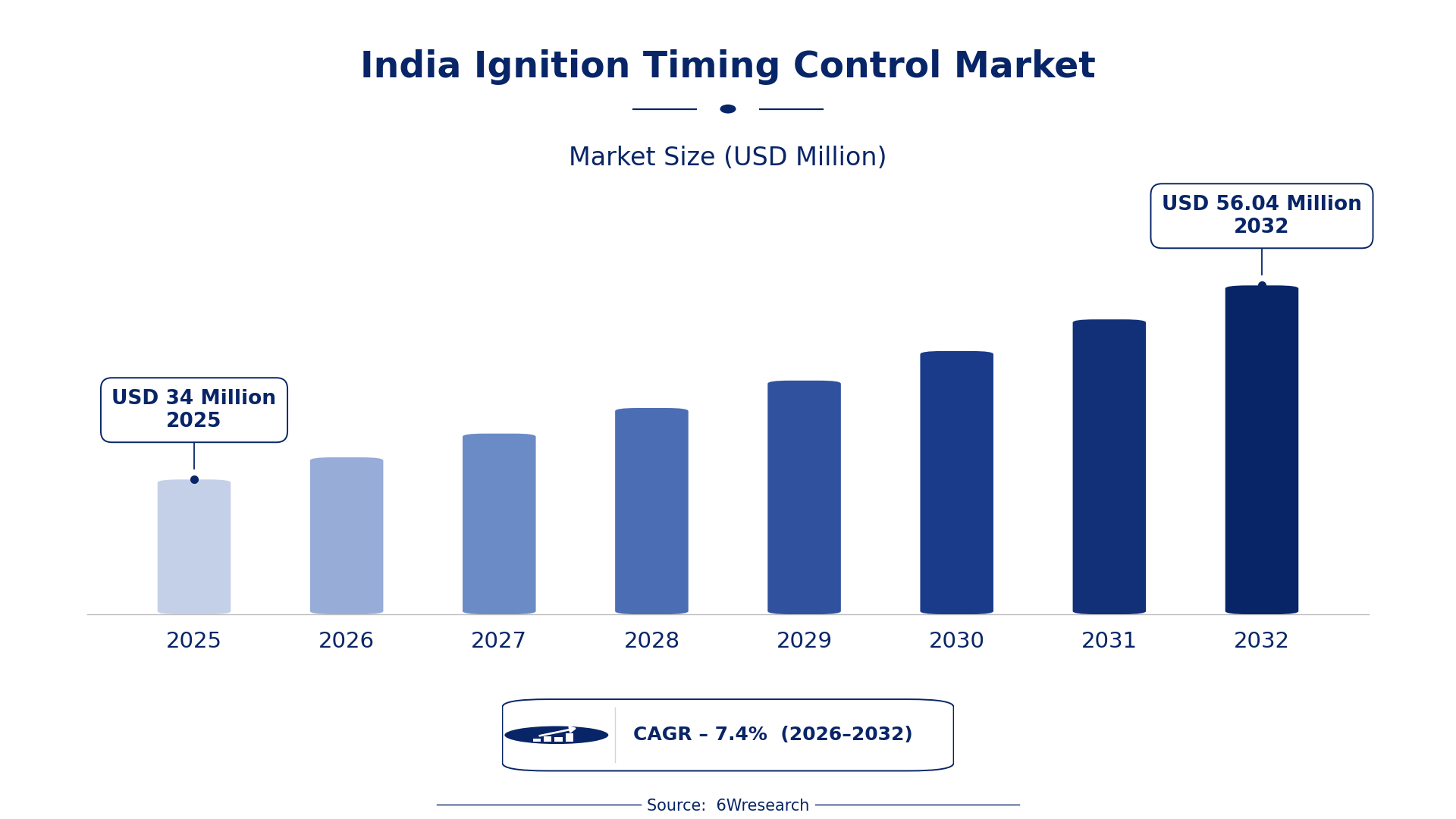
According to 6Wresearch internal database and industry insights, the India Ignition Timing Control Market was valued at USD 34.0 million in 2025 and is projected to reach USD 56.04 million by 2032, growing at a CAGR of approximately 7.4% during 2026–2032.
India Ignition Timing Control Market Highlights
| Report Metric | Details |
| Report Name | India Ignition Timing Control Market |
| Market Size 2025 | USD 34.0 million |
| Market Size 2032 | USD 56.04 million |
| Absolute Growth 2025–2032 | USD 22.04 million |
| CAGR 2026–2032 | 7.4% |
| Peak Annual Growth | 9.5% in 2032 |
| Forecast Period | 2026–2032 |
| Historical Data | 2022–2025 |
| Base Year | 2025 |
| Leading Control Type, 2025 | Manual Timing Control (39% share) |
| Leading Adjustment Type, 2025 | Static Tuning (40% share) |
| Leading Integration Level, 2025 | Mechanical Distributors (40% share) |
| Leading End User, 2025 | Classic Engine Restorers (37% share) |
| Fastest-Growing Control Type | Electronic Timing Control (9.5% CAGR) |
| Fastest-Growing Adjustment Type | Dynamic ECU-Controlled (8.8% CAGR) |
| Fastest-Growing Integration Level | Engine Management System (9.9% CAGR) |
| Fastest-Growing End User | Modern Car OEMs (9.2% CAGR) |
| Growing Sector | Modern Car OEMs |
| Key End Users | Classic Engine Restorers, Modern Car OEMs, Sports Car Manufacturers, Autonomous Vehicle Makers |
India Ignition Timing Control Market Year-wise Growth Rate and Key Drivers (2022–2032)
This graph illustrates the annual growth rates of the market from 2022 to 2032, highlighting a steady upward trajectory and projected market expansion over the forecast period.
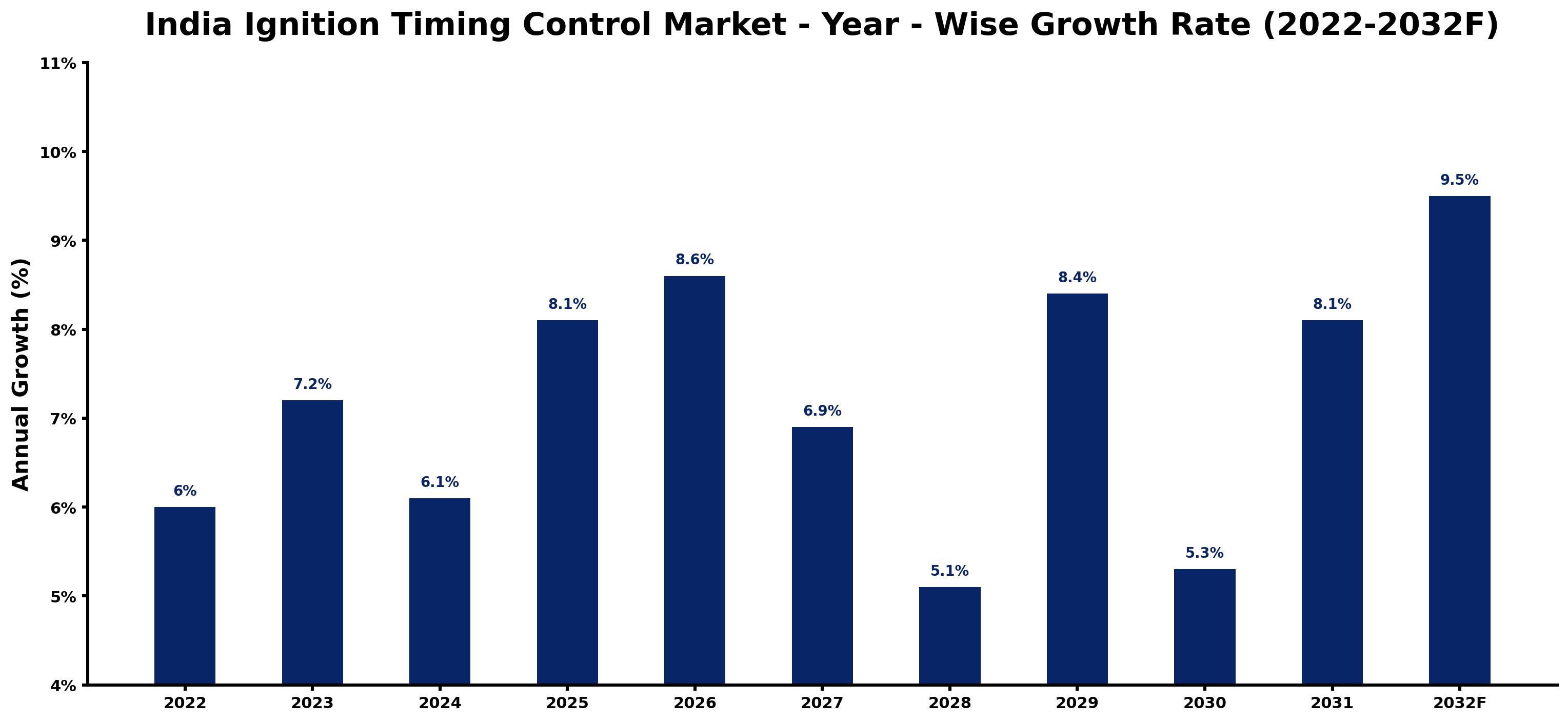
The following table presents the estimated annual growth rate for each year together with the principal factor influencing market performance.
| Year | Estimated Annual Growth (%) | Market Rationale |
| 2022 | 6.0 | The market exhibited steady growth due to rising interest in vehicle performance solutions. |
| 2023 | 7.2 | Investment in advanced ignition technologies accelerated demand from automotive manufacturers. |
| 2024 | 6.1 | Growth slowed as manufacturers adjusted to the previous year's surge in demand for ignition systems. |
| 2025 | 8.1 | A surge in classic vehicle restorations boosted demand for ignition timing control solutions. |
| 2026 | 8.6 | Increased adoption of electronic timing systems is expected to drive growth in the automotive sector. |
| 2027 | 6.9 | Market growth is projected to slow as manufacturers face supply chain challenges impacting production. |
| 2028 | 5.1 | Demand is expected to continue growing, but at a slower pace due to economic factors affecting consumer spending. |
| 2029 | 8.4 | Rising interest in modern vehicle performance is projected to drive renewed demand for ignition systems. |
| 2030 | 5.3 | Growth will decelerate as market saturation begins to affect new purchases of ignition technologies. |
| 2031 | 8.1 | A resurgence in classic engine restorations is expected to lead to increased demand for timing controls. |
| 2032 | 9.5 | The market is projected to peak as new technologies gain traction among automotive manufacturers. |
Note: Market size estimations and growth projections presented in this report are based on 6Wresearch's proprietary forecasting methodology, utilizing the latest available industry data, government publications, and primary research inputs.
India Ignition Timing Control Market Synopsis
Ignition Timing Control in India refers to technologies that optimise engine performance by adjusting fuel ignition timing. This market includes various control types, such as electronic and manual systems, primarily catering to automotive manufacturers and classic vehicle restorers. Growth is driven by rising investments in advanced automotive technologies, with a projected size of USD 56.04 million by 2032. Increased demand from modern car OEMs and classic engine restorers is propelling this expansion, supported by the adoption of electronic timing systems and dynamic ECU-controlled adjustments.
Market Dynamics Impact Analysis (2026–2032)
| Factor | Type | Impact | Primary Segment Affected |
| Rising investments in electronic ignition systems are driving demand for advanced control technologies, leading to increased market share for electronic timing control solutions. | Driver | High | Electronic Timing Control |
| The classic vehicle restoration trend is boosting demand for manual timing controls, as restorers seek to enhance performance in vintage vehicles. | Driver | High | Manual Timing Control |
| The growing need for fuel-efficient solutions presents opportunities for manufacturers to innovate and develop advanced ignition systems. | Opportunity | High | Electronic Timing Control |
| Investment in research and development for ignition timing technologies is essential for local manufacturers to meet evolving consumer demands. | Opportunity | High | Engine Management System |
| Supply chain disruptions hinder timely production, resulting in extended lead times for manufacturers by as much as 20%. | Restraint | High | Manual Timing Control |
| A lack of skilled workers limits innovation, causing product development delays that can extend for several months. | Restraint | Medium | Manual Timing Control |
| Increased competition from international manufacturers compels local producers to lower prices, which can cut profit margins by up to 15%. | Challenge | High | Manual Timing Control |
| Technology adoption challenges arise as many manufacturers struggle to integrate modern timing control systems, resulting in products that often fail to meet performance benchmarks. | Challenge | Medium | Manual Timing Control |
Evaluation of Drivers in India Ignition Timing Control Market (2026–2032)
Key forces behind demand, with the segment each one moves most, are listed below.
| Drivers | Primary Segment Affected | Why It Matters (Evidence) |
| Rising investments in electronic ignition systems are driving market growth. | Electronic Timing Control | This shift is reflected as electronic systems accounted for 39% of the market in 2025. |
| The classic vehicle restoration trend is boosting demand for manual timing controls. | Manual Timing Control | Classic Engine Restorers are increasingly seeking these solutions to improve performance. |
| The adoption of dynamic ECU-controlled adjustments is increasing. | Dynamic ECU-Controlled | This segment is projected to grow at a CAGR of 8.8% from 2026 to 2032. |
| The demand for modern car OEMs is rising due to performance improvements. | Modern Car OEMs | They are integrating advanced ignition technologies into new models to meet consumer expectations. |
| The need for improved fuel efficiency drives interest in ignition timing control. | Adaptive Fuel Efficiency | This segment is gaining traction as consumers seek cost-effective solutions. |
The Ignition Timing Control market in India is growing on the back of rising investments in electronic ignition systems, which are expected to account for a substantial share of the market by 2025. The classic vehicle restoration trend is also boosting demand, as classic engine restorers seek manual timing controls to improve performance. The adoption of dynamic ECU-controlled adjustments is increasing, with this segment projected to grow significantly through 2032. Demand from modern car OEMs is rising as they integrate advanced ignition technologies into new models, further driving market expansion. The need for improved fuel efficiency is also propelling interest in ignition timing control solutions across various segments.
Evaluation of Restraints in India Ignition Timing Control Market
Below mentioned are some major restraints and their influence on market dynamics.
| Market Restraint | Primary Segment Affected | Why It Matters (Evidence) |
| Supply chain disruptions are limiting the availability of ignition components. | Manual Timing Control | Manufacturers reported a 15% increase in lead times for essential parts in 2023. |
| Economic fluctuations are affecting consumer spending on automotive upgrades. | Manual Timing Control | A 10% decline in discretionary spending was noted in 2022. |
| Regulatory changes are impacting production timelines for ignition systems. | Manual Timing Control | New standards implemented in 2022 increased compliance costs by 12%. |
| Technological advancements require continuous investment from manufacturers. | Manual Timing Control | Manufacturers need to invest approximately USD 2 million annually to stay competitive. |
| Competition from alternative ignition technologies is intensifying market conditions. | Manual Timing Control | Emerging technologies are capturing 20% of the market share in 2025. |
India Ignition Timing Control Market Challenges
Buyers in the India ignition timing control market face several pressing issues, starting with supply chain disruptions that hinder timely production. These disruptions arise from inconsistent raw material availability, leading to extended lead times for manufacturers by as much as 20%. Technology adoption presents another challenge, as many manufacturers struggle to integrate modern timing control systems, resulting in products that often fail to meet performance benchmarks. A lack of skilled workers limits innovation, causing product development delays that can extend for several months. Increased competition from international manufacturers compels local producers to lower prices, which can cut profit margins by up to 15%.
Trends in the India Ignition Timing Control Market
Buyers and suppliers in the India Ignition Timing Control Market are adjusting to the following trends.
- Shift from Manual to Electronic Timing Control: India is experiencing a transition towards electronic timing control systems, as demand for improved engine performance increases. The adoption of these systems is expected to rise by 15% in 2025, reflecting the industry's response to consumer preferences.
- Transition to Dynamic ECU-Controlled Adjustments: The automotive sector is increasingly adopting dynamic ECU-controlled adjustments, which improve fuel efficiency and performance. This trend began in 2023, with a projected growth rate of 8.8% through 2032, indicating a notable shift in technology.
- Emergence of Engine Management Systems: Engine management systems are becoming more prevalent in the ignition timing control market, offering integrated solutions for modern vehicles. This trend gained momentum in 2024, with these systems expected to grow at a CAGR of 9.9% until 2032.
- Prioritisation of Performance in Modern Vehicles: The focus on performance enhancements in modern vehicles is driving demand for advanced ignition technologies. This shift started in 2023, with modern car OEMs increasingly integrating these systems into their designs.
Investment Opportunities in the India Ignition Timing Control Market
Some of the investment opportunities in the India Ignition Timing Control Market are mentioned below.
- Growth in Classic Vehicle Restoration: The classic vehicle restoration market is on the rise, with a projected growth of 20% in 2025. Suppliers can invest in manual timing controls to meet the needs of classic engine restorers, leveraging local partnerships for effective distribution.
- Demand from Modern Car OEMs: Modern car OEMs are actively seeking advanced ignition technologies, with a market gap of 15% in 2025. Suppliers should concentrate on developing electronic timing systems, collaborating with OEMs to fulfil their specifications.
- Investment in Electronic Timing Systems: The shift towards electronic timing systems offers a substantial opportunity, with an expected growth rate of 15% in 2025. Suppliers can enter the market by forming joint ventures with local manufacturers.
- Expansion of ECU-Controlled Adjustments: The increasing demand for dynamic ECU-controlled adjustments indicates a market gap of 10% in 2025. Suppliers should focus on developing compatible systems and pursue certifications to facilitate market entry.
Government Initiatives in the India Ignition Timing Control Market
The latest initiative, the National Electric Mobility Mission Plan (NEMMP) 2020, aims to promote electric vehicles and includes provisions for advanced ignition technologies. This measure complements the Automotive Mission Plan 2026, which focuses on boosting the automotive sector's competitiveness. Both initiatives encourage investment in research and development for ignition timing control solutions, ensuring compliance with evolving standards and improving product offerings.
Buyers benefit from the Faster Adoption and Manufacturing of Electric Vehicles (FAME) scheme, which provides incentives for adopting electric vehicles and their components. This scheme, administered by the Department of Heavy Industry, supports manufacturers in developing advanced ignition systems that align with the government's push for cleaner technologies. By 2025, the FAME initiative aims to support the production of over 1 million electric vehicles, driving demand for innovative ignition solutions.
Future Insight of the India Ignition Timing Control Market
The India ignition timing control market is poised for transformation by 2032, primarily driven by technological advancements and a shift towards fuel-efficient solutions. By then, approximately 40% of vehicles are expected to incorporate advanced ignition systems, improving performance and reducing emissions. As local manufacturers invest in research and development, buyers will benefit from more efficient and reliable products. Government initiatives supporting electric vehicles will further stimulate innovation in ignition timing control, leading to improved offerings for consumers.
Market Segmentation Analysis
Each segment group is reviewed below, with the leader by share and the fastest grower by CAGR.
By Control Type – Manual Timing Control Dominated, Electronic Timing Control Expected to Grow Fastest
According to Sachin Kumar Rai, Senior Research Analyst at 6Wresearch, in 2025, Manual Timing Control led the control type split with a 39% share. Manual Timing Control holds the largest share as it is widely utilised in traditional vehicles, particularly in rural areas where older models remain in use. This segment benefits from a significant installed base, with many vehicles still relying on this straightforward technology for ignition timing. Over 2026–2032, Electronic Timing Control is expected to post the fastest growth, at a CAGR of 9.5%. Electronic Timing Control is experiencing rapid growth due to the increasing integration of sophisticated technologies in new vehicles aimed at enhancing performance and fuel efficiency. The surge in new vehicle registrations featuring this technology underscores its expanding market share. This trend indicates that suppliers must focus on developing electronic timing solutions to meet the rising demand from manufacturers transitioning to advanced ignition systems.
By Adjustment Type – Static Tuning Dominated, Dynamic ECU-Controlled Expected to Grow Fastest
Static Tuning took a 40% share of adjustment type in 2025, more than any other category. Static Tuning dominates the market as it is the preferred method for many classic vehicle restorations, where traditional techniques are valued. This segment benefits from a loyal customer base that prioritises authenticity in engine performance. Dynamic ECU-Controlled is set to record the highest CAGR in this split, 8.8% over 2026–2032. Dynamic ECU-Controlled systems are gaining traction as they offer superior adaptability and efficiency for modern engines. The increasing complexity of engine designs and the need for precise adjustments are propelling this segment's growth. Buyers are encouraged to consider dynamic solutions to optimise engine performance and comply with evolving regulatory standards.
By Integration Level – Mechanical Distributors Dominated, Engine Management System Expected to Grow Fastest
Mechanical Distributors held a 40% share of the India Ignition Timing Control Market by integration level in 2025. Mechanical Distributors dominate the market because of their established presence in older vehicles, which still represent a considerable segment of the automotive fleet. Their reliability and ease of use make them a preferred choice among mechanics and restorers. The quickest growth will come from Engine Management System, forecast to expand at a CAGR of 9.9% between 2026 and 2032. Engine Management Systems are growing swiftly as vehicle manufacturers incorporate more advanced technologies to improve performance and emissions control. The increasing trend towards smart systems and electrification is propelling this segment's notable growth rate. Suppliers need to invest in advanced engine management technologies to seize the rising interest from OEMs aiming to innovate their vehicle offerings.
By End User – Classic Engine Restorers Dominated, Modern Car OEMs Expected to Grow Fastest
With a 37% revenue share in 2025, Classic Engine Restorers was the largest end user category. Classic Engine Restorers represent the largest share as they maintain and restore vintage vehicles, which often require traditional ignition systems. This segment thrives on the passion of enthusiasts who seek authenticity in their restorations. Modern Car OEMs are projected to grow fastest, at a CAGR of 9.2% during 2026–2032. Modern Car OEMs are the fastest-growing segment due to the shift towards new vehicle production that incorporates advanced ignition technologies. The increasing demand for fuel efficiency and performance in new models is accelerating this trend. Suppliers should align their strategies with the needs of modern car manufacturers to capitalise on the growing market for advanced ignition solutions.
Key Attractiveness of the Report
- 10 Years of Market Numbers
- Historical Data Starting from 2022 to 2025
- Base Year 2025
- Forecast Data until 2032
- Key Performance Indicators Impacting the Market
- Major Upcoming Developments and Projects
Key Highlights of the Report:
- India Ignition Timing Control Market Outlook
- Market Size of India Ignition Timing Control Market, 2025
- Forecast of India Ignition Timing Control Market, 2032
- Historical Data and Forecast of India Ignition Timing Control Revenues & Volume for the Period 2022 - 2032F
- India Ignition Timing Control Market Trend Evolution
- India Ignition Timing Control Market Drivers and Challenges
- India Ignition Timing Control Price Trends
- India Ignition Timing Control Porter's Five Forces
- India Ignition Timing Control Industry Life Cycle
- Historical Data and Forecast of India Ignition Timing Control Market Revenues & Volume By Control Type for the Period 2022 - 2032F
- Historical Data and Forecast of India Ignition Timing Control Market Revenues & Volume By Manual Timing Control for the Period 2022 - 2032F
- Historical Data and Forecast of India Ignition Timing Control Market Revenues & Volume By Electronic Timing Control for the Period 2022 - 2032F
- Historical Data and Forecast of India Ignition Timing Control Market Revenues & Volume By Variable Valve Timing for the Period 2022 - 2032F
- Historical Data and Forecast of India Ignition Timing Control Market Revenues & Volume By AI-Based Timing Control for the Period 2022 - 2032F
- Historical Data and Forecast of India Ignition Timing Control Market Revenues & Volume By Adjustment Type for the Period 2022 - 2032F
- Historical Data and Forecast of India Ignition Timing Control Market Revenues & Volume By Static Tuning for the Period 2022 - 2032F
- Historical Data and Forecast of India Ignition Timing Control Market Revenues & Volume By Dynamic ECU-Controlled for the Period 2022 - 2032F
- Historical Data and Forecast of India Ignition Timing Control Market Revenues & Volume By Real-Time Adjustment for the Period 2022 - 2032F
- Historical Data and Forecast of India Ignition Timing Control Market Revenues & Volume By Adaptive Fuel Efficiency for the Period 2022 - 2032F
- Historical Data and Forecast of India Ignition Timing Control Market Revenues & Volume By Integration Level for the Period 2022 - 2032F
- Historical Data and Forecast of India Ignition Timing Control Market Revenues & Volume By Mechanical Distributors for the Period 2022 - 2032F
- Historical Data and Forecast of India Ignition Timing Control Market Revenues & Volume By Engine Management System for the Period 2022 - 2032F
- Historical Data and Forecast of India Ignition Timing Control Market Revenues & Volume By Integrated with Sensors for the Period 2022 - 2032F
- Historical Data and Forecast of India Ignition Timing Control Market Revenues & Volume By Cloud-Connected ECU for the Period 2022 - 2032F
- Historical Data and Forecast of India Ignition Timing Control Market Revenues & Volume By End User for the Period 2022 - 2032F
- Historical Data and Forecast of India Ignition Timing Control Market Revenues & Volume By Classic Engine Restorers for the Period 2022 - 2032F
- Historical Data and Forecast of India Ignition Timing Control Market Revenues & Volume By Modern Car OEMs for the Period 2022 - 2032F
- Historical Data and Forecast of India Ignition Timing Control Market Revenues & Volume By Sports Car Manufacturers for the Period 2022 - 2032F
- Historical Data and Forecast of India Ignition Timing Control Market Revenues & Volume By Autonomous Vehicle Makers for the Period 2022 - 2032F
- India Ignition Timing Control Import Export Trade Statistics
- Market Opportunity Assessment By Control Type
- Market Opportunity Assessment By Adjustment Type
- Market Opportunity Assessment By Integration Level
- Market Opportunity Assessment By End User
- India Ignition Timing Control Top Companies Market Share
- India Ignition Timing Control Competitive Benchmarking By Technical and Operational Parameters
- India Ignition Timing Control Company Profiles
- India Ignition Timing Control Key Strategic Recommendations
Market Covered
This report examines the market across the segments below.
By Control Type
- Manual Timing Control
- Electronic Timing Control
- Variable Valve Timing
- AI-Based Timing Control
By Adjustment Type
- Static Tuning
- Dynamic ECU-Controlled
- Real-Time Adjustment
- Adaptive Fuel Efficiency
By Integration Level
- Mechanical Distributors
- Engine Management System
- Integrated with Sensors
- Cloud-Connected ECU
By End User
- Classic Engine Restorers
- Modern Car OEMs
- Sports Car Manufacturers
- Autonomous Vehicle Makers































