China Ignition Timing Control Market Size & Growth Rate
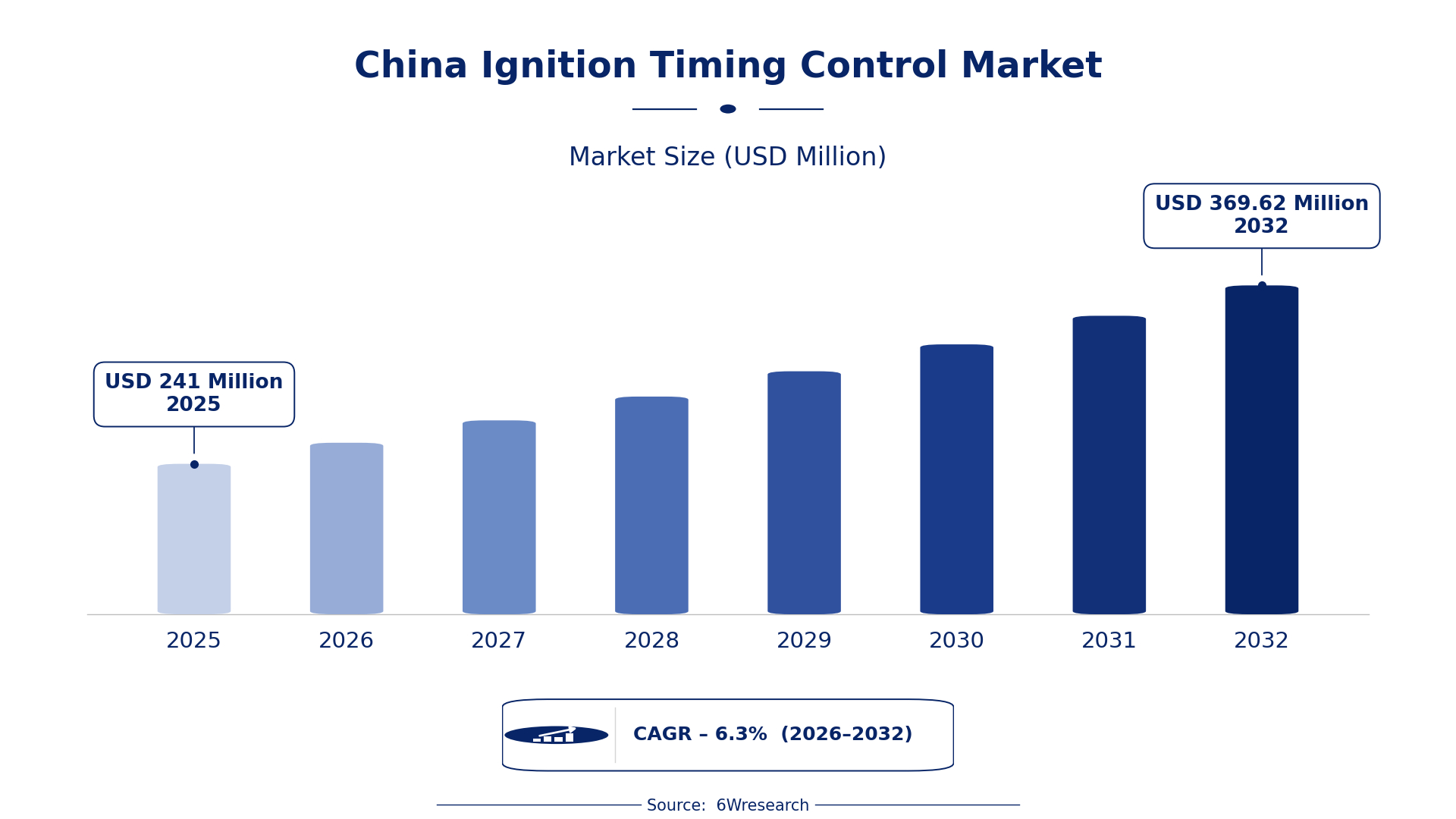
According to 6Wresearch internal database and industry insights, the China Ignition Timing Control Market was valued at USD 241.0 million in 2025 and is projected to reach USD 369.62 million by 2032, growing at a CAGR of approximately 6.3% during 2026–2032.
China Ignition Timing Control Market Highlights
| Report Metric | Details |
| Report Name | China Ignition Timing Control Market |
| Market Size 2025 | USD 241.0 million |
| Market Size 2032 | USD 369.62 million |
| Absolute Growth 2025–2032 | USD 128.62 million |
| CAGR 2026–2032 | 6.3% |
| Peak Annual Growth | 8.7% in 2027 |
| Forecast Period | 2026–2032 |
| Historical Data | 2022–2025 |
| Base Year | 2025 |
| Leading Control Type, 2025 | Manual Timing Control (41% share) |
| Leading Adjustment Type, 2025 | Static Tuning (50% share) |
| Leading Integration Level, 2025 | Mechanical Distributors (40% share) |
| Leading End User, 2025 | Classic Engine Restorers (42% share) |
| Fastest-Growing Control Type | Electronic Timing Control (8.7% CAGR) |
| Fastest-Growing Adjustment Type | Dynamic ECU-Controlled (7.7% CAGR) |
| Fastest-Growing Integration Level | Engine Management System (8.2% CAGR) |
| Fastest-Growing End User | Modern Car OEMs (7.5% CAGR) |
| Growing Sector | Modern Car OEMs |
| Key End Users | Classic Engine Restorers, Modern Car OEMs, Sports Car Manufacturers, Autonomous Vehicle Makers |
China Ignition Timing Control Market Year-wise Growth Rate and Key Drivers (2022–2032)
This graph illustrates the annual growth rates of the market from 2022 to 2032, highlighting a steady upward trajectory and projected market expansion over the forecast period.
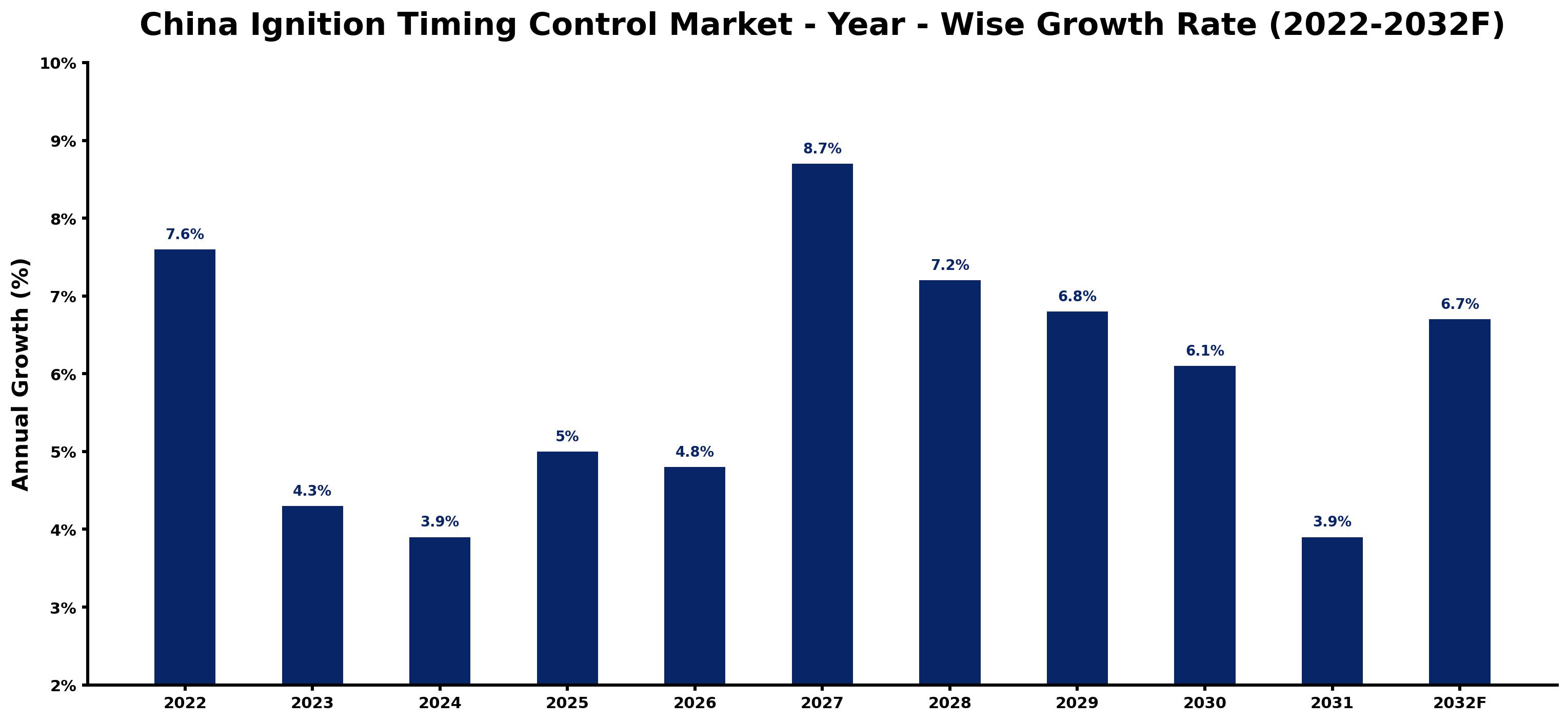
The following table presents the estimated annual growth rate for each year together with the principal factor influencing market performance.
| Year | Estimated Annual Growth (%) | Market Rationale |
| 2022 | 7.6 | The automotive sector produced over 26 million vehicles, sustaining demand for ignition timing control systems. |
| 2023 | 4.3 | The adoption of AI-based ignition timing control is expected to rise by 15%, influencing market growth. |
| 2024 | 3.9 | The average fuel efficiency target of 5.0 L/100km by 2025 drives innovation in ignition control technology. |
| 2025 | 5.0 | The automotive aftermarket is projected to expand, boosting the need for ignition timing control services. |
| 2026 | 4.8 | Growth in the automotive sector is supported by the 'Automotive Industry Development Plan' promoting technology advancements. |
| 2027 | 8.7 | The demand for Electronic Timing Control is expected to surge, driven by modern car manufacturers seeking optimal performance. |
| 2028 | 7.2 | The Guangdong province remains a significant hub for automotive manufacturing, impacting ignition timing control demand. |
| 2029 | 6.8 | The increasing focus on emissions standards continues to drive innovation in ignition timing technologies. |
| 2030 | 6.1 | The ongoing development of advanced engine management systems supports the growth of ignition timing control solutions. |
| 2031 | 3.9 | The market will stabilise as the automotive sector adapts to new regulatory standards. |
| 2032 | 6.7 | The continued investment in automotive technology advancements is projected to enhance ignition timing control systems. |
Note: Market size estimations and growth projections presented in this report are based on 6Wresearch's proprietary forecasting methodology, utilizing the latest available industry data, government publications, and primary research inputs.
China Ignition Timing Control Market Synopsis
Ignition Timing Control technology optimises ignition timing in internal combustion engines in China. It is created through advanced electronic systems or mechanical components, improving engine performance, fuel efficiency, and reducing emissions. The China Ignition Timing Control Market is growing due to the automotive sector's production of over 26 million vehicles in 2022 and the adoption of advanced technologies. Key drivers include the push for improved fuel efficiency and stringent emissions standards. The market will reach USD 369.62 million by 2032, reflecting increasing demand from modern car manufacturers and sports car makers.
Market Dynamics Impact Analysis (2026–2032)
| Factor | Type | Impact | Primary Segment Affected |
| Growing production of vehicles in the automotive sector | Driver | High | Electronic Timing Control |
| Increasing focus on emissions standards | Driver | High | Adaptive Fuel Efficiency |
| Expansion of the automotive aftermarket | Opportunity | High | Manual Timing Control |
| Rising adoption of AI-based technologies | Opportunity | High | AI-Based Timing Control |
| Limited use of Manual Timing Control in modern vehicles | Restraint | Medium | Manual Timing Control |
| Challenges in integrating new technologies with existing systems | Restraint | Medium | Dynamic ECU-Controlled |
| High costs associated with advanced technology adoption | Challenge | High | Engine Management System |
| Regulatory compliance requirements delaying product launches | Challenge | Medium | Manual Timing Control |
Evaluation of Drivers in China Ignition Timing Control Market (2026–2032)
The table below links each growth driver to the segment it affects and the evidence for it.
| Drivers | Primary Segment Affected | Why It Matters (Evidence) |
| Rising vehicle production | Electronic Timing Control | In 2022, over 26 million vehicles were produced, increasing demand for advanced ignition systems. |
| Emissions standards compliance | Adaptive Fuel Efficiency | The average fuel efficiency of new vehicles is targeted at 5.0 L/100km by 2025, driving innovation. |
| Automotive aftermarket growth | Manual Timing Control | The automotive aftermarket is projected to expand, increasing demand for ignition timing control services. |
| AI technology adoption | AI-Based Timing Control | The expected 15% increase in AI-based ignition control adoption in 2023 will drive market growth. |
| Investment in automotive technology | Dynamic ECU-Controlled | The Chinese government invested 10 billion CNY in automotive technology advancements through 'Made in China 2025'. |
Expansion of the Ignition Timing Control market in China is backed by rising vehicle production, increasing focus on emissions standards, and growth in the automotive aftermarket. In 2022, over 26 million vehicles were produced, leading to heightened demand for advanced ignition systems. The automotive aftermarket is expanding, boosting the need for ignition timing control services. The anticipated 15% increase in AI-based ignition timing control adoption in 2023 supports market growth. The average fuel efficiency target of 5.0 L/100km by 2025 drives innovation in related technologies.
Evaluation of Restraints in China Ignition Timing Control Market
The main factors holding the market back are set out below.
| Market Restraint | Primary Segment Affected | Why It Matters (Evidence) |
| Limited application of Manual Timing Control in modern vehicles | Manual Timing Control | This technology is primarily used in classic vehicles, restricting its market potential. |
| Integration challenges with existing systems | Dynamic ECU-Controlled | New technologies may face compatibility issues, delaying adoption and increasing costs. |
| High costs of advanced ignition systems | Engine Management System | The investment required for advanced systems can deter smaller manufacturers from adopting new technologies. |
| Regulatory compliance delays | Manual Timing Control | Strict emissions regulations can slow down the introduction of new ignition technologies. |
| Niche market for Classic Engine Restorers | Classic Engine Restorers | Limited demand for ignition timing control in vintage cars restricts overall market growth. |
China Ignition Timing Control Market Challenges
In 2022, over 26 million vehicles produced in China highlighted a pressing supply issue, as many automotive manufacturers struggle to source reliable ignition timing control systems. This challenge arises from a limited number of local suppliers, which delays production schedules for car makers. A shortage of skilled professionals in advanced automotive technologies exacerbates the problem, with over 200 research institutions unable to meet the growing demand for expertise in ignition systems. Rising costs are also a concern, as the average ignition timing control system now costs 15% more, squeezing profit margins for producers.
Trends in the China Ignition Timing Control Market
Below mentioned are some of the trends shaping the China Ignition Timing Control Market growth.
- Shift from Manual to Electronic Timing Control: Since 2022, there has been a clear shift towards Electronic Timing Control systems in modern vehicles. With over 26 million vehicles produced in 2022, this trend is set to continue as manufacturers pursue optimal performance.
- Increase in AI-Based Timing Control Adoption: In 2023, the adoption of AI-based ignition timing control is anticipated to rise by 15%, reflecting a growing trend towards advanced technologies in the automotive sector. This shift indicates a move towards more efficient and responsive ignition systems.
- Focus on Fuel Efficiency Standards: The average fuel efficiency target of 5.0 L/100km by 2025 is driving innovation in ignition timing control technologies. This emphasis on efficiency is shaping product development across the automotive industry.
- Expansion of Automotive Aftermarket Services: The automotive aftermarket in China is expanding, with ignition timing control services in high demand. This growth reflects the increasing need for maintenance and upgrades in existing vehicles.
Investment Opportunities in the China Ignition Timing Control Market
Investors looking at the China Ignition Timing Control Market should consider the following areas.
- Modern Car OEMs: Modern car manufacturers are increasingly adopting advanced ignition timing control technologies, with over 26 million vehicles produced in 2022. Investing in Electronic Timing Control systems will cater to their demand for efficiency and performance.
- Dynamic ECU-Controlled Systems: The automotive sector is growing, with substantial investment in Dynamic ECU-Controlled systems. The Guangdong province is a key hub for automotive manufacturing, presenting opportunities for suppliers.
- AI-Based Timing Control: With a projected 15% increase in AI-based timing control adoption in 2023, suppliers can invest in this emerging technology. Collaborating with automotive research institutions will facilitate entry into this growing segment.
- Aftermarket Services: The automotive aftermarket is expanding, with ignition timing control services in high demand. Suppliers can enter this market by partnering with local service providers to offer comprehensive solutions.
Government Initiatives in the China Ignition Timing Control Market
The 'Automotive Industry Development Plan' launched by the National Development and Reform Commission in 2021 promotes innovation in vehicle technology, impacting ignition timing control systems. This initiative aims to improve the automotive sector's competitiveness and sustainability by encouraging advancements in ignition technologies and enhancing fuel efficiency standards. The plan has allocated substantial resources to support research and development in this area, benefiting both producers and buyers.
The Ministry of Industry and Information Technology oversees the implementation of the ISO 26262 standard for functional safety in ignition timing control systems. This standard ensures that manufacturers meet safety requirements, improving the reliability of ignition systems and supporting compliance with regulatory frameworks. The ministry has also initiated various funding schemes to assist manufacturers in upgrading their technologies, facilitating better market access.
Future Insight of the China Ignition Timing Control Market
By 2032, buyers and suppliers in the China ignition timing control market can expect substantial changes driven by government initiatives and technological advancements. The 'Automotive Industry Development Plan' will promote the integration of new ignition technologies, enhancing vehicle performance and meeting stricter emissions standards. Adoption of AI-based ignition control is set to rise, with an expected increase of 15% in 2023. Efforts to reach an average fuel efficiency of 5.0 L/100km by 2025 will further influence product innovation and competitive strategies.
Market Segmentation Analysis
Each segment group is reviewed below, with the leader by share and the fastest grower by CAGR.
By Control Type – Manual Timing Control Dominated, Electronic Timing Control Expected to Grow Fastest
According to Bhawna Singh, Assistant Manager at 6Wresearch, Manual Timing Control held a 41% share of the China Ignition Timing Control Market by control type in 2025. Manual Timing Control holds the largest share as it caters primarily to classic vehicles, appealing to vintage car enthusiasts who seek authenticity. This segment remains particularly relevant in regions like Guangdong, where the restoration of classic cars is a cherished activity. Electronic Timing Control is projected to grow fastest, at a CAGR of 8.7% during 2026–2032. Electronic Timing Control is experiencing rapid growth as modern vehicles increasingly rely on sophisticated ignition systems to enhance performance. With over 26 million vehicles produced in 2022, the demand for this technology is set to expand further, solidifying its market position. Suppliers should focus on developing advanced electronic solutions to meet the evolving needs of contemporary automotive manufacturers.
By Adjustment Type – Static Tuning Dominated, Dynamic ECU-Controlled Expected to Grow Fastest
Static Tuning accounted for a 50% market share by adjustment type in 2025. Static Tuning commands the largest share as it is predominantly used in older vehicle models, appealing to a niche market of classic car restorers. Despite its limited application, this segment remains significant among enthusiasts dedicated to preserving vintage vehicles. Over 2026–2032, Dynamic ECU-Controlled is expected to post the fastest growth, at a CAGR of 7.7%. Dynamic ECU-Controlled systems are rapidly gaining traction due to their integration in modern engine management, optimising performance and fuel efficiency. As the automotive sector shifts towards contemporary technologies, this segment is poised for swift growth with new models entering the market. Buyers should prioritise dynamic solutions to enhance vehicle performance and comply with stringent fuel efficiency standards.
By Integration Level – Mechanical Distributors Dominated, Engine Management System Expected to Grow Fastest
With a 40% revenue share in 2025, Mechanical Distributors was the largest integration level category. Mechanical Distributors maintain the largest market share as they are still found in older engine designs, appealing to a niche market of classic vehicle restorers. Their continued use reflects a demand for traditional ignition systems in specific restoration projects. The quickest growth will come from Engine Management System, forecast to expand at a CAGR of 8.2% between 2026 and 2032. Engine Management Systems are the fastest-growing segment, as they are integral to modern automotive technology, allowing for optimal performance and emissions control. The widespread adoption of these systems in new vehicles ensures sustained growth in this area. Suppliers must innovate within engine management technologies to capture the expanding market of modern automotive manufacturers.
By End User – Classic Engine Restorers Dominated, Modern Car OEMs Expected to Grow Fastest
In 2025, Classic Engine Restorers led the end user split with a 42% share. Classic Engine Restorers account for the largest share as they serve a niche market focused on vintage cars, which often require traditional ignition systems. This segment's persistence highlights the ongoing interest in automotive heritage and restoration practices. Modern Car OEMs are set to record the highest CAGR in this split, 7.5% over 2026–2032. Modern Car OEMs are driving the fastest growth as they demand advanced ignition timing control technologies for new vehicle models. The production of over 26 million vehicles in 2022 reflects a significant rise in demand for this segment, ensuring its rapid expansion. Suppliers should align their offerings with the requirements of modern car manufacturers to capitalise on the increasing demand for advanced ignition technologies.
Key Attractiveness of the Report
- 10 Years of Market Numbers
- Historical Data Starting from 2022 to 2025
- Base Year 2025
- Forecast Data until 2032
- Key Performance Indicators Impacting the Market
- Major Upcoming Developments and Projects
Key Highlights of the Report:
- China Ignition Timing Control Market Outlook
- Market Size of China Ignition Timing Control Market, 2025
- Forecast of China Ignition Timing Control Market, 2032
- Historical Data and Forecast of China Ignition Timing Control Revenues & Volume for the Period 2022 - 2032F
- China Ignition Timing Control Market Trend Evolution
- China Ignition Timing Control Market Drivers and Challenges
- China Ignition Timing Control Price Trends
- China Ignition Timing Control Porter's Five Forces
- China Ignition Timing Control Industry Life Cycle
- Historical Data and Forecast of China Ignition Timing Control Market Revenues & Volume By Control Type for the Period 2022 - 2032F
- Historical Data and Forecast of China Ignition Timing Control Market Revenues & Volume By Manual Timing Control for the Period 2022 - 2032F
- Historical Data and Forecast of China Ignition Timing Control Market Revenues & Volume By Electronic Timing Control for the Period 2022 - 2032F
- Historical Data and Forecast of China Ignition Timing Control Market Revenues & Volume By Variable Valve Timing for the Period 2022 - 2032F
- Historical Data and Forecast of China Ignition Timing Control Market Revenues & Volume By AI-Based Timing Control for the Period 2022 - 2032F
- Historical Data and Forecast of China Ignition Timing Control Market Revenues & Volume By Adjustment Type for the Period 2022 - 2032F
- Historical Data and Forecast of China Ignition Timing Control Market Revenues & Volume By Static Tuning for the Period 2022 - 2032F
- Historical Data and Forecast of China Ignition Timing Control Market Revenues & Volume By Dynamic ECU-Controlled for the Period 2022 - 2032F
- Historical Data and Forecast of China Ignition Timing Control Market Revenues & Volume By Real-Time Adjustment for the Period 2022 - 2032F
- Historical Data and Forecast of China Ignition Timing Control Market Revenues & Volume By Adaptive Fuel Efficiency for the Period 2022 - 2032F
- Historical Data and Forecast of China Ignition Timing Control Market Revenues & Volume By Integration Level for the Period 2022 - 2032F
- Historical Data and Forecast of China Ignition Timing Control Market Revenues & Volume By Mechanical Distributors for the Period 2022 - 2032F
- Historical Data and Forecast of China Ignition Timing Control Market Revenues & Volume By Engine Management System for the Period 2022 - 2032F
- Historical Data and Forecast of China Ignition Timing Control Market Revenues & Volume By Integrated with Sensors for the Period 2022 - 2032F
- Historical Data and Forecast of China Ignition Timing Control Market Revenues & Volume By Cloud-Connected ECU for the Period 2022 - 2032F
- Historical Data and Forecast of China Ignition Timing Control Market Revenues & Volume By End User for the Period 2022 - 2032F
- Historical Data and Forecast of China Ignition Timing Control Market Revenues & Volume By Classic Engine Restorers for the Period 2022 - 2032F
- Historical Data and Forecast of China Ignition Timing Control Market Revenues & Volume By Modern Car OEMs for the Period 2022 - 2032F
- Historical Data and Forecast of China Ignition Timing Control Market Revenues & Volume By Sports Car Manufacturers for the Period 2022 - 2032F
- Historical Data and Forecast of China Ignition Timing Control Market Revenues & Volume By Autonomous Vehicle Makers for the Period 2022 - 2032F
- China Ignition Timing Control Import Export Trade Statistics
- Market Opportunity Assessment By Control Type
- Market Opportunity Assessment By Adjustment Type
- Market Opportunity Assessment By Integration Level
- Market Opportunity Assessment By End User
- China Ignition Timing Control Top Companies Market Share
- China Ignition Timing Control Competitive Benchmarking By Technical and Operational Parameters
- China Ignition Timing Control Company Profiles
- China Ignition Timing Control Key Strategic Recommendations
Market Covered
The report offers an extensive study of the following market segments.
By Control Type
- Manual Timing Control
- Electronic Timing Control
- Variable Valve Timing
- AI-Based Timing Control
By Adjustment Type
- Static Tuning
- Dynamic ECU-Controlled
- Real-Time Adjustment
- Adaptive Fuel Efficiency
By Integration Level
- Mechanical Distributors
- Engine Management System
- Integrated with Sensors
- Cloud-Connected ECU
By End User
- Classic Engine Restorers
- Modern Car OEMs
- Sports Car Manufacturers
- Autonomous Vehicle Makers































