India Immersive Flight Systems Market Size & Growth Rate
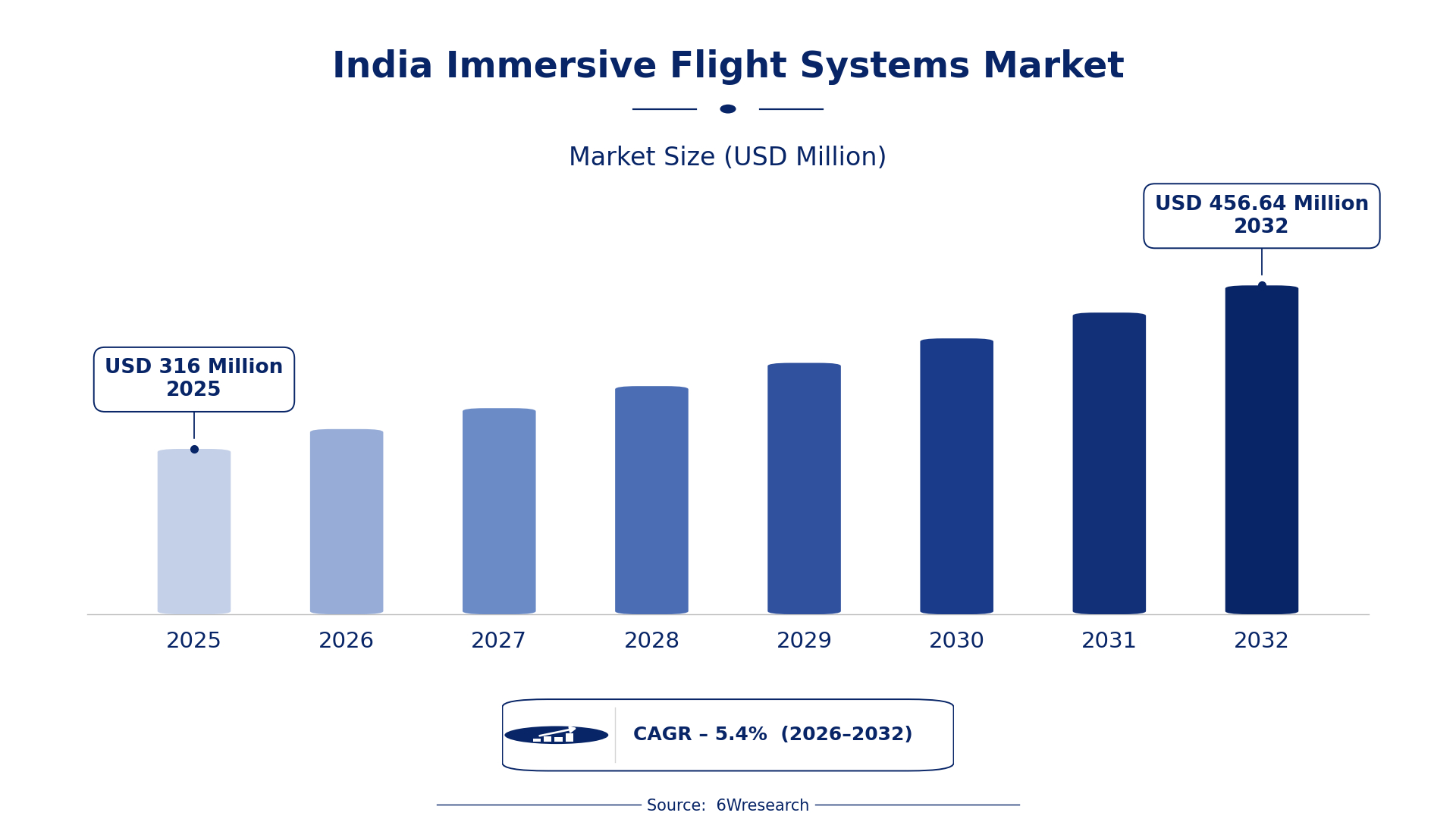
According to 6Wresearch internal database and industry insights, the India Immersive Flight Systems Market was valued at USD 316.0 million in 2025 and is projected to reach USD 456.64 million by 2032, growing at a CAGR of approximately 5.4% during 2026–2032.
India Immersive Flight Systems Market Highlights
| Report Metric | Details |
| Report Name | India Immersive Flight Systems Market |
| Market Size 2025 | USD 316.0 million |
| Market Size 2032 | USD 456.64 million |
| Absolute Growth 2025–2032 | USD 140.64 million |
| CAGR 2026–2032 | 5.4% |
| Peak Annual Growth | 7.7% in 2031 |
| Forecast Period | 2026–2032 |
| Historical Data | 2022–2025 |
| Base Year | 2025 |
| Leading System Type, 2025 | Virtual Cockpit (51% share) |
| Leading Application Level, 2025 | Flight Simulation (41% share) |
| Leading Integration Mode, 2025 | VR/AR Interfaces (47% share) |
| Leading End User, 2025 | Flight Schools (51% share) |
| Fastest-Growing System Type | AR Heads-Up Display (6.7% CAGR) |
| Fastest-Growing Application Level | Navigation Aid (6.9% CAGR) |
| Fastest-Growing Integration Mode | HUD Integration (8.1% CAGR) |
| Fastest-Growing End User | Aircraft OEMs (6.7% CAGR) |
| Growing Sector | Navigation Aid |
| Key End Users | Flight Simulation, Navigation Aid, Situational Awareness, Pilot Interaction |
India Immersive Flight Systems Market Year-wise Growth Rate and Key Drivers (2022–2032)
This graph illustrates the annual growth rates of the market from 2022 to 2032, highlighting a steady upward trajectory and projected market expansion over the forecast period.
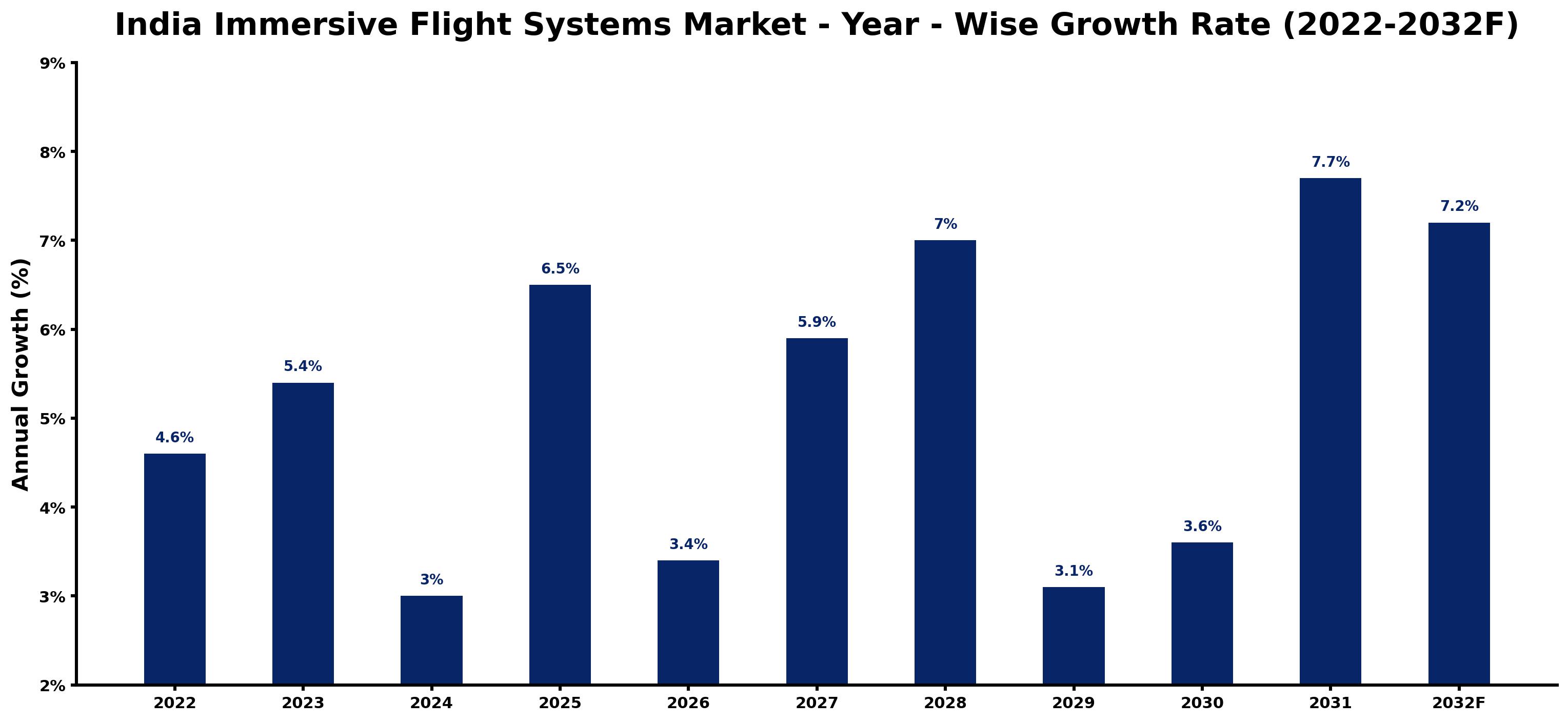
The table below sets out the estimated growth rate for each year and the main factor behind it.
| Year | Estimated Annual Growth (%) | Market Rationale |
| 2022 | 4.6 | The market experienced steady growth due to increased adoption of immersive technologies in training programmes. |
| 2023 | 5.4 | Demand rose as the Indian military expanded its investment in advanced flight simulation technologies. |
| 2024 | 3.0 | Growth slowed as the market adjusted to new regulatory guidelines affecting flight simulation devices. |
| 2025 | 6.5 | The market peaked as flight schools upgraded their training capabilities with immersive systems. |
| 2026 | 3.4 | Demand moderated as some flight schools faced budget constraints for system upgrades. |
| 2027 | 5.9 | Growth accelerated as more flight schools integrated immersive technologies into their curricula. |
| 2028 | 7.0 | The market continued to expand due to rising pilot training needs across various sectors. |
| 2029 | 3.1 | Growth decelerated slightly as military demand fluctuated, impacting overall revenue streams. |
| 2030 | 3.6 | Demand increased again as flight schools sought to improve training effectiveness. |
| 2031 | 7.7 | The market peaked due to heightened investment in immersive systems by both military and civilian sectors. |
| 2032 | 7.2 | Growth is expected to slow as the market stabilises, reflecting a mature adoption phase of immersive technologies. |
Note: Market size estimations and growth projections presented in this report are based on 6Wresearch's proprietary forecasting methodology, utilizing the latest available industry data, government publications, and primary research inputs.
India Immersive Flight Systems Market Synopsis
Immersive Flight Systems represent advanced simulation technologies that integrate virtual and augmented reality to improve pilot training in India. With over 200 flight schools utilising these systems, demand is driven by military investments and the National Civil Aviation Policy, which promotes simulation technologies. The India Immersive Flight Systems Market is growing as the aviation sector aims to train over 1,000 pilots annually, reflecting a strong need for effective training solutions.
Market Dynamics Impact Analysis (2026–2032)
| Factor | Type | Impact | Primary Segment Affected |
| Increased investment in flight simulation technologies by the military | Driver | High | Military Aircraft Trainers |
| Growing number of flight schools adopting immersive systems | Driver | High | Flight Schools |
| Rising demand for situational awareness technologies | Opportunity | Medium | AR Heads-Up Display |
| Expansion of pilot training programmes across India | Opportunity | Medium | Flight Simulation |
| Regulatory hurdles delaying technology adoption | Restraint | High | Flight Simulation |
| High initial investment costs for immersive systems | Restraint | Medium | VR/AR Interfaces |
| Technological obsolescence requiring frequent updates | Challenge | High | Virtual Cockpit |
| Fluctuating military demand affecting revenue predictability | Challenge | Medium | Military Aircraft Trainers |
Evaluation of Drivers in India Immersive Flight Systems Market (2026–2032)
Below mentioned are some major drivers and their influence on market dynamics.
| Drivers | Primary Segment Affected | Why It Matters (Evidence) |
| Increased military investment in flight simulation technologies | Military Aircraft Trainers | This investment of over INR 1 billion enhances training capabilities, leading to higher demand for immersive systems. |
| Growing number of flight schools adopting immersive systems | Flight Schools | With over 200 flight schools in India, the demand for effective training solutions is rising. |
| Expansion of pilot training programmes across India | Flight Simulation | The aviation sector's need to train over 1,000 pilots annually drives demand for immersive technologies. |
| Rising demand for situational awareness technologies | AR Heads-Up Display | As the market grows, flight schools are increasingly integrating AR technologies for improved training. |
| Support from the National Civil Aviation Policy for simulation technologies | Flight Simulation | This policy encourages flight schools to adopt advanced training solutions, boosting market growth. |
The Indian military has invested over INR 1 billion in advanced flight simulation technologies, improving training capabilities and driving demand. Over 200 flight schools are adopting immersive systems to enhance training effectiveness, reflecting a strong market need. The aviation sector is expected to train over 1,000 pilots annually using these technologies, further contributing to market growth.
Evaluation of Restraints in India Immersive Flight Systems Market
The key brakes on demand, and where they bite hardest, are shown below.
| Market Restraint | Primary Segment Affected | Why It Matters (Evidence) |
| Regulatory hurdles delaying technology adoption | Flight Simulation | New guidelines from the Directorate General of Civil Aviation can prolong certification processes by up to six months. |
| High initial investment costs for immersive systems | VR/AR Interfaces | The initial investment for immersive systems can exceed INR 5 million, deterring smaller flight schools. |
| Limited awareness of advanced simulation technologies | Flight Schools | Some flight schools may not fully understand the benefits of immersive systems, hindering adoption. |
| Technological obsolescence requiring frequent updates | Virtual Cockpit | Rapid advancements in simulation technologies lead to obsolescence within two to three years. |
| Fluctuating military demand affecting revenue predictability | Military Aircraft Trainers | Unpredictable military demand can complicate financial planning for suppliers. |
India Immersive Flight Systems Market Challenges
Buyers and suppliers in the India Immersive Flight Systems Market face notable regulatory challenges, as new guidelines from the Directorate General of Civil Aviation can postpone the adoption of advanced simulation technologies by up to six months. This affects flight schools' ability to train pilots efficiently, potentially leading to shortages of skilled personnel. Cost remains a major hurdle, with initial investments for immersive systems surpassing INR 5 million, deterring smaller flight schools from upgrading their training capabilities. Technological challenges persist, as rapid advancements can make systems obsolete within two to three years, forcing buyers to frequently invest in updates and straining their budgets.
Trends in the India Immersive Flight Systems Market
The trends below show where the India Immersive Flight Systems Market is heading.
- Shift from Traditional to Immersive Training: India is moving away from traditional flight training methods towards immersive training solutions. This shift is reflected in flight schools adopting advanced simulation technologies, with over 200 institutions now using immersive systems.
- Growing Adoption of AR Technologies: The incorporation of AR technologies in flight training is becoming increasingly common in India. The AR Heads-Up Display market is expanding due to heightened demand for improved situational awareness during flight operations.
- Increased Focus on Pilot Training Efficiency: Flight schools are placing greater emphasis on training efficiency by adopting immersive flight systems. The National Civil Aviation Policy supports this trend, aiming to enhance training outcomes for over 1,000 pilots annually.
- Expansion of Military Training Capabilities: The Indian military is broadening its training capabilities through immersive flight systems. Since 2021, the Indian Air Force has embraced these technologies to refine pilot training methodologies.
Investment Opportunities in the India Immersive Flight Systems Market
Investors looking at the India Immersive Flight Systems Market should consider the following areas.
- Flight Schools Seeking Advanced Training Solutions: With over 200 flight schools in India, there is a rising demand for immersive flight systems. Investing in partnerships with these institutions can facilitate the provision of advanced training technologies.
- Joint Ventures for System Integration: Forming joint ventures with local flight schools can promote the adoption of immersive systems. This strategy allows suppliers to effectively navigate regulatory challenges while addressing market demand.
- Supply of AR Heads-Up Display Technologies: The increasing demand for situational awareness technologies presents an opportunity to supply AR Heads-Up Display systems. Targeting military and civilian training facilities can yield substantial returns.
- Investment in Simulation Technology Development: Investing in the development of simulation technologies can address the needs of the aviation sector. Collaborating with the Ministry of Civil Aviation can provide access to funding and support.
Government Initiatives in the India Immersive Flight Systems Market
The National Aviation Policy, introduced by the Ministry of Civil Aviation in 2021, promotes the adoption of advanced training technologies in the aviation sector. This policy encourages flight schools to integrate immersive flight systems, improving pilot training efficiency. In 2022, the Directorate General of Civil Aviation revised the Civil Aviation Requirements to include standards for flight simulation devices, ensuring these technologies meet safety and operational benchmarks. The Aviation Skill Development Program, launched in 2023, aims to enhance pilot training through immersive technologies, targeting an increase in skilled personnel within the industry. These initiatives support the growth of the immersive flight systems market in India.
The Directorate General of Civil Aviation is tasked with approving flight simulation training devices and ensuring compliance with the latest standards. Additionally, the Ministry of Defence oversees the Defence Acquisition Procedure, which includes funding for advanced simulation systems used in military training. The Aerospace Simulation Center, established by the Indian Air Force in 2022, focuses on developing new training methodologies. These agencies play a crucial role in facilitating the integration of immersive flight systems, advancing pilot training across both civilian and military sectors.
Future Insight of the India Immersive Flight Systems Market
Several forward-looking factors should support the India Immersive Flight Systems Market over the coming years. The National Civil Aviation Policy will continue to advocate for the integration of simulation technologies, improving training efficiency across the sector. By 2032, the Indian aviation sector aims to train over 1,200 pilots annually using immersive technologies, significantly increasing demand for advanced training solutions. The 'Skill India' initiative will bolster aviation training capabilities, ensuring a skilled workforce, while military investments will drive innovation and broader adoption of these systems.
Market Segmentation Analysis
Each segment group is reviewed below, with the leader by share and the fastest grower by CAGR.
By System Type – Virtual Cockpit Dominated, AR Heads-Up Display Expected to Grow Fastest
According to Sachin Kumar Rai, Senior Research Analyst at 6Wresearch, the largest system type category in 2025 was Virtual Cockpit, with a 51% share of total revenue. Virtual Cockpit systems dominate the market share in India, primarily due to their use in over 200 flight schools that rely on these systems for effective pilot training. This extensive adoption highlights their importance in enhancing the quality of aviation education across the country. The quickest growth will come from AR Heads-Up Display, forecast to expand at a CAGR of 6.7% between 2026 and 2032. The AR Heads-Up Display segment is experiencing rapid growth as it significantly enhances pilot situational awareness, which is increasingly recognised as vital for aviation safety. With rising investments in advanced simulation technologies, this segment is poised for continued expansion. Suppliers should focus on developing AR technologies to meet the growing demand from flight schools and military training initiatives.
By Application Level – Flight Simulation Dominated, Navigation Aid Expected to Grow Fastest
Flight Simulation accounted for a 41% market share by application level in 2025. Flight Simulation holds the largest market share as it is crucial for pilot training and skill development, with substantial investments from the Indian military in these systems. This application remains a cornerstone of aviation training efforts nationwide, ensuring its continued prominence. Over 2026–2032, Navigation Aid is expected to post the fastest growth, at a CAGR of 6.9%. The Navigation Aid segment is growing swiftly as it aids pilots in operational tasks, complementing the main focus of immersive systems. With the aviation sector aiming to train over 1,000 pilots annually, the demand for navigation aids is set to rise significantly. Buyers should integrate advanced navigation aids to enhance training outcomes and improve operational efficiency.
By Integration Mode – VR/AR Interfaces Dominated, HUD Integration Expected to Grow Fastest
With a 47% revenue share in 2025, VR/AR Interfaces was the largest integration mode category. VR/AR Interfaces lead the market share due to their fundamental role in creating immersive training experiences for pilots. Their widespread adoption in flight schools ensures a steady demand for VR/AR solutions within the aviation sector. HUD Integration is set to record the highest CAGR in this split, 8.1% over 2026–2032. HUD Integration is gaining traction as it delivers essential real-time flight data, crucial for pilot performance. The increasing focus on situational awareness in aviation training is driving the growth of this segment. Suppliers should prioritise HUD integration technologies to align with the evolving needs of flight training programmes.
By End User – Flight Schools Dominated, Aircraft OEMs Expected to Grow Fastest
Flight Schools held a 51% share of the India Immersive Flight Systems Market by end user in 2025. Flight Schools represent the largest market share as they are the primary users of immersive flight systems, extensively utilising them for pilot training. With over 200 flight schools operating in India, this segment's demand remains strong and consistent. Aircraft OEMs are projected to grow fastest, at a CAGR of 6.7% during 2026–2032. Aircraft OEMs are witnessing the fastest growth as they increasingly adopt immersive systems for design and testing, although they are not the main users. This trend underscores the broader integration of simulation technologies in aircraft development processes. Buyers should explore partnerships with aircraft OEMs to leverage immersive systems for enhanced training and operational capabilities.
Key Attractiveness of the Report
- 10 Years of Market Numbers
- Historical Data Starting from 2022 to 2025
- Base Year 2025
- Forecast Data until 2032
- Key Performance Indicators Impacting the Market
- Major Upcoming Developments and Projects
Key Highlights of the Report:
- India Immersive Flight Systems Market Outlook
- Market Size of India Immersive Flight Systems Market, 2025
- Forecast of India Immersive Flight Systems Market, 2032
- Historical Data and Forecast of India Immersive Flight Systems Revenues & Volume for the Period 2022 - 2032F
- India Immersive Flight Systems Market Trend Evolution
- India Immersive Flight Systems Market Drivers and Challenges
- India Immersive Flight Systems Price Trends
- India Immersive Flight Systems Porter's Five Forces
- India Immersive Flight Systems Industry Life Cycle
- Historical Data and Forecast of India Immersive Flight Systems Market Revenues & Volume By System Type for the Period 2022 - 2032F
- Historical Data and Forecast of India Immersive Flight Systems Market Revenues & Volume By Virtual Cockpit for the Period 2022 - 2032F
- Historical Data and Forecast of India Immersive Flight Systems Market Revenues & Volume By AR Heads-Up Display for the Period 2022 - 2032F
- Historical Data and Forecast of India Immersive Flight Systems Market Revenues & Volume By 3D Flight Visualization for the Period 2022 - 2032F
- Historical Data and Forecast of India Immersive Flight Systems Market Revenues & Volume By Gesture-Controlled UI for the Period 2022 - 2032F
- Historical Data and Forecast of India Immersive Flight Systems Market Revenues & Volume By Application Level for the Period 2022 - 2032F
- Historical Data and Forecast of India Immersive Flight Systems Market Revenues & Volume By Flight Simulation for the Period 2022 - 2032F
- Historical Data and Forecast of India Immersive Flight Systems Market Revenues & Volume By Navigation Aid for the Period 2022 - 2032F
- Historical Data and Forecast of India Immersive Flight Systems Market Revenues & Volume By Situational Awareness for the Period 2022 - 2032F
- Historical Data and Forecast of India Immersive Flight Systems Market Revenues & Volume By Pilot Interaction for the Period 2022 - 2032F
- Historical Data and Forecast of India Immersive Flight Systems Market Revenues & Volume By Integration Mode for the Period 2022 - 2032F
- Historical Data and Forecast of India Immersive Flight Systems Market Revenues & Volume By VR/AR Interfaces for the Period 2022 - 2032F
- Historical Data and Forecast of India Immersive Flight Systems Market Revenues & Volume By HUD Integration for the Period 2022 - 2032F
- Historical Data and Forecast of India Immersive Flight Systems Market Revenues & Volume By Mixed Reality Engine for the Period 2022 - 2032F
- Historical Data and Forecast of India Immersive Flight Systems Market Revenues & Volume By Wearable Sensors for the Period 2022 - 2032F
- Historical Data and Forecast of India Immersive Flight Systems Market Revenues & Volume By End User for the Period 2022 - 2032F
- Historical Data and Forecast of India Immersive Flight Systems Market Revenues & Volume By Flight Schools for the Period 2022 - 2032F
- Historical Data and Forecast of India Immersive Flight Systems Market Revenues & Volume By Aircraft OEMs for the Period 2022 - 2032F
- Historical Data and Forecast of India Immersive Flight Systems Market Revenues & Volume By Military Aircraft Trainers for the Period 2022 - 2032F
- Historical Data and Forecast of India Immersive Flight Systems Market Revenues & Volume By Experimental Aviation Labs for the Period 2022 - 2032F
- India Immersive Flight Systems Import Export Trade Statistics
- Market Opportunity Assessment By System Type
- Market Opportunity Assessment By Application Level
- Market Opportunity Assessment By Integration Mode
- Market Opportunity Assessment By End User
- India Immersive Flight Systems Top Companies Market Share
- India Immersive Flight Systems Competitive Benchmarking By Technical and Operational Parameters
- India Immersive Flight Systems Company Profiles
- India Immersive Flight Systems Key Strategic Recommendations
Market Covered
The report offers an extensive study of the following market segments.
By System Type
- Virtual Cockpit
- AR Heads-Up Display
- 3D Flight Visualization
- Gesture-Controlled UI
By Application Level
- Flight Simulation
- Navigation Aid
- Situational Awareness
- Pilot Interaction
By Integration Mode
- VR/AR Interfaces
- HUD Integration
- Mixed Reality Engine
- Wearable Sensors
By End User
- Flight Schools
- Aircraft OEMs
- Military Aircraft Trainers
- Experimental Aviation Labs































