China Immersive Flight Systems Market Size & Growth Rate
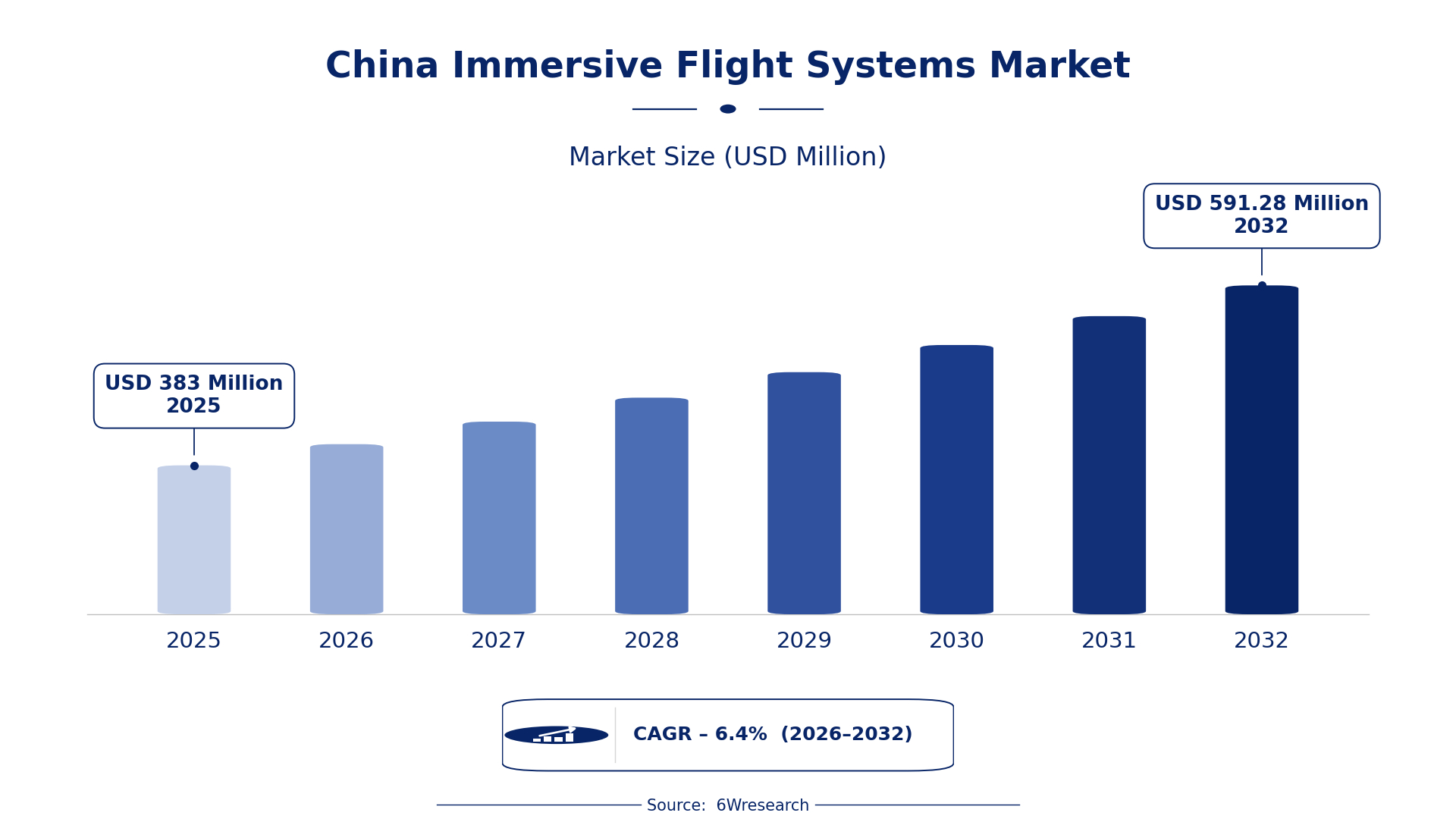
According to 6Wresearch internal database and industry insights, the China Immersive Flight Systems Market was valued at USD 383.0 million in 2025 and is projected to reach USD 591.28 million by 2032, growing at a CAGR of approximately 6.4% during 2026–2032.
China Immersive Flight Systems Market Highlights
| Report Metric | Details |
| Report Name | China Immersive Flight Systems Market |
| Market Size 2025 | USD 383.0 million |
| Market Size 2032 | USD 591.28 million |
| Absolute Growth 2025–2032 | USD 208.28 million |
| CAGR 2026–2032 | 6.4% |
| Peak Annual Growth | 8.4% in 2031 |
| Forecast Period | 2026–2032 |
| Historical Data | 2022–2025 |
| Base Year | 2025 |
| Leading System Type, 2025 | Virtual Cockpit (42% share) |
| Leading Application Level, 2025 | Flight Simulation (49% share) |
| Leading Integration Mode, 2025 | VR/AR Interfaces (44% share) |
| Leading End User, 2025 | Flight Schools (44% share) |
| Fastest-Growing System Type | AR Heads-Up Display (8.7% CAGR) |
| Fastest-Growing Application Level | Navigation Aid (7.6% CAGR) |
| Fastest-Growing Integration Mode | HUD Integration (8.6% CAGR) |
| Fastest-Growing End User | Aircraft OEMs (8.1% CAGR) |
| Growing Sector | Navigation Aid |
| Key End Users | Flight Simulation, Navigation Aid, Situational Awareness, Pilot Interaction |
China Immersive Flight Systems Market Year-wise Growth Rate and Key Drivers (2022–2032)
This graph illustrates the annual growth rates of the market from 2022 to 2032, highlighting a steady upward trajectory and projected market expansion over the forecast period.
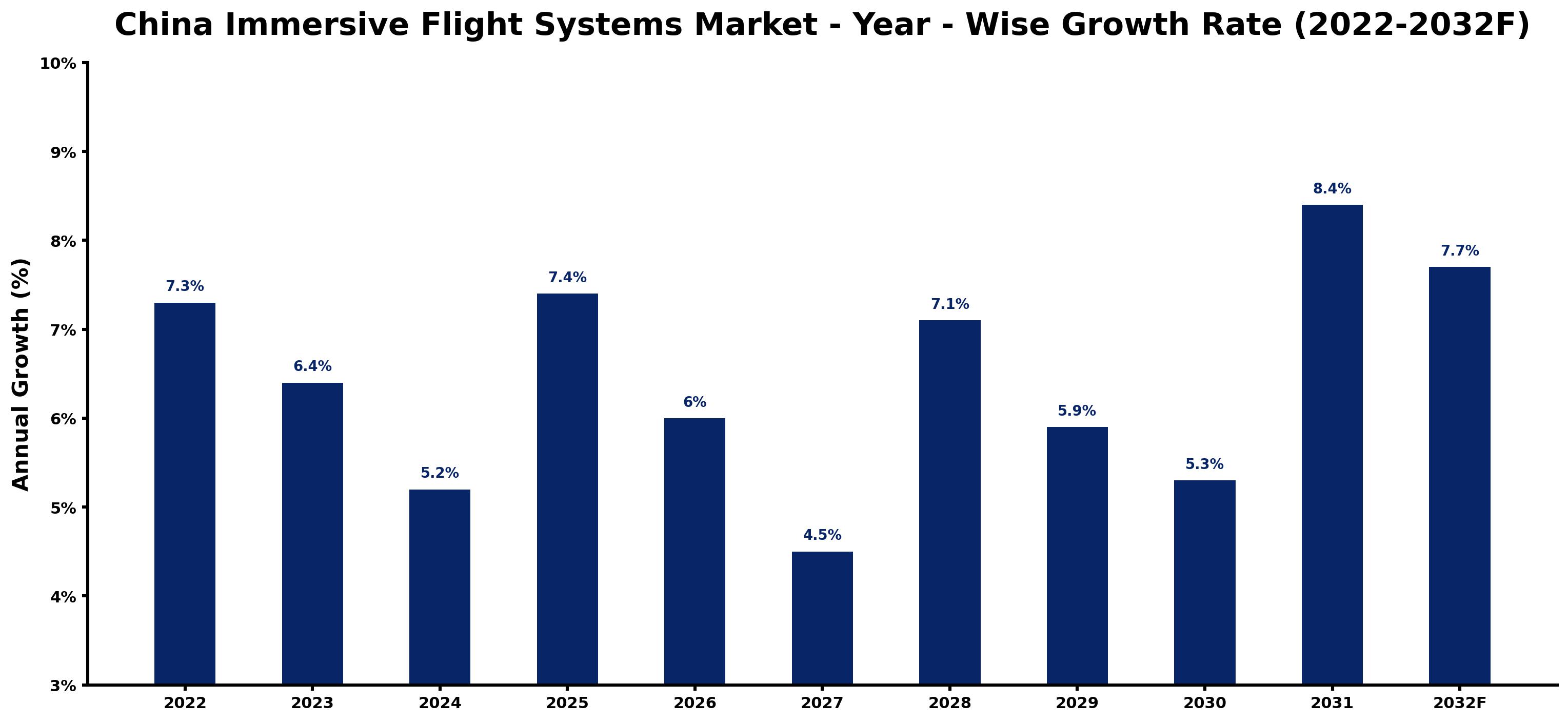
The table below sets out the estimated growth rate for each year and the main factor behind it.
| Year | Estimated Annual Growth (%) | Market Rationale |
| 2022 | 7.3 | The aviation sector showed solid demand for immersive training technologies in this year. |
| 2023 | 6.4 | Growth slowed as flight schools integrated AR technologies into their training programs. |
| 2024 | 5.2 | Demand continued to slow as flight schools adjusted to updated training standards from the Civil Aviation Administration. |
| 2025 | 7.4 | Military training programs expanded their use of immersive systems, particularly in the Beijing-Tianjin-Hebei region. |
| 2026 | 6.0 | The market is expected to see a slowdown as budget constraints affect flight schools' technology investments. |
| 2027 | 4.5 | Demand is projected to slow further as suppliers struggle to meet evolving technology standards in aviation. |
| 2028 | 7.1 | Growth is expected to improve as the aviation sector invests in advanced training technologies and infrastructure. |
| 2029 | 5.9 | The market is projected to slow again as military budgets face scrutiny amid economic challenges. |
| 2030 | 5.3 | Growth is expected to remain sluggish as flight schools adapt to new regulations from the National Aviation Administration. |
| 2031 | 8.4 | Demand is projected to surge as military investments in immersive training systems increase pilot readiness. |
| 2032 | 7.7 | Growth is expected to slow as the Aerospace Innovation Strategy drives compliance with new training standards. |
Note: Market size estimations and growth projections presented in this report are based on 6Wresearch's proprietary forecasting methodology, utilizing the latest available industry data, government publications, and primary research inputs.
China Immersive Flight Systems Market Synopsis
Immersive Flight Systems in China incorporate advanced technologies such as virtual and augmented reality to create realistic flight simulations. These systems play a crucial role in pilot training, navigation support, and improving situational awareness. The China Immersive Flight Systems Market is expanding due to strong demand from flight schools and military training programmes. Ongoing investments in advanced training technologies and infrastructure within the aviation sector are propelling this growth. With over 200 flight schools actively using these systems, further market expansion is anticipated in the coming years.
Market Dynamics Impact Analysis (2026–2032)
| Factor | Type | Impact | Primary Segment Affected |
| Growing demand from flight schools for advanced training solutions | Driver | High | Flight Simulation |
| Increased military investment in immersive training technologies | Driver | High | Military Aircraft Trainers |
| Rising demand for AR technologies in military training | Opportunity | High | Military Aircraft Trainers |
| Expansion of flight schools in urban areas | Opportunity | Medium | Flight Schools |
| Budget constraints faced by flight schools impacting technology adoption | Restraint | High | Flight Schools |
| Competition among suppliers leading to pricing pressures | Restraint | Medium | Military Aircraft Trainers |
| Flight schools facing delays in technology integration | Challenge | High | Flight Schools |
| Regulatory changes requiring updates to training systems | Challenge | Medium | Military Aircraft Trainers |
Evaluation of Drivers in China Immersive Flight Systems Market (2026–2032)
Key forces behind demand, with the segment each one moves most, are listed below.
| Drivers | Primary Segment Affected | Why It Matters (Evidence) |
| Increased funding for aviation training infrastructure | Flight Schools | The Chinese government allocated 500 million RMB to enhance aviation training infrastructure, boosting investment in immersive systems. |
| Growing military adoption of AR technologies | Military Aircraft Trainers | The military aviation sector has integrated AR technologies in training programs since 2021, driving demand for immersive flight systems. |
| Expansion of flight schools across urban regions | Flight Schools | The increasing number of training facilities in urban areas boosts demand for advanced simulation technologies. |
| Support from the National Aviation Administration | Flight Simulation | The National Aviation Administration promotes advanced simulation technologies, encouraging flight schools to adopt immersive flight systems for training. |
| Technological advancements in immersive systems | AR Heads-Up Display | Innovations in AR technologies improve situational awareness, creating demand among flight schools and military trainers. |
The military's adoption of AR technologies since 2021 has driven demand for immersive systems in military aircraft training. Expansion of flight schools across urban regions increases the need for advanced simulation technologies. Support from the National Aviation Administration promotes these technologies, while innovations in AR improve situational awareness, resulting in higher purchases from flight schools and military trainers alike.
Evaluation of Restraints in China Immersive Flight Systems Market
The main factors holding the market back are set out below.
| Market Restraint | Primary Segment Affected | Why It Matters (Evidence) |
| Budget constraints limiting technology upgrades in flight schools | Flight Schools | Flight schools face budget limitations that hinder their ability to invest in new immersive flight systems. |
| Supplier competition leading to pricing pressures | Military Aircraft Trainers | Increased competition among suppliers results in pricing pressures, affecting profit margins for military training systems. |
| Integration delays due to evolving technology standards | Flight Schools | Flight schools experience delays in integrating new technologies, impacting their training efficiency. |
| Regulatory changes requiring compliance updates | Military Aircraft Trainers | Changes in regulations necessitate updates to training systems, causing delays in implementation for military trainers. |
| Limited awareness of immersive technologies among smaller flight schools | Flight Schools | Smaller flight schools may lack awareness of the benefits of immersive technologies, affecting their adoption rates. |
China Immersive Flight Systems Market Challenges
In the China Immersive Flight Systems market, rising costs present a notable challenge for flight schools and military programs. The integration of advanced virtual and augmented reality technologies can consume up to 30% of a training budget, which limits funding for essential upgrades. Outdated infrastructure hampers technology adoption, causing delays in pilot training effectiveness for educational institutions. A lack of qualified professionals to operate and maintain these complex systems creates operational bottlenecks, affecting the efficiency of training programs. Increased competition among flight schools drives price wars, which can squeeze profit margins for suppliers.
Trends in the China Immersive Flight Systems Market
Below mentioned are some of the trends shaping the China Immersive Flight Systems Market growth.
- Shift towards AR technologies in military training: The military sector is increasingly adopting AR technologies for training purposes, which enhances pilot readiness. Since 2021, military training programmes have integrated AR systems, reflecting a growing trend towards immersive technologies.
- Transition from traditional to immersive training methods: Flight schools are transitioning from traditional training methods to immersive systems, which improves training effectiveness. In 2023, over 200 flight schools in China adopted immersive flight systems, highlighting this shift.
- Emergence of advanced simulation standards: The Civil Aviation Administration of China updated standards for flight simulation training devices in 2023, promoting the use of immersive technologies. This change encourages flight schools to enhance their training programmes.
- Focus on improving situational awareness in aviation: AR technologies are prioritised for enhancing situational awareness in aviation training. The National Aviation Administration's initiatives support the integration of AR in pilot training, reflecting this trend.
Investment Opportunities in the China Immersive Flight Systems Market
Investors looking at the China Immersive Flight Systems Market should consider the following areas.
- Partner with flight schools for immersive systems: With over 200 flight schools in China, there is a strong demand for immersive flight systems. Collaborating with these institutions can lead to substantial market entry opportunities.
- Supply advanced AR training technologies: The military's increasing investment in AR technologies presents an opportunity to provide advanced training solutions. Engaging with military aircraft trainers can facilitate market entry.
- Invest in Guangdong province's aerospace sector: The Guangdong province is a hub for aircraft manufacturing, creating demand for immersive flight systems. Establishing partnerships with local manufacturers can enhance market presence.
- Focus on regulatory compliance solutions: As regulations evolve, flight schools will require compliant immersive systems. Offering solutions that meet the latest standards can position suppliers advantageously.
Government Initiatives in the China Immersive Flight Systems Market
The Civil Aviation Administration of China initiated the 'Aviation Training Technology Development Plan' in 2021, aiming to improve pilot training through advanced technologies. This plan encourages flight schools to adopt immersive flight systems, enhancing the quality of pilot education. In 2022, the Ministry of Industry and Information Technology launched the 'Smart Aviation Initiative', promoting the integration of immersive technologies in aviation training. The National Development and Reform Commission approved the 'Aerospace Innovation Strategy' in 2023, focusing on incorporating AR/VR in aviation education to improve training effectiveness. These measures aim to modernise training practices and improve the capabilities of aviation professionals in China.
In 2023, the State Administration for Science, Technology and Industry for National Defense allocated a budget of 500 million RMB to support military training innovations, including immersive flight systems. This funding is intended to enhance the training effectiveness of military pilots through advanced technologies. The Ministry of Education's 'Aviation Training Enhancement Program' has been operational since 2020, encouraging flight schools to implement immersive systems in their curricula. These initiatives are designed to ensure that both military and civilian aviation sectors benefit from cutting-edge training methodologies, ultimately leading to improved pilot readiness and operational efficiency.
Future Insight of the China Immersive Flight Systems Market
Several forward-looking factors should support the China Immersive Flight Systems market by 2032. Government investments in aviation training infrastructure will enable broader adoption of immersive technologies across various training platforms. The National Aviation Administration's new standards will mandate AR/VR technologies in pilot training, fostering a more skilled workforce. Military initiatives to incorporate virtual reality systems will further boost demand for advanced training solutions. The Guangdong province's focus on aircraft manufacturing will drive the integration of immersive flight systems, improving operational capabilities.
Market Segmentation Analysis
The analysis below covers each segmentation, its leading category in 2025 and its fastest-growing category through 2032.
By System Type – Virtual Cockpit Dominated, AR Heads-Up Display Expected to Grow Fastest
According to Sachin Kumar Rai, Senior Research Analyst at 6Wresearch, Virtual Cockpit held a 42% share of the China Immersive Flight Systems Market by system type in 2025. The Virtual Cockpit segment holds the largest share in China due to its essential role in over 200 flight schools, offering a realistic flight experience vital for effective pilot training. This extensive utilisation ensures a consistent demand for immersive flight systems within the aviation education framework. AR Heads-Up Display is set to record the highest CAGR in this split, 8.7% over 2026–2032. The AR Heads-Up Display is witnessing rapid growth as it directly enhances situational awareness by displaying critical flight data in the pilot's line of sight. Its adoption has accelerated following the CAAC's 2023 regulations that incorporate AR/VR technologies, indicating a promising growth trajectory. Suppliers should focus on developing advanced AR technologies to cater to the increasing demand from flight schools and military training programmes.
By Application Level – Flight Simulation Dominated, Navigation Aid Expected to Grow Fastest
In 2025, Flight Simulation led the application level split with a 49% share. Flight Simulation commands the largest market share because it is essential for pilot training and skill development, supported by the National Aviation Administration of China's promotion of advanced simulation technologies. This critical function in aviation training solidifies its position as a key component in the immersive flight systems market. Over 2026–2032, Navigation Aid is expected to post the fastest growth, at a CAGR of 7.6%. The Navigation Aid application is rapidly growing as it supports pilots in real-time navigation tasks, which are increasingly vital given the complexities of modern aviation. The emphasis on enhancing pilot readiness through immersive technologies is further driving this growth. Buyers should invest in navigation aid technologies to improve operational efficiency and safety in aviation.
By Integration Mode – VR/AR Interfaces Dominated, HUD Integration Expected to Grow Fastest
VR/AR Interfaces took a 44% share of integration mode in 2025, more than any other category. VR/AR Interfaces lead the market due to their integral role in providing immersive training experiences, allowing pilots to engage effectively with realistic simulations. This widespread adoption across flight schools and military programmes ensures a steady demand for these interfaces. HUD Integration is projected to grow fastest, at a CAGR of 8.6% during 2026–2032. HUD Integration is advancing swiftly, offering pilots real-time data without distraction, which is crucial for maintaining focus during flight operations. Continuous investments in training infrastructure are driving faster adoption rates of this integration mode. Suppliers must innovate in HUD technologies to address the growing need for seamless integration in aviation training.
By End User – Flight Schools Dominated, Aircraft OEMs Expected to Grow Fastest
With a 44% revenue share in 2025, Flight Schools was the largest end user category. Flight Schools account for the largest share as they are key users for training new pilots, with over 200 institutions actively employing immersive flight systems. This extensive network of flight schools generates a strong demand for advanced training technologies. The quickest growth will come from Aircraft OEMs, forecast to expand at a CAGR of 8.1% between 2026 and 2032. Aircraft OEMs are experiencing the fastest growth as they incorporate immersive flight systems into new aircraft designs, responding to the increasing complexity of aviation technology. This trend is expected to accelerate as the aviation industry continues to evolve. Suppliers should align their offerings with the requirements of aircraft OEMs to capitalise on this expanding market segment.
Key Attractiveness of the Report
- 10 Years of Market Numbers
- Historical Data Starting from 2022 to 2025
- Base Year 2025
- Forecast Data until 2032
- Key Performance Indicators Impacting the Market
- Major Upcoming Developments and Projects
Key Highlights of the Report:
- China Immersive Flight Systems Market Outlook
- Market Size of China Immersive Flight Systems Market, 2025
- Forecast of China Immersive Flight Systems Market, 2032
- Historical Data and Forecast of China Immersive Flight Systems Revenues & Volume for the Period 2022 - 2032F
- China Immersive Flight Systems Market Trend Evolution
- China Immersive Flight Systems Market Drivers and Challenges
- China Immersive Flight Systems Price Trends
- China Immersive Flight Systems Porter's Five Forces
- China Immersive Flight Systems Industry Life Cycle
- Historical Data and Forecast of China Immersive Flight Systems Market Revenues & Volume By System Type for the Period 2022 - 2032F
- Historical Data and Forecast of China Immersive Flight Systems Market Revenues & Volume By Virtual Cockpit for the Period 2022 - 2032F
- Historical Data and Forecast of China Immersive Flight Systems Market Revenues & Volume By AR Heads-Up Display for the Period 2022 - 2032F
- Historical Data and Forecast of China Immersive Flight Systems Market Revenues & Volume By 3D Flight Visualization for the Period 2022 - 2032F
- Historical Data and Forecast of China Immersive Flight Systems Market Revenues & Volume By Gesture-Controlled UI for the Period 2022 - 2032F
- Historical Data and Forecast of China Immersive Flight Systems Market Revenues & Volume By Application Level for the Period 2022 - 2032F
- Historical Data and Forecast of China Immersive Flight Systems Market Revenues & Volume By Flight Simulation for the Period 2022 - 2032F
- Historical Data and Forecast of China Immersive Flight Systems Market Revenues & Volume By Navigation Aid for the Period 2022 - 2032F
- Historical Data and Forecast of China Immersive Flight Systems Market Revenues & Volume By Situational Awareness for the Period 2022 - 2032F
- Historical Data and Forecast of China Immersive Flight Systems Market Revenues & Volume By Pilot Interaction for the Period 2022 - 2032F
- Historical Data and Forecast of China Immersive Flight Systems Market Revenues & Volume By Integration Mode for the Period 2022 - 2032F
- Historical Data and Forecast of China Immersive Flight Systems Market Revenues & Volume By VR/AR Interfaces for the Period 2022 - 2032F
- Historical Data and Forecast of China Immersive Flight Systems Market Revenues & Volume By HUD Integration for the Period 2022 - 2032F
- Historical Data and Forecast of China Immersive Flight Systems Market Revenues & Volume By Mixed Reality Engine for the Period 2022 - 2032F
- Historical Data and Forecast of China Immersive Flight Systems Market Revenues & Volume By Wearable Sensors for the Period 2022 - 2032F
- Historical Data and Forecast of China Immersive Flight Systems Market Revenues & Volume By End User for the Period 2022 - 2032F
- Historical Data and Forecast of China Immersive Flight Systems Market Revenues & Volume By Flight Schools for the Period 2022 - 2032F
- Historical Data and Forecast of China Immersive Flight Systems Market Revenues & Volume By Aircraft OEMs for the Period 2022 - 2032F
- Historical Data and Forecast of China Immersive Flight Systems Market Revenues & Volume By Military Aircraft Trainers for the Period 2022 - 2032F
- Historical Data and Forecast of China Immersive Flight Systems Market Revenues & Volume By Experimental Aviation Labs for the Period 2022 - 2032F
- China Immersive Flight Systems Import Export Trade Statistics
- Market Opportunity Assessment By System Type
- Market Opportunity Assessment By Application Level
- Market Opportunity Assessment By Integration Mode
- Market Opportunity Assessment By End User
- China Immersive Flight Systems Top Companies Market Share
- China Immersive Flight Systems Competitive Benchmarking By Technical and Operational Parameters
- China Immersive Flight Systems Company Profiles
- China Immersive Flight Systems Key Strategic Recommendations
Market Covered
This report examines the market across the segments below.
By System Type
- Virtual Cockpit
- AR Heads-Up Display
- 3D Flight Visualization
- Gesture-Controlled UI
By Application Level
- Flight Simulation
- Navigation Aid
- Situational Awareness
- Pilot Interaction
By Integration Mode
- VR/AR Interfaces
- HUD Integration
- Mixed Reality Engine
- Wearable Sensors
By End User
- Flight Schools
- Aircraft OEMs
- Military Aircraft Trainers
- Experimental Aviation Labs































