India Immunologic Disorders Market Size & Growth Rate
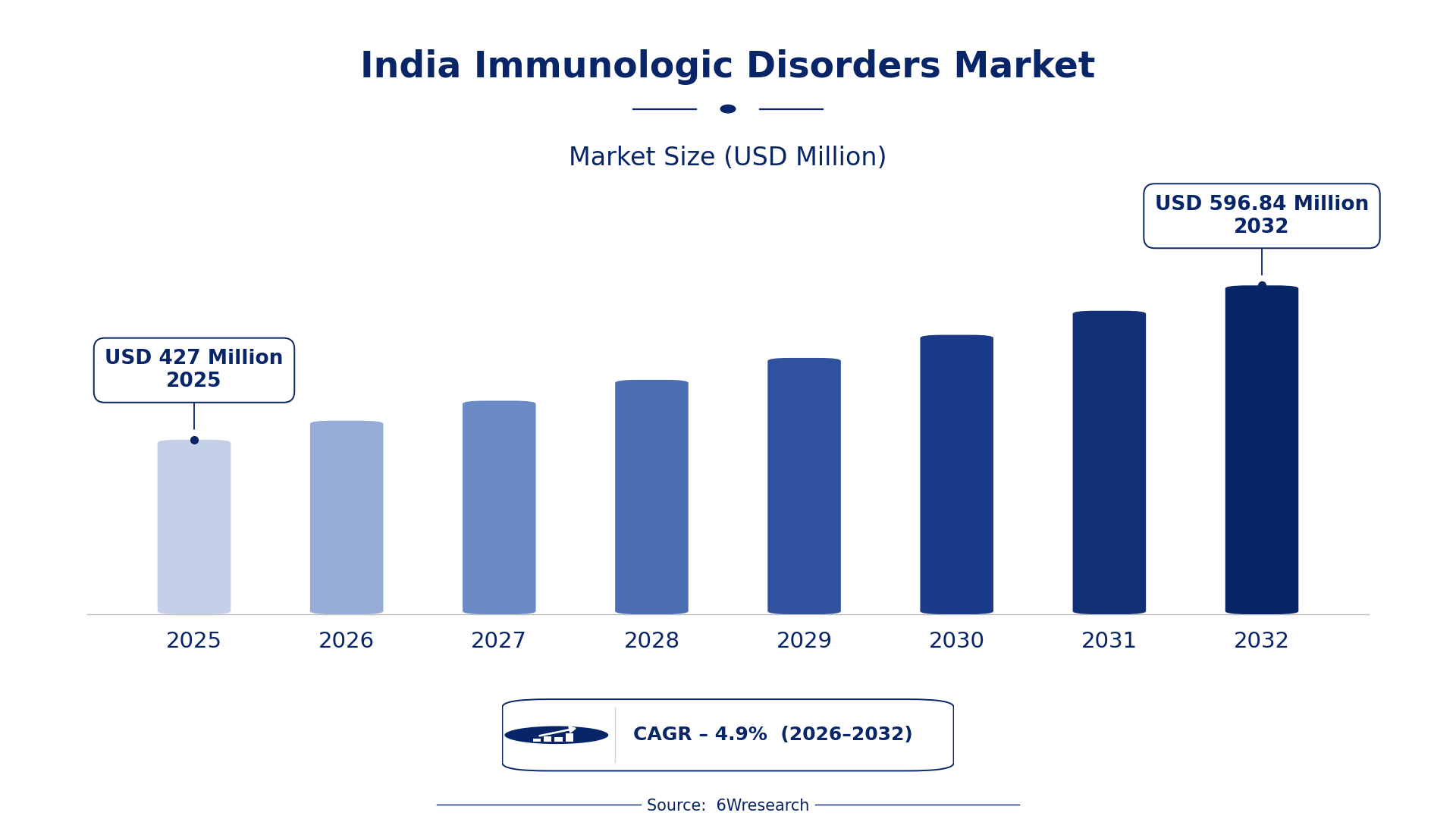
According to 6Wresearch internal database and industry insights, the India Immunologic Disorders Market was valued at USD 427.0 million in 2025 and is projected to reach USD 596.84 million by 2032, growing at a CAGR of approximately 4.9% during 2026–2032.
India Immunologic Disorders Market Highlights
| Report Metric | Details |
| Report Name | India Immunologic Disorders Market |
| Market Size 2025 | USD 427.0 million |
| Market Size 2032 | USD 596.84 million |
| Absolute Growth 2025–2032 | USD 169.84 million |
| CAGR 2026–2032 | 4.9% |
| Peak Annual Growth | 6.8% in 2026 |
| Forecast Period | 2026–2032 |
| Historical Data | 2022–2025 |
| Base Year | 2025 |
| Leading Disorder Category, 2025 | Autoimmune Disorders (43% share) |
| Leading Pathophysiology, 2025 | Overactive Immune System (46% share) |
| Leading Treatment Modality, 2025 | Immunosuppressive Therapy (44% share) |
| Leading End User, 2025 | Rheumatology Clinics (45% share) |
| Fastest-Growing Disorder Category | Immunodeficiencies (6.5% CAGR) |
| Fastest-Growing Pathophysiology | Weak/Absent Immune Response (7.5% CAGR) |
| Fastest-Growing Treatment Modality | Immunoglobulin Therapy (7.4% CAGR) |
| Fastest-Growing End User | Rare Disease Clinics (6.6% CAGR) |
| Growing Sector | Immunology |
| Key End Users | Rheumatology Clinics, Rare Disease Clinics, Allergy Specialists, Inpatient Immunology Units |
India Immunologic Disorders Market Year-wise Growth Rate and Key Drivers (2022–2032)
This graph illustrates the annual growth rates of the market from 2022 to 2032, highlighting a steady upward trajectory and projected market expansion over the forecast period.
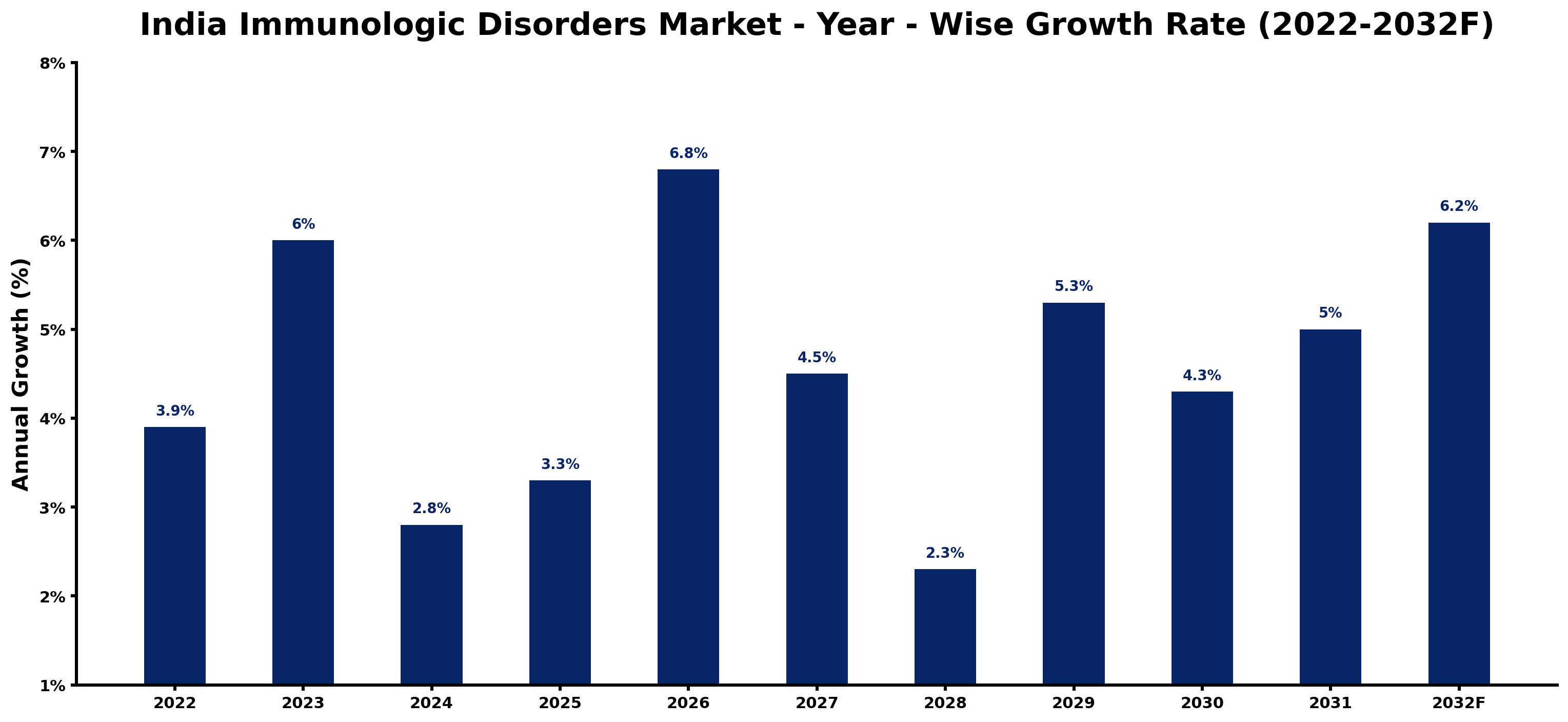
Each row of the following table gives one year's estimated growth and the event or demand shift that explains it.
| Year | Estimated Annual Growth (%) | Market Rationale |
| 2022 | 3.9 | The market showed steady growth, driven by the National Health Mission's awareness campaigns. |
| 2023 | 6.0 | Growth accelerated due to increased funding for immunotherapy research and development. |
| 2024 | 2.8 | The market experienced a slowdown as demand stabilised following previous peaks. |
| 2025 | 3.3 | Growth resumed as healthcare facilities expanded their immunologic disorder services in urban areas. |
| 2026 | 6.8 | The market peaked with advancements in treatment modalities and improved patient access. |
| 2027 | 4.5 | Growth slowed as the market adjusted to new treatment standards and practices. |
| 2028 | 2.3 | Demand continued to slow, reflecting a shift towards preventive care initiatives. |
| 2029 | 5.3 | Growth rebounded as new immunotherapies gained traction among healthcare providers. |
| 2030 | 4.3 | The market experienced another slowdown as competition intensified among treatment providers. |
| 2031 | 5.0 | Growth picked up again, driven by increasing patient populations and new treatment options. |
| 2032 | 6.2 | The market is expected to grow further as awareness and access to therapies improve. |
Note: Market size estimations and growth projections presented in this report are based on 6Wresearch's proprietary forecasting methodology, utilizing the latest available industry data, government publications, and primary research inputs.
India Immunologic Disorders Market Synopsis
The India Immunologic Disorders Market includes conditions that impact the immune system, often requiring targeted treatments. This encompasses autoimmune diseases, immunodeficiencies, and allergic conditions, which necessitate therapies such as immunosuppressive and immunoglobulin treatments. A patient population exceeding 30 million and growing healthcare investments drive demand. National initiatives, including the National Program for Prevention and Control of Cancer, Diabetes, Cardiovascular Diseases & Stroke, further support effective management solutions.
Market Dynamics Impact Analysis (2026–2032)
| Factor | Type | Impact | Primary Segment Affected |
| Rising patient population requiring specialized treatments | Driver | High | Autoimmune Disorders |
| Increased investment in immunotherapy research and development | Driver | High | Immunodeficiencies |
| Growing demand for immunologic therapies in urban healthcare facilities | Opportunity | High | Allergic Conditions |
| Expansion of rheumatology clinics in metropolitan areas | Opportunity | High | Rheumatology Clinics |
| Limited access to advanced therapies in rural regions | Restraint | Medium | Inflammatory Syndromes |
| High costs associated with immunosuppressive therapies | Restraint | High | Immunosuppressive Therapy |
| Challenges in patient access to specialized care | Challenge | High | Rare Disease Clinics |
| Regulatory hurdles in the approval of new therapies | Challenge | Medium | Biologics & Steroids |
Evaluation of Drivers in India Immunologic Disorders Market (2026–2032)
The factors lifting demand, and the evidence behind each, are summarised below.
| Drivers | Primary Segment Affected | Why It Matters (Evidence) |
| Increasing prevalence of autoimmune disorders | Autoimmune Disorders | Over 30 million patients in India require continuous management and treatment. |
| Growth in immunotherapy research funding | Immunodeficiencies | The Department of Biotechnology allocated INR 500 crores to promote immunologic therapies. |
| Rising allergy cases reported across urban areas | Allergic Conditions | The All India Institute of Medical Sciences noted a rise in allergy cases in 2022. |
| Expansion of rheumatology clinics in major cities | Rheumatology Clinics | Concentration in metropolitan areas like Delhi and Mumbai improves patient access to care. |
| National health initiatives promoting immunologic disorder awareness | Inflammatory Syndromes | The National Health Mission's campaigns are increasing public knowledge and treatment-seeking. |
Growth in the Immunologic Disorders market in India is rooted in the increasing patient population, heightened healthcare investments, and a broader range of treatment options. More than 30 million patients with autoimmune disorders create a strong demand for specialised therapies. The Department of Biotechnology's funding for immunotherapy research encourages advancements in treatment methods. Urban healthcare facilities are adapting to the rise in allergy cases, as reported by the All India Institute of Medical Sciences. The proliferation of rheumatology clinics in metropolitan areas improves patient access to necessary care, contributing to overall market expansion.
Evaluation of Restraints in India Immunologic Disorders Market
The table below lists the restraints and the evidence behind each.
| Market Restraint | Primary Segment Affected | Why It Matters (Evidence) |
| Limited access to advanced therapies in rural regions | Inflammatory Syndromes | Patients in rural areas face challenges in accessing specialized immunologic care, impacting treatment outcomes. |
| High costs associated with immunosuppressive therapies | Immunosuppressive Therapy | The financial burden of these therapies limits access for many patients, affecting overall market growth. |
| Inadequate awareness of immunologic disorders among the general population | Allergic Conditions | Low awareness results in delayed diagnosis and treatment, hindering effective management. |
| Regulatory hurdles in the approval of new therapies | Biologics & Steroids | Lengthy approval processes can delay the introduction of new treatment options, affecting patient access. |
| Insufficient number of trained healthcare professionals | Rare Disease Clinics | A lack of specialists limits the capacity to manage complex immunologic disorders effectively. |
India Immunologic Disorders Market Challenges
Buyers and suppliers in the India immunologic disorders market are grappling with a skills shortage, as over 30 million patients with autoimmune disorders face a lack of trained professionals to deliver adequate care. This challenge arises from limited educational programmes in immunology, causing delays in access to crucial therapies. Suppliers also face supply chain disruptions, particularly in obtaining immunoglobulin therapy, leading to stock shortages in clinics and hospitals. Competition among healthcare providers in major cities like Delhi and Mumbai drives treatment costs higher, complicating affordability for buyers. Slow technology adoption persists, as many facilities lack modern diagnostic equipment, which can impede timely patient care.
Trends in the India Immunologic Disorders Market
Several trends are reshaping the India Immunologic Disorders Market; the most important are set out below.
- Shift towards Personalized Immunotherapy: India is shifting towards personalised immunotherapy for autoimmune disorders, backed by advancements in genetic research. The National Institute of Immunology is spearheading studies in this field, enhancing treatment efficacy.
- Increase in Allergy Management Programs: The surge in allergy cases has led to the creation of dedicated management programmes in urban healthcare facilities. In 2022, allergy cases rose sharply, highlighting the demand for specialised care.
- Growth of Telemedicine in Immunologic Care: Telemedicine is gaining traction for managing immunologic disorders, particularly in rural areas. A recent survey revealed that many patients prefer virtual consultations for their convenience.
- Expansion of Research Initiatives: Research initiatives for immunologic disorders are on the rise, with the Indian Council of Medical Research launching a national registry for rare diseases. This effort aims to enhance data collection and treatment strategies.
Investment Opportunities in the India Immunologic Disorders Market
Some of the investment opportunities in the India Immunologic Disorders Market are mentioned below.
- Rheumatology Clinics Seeking Advanced Therapies: Rheumatology clinics are increasingly pursuing advanced immunologic therapies to meet patient needs. The market gap is clear, with over 30 million patients requiring specialised treatment.
- Joint Ventures for Immunotherapy Development: Joint ventures with local healthcare providers can accelerate the development of immunotherapies. Collaborating with research institutions can streamline the approval process for new therapies.
- Investment in Urban Healthcare Facilities: Urban healthcare facilities are expanding to accommodate the growing patient population. Investing in these facilities can help meet the rising demand for immunologic disorder treatments.
- Funding Opportunities in Immunologic Research: The government has allocated substantial funds for research into immunologic disorders, with significant amounts available. Partnering with research institutions can open pathways for innovation and development.
Government Initiatives in the India Immunologic Disorders Market
The Ayushman Bharat scheme, launched by the National Health Mission in 2020, aims to provide health coverage for immunologic disorder treatments, targeting 500 million citizens. This initiative enhances access to necessary therapies for patients suffering from immunologic disorders. The Drug Controller General of India supervises the approval of biologics and immunosuppressive drugs, ensuring that new therapies meet safety and efficacy standards. This regulatory framework is crucial for maintaining the quality of treatments available to patients.
The Department of Biotechnology supports research in immunologic therapies through various funding initiatives. This includes backing for innovative treatment development and collaboration with academic institutions to strengthen the research environment.
Future Insight of the India Immunologic Disorders Market
The India immunologic disorders market is poised for substantial evolution by 2032, driven by several key factors. The national programme for rare diseases, launched in 2021, aims to improve access to therapies for patients, potentially benefiting millions. Research funding for immunologic disorders has seen an increase in the 2023 budget, supporting advancements in treatment options. As the National Health Mission raises awareness, more patients will seek diagnosis and treatment, creating opportunities for suppliers to broaden their offerings and enhance patient outcomes.
Market Segmentation Analysis
The report offers a comprehensive study of the following market segments and their leading categories in the market.
By Disorder Category – Autoimmune Disorders Dominated, Immunodeficiencies Expected to Grow Fastest
According to Sachin Kumar Rai, Senior Research Analyst at 6Wresearch, in 2025, Autoimmune Disorders led the disorder category split with a 43% share. Autoimmune disorders represent the largest market share in India, with over 30 million patients requiring ongoing management and specific therapies. The national programme for rare diseases launched by the Indian Council of Medical Research in 2021 highlights the commitment to addressing these critical health issues. The quickest growth will come from Immunodeficiencies, forecast to expand at a CAGR of 6.5% between 2026 and 2032. The immunodeficiencies segment is experiencing rapid growth, driven by heightened awareness and an increase in treatment options, especially with immunoglobulin therapy now recognised under the National Health Policy 2017. The rising demand for effective therapies in urban healthcare facilities is a significant factor in this expansion. This indicates that suppliers must focus on developing targeted therapies for immunodeficiencies to capture the growing market share.
By Pathophysiology – Overactive Immune System Dominated, Weak/Absent Immune Response Expected to Grow Fastest
Overactive Immune System accounted for a 46% market share by pathophysiology in 2025. The overactive immune system segment leads the market, closely tied to the high incidence of autoimmune disorders in India. This is reflected in the increasing number of patients seeking treatment at rheumatology clinics located in metropolitan areas such as Delhi and Mumbai. Weak/Absent Immune Response is set to record the highest CAGR in this split, 7.5% over 2026–2032. The weak or absent immune response segment is experiencing rapid growth due to the pressing need for effective treatments for immunodeficiencies, which are vital for patient health. The heightened focus on research and development by institutions like the National Institute of Immunology is propelling this segment's expansion. Healthcare providers must respond to the growing demand for therapies targeting weak immune responses.
By Treatment Modality – Immunosuppressive Therapy Dominated, Immunoglobulin Therapy Expected to Grow Fastest
The largest treatment modality category in 2025 was Immunosuppressive Therapy, with a 44% share of total revenue. Immunosuppressive therapy commands the largest market share as it is the primary treatment for autoimmune diseases, directly affecting a vast patient population. Its widespread application in rheumatology clinics across metropolitan areas underscores its essential role in managing these conditions. Immunoglobulin Therapy is projected to grow fastest, at a CAGR of 7.4% during 2026–2032. Immunoglobulin therapy is rapidly gaining traction due to its vital role in treating immunodeficiencies, particularly as awareness among healthcare professionals increases. Its recognition under national health policies is poised to further boost its adoption in treatment protocols. Manufacturers should prioritise the development of immunoglobulin therapies to effectively address the surging demand in the market.
By End User – Rheumatology Clinics Dominated, Rare Disease Clinics Expected to Grow Fastest
With a 45% revenue share in 2025, Rheumatology Clinics was the largest end user category. Rheumatology clinics capture the largest market share as they serve as the primary care centres for patients with autoimmune disorders, directly addressing their treatment needs. The concentration of these clinics in urban areas facilitates access to necessary therapies and management options. Over 2026–2032, Rare Disease Clinics are expected to post the fastest growth, at a CAGR of 6.6%. Rare disease clinics are growing at a rapid pace due to the increasing recognition and treatment of unique immunologic disorders, supported by government initiatives. This segment's growth reflects a broader trend towards specialised care in the healthcare system. Providers should consider partnerships with rare disease clinics to tap into this expanding market segment.
Key Attractiveness of the Report
- 10 Years of Market Numbers
- Historical Data Starting from 2022 to 2025
- Base Year 2025
- Forecast Data until 2032
- Key Performance Indicators Impacting the Market
- Major Upcoming Developments and Projects
Key Highlights of the Report:
- India Immunologic Disorders Market Outlook
- Market Size of India Immunologic Disorders Market, 2025
- Forecast of India Immunologic Disorders Market, 2032
- Historical Data and Forecast of India Immunologic Disorders Revenues & Volume for the Period 2022 - 2032F
- India Immunologic Disorders Market Trend Evolution
- India Immunologic Disorders Market Drivers and Challenges
- India Immunologic Disorders Price Trends
- India Immunologic Disorders Porter's Five Forces
- India Immunologic Disorders Industry Life Cycle
- Historical Data and Forecast of India Immunologic Disorders Market Revenues & Volume By Disorder Category for the Period 2022 - 2032F
- Historical Data and Forecast of India Immunologic Disorders Market Revenues & Volume By Autoimmune Disorders for the Period 2022 - 2032F
- Historical Data and Forecast of India Immunologic Disorders Market Revenues & Volume By Immunodeficiencies for the Period 2022 - 2032F
- Historical Data and Forecast of India Immunologic Disorders Market Revenues & Volume By Allergic Conditions for the Period 2022 - 2032F
- Historical Data and Forecast of India Immunologic Disorders Market Revenues & Volume By Inflammatory Syndromes for the Period 2022 - 2032F
- Historical Data and Forecast of India Immunologic Disorders Market Revenues & Volume By Pathophysiology for the Period 2022 - 2032F
- Historical Data and Forecast of India Immunologic Disorders Market Revenues & Volume By Overactive Immune System for the Period 2022 - 2032F
- Historical Data and Forecast of India Immunologic Disorders Market Revenues & Volume By Weak/Absent Immune Response for the Period 2022 - 2032F
- Historical Data and Forecast of India Immunologic Disorders Market Revenues & Volume By Hyperactive Reactions for the Period 2022 - 2032F
- Historical Data and Forecast of India Immunologic Disorders Market Revenues & Volume By Cytokine Storms, IL Overdrive for the Period 2022 - 2032F
- Historical Data and Forecast of India Immunologic Disorders Market Revenues & Volume By Treatment Modality for the Period 2022 - 2032F
- Historical Data and Forecast of India Immunologic Disorders Market Revenues & Volume By Immunosuppressive Therapy for the Period 2022 - 2032F
- Historical Data and Forecast of India Immunologic Disorders Market Revenues & Volume By Immunoglobulin Therapy for the Period 2022 - 2032F
- Historical Data and Forecast of India Immunologic Disorders Market Revenues & Volume By Desensitization & Biologics for the Period 2022 - 2032F
- Historical Data and Forecast of India Immunologic Disorders Market Revenues & Volume By Biologics & Steroids for the Period 2022 - 2032F
- Historical Data and Forecast of India Immunologic Disorders Market Revenues & Volume By End User for the Period 2022 - 2032F
- Historical Data and Forecast of India Immunologic Disorders Market Revenues & Volume By Rheumatology Clinics for the Period 2022 - 2032F
- Historical Data and Forecast of India Immunologic Disorders Market Revenues & Volume By Rare Disease Clinics for the Period 2022 - 2032F
- Historical Data and Forecast of India Immunologic Disorders Market Revenues & Volume By Allergy Specialists for the Period 2022 - 2032F
- Historical Data and Forecast of India Immunologic Disorders Market Revenues & Volume By Inpatient Immunology Units for the Period 2022 - 2032F
- India Immunologic Disorders Import Export Trade Statistics
- Market Opportunity Assessment By Disorder Category
- Market Opportunity Assessment By Pathophysiology
- Market Opportunity Assessment By Treatment Modality
- Market Opportunity Assessment By End User
- India Immunologic Disorders Top Companies Market Share
- India Immunologic Disorders Competitive Benchmarking By Technical and Operational Parameters
- India Immunologic Disorders Company Profiles
- India Immunologic Disorders Key Strategic Recommendations
Market Covered
The report offers an extensive study of the following market segments.
By Disorder Category
- Autoimmune Disorders
- Immunodeficiencies
- Allergic Conditions
- Inflammatory Syndromes
By Pathophysiology
- Overactive Immune System
- Weak/Absent Immune Response
- Hyperactive Reactions
- Cytokine Storms
- IL Overdrive
By Treatment Modality
- Immunosuppressive Therapy
- Immunoglobulin Therapy
- Desensitization & Biologics
- Biologics & Steroids
By End User
- Rheumatology Clinics
- Rare Disease Clinics
- Allergy Specialists
- Inpatient Immunology Units































