India Implantable Electronics Market Size & Growth Rate
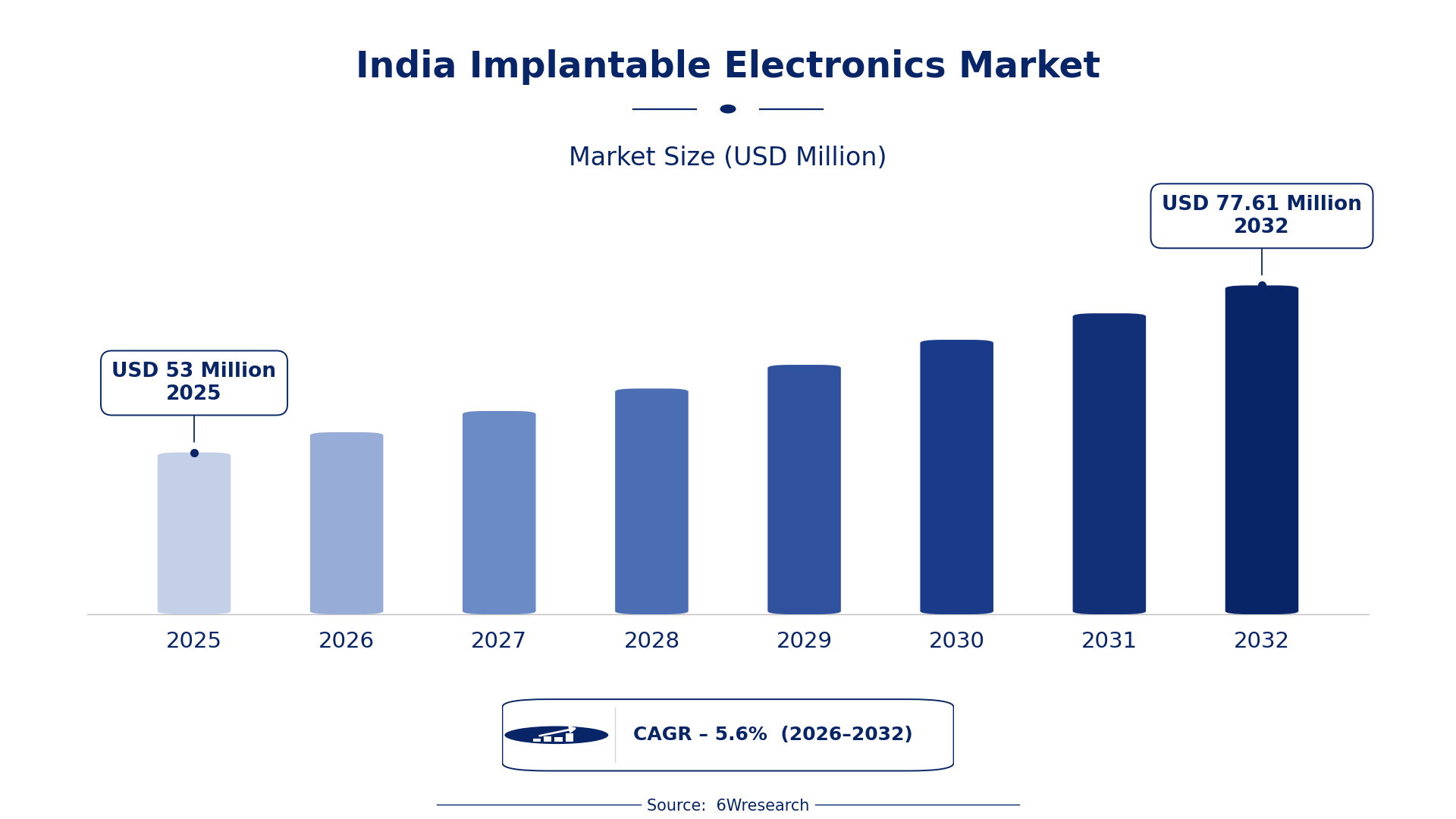
According to 6Wresearch internal database and industry insights, the India Implantable Electronics Market was valued at USD 53.0 million in 2025 and is projected to reach USD 77.61 million by 2032, growing at a CAGR of approximately 5.6% during 2026–2032.
India Implantable Electronics Market Highlights
| Report Metric | Details |
| Report Name | India Implantable Electronics Market |
| Market Size 2025 | USD 53.0 million |
| Market Size 2032 | USD 77.61 million |
| Absolute Growth 2025–2032 | USD 24.61 million |
| CAGR 2026–2032 | 5.6% |
| Peak Annual Growth | 7.9% in 2030 |
| Forecast Period | 2026–2032 |
| Historical Data | 2022–2025 |
| Base Year | 2025 |
| Leading Component Type, 2025 | Neural Sensors (44% share) |
| Leading Functionality, 2025 | Brain Signal Monitoring (42% share) |
| Leading Connectivity Mode, 2025 | Wireless/Optical (37% share) |
| Leading End User, 2025 | Research Institutions (41% share) |
| Fastest-Growing Component Type | Heart Rhythm Monitors (7.3% CAGR) |
| Fastest-Growing Functionality | Arrhythmia Detection (8.3% CAGR) |
| Fastest-Growing Connectivity Mode | Bluetooth/IoT (7.1% CAGR) |
| Fastest-Growing End User | Cardiac Centers (8.2% CAGR) |
| Growing Sector | Healthcare Technology |
| Key End Users | Research Institutions, Cardiac Centers, Specialized Clinics, Chronic Disease Care Units |
India Implantable Electronics Market Year-wise Growth Rate and Key Drivers (2022–2032)
This graph illustrates the annual growth rates of the market from 2022 to 2032, highlighting a steady upward trajectory and projected market expansion over the forecast period.
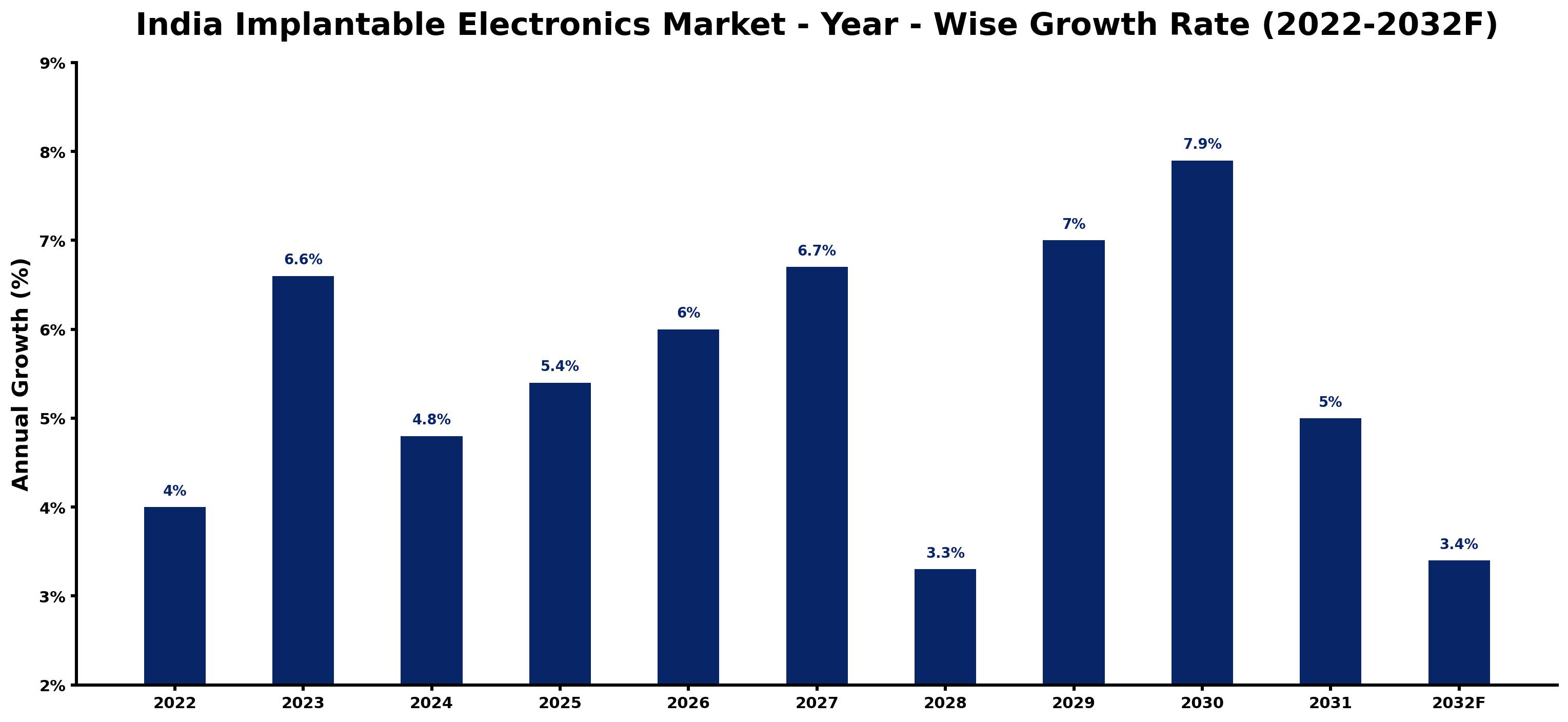
Annual growth estimates for each year appear below with the principal reason behind them, explaining the shifts that set the pace of the market.
| Year | Estimated Annual Growth (%) | Market Rationale |
| 2022 | 4.0 | The market showed steady demand for healthcare technologies among the population. |
| 2023 | 6.6 | Growth accelerated due to increased awareness of cardiac health management initiatives. |
| 2024 | 4.8 | Demand slowed as the market adjusted to new healthcare standards and regulations. |
| 2025 | 5.4 | Investment in research institutions boosted the need for advanced monitoring devices. |
| 2026 | 6.0 | The rise in cardiac patients is expected to drive demand for heart rhythm monitors. |
| 2027 | 6.7 | Increased adoption of implantable devices in clinics will enhance market growth. |
| 2028 | 3.3 | A slowdown is expected as the market faces saturation in certain segments. |
| 2029 | 7.0 | Demand is projected to surge as cardiac centers expand their use of monitoring technologies. |
| 2030 | 7.9 | The peak growth will be driven by the integration of devices into health records by 2025. |
| 2031 | 5.0 | Growth is expected to slow as the market matures and competition intensifies. |
| 2032 | 3.4 | A further slowdown is anticipated as the market stabilizes. |
Note: Market size estimations and growth projections presented in this report are based on 6Wresearch's proprietary forecasting methodology, utilizing the latest available industry data, government publications, and primary research inputs.
India Implantable Electronics Market Synopsis
Implantable electronics in India are advanced medical devices integrated into the human body for health monitoring and treatment. These devices, made from biocompatible materials and advanced microelectronics technology, are primarily used for cardiac monitoring, drug delivery, and neurological signal processing. The India Implantable Electronics Market is expanding due to increasing healthcare demands, particularly from research institutions and cardiac centres that are adopting these technologies at a rapid pace. In 2022, around 2 million cardiac patients required monitoring devices, underscoring the pressing need for such advancements in healthcare.
Market Dynamics Impact Analysis (2026–2032)
| Factor | Type | Impact | Primary Segment Affected |
| Increasing prevalence of cardiac diseases driving demand for monitoring devices | Driver | High | Heart Rhythm Monitors |
| Growing research activities in neural sensors for brain disorders | Driver | High | Neural Sensors |
| Expansion of cardiac centers requiring advanced monitoring solutions | Opportunity | High | Cardiac Centers |
| Rising diabetic population necessitating glucose monitoring technologies | Opportunity | High | Implantable Biosensors |
| Regulatory hurdles delaying product approvals for new technologies | Restraint | Medium | Drug Delivery Chips |
| Limited awareness among healthcare providers about advanced implantable devices | Restraint | Medium | Implantable Biosensors |
| The India Implantable Electronics Market faces a few practical problems, including high production costs. | Challenge | High | Neural Sensors |
| Competition from alternative monitoring solutions poses a challenge to market growth. | Challenge | Medium | Heart Rhythm Monitors |
Evaluation of Drivers in India Implantable Electronics Market (2026–2032)
Key forces behind demand, with the segment each one moves most, are listed below.
| Drivers | Primary Segment Affected | Why It Matters (Evidence) |
| Rising cardiac patient population | Heart Rhythm Monitors | In 2022, India reported approximately 2 million cardiac patients requiring monitoring devices, increasing demand for heart rhythm monitors. |
| Growing research on neural sensors | Neural Sensors | Research institutions are focusing on neural sensors, stimulating demand for advanced monitoring solutions. |
| Expansion of healthcare facilities | Implantable Biosensors | Cardiac centers are adopting implantable biosensors for continuous monitoring, driving purchases. |
| Government initiatives promoting health technology | Drug Delivery Chips | The National Health Mission promotes the use of implantable devices in rural health programs, boosting market growth. |
| Rising diabetic population | Glucose/Lactate Monitoring | India has an estimated 77 million diabetic patients, creating demand for glucose monitoring solutions. |
Market growth in India for Implantable Electronics rests on rising cardiac patient numbers, increasing research activities, and support for health technology. In 2022, approximately 2 million cardiac patients required monitoring devices, leading to heightened demand for heart rhythm monitors. Research on neural sensors is gaining traction, with institutions focusing on practical applications. The expansion of healthcare facilities will drive purchases of implantable biosensors for continuous monitoring. With a large diabetic population, the need for glucose monitoring solutions is also increasing, further stimulating market activity.
Evaluation of Restraints in India Implantable Electronics Market
The following restraints limit how fast demand can grow.
| Market Restraint | Primary Segment Affected | Why It Matters (Evidence) |
| High production costs for advanced implantable devices | Neural Sensors | The cost of developing and manufacturing neural sensors is high, limiting market entry for new producers. |
| Regulatory delays in product approvals | Drug Delivery Chips | The Medical Device Rules 2017 create lengthy approval processes, hindering timely market entry. |
| Limited awareness among healthcare providers | Implantable Biosensors | Many healthcare providers are unaware of the benefits of implantable biosensors, slowing adoption rates. |
| Competition from alternative monitoring solutions | Heart Rhythm Monitors | Emerging technologies in cardiac monitoring create competitive pressure, affecting market share. |
| Saturation in certain segments of the market | Glucose/Lactate Monitoring | The market for glucose monitoring devices is becoming saturated, limiting growth potential. |
India Implantable Electronics Market Challenges
The India Implantable Electronics Market faces several practical problems, starting with high regulatory costs that burden producers. Compliance with the Medical Device Rules 2017 can take up to six months, delaying access to essential devices for healthcare providers. Regulatory hurdles restrict the availability of advanced implantable electronics, which can lead to treatment delays for approximately 2 million cardiac patients needing monitoring solutions. Competition from imported devices, which often have established market presence, pressures local producers to lower prices, impacting their profit margins. Supply chain issues arise from reliance on imported components, causing delays in production and affecting delivery timelines for hospitals.
Trends in the India Implantable Electronics Market
The trends below show where the India Implantable Electronics Market is heading.
- Shift towards Advanced Monitoring Technologies: India is experiencing a shift towards advanced monitoring technologies in healthcare, particularly in cardiac care. The National Digital Health Mission aims to integrate implantable devices into health records by 2025, which will streamline patient monitoring and data management.
- Increased Adoption of Neural Sensors: Research institutions in India are adopting neural sensors for brain research, improving capabilities in neurological studies. In 2022, this segment saw a rise in investment, reflecting the growing importance of brain signal monitoring.
- Integration of Implantable Devices into Health Systems: The integration of implantable devices into health systems is becoming a priority, driven by initiatives from the National Health Mission. By 2025, this integration is expected to improve patient care and monitoring efficiency across healthcare facilities.
- Growth in Cardiac Centers: Cardiac centers are expanding their use of implantable electronics, particularly heart rhythm monitors. In 2025, these centers are projected to hold a 41% market share, reflecting the increasing demand for advanced cardiac monitoring solutions.
Investment Opportunities in the India Implantable Electronics Market
Investors looking at the India Implantable Electronics Market should consider the following areas.
- Partner with Research Institutions: By partnering with research institutions, suppliers can tap into the growing demand for neural sensors. The Indian Council of Medical Research supports this sector, which is projected to see increased funding in the coming years.
- Invest in Rural Health Programs: With the National Health Mission promoting implantable devices, there is an opportunity to invest in rural health programs. In 2022, this initiative aimed to improve healthcare access for underserved populations.
- Expand Offerings for Diabetic Patients: The large diabetic population in India presents an opportunity for suppliers of glucose monitoring devices. Targeted marketing to chronic disease care units can improve market penetration in this segment.
- Develop Advanced Drug Delivery Solutions: There is a growing need for advanced drug delivery solutions in healthcare. The Drug Controller General of India oversees the regulation of these devices, creating a clear pathway for new entrants.
Government Initiatives in the India Implantable Electronics Market
The Medical Device Rules 2017 govern the approval of implantable electronics in India, ensuring that all devices meet safety and efficacy standards. This regulatory framework is essential for manufacturers as it dictates the testing and certification processes required before market entry. Compliance with these rules is vital for maintaining quality and gaining consumer trust. Additionally, the Bureau of Indian Standards sets the standards for medical devices, ensuring that products meet specific requirements for safety and performance.
The National Health Mission has allocated USD 1.5 billion to improve healthcare infrastructure, which includes funding for the integration of implantable devices into health records. The Ministry of Health and Family Welfare administers this programme, which aims to improve healthcare delivery across rural and urban areas. By 2025, this initiative is projected to enhance access to advanced medical technologies for patients.
Future Insight of the India Implantable Electronics Market
The India Implantable Electronics Market is expected to grow substantially by 2032, driven by advancements in technology and supportive government initiatives. The National Digital Health Mission aims to integrate implantable devices into health records, improving patient monitoring. Research on biosensors is gaining traction, with institutions focusing on practical applications. As the population of diabetic patients reaches approximately 77 million, the demand for glucose monitoring devices will rise, creating opportunities for local producers and improving access for buyers.
Market Segmentation Analysis
The analysis below covers each segmentation, its leading category in 2025 and its fastest-growing category through 2032.
By Component Type – Neural Sensors Dominated, Heart Rhythm Monitors Expected to Grow Fastest
According to Sachin Kumar Rai, Senior Research Analyst at 6Wresearch, the largest component type category in 2025 was Neural Sensors, with a 44% share of total revenue. Neural sensors hold the largest market share as they are crucial for monitoring brain activity and treating neurological disorders. The increasing number of research institutions in India focusing on neuroscience significantly boosts the demand for these advanced devices. Over 2026–2032, Heart Rhythm Monitors are expected to post the fastest growth, at a CAGR of 7.3%. Heart rhythm monitors are experiencing rapid growth due to the high prevalence of cardiac conditions, with approximately 2 million patients in India requiring monitoring devices. This expanding patient base ensures that heart rhythm monitors will continue to strengthen their market position. Suppliers must focus on ensuring the availability of heart rhythm monitors to meet the rising demand from healthcare providers.
By Functionality – Brain Signal Monitoring Dominated, Arrhythmia Detection Expected to Grow Fastest
In 2025, Brain Signal Monitoring led the functionality split with a 42% share. Brain signal monitoring leads the market as it is directly linked to essential neurological applications, making it vital for effective patient management. The growing emphasis on neurological health in India further drives the demand for these monitoring solutions. Arrhythmia Detection is set to record the highest CAGR in this split, 8.3% over 2026–2032. Arrhythmia detection is witnessing swift growth due to its critical importance in managing cardiac health, especially with the increasing number of patients needing ongoing monitoring. This segment's expansion underscores a pressing need for effective cardiac care technologies. Buyers will benefit from the increasing availability of arrhythmia detection devices, which will improve patient outcomes in cardiac health.
By Connectivity Mode – Wireless/Optical Dominated, Bluetooth/IoT Expected to Grow Fastest
Wireless/Optical accounted for a 37% market share by connectivity mode in 2025. Wireless/optical connectivity is the leading mode as it is integral to facilitating data transmission for various implantable electronics. Its role in healthcare applications is essential for enabling real-time monitoring and efficient data collection. Bluetooth/IoT is projected to grow fastest, at a CAGR of 7.1% during 2026–2032. Bluetooth/IoT is the fastest-growing connectivity mode, driven by the rising demand for enhanced connectivity in healthcare settings. The adoption of these technologies allows for improved patient management and greater access to health data. Suppliers should invest in Bluetooth/IoT technologies to keep pace with the increasing trend towards interconnected healthcare solutions.
By End User – Research Institutions Dominated, Cardiac Centers Expected to Grow Fastest
With a 41% revenue share in 2025, Research Institutions was the largest end user category. Research institutions command the largest market share as they are the primary users of implantable electronics for clinical studies and trials. Their commitment to advancing medical research ensures a consistent demand for these devices. The quickest growth will come from Cardiac Centers, forecast to expand at a CAGR of 8.2% between 2026 and 2032. Cardiac centers are rapidly increasing their utilisation of implantable electronics, driven by the urgent need for effective patient monitoring and treatment solutions. The growing population of cardiac patients necessitates this expansion. Suppliers must focus on meeting the needs of cardiac centers to capitalise on the rising demand for monitoring devices in patient care.
Key Attractiveness of the Report
- 10 Years of Market Numbers
- Historical Data Starting from 2022 to 2025
- Base Year 2025
- Forecast Data until 2032
- Key Performance Indicators Impacting the Market
- Major Upcoming Developments and Projects
Key Highlights of the Report:
- India Implantable Electronics Market Outlook
- Market Size of India Implantable Electronics Market, 2025
- Forecast of India Implantable Electronics Market, 2032
- Historical Data and Forecast of India Implantable Electronics Revenues & Volume for the Period 2022 - 2032F
- India Implantable Electronics Market Trend Evolution
- India Implantable Electronics Market Drivers and Challenges
- India Implantable Electronics Price Trends
- India Implantable Electronics Porter's Five Forces
- India Implantable Electronics Industry Life Cycle
- Historical Data and Forecast of India Implantable Electronics Market Revenues & Volume By Component Type for the Period 2022 - 2032F
- Historical Data and Forecast of India Implantable Electronics Market Revenues & Volume By Neural Sensors for the Period 2022 - 2032F
- Historical Data and Forecast of India Implantable Electronics Market Revenues & Volume By Heart Rhythm Monitors for the Period 2022 - 2032F
- Historical Data and Forecast of India Implantable Electronics Market Revenues & Volume By Drug Delivery Chips for the Period 2022 - 2032F
- Historical Data and Forecast of India Implantable Electronics Market Revenues & Volume By Implantable Biosensors for the Period 2022 - 2032F
- Historical Data and Forecast of India Implantable Electronics Market Revenues & Volume By Functionality for the Period 2022 - 2032F
- Historical Data and Forecast of India Implantable Electronics Market Revenues & Volume By Brain Signal Monitoring for the Period 2022 - 2032F
- Historical Data and Forecast of India Implantable Electronics Market Revenues & Volume By Arrhythmia Detection for the Period 2022 - 2032F
- Historical Data and Forecast of India Implantable Electronics Market Revenues & Volume By Controlled Release for the Period 2022 - 2032F
- Historical Data and Forecast of India Implantable Electronics Market Revenues & Volume By Glucose/Lactate Monitoring for the Period 2022 - 2032F
- Historical Data and Forecast of India Implantable Electronics Market Revenues & Volume By Connectivity Mode for the Period 2022 - 2032F
- Historical Data and Forecast of India Implantable Electronics Market Revenues & Volume By Wireless/Optical for the Period 2022 - 2032F
- Historical Data and Forecast of India Implantable Electronics Market Revenues & Volume By Bluetooth/IoT for the Period 2022 - 2032F
- Historical Data and Forecast of India Implantable Electronics Market Revenues & Volume By NFC for the Period 2022 - 2032F
- Historical Data and Forecast of India Implantable Electronics Market Revenues & Volume By Wireless Transmission for the Period 2022 - 2032F
- Historical Data and Forecast of India Implantable Electronics Market Revenues & Volume By End User for the Period 2022 - 2032F
- Historical Data and Forecast of India Implantable Electronics Market Revenues & Volume By Research Institutions for the Period 2022 - 2032F
- Historical Data and Forecast of India Implantable Electronics Market Revenues & Volume By Cardiac Centers for the Period 2022 - 2032F
- Historical Data and Forecast of India Implantable Electronics Market Revenues & Volume By Specialized Clinics for the Period 2022 - 2032F
- Historical Data and Forecast of India Implantable Electronics Market Revenues & Volume By Chronic Disease Care Units for the Period 2022 - 2032F
- India Implantable Electronics Import Export Trade Statistics
- Market Opportunity Assessment By Component Type
- Market Opportunity Assessment By Functionality
- Market Opportunity Assessment By Connectivity Mode
- Market Opportunity Assessment By End User
- India Implantable Electronics Top Companies Market Share
- India Implantable Electronics Competitive Benchmarking By Technical and Operational Parameters
- India Implantable Electronics Company Profiles
- India Implantable Electronics Key Strategic Recommendations
Market Covered
This report examines the market across the segments below.
By Component Type
- Neural Sensors
- Heart Rhythm Monitors
- Drug Delivery Chips
- Implantable Biosensors
By Functionality
- Brain Signal Monitoring
- Arrhythmia Detection
- Controlled Release
- Glucose/Lactate Monitoring
By Connectivity Mode
- Wireless/Optical
- Bluetooth/IoT
- NFC
- Wireless Transmission
By End User
- Research Institutions
- Cardiac Centers
- Specialized Clinics
- Chronic Disease Care Units































