India In-Cabin Proximity Sensor Market Size & Growth Rate
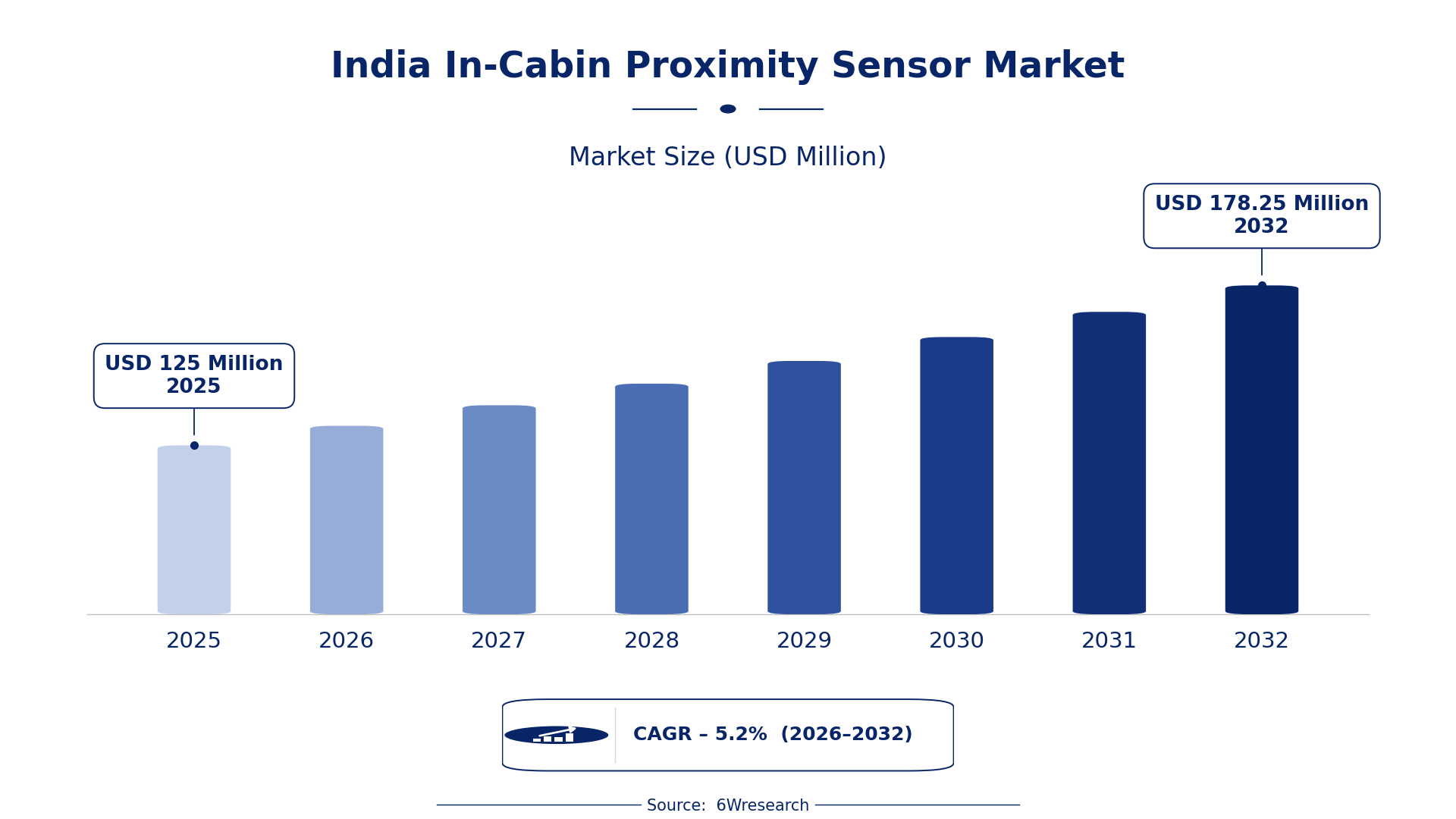
According to 6Wresearch internal database and industry insights, the India In-Cabin Proximity Sensor Market was valued at USD 125.0 million in 2025 and is projected to reach USD 178.25 million by 2032, growing at a CAGR of approximately 5.2% during 2026–2032.
India In-Cabin Proximity Sensor Market Highlights
| Report Metric | Details |
| Report Name | India In-Cabin Proximity Sensor Market |
| Market Size 2025 | USD 125.0 million |
| Market Size 2032 | USD 178.25 million |
| Absolute Growth 2025–2032 | USD 53.25 million |
| CAGR 2026–2032 | 5.2% |
| Peak Annual Growth | 7.6% in 2027 |
| Forecast Period | 2026–2032 |
| Historical Data | 2022–2025 |
| Base Year | 2025 |
| Leading Sensor Type, 2025 | Capacitive Proximity (50% share) |
| Leading Detection Range, 2025 | Short Range (cm) (48% share) |
| Leading Functionality, 2025 | Touchless Controls (42% share) |
| Leading End User, 2025 | Smart Cockpit OEMs (36% share) |
| Fastest-Growing Sensor Type | Infrared Proximity (6.9% CAGR) |
| Fastest-Growing Detection Range | Medium Range (7.5% CAGR) |
| Fastest-Growing Functionality | Gesture/Hand Detection (7.5% CAGR) |
| Fastest-Growing End User | EV/AV Manufacturers (7.6% CAGR) |
| Growing Sector | automotive |
| Key End Users | Smart Cockpit OEMs, Luxury Car Manufacturers, EV/AV Manufacturers |
India In-Cabin Proximity Sensor Market Year-wise Growth Rate and Key Drivers (2022–2032)
This graph illustrates the annual growth rates of the market from 2022 to 2032, highlighting a steady upward trajectory and projected market expansion over the forecast period.
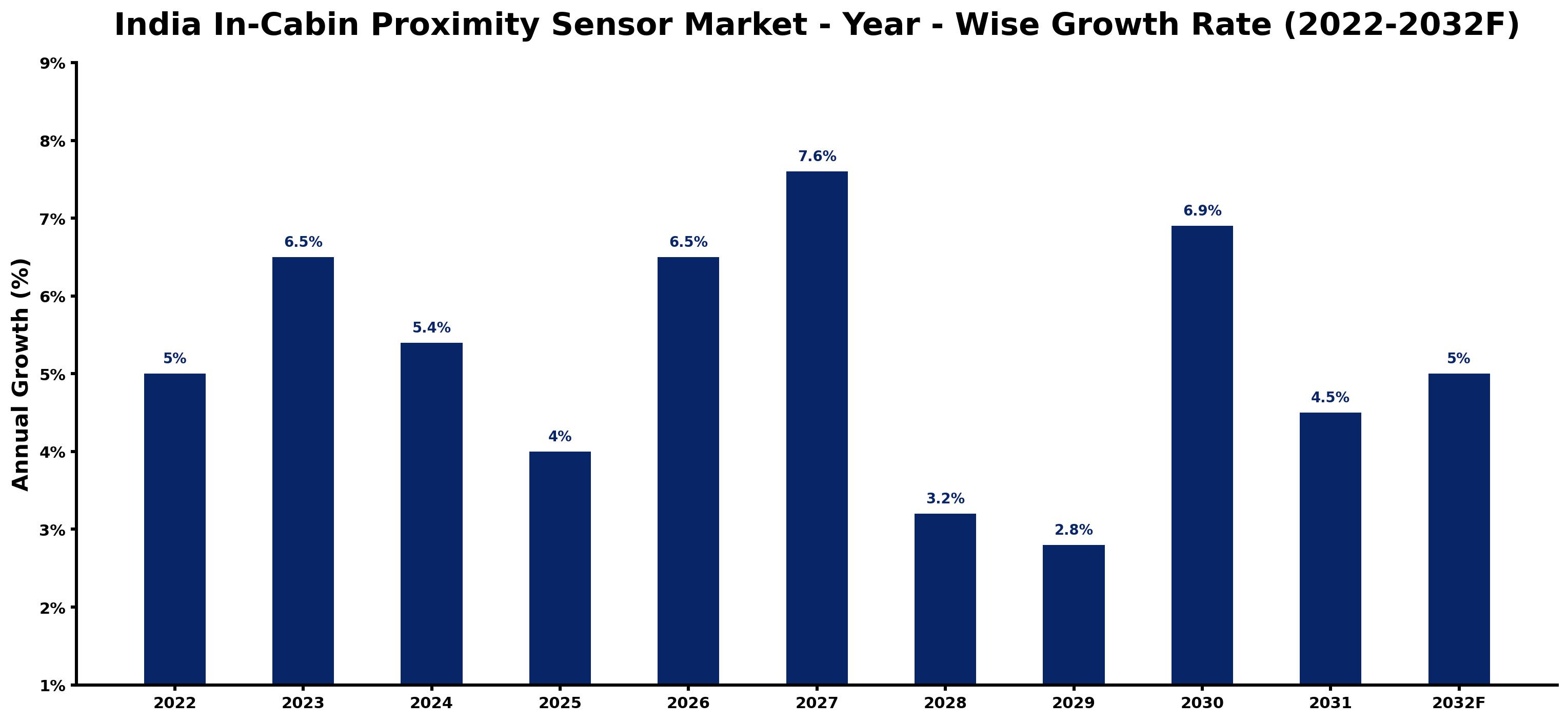
The following table presents the estimated annual growth rate for each year together with the principal factor influencing market performance.
| Year | Estimated Annual Growth (%) | Market Rationale |
| 2022 | 5.0 | The market experienced steady growth due to ongoing demand from domestic manufacturers. |
| 2023 | 6.5 | Growth accelerated as the automotive sector expanded, driven by rising vehicle production. |
| 2024 | 5.4 | A slight slowdown occurred as manufacturers adjusted to market dynamics and demand patterns. |
| 2025 | 4.0 | Growth continued to slow as the market stabilised, reflecting broader economic conditions. |
| 2026 | 6.5 | An increase in demand was observed due to heightened interest in electric vehicles and smart technologies. |
| 2027 | 7.6 | The market peaked with strong growth driven by innovative sensor applications in vehicles. |
| 2028 | 3.2 | Growth decelerated as the market began to normalise after the peak period. |
| 2029 | 2.8 | A further slowdown occurred as manufacturers faced challenges in meeting evolving standards. |
| 2030 | 6.9 | Demand surged again, supported by advancements in sensor technology and user experience. |
| 2031 | 4.5 | Growth slowed as the market adjusted to new regulations and standards in the automotive sector. |
| 2032 | 5.0 | A rebound in growth is expected as demand for advanced safety features increases. |
Note: Market size estimations and growth projections presented in this report are based on 6Wresearch's proprietary forecasting methodology, utilizing the latest available industry data, government publications, and primary research inputs.
India In-Cabin Proximity Sensor Market Synopsis
The In-Cabin Proximity Sensor Market in India includes advanced electronic devices that detect occupant presence and movement within vehicles. These sensors utilise capacitive, infrared, and ultrasonic technologies to improve user interaction and safety features. The market is expanding due to increasing demand from domestic manufacturers, especially in the electric and autonomous vehicle segments. The Smart Mobility Mission Plan 2025 and the National Electric Mobility Mission Plan 2020 are major contributors to this growth, promoting electric vehicles and smart technologies. As the automotive sector progresses, the need for advanced in-cabin solutions continues to increase.
Market Dynamics Impact Analysis (2026–2032)
| Factor | Type | Impact | Primary Segment Affected |
| Growing demand for electric vehicles and smart technologies. | Driver | High | Capacitive Proximity |
| Increasing focus on safety features in vehicles. | Driver | High | Airbag Deployment Systems |
| High demand for touchless controls in luxury vehicles. | Opportunity | High | Touchless Controls |
| Emerging market for gesture detection in smart cockpits. | Opportunity | Medium | Gesture/Hand Detection |
| Challenges in meeting evolving safety standards. | Restraint | High | Infrared Proximity |
| Limited awareness of advanced sensor technologies among manufacturers. | Restraint | Medium | Ultrasonic Sensors |
| Supply chain disruptions affecting production timelines. | Challenge | High | mmWave Radar |
| Competition from alternative sensing technologies. | Challenge | Medium | Short Range (cm) |
Evaluation of Drivers in India In-Cabin Proximity Sensor Market (2026–2032)
The factors lifting demand, and the evidence behind each, are summarised below.
| Drivers | Primary Segment Affected | Why It Matters (Evidence) |
| Rising production of electric vehicles increases sensor demand. | Capacitive Proximity | In 2022, the Indian automotive industry produced over 22 million vehicles, boosting sensor integration. |
| Growing safety regulations drive demand for advanced sensors. | Airbag Deployment Systems | Proximity sensors are increasingly used in airbag systems to improve safety measures. |
| Luxury car market expansion boosts demand for touchless features. | Touchless Controls | The demand for luxury cars in India is projected to grow by 20% annually until 2025. |
| Smart cockpit development fuels gesture detection technology. | Gesture/Hand Detection | Smart Cockpit OEMs are investing in advanced interfaces to improve user experience. |
| Government initiatives support the automotive sector's growth. | EV/AV Manufacturers | The National Electric Mobility Mission Plan 2020 allocated INR 10,000 crore to promote EV adoption. |
In 2022, the Indian automotive industry produced over 22 million vehicles, which facilitated greater sensor integration. The demand for luxury cars is expected to increase by 20% annually until 2025, resulting in more purchases of touchless controls. Investment in advanced interfaces is enhancing user experience through gesture detection.
Evaluation of Restraints in India In-Cabin Proximity Sensor Market
The following restraints limit how fast demand can grow.
| Market Restraint | Primary Segment Affected | Why It Matters (Evidence) |
| Challenges in meeting evolving safety standards hinder production. | Infrared Proximity | The Bureau of Indian Standards is working on new regulations for automotive safety, impacting sensor deployment. |
| Limited awareness of advanced sensor technologies restricts market growth. | Ultrasonic Sensors | Many manufacturers are still adapting to the latest technology trends, slowing adoption rates. |
| Supply chain disruptions affect production timelines and costs. | mmWave Radar | The automotive sector faces delays due to global supply chain issues, impacting sensor availability. |
| Competition from alternative sensing technologies limits market share. | Short Range (cm) | Emerging technologies may offer similar functionalities, challenging traditional sensor applications. |
| High development costs for advanced sensor technologies restrict market entry. | Touchless Controls | Manufacturers face substantial investment requirements to integrate new sensor technologies. |
India In-Cabin Proximity Sensor Market Challenges
The India In-Cabin Proximity Sensor Market encounters several practical challenges, starting with supply chain disruptions that affect the availability of critical components. Global semiconductor shortages lead to delays for manufacturers, potentially costing them up to 20% in lost revenue. Compliance with ISO 26262 standards for functional safety poses regulatory challenges, as extensive testing can prolong product development timelines by six months for suppliers. Rising raw material costs further strain budgets, compelling producers to raise prices, which may deter buyers in a competitive automotive market. A skills gap in the workforce restricts manufacturers' ability to innovate, as the automotive sector employs over 37 million people, yet many lack expertise in advanced sensor technologies.
Trends in the India In-Cabin Proximity Sensor Market
Below mentioned are some of the trends shaping the India In-Cabin Proximity Sensor Market growth.
- Shift towards Touchless Controls in Vehicles: The Smart Mobility Mission Plan 2025 is promoting the adoption of touchless controls in vehicles, enhancing user interaction. With a projected 20% growth in luxury car demand annually until 2025, manufacturers are increasingly integrating these features.
- Emergence of Gesture Detection in Smart Cockpits: Smart Cockpit OEMs are prioritising gesture detection technologies to elevate user experience. This trend is clear as the automotive sector evolves, with a notable increase in demand for these systems.
- Growth in EV/AV Manufacturers' Demand for Proximity Sensors: The National Electric Mobility Mission Plan 2020 has stimulated demand for proximity sensors among EV/AV manufacturers. With INR 10,000 crore allocated for EV adoption, the market for these sensors is expanding rapidly.
- Focus on Safety Features in Automotive Design: The Automotive Mission Plan 2026 prioritises safety features, resulting in increased integration of proximity sensors in vehicles. This shift is crucial as the automotive sector aims to improve overall safety standards.
Investment Opportunities in the India In-Cabin Proximity Sensor Market
The following opportunities in the India In-Cabin Proximity Sensor Market pair current demand with a clear way in.
- EV Manufacturers Seeking Advanced Sensor Solutions: Electric vehicle manufacturers are increasingly looking for advanced sensor solutions to improve vehicle safety and user experience. With the electric vehicle market projected to grow significantly, suppliers can tap into this demand by partnering with local manufacturers.
- Growing Demand for Gesture Detection Technologies: The rise in smart cockpit designs has created a gap in gesture detection technologies. Suppliers can invest in developing these solutions, targeting Smart Cockpit OEMs to fulfil their needs.
- Integration of Touchless Controls in Luxury Vehicles: Luxury vehicle manufacturers are prioritising touchless controls to improve user interaction. With a projected 20% annual growth in luxury car demand, suppliers should focus on providing innovative touchless sensor solutions.
- Expansion of Safety Features in Automotive Design: The automotive sector's focus on safety features presents opportunities for suppliers of proximity sensors. With the Automotive Mission Plan 2026 driving innovation, suppliers can enter the market by aligning with safety standards.
Government Initiatives in the India In-Cabin Proximity Sensor Market
The Automotive Mission Plan 2026 aims to position India as a global automotive hub, encouraging advancements in sensor technology. This initiative supports manufacturers in developing cutting-edge technologies and integrating them into new vehicle models, ensuring compliance with safety standards. The government has allocated substantial resources to this plan, promoting growth in the automotive sector.
The Bureau of Indian Standards is formulating new regulations for automotive safety, including standards for proximity sensors, to be implemented by 2024. This initiative will facilitate smoother market entry and compliance for new products, ensuring that manufacturers meet the necessary safety regulations. The Ministry of Heavy Industries and Public Enterprises oversees these developments, advancing automotive technology.
Future Insight of the India In-Cabin Proximity Sensor Market
The India In-Cabin Proximity Sensor Market is set for substantial evolution by 2032, driven by several transformative factors. The Smart Mobility Mission Plan 2025 will encourage the adoption of electric vehicles and smart technologies, creating new opportunities for sensor integration. The National Electric Mobility Mission Plan 2020 will continue to provide incentives, increasing demand for advanced safety features. The automotive sector's production of over 22 million vehicles in 2022 underscores a robust market for in-cabin technologies, while the anticipated 20% annual growth in luxury car demand will further heighten the need for sophisticated user experiences.
Market Segmentation Analysis
The report offers a comprehensive study of the following market segments and their leading categories in the market.
By Sensor Type – Capacitive Proximity Dominated, Infrared Proximity Expected to Grow Fastest
According to Sachin Kumar Rai, Senior Research Analyst at 6Wresearch, Capacitive Proximity held a 50% share of the India In-Cabin Proximity Sensor Market by sensor type in 2025. Capacitive proximity sensors hold the largest share in the India in-cabin proximity sensor market due to their critical role in touchless controls, essential for modern vehicle interfaces. Their widespread adoption in smart cockpits has established them as a preferred choice among vehicle manufacturers. The quickest growth will come from Infrared Proximity, forecast to expand at a CAGR of 6.9% between 2026 and 2032. Infrared proximity sensors are growing rapidly, primarily because they are increasingly used for gesture detection in luxury vehicles that aim to enhance user experience. As manufacturers continue to integrate advanced technologies, this segment is likely to expand further. Suppliers should focus on capacitive and infrared technologies to meet the rising demand in the automotive sector.
By Detection Range – Short Range (cm) Dominated, Medium Range Expected to Grow Fastest
The largest detection range category in 2025 was Short Range (cm), with a 48% share of total revenue. Short range sensors dominate the market as they are vital for the immediate detection of occupant presence, crucial for safety features like airbag deployment. Their effectiveness in enhancing safety measures makes them a preferred option for vehicle manufacturers. Over 2026–2032, Medium Range is expected to post the fastest growth, at a CAGR of 7.5%. Medium range sensors are witnessing the fastest growth due to their specific applications in advanced vehicle systems, appealing to manufacturers seeking versatile solutions. This segment's growth reflects the increasing complexity of vehicle designs. Manufacturers should consider incorporating medium range sensors in their product lines to capture emerging opportunities.
By Functionality – Touchless Controls Dominated, Gesture/Hand Detection Expected to Grow Fastest
In 2025, Touchless Controls led the functionality split with a 42% share. Touchless controls are the leading functionality in the market, integral for modern vehicle interfaces that improve user interaction and safety. The demand for seamless and intuitive controls in vehicles drives their widespread adoption. Gesture/Hand Detection is set to record the highest CAGR in this split, 7.5% over 2026–2032. Gesture and hand detection functionalities are rapidly expanding, especially in luxury vehicles where enhancing user experience is critical. This trend indicates a shift towards more advanced interaction methods in the automotive sector. Suppliers should invest in developing gesture detection technologies to align with evolving consumer preferences.
By End User – Smart Cockpit OEMs Dominated, EV/AV Manufacturers Expected to Grow Fastest
Smart Cockpit OEMs took a 36% share of end user in 2025, more than any other category. Smart cockpit OEMs represent the largest share of end users, as they play a crucial role in developing advanced vehicle interiors that incorporate various technologies. Their focus on enhancing user experience drives the demand for in-cabin proximity sensors. EV/AV Manufacturers are projected to grow fastest, at a CAGR of 7.6% during 2026–2032. EV and AV manufacturers are the fastest-growing segment, driven by the increasing integration of new technologies in electric and autonomous vehicles. This growth highlights the industry's shift towards more sophisticated vehicle systems. Suppliers should strengthen partnerships with EV and AV manufacturers to capitalise on the rapid growth in this segment.
Key Attractiveness of the Report
- 10 Years of Market Numbers
- Historical Data Starting from 2022 to 2025
- Base Year 2025
- Forecast Data until 2032
- Key Performance Indicators Impacting the Market
- Major Upcoming Developments and Projects
Key Highlights of the Report:
- India In-Cabin Proximity Sensor Market Outlook
- Market Size of India In-Cabin Proximity Sensor Market, 2025
- Forecast of India In-Cabin Proximity Sensor Market, 2032
- Historical Data and Forecast of India In-Cabin Proximity Sensor Revenues & Volume for the Period 2022 - 2032F
- India In-Cabin Proximity Sensor Market Trend Evolution
- India In-Cabin Proximity Sensor Market Drivers and Challenges
- India In-Cabin Proximity Sensor Price Trends
- India In-Cabin Proximity Sensor Porter's Five Forces
- India In-Cabin Proximity Sensor Industry Life Cycle
- Historical Data and Forecast of India In-Cabin Proximity Sensor Market Revenues & Volume By Sensor Type for the Period 2022 - 2032F
- Historical Data and Forecast of India In-Cabin Proximity Sensor Market Revenues & Volume By Capacitive Proximity for the Period 2022 - 2032F
- Historical Data and Forecast of India In-Cabin Proximity Sensor Market Revenues & Volume By Infrared Proximity for the Period 2022 - 2032F
- Historical Data and Forecast of India In-Cabin Proximity Sensor Market Revenues & Volume By Ultrasonic Sensors for the Period 2022 - 2032F
- Historical Data and Forecast of India In-Cabin Proximity Sensor Market Revenues & Volume By mmWave Radar for the Period 2022 - 2032F
- Historical Data and Forecast of India In-Cabin Proximity Sensor Market Revenues & Volume By Detection Range for the Period 2022 - 2032F
- Historical Data and Forecast of India In-Cabin Proximity Sensor Market Revenues & Volume By Short Range (cm) for the Period 2022 - 2032F
- Historical Data and Forecast of India In-Cabin Proximity Sensor Market Revenues & Volume By Medium Range for the Period 2022 - 2032F
- Historical Data and Forecast of India In-Cabin Proximity Sensor Market Revenues & Volume By Wide Range for the Period 2022 - 2032F
- Historical Data and Forecast of India In-Cabin Proximity Sensor Market Revenues & Volume By Long Range + High Accuracy for the Period 2022 - 2032F
- Historical Data and Forecast of India In-Cabin Proximity Sensor Market Revenues & Volume By Functionality for the Period 2022 - 2032F
- Historical Data and Forecast of India In-Cabin Proximity Sensor Market Revenues & Volume By Touchless Controls for the Period 2022 - 2032F
- Historical Data and Forecast of India In-Cabin Proximity Sensor Market Revenues & Volume By Gesture/Hand Detection for the Period 2022 - 2032F
- Historical Data and Forecast of India In-Cabin Proximity Sensor Market Revenues & Volume By Occupant Classification for the Period 2022 - 2032F
- Historical Data and Forecast of India In-Cabin Proximity Sensor Market Revenues & Volume By Vital Sign Monitoring for the Period 2022 - 2032F
- Historical Data and Forecast of India In-Cabin Proximity Sensor Market Revenues & Volume By End User for the Period 2022 - 2032F
- Historical Data and Forecast of India In-Cabin Proximity Sensor Market Revenues & Volume By Smart Cockpit OEMs for the Period 2022 - 2032F
- Historical Data and Forecast of India In-Cabin Proximity Sensor Market Revenues & Volume By Luxury Car Manufacturers for the Period 2022 - 2032F
- Historical Data and Forecast of India In-Cabin Proximity Sensor Market Revenues & Volume By Airbag Deployment Systems for the Period 2022 - 2032F
- Historical Data and Forecast of India In-Cabin Proximity Sensor Market Revenues & Volume By EV/AV Manufacturers for the Period 2022 - 2032F
- India In-Cabin Proximity Sensor Import Export Trade Statistics
- Market Opportunity Assessment By Sensor Type
- Market Opportunity Assessment By Detection Range
- Market Opportunity Assessment By Functionality
- Market Opportunity Assessment By End User
- India In-Cabin Proximity Sensor Top Companies Market Share
- India In-Cabin Proximity Sensor Competitive Benchmarking By Technical and Operational Parameters
- India In-Cabin Proximity Sensor Company Profiles
- India In-Cabin Proximity Sensor Key Strategic Recommendations
Market Covered
This report examines the market across the segments below.
By Sensor Type
- Capacitive Proximity
- Infrared Proximity
- Ultrasonic Sensors
- mmWave Radar
By Detection Range
- Short Range (cm)
- Medium Range
- Wide Range
- Long Range + High Accuracy
By Functionality
- Touchless Controls
- Gesture/Hand Detection
- Occupant Classification
- Vital Sign Monitoring
By End User
- Smart Cockpit OEMs
- Luxury Car Manufacturers
- Airbag Deployment Systems
- EV/AV Manufacturers































