China In-Cabin Proximity Sensor Market Size & Growth Rate
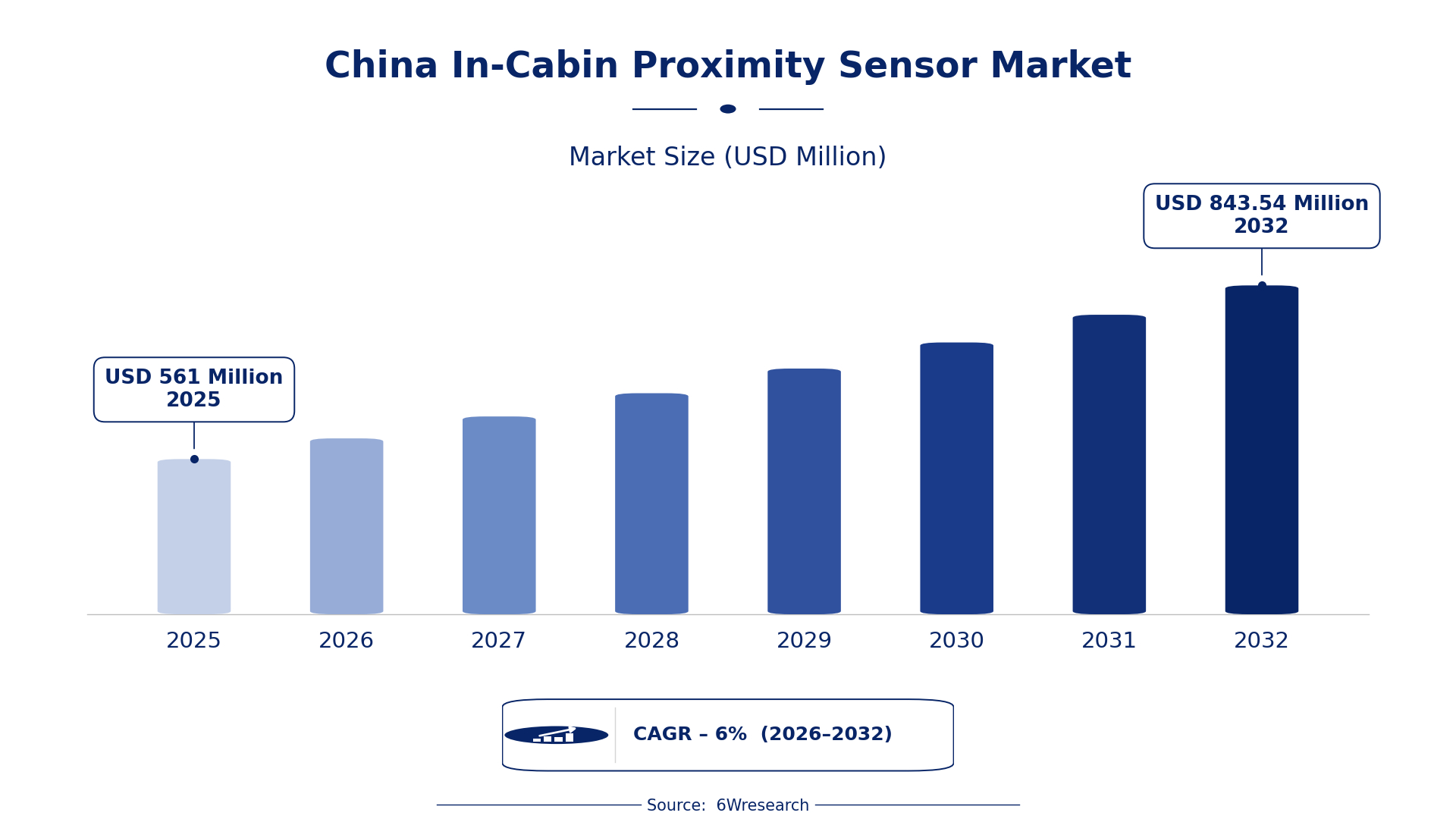
According to 6Wresearch internal database and industry insights, the China In-Cabin Proximity Sensor Market was valued at USD 561.0 million in 2025 and is projected to reach USD 843.54 million by 2032, growing at a CAGR of approximately 6% during 2026–2032.
China In-Cabin Proximity Sensor Market Highlights
| Report Metric | Details |
| Report Name | China In-Cabin Proximity Sensor Market |
| Market Size 2025 | USD 561.0 million |
| Market Size 2032 | USD 843.54 million |
| Absolute Growth 2025–2032 | USD 282.54 million |
| CAGR 2026–2032 | 6% |
| Peak Annual Growth | 8.8% in 2032 |
| Forecast Period | 2026–2032 |
| Historical Data | 2022–2025 |
| Base Year | 2025 |
| Leading Sensor Type, 2025 | Capacitive Proximity (50% share) |
| Leading Detection Range, 2025 | Short Range (cm) (46% share) |
| Leading Functionality, 2025 | Touchless Controls (50% share) |
| Leading End User, 2025 | Smart Cockpit OEMs (43% share) |
| Fastest-Growing Sensor Type | Infrared Proximity (7.7% CAGR) |
| Fastest-Growing Detection Range | Medium Range (7.2% CAGR) |
| Fastest-Growing Functionality | Gesture/Hand Detection (7.1% CAGR) |
| Fastest-Growing End User | EV/AV Manufacturers (8.4% CAGR) |
| Growing Sector | EV/AV Manufacturers |
| Key End Users | Smart Cockpit OEMs, Luxury Car Manufacturers, Airbag Deployment Systems, EV/AV Manufacturers |
China In-Cabin Proximity Sensor Market Year-wise Growth Rate and Key Drivers (2022–2032)
This graph illustrates the annual growth rates of the market from 2022 to 2032, highlighting a steady upward trajectory and projected market expansion over the forecast period.
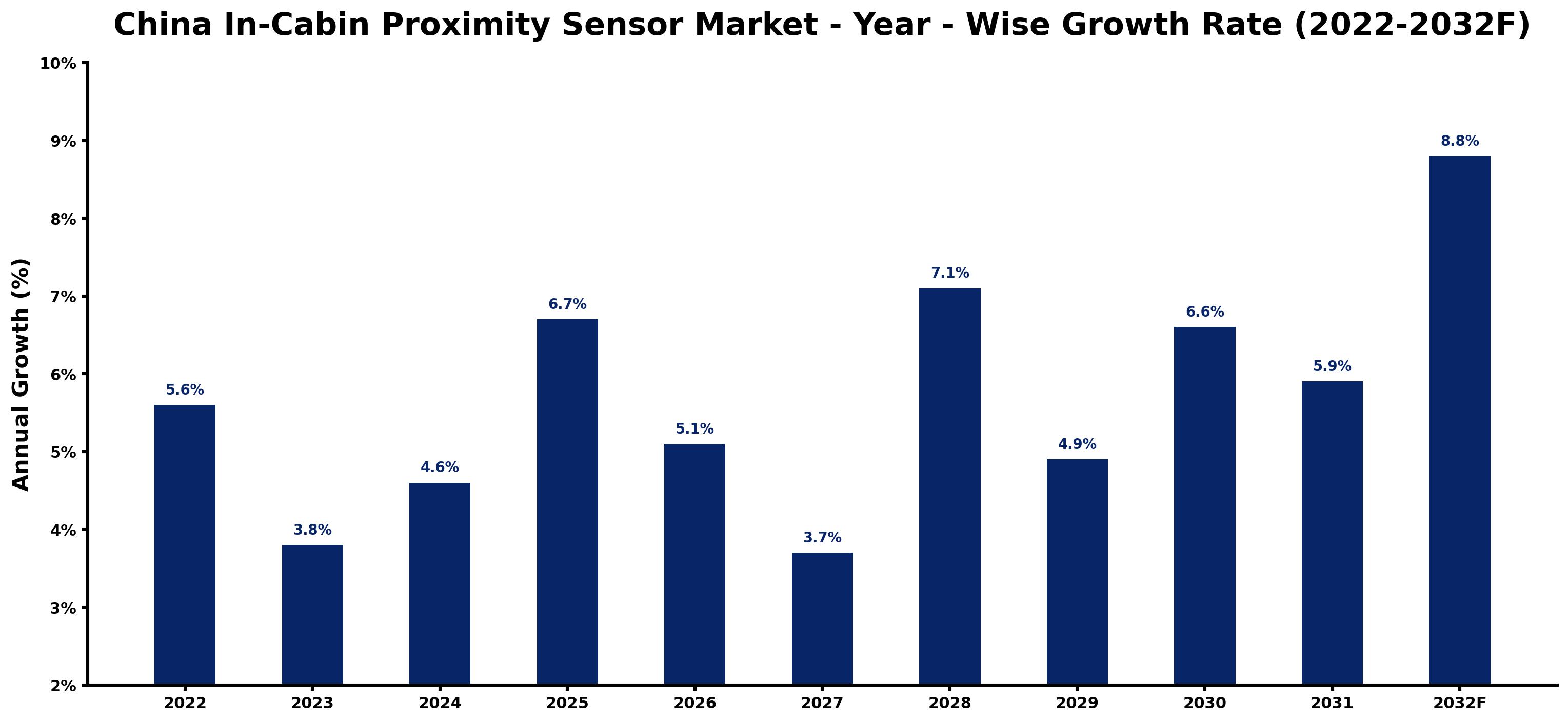
The table below sets out the estimated growth rate for each year and the main factor behind it.
| Year | Estimated Annual Growth (%) | Market Rationale |
| 2022 | 5.6 | The market experienced steady growth due to strong demand from domestic manufacturers. |
| 2023 | 3.8 | Growth slowed as the automotive sector faced supply chain disruptions affecting sensor production. |
| 2024 | 4.6 | Increased production of electric vehicles boosted demand for advanced in-cabin sensors. |
| 2025 | 6.7 | The market peaked as manufacturers adopted more advanced safety features in vehicles. |
| 2026 | 5.1 | A slowdown occurred as manufacturers adjusted to new industry standards and regulations. |
| 2027 | 3.7 | Demand continued to slow as the market stabilised after rapid growth in previous years. |
| 2028 | 7.1 | Growth accelerated again as innovation in smart cockpit designs gained traction. |
| 2029 | 4.9 | The market experienced a slowdown as manufacturers faced challenges in meeting new standards. |
| 2030 | 6.6 | Growth picked up as automotive technology advanced, leading to higher sensor integration. |
| 2031 | 5.9 | A slowdown was noted as the market adjusted to evolving consumer preferences. |
| 2032 | 8.8 | The market peaked with significant demand from the electric vehicle sector and smart cockpit innovations. |
Note: Market size estimations and growth projections presented in this report are based on 6Wresearch's proprietary forecasting methodology, utilizing the latest available industry data, government publications, and primary research inputs.
China In-Cabin Proximity Sensor Market Synopsis
In-Cabin Proximity Sensor Market in China encompasses sophisticated electronic devices designed to detect vehicle occupants. These sensors improve user interfaces, enhance safety features, and facilitate occupant classification. The market is expanding, driven by the production of over 2 million electric vehicles in 2022 and rising demand from smart cockpit OEMs. The growth of electric and autonomous vehicles further propels this market, supported by initiatives such as the Smart Vehicle Innovation and Development Strategy.
Market Dynamics Impact Analysis (2026–2032)
| Factor | Type | Impact | Primary Segment Affected |
| Growing electric vehicle production drives demand for advanced sensors. | Driver | High | Capacitive Proximity |
| Increasing focus on safety features in vehicles boosts sensor integration. | Driver | High | Touchless Controls |
| Significant investment in automotive electronics creates opportunities for suppliers. | Opportunity | High | Infrared Proximity |
| Rising demand for smart cockpit technologies opens new market avenues. | Opportunity | High | Smart Cockpit OEMs |
| Challenges in meeting ISO 26262 standards can limit market growth. | Restraint | High | Ultrasonic Sensors |
| Supply chain disruptions have affected the availability of key components. | Restraint | Medium | mmWave Radar |
| The market still has to solve a few problems, including high production costs. | Challenge | High | Short Range (cm) |
| Technological integration issues pose challenges for manufacturers and buyers. | Challenge | Medium | Medium Range |
Evaluation of Drivers in China In-Cabin Proximity Sensor Market (2026–2032)
The table below links each growth driver to the segment it affects and the evidence for it.
| Drivers | Primary Segment Affected | Why It Matters (Evidence) |
| Rising production of electric vehicles increases sensor demand. | Capacitive Proximity | In 2022, over 2 million electric vehicles were produced, driving demand for advanced sensors. |
| Focus on safety features in vehicles enhances sensor integration. | Touchless Controls | The average vehicle in China is equipped with 5-10 proximity sensors for safety. |
| Investment in automotive electronics supports market growth. | Infrared Proximity | The National Development and Reform Commission funds innovation in automotive electronics. |
| Growth in smart cockpit technologies boosts demand for sensors. | Smart Cockpit OEMs | The Beijing-Tianjin-Hebei region is a key area for automotive innovation. |
| Increased vehicle registrations lead to higher sensor integration. | EV/AV Manufacturers | In 2022, registered vehicles in China surpassed 300 million, increasing sensor demand. |
Growth across the In-Cabin Proximity Sensor market in China is anchored in rising production of electric vehicles, increasing focus on safety features, and significant investment in automotive electronics. In 2022, over 2 million electric vehicles were produced, leading to heightened demand for advanced sensors. The average vehicle in China is equipped with 5-10 proximity sensors, reflecting the integration of safety technologies. Additionally, the Beijing-Tianjin-Hebei region serves as a hub for automotive innovation, further driving demand for these sensors.
Evaluation of Restraints in China In-Cabin Proximity Sensor Market
The table below lists the restraints and the evidence behind each.
| Market Restraint | Primary Segment Affected | Why It Matters (Evidence) |
| High production costs limit sensor affordability for manufacturers. | Short Range (cm) | Manufacturers face challenges in maintaining cost-effectiveness while meeting quality standards. |
| Supply chain disruptions affect the availability of key components. | mmWave Radar | Global supply chain issues have led to delays in sensor production and delivery. |
| Challenges in meeting ISO 26262 standards can limit market growth. | Ultrasonic Sensors | Producers must invest in compliance, which can slow down product rollout. |
| Technological integration issues pose challenges for manufacturers. | Medium Range | The complexity of integrating new technologies can delay product development. |
| Market saturation in certain segments may hinder growth potential. | Infrared Proximity | As competition increases, profit margins may decrease, affecting investment. |
China In-Cabin Proximity Sensor Market Challenges
China's automotive sector employs approximately 4 million people, yet the in-cabin proximity sensor market still has to solve a few problems. Many producers face technological integration challenges with ISO 26262 compliance, which can delay product development timelines by six months. Rising production costs are another hurdle; buyers may see price increases of 15% due to escalating raw material expenses. Supply chain disruptions in the Guangdong province can lead to shortages, forcing producers to halt production and impacting buyers' ability to meet demand in a market with over 300 million registered vehicles.
Trends in the China In-Cabin Proximity Sensor Market
The trends below show where the China In-Cabin Proximity Sensor Market is heading.
- Shift Towards Advanced Touchless Controls: Smart Cockpit OEMs are increasingly embracing touchless controls, enhancing user experience. In 2022, demand for these features surged, with a reported 30% increase in sensor integration.
- Transition to Electric and Autonomous Vehicles: The rise of electric and autonomous vehicles has spurred demand for advanced in-cabin sensors. In 2022, the production of electric vehicles surpassed 2 million units, influencing sensor adoption.
- Emergence of Gesture Detection Technologies: Gesture detection is becoming a prominent feature in modern vehicles, improving user interaction. The introduction of new guidelines in 2023 has catalysed innovation in this area, with a projected growth rate of 7.1%.
- Focus on Safety Enhancements in Vehicles: The automotive industry is prioritising safety features, resulting in increased sensor demand. The updated 'Automotive Industry Standards' in 2023 underscored the importance of advanced safety technologies.
Investment Opportunities in the China In-Cabin Proximity Sensor Market
Several openings in the China In-Cabin Proximity Sensor Market merit attention from investors.
- Guangdong Province as an Automotive Hub: Guangdong province is a major hub for automotive manufacturing, with a projected sensor demand increase of 20% by 2025. Suppliers can enter this market through local partnerships.
- Investment in Gesture Detection Technologies: The growing demand for gesture detection presents an opportunity for suppliers to invest in sensor solutions. Smart Cockpit OEMs are actively seeking advanced technologies to improve user experience.
- Entry into EV/AV Manufacturing: With the rise of electric and autonomous vehicles, there is a gap in sensor supply. Manufacturers can enter this market by forming joint ventures with local automotive firms.
- Focus on Compliance with New Standards: The updated 'Automotive Industry Standards' in 2023 create opportunities for suppliers to provide compliant sensor technologies. Meeting these standards can enhance marketability and trust among buyers.
Government Initiatives in the China In-Cabin Proximity Sensor Market
In 2023, the Ministry of Industry and Information Technology revised the 'Automotive Industry Standards' to include specifications for in-cabin sensor performance. This measure strengthens prior regulations by ensuring that all new sensors adhere to stringent safety and quality benchmarks, thereby enhancing overall vehicle safety. The National Development and Reform Commission's '14th Five-Year Plan' highlights the development of intelligent vehicles, driving demand for proximity sensors.
The China Automotive Technology and Research Center has launched a certification program for in-cabin sensor technologies in 2023. This initiative ensures that manufacturers comply with safety standards, facilitating smoother market entry for certified products and building consumer confidence. The Ministry of Transport's 'Intelligent Transportation System Development Plan' aims to improve vehicle safety through advanced sensor technologies, supporting the integration of these systems in new vehicles.
Future Insight of the China In-Cabin Proximity Sensor Market
The in-cabin proximity sensor market in China is set for significant changes by 2032, driven by advancements in automotive electronics standards and government backing for innovation. The Ministry of Industry and Information Technology's recent program will improve sensor integration, streamlining production processes. As the automotive industry aims for carbon neutrality by 2060, the shift towards electric vehicles will elevate demand, potentially increasing the average number of sensors per vehicle to 10-15. The Beijing-Tianjin-Hebei region is expected to become a centre for advanced sensor technologies, benefiting both buyers and suppliers.
Market Segmentation Analysis
The analysis below covers each segmentation, its leading category in 2025 and its fastest-growing category through 2032.
By Sensor Type – Capacitive Proximity Dominated, Infrared Proximity Expected to Grow Fastest
According to Sachin Kumar Rai, Senior Research Analyst at 6Wresearch, Capacitive Proximity took a 50% share of sensor type in 2025, more than any other category. Capacitive Proximity sensors lead the China In-Cabin Proximity Sensor Market due to their widespread use in touchless controls, essential for modern vehicle interfaces. Their prevalence in regions like Guangdong, a major automotive manufacturing hub, reinforces their dominant position. Infrared Proximity is projected to grow fastest, at a CAGR of 7.7% during 2026–2032. Infrared Proximity sensors are experiencing rapid growth as they are increasingly utilised for gesture detection in smart cockpits, reflecting a shift towards more intuitive user interactions. With the rise in electric vehicle production, demand for this technology is expected to escalate further. Suppliers should focus on enhancing Infrared Proximity technology to meet the growing demands of automotive manufacturers.
By Detection Range – Short Range (cm) Dominated, Medium Range Expected to Grow Fastest
Short Range (cm) accounted for a 46% market share by detection range in 2025. Short Range sensors capture the largest market share as they are crucial for immediate proximity detection, ensuring safety and convenience in vehicles. The average vehicle's integration of 5-10 of these sensors highlights their essential role in automotive safety features. The quickest growth will come from Medium Range, forecast to expand at a CAGR of 7.2% between 2026 and 2032. Medium Range sensors are rapidly gaining traction as they are vital for detecting occupants at moderate distances, aligning with advancements in vehicle design. This segment's growth is further bolstered by the increasing number of registered vehicles in China. Manufacturers must invest in Medium Range technology to capitalise on the rising demand from automotive companies.
By Functionality – Touchless Controls Dominated, Gesture/Hand Detection Expected to Grow Fastest
Touchless Controls held a 50% share of the China In-Cabin Proximity Sensor Market by functionality in 2025. Touchless Controls represent the largest share in the market as they significantly enhance user experience in modern vehicles, making them a preferred choice among manufacturers. This functionality is increasingly integrated into vehicles to improve safety and convenience features. Gesture/Hand Detection is set to record the highest CAGR in this split, 7.1% over 2026–2032. Gesture/Hand Detection is the fastest-growing functionality, driven by the rising demand for more intuitive vehicle interaction. As automotive technology progresses, this feature is becoming a standard expectation in new vehicle models. Suppliers should prioritise the development of Gesture/Hand Detection capabilities to remain competitive in the market.
By End User – Smart Cockpit OEMs Dominated, EV/AV Manufacturers Expected to Grow Fastest
The largest end user category in 2025 was Smart Cockpit OEMs, with a 43% share of total revenue. Smart Cockpit OEMs dominate the market as they are the primary users of in-cabin proximity sensors for advanced cockpit designs, reflecting the industry's focus on enhancing user interfaces. Their substantial investments in technology drive the demand for these sensors. Over 2026–2032, EV/AV Manufacturers are expected to post the fastest growth, at a CAGR of 8.4%. EV/AV Manufacturers are the fastest-growing end users due to the rapid expansion of electric and autonomous vehicles, which necessitate advanced sensor technologies for safety and functionality. This growth is further supported by government initiatives promoting electric vehicles. Suppliers should align their offerings with the needs of EV/AV Manufacturers to seize emerging opportunities in the market.
Key Attractiveness of the Report
- 10 Years of Market Numbers
- Historical Data Starting from 2022 to 2025
- Base Year 2025
- Forecast Data until 2032
- Key Performance Indicators Impacting the Market
- Major Upcoming Developments and Projects
Key Highlights of the Report:
- China In-Cabin Proximity Sensor Market Outlook
- Market Size of China In-Cabin Proximity Sensor Market, 2025
- Forecast of China In-Cabin Proximity Sensor Market, 2032
- Historical Data and Forecast of China In-Cabin Proximity Sensor Revenues & Volume for the Period 2022 - 2032F
- China In-Cabin Proximity Sensor Market Trend Evolution
- China In-Cabin Proximity Sensor Market Drivers and Challenges
- China In-Cabin Proximity Sensor Price Trends
- China In-Cabin Proximity Sensor Porter's Five Forces
- China In-Cabin Proximity Sensor Industry Life Cycle
- Historical Data and Forecast of China In-Cabin Proximity Sensor Market Revenues & Volume By Sensor Type for the Period 2022 - 2032F
- Historical Data and Forecast of China In-Cabin Proximity Sensor Market Revenues & Volume By Capacitive Proximity for the Period 2022 - 2032F
- Historical Data and Forecast of China In-Cabin Proximity Sensor Market Revenues & Volume By Infrared Proximity for the Period 2022 - 2032F
- Historical Data and Forecast of China In-Cabin Proximity Sensor Market Revenues & Volume By Ultrasonic Sensors for the Period 2022 - 2032F
- Historical Data and Forecast of China In-Cabin Proximity Sensor Market Revenues & Volume By mmWave Radar for the Period 2022 - 2032F
- Historical Data and Forecast of China In-Cabin Proximity Sensor Market Revenues & Volume By Detection Range for the Period 2022 - 2032F
- Historical Data and Forecast of China In-Cabin Proximity Sensor Market Revenues & Volume By Short Range (cm) for the Period 2022 - 2032F
- Historical Data and Forecast of China In-Cabin Proximity Sensor Market Revenues & Volume By Medium Range for the Period 2022 - 2032F
- Historical Data and Forecast of China In-Cabin Proximity Sensor Market Revenues & Volume By Wide Range for the Period 2022 - 2032F
- Historical Data and Forecast of China In-Cabin Proximity Sensor Market Revenues & Volume By Long Range + High Accuracy for the Period 2022 - 2032F
- Historical Data and Forecast of China In-Cabin Proximity Sensor Market Revenues & Volume By Functionality for the Period 2022 - 2032F
- Historical Data and Forecast of China In-Cabin Proximity Sensor Market Revenues & Volume By Touchless Controls for the Period 2022 - 2032F
- Historical Data and Forecast of China In-Cabin Proximity Sensor Market Revenues & Volume By Gesture/Hand Detection for the Period 2022 - 2032F
- Historical Data and Forecast of China In-Cabin Proximity Sensor Market Revenues & Volume By Occupant Classification for the Period 2022 - 2032F
- Historical Data and Forecast of China In-Cabin Proximity Sensor Market Revenues & Volume By Vital Sign Monitoring for the Period 2022 - 2032F
- Historical Data and Forecast of China In-Cabin Proximity Sensor Market Revenues & Volume By End User for the Period 2022 - 2032F
- Historical Data and Forecast of China In-Cabin Proximity Sensor Market Revenues & Volume By Smart Cockpit OEMs for the Period 2022 - 2032F
- Historical Data and Forecast of China In-Cabin Proximity Sensor Market Revenues & Volume By Luxury Car Manufacturers for the Period 2022 - 2032F
- Historical Data and Forecast of China In-Cabin Proximity Sensor Market Revenues & Volume By Airbag Deployment Systems for the Period 2022 - 2032F
- Historical Data and Forecast of China In-Cabin Proximity Sensor Market Revenues & Volume By EV/AV Manufacturers for the Period 2022 - 2032F
- China In-Cabin Proximity Sensor Import Export Trade Statistics
- Market Opportunity Assessment By Sensor Type
- Market Opportunity Assessment By Detection Range
- Market Opportunity Assessment By Functionality
- Market Opportunity Assessment By End User
- China In-Cabin Proximity Sensor Top Companies Market Share
- China In-Cabin Proximity Sensor Competitive Benchmarking By Technical and Operational Parameters
- China In-Cabin Proximity Sensor Company Profiles
- China In-Cabin Proximity Sensor Key Strategic Recommendations
Market Covered
The report offers an extensive study of the following market segments.
By Sensor Type
- Capacitive Proximity
- Infrared Proximity
- Ultrasonic Sensors
- mmWave Radar
By Detection Range
- Short Range (cm)
- Medium Range
- Wide Range
- Long Range + High Accuracy
By Functionality
- Touchless Controls
- Gesture/Hand Detection
- Occupant Classification
- Vital Sign Monitoring
By End User
- Smart Cockpit OEMs
- Luxury Car Manufacturers
- Airbag Deployment Systems
- EV/AV Manufacturers































