India In-Flight Kitchen Module Market Size & Growth Rate
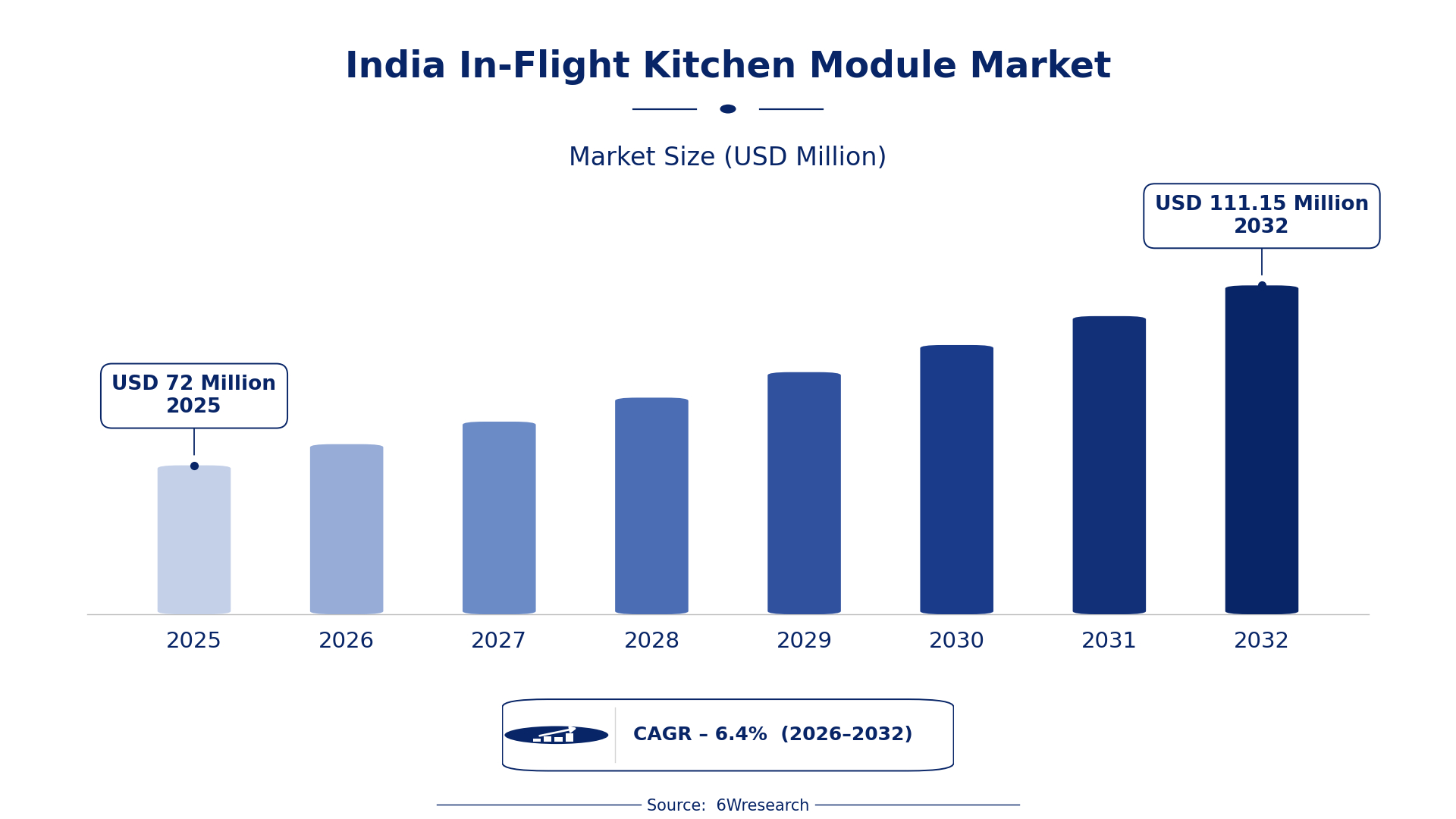
According to 6Wresearch internal database and industry insights, the India In-Flight Kitchen Module Market was valued at USD 72.0 million in 2025 and is projected to reach USD 111.15 million by 2032, growing at a CAGR of approximately 6.4% during 2026–2032.
India In-Flight Kitchen Module Market Highlights
| Report Metric | Details |
| Report Name | India In-Flight Kitchen Module Market |
| Market Size 2025 | USD 72.0 million |
| Market Size 2032 | USD 111.15 million |
| Absolute Growth 2025–2032 | USD 39.15 million |
| CAGR 2026–2032 | 6.4% |
| Peak Annual Growth | 8.8% in 2031 |
| Forecast Period | 2026–2032 |
| Historical Data | 2022–2025 |
| Base Year | 2025 |
| Leading Module Type, 2025 | Galley Inserts (43% share) |
| Leading Material Type, 2025 | Aluminum / Composites (46% share) |
| Leading Placement Zone, 2025 | Business Class Kitchens (45% share) |
| Leading Distribution Channel, 2025 | OEM Catering Integrators (38% share) |
| Fastest-Growing Module Type | Ovens and Warmers (7.9% CAGR) |
| Fastest-Growing Placement Zone | Galley Systems (8.3% CAGR) |
| Fastest-Growing Distribution Channel | Galley Equipment Suppliers (8.1% CAGR) |
| Growing Sector | Galley Equipment Suppliers |
| Key End Users | OEM Catering Integrators, Galley Equipment Suppliers, Airline Catering OEMs, Avionics Retail Chains |
India In-Flight Kitchen Module Market Year-wise Growth Rate and Key Drivers (2022–2032)
This graph illustrates the annual growth rates of the market from 2022 to 2032, highlighting a steady upward trajectory and projected market expansion over the forecast period.
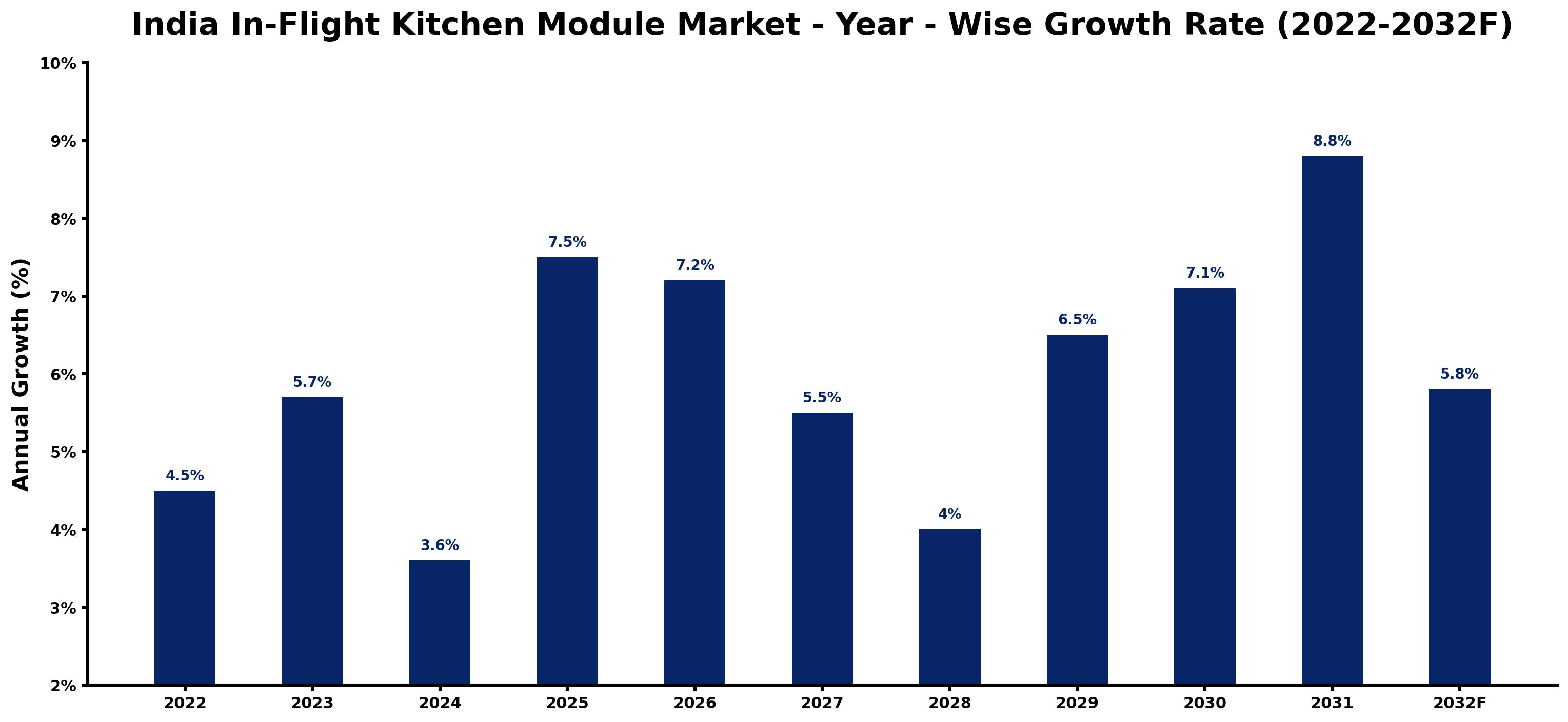
The table below sets out the estimated growth rate for each year and the main factor behind it.
| Year | Estimated Annual Growth (%) | Market Rationale |
| 2022 | 4.5 | The market experienced steady growth as airlines focused on enhancing in-flight services. |
| 2023 | 5.7 | Demand increased due to rising passenger numbers and investments in kitchen module upgrades. |
| 2024 | 3.6 | Growth slowed as airlines adjusted to new safety regulations impacting procurement timelines. |
| 2025 | 7.5 | The market surged as airlines expanded their premium services, boosting kitchen module demand. |
| 2026 | 7.2 | A slight slowdown occurred as airlines faced supply chain challenges affecting module production. |
| 2027 | 5.5 | Demand continued to slow, influenced by increased competition among domestic airlines. |
| 2028 | 4.0 | The market growth rate decreased as airlines focused on cost management amid rising operational expenses. |
| 2029 | 6.5 | Growth accelerated again as airlines invested in modern galley systems to improve service quality. |
| 2030 | 7.1 | Demand rose as the aviation sector prepared for a significant increase in passenger traffic. |
| 2031 | 8.8 | The market peaked as airlines prioritised upgrades to meet evolving passenger expectations. |
| 2032 | 5.8 | Growth slowed as airlines balanced investments with the need for operational efficiency. |
Note: Market size estimations and growth projections presented in this report are based on 6Wresearch's proprietary forecasting methodology, utilizing the latest available industry data, government publications, and primary research inputs.
India In-Flight Kitchen Module Market Synopsis
The In-Flight Kitchen Module Market in India encompasses specialized equipment used in aircraft for meal preparation and service. These modules are constructed from lightweight materials like aluminum and composites, optimizing space and weight. The market is growing due to increasing passenger numbers, with the aviation sector projected to reach 1.1 billion passengers by 2030. Domestic airlines and international carriers are investing in modern galley systems to improve service quality. Initiatives like the National Civil Aviation Policy are driving demand for in-flight catering services.
Market Dynamics Impact Analysis (2026–2032)
| Factor | Type | Impact | Primary Segment Affected |
| Growing passenger traffic and airline investments in service quality | Driver | High | Galley Inserts |
| Increasing focus on food safety and quality standards | Driver | High | Refrigeration Units |
| Rising demand for premium in-flight experiences | Opportunity | High | Business Class Kitchens |
| Expansion of regional airports enhancing connectivity | Opportunity | High | Galley Systems |
| Challenges in sourcing lightweight materials | Restraint | Medium | Aluminum / Composites |
| Regulatory compliance costs impacting small suppliers | Restraint | Medium | Galley Equipment Suppliers |
| Supply chain disruptions affecting timely deliveries | Challenge | High | OEM Catering Integrators |
| Competition among airlines for catering contracts | Challenge | Medium | Airline Catering OEMs |
Evaluation of Drivers in India In-Flight Kitchen Module Market (2026–2032)
The table below links each growth driver to the segment it affects and the evidence for it.
| Drivers | Primary Segment Affected | Why It Matters (Evidence) |
| Increasing passenger numbers driving demand for meal services | Galley Inserts | India's aviation sector is projected to reach 1.1 billion passengers by 2030, prompting airlines to improve meal services. |
| Investments in modern galley systems for improved service | Refrigeration Units | Airlines are investing in modern galley systems, resulting in higher demand for refrigeration units to maintain food quality. |
| Focus on food safety regulations improving equipment standards | Ovens and Warmers | The Bureau of Civil Aviation Security sets standards that require airlines to upgrade their in-flight kitchen modules, increasing demand for ovens. |
| Growth in premium travel segments boosting kitchen module needs | Business Class Kitchens | As airlines expand premium services, the demand for specialized kitchen modules in business class is rising. |
| Regional connectivity initiatives increasing flight frequencies | Galley Systems | The government's push for regional airports is resulting in more flights, thus increasing the need for efficient galley systems. |
Growth in the In-Flight Kitchen Module market in India comes from rising passenger traffic, airline investments in service quality, and compliance with food safety standards. The aviation sector is projected to reach 1.1 billion passengers by 2030, prompting airlines to improve meal services. Investments in modern galley systems are driving demand for refrigeration units to maintain food quality. New standards from the Bureau of Civil Aviation Security require airlines to upgrade their in-flight kitchen modules, boosting demand for ovens. As airlines expand premium services, the need for specialized kitchen modules in business class is rising, further driving growth.
Evaluation of Restraints in India In-Flight Kitchen Module Market
The following restraints limit how fast demand can grow.
| Market Restraint | Primary Segment Affected | Why It Matters (Evidence) |
| Challenges in sourcing lightweight materials for kitchen modules | Aluminum / Composites | Supply chain disruptions have made it difficult for manufacturers to obtain necessary lightweight materials. |
| Regulatory compliance costs impacting small suppliers | Galley Equipment Suppliers | Smaller suppliers struggle to meet stringent regulations, limiting their ability to compete effectively. |
| Increased operational costs for airlines affecting budgets | OEM Catering Integrators | Rising operational costs have led airlines to reassess their catering budgets, impacting demand for new modules. |
| Limited availability of skilled labour for installation and maintenance | Airline Catering OEMs | A shortage of skilled labour affects the timely installation and maintenance of kitchen modules. |
| Market volatility impacting investment decisions | Galley Systems | Economic fluctuations create uncertainty, causing airlines to delay investments in new kitchen systems. |
India In-Flight Kitchen Module Market Challenges
Buyers and suppliers in the India In-Flight Kitchen Module market encounter supply chain disruptions due to shortages of lightweight materials like aluminium and composites, which delay production timelines and increase costs for manufacturers. Competition intensifies among domestic airlines as they strive to improve passenger experience, placing pressure on suppliers to deliver solutions more swiftly, which can lead to higher costs. Regulatory standards from the Bureau of Civil Aviation Security slow the adoption of new technologies, impacting operational efficiency for airlines. Increased investments in in-flight catering by airlines to meet growing passenger demands may result in higher ticket prices for consumers, influencing overall demand.
Trends in the India In-Flight Kitchen Module Market
Below mentioned are some of the trends shaping the India In-Flight Kitchen Module Market growth.
- Shift towards Sustainable In-Flight Catering Practices: Airlines are increasingly embracing sustainable practices in in-flight catering to minimise waste. For instance, initiatives aimed at reducing single-use plastics are gaining momentum, with a reported 30% reduction in waste anticipated by 2025.
- Increase in Premium In-Flight Services: The demand for premium in-flight services is on the rise, as airlines concentrate on enhancing passenger experiences. By 2030, it is projected that 40% of airlines will upgrade their kitchen modules for business class offerings.
- Adoption of Smart Kitchen Technology: Smart kitchen technology is being incorporated into in-flight catering, enhancing efficiency and service. Reports suggest that 25% of new modules will feature smart technology by 2025.
- Expansion of Regional Airport Connectivity: The Indian government is improving regional airport connectivity, resulting in increased flight frequencies. This initiative, which started in 2020, is expected to substantially boost demand for in-flight catering.
Investment Opportunities in the India In-Flight Kitchen Module Market
Some of the investment opportunities in the India In-Flight Kitchen Module Market are mentioned below.
- Regional Airports Expansion: With over 100 operational airports, there is an opportunity to supply modern kitchen modules to regional airlines. The government aims to enhance connectivity, generating demand for efficient in-flight services.
- Sustainable Kitchen Solutions: The shift towards sustainable practices offers an opportunity to provide eco-friendly kitchen modules. Airlines are increasingly focused on waste reduction, creating demand for innovative solutions.
- Smart Kitchen Technology Integration: As airlines adopt smart technology, a gap exists in the market for suppliers of advanced kitchen modules. Collaborating with airlines to develop these solutions can be advantageous.
- Investment in Premium Services: The rising demand for premium in-flight services presents a chance to supply specialised kitchen modules. Airlines are investing in upgrades, creating opportunities for suppliers.
Government Initiatives in the India In-Flight Kitchen Module Market
The National Civil Aviation Policy 2016, launched by the Ministry of Civil Aviation, aims to enhance regional connectivity and in-flight services. This policy encourages investments in modern kitchen modules, ensuring compliance with safety standards. The Bureau of Civil Aviation Security updated catering security guidelines in 2021 to maintain food safety and quality, requiring producers to adhere to stricter regulations in their kitchen modules. The Directorate General of Civil Aviation issued guidelines in 2022 for the standardisation of in-flight catering equipment, ensuring uniformity across airlines. The Food Safety and Standards Authority of India (FSSAI) implemented new regulations in 2021 to ensure food safety in in-flight catering, requiring airlines to meet specific safety standards, thus impacting their procurement strategies.
Airlines utilise the 'Ude Desh ka Aam Naagrik' scheme to promote affordable air travel and improve catering services. This initiative supports investments in regional airports, leading to increased flight frequencies and higher demand for in-flight kitchen modules. The Airports Authority of India oversees airport operations and catering standards, ensuring compliance with regulations. The Directorate General of Civil Aviation provides approvals for new catering facilities, facilitating the entry of modern kitchen modules into the market. These measures collectively improve the operational framework for in-flight catering, benefiting both producers and airlines.
Future Insight of the India In-Flight Kitchen Module Market
The India In-Flight Kitchen Module market is set for growth as the aviation sector prepares for 1.1 billion passengers by 2030, backed by government initiatives to enhance regional connectivity. Airlines will prioritise investments in modern galley systems to elevate service quality and improve the passenger experience. A shift towards sustainable practices will drive innovations aimed at reducing waste and enhancing meal preparation efficiency. With over 100 operational airports, the existing infrastructure will support the expansion of in-flight catering services, creating opportunities for both buyers and suppliers.
Market Segmentation Analysis
The analysis below covers each segmentation, its leading category in 2025 and its fastest-growing category through 2032.
By Module Type – Galley Inserts Dominated, Ovens and Warmers Expected to Grow Fastest
According to Shubham Deep, Research Manager at 6Wresearch, Galley Inserts accounted for a 43% market share by module type in 2025. Galley Inserts hold the largest share as they are essential for meal preparation and storage during flights, directly influencing in-flight catering efficiency. Their critical role in domestic airlines, which are projected to serve 1.1 billion passengers by 2030, underscores their importance. The quickest growth will come from Ovens and Warmers, forecast to expand at a CAGR of 7.9% between 2026 and 2032. Ovens and Warmers are set for rapid growth as airlines invest in modern galley systems to enhance passenger experiences. This focus on improving meal service quality will continue to drive demand for effective heating solutions. Suppliers should prioritise advancements in oven and warmer technologies to meet the evolving expectations of airlines.
By Material Type – Aluminum / Composites Dominated and Is Expected to Record the Fastest Growth
With a 46% revenue share in 2025, Aluminum / Composites was the largest material type category. Aluminum / Composites dominate the market share due to their widespread use in lightweight and durable modules, which are vital for aircraft efficiency. Their common application in galley systems supports the aviation industry's objective of improved operational performance. Aluminum / Composites are also forecast to expand faster than any other category, at a CAGR of 8.4% over 2026–2032. The growth of Aluminum / Composites is expected to accelerate as airlines increasingly adopt these materials for new galley systems, solidifying their market leadership. This trend will likely widen the gap between this segment and alternatives. Buyers should focus on sourcing modules made from aluminum and composites to ensure compliance with industry standards and enhance operational efficiency.
By Placement Zone – Business Class Kitchens Dominated, Galley Systems Expected to Grow Fastest
In 2025, Business Class Kitchens led the placement zone split with a 45% share. Business Class Kitchens command the largest share as they are specifically designed to elevate meal service in premium cabins, catering to the growing demand for luxury travel experiences. This segment's focus on quality service aligns with increasing passenger expectations in the aviation sector. Over 2026–2032, Galley Systems are expected to post the fastest growth, at a CAGR of 8.3%. Galley Systems are experiencing the fastest growth because they are integral to the aircraft's food service infrastructure, reflecting airlines' investments in modernising their catering operations. This shift indicates a trend towards more efficient and technologically advanced in-flight services. Suppliers should develop versatile galley systems that accommodate various aircraft designs and service needs.
By Distribution Channel – OEM Catering Integrators Dominated, Galley Equipment Suppliers Expected to Grow Fastest
OEM Catering Integrators held a 38% share of the India In-Flight Kitchen Module Market by distribution channel in 2025. OEM Catering Integrators lead the market share as they are essential for integrating kitchen modules into aircraft designs, ensuring compliance with aviation standards. Their established relationships with airlines position them as key players in the supply chain. Galley Equipment Suppliers are set to record the highest CAGR in this split, 8.1% over 2026–2032. Galley Equipment Suppliers are witnessing rapid growth due to the increasing demand for kitchen modules directly from airlines aiming to enhance their in-flight offerings. This shift highlights the industry's move towards direct procurement models. Suppliers should strengthen partnerships with galley equipment suppliers to secure a competitive edge in distributing in-flight kitchen modules.
Key Attractiveness of the Report
- 10 Years of Market Numbers
- Historical Data Starting from 2022 to 2025
- Base Year 2025
- Forecast Data until 2032
- Key Performance Indicators Impacting the Market
- Major Upcoming Developments and Projects
Key Highlights of the Report:
- India In-Flight Kitchen Module Market Outlook
- Market Size of India In-Flight Kitchen Module Market, 2025
- Forecast of India In-Flight Kitchen Module Market, 2032
- Historical Data and Forecast of India In-Flight Kitchen Module Revenues & Volume for the Period 2022 - 2032F
- India In-Flight Kitchen Module Market Trend Evolution
- India In-Flight Kitchen Module Market Drivers and Challenges
- India In-Flight Kitchen Module Price Trends
- India In-Flight Kitchen Module Porter's Five Forces
- India In-Flight Kitchen Module Industry Life Cycle
- Historical Data and Forecast of India In-Flight Kitchen Module Market Revenues & Volume By Module Type for the Period 2022 - 2032F
- Historical Data and Forecast of India In-Flight Kitchen Module Market Revenues & Volume By Galley Inserts for the Period 2022 - 2032F
- Historical Data and Forecast of India In-Flight Kitchen Module Market Revenues & Volume By Refrigeration Units for the Period 2022 - 2032F
- Historical Data and Forecast of India In-Flight Kitchen Module Market Revenues & Volume By Ovens and Warmers for the Period 2022 - 2032F
- Historical Data and Forecast of India In-Flight Kitchen Module Market Revenues & Volume By Coffee Makers for the Period 2022 - 2032F
- Historical Data and Forecast of India In-Flight Kitchen Module Market Revenues & Volume By Material Type for the Period 2022 - 2032F
- Historical Data and Forecast of India In-Flight Kitchen Module Market Revenues & Volume By Aluminum / Composites for the Period 2022 - 2032F
- Historical Data and Forecast of India In-Flight Kitchen Module Market Revenues & Volume By Steel / Composite for the Period 2022 - 2032F
- Historical Data and Forecast of India In-Flight Kitchen Module Market Revenues & Volume By Electric / Convection for the Period 2022 - 2032F
- Historical Data and Forecast of India In-Flight Kitchen Module Market Revenues & Volume By Modular Units for the Period 2022 - 2032F
- Historical Data and Forecast of India In-Flight Kitchen Module Market Revenues & Volume By Placement Zone for the Period 2022 - 2032F
- Historical Data and Forecast of India In-Flight Kitchen Module Market Revenues & Volume By Aft / Front Section for the Period 2022 - 2032F
- Historical Data and Forecast of India In-Flight Kitchen Module Market Revenues & Volume By Galley Systems for the Period 2022 - 2032F
- Historical Data and Forecast of India In-Flight Kitchen Module Market Revenues & Volume By Business Class Kitchens for the Period 2022 - 2032F
- Historical Data and Forecast of India In-Flight Kitchen Module Market Revenues & Volume By Beverage Service for the Period 2022 - 2032F
- Historical Data and Forecast of India In-Flight Kitchen Module Market Revenues & Volume By Distribution Channel for the Period 2022 - 2032F
- Historical Data and Forecast of India In-Flight Kitchen Module Market Revenues & Volume By Galley Equipment Suppliers for the Period 2022 - 2032F
- Historical Data and Forecast of India In-Flight Kitchen Module Market Revenues & Volume By OEM Catering Integrators for the Period 2022 - 2032F
- Historical Data and Forecast of India In-Flight Kitchen Module Market Revenues & Volume By Airline Catering OEMs for the Period 2022 - 2032F
- Historical Data and Forecast of India In-Flight Kitchen Module Market Revenues & Volume By Avionics Retail Chains for the Period 2022 - 2032F
- India In-Flight Kitchen Module Import Export Trade Statistics
- Market Opportunity Assessment By Module Type
- Market Opportunity Assessment By Material Type
- Market Opportunity Assessment By Placement Zone
- Market Opportunity Assessment By Distribution Channel
- India In-Flight Kitchen Module Top Companies Market Share
- India In-Flight Kitchen Module Competitive Benchmarking By Technical and Operational Parameters
- India In-Flight Kitchen Module Company Profiles
- India In-Flight Kitchen Module Key Strategic Recommendations
Market Covered
The report offers an extensive study of the following market segments.
By Module Type
- Galley Inserts
- Refrigeration Units
- Ovens and Warmers
- Coffee Makers
By Material Type
- Aluminum / Composites
- Steel / Composite
- Electric / Convection
- Modular Units
By Placement Zone
- Aft / Front Section
- Galley Systems
- Business Class Kitchens
- Beverage Service
By Distribution Channel
- Galley Equipment Suppliers
- OEM Catering Integrators
- Airline Catering OEMs
- Avionics Retail Chains































