India In-Line Air Detection Market Size & Growth Rate
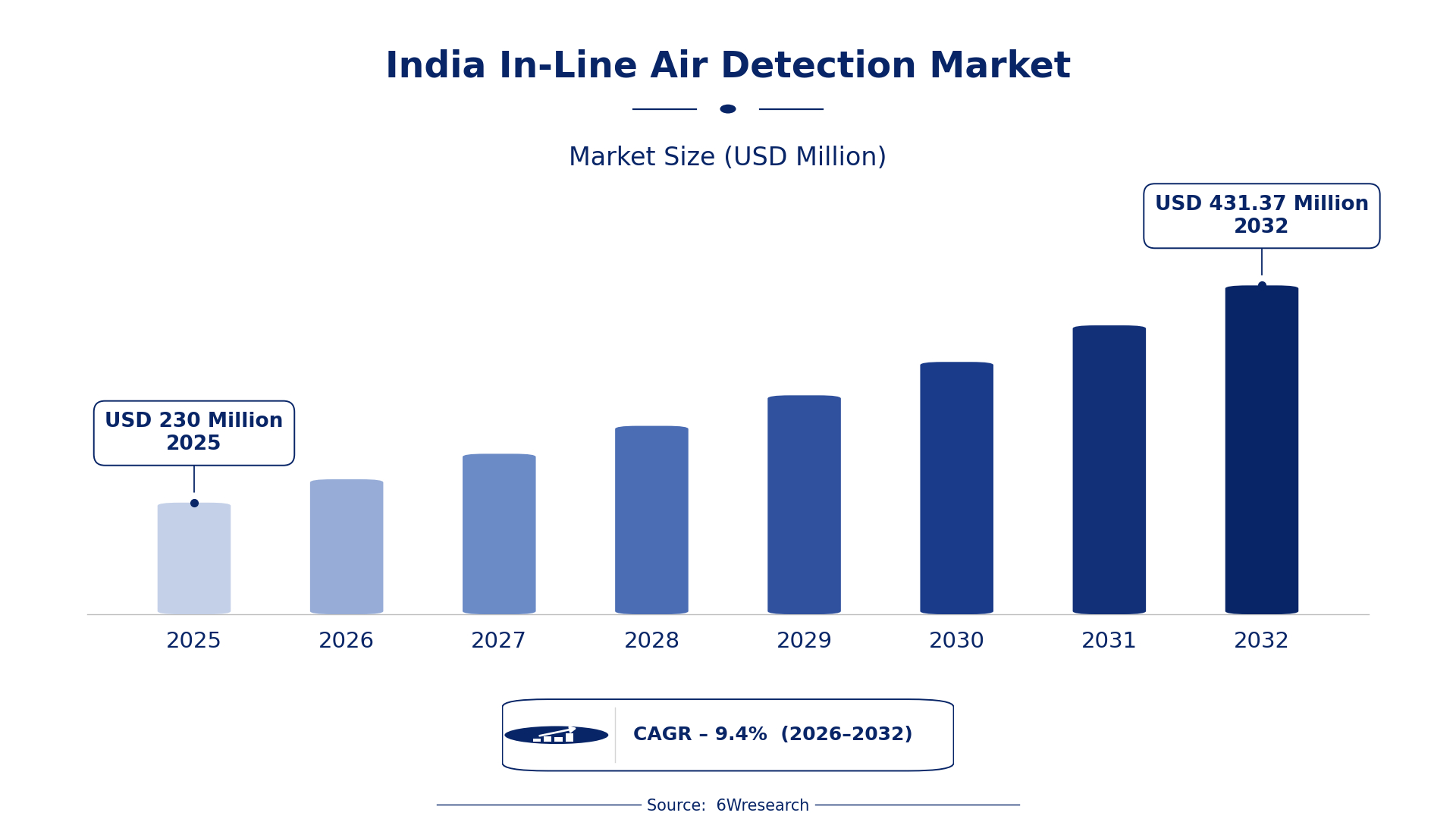
According to 6Wresearch internal database and industry insights, the India In-Line Air Detection Market was valued at USD 230.0 million in 2025 and is projected to reach USD 431.37 million by 2032, growing at a CAGR of approximately 9.4% during 2026–2032.
India In-Line Air Detection Market Highlights
| Report Metric | Details |
| Report Name | India In-Line Air Detection Market |
| Market Size 2025 | USD 230.0 million |
| Market Size 2032 | USD 431.37 million |
| Absolute Growth 2025–2032 | USD 201.37 million |
| CAGR 2026–2032 | 9.4% |
| Peak Annual Growth | 11.2% in 2032 |
| Forecast Period | 2026–2032 |
| Historical Data | 2022–2025 |
| Base Year | 2025 |
| Leading Detection Type, 2025 | Air-in-Line Sensors (43% share) |
| Leading Application Area, 2025 | IV Infusion Lines (40% share) |
| Leading Sensor Technology, 2025 | Ultrasonic Sensors (53% share) |
| Leading Device Placement, 2025 | Device Integrated (36% share) |
| Leading End User Sector, 2025 | Hospitals (39% share) |
| Fastest-Growing Detection Type | Microbubble Detection (11.2% CAGR) |
| Fastest-Growing Application Area | Dialysis Machines (11.7% CAGR) |
| Fastest-Growing Sensor Technology | Optical Detectors (11.4% CAGR) |
| Fastest-Growing Device Placement | Embedded (11.3% CAGR) |
| Fastest-Growing End User Sector | Nephrology Centers (11.8% CAGR) |
| Growing Sector | Dialysis Machines |
| Key End Users | IV Infusion Lines, Dialysis Machines, Ventilators, IV Contrast Agents |
India In-Line Air Detection Market Year-wise Growth Rate and Key Drivers (2022–2032)
This graph illustrates the annual growth rates of the market from 2022 to 2032, highlighting a steady upward trajectory and projected market expansion over the forecast period.
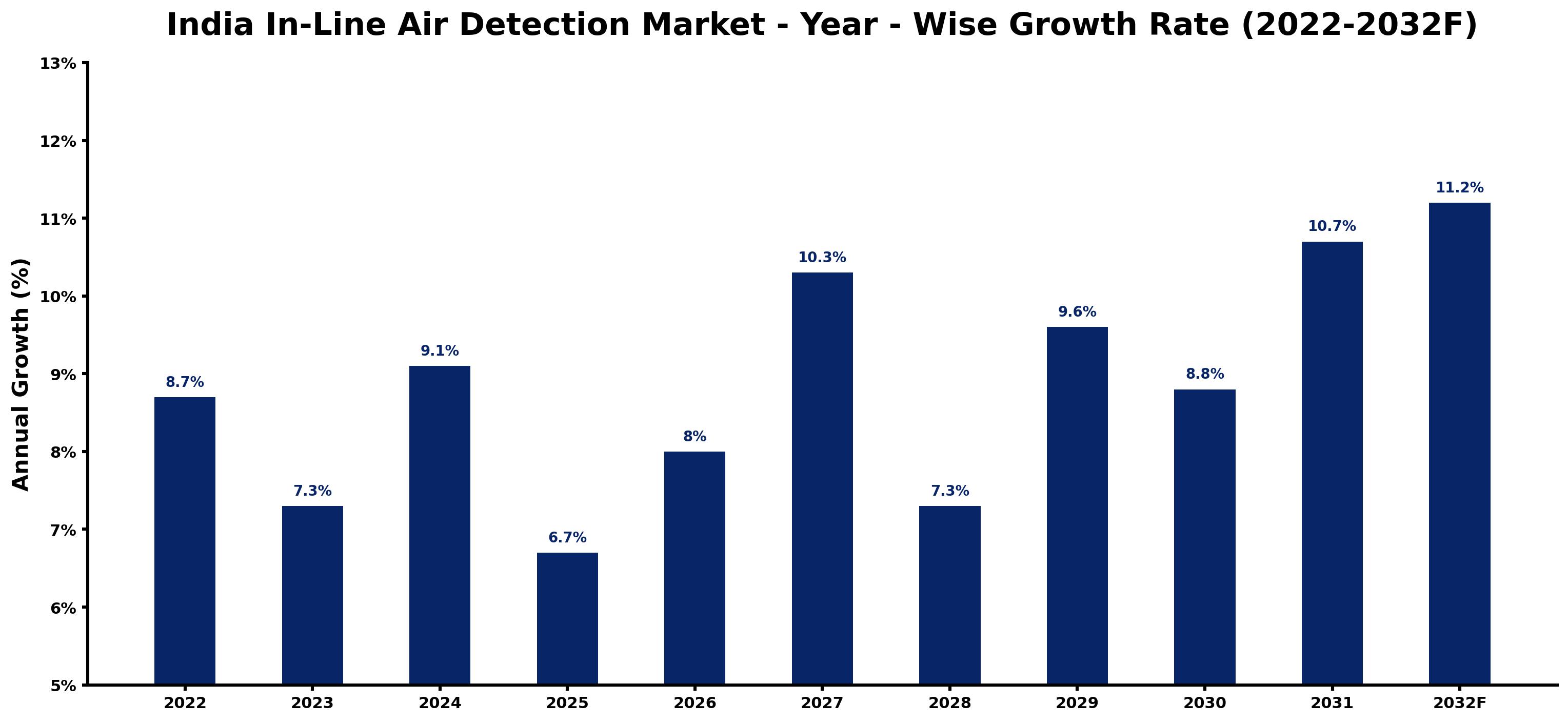
Each row of the following table gives one year's estimated growth and the event or demand shift that explains it.
| Year | Estimated Annual Growth (%) | Market Rationale |
| 2022 | 8.7 | The market experienced steady growth due to increasing healthcare investments from the National Health Mission. |
| 2023 | 7.3 | Demand growth slowed as hospitals adjusted to the Medical Devices Rules, 2017, for new medical device standards. |
| 2024 | 9.1 | Growth accelerated with the rising adoption of IV infusion technologies in hospitals across the country. |
| 2025 | 6.7 | Market growth slowed as hospitals faced budget constraints on new equipment purchases. |
| 2026 | 8.0 | Demand increased as nephrology centers expanded their dialysis capabilities to meet patient needs. |
| 2027 | 10.3 | The market saw a rise in demand driven by advancements in ultrasonic sensor technology. |
| 2028 | 7.3 | Growth slowed as hospitals focused on optimizing existing medical devices to improve efficiency. |
| 2029 | 9.6 | Demand increased with the expansion of critical care units in hospitals, enhancing patient safety. |
| 2030 | 8.8 | Growth slowed as competition among suppliers intensified, affecting pricing strategies in the market. |
| 2031 | 10.7 | Demand surged as hospitals upgraded to meet new healthcare standards and improve patient outcomes. |
| 2032 | 11.2 | The market peaked with the implementation of advanced detection technologies in medical devices. |
Note: Market size estimations and growth projections presented in this report are based on 6Wresearch's proprietary forecasting methodology, utilizing the latest available industry data, government publications, and primary research inputs.
India In-Line Air Detection Market Synopsis
In-Line Air Detection technology in India identifies and eliminates air bubbles in medical fluid delivery systems, ensuring patient safety during IV infusions and dialysis procedures. The India In-Line Air Detection Market is expanding due to rising healthcare investments and the growth of nephrology centers. The National Health Mission's focus on improving healthcare quality further drives demand for these technologies. With over 1,500 hospitals equipped with advanced devices, the market is set for substantial growth as patient safety remains a priority.
Market Dynamics Impact Analysis (2026–2032)
| Factor | Type | Impact | Primary Segment Affected |
| Increasing healthcare investments are driving demand for advanced medical devices. | Driver | High | IV Infusion Lines |
| Expansion of nephrology centers is creating a need for dialysis machines. | Driver | High | Dialysis Machines |
| Growing demand for patient safety technologies presents investment opportunities. | Opportunity | High | Air-in-Line Sensors |
| The rise of telemedicine creates demand for remote monitoring solutions. | Opportunity | Medium | Remote Monitoring |
| Budget constraints in hospitals limit the purchase of new technologies. | Restraint | High | Hospitals |
| Competition among suppliers may lead to price wars, affecting margins. | Restraint | Medium | Nephrology Centers |
| Limited awareness of advanced air detection technologies hampers adoption. | Challenge | High | Critical Care Units |
| Regulatory hurdles can delay the introduction of new devices. | Challenge | Medium | Imaging Clinics |
Evaluation of Drivers in India In-Line Air Detection Market (2026–2032)
The table below links each growth driver to the segment it affects and the evidence for it.
| Drivers | Primary Segment Affected | Why It Matters (Evidence) |
| Increased healthcare spending on advanced medical technologies. | IV Infusion Lines | In 2022, over 1,500 hospitals in India adopted advanced medical devices, boosting demand. |
| Expansion of nephrology centers necessitating advanced dialysis machines. | Dialysis Machines | With over 200 nephrology centers operating in India, demand for dialysis technologies is rising. |
| Growing focus on patient safety driving investments in air detection technologies. | Air-in-Line Sensors | The National Health Mission aims to improve healthcare quality, increasing demand for safety technologies. |
| Adoption of new medical standards encouraging hospitals to upgrade equipment. | Hospitals | The Medical Devices Rules, 2017, promote the use of advanced technologies in healthcare. |
| Technological advancements in sensor technology improving detection capabilities. | Ultrasonic Sensors | The rise of ultrasonic sensors in medical devices improves patient safety and monitoring. |
The In-Line Air Detection market in India is expanding due to rising healthcare spending, the proliferation of nephrology centres, and advancements in sensor technology. In 2022, over 1,500 hospitals adopted advanced medical devices, which increased the demand for air detection technologies. The emphasis on patient safety has prompted investments in these technologies, with the National Health Mission advocating for quality improvements. The demand for advanced dialysis machines is increasing as more nephrology centres operate nationwide. Technological advancements in sensor technology are improving detection capabilities, ensuring better monitoring and safety for patients.
Evaluation of Restraints in India In-Line Air Detection Market
The table below lists the restraints and the evidence behind each.
| Market Restraint | Primary Segment Affected | Why It Matters (Evidence) |
| Limited availability of advanced medical devices in hospitals. | IV Infusion Lines | Only over 1,500 hospitals are equipped with such technologies, restricting patient safety during procedures. |
| Struggles to meet ISO 13485 standards delaying technology adoption. | Dialysis Machines | Many facilities face challenges in compliance, which affects the availability of essential technologies. |
| A leading supplier on outdated technology affecting supply chains. | Air-in-Line Sensors | Producers cannot efficiently source modern sensors, leading to longer lead times for hospitals. |
| Skills gap in the workforce hampers effective device use. | Hospitals | Inadequate training for staff in over 200 nephrology centers can compromise patient care. |
| Budget constraints limiting equipment upgrades in hospitals. | Critical Care Units | Hospitals often face financial limitations that hinder the adoption of advanced detection technologies. |
India In-Line Air Detection Market Challenges
The India In-Line Air Detection market encounters several practical issues, starting with limited access to advanced medical devices; only over 1,500 hospitals are equipped with these technologies, which compromises patient safety during IV infusions and dialysis procedures. Many facilities struggle to meet ISO 13485 standards, causing delays in implementing essential technologies for buyers. Outdated technology disrupts supply chains, as producers face challenges in sourcing modern sensors, resulting in longer lead times for healthcare providers. A skills gap in the workforce further complicates the effective use of these devices, leading to inadequate training for nephrology centres, which can negatively impact patient care.
Trends in the India In-Line Air Detection Market
The trends below show where the India In-Line Air Detection Market is heading.
- Shift towards Advanced Sensor Technologies: The focus on improving healthcare quality has led to a shift towards advanced sensor technologies in medical devices. In 2023, the integration of these technologies in over 1,500 hospitals has improved patient safety.
- Transition from Manual to Automated Monitoring: Since 2023, hospitals have increasingly adopted automated monitoring systems for IV infusions. This change is evident in nephrology centres, where many facilities have integrated these systems to improve patient outcomes.
- Emergence of Integrated Medical Devices: The trend towards integrated medical devices has gained traction in India, particularly in critical care units. In 2022, the market for integrated devices was valued at approximately $1.2 billion, reflecting growing demand.
- Prioritisation of Patient Safety Standards: Following the Medical Devices Rules, 2017, hospitals have prioritised compliance with patient safety standards. This shift has resulted in increased investments in air detection technologies across the healthcare sector.
Investment Opportunities in the India In-Line Air Detection Market
Investors looking at the India In-Line Air Detection Market should consider the following areas.
- Supply of Advanced Medical Devices: With over 1,500 hospitals in India, there is an opportunity to supply advanced medical devices. The market is expected to grow as hospitals upgrade their equipment to meet new standards.
- Investment in Nephrology Technologies: The need for advanced dialysis machines is rising, especially with over 200 nephrology centres operating in India. Suppliers can enter this market by partnering with local healthcare providers.
- Development of Integrated Air Detection Systems: There is a growing demand for integrated air detection systems in hospitals, driven by the focus on patient safety. Investing in this technology can meet the needs of critical care units effectively.
- Expansion of Sensor Technology Solutions: The rise of ultrasonic and optical sensors presents an opportunity for suppliers to expand their offerings. The market is projected to grow as hospitals adopt these technologies.
Government Initiatives in the India In-Line Air Detection Market
The National Medical Devices Policy, launched in 2021, promotes indigenous manufacturing and innovation in the medical devices sector. This policy aims to improve production capabilities and reduce reliance on imports, benefiting producers and buyers alike. By encouraging local manufacturing, the policy is expected to enhance the availability of advanced medical devices in India, supporting healthcare facilities in their operations.
The Bureau of Indian Standards oversees the implementation of the Medical Devices Rules, 2017, which streamline the approval process for new medical devices. This agency funds initiatives that promote compliance with safety standards, enabling producers to bring innovative products to market more efficiently.
Future Insight of the India In-Line Air Detection Market
By 2032, transformative changes are expected in the India In-Line Air Detection market, influenced by the National Health Mission's focus on improving healthcare accessibility and quality. The launch of the 'Ayushman Bharat Digital Mission' will facilitate better healthcare delivery, promoting seamless integration of technology in medical practices. The National Medical Devices Policy, 2023, will encourage domestic manufacturing, thereby reducing reliance on imports. With a population exceeding 1.4 billion, the demand for effective medical solutions will likely rise, prompting suppliers to innovate and address critical patient safety requirements.
Market Segmentation Analysis
The report offers a comprehensive study of the following market segments and their leading categories in the market.
By Detection Type – Air-in-Line Sensors Dominated, Microbubble Detection Expected to Grow Fastest
According to Shubham Deep, Research Manager at 6Wresearch, Air-in-Line Sensors held a 43% share of the India In-Line Air Detection Market by detection type in 2025. Air-in-Line Sensors hold the largest market share as they are essential for preventing air embolisms during medical procedures. With over 1,500 hospitals in India equipped with advanced medical devices, the demand for these sensors remains strong. Microbubble Detection is set to record the highest CAGR in this split, 11.2% over 2026–2032. Microbubble Detection is gaining momentum due to its critical role in ensuring patient safety during IV infusions. The increasing emphasis on patient safety in hospitals significantly propels this segment's growth. Suppliers should focus on enhancing air-in-line sensor offerings to meet the rising demand from hospitals.
By Application Area – IV Infusion Lines Dominated, Dialysis Machines Expected to Grow Fastest
IV Infusion Lines accounted for a 40% market share by application area in 2025. IV Infusion Lines lead the market owing to their extensive use in hospitals for medication delivery, which is essential for safe and effective treatment. This widespread application across numerous healthcare facilities reinforces their dominant position. The quickest growth will come from Dialysis Machines, forecast to expand at a CAGR of 11.7% between 2026 and 2032. Dialysis Machines are experiencing the fastest growth due to the rising number of nephrology centers in India, which are essential for patient treatment. The increasing prevalence of kidney diseases is propelling this segment forward. Buyers can expect improved availability and innovation in dialysis machines as demand continues to escalate.
By Sensor Technology – Ultrasonic Sensors Dominated, Optical Detectors Expected to Grow Fastest
The largest sensor technology category in 2025 was Ultrasonic Sensors, with a 53% share of total revenue. Ultrasonic Sensors lead the market primarily because of their effectiveness in detecting air bubbles in medical fluids. Their extensive use in hospitals ensures a robust installed base, reinforcing their market share. Over 2026–2032, Optical Detectors are expected to post the fastest growth, at a CAGR of 11.4%. Optical Detectors are experiencing rapid growth as they provide effective monitoring of fluid clarity and air presence, which is increasingly vital in medical applications. This technology's versatility boosts its appeal across various medical devices. Suppliers should prioritise the development of optical detection technologies to capitalise on the growing demand.
By Device Placement – Device Integrated Dominated, Embedded Expected to Grow Fastest
In 2025, Device Integrated led the device placement split with a 36% share. Device Integrated solutions dominate the market as they are built directly into medical devices for real-time detection, ensuring immediate response to air presence. This integration is crucial for maintaining patient safety during medical procedures. Embedded is projected to grow fastest, at a CAGR of 11.3% during 2026–2032. Embedded solutions are witnessing the fastest growth due to their adaptability in various medical devices, allowing for enhanced functionality. This trend is driven by the increasing need for compact and efficient medical technologies. Suppliers should prioritise the development of embedded solutions to align with the evolving requirements of healthcare providers.
By End User Sector – Hospitals Dominated, Nephrology Centers Expected to Grow Fastest
With a 39% revenue share in 2025, Hospitals was the largest end user sector category. Hospitals are the primary end-users of air detection technologies, essential for ensuring patient safety during medical procedures. Their extensive use of advanced medical devices solidifies their leading market share. Nephrology Centers are set to record the highest CAGR in this split, 11.8% over 2026–2032. Nephrology Centers are rapidly expanding as significant users of air detection technologies due to the high demand for dialysis treatments. The increasing number of patients requiring dialysis drives growth in this sector. Suppliers should tailor their offerings to meet the specific needs of nephrology centers as their market share continues to grow.
Key Attractiveness of the Report
- 10 Years of Market Numbers
- Historical Data Starting from 2022 to 2025
- Base Year 2025
- Forecast Data until 2032
- Key Performance Indicators Impacting the Market
- Major Upcoming Developments and Projects
Key Highlights of the Report:
- India In-Line Air Detection Market Outlook
- Market Size of India In-Line Air Detection Market, 2025
- Forecast of India In-Line Air Detection Market, 2032
- Historical Data and Forecast of India In-Line Air Detection Revenues & Volume for the Period 2022 - 2032F
- India In-Line Air Detection Market Trend Evolution
- India In-Line Air Detection Market Drivers and Challenges
- India In-Line Air Detection Price Trends
- India In-Line Air Detection Porter's Five Forces
- India In-Line Air Detection Industry Life Cycle
- Historical Data and Forecast of India In-Line Air Detection Market Revenues & Volume By Detection Type for the Period 2022 - 2032F
- Historical Data and Forecast of India In-Line Air Detection Market Revenues & Volume By Microbubble Detection for the Period 2022 - 2032F
- Historical Data and Forecast of India In-Line Air Detection Market Revenues & Volume By Air-in-Line Sensors for the Period 2022 - 2032F
- Historical Data and Forecast of India In-Line Air Detection Market Revenues & Volume By Respiratory Line Monitoring for the Period 2022 - 2032F
- Historical Data and Forecast of India In-Line Air Detection Market Revenues & Volume By Medical Imaging Contrast for the Period 2022 - 2032F
- Historical Data and Forecast of India In-Line Air Detection Market Revenues & Volume By Application Area for the Period 2022 - 2032F
- Historical Data and Forecast of India In-Line Air Detection Market Revenues & Volume By IV Infusion Lines for the Period 2022 - 2032F
- Historical Data and Forecast of India In-Line Air Detection Market Revenues & Volume By Dialysis Machines for the Period 2022 - 2032F
- Historical Data and Forecast of India In-Line Air Detection Market Revenues & Volume By Ventilators for the Period 2022 - 2032F
- Historical Data and Forecast of India In-Line Air Detection Market Revenues & Volume By IV Contrast Agents for the Period 2022 - 2032F
- Historical Data and Forecast of India In-Line Air Detection Market Revenues & Volume By Sensor Technology for the Period 2022 - 2032F
- Historical Data and Forecast of India In-Line Air Detection Market Revenues & Volume By Ultrasonic Sensors for the Period 2022 - 2032F
- Historical Data and Forecast of India In-Line Air Detection Market Revenues & Volume By Optical Detectors for the Period 2022 - 2032F
- Historical Data and Forecast of India In-Line Air Detection Market Revenues & Volume By Capacitive Sensors for the Period 2022 - 2032F
- Historical Data and Forecast of India In-Line Air Detection Market Revenues & Volume By Piezoelectric for the Period 2022 - 2032F
- Historical Data and Forecast of India In-Line Air Detection Market Revenues & Volume By Device Placement for the Period 2022 - 2032F
- Historical Data and Forecast of India In-Line Air Detection Market Revenues & Volume By Bedside Devices for the Period 2022 - 2032F
- Historical Data and Forecast of India In-Line Air Detection Market Revenues & Volume By Device Integrated for the Period 2022 - 2032F
- Historical Data and Forecast of India In-Line Air Detection Market Revenues & Volume By Embedded for the Period 2022 - 2032F
- Historical Data and Forecast of India In-Line Air Detection Market Revenues & Volume By Remote Monitoring for the Period 2022 - 2032F
- Historical Data and Forecast of India In-Line Air Detection Market Revenues & Volume By End User Sector for the Period 2022 - 2032F
- Historical Data and Forecast of India In-Line Air Detection Market Revenues & Volume By Hospitals for the Period 2022 - 2032F
- Historical Data and Forecast of India In-Line Air Detection Market Revenues & Volume By Nephrology Centers for the Period 2022 - 2032F
- Historical Data and Forecast of India In-Line Air Detection Market Revenues & Volume By Critical Care Units for the Period 2022 - 2032F
- Historical Data and Forecast of India In-Line Air Detection Market Revenues & Volume By Imaging Clinics for the Period 2022 - 2032F
- India In-Line Air Detection Import Export Trade Statistics
- Market Opportunity Assessment By Detection Type
- Market Opportunity Assessment By Application Area
- Market Opportunity Assessment By Sensor Technology
- Market Opportunity Assessment By Device Placement
- Market Opportunity Assessment By End User Sector
- India In-Line Air Detection Top Companies Market Share
- India In-Line Air Detection Competitive Benchmarking By Technical and Operational Parameters
- India In-Line Air Detection Company Profiles
- India In-Line Air Detection Key Strategic Recommendations
Market Covered
Segments analysed in this report are listed below.
By Detection Type
- Microbubble Detection
- Air-in-Line Sensors
- Respiratory Line Monitoring
- Medical Imaging Contrast
By Application Area
- IV Infusion Lines
- Dialysis Machines
- Ventilators
- IV Contrast Agents
By Sensor Technology
- Ultrasonic Sensors
- Optical Detectors
- Capacitive Sensors
- Piezoelectric
By Device Placement
- Bedside Devices
- Device Integrated
- Embedded
- Remote Monitoring
By End User Sector
- Hospitals
- Nephrology Centers
- Critical Care Units
- Imaging Clinics































