India In-Wheel Motor System Market Size & Growth Rate
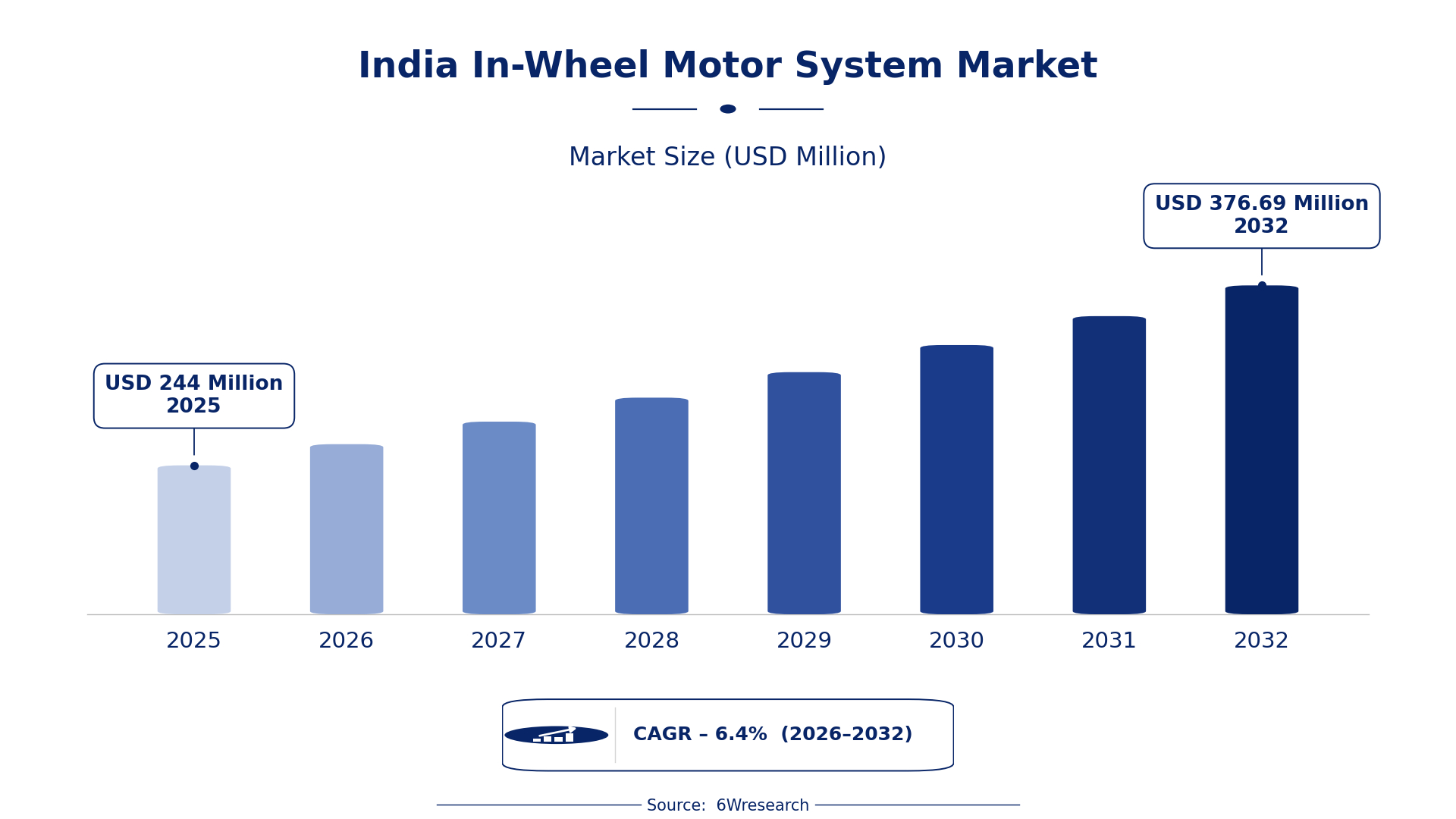
According to 6Wresearch internal database and industry insights, the India In-Wheel Motor System Market was valued at USD 244.0 million in 2025 and is projected to reach USD 376.69 million by 2032, growing at a CAGR of approximately 6.4% during 2026–2032.
India In-Wheel Motor System Market Highlights
| Report Metric | Details |
| Report Name | India In-Wheel Motor System Market |
| Market Size 2025 | USD 244.0 million |
| Market Size 2032 | USD 376.69 million |
| Absolute Growth 2025–2032 | USD 132.69 million |
| CAGR 2026–2032 | 6.4% |
| Peak Annual Growth | 8.0% in 2029 |
| Forecast Period | 2026–2032 |
| Historical Data | 2022–2025 |
| Base Year | 2025 |
| Leading Motor Type, 2025 | Permanent Magnet (48% share) |
| Leading Vehicle Type, 2025 | Electric Passenger Cars (44% share) |
| Leading Power Rating, 2025 | <50 kW (42% share) |
| Leading Distribution Channel, 2025 | OEMs (40% share) |
| Leading End User, 2025 | EV Manufacturers (39% share) |
| Fastest-Growing Motor Type | Brushless DC Motor (8.9% CAGR) |
| Fastest-Growing Vehicle Type | Two-Wheelers (8.0% CAGR) |
| Fastest-Growing Power Rating | 50–100 kW (7.7% CAGR) |
| Fastest-Growing Distribution Channel | Direct Sales (9.0% CAGR) |
| Fastest-Growing End User | Fleet Operators (8.8% CAGR) |
| Growing Sector | Electric Vehicles |
| Key End Users | EV Manufacturers, Fleet Operators, OEMs |
India In-Wheel Motor System Market Year-wise Growth Rate and Key Drivers (2022–2032)
This graph illustrates the annual growth rates of the market from 2022 to 2032, highlighting a steady upward trajectory and projected market expansion over the forecast period.
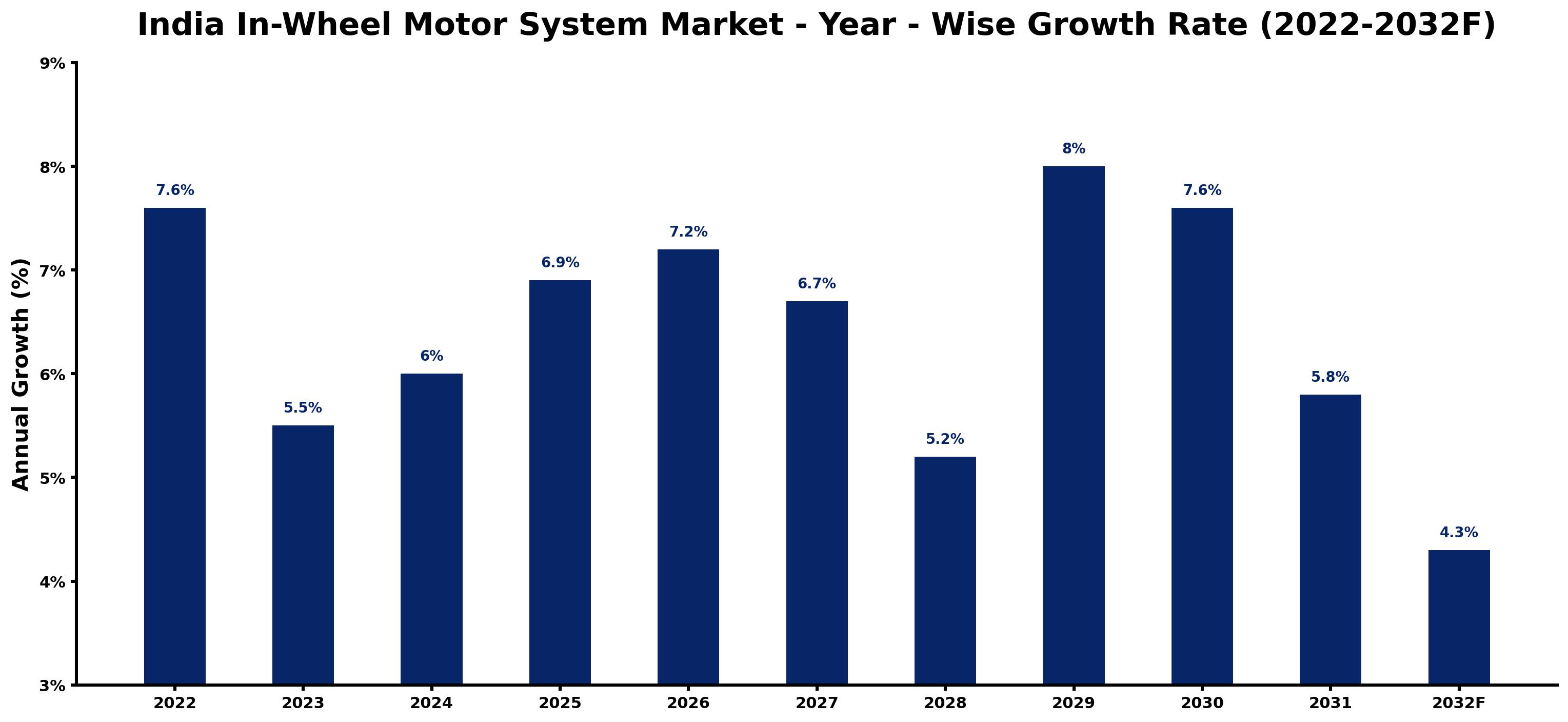
Each row of the following table gives one year's estimated growth and the event or demand shift that explains it.
| Year | Estimated Annual Growth (%) | Market Rationale |
| 2022 | 7.6 | The market experienced strong growth due to increased electric vehicle adoption and supportive government policies such as the FAME II scheme. |
| 2023 | 5.5 | Growth slowed as the market adjusted to previous high demand levels and supply chain challenges affecting OEMs. |
| 2024 | 6.0 | A resurgence in demand was driven by rising investments in electric mobility and infrastructure development, particularly in electric passenger cars. |
| 2025 | 6.9 | Continued growth was supported by the expanding electric passenger car segment and government incentives like the Production Linked Incentive scheme. |
| 2026 | 7.2 | Manufacturers are expected to increase production capacities to meet rising demand from EV manufacturers and fleet operators. |
| 2027 | 6.7 | Growth is projected to slow slightly due to increased competition among suppliers in the hub motor segment. |
| 2028 | 5.2 | A further slowdown is anticipated as the market stabilises after rapid growth in previous years, particularly in two-wheelers. |
| 2029 | 8.0 | The market is expected to rebound with the highest growth rate, driven by new technological advancements in electric motors and standards set by the Bureau of Indian Standards. |
| 2030 | 7.6 | Growth will decelerate as the market matures and faces increasing competition from alternative technologies in the EV sector. |
| 2031 | 5.8 | A continued slowdown is expected as the market reaches a more stable growth phase, influenced by regulatory hurdles. |
| 2032 | 4.3 | The market is projected to grow at a slower pace as it approaches saturation in certain segments, particularly in electric passenger cars. |
Note: Market size estimations and growth projections presented in this report are based on 6Wresearch's proprietary forecasting methodology, utilizing the latest available industry data, government publications, and primary research inputs.
India In-Wheel Motor System Market Synopsis
The India In-Wheel Motor System Market features electric motor technology embedded in vehicle wheels, improving efficiency and optimising space. This technology is mainly utilised in electric vehicles, with projections indicating the market will reach USD 244.0 million by 2025. Growth stems from increasing domestic demand and supportive government initiatives, including the FAME II scheme and the National Electric Mobility Mission Plan, which target a 30% electric vehicle penetration by 2030.
Market Dynamics Impact Analysis (2026–2032)
| Factor | Type | Impact | Primary Segment Affected |
| Growing adoption of electric passenger cars driven by government incentives and consumer interest. | Driver | High | Electric Passenger Cars |
| Increased demand for efficient and compact motor solutions in electric vehicles. | Driver | High | Hub Motor |
| Expansion of the electric two-wheeler market due to urbanisation and environmental concerns. | Opportunity | High | Two-Wheelers |
| Potential for growth in fleet operators adopting electric vehicles for logistics. | Opportunity | Medium | Fleet Operators |
| Supply chain disruptions affecting component availability for manufacturers. | Restraint | High | OEMs |
| High initial costs of electric vehicle technology limiting widespread adoption. | Restraint | Medium | EV Manufacturers |
| The In-Wheel Motor System market in India faces challenges from high production costs. | Challenge | High | Electric Passenger Cars |
| Technological advancements in alternative motor systems could impact market share. | Challenge | Medium | Hub Motor |
Evaluation of Drivers in India In-Wheel Motor System Market (2026–2032)
Below mentioned are some major drivers and their influence on market dynamics.
| Drivers | Primary Segment Affected | Why It Matters (Evidence) |
| Government incentives for electric vehicle adoption encourage manufacturers to invest in in-wheel technology. | Electric Passenger Cars | The FAME II scheme has a budget of ₹10,000 crore, promoting electric vehicle purchases and enhancing market growth. |
| The increasing demand for efficient and compact motor solutions drives manufacturers to adopt in-wheel motor systems. | Hub Motor | The installed base of electric two-wheelers reached 1.5 million units in 2023, increasing demand for in-wheel motors and components. |
| Rising urbanisation in India boosts the electric two-wheeler market, creating demand for in-wheel motors. | Two-Wheelers | The electric two-wheeler segment is expected to see substantial growth driven by urban demand, projected to increase by 20% annually. |
| Fleet operators are increasingly adopting electric vehicles, leading to higher demand for in-wheel motor systems. | Fleet Operators | The Indian government aims for 1 million electric buses by 2030, promoting fleet electrification and driving demand for in-wheel motors. |
| The Production Linked Incentive scheme encourages domestic manufacturing of electric vehicle components, enhancing local supply. | OEMs | The scheme, initiated in 2021, supports the growth of local manufacturing capabilities, aiming for a ₹25,000 crore investment. |
The installed base of electric two-wheelers reached 1.5 million units in 2023, further fuelling demand for efficient motor solutions. Furthermore, the Production Linked Incentive scheme promotes local manufacturing of electric vehicle components, strengthening supply chain resilience and competitiveness.
Evaluation of Restraints in India In-Wheel Motor System Market
The following restraints limit how fast demand can grow.
| Market Restraint | Primary Segment Affected | Why It Matters (Evidence) |
| High production costs of in-wheel motor systems | Hub Motor | The manufacturing of hub motors requires advanced materials and precision engineering, leading to elevated costs that can deter widespread adoption. |
| Limited availability of skilled workforce | Electric Passenger Cars | A shortage of trained professionals in electric vehicle technology hampers production efficiency and innovation, affecting the supply of in-wheel motor systems. |
| Regulatory compliance challenges | Induction Motor | Compliance with evolving standards set by the Bureau of Indian Standards can extend project timelines, impacting manufacturers' ability to meet market demand. |
| Insufficient charging infrastructure | Commercial EVs | The lack of adequate charging stations limits the operational range of electric vehicles, reducing the attractiveness of in-wheel motor systems for fleet operators. |
| Market competition from alternative technologies | Brushless DC Motor | The presence of competing motor technologies may limit the market share of in-wheel motors, as buyers seek cost-effective and efficient solutions. |
India In-Wheel Motor System Market Challenges
In the India In-Wheel Motor System market, a notable challenge is the shortage of skilled professionals, which hampers production efficiency and innovation. This skills gap arises from insufficient technical training programs, delaying product development timelines for manufacturers by up to six months. Buyers are facing rising costs as competition intensifies among suppliers, resulting in price increases of around 15% for components. Regulatory hurdles complicate market conditions, as compliance with changing standards can extend project timelines by an average of three months, limiting manufacturers' ability to meet growing demand.
Trends in the India In-Wheel Motor System Market
Buyers and suppliers in the India In-Wheel Motor System Market are adjusting to the following trends.
- Shift from Conventional to In-Wheel Motors: Since 2021, the trend towards in-wheel motor systems has accelerated, especially in electric passenger cars. The Bureau of Indian Standards has introduced new standards for electric vehicle components, ensuring safety and performance.
- Growing Demand for Electric Two-Wheelers: In 2023, urban consumers increasingly chose electric two-wheelers, motivated by environmental concerns. The installed base of electric two-wheelers reached 1.5 million units, highlighting this shift in consumer preferences.
- Expansion of Fleet Electrification Initiatives: The Indian government has established a target of 1 million electric buses by 2030, promoting fleet electrification. This initiative is expected to drive demand for in-wheel motor systems in commercial applications.
- Emergence of Direct Sales Channels: In 2026, direct sales channels for electric vehicles are projected to expand, with a CAGR of 9.0%. This shift allows manufacturers to connect with consumers more effectively, improving market penetration.
Investment Opportunities in the India In-Wheel Motor System Market
Several openings in the India In-Wheel Motor System Market merit attention from investors.
- Supply of In-Wheel Motor Systems: With the electric passenger car market projected to grow, suppliers can invest in in-wheel motor systems to meet rising demand. EV manufacturers are key buyers in this expanding market, which is expected to reach USD 244.0 million by 2025.
- Investment in Electric Two-Wheeler Components: The electric two-wheeler segment is set to grow, creating a gap for component suppliers. Urban consumers are increasingly adopting electric two-wheelers, presenting opportunities for local manufacturers to fill this demand.
- Development of Charging Infrastructure: The need for efficient charging infrastructure is growing alongside electric vehicle adoption. Fleet operators require effective charging solutions to support their electric vehicle fleets, creating investment opportunities projected to exceed ₹5,000 crore by 2025.
- Partnerships with Local Manufacturers: Collaborating with local manufacturers can enhance market entry for suppliers of in-wheel motor systems. The Maharashtra EV policy offers incentives for electric vehicle manufacturers, facilitating partnerships and local production.
Government Initiatives in the India In-Wheel Motor System Market
The FAME II scheme, introduced in 2021, provides subsidies for electric vehicle purchases, encouraging adoption and supporting manufacturers. This initiative complements the National Electric Mobility Mission Plan, which aims for 30% electric vehicle penetration by 2030, promoting sustainable transport in India. The scheme motivates manufacturers to invest in in-wheel motor systems, propelling market growth.
The Production Linked Incentive scheme encourages domestic manufacturing of electric vehicles and components, with a budget of ₹25,000 crore allocated for the automotive sector. The Automotive Research Association of India plays a crucial role in developing EV technology standards, ensuring compliance and safety for manufacturers and buyers.
Future Insight of the India In-Wheel Motor System Market
By 2032, buyers and suppliers in the India In-Wheel Motor System market can anticipate notable advancements, shaped by government initiatives and technological progress. The National Electric Mobility Mission Plan aims for 30% electric vehicle penetration by 2030, which will broaden the market for electric two-wheelers. The Production Linked Incentive scheme will strengthen local manufacturing capabilities, enhancing supply chain stability. Additionally, the establishment of standards by the Bureau of Indian Standards will simplify compliance, enabling suppliers to focus on innovation and competitiveness.
Market Segmentation Analysis
The analysis below covers each segmentation, its leading category in 2025 and its fastest-growing category through 2032.
By Motor Type – Permanent Magnet Dominated, Brushless DC Motor Expected to Grow Fastest
According to Shubham Deep, Research Manager at 6Wresearch, Permanent Magnet held a 48% share of the India In-Wheel Motor System Market by motor type in 2025. Permanent Magnet motors hold the largest market share due to their efficiency in torque generation, making them ideal for electric vehicles. Their widespread application in electric passenger cars highlights their critical role in the India In-Wheel Motor System Market. The quickest growth will come from Brushless DC Motor, forecast to expand at a CAGR of 8.9% between 2026 and 2032. The Brushless DC Motor segment is experiencing rapid growth, primarily due to its efficiency and performance in electric vehicles. As urban demand for electric two-wheelers rises, this segment is well-positioned for significant expansion, further solidifying the dominance of Permanent Magnet motors. Suppliers should focus on increasing production capabilities for Brushless DC Motors to meet the surging demand in the electric vehicle sector.
By Vehicle Type – Electric Passenger Cars Dominated, Two-Wheelers Expected to Grow Fastest
Electric Passenger Cars accounted for a 44% market share by vehicle type in 2025. Electric Passenger Cars dominate the market share as they represent a substantial application in India's expanding electric vehicle sector. The growing consumer inclination towards personal electric mobility reinforces this segment's leading position. Two-Wheelers are set to record the highest CAGR in this split, 8.0% over 2026–2032. The Two-Wheelers segment is projected to grow swiftly, propelled by urban demand and government incentives for electric two-wheelers. With an installed base of 1.5 million electric two-wheelers in 2023, this segment's growth trajectory is set to accelerate. Manufacturers must adapt their strategies to target the rapidly expanding Two-Wheelers segment to seize emerging market opportunities.
By Power Rating – <50 kW Dominated, 50–100 kW Expected to Grow Fastest
The largest power rating category in 2025 was <50 kW, with a 42% share of total revenue. The <50 kW power rating segment leads the market as it is commonly utilised in smaller electric vehicles, which are increasingly sought after. This segment's popularity is driven by the rising adoption of compact electric models in urban environments. 50–100 kW is projected to grow fastest, at a CAGR of 7.7% during 2026–2032. The 50–100 kW segment is witnessing the fastest growth, catering to mid-range electric vehicles that appeal to a wider consumer base. This expansion is fuelled by the growing interest in electric passenger cars with improved performance capabilities. Suppliers should consider broadening their offerings in the 50–100 kW range to attract mid-range electric vehicle manufacturers.
By Distribution Channel – OEMs Dominated, Direct Sales Expected to Grow Fastest
In 2025, OEMs led the distribution channel split with a 40% share. OEMs serve as the primary distribution channel, acting as the main link for vehicle manufacturers to incorporate in-wheel motor systems into their products. This established connection ensures a steady demand for in-wheel motor systems from OEMs. Over 2026–2032, Direct Sales is expected to post the fastest growth, at a CAGR of 9.0%. Direct Sales is the fastest-growing channel, focusing on niche markets that require customised solutions. This growth is driven by increasing demand from specific segments, such as fleet operators, seeking direct procurement options. Suppliers should investigate direct sales strategies to effectively engage niche markets and strengthen their market presence.
By End User – EV Manufacturers Dominated, Fleet Operators Expected to Grow Fastest
EV Manufacturers took a 39% share of end user in 2025, more than any other category. EV Manufacturers hold the largest share of the market as they are the primary users of in-wheel motor systems in their electric vehicles. Their commitment to electric mobility drives consistent demand for advanced motor technologies. The quickest growth will come from Fleet Operators, forecast to expand at a CAGR of 8.8% between 2026 and 2032. Fleet Operators are the fastest-growing end user segment, increasingly adopting electric vehicles for their fleets. This trend is propelled by government initiatives promoting electric mobility and sustainability in transportation, indicating a shift towards electrification. Suppliers should develop targeted solutions for fleet operators to capitalise on the growing trend of electrification in fleet management.
Key Attractiveness of the Report
- 10 Years of Market Numbers
- Historical Data Starting from 2022 to 2025
- Base Year 2025
- Forecast Data until 2032
- Key Performance Indicators Impacting the Market
- Major Upcoming Developments and Projects
Key Highlights of the Report:
- India In-Wheel Motor System Market Outlook
- Market Size of India In-Wheel Motor System Market, 2025
- Forecast of India In-Wheel Motor System Market, 2032
- Historical Data and Forecast of India In-Wheel Motor System Revenues & Volume for the Period 2022 - 2032F
- India In-Wheel Motor System Market Trend Evolution
- India In-Wheel Motor System Market Drivers and Challenges
- India In-Wheel Motor System Price Trends
- India In-Wheel Motor System Porter's Five Forces
- India In-Wheel Motor System Industry Life Cycle
- Historical Data and Forecast of India In-Wheel Motor System Market Revenues & Volume By Motor Type for the Period 2022 - 2032F
- Historical Data and Forecast of India In-Wheel Motor System Market Revenues & Volume By Permanent Magnet for the Period 2022 - 2032F
- Historical Data and Forecast of India In-Wheel Motor System Market Revenues & Volume By Induction Motor for the Period 2022 - 2032F
- Historical Data and Forecast of India In-Wheel Motor System Market Revenues & Volume By Brushless DC Motor for the Period 2022 - 2032F
- Historical Data and Forecast of India In-Wheel Motor System Market Revenues & Volume By Hub Motor for the Period 2022 - 2032F
- Historical Data and Forecast of India In-Wheel Motor System Market Revenues & Volume By Vehicle Type for the Period 2022 - 2032F
- Historical Data and Forecast of India In-Wheel Motor System Market Revenues & Volume By Electric Passenger Cars for the Period 2022 - 2032F
- Historical Data and Forecast of India In-Wheel Motor System Market Revenues & Volume By Commercial EVs for the Period 2022 - 2032F
- Historical Data and Forecast of India In-Wheel Motor System Market Revenues & Volume By Two-Wheelers for the Period 2022 - 2032F
- Historical Data and Forecast of India In-Wheel Motor System Market Revenues & Volume By Autonomous Vehicles for the Period 2022 - 2032F
- Historical Data and Forecast of India In-Wheel Motor System Market Revenues & Volume By Power Rating for the Period 2022 - 2032F
- Historical Data and Forecast of India In-Wheel Motor System Market Revenues & Volume By 50 kW for the Period 2022 - 2032F
- Historical Data and Forecast of India In-Wheel Motor System Market Revenues & Volume By 50 100 kW for the Period 2022 - 2032F
- Historical Data and Forecast of India In-Wheel Motor System Market Revenues & Volume By 10 kW for the Period 2022 - 2032F
- Historical Data and Forecast of India In-Wheel Motor System Market Revenues & Volume By 100 150 kW for the Period 2022 - 2032F
- Historical Data and Forecast of India In-Wheel Motor System Market Revenues & Volume By Distribution Channel for the Period 2022 - 2032F
- Historical Data and Forecast of India In-Wheel Motor System Market Revenues & Volume By OEMs for the Period 2022 - 2032F
- Historical Data and Forecast of India In-Wheel Motor System Market Revenues & Volume By Tier-1 Suppliers for the Period 2022 - 2032F
- Historical Data and Forecast of India In-Wheel Motor System Market Revenues & Volume By Online Platforms for the Period 2022 - 2032F
- Historical Data and Forecast of India In-Wheel Motor System Market Revenues & Volume By Direct Sales for the Period 2022 - 2032F
- Historical Data and Forecast of India In-Wheel Motor System Market Revenues & Volume By End User for the Period 2022 - 2032F
- Historical Data and Forecast of India In-Wheel Motor System Market Revenues & Volume By EV Manufacturers for the Period 2022 - 2032F
- Historical Data and Forecast of India In-Wheel Motor System Market Revenues & Volume By Fleet Operators for the Period 2022 - 2032F
- Historical Data and Forecast of India In-Wheel Motor System Market Revenues & Volume By Aftermarket Retrofitters for the Period 2022 - 2032F
- Historical Data and Forecast of India In-Wheel Motor System Market Revenues & Volume By Robotics Integrators for the Period 2022 - 2032F
- India In-Wheel Motor System Import Export Trade Statistics
- Market Opportunity Assessment By Motor Type
- Market Opportunity Assessment By Vehicle Type
- Market Opportunity Assessment By Power Rating
- Market Opportunity Assessment By Distribution Channel
- Market Opportunity Assessment By End User
- India In-Wheel Motor System Top Companies Market Share
- India In-Wheel Motor System Competitive Benchmarking By Technical and Operational Parameters
- India In-Wheel Motor System Company Profiles
- India In-Wheel Motor System Key Strategic Recommendations
Market Covered
This report examines the market across the segments below.
By Motor Type
- Permanent Magnet
- Induction Motor
- Brushless DC Motor
- Hub Motor
By Vehicle Type
- Electric Passenger Cars
- Commercial EVs
- Two-Wheelers
- Autonomous Vehicles
By Power Rating
- <50 kW
- 50–100 kW
- <10 kW
- 100–150 kW
By Distribution Channel
- OEMs
- Tier-1 Suppliers
- Online Platforms
- Direct Sales
By End User
- EV Manufacturers
- Fleet Operators
- Aftermarket Retrofitters
- Robotics Integrators































