India In-Wheel Propulsion System Market Size & Growth Rate
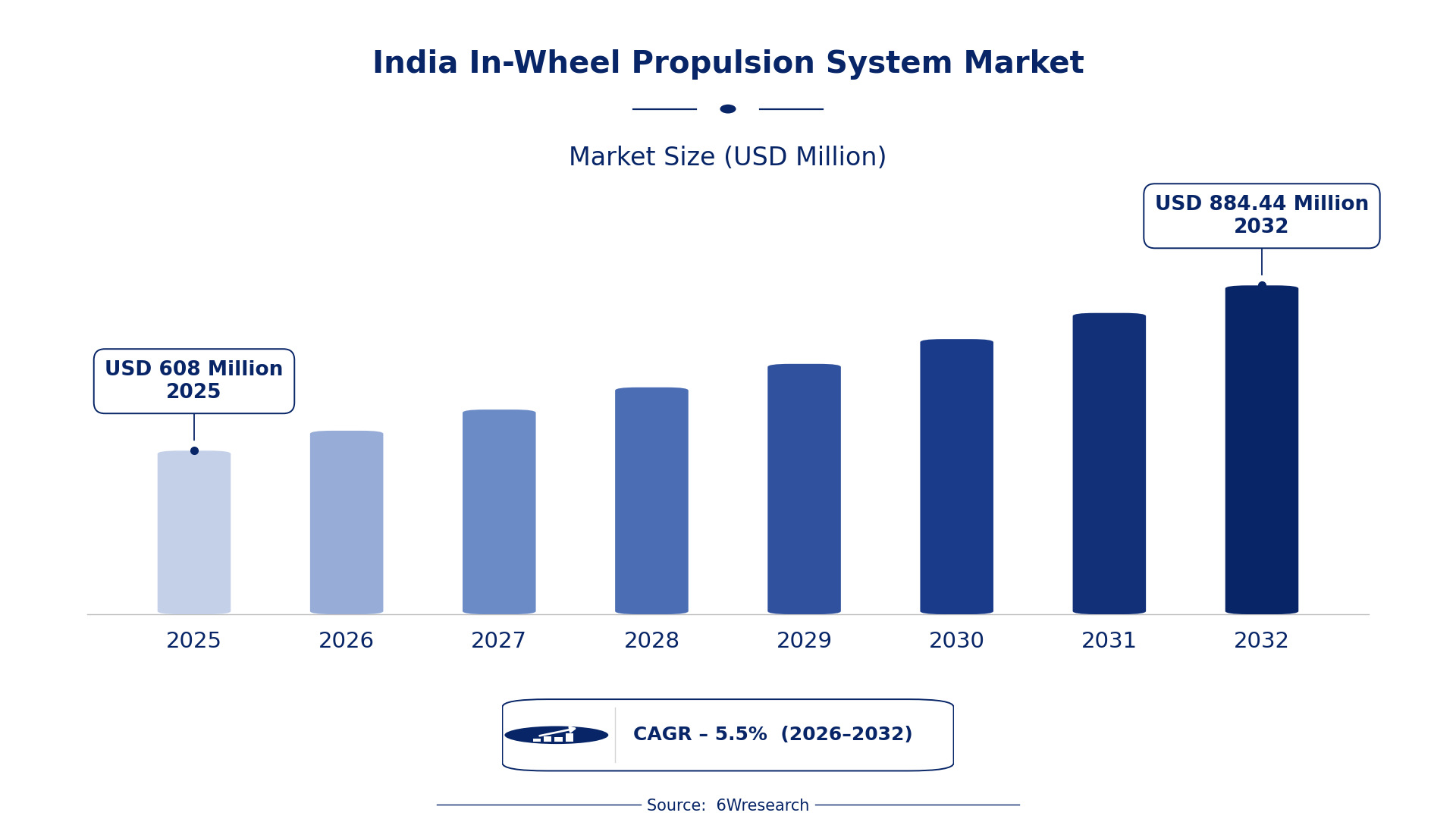
According to 6Wresearch internal database and industry insights, the India In-Wheel Propulsion System Market was valued at USD 608.0 million in 2025 and is projected to reach USD 884.44 million by 2032, growing at a CAGR of approximately 5.5% during 2026–2032.
India In-Wheel Propulsion System Market Highlights
| Report Metric | Details |
| Report Name | India In-Wheel Propulsion System Market |
| Market Size 2025 | USD 608.0 million |
| Market Size 2032 | USD 884.44 million |
| Absolute Growth 2025–2032 | USD 276.44 million |
| CAGR 2026–2032 | 5.5% |
| Peak Annual Growth | 8.1% in 2028 |
| Forecast Period | 2026–2032 |
| Historical Data | 2022–2025 |
| Base Year | 2025 |
| Leading Propulsion Type, 2025 | Electric Drive Unit (43% share) |
| Leading Power Source, 2025 | Battery Electric Vehicle (52% share) |
| Leading Vehicle Segment, 2025 | SUVs (50% share) |
| Leading Control Architecture, 2025 | Distributed (51% share) |
| Leading End User, 2025 | Vehicle OEMs (42% share) |
| Fastest-Growing Propulsion Type | Dual-Motor System (8.1% CAGR) |
| Fastest-Growing Vehicle Segment | Mid-Size Cars (6.9% CAGR) |
| Fastest-Growing Control Architecture | Torque Vectoring (7.1% CAGR) |
| Fastest-Growing End User | EV Startups (7.6% CAGR) |
| Growing Sector | EV Startups |
| Key End Users | Vehicle OEMs, EV Startups, Performance Brands, Micro Mobility Firms |
India In-Wheel Propulsion System Market Year-wise Growth Rate and Key Drivers (2022–2032)
This graph illustrates the annual growth rates of the market from 2022 to 2032, highlighting a steady upward trajectory and projected market expansion over the forecast period.
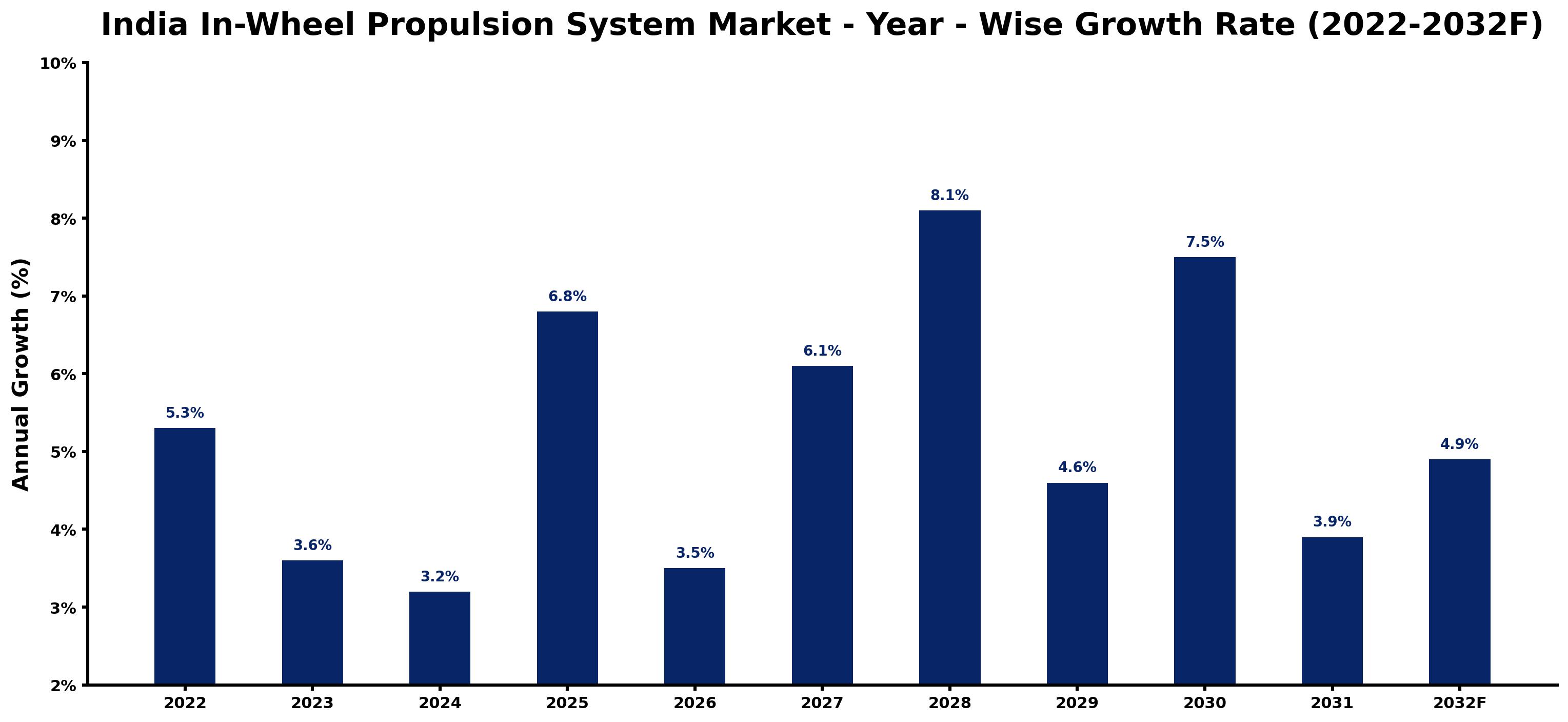
The table below sets out the estimated growth rate for each year and the main factor behind it.
| Year | Estimated Annual Growth (%) | Market Rationale |
| 2022 | 5.3 | The market experienced steady growth driven by increased electric vehicle adoption. |
| 2023 | 3.6 | Growth slowed as manufacturers faced supply chain disruptions impacting production schedules. |
| 2024 | 3.2 | Demand continued to rise, albeit at a slower pace, as buyers awaited new electric models. |
| 2025 | 6.8 | The market surged due to heightened investments in electric vehicle infrastructure and production. |
| 2026 | 3.5 | Growth decelerated as the market adjusted to new regulatory standards and consumer preferences. |
| 2027 | 6.1 | An uptick in electric vehicle sales propelled growth as new models entered the market. |
| 2028 | 8.1 | The peak growth rate was achieved, driven by increased consumer awareness and incentives. |
| 2029 | 4.6 | Growth moderated as the market began to stabilise following peak demand periods. |
| 2030 | 7.5 | An increase in government support for electric vehicle initiatives stimulated demand. |
| 2031 | 3.9 | Growth slowed again as the market faced challenges from rising production costs. |
| 2032 | 4.9 | The market rebounded with renewed interest in electric vehicles and technological advancements. |
Note: Market size estimations and growth projections presented in this report are based on 6Wresearch's proprietary forecasting methodology, utilizing the latest available industry data, government publications, and primary research inputs.
India In-Wheel Propulsion System Market Synopsis
The In-Wheel Propulsion System Market in India features cutting-edge technology that integrates electric motors into vehicle wheels, boosting efficiency and performance. This system primarily serves electric and hybrid vehicles, enhancing torque and optimising space. The market is expanding due to increasing demand from domestic consumers and exports, especially in the electric vehicle segment. Government initiatives such as the National Electric Mobility Mission Plan aim for 30% of vehicles to be electric by 2030, further propelling market growth.
Market Dynamics Impact Analysis (2026–2032)
| Factor | Type | Impact | Primary Segment Affected |
| Growing adoption of electric vehicles driven by government incentives and consumer demand. | Driver | High | Battery Electric Vehicle |
| Increasing investments in electric vehicle manufacturing facilities in key states. | Driver | High | Electric Drive Unit |
| Emerging demand from electric vehicle startups focusing on innovative designs. | Opportunity | High | EV Startups |
| Expansion of electric vehicle infrastructure, including charging stations. | Opportunity | High | Vehicle OEMs |
| High production costs due to reliance on imported components. | Restraint | High | Hybrid Propulsion |
| Limited consumer awareness regarding the benefits of in-wheel systems. | Restraint | Medium | Dual-Motor System |
| The In-Wheel Propulsion System Market in India faces regulatory hurdles that slow growth. | Challenge | High | Regenerative Propulsion |
| Competition from alternative propulsion technologies poses a risk to market share. | Challenge | Medium | Torque Vectoring |
Evaluation of Drivers in India In-Wheel Propulsion System Market (2026–2032)
Below mentioned are some major drivers and their influence on market dynamics.
| Drivers | Primary Segment Affected | Why It Matters (Evidence) |
| Government incentives under the FAME II scheme boost electric vehicle adoption. | Battery Electric Vehicle | The scheme allocates ₹10,000 crore to promote electric vehicle sales, encouraging manufacturers to invest in in-wheel systems. |
| Increased consumer demand for electric SUVs drives production. | Electric Drive Unit | With 50% of the vehicle segment being SUVs, manufacturers are focusing on in-wheel systems for efficiency. |
| Investment in electric vehicle manufacturing facilities in Maharashtra enhances capacity. | Hybrid Propulsion | Maharashtra is a key hub for electric vehicle production, leading to increased local supply and demand. |
| Rising interest from EV startups accelerates innovation in propulsion technologies. | EV Startups | These new companies are actively seeking advanced solutions like in-wheel systems to differentiate their products. |
| The push for energy-efficient vehicles aligns with global sustainability trends. | Regenerative Propulsion | The Bureau of Energy Efficiency's Standards and Labeling Program promotes energy-efficient vehicles, stimulating demand. |
The growth of the In-Wheel Propulsion System market in India is supported by substantial investments in electric vehicle manufacturing and rising consumer demand. The FAME II scheme incentivises the adoption of electric vehicles, directly influencing production levels. By 2022, around 1.5 million electric vehicles were registered in India, showcasing increasing consumer interest. Key states like Maharashtra are boosting manufacturing capacity, which aligns with local demand. The automotive sector contributed 7.1% to the GDP in 2021-2022, reflecting strong economic support for this market.
Evaluation of Restraints in India In-Wheel Propulsion System Market
The following restraints limit how fast demand can grow.
| Market Restraint | Primary Segment Affected | Why It Matters (Evidence) |
| High production costs due to reliance on imported components limit profitability. | Hybrid Propulsion | Manufacturers face challenges in sourcing affordable components, impacting pricing strategies and margins. |
| Limited consumer awareness regarding the benefits of in-wheel systems hinders adoption. | Dual-Motor System | Many potential buyers are unaware of the advantages, slowing market penetration and growth. |
| Regulatory hurdles related to safety standards can delay product launches. | Regenerative Propulsion | Compliance with the Bureau of Indian Standards can extend development timelines, impacting market entry. |
| Competition from alternative propulsion technologies can divert investment. | Battery Electric Vehicle | Changes in disposable income may affect the willingness to invest in new technologies. |
| Supply chain disruptions impact the availability of key components for in-wheel systems. | Electric Drive Unit | Manufacturers struggle to secure timely deliveries, delaying production schedules and affecting market growth. |
India In-Wheel Propulsion System Market Challenges
Producers in the India In-Wheel Propulsion System market encounter supply chain disruptions, particularly in sourcing advanced materials, which can delay production timelines by up to 20%. Skills shortages in electric vehicle technology are apparent, with only 25% of automotive engineers trained in in-wheel systems, restricting innovation for manufacturers. Rising costs of precision engineering can inflate manufacturing expenses by 15%, squeezing profit margins for producers. The rapid pace of technological advancements requires ongoing investment in R&D, diverting resources and extending time-to-market for new products for suppliers.
Trends in the India In-Wheel Propulsion System Market
Several trends are reshaping the India In-Wheel Propulsion System Market; the most important are set out below.
- Shift Towards Electric Vehicle Adoption: India's electric vehicle market is projected to reach 6.34 million units by 2025, driven by government incentives. This shift is encouraging manufacturers to invest in in-wheel propulsion systems, improving vehicle efficiency.
- Transition from Traditional to Advanced Propulsion Systems: The automotive industry in Maharashtra is increasingly adopting in-wheel propulsion systems, with a focus on electric SUVs. This trend is supported by a projected market size of USD 608.0 million by 2025.
- Emergence of EV Startups: The rise of EV startups in India is driving innovation in propulsion technologies, with many seeking in-wheel systems for their vehicles. This segment is expected to grow significantly, with a CAGR of 7.6% by 2032.
- Prioritisation of Energy Efficiency Standards: The Bureau of Energy Efficiency's Standards and Labeling Program launched in 2023 is promoting energy-efficient vehicles. This initiative is expected to stimulate the adoption of in-wheel propulsion systems.
Investment Opportunities in the India In-Wheel Propulsion System Market
Some of the investment opportunities in the India In-Wheel Propulsion System Market are mentioned below.
- Maharashtra's Manufacturing Facilities: Maharashtra is a key hub for electric vehicle production, presenting significant investment opportunities in in-wheel propulsion systems. Suppliers can enter this market by partnering with local manufacturers to enhance production capabilities.
- Government Incentives for EV Adoption: With the FAME II scheme allocating ₹10,000 crore, there is a substantial opportunity for investment in electric vehicle components. Collaborating with vehicle OEMs will facilitate market entry and growth.
- Growing Demand from EV Startups: The rise of EV startups offers a chance to supply advanced in-wheel propulsion systems. This segment is expected to expand rapidly, driven by innovation and consumer interest in electric vehicles.
- Emerging Energy Efficiency Standards: The Bureau of Energy Efficiency's new standards create a demand for compliant in-wheel systems. Suppliers should focus on certification to meet these evolving requirements.
Government Initiatives in the India In-Wheel Propulsion System Market
The National Electric Mobility Mission Plan 2020, launched by the Ministry of Heavy Industries, aims to promote electric vehicles and reduce pollution. This initiative encourages manufacturers to develop in-wheel propulsion systems, aligning with the goal of having 30% of all vehicles electric by 2030. The FAME II scheme, updated in 2021, has a budget of ₹10,000 crore to incentivise electric vehicle adoption, directly benefiting both producers and consumers in the market.
The Bureau of Energy Efficiency actively supports the implementation of electric vehicle policies. They work closely with manufacturers to ensure compliance with safety standards and promote the adoption of in-wheel propulsion systems among vehicle OEMs, enhancing the overall framework for electric mobility.
Future Insight of the India In-Wheel Propulsion System Market
Several forward-looking factors should support the India In-Wheel Propulsion System market over the coming years. The government's goal of having 30% of all vehicles electric by 2030 will drive demand for in-wheel systems. The FAME II scheme, with an allocation of ₹10,000 crore, will incentivise manufacturers and consumers, encouraging wider adoption of electric vehicles. The establishment of the Bureau of Indian Standards will ensure safety and performance, boosting consumer confidence and driving market growth.
Market Segmentation Analysis
Each segment group is reviewed below, with the leader by share and the fastest grower by CAGR.
By Propulsion Type – Electric Drive Unit Dominated, Dual-Motor System Expected to Grow Fastest
According to Shubham Deep, Research Manager at 6Wresearch, in 2025, Electric Drive Unit led the propulsion type split with a 43% share. The Electric Drive Unit captures the largest market share as it is a critical component in electric vehicles, which are increasingly popular in India. With government initiatives like the FAME India Scheme promoting electric mobility, this segment is well-positioned to meet the rising demand for efficient propulsion systems. Dual-Motor System is set to record the highest CAGR in this split, 8.1% over 2026–2032. The Dual-Motor System is experiencing rapid growth due to its capability to enhance performance in high-end electric vehicles, appealing to discerning consumers. As the market for advanced features expands, this segment's growth will likely continue to strengthen the Electric Drive Unit's leading position. Suppliers should focus on developing advanced Electric Drive Units to meet the growing needs of manufacturers.
By Power Source – Battery Electric Vehicle Dominated and Is Expected to Record the Fastest Growth
With a 52% revenue share in 2025, Battery Electric Vehicle was the largest power source category. Battery Electric Vehicles dominate the market share as they are the primary application for in-wheel systems, aligning with the government's push for electric mobility. With an installed base of approximately 1.5 million units, this segment is well-established and continues to grow. Battery Electric Vehicle is also forecast to expand faster than any other category, at a CAGR of 7.0% over 2026–2032. Battery Electric Vehicles are also the fastest-growing segment, driven by the government's target for 30% of all vehicles to be electric by 2030. This alignment of policy and market demand will sustain the momentum of this segment's growth. Buyers and suppliers should prioritise innovations in Battery Electric Vehicle technology to capitalise on the expanding market.
By Vehicle Segment – SUVs Dominated, Mid-Size Cars Expected to Grow Fastest
SUVs took a 50% share of vehicle segment in 2025, more than any other category. SUVs lead the market share, driven by their increasing popularity among consumers opting for electric vehicles. This trend is particularly strong in regions like Maharashtra and Tamil Nadu, where the demand for electric SUVs is surging. Mid-Size Cars are projected to grow fastest, at a CAGR of 6.9% during 2026–2032. Mid-Size Cars are the fastest-growing segment, as they offer a practical balance of performance and affordability for in-wheel systems. This shift reflects changing consumer preferences towards versatile electric vehicle options that cater to a wider audience. Suppliers should consider expanding their product offerings to include more options for Mid-Size Cars to seize emerging market opportunities.
By Control Architecture – Distributed Dominated, Torque Vectoring Expected to Grow Fastest
Distributed accounted for a 51% market share by control architecture in 2025. The Distributed control architecture holds the largest market share as it is essential for modern electric vehicle designs, ensuring effective power distribution across the vehicle. Its increasing adoption aligns with the automotive industry's shift towards electric propulsion systems, making it a vital component. Over 2026–2032, Torque Vectoring is expected to post the fastest growth, at a CAGR of 7.1%. Torque Vectoring is the fastest-growing segment, as it significantly enhances handling in performance vehicles, attracting consumers who seek superior driving experiences. The rising demand for improved vehicle dynamics indicates that this technology will gain further traction in the market. Manufacturers should invest in advanced control architectures like Torque Vectoring to align with the expectations of performance-oriented consumers.
By End User – Vehicle OEMs Dominated, EV Startups Expected to Grow Fastest
Vehicle OEMs held a 42% share of the India In-Wheel Propulsion System Market by end user in 2025. Vehicle OEMs dominate the market share as they are the primary users of in-wheel propulsion systems, integrating this technology into their electric vehicle offerings. Their established production capabilities ensure consistent demand for these systems in the expanding electric vehicle market. EV Startups are set to record the highest CAGR in this split, 7.6% over 2026–2032. EV Startups are the fastest-growing segment, driven by a surge in demand for innovative electric vehicles from emerging companies. This trend indicates a shift towards a more diverse market landscape, reshaping traditional dynamics in the automotive sector. Suppliers should engage with EV Startups to explore partnerships that leverage their innovative approaches to electric vehicle design.
Key Attractiveness of the Report
- 10 Years of Market Numbers
- Historical Data Starting from 2022 to 2025
- Base Year 2025
- Forecast Data until 2032
- Key Performance Indicators Impacting the Market
- Major Upcoming Developments and Projects
Key Highlights of the Report:
- India In-Wheel Propulsion System Market Outlook
- Market Size of India In-Wheel Propulsion System Market, 2025
- Forecast of India In-Wheel Propulsion System Market, 2032
- Historical Data and Forecast of India In-Wheel Propulsion System Revenues & Volume for the Period 2022 - 2032F
- India In-Wheel Propulsion System Market Trend Evolution
- India In-Wheel Propulsion System Market Drivers and Challenges
- India In-Wheel Propulsion System Price Trends
- India In-Wheel Propulsion System Porter's Five Forces
- India In-Wheel Propulsion System Industry Life Cycle
- Historical Data and Forecast of India In-Wheel Propulsion System Market Revenues & Volume By Propulsion Type for the Period 2022 - 2032F
- Historical Data and Forecast of India In-Wheel Propulsion System Market Revenues & Volume By Electric Drive Unit for the Period 2022 - 2032F
- Historical Data and Forecast of India In-Wheel Propulsion System Market Revenues & Volume By Hybrid Propulsion for the Period 2022 - 2032F
- Historical Data and Forecast of India In-Wheel Propulsion System Market Revenues & Volume By Dual-Motor System for the Period 2022 - 2032F
- Historical Data and Forecast of India In-Wheel Propulsion System Market Revenues & Volume By Regenerative Propulsion for the Period 2022 - 2032F
- Historical Data and Forecast of India In-Wheel Propulsion System Market Revenues & Volume By Power Source for the Period 2022 - 2032F
- Historical Data and Forecast of India In-Wheel Propulsion System Market Revenues & Volume By Battery Electric Vehicle for the Period 2022 - 2032F
- Historical Data and Forecast of India In-Wheel Propulsion System Market Revenues & Volume By Plug-in Hybrid for the Period 2022 - 2032F
- Historical Data and Forecast of India In-Wheel Propulsion System Market Revenues & Volume By Fuel Cell Electric for the Period 2022 - 2032F
- Historical Data and Forecast of India In-Wheel Propulsion System Market Revenues & Volume By BEV for the Period 2022 - 2032F
- Historical Data and Forecast of India In-Wheel Propulsion System Market Revenues & Volume By Vehicle Segment for the Period 2022 - 2032F
- Historical Data and Forecast of India In-Wheel Propulsion System Market Revenues & Volume By Mid-Size Cars for the Period 2022 - 2032F
- Historical Data and Forecast of India In-Wheel Propulsion System Market Revenues & Volume By SUVs for the Period 2022 - 2032F
- Historical Data and Forecast of India In-Wheel Propulsion System Market Revenues & Volume By Performance Cars for the Period 2022 - 2032F
- Historical Data and Forecast of India In-Wheel Propulsion System Market Revenues & Volume By Two-Wheelers for the Period 2022 - 2032F
- Historical Data and Forecast of India In-Wheel Propulsion System Market Revenues & Volume By Control Architecture for the Period 2022 - 2032F
- Historical Data and Forecast of India In-Wheel Propulsion System Market Revenues & Volume By Centralized for the Period 2022 - 2032F
- Historical Data and Forecast of India In-Wheel Propulsion System Market Revenues & Volume By Distributed for the Period 2022 - 2032F
- Historical Data and Forecast of India In-Wheel Propulsion System Market Revenues & Volume By Torque Vectoring for the Period 2022 - 2032F
- Historical Data and Forecast of India In-Wheel Propulsion System Market Revenues & Volume By Sensor-Based Control for the Period 2022 - 2032F
- Historical Data and Forecast of India In-Wheel Propulsion System Market Revenues & Volume By End User for the Period 2022 - 2032F
- Historical Data and Forecast of India In-Wheel Propulsion System Market Revenues & Volume By EV Startups for the Period 2022 - 2032F
- Historical Data and Forecast of India In-Wheel Propulsion System Market Revenues & Volume By Vehicle OEMs for the Period 2022 - 2032F
- Historical Data and Forecast of India In-Wheel Propulsion System Market Revenues & Volume By Performance Brands for the Period 2022 - 2032F
- Historical Data and Forecast of India In-Wheel Propulsion System Market Revenues & Volume By Micro Mobility Firms for the Period 2022 - 2032F
- India In-Wheel Propulsion System Import Export Trade Statistics
- Market Opportunity Assessment By Propulsion Type
- Market Opportunity Assessment By Power Source
- Market Opportunity Assessment By Vehicle Segment
- Market Opportunity Assessment By Control Architecture
- Market Opportunity Assessment By End User
- India In-Wheel Propulsion System Top Companies Market Share
- India In-Wheel Propulsion System Competitive Benchmarking By Technical and Operational Parameters
- India In-Wheel Propulsion System Company Profiles
- India In-Wheel Propulsion System Key Strategic Recommendations
Market Covered
The report offers an extensive study of the following market segments.
By Propulsion Type
- Electric Drive Unit
- Hybrid Propulsion
- Dual-Motor System
- Regenerative Propulsion
By Power Source
- Battery Electric Vehicle
- Plug-in Hybrid
- Fuel Cell Electric
- BEV
By Vehicle Segment
- Mid-Size Cars
- SUVs
- Performance Cars
- Two-Wheelers
By Control Architecture
- Centralized
- Distributed
- Torque Vectoring
- Sensor-Based Control
By End User
- EV Startups
- Vehicle OEMs
- Performance Brands
- Micro Mobility Firms































