India In‑Cabin Sensing Market Size & Growth Rate
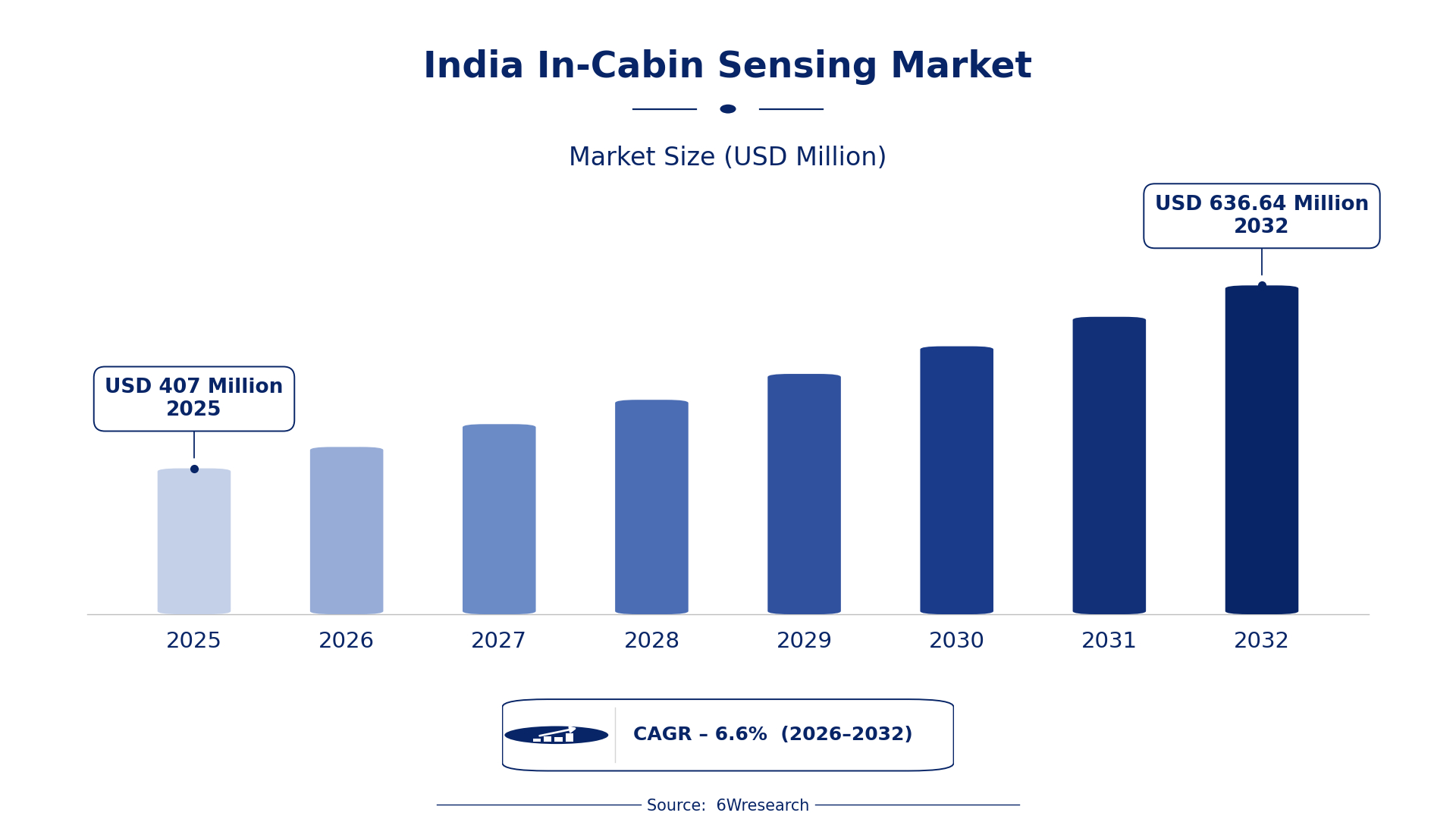
According to 6Wresearch internal database and industry insights, the India In‑Cabin Sensing Market was valued at USD 407.0 million in 2025 and is projected to reach USD 636.64 million by 2032, growing at a CAGR of approximately 6.6% during 2026–2032.
India In‑Cabin Sensing Market Highlights
| Report Metric | Details |
| Report Name | India In‑Cabin Sensing Market |
| Market Size 2025 | USD 407.0 million |
| Market Size 2032 | USD 636.64 million |
| Absolute Growth 2025–2032 | USD 229.64 million |
| CAGR 2026–2032 | 6.6% |
| Peak Annual Growth | 8.5% in 2027 |
| Forecast Period | 2026–2032 |
| Historical Data | 2022–2025 |
| Base Year | 2025 |
| Leading Sensor Group, 2025 | Occupancy Sensors (38% share) |
| Leading Data Captured, 2025 | Presence (29% share) |
| Leading Feature Enabled, 2025 | Seatbelt Alerts (48% share) |
| Leading End User, 2025 | Vehicle Safety Integrators (46% share) |
| Fastest-Growing Sensor Group | Air Quality Sensors (8.5% CAGR) |
| Fastest-Growing Data Captured | VOC (9.4% CAGR) |
| Fastest-Growing Feature Enabled | Drowsiness Detection (8.5% CAGR) |
| Fastest-Growing End User | ADAS Tier-1s (9.1% CAGR) |
| Growing Sector | ADAS Tier-1s |
| Key End Users | Vehicle Safety Integrators, ADAS Tier-1s, HVAC System Providers, Advanced Telematics Firms |
India In‑Cabin Sensing Market Year-wise Growth Rate and Key Drivers (2022–2032)
This graph illustrates the annual growth rates of the market from 2022 to 2032, highlighting a steady upward trajectory and projected market expansion over the forecast period.
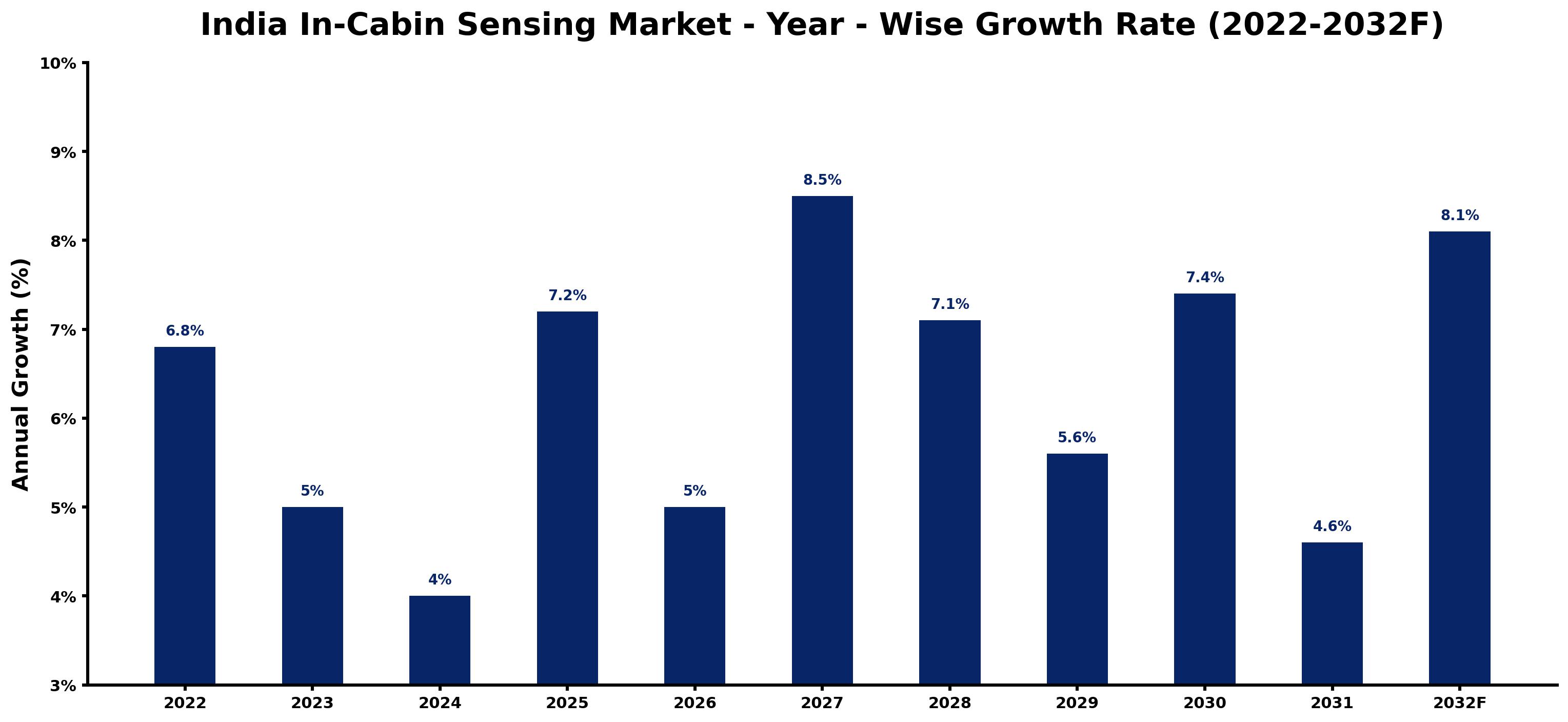
The following table presents the estimated annual growth rate for each year together with the principal factor influencing market performance.
| Year | Estimated Annual Growth (%) | Market Rationale |
| 2022 | 6.8 | The market showed strong activity with a growth rate of 6.8%. |
| 2023 | 5.0 | Growth slowed compared to the previous year, reflecting market adjustments. |
| 2024 | 4.0 | Continued slowdown in growth as demand stabilised within the sector. |
| 2025 | 7.2 | Growth accelerated again, driven by increased vehicle production and safety standards. |
| 2026 | 5.0 | A slower growth rate was observed as the market adjusted to new regulations. |
| 2027 | 8.5 | The market rebounded with strong growth driven by emerging technologies. |
| 2028 | 7.1 | Growth decelerated slightly as the market matured and demand stabilised. |
| 2029 | 5.6 | A further slowdown occurred as competition increased among suppliers. |
| 2030 | 7.4 | Growth picked up again, supported by rising electric vehicle adoption. |
| 2031 | 4.6 | The market experienced a slowdown as growth rates normalised post-peak. |
| 2032 | 8.1 | A resurgence in growth is expected as new technologies gain traction. |
Note: Market size estimations and growth projections presented in this report are based on 6Wresearch's proprietary forecasting methodology, utilizing the latest available industry data, government publications, and primary research inputs.
India In‑Cabin Sensing Market Synopsis
In-Cabin Sensing Market in India includes a range of sensors that monitor the vehicle cabin environment, improving safety and air quality while offering driver assistance features. This technology utilises advanced sensors and data analytics. The market is expanding due to the thriving automotive industry, expected to reach $300 billion by 2026, alongside a growing demand for electric vehicles. The National Electric Mobility Mission Plan and the FAME India Scheme are pivotal in driving this growth, encouraging the adoption of in-cabin sensing technologies.
Market Dynamics Impact Analysis (2026–2032)
| Factor | Type | Impact | Primary Segment Affected |
| Rising vehicle production and safety regulations drive demand for in-cabin sensing technologies. | Driver | High | Occupancy Sensors |
| Increased focus on air quality in vehicles leads to higher demand for air quality sensors. | Driver | High | Air Quality Sensors |
| Growing electric vehicle market presents opportunities for advanced sensing technologies. | Opportunity | High | Vehicle Safety Integrators |
| Investment in smart vehicle technologies creates demand for in-cabin sensing solutions. | Opportunity | Medium | ADAS Tier-1s |
| High costs associated with advanced sensor technologies may limit market growth. | Restraint | High | Driver Sensors |
| Regulatory compliance and certification processes can delay product launches. | Restraint | Medium | Air Quality Sensors |
| Challenges in integrating advanced technologies can hinder market expansion. | Challenge | High | Biometric Sensors |
| Limited awareness of in-cabin sensing benefits affects adoption rates. | Challenge | Medium | Drowsiness Detection |
Evaluation of Drivers in India In‑Cabin Sensing Market (2026–2032)
The main growth drivers and the segments they affect most are set out below.
| Drivers | Primary Segment Affected | Why It Matters (Evidence) |
| Increased vehicle production in India enhances demand for in-cabin sensing technologies. | Occupancy Sensors | India produced over 4 million passenger vehicles in 2022, driving sensor adoption. |
| Growing emphasis on air quality in vehicles boosts demand for air quality sensors. | Air Quality Sensors | The Indian government aims to reduce vehicular emissions by 30% by 2030. |
| The rise of electric vehicles creates opportunities for advanced sensing technologies. | Vehicle Safety Integrators | India's vehicle population is expected to exceed 300 million by 2025. |
| Investment in automotive safety standards drives demand for in-cabin sensing solutions. | Driver Sensors | The Bureau of Indian Standards updated automotive safety standards in 2022. |
| The increasing focus on driver assistance systems fuels demand for biometric sensors. | Biometric Sensors | The Automotive Mission Plan 2026 aims for a sustainable automotive ecosystem. |
Market growth for In-Cabin Sensing in India is driven by increasing vehicle production, a heightened focus on air quality, and the rise of electric vehicles. In 2022, India produced over 4 million passenger vehicles, propelling sensor adoption within the automotive sector. Updated automotive safety standards in 2022 create a strong requirement for in-cabin sensing technologies. The expanding electric vehicle market, projected to reach $300 billion by 2026, presents further opportunities for advanced sensing solutions.
Evaluation of Restraints in India In‑Cabin Sensing Market
The table below lists the restraints and the evidence behind each.
| Market Restraint | Primary Segment Affected | Why It Matters (Evidence) |
| High costs of advanced sensor technologies limit market growth. | Driver Sensors | The high investment required for development can deter smaller manufacturers. |
| Regulatory compliance and certification processes can delay product launches. | Air Quality Sensors | Producers must navigate complex regulations, impacting time to market. |
| Limited awareness of in-cabin sensing benefits affects adoption rates. | Drowsiness Detection | Many consumers and manufacturers are unaware of the advantages these technologies offer. |
| Integration challenges with existing vehicle systems can hinder expansion. | Biometric Sensors | Compatibility issues may arise, complicating the implementation of new technologies. |
| Market competition may drive prices down, affecting profitability. | Occupancy Sensors | Increased competition among suppliers can lead to price wars. |
India In‑Cabin Sensing Market Challenges
Buyers in the India In-Cabin Sensing market face intense competition, as local and international companies vie for market share, which drives down prices and compresses profit margins. Supply chain issues frequently arise due to dependence on imported components for advanced sensors, leading to production delays and increased costs for manufacturers. Compliance with stringent safety standards set by the Bureau of Indian Standards imposes rising expenses on buyers, necessitating substantial investments in technology and testing. Skills shortages in the automotive sector hinder the development of in-cabin sensing technologies, delaying innovation and limiting producers' capacity to meet market demands effectively.
Trends in the India In‑Cabin Sensing Market
Buyers and suppliers in the India In‑Cabin Sensing Market are adjusting to the following trends.
- Shift towards Air Quality Monitoring: In 2021, the emphasis on air quality in vehicles grew, spurred by regulatory changes. The updated automotive safety standards reflect an increasing need for cleaner cabin environments, aiding manufacturers in improving their product offerings.
- Transition from Basic to Advanced Driver Assistance Systems: The rise of electric vehicles since 2020 has led to a heightened demand for advanced driver assistance systems. Vehicle Safety Integrators are incorporating in-cabin sensing technologies, with a projected growth rate of 9.1% for ADAS Tier-1s by 2032. This transition motivates suppliers to innovate.
- Emergence of Biometric Sensors for Security: Since 2021, the uptake of biometric sensors has accelerated, particularly for vehicle security. The demand for advanced security features has resulted in a projected growth rate of 8.5% for this segment, encouraging manufacturers to invest in new technologies.
- Surge in Demand for Drowsiness Detection Systems: The growing awareness of road safety has led to a surge in demand for drowsiness detection systems. With a projected growth rate of 8.5% by 2032, this trend is motivating Vehicle Safety Integrators to integrate these technologies into their offerings.
Investment Opportunities in the India In‑Cabin Sensing Market
The following opportunities in the India In‑Cabin Sensing Market pair current demand with a clear way in.
- Invest in Air Quality Sensor Technologies: With the government's goal to reduce vehicular emissions by 30% by 2030, there is a chance to invest in air quality sensor technologies. Vehicle Safety Integrators can improve their offerings by incorporating these advanced features.
- Focus on Advanced Driver Assistance Systems: As the demand for electric vehicles increases, there is an opportunity to provide advanced driver assistance systems. Partnering with ADAS Tier-1s will ease entry into this expanding market segment.
- Expand Biometric Sensor Offerings: The growing emphasis on vehicle security creates an opportunity to supply biometric sensors. Collaborating with Vehicle Safety Integrators can facilitate market access and broaden product lines.
- Capitalize on Drowsiness Detection Technologies: The rising awareness of road safety presents a chance to invest in drowsiness detection technologies. Engaging with automotive manufacturers can ease entry into this growing market.
Government Initiatives in the India In‑Cabin Sensing Market
The Bureau of Indian Standards (BIS) updated automotive safety standards in 2022 to include advanced in-cabin sensing technologies, establishing new compliance requirements for manufacturers. This initiative builds on the National Electric Mobility Mission Plan (NEMMP) 2020, aimed at promoting electric vehicle adoption and reducing emissions. The updated standards ensure that new vehicles meet safety and environmental criteria, prompting manufacturers to innovate and comply with regulations. The FAME India Scheme Phase II, launched in 2021, allocates ₹10,000 crore to support electric vehicle manufacturing and infrastructure development, allowing manufacturers to access funding for developing in-cabin sensing technologies.
Vehicle Safety Integrators benefit from the FAME India Scheme Phase II, which allocates ₹10,000 crore to support electric vehicle manufacturing and infrastructure development. This scheme, initiated in 2021, enables manufacturers to access funding for developing in-cabin sensing technologies. Additionally, the Automotive Skill Development Council (ASDC) launched a training programme in 2021 to enhance skills in automotive technology, targeting 1 million trainees by 2025, ensuring a skilled workforce for the industry. The implementation of these measures supports the growth and innovation of in-cabin sensing technologies.
Future Insight of the India In‑Cabin Sensing Market
By 2032, buyers and suppliers in the India In-Cabin Sensing market can expect significant advancements driven by initiatives like the National Electric Mobility Mission Plan, which will boost electric vehicle production. The Automotive Mission Plan 2026 will facilitate a shift towards a sustainable automotive ecosystem, creating a heightened demand for in-cabin sensing technologies. India's vehicle population is projected to exceed 300 million by 2025, intensifying the need for enhanced safety features. Training initiatives from the Automotive Skill Development Council will ensure a skilled workforce, enabling producers to innovate and respond to market demands.
Market Segmentation Analysis
The report offers a comprehensive study of the following market segments and their leading categories in the market.
By Sensor Group – Occupancy Sensors Dominated, Air Quality Sensors Expected to Grow Fastest
According to Sachin Kumar Rai, Senior Research Analyst at 6Wresearch, Occupancy Sensors held a 38% share of the India In‑Cabin Sensing Market by sensor group in 2025. Occupancy sensors hold the largest share in India's in-cabin sensing market as they are essential for detecting passenger presence, which is critical for vehicle safety. The production of over 4 million passenger vehicles in 2022 creates a strong demand for these sensors. Over 2026–2032, Air Quality Sensors are expected to post the fastest growth, at a CAGR of 8.5%. Air quality sensors are experiencing the fastest growth due to the increasing focus on maintaining cabin air quality amid rising health concerns. Government initiatives aimed at reducing vehicular emissions by 30% by 2030 are significantly boosting the demand for these sensors. Suppliers should enhance their air quality sensor offerings to capitalise on this growing trend in the in-cabin sensing market.
By Data Captured – Presence Dominated, VOC Expected to Grow Fastest
In 2025, Presence led the data captured split with a 29% share. Presence data captured by sensors is vital for safety systems, making it the leading segment in the in-cabin sensing market. The regulations set by the Bureau of Indian Standards highlight the necessity of such technology for compliance and safety. VOC is set to record the highest CAGR in this split, 9.4% over 2026–2032. Volatile Organic Compound (VOC) data is the fastest-growing segment, driven by the rising awareness of air quality issues and the need for effective monitoring in vehicles. This growth is supported by the automotive sector's focus on health and safety. Buyers should prioritise solutions that enhance VOC monitoring capabilities to align with emerging safety standards.
By Feature Enabled – Seatbelt Alerts Dominated, Drowsiness Detection Expected to Grow Fastest
With a 48% revenue share in 2025, Seatbelt Alerts was the largest feature enabled category. Seatbelt alerts are the leading feature enabled by in-cabin sensing technology, as they are crucial for compliance with safety regulations in vehicles. The Automotive Mission Plan 2026 underscores the importance of such features in promoting vehicle safety. Drowsiness Detection is projected to grow fastest, at a CAGR of 8.5% during 2026–2032. Drowsiness detection is growing at the fastest rate, reflecting the increasing emphasis on preventing accidents caused by driver fatigue. This trend aligns with the Automotive Research Association of India's initiatives to advance safety technologies. Suppliers must invest in drowsiness detection technologies to meet the rising demand for advanced safety features.
By End User – Vehicle Safety Integrators Dominated, ADAS Tier-1s Expected to Grow Fastest
Vehicle Safety Integrators took a 46% share of end user in 2025, more than any other category. Vehicle safety integrators dominate the market as primary users of in-cabin sensing technology, integrating these systems into various vehicle models. Their role is vital in ensuring vehicles comply with stringent safety standards established by regulatory bodies. The quickest growth will come from ADAS Tier-1s, forecast to expand at a CAGR of 9.1% between 2026 and 2032. ADAS Tier-1s are experiencing the fastest growth as they increasingly incorporate advanced driver assistance systems into vehicles. This trend is driven by the demand for enhanced safety features and adherence to evolving regulations. Suppliers should focus on ADAS Tier-1s to expand their market presence and address the growing demand for advanced safety systems.
Key Attractiveness of the Report
- 10 Years of Market Numbers
- Historical Data Starting from 2022 to 2025
- Base Year 2025
- Forecast Data until 2032
- Key Performance Indicators Impacting the Market
- Major Upcoming Developments and Projects
Key Highlights of the Report:
- India In‑Cabin Sensing Market Outlook
- Market Size of India In‑Cabin Sensing Market, 2025
- Forecast of India In‑Cabin Sensing Market, 2032
- Historical Data and Forecast of India In‑Cabin Sensing Revenues & Volume for the Period 2022 - 2032F
- India In‑Cabin Sensing Market Trend Evolution
- India In‑Cabin Sensing Market Drivers and Challenges
- India In‑Cabin Sensing Price Trends
- India In‑Cabin Sensing Porter's Five Forces
- India In‑Cabin Sensing Industry Life Cycle
- Historical Data and Forecast of India In‑Cabin Sensing Market Revenues & Volume By Sensor Group for the Period 2022 - 2032F
- Historical Data and Forecast of India In‑Cabin Sensing Market Revenues & Volume By Occupancy Sensors for the Period 2022 - 2032F
- Historical Data and Forecast of India In‑Cabin Sensing Market Revenues & Volume By Driver Sensors for the Period 2022 - 2032F
- Historical Data and Forecast of India In‑Cabin Sensing Market Revenues & Volume By Air Quality Sensors for the Period 2022 - 2032F
- Historical Data and Forecast of India In‑Cabin Sensing Market Revenues & Volume By Biometric Sensors for the Period 2022 - 2032F
- Historical Data and Forecast of India In‑Cabin Sensing Market Revenues & Volume By Data Captured for the Period 2022 - 2032F
- Historical Data and Forecast of India In‑Cabin Sensing Market Revenues & Volume By Presence, Motion for the Period 2022 - 2032F
- Historical Data and Forecast of India In‑Cabin Sensing Market Revenues & Volume By Eye, Head, Hands for the Period 2022 - 2032F
- Historical Data and Forecast of India In‑Cabin Sensing Market Revenues & Volume By VOC, PM, Humidity for the Period 2022 - 2032F
- Historical Data and Forecast of India In‑Cabin Sensing Market Revenues & Volume By Heart, Respiration Rate for the Period 2022 - 2032F
- Historical Data and Forecast of India In‑Cabin Sensing Market Revenues & Volume By Feature Enabled for the Period 2022 - 2032F
- Historical Data and Forecast of India In‑Cabin Sensing Market Revenues & Volume By Seatbelt Alerts for the Period 2022 - 2032F
- Historical Data and Forecast of India In‑Cabin Sensing Market Revenues & Volume By Drowsiness Detection for the Period 2022 - 2032F
- Historical Data and Forecast of India In‑Cabin Sensing Market Revenues & Volume By Cabin Purification for the Period 2022 - 2032F
- Historical Data and Forecast of India In‑Cabin Sensing Market Revenues & Volume By Emergency Alerts for the Period 2022 - 2032F
- Historical Data and Forecast of India In‑Cabin Sensing Market Revenues & Volume By End User for the Period 2022 - 2032F
- Historical Data and Forecast of India In‑Cabin Sensing Market Revenues & Volume By Vehicle Safety Integrators for the Period 2022 - 2032F
- Historical Data and Forecast of India In‑Cabin Sensing Market Revenues & Volume By ADAS Tier-1s for the Period 2022 - 2032F
- Historical Data and Forecast of India In‑Cabin Sensing Market Revenues & Volume By HVAC System Providers for the Period 2022 - 2032F
- Historical Data and Forecast of India In‑Cabin Sensing Market Revenues & Volume By Advanced Telematics Firms for the Period 2022 - 2032F
- India In‑Cabin Sensing Import Export Trade Statistics
- Market Opportunity Assessment By Sensor Group
- Market Opportunity Assessment By Data Captured
- Market Opportunity Assessment By Feature Enabled
- Market Opportunity Assessment By End User
- India In‑Cabin Sensing Top Companies Market Share
- India In‑Cabin Sensing Competitive Benchmarking By Technical and Operational Parameters
- India In‑Cabin Sensing Company Profiles
- India In‑Cabin Sensing Key Strategic Recommendations
Market Covered
Segments analysed in this report are listed below.
By Sensor Group
- Occupancy Sensors
- Driver Sensors
- Air Quality Sensors
- Biometric Sensors
By Data Captured
- Presence
- Motion
- Eye
- Head
- Hands
- VOC
- PM
- Humidity
- Heart
- Respiration Rate
By Feature Enabled
- Seatbelt Alerts
- Drowsiness Detection
- Cabin Purification
- Emergency Alerts
By End User
- Vehicle Safety Integrators
- ADAS Tier-1s
- HVAC System Providers
- Advanced Telematics Firms































