China In‑Cabin Sensing Market Size & Growth Rate

According to 6Wresearch internal database and industry insights, the China In‑Cabin Sensing Market was valued at USD 1.58 billion in 2025 and is projected to reach USD 2.21 billion by 2032, growing at a CAGR of approximately 4.9% during 2026–2032.
China In‑Cabin Sensing Market Highlights
| Report Metric | Details |
| Report Name | China In‑Cabin Sensing Market |
| Market Size 2025 | USD 1.58 billion |
| Market Size 2032 | USD 2.21 billion |
| Absolute Growth 2025–2032 | USD 0.63 billion |
| CAGR 2026–2032 | 4.9% |
| Peak Annual Growth | 7.3% in 2029 |
| Forecast Period | 2026–2032 |
| Historical Data | 2022–2025 |
| Base Year | 2025 |
| Leading Sensor Group, 2025 | Occupancy Sensors (48% share) |
| Leading Data Captured, 2025 | Presence (24% share) |
| Leading Feature Enabled, 2025 | Seatbelt Alerts (45% share) |
| Leading End User, 2025 | Vehicle Safety Integrators (41% share) |
| Fastest-Growing Sensor Group | Biometric Sensors (7.1% CAGR) |
| Fastest-Growing Feature Enabled | Drowsiness Detection (6.9% CAGR) |
| Fastest-Growing End User | ADAS Tier-1s (6.2% CAGR) |
| Growing Sector | automotive safety technology |
| Key End Users | Vehicle Safety Integrators, ADAS Tier-1s, HVAC System Providers, Advanced Telematics Firms |
China In‑Cabin Sensing Market Year-wise Growth Rate and Key Drivers (2022–2032)
This graph illustrates the annual growth rates of the market from 2022 to 2032, highlighting a steady upward trajectory and projected market expansion over the forecast period.
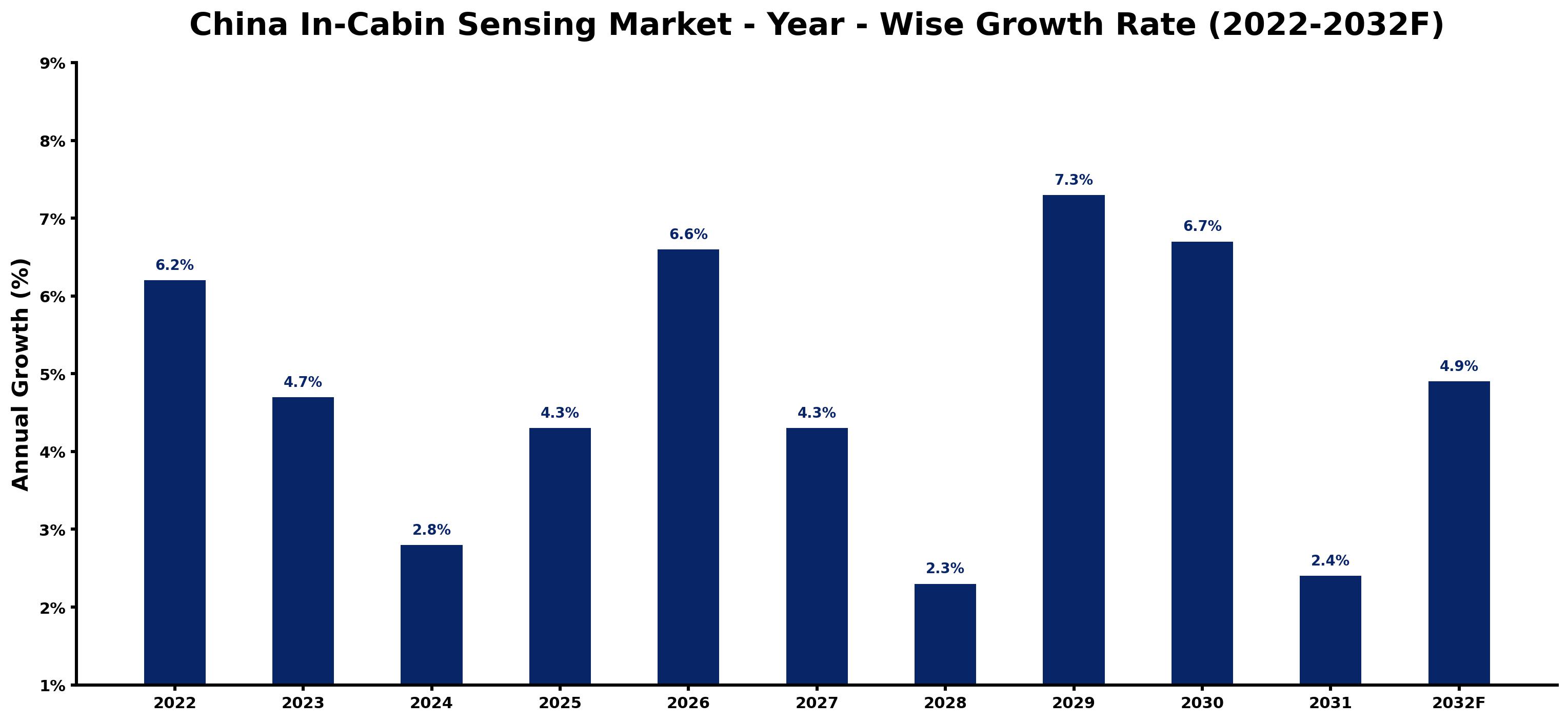
Year by year, the estimates below pair each growth rate with the development that shaped it.
| Year | Estimated Annual Growth (%) | Market Rationale |
| 2022 | 6.2 | The automotive industry produced over 26 million vehicles, driving demand for in-cabin sensing technologies. |
| 2023 | 4.7 | The market experienced slower growth due to ongoing adjustments in automotive safety regulations. |
| 2024 | 2.8 | Demand continued to slow as manufacturers adapted to new safety technology requirements. |
| 2025 | 4.3 | Growth accelerated as the automotive market projected to reach 35 million units by 2025. |
| 2026 | 6.6 | Increased investments in smart vehicle technologies boosted growth in in-cabin sensing. |
| 2027 | 4.3 | A slowdown occurred as manufacturers focused on integrating advanced driver monitoring systems. |
| 2028 | 2.3 | The market saw further deceleration due to evolving safety standards and regulations. |
| 2029 | 7.3 | Growth surged as the market responded to the rising need for enhanced vehicle safety features. |
| 2030 | 6.7 | The market experienced a slowdown as manufacturers adjusted to new technological demands. |
| 2031 | 2.4 | Growth slowed further as the focus shifted to compliance with updated safety regulations. |
| 2032 | 4.9 | The market is expected to grow as demand for advanced sensing technologies increases. |
Note: Market size estimations and growth projections presented in this report are based on 6Wresearch's proprietary forecasting methodology, utilizing the latest available industry data, government publications, and primary research inputs.
China In‑Cabin Sensing Market Synopsis
In-Cabin Sensing Market in China encompasses advanced sensor technologies that monitor the vehicle's interior environment and occupants. These systems improve vehicle safety, enhance air quality, and provide driver assistance features. The market is expanding due to strong demand from domestic manufacturers and the push for advanced vehicle technologies. With a population of 1.4 billion, the need for improved safety regulations is driving this growth.
Market Dynamics Impact Analysis (2026–2032)
| Factor | Type | Impact | Primary Segment Affected |
| Increasing vehicle production and safety regulations drive demand for advanced sensing technologies. | Driver | High | Occupancy Sensors |
| The rise of smart vehicle technologies creates opportunities for innovative sensing solutions. | Driver | High | Biometric Sensors |
| Growing consumer awareness of vehicle safety features presents a significant opportunity. | Opportunity | High | Vehicle Safety Integrators |
| The push for electric vehicles is creating a demand for integrated sensing technologies. | Opportunity | High | ADAS Tier-1s |
| High costs associated with advanced sensor technologies may limit adoption among manufacturers. | Restraint | Medium | Driver Sensors |
| Limited awareness of in-cabin sensing benefits among consumers may hinder market growth. | Restraint | Medium | Air Quality Sensors |
| Competition from alternative safety technologies poses challenges for market players. | Challenge | High | Biometric Sensors |
| Technological integration challenges may delay the adoption of advanced sensing systems. | Challenge | Medium | Occupancy Sensors |
Evaluation of Drivers in China In‑Cabin Sensing Market (2026–2032)
Below mentioned are some major drivers and their influence on market dynamics.
| Drivers | Primary Segment Affected | Why It Matters (Evidence) |
| Increasing vehicle production in China drives demand for occupancy sensors to enhance safety features. | Occupancy Sensors | In 2022, over 26 million vehicles were produced, necessitating advanced safety solutions. |
| The rise of smart vehicle technologies is boosting the adoption of biometric sensors. | Biometric Sensors | China's electric vehicle market is expected to reach 20% penetration by 2025. |
| Growing consumer demand for enhanced safety features is propelling the market for driver sensors. | Driver Sensors | Automotive safety regulations require advanced driver monitoring systems by 2025. |
| The increasing focus on air quality in vehicles is driving demand for air quality sensors. | Air Quality Sensors | The National Standard GB/T 34590 outlines requirements for vehicle safety systems. |
| The need for compliance with updated safety regulations is enhancing market growth for drowsiness detection systems. | Drowsiness Detection | The 'Regulations on the Safety of Motor Vehicle Operation' were updated in 2022. |
Market growth in China for In-Cabin Sensing relies on rising vehicle production, increasing consumer demand for safety features, and the push for smart vehicle technologies. In 2022, over 26 million vehicles were produced, necessitating advanced safety solutions. The electric vehicle market is projected to achieve 20% penetration by 2025, driving the need for integrated sensing technologies. As awareness of air quality issues grows, the market for air quality sensors is set to expand considerably.
Evaluation of Restraints in China In‑Cabin Sensing Market
Below mentioned are some major restraints and their influence on market dynamics.
| Market Restraint | Primary Segment Affected | Why It Matters (Evidence) |
| High costs associated with advanced sensor technologies may limit adoption among manufacturers. | Driver Sensors | The integration of advanced technologies often requires substantial investment, which may deter smaller manufacturers. |
| Limited awareness of in-cabin sensing benefits among consumers may hinder market growth. | Air Quality Sensors | Many consumers remain unaware of the advantages of advanced sensing technologies in improving safety. |
| Competition from alternative safety technologies poses challenges for market players. | Biometric Sensors | Emerging technologies may offer similar benefits at lower costs, impacting market share. |
| Technological integration challenges may delay the adoption of advanced sensing systems. | Occupancy Sensors | Complexity in integrating new technologies with existing systems can slow down implementation. |
| Regulatory compliance costs can be burdensome for manufacturers. | Drowsiness Detection | Adhering to updated safety regulations often requires significant financial investment. |
China In‑Cabin Sensing Market Challenges
In 2022, the automotive industry in China produced over 26 million vehicles, but compliance with stringent safety regulations presents a challenge for producers. The requirement for advanced driver monitoring systems by 2025 compels manufacturers to innovate rapidly, inflating production costs and squeezing profit margins. Intense competition among domestic manufacturers and international suppliers for in-cabin sensing technologies drives prices down, which can diminish profitability for suppliers. Skills shortages in advanced sensor technology hinder development timelines, delaying product launches and limiting options for buyers seeking effective safety solutions.
Trends in the China In‑Cabin Sensing Market
Several trends are reshaping the China In‑Cabin Sensing Market; the most important are set out below.
- Shift Towards Advanced Driver Monitoring Systems: The automotive industry is increasingly adopting advanced driver monitoring systems to improve safety. The updated 'Regulations on the Safety of Motor Vehicle Operation' in 2022 require these systems, pushing manufacturers to integrate them into new vehicles.
- Transition from Basic to Smart Vehicle Technologies: The 'Smart Vehicle Innovation and Development Strategy' launched in 2020 promotes the integration of smart technologies in vehicles. This initiative is driving an increase in the adoption of in-cabin sensing technologies.
- Growing Focus on Air Quality Monitoring: With rising concerns about air quality, manufacturers are prioritising air quality sensors in vehicles. In 2023, the National Development and Reform Commission announced initiatives to promote smart transportation, including air quality monitoring.
- Increased Demand for Biometric Sensors: Vehicle Safety Integrators are increasingly incorporating biometric sensors to improve safety features. The market for these sensors is projected to grow at a CAGR of 7.1% from 2026 to 2032.
Investment Opportunities in the China In‑Cabin Sensing Market
Investors looking at the China In‑Cabin Sensing Market should consider the following areas.
- Vehicle Safety Integrators Seeking Advanced Solutions: Vehicle Safety Integrators are looking for advanced in-cabin sensing technologies to improve safety. With the automotive market projected to produce over 35 million units by 2025, this presents an opportunity for suppliers.
- Rising Demand for Smart Vehicle Technologies: The push for smart vehicle technologies creates a timely opportunity for investment in advanced sensing solutions. The Guangdong province is a leading area for automotive innovation and production, making it an ideal location for partnerships.
- Gap in Advanced Driver Monitoring Systems: With automotive safety regulations requiring advanced driver monitoring systems by 2025, there is a clear gap in the market. Suppliers can enter by collaborating with local manufacturers to meet these requirements.
- Entry into the Growing Electric Vehicle Market: The electric vehicle market is expected to reach 20% penetration by 2025, creating demand for integrated sensing technologies. Partnerships with local manufacturers can facilitate entry into this expanding sector.
Government Initiatives in the China In‑Cabin Sensing Market
The 'Smart Vehicle Innovation and Development Strategy' launched by the Ministry of Industry and Information Technology in 2020 promotes advanced automotive technologies. This strategy aims to support the integration of smart technologies, including in-cabin sensing systems, into new vehicles. By encouraging innovation, the government helps manufacturers adopt these technologies, ensuring compliance with upcoming safety regulations. The strategy is part of a broader initiative to modernise the automotive industry and improve vehicle safety standards across the country. Such measures are expected to impact the adoption of in-cabin sensing technologies in the coming years, with a budget of 500 million yuan allocated for related projects.
The Ministry of Industry and Information Technology oversees the approval of automotive safety standards and funding for innovation projects. In 2023, the government allocated 500 million yuan to support automotive safety technology development, including in-cabin sensing technologies. This funding aids research and development efforts aimed at improving vehicle safety features. Additionally, the China Automotive Technology and Research Center plays a vital role in establishing safety standards and regulations, ensuring that manufacturers comply with the latest requirements. These agencies work together to create a conducive environment for the growth of advanced automotive technologies.
Future Insight of the China In‑Cabin Sensing Market
Several forward-looking factors are expected to support the in-cabin sensing market in China over the coming years. The 'Smart Vehicle Innovation and Development Strategy' launched in 2020 will catalyse advancements in automotive technologies, creating a more dynamic environment. By 2025, China's electric vehicle market is set to achieve a 20% penetration rate, boosting demand for in-cabin sensing solutions. Initiatives from the National Development and Reform Commission will promote smart transportation, driving substantial investments in safety technologies and expanding market opportunities.
Market Segmentation Analysis
Each segment group is reviewed below, with the leader by share and the fastest grower by CAGR.
By Sensor Group – Occupancy Sensors Dominated, Biometric Sensors Expected to Grow Fastest
According to Sachin Kumar Rai, Senior Research Analyst at 6Wresearch, Occupancy Sensors accounted for a 48% market share by sensor group in 2025. Occupancy sensors hold the largest share in the China In-Cabin Sensing Market because they are crucial for detecting passenger presence and activating essential safety features. Their significance is highlighted by the automotive safety regulations set to be enforced by 2025, which will drive their widespread adoption. Over 2026–2032, Biometric Sensors are expected to post the fastest growth, at a CAGR of 7.1%. Biometric sensors are experiencing rapid growth as they provide critical data on driver health metrics, which is increasingly recognised as vital for enhancing vehicle safety and personalisation. This growth is propelled by the rising focus on advanced driver monitoring systems, ensuring that biometric sensing will continue to gain momentum. Suppliers should focus on advancing biometric sensing technologies to meet the rising demand for enhanced vehicle safety features.
By Data Captured – Presence Dominated and Is Expected to Record the Fastest Growth
In 2025, Presence led the data captured split with a 24% share. Presence detection leads the market as it is essential for activating safety alerts and features within vehicles. This capability is increasingly demanded by both consumers and manufacturers, ensuring that presence detection remains a key focus area in the in-cabin sensing landscape. Its lead should widen, with a projected CAGR of 6.0% during 2026–2032, the highest in this split. The presence detection segment is also the fastest-growing due to its critical role in enhancing vehicle safety systems. As automotive safety regulations tighten, the demand for effective presence detection technologies is expected to rise significantly, reinforcing its growth trajectory. This indicates that suppliers should invest in refining presence detection technologies to stay competitive in the evolving market.
By Feature Enabled – Seatbelt Alerts Dominated, Drowsiness Detection Expected to Grow Fastest
Seatbelt Alerts took a 45% share of feature enabled in 2025, more than any other category. Seatbelt alerts are the leading feature enabled by in-cabin sensing technology, as they play a vital role in ensuring passenger safety compliance. Their importance is underscored by regulatory requirements and consumer expectations for enhanced safety measures in vehicles. Drowsiness Detection is set to record the highest CAGR in this split, 6.9% over 2026–2032. Drowsiness detection is rapidly gaining traction as it addresses a critical safety concern by preventing accidents caused by driver fatigue. The increasing awareness of road safety issues is driving the demand for this feature, contributing to its fast growth. This suggests that suppliers should prioritise the development of advanced drowsiness detection systems to meet market needs.
By End User – Vehicle Safety Integrators Dominated, ADAS Tier-1s Expected to Grow Fastest
With a 41% revenue share in 2025, Vehicle Safety Integrators was the largest end user category. Vehicle safety integrators dominate the market as they are directly responsible for implementing in-cabin sensing solutions to enhance vehicle safety. Their pivotal role in the automotive supply chain ensures that they will continue to lead in the adoption of these technologies. The quickest growth will come from ADAS Tier-1s, forecast to expand at a CAGR of 6.2% between 2026 and 2032. ADAS Tier-1s are the fastest-growing end user group as they integrate advanced sensing technologies into vehicle safety systems. The increasing complexity of automotive safety requirements is propelling their demand for sophisticated in-cabin sensing solutions, ensuring rapid growth in this segment. This trend indicates that suppliers must strengthen partnerships with ADAS Tier-1s to capture the growing demand for advanced sensing technologies.
Key Attractiveness of the Report
- 10 Years of Market Numbers
- Historical Data Starting from 2022 to 2025
- Base Year 2025
- Forecast Data until 2032
- Key Performance Indicators Impacting the Market
- Major Upcoming Developments and Projects
Key Highlights of the Report:
- China In‑Cabin Sensing Market Outlook
- Market Size of China In‑Cabin Sensing Market, 2025
- Forecast of China In‑Cabin Sensing Market, 2032
- Historical Data and Forecast of China In‑Cabin Sensing Revenues & Volume for the Period 2022 - 2032F
- China In‑Cabin Sensing Market Trend Evolution
- China In‑Cabin Sensing Market Drivers and Challenges
- China In‑Cabin Sensing Price Trends
- China In‑Cabin Sensing Porter's Five Forces
- China In‑Cabin Sensing Industry Life Cycle
- Historical Data and Forecast of China In‑Cabin Sensing Market Revenues & Volume By Sensor Group for the Period 2022 - 2032F
- Historical Data and Forecast of China In‑Cabin Sensing Market Revenues & Volume By Occupancy Sensors for the Period 2022 - 2032F
- Historical Data and Forecast of China In‑Cabin Sensing Market Revenues & Volume By Driver Sensors for the Period 2022 - 2032F
- Historical Data and Forecast of China In‑Cabin Sensing Market Revenues & Volume By Air Quality Sensors for the Period 2022 - 2032F
- Historical Data and Forecast of China In‑Cabin Sensing Market Revenues & Volume By Biometric Sensors for the Period 2022 - 2032F
- Historical Data and Forecast of China In‑Cabin Sensing Market Revenues & Volume By Data Captured for the Period 2022 - 2032F
- Historical Data and Forecast of China In‑Cabin Sensing Market Revenues & Volume By Presence, Motion for the Period 2022 - 2032F
- Historical Data and Forecast of China In‑Cabin Sensing Market Revenues & Volume By Eye, Head, Hands for the Period 2022 - 2032F
- Historical Data and Forecast of China In‑Cabin Sensing Market Revenues & Volume By VOC, PM, Humidity for the Period 2022 - 2032F
- Historical Data and Forecast of China In‑Cabin Sensing Market Revenues & Volume By Heart, Respiration Rate for the Period 2022 - 2032F
- Historical Data and Forecast of China In‑Cabin Sensing Market Revenues & Volume By Feature Enabled for the Period 2022 - 2032F
- Historical Data and Forecast of China In‑Cabin Sensing Market Revenues & Volume By Seatbelt Alerts for the Period 2022 - 2032F
- Historical Data and Forecast of China In‑Cabin Sensing Market Revenues & Volume By Drowsiness Detection for the Period 2022 - 2032F
- Historical Data and Forecast of China In‑Cabin Sensing Market Revenues & Volume By Cabin Purification for the Period 2022 - 2032F
- Historical Data and Forecast of China In‑Cabin Sensing Market Revenues & Volume By Emergency Alerts for the Period 2022 - 2032F
- Historical Data and Forecast of China In‑Cabin Sensing Market Revenues & Volume By End User for the Period 2022 - 2032F
- Historical Data and Forecast of China In‑Cabin Sensing Market Revenues & Volume By Vehicle Safety Integrators for the Period 2022 - 2032F
- Historical Data and Forecast of China In‑Cabin Sensing Market Revenues & Volume By ADAS Tier-1s for the Period 2022 - 2032F
- Historical Data and Forecast of China In‑Cabin Sensing Market Revenues & Volume By HVAC System Providers for the Period 2022 - 2032F
- Historical Data and Forecast of China In‑Cabin Sensing Market Revenues & Volume By Advanced Telematics Firms for the Period 2022 - 2032F
- China In‑Cabin Sensing Import Export Trade Statistics
- Market Opportunity Assessment By Sensor Group
- Market Opportunity Assessment By Data Captured
- Market Opportunity Assessment By Feature Enabled
- Market Opportunity Assessment By End User
- China In‑Cabin Sensing Top Companies Market Share
- China In‑Cabin Sensing Competitive Benchmarking By Technical and Operational Parameters
- China In‑Cabin Sensing Company Profiles
- China In‑Cabin Sensing Key Strategic Recommendations
Market Covered
This report examines the market across the segments below.
By Sensor Group
- Occupancy Sensors
- Driver Sensors
- Air Quality Sensors
- Biometric Sensors
By Data Captured
- Presence
- Motion
- Eye
- Head
- Hands
- VOC
- PM
- Humidity
- Heart
- Respiration Rate
By Feature Enabled
- Seatbelt Alerts
- Drowsiness Detection
- Cabin Purification
- Emergency Alerts
By End User
- Vehicle Safety Integrators
- ADAS Tier-1s
- HVAC System Providers
- Advanced Telematics Firms































