India Incontinence Implants Market Size & Growth Rate
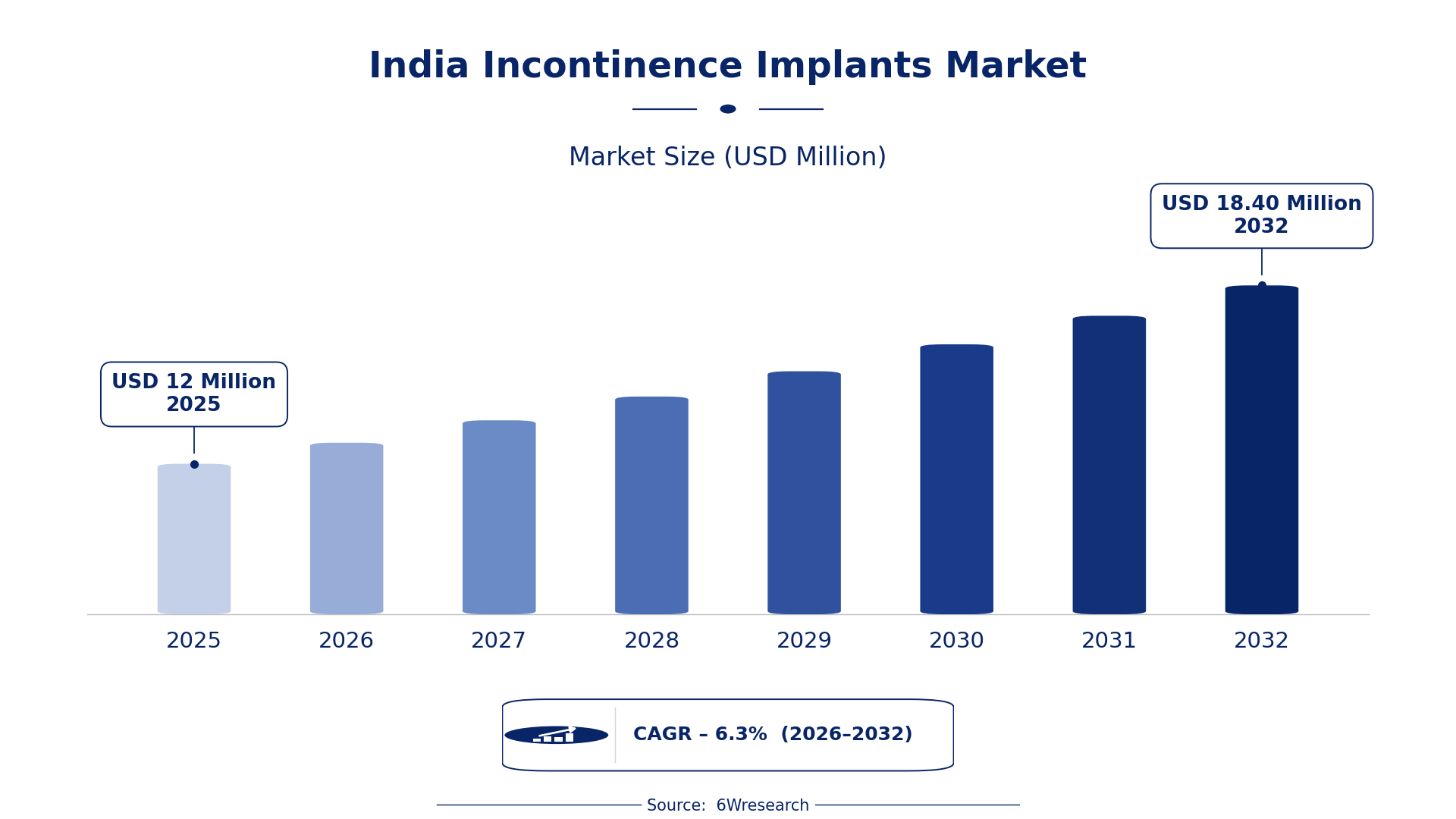
According to 6Wresearch internal database and industry insights, the India Incontinence Implants Market was valued at USD 12.0 million in 2025 and is projected to reach USD 18.40 million by 2032, growing at a CAGR of approximately 6.3% during 2026–2032.
India Incontinence Implants Market Highlights
| Report Metric | Details |
| Report Name | India Incontinence Implants Market |
| Market Size 2025 | USD 12.0 million |
| Market Size 2032 | USD 18.40 million |
| Absolute Growth 2025–2032 | USD 6.40 million |
| CAGR 2026–2032 | 6.3% |
| Peak Annual Growth | 8.5% in 2029 |
| Forecast Period | 2026–2032 |
| Historical Data | 2022–2025 |
| Base Year | 2025 |
| Leading Implant Type, 2025 | Artificial Urinary Sphincters (44% share) |
| Leading Gender Focus, 2025 | Female Focused (42% share) |
| Leading Mechanism of Action, 2025 | Sphincter Compression (43% share) |
| Leading End User, 2025 | Urology Departments (35% share) |
| Fastest-Growing Implant Type | Bladder Stimulators (8.9% CAGR) |
| Fastest-Growing Gender Focus | Nerve Modulation (8.8% CAGR) |
| Fastest-Growing Mechanism of Action | Supportive Mesh (7.7% CAGR) |
| Fastest-Growing End User | Women's Health Clinics (7.8% CAGR) |
| Growing Sector | Urology |
| Key End Users | Urology Departments, Women's Health Clinics, Outpatient Surgery Units, Neurology Centers |
India Incontinence Implants Market Year-wise Growth Rate and Key Drivers (2022–2032)
This graph illustrates the annual growth rates of the market from 2022 to 2032, highlighting a steady upward trajectory and projected market expansion over the forecast period.
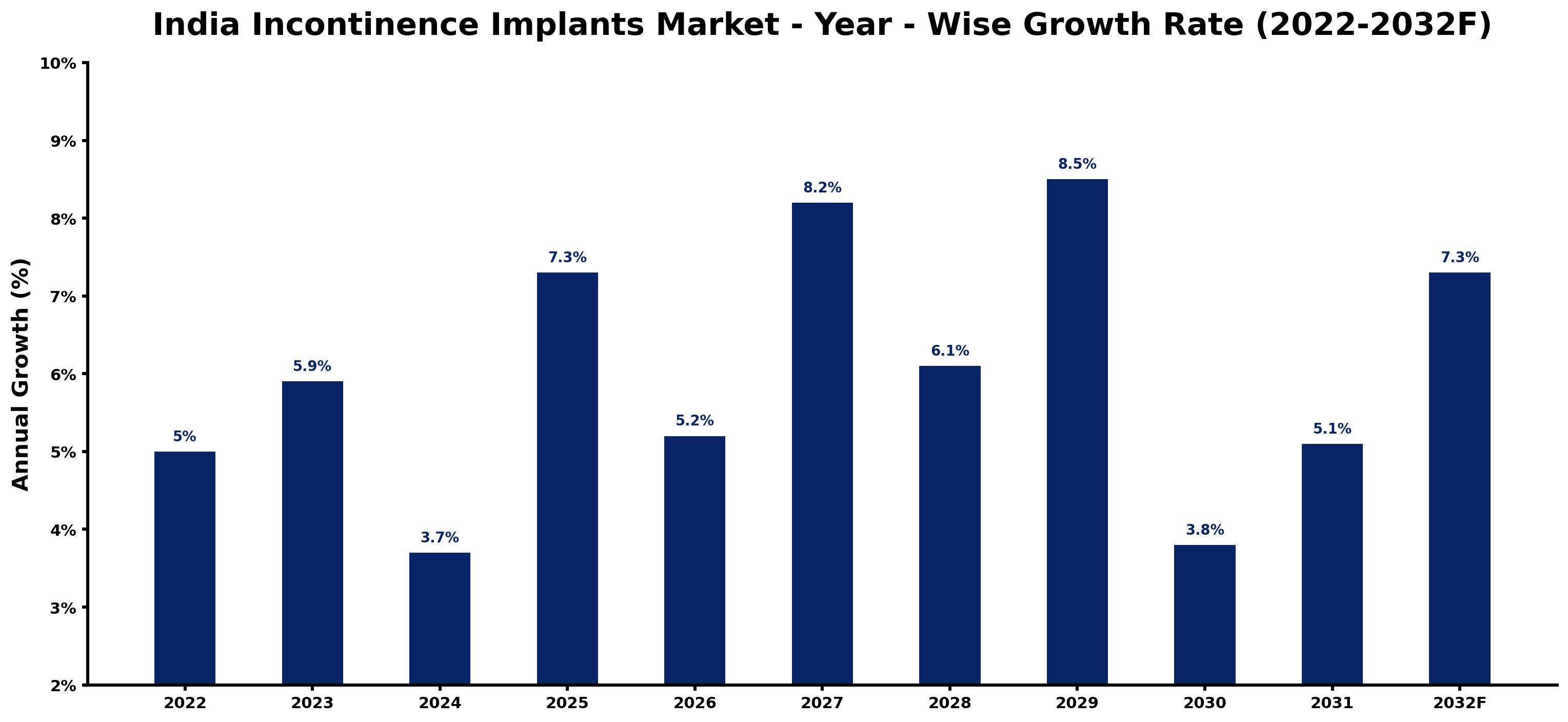
Each row of the following table gives one year's estimated growth and the event or demand shift that explains it.
| Year | Estimated Annual Growth (%) | Market Rationale |
| 2022 | 5.0 | The market experienced steady growth due to increasing awareness of treatment options. |
| 2023 | 5.9 | Demand rose as healthcare facilities upgraded their urology departments with advanced implants. |
| 2024 | 3.7 | Growth slowed as some hospitals faced budget constraints affecting procurement. |
| 2025 | 7.3 | The market rebounded with heightened interest in artificial urinary sphincters. |
| 2026 | 5.2 | A slight slowdown occurred as manufacturers adjusted to new regulations. |
| 2027 | 8.2 | Demand surged due to the growing prevalence of urinary incontinence among women. |
| 2028 | 6.1 | Growth decelerated as competition intensified among implant suppliers. |
| 2029 | 8.5 | The market peaked with significant investments in urology advancements. |
| 2030 | 3.8 | Growth slowed as the market began to stabilise after rapid expansion. |
| 2031 | 5.1 | Demand increased as women's health clinics expanded their service offerings. |
| 2032 | 7.3 | The market grew as awareness campaigns reached more rural regions. |
Note: Market size estimations and growth projections presented in this report are based on 6Wresearch's proprietary forecasting methodology, utilizing the latest available industry data, government publications, and primary research inputs.
India Incontinence Implants Market Synopsis
Incontinence Implants Market in India includes medical devices aimed at treating urinary incontinence, primarily constructed from biocompatible materials. These implants are integral to surgical procedures that support the bladder or urethra, greatly enhancing patients' quality of life. The market is growing due to a rising incidence of urinary incontinence, with around 30% of women in urban areas affected. The National Health Mission is actively promoting awareness and treatment options, which is driving demand from healthcare facilities and individual users.
Market Dynamics Impact Analysis (2026–2032)
| Factor | Type | Impact | Primary Segment Affected |
| Increasing awareness of urinary incontinence treatments | Driver | High | Artificial Urinary Sphincters |
| Growing demand for advanced urology solutions | Driver | High | Urethral Slings |
| Expansion of women's health clinics | Opportunity | High | Women's Health Clinics |
| Rising investments in healthcare infrastructure | Opportunity | High | Urology Departments |
| Limited access to advanced treatments in rural areas | Restraint | High | Bladder Stimulators |
| Cost constraints faced by healthcare facilities | Restraint | Medium | Injectable Implants |
| Regulatory challenges in medical device approvals | Challenge | High | Artificial Urinary Sphincters |
| Competition among implant manufacturers | Challenge | Medium | Urethral Slings |
Evaluation of Drivers in India Incontinence Implants Market (2026–2032)
Key forces behind demand, with the segment each one moves most, are listed below.
| Drivers | Primary Segment Affected | Why It Matters (Evidence) |
| Awareness campaigns about urinary incontinence | Artificial Urinary Sphincters | The National Health Mission's initiatives have led to increased patient inquiries and purchases. |
| Technological advancements in urology | Urethral Slings | Hospitals are investing in state-of-the-art solutions to meet patient needs, increasing demand. |
| Growing female population experiencing urinary issues | Women's Health Clinics | With 30% of urban women affected, clinics are expanding services to cater to this demographic. |
| Government support for healthcare access | Urology Departments | The 'Ayushman Bharat' scheme provides funding for surgical treatments, boosting implant sales. |
| Increased surgical procedures for urinary incontinence | Bladder Stimulators | As awareness rises, more patients seek surgical options, leading to higher demand. |
Approximately 30% of urban women experience urinary incontinence, driving demand for effective solutions. The 'Ayushman Bharat' scheme provides funding for surgical treatments, further boosting sales. As awareness rises, more patients seek surgical options, leading to higher demand for urethral slings and bladder stimulators.
Evaluation of Restraints in India Incontinence Implants Market
The main factors holding the market back are set out below.
| Market Restraint | Primary Segment Affected | Why It Matters (Evidence) |
| Limited access to advanced treatments in rural areas | Bladder Stimulators | Many rural healthcare facilities lack the resources to provide advanced incontinence solutions. |
| Cost constraints faced by healthcare facilities | Injectable Implants | Budget limitations restrict hospitals from procuring newer implant technologies. |
| Regulatory challenges in medical device approvals | Artificial Urinary Sphincters | The approval process can delay product availability, affecting market growth. |
| Competition among implant manufacturers | Urethral Slings | Intense competition can lead to price wars, impacting profitability for suppliers. |
| Limited awareness among patients in rural regions | Women's Health Clinics | Patients in these areas may not seek treatment due to lack of information. |
India Incontinence Implants Market Challenges
In the India incontinence implants market, 30% of urban women experience urinary incontinence, but many healthcare facilities lack access to advanced surgical techniques. This technological shortfall leads to prolonged recovery times and less effective treatments for patients in hospitals. Compliance with ISO 13485 standards can delay the launch of new products, resulting in a shortage of essential implants for clinics. Buyers, particularly women's health clinics, struggle with fluctuating demand for urethral slings, complicating inventory management and risking stockouts. High costs associated with sophisticated implants discourage patients from pursuing treatment, restricting access to necessary care.
Trends in the India Incontinence Implants Market
Below mentioned are some of the trends shaping the India Incontinence Implants Market growth.
- Shift towards Advanced Urology Solutions: The National Health Mission's initiatives have led to increased adoption of advanced urology solutions, with a reported rise in demand for artificial urinary sphincters in urban hospitals.
- Expansion of Women's Health Clinics: Women's health clinics are increasingly focusing on urinary incontinence treatments, with a reported growth in patient visits for urethral slings since 2020.
- Increased Use of Telemedicine: The Digital India program has improved access to urology consultations, with telemedicine services growing in recent years, facilitating more patients to seek treatment.
- Rising Popularity of Bladder Stimulators: Bladder stimulators are gaining traction in specialized neurology centers, with an increase in usage reported among patients with neurogenic bladder management.
Investment Opportunities in the India Incontinence Implants Market
Several openings in the India Incontinence Implants Market merit attention from investors.
- Growth in Urology Departments: Urology departments in major hospitals are expanding their services, with a projected increase in patient volume, creating demand for advanced implants.
- Investment in Women's Health Clinics: Women's health clinics are seeking to expand their offerings, with an increase in funding for new treatments, creating opportunities for suppliers of incontinence implants.
- Partnerships with Local Manufacturers: Local manufacturers are looking for partnerships to improve production capabilities, with a gap in supply reported in the market, presenting entry opportunities.
- Expansion of Telemedicine Services: The rise of telemedicine services is creating a demand for remote consultations, with an increase in patients seeking urology advice online.
Government Initiatives in the India Incontinence Implants Market
The Central Drugs Standard Control Organization manages the approval of medical devices, ensuring adherence to safety standards. The 'Make in India' initiative promotes local manufacturing of medical devices, including incontinence implants, focusing on quality and affordability, launched in 2020. This initiative aims to boost domestic production capabilities and lessen dependence on imports. The 'Digital India' program encourages telemedicine services, improving access to urology consultations and treatments, updated in 2022, which has increased patient engagement and treatment adherence.
The Ministry of Health and Family Welfare has rolled out the 'National Health Mission', aimed at reducing the incidence of urinary incontinence through awareness programs, launched in 2020. This initiative has greatly improved access to treatment options for patients across India. The 'Ayushman Bharat' scheme continues to provide financial support for surgical treatments, including incontinence implants, as of 2023, ensuring that more patients can afford necessary procedures.
Future Insight of the India Incontinence Implants Market
Several forward-looking factors should support the India incontinence implants market by 2032. The National Health Mission's initiatives will raise awareness and improve treatment options, particularly in rural areas, enhancing access for underserved populations. Innovations in biocompatible materials will yield more effective implants, boosting patient satisfaction. Urology departments are projected to see a 20% rise in the adoption of new technologies, including artificial urinary sphincters for male patients post-prostate surgery. The 'Ayushman Bharat' scheme will further broaden healthcare access, making treatments more affordable.
Market Segmentation Analysis
The analysis below covers each segmentation, its leading category in 2025 and its fastest-growing category through 2032.
By Implant Type – Artificial Urinary Sphincters Dominated, Bladder Stimulators Expected to Grow Fastest
According to Sachin Kumar Rai, Senior Research Analyst at 6Wresearch, in 2025, Artificial Urinary Sphincters led the implant type split with a 44% share. Artificial urinary sphincters hold the largest share in the India incontinence implants market as they are specifically designed for managing severe urinary incontinence, particularly beneficial for male patients post-prostate surgery. Their extensive use in urology departments of major hospitals solidifies their dominant position. Bladder Stimulators are projected to grow fastest, at a CAGR of 8.9% during 2026–2032. Bladder stimulators are experiencing rapid growth due to their increasing application in specialized neurology centers for managing neurogenic bladder conditions. This trend indicates a shift towards diverse treatment options, which is likely to further enhance the market share of bladder stimulators. Suppliers should focus on developing bladder stimulators to meet the growing demand for advanced incontinence treatment solutions.
By Gender Focus – Female Focused Dominated, Nerve Modulation Expected to Grow Fastest
Female Focused held a 42% share of the India Incontinence Implants Market by gender focus in 2025. The female-focused segment leads the market as urinary incontinence predominantly affects women, with a significant prevalence of 30% in urban areas. This demographic drives substantial usage of incontinence implants tailored for female patients, particularly in dedicated women's health clinics. The quickest growth will come from Nerve Modulation, forecast to expand at a CAGR of 8.8% between 2026 and 2032. Nerve modulation is emerging as the fastest-growing focus area, reflecting a rising interest in new technologies for urinary incontinence treatment. As research progresses and awareness increases, this segment is expected to significantly expand its market share. Buyers can expect a broader range of treatment options as suppliers invest in technologies specifically designed for female patients.
By Mechanism of Action – Sphincter Compression Dominated, Supportive Mesh Expected to Grow Fastest
The largest mechanism of action category in 2025 was Sphincter Compression, with a 43% share of total revenue. Sphincter compression is the leading mechanism of action, primarily used in artificial urinary sphincters that effectively manage urination control in patients with severe incontinence. Its direct application in established treatment protocols makes it the most prevalent mechanism within the market. Over 2026–2032, Supportive Mesh is expected to post the fastest growth, at a CAGR of 7.7%. Supportive mesh is rapidly gaining popularity as it provides essential structural support in slings, appealing to both patients and healthcare providers. Its increasing adoption in surgical procedures indicates a shift towards more supportive treatment options within the market. Suppliers should consider expanding their product offerings to include supportive mesh solutions, addressing the rising demand for effective incontinence treatments.
By End User – Urology Departments Dominated, Women's Health Clinics Expected to Grow Fastest
Urology Departments accounted for a 35% market share by end user in 2025. Urology departments dominate the market as the primary users of incontinence implants, providing essential care for patients suffering from urinary incontinence. Their established infrastructure and expertise in urology make them key players in the distribution of these medical devices. Women's Health Clinics are set to record the highest CAGR in this split, 7.8% over 2026–2032. Women's health clinics are the fastest-growing end user segment, focusing specifically on female patients with incontinence. This trend indicates a shift towards specialised care that addresses the unique needs of women. Suppliers should strengthen partnerships with women's health clinics to better serve this expanding market segment.
Key Attractiveness of the Report
- 10 Years of Market Numbers
- Historical Data Starting from 2022 to 2025
- Base Year 2025
- Forecast Data until 2032
- Key Performance Indicators Impacting the Market
- Major Upcoming Developments and Projects
Key Highlights of the Report:
- India Incontinence Implants Market Outlook
- Market Size of India Incontinence Implants Market, 2025
- Forecast of India Incontinence Implants Market, 2032
- Historical Data and Forecast of India Incontinence Implants Revenues & Volume for the Period 2022 - 2032F
- India Incontinence Implants Market Trend Evolution
- India Incontinence Implants Market Drivers and Challenges
- India Incontinence Implants Price Trends
- India Incontinence Implants Porter's Five Forces
- India Incontinence Implants Industry Life Cycle
- Historical Data and Forecast of India Incontinence Implants Market Revenues & Volume By Implant Type for the Period 2022 - 2032F
- Historical Data and Forecast of India Incontinence Implants Market Revenues & Volume By Artificial Urinary Sphincters for the Period 2022 - 2032F
- Historical Data and Forecast of India Incontinence Implants Market Revenues & Volume By Urethral Slings for the Period 2022 - 2032F
- Historical Data and Forecast of India Incontinence Implants Market Revenues & Volume By Bladder Stimulators for the Period 2022 - 2032F
- Historical Data and Forecast of India Incontinence Implants Market Revenues & Volume By Injectable Implants for the Period 2022 - 2032F
- Historical Data and Forecast of India Incontinence Implants Market Revenues & Volume By Gender Focus for the Period 2022 - 2032F
- Historical Data and Forecast of India Incontinence Implants Market Revenues & Volume By Male/Female for the Period 2022 - 2032F
- Historical Data and Forecast of India Incontinence Implants Market Revenues & Volume By Female Focused for the Period 2022 - 2032F
- Historical Data and Forecast of India Incontinence Implants Market Revenues & Volume By Nerve Modulation for the Period 2022 - 2032F
- Historical Data and Forecast of India Incontinence Implants Market Revenues & Volume By Volume Augmentation for the Period 2022 - 2032F
- Historical Data and Forecast of India Incontinence Implants Market Revenues & Volume By Mechanism of Action for the Period 2022 - 2032F
- Historical Data and Forecast of India Incontinence Implants Market Revenues & Volume By Sphincter Compression for the Period 2022 - 2032F
- Historical Data and Forecast of India Incontinence Implants Market Revenues & Volume By Supportive Mesh for the Period 2022 - 2032F
- Historical Data and Forecast of India Incontinence Implants Market Revenues & Volume By Electrical Signal Device for the Period 2022 - 2032F
- Historical Data and Forecast of India Incontinence Implants Market Revenues & Volume By Bio-Bulking Agents for the Period 2022 - 2032F
- Historical Data and Forecast of India Incontinence Implants Market Revenues & Volume By End User for the Period 2022 - 2032F
- Historical Data and Forecast of India Incontinence Implants Market Revenues & Volume By Urology Departments for the Period 2022 - 2032F
- Historical Data and Forecast of India Incontinence Implants Market Revenues & Volume By Women s Health Clinics for the Period 2022 - 2032F
- Historical Data and Forecast of India Incontinence Implants Market Revenues & Volume By Neurology/Urology Centers for the Period 2022 - 2032F
- Historical Data and Forecast of India Incontinence Implants Market Revenues & Volume By Outpatient Surgery Units for the Period 2022 - 2032F
- India Incontinence Implants Import Export Trade Statistics
- Market Opportunity Assessment By Implant Type
- Market Opportunity Assessment By Gender Focus
- Market Opportunity Assessment By Mechanism of Action
- Market Opportunity Assessment By End User
- India Incontinence Implants Top Companies Market Share
- India Incontinence Implants Competitive Benchmarking By Technical and Operational Parameters
- India Incontinence Implants Company Profiles
- India Incontinence Implants Key Strategic Recommendations
Market Covered
The report offers an extensive study of the following market segments.
By Implant Type
- Artificial Urinary Sphincters
- Urethral Slings
- Bladder Stimulators
- Injectable Implants
By Gender Focus
- Male/Female
- Female Focused
- Nerve Modulation
- Volume Augmentation
By Mechanism of Action
- Sphincter Compression
- Supportive Mesh
- Electrical Signal Device
- Bio-Bulking Agents
By End User
- Urology Departments
- Women's Health Clinics
- Neurology/Urology Centers
- Outpatient Surgery Units































