India Indoor Wireless Market Size & Growth Rate
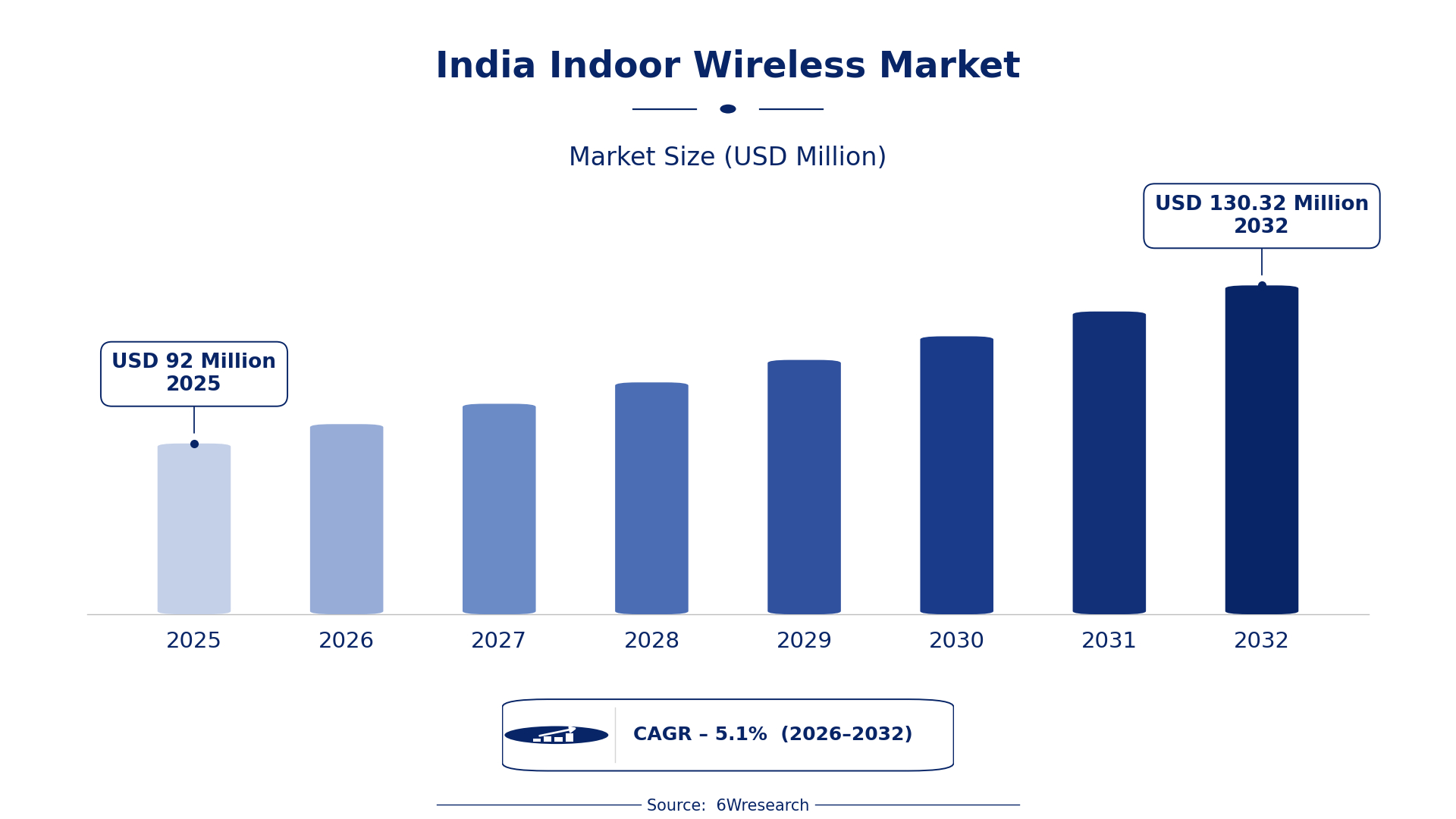
According to 6Wresearch internal database and industry insights, the India Indoor Wireless Market was valued at USD 92.0 million in 2025 and is projected to reach USD 130.32 million by 2032, growing at a CAGR of approximately 5.1% during 2026–2032.
India Indoor Wireless Market Highlights
| Report Metric | Details |
| Report Name | India Indoor Wireless Market |
| Market Size 2025 | USD 92.0 million |
| Market Size 2032 | USD 130.32 million |
| Absolute Growth 2025–2032 | USD 38.32 million |
| CAGR 2026–2032 | 5.1% |
| Peak Annual Growth | 8.1% in 2032 |
| Forecast Period | 2026–2032 |
| Historical Data | 2022–2025 |
| Base Year | 2025 |
| Leading Technology Type, 2025 | Wi-Fi 6/6E (39% share) |
| Leading Coverage Area, 2025 | Enterprise/Residential (44% share) |
| Leading Use Case, 2025 | High-Speed Internet (53% share) |
| Leading End User, 2025 | Smart Building Planners (44% share) |
| Fastest-Growing Technology Type | mmWave 5G (6.5% CAGR) |
| Fastest-Growing Coverage Area | High-Capacity Spots (7.2% CAGR) |
| Fastest-Growing Use Case | Ultra-HD Streaming (6.4% CAGR) |
| Fastest-Growing End User | Telecom Service Providers (7.2% CAGR) |
| Growing Sector | Telecom Service Providers |
| Key End Users | Smart Building Planners, Telecom Service Providers, Consumer Electronics Brands, IT Infrastructure Providers |
India Indoor Wireless Market Year-wise Growth Rate and Key Drivers (2022–2032)
This graph illustrates the annual growth rates of the market from 2022 to 2032, highlighting a steady upward trajectory and projected market expansion over the forecast period.
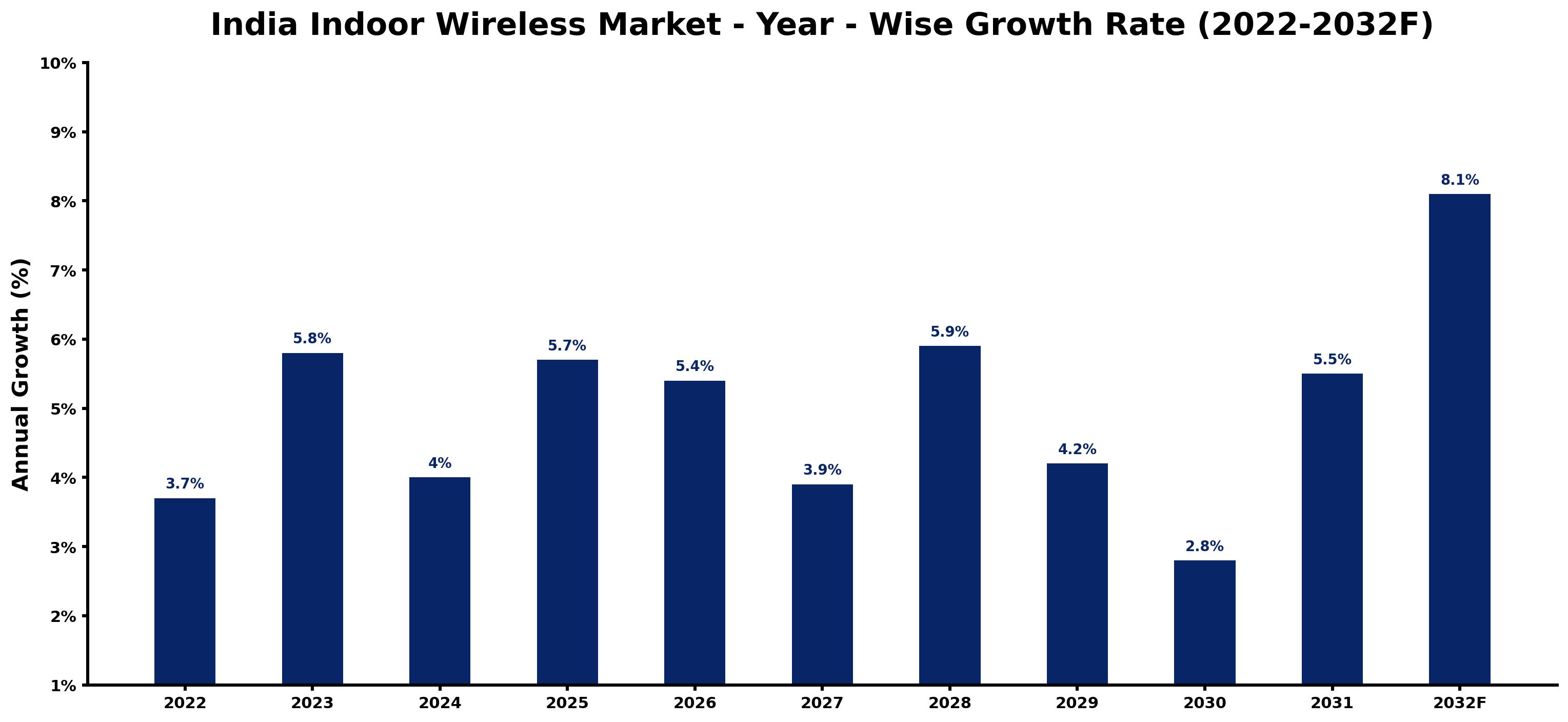
Below, each year's estimated growth is shown next to the factor that most influenced it.
| Year | Estimated Annual Growth (%) | Market Rationale |
| 2022 | 3.7 | The market experienced steady demand due to ongoing urbanisation and infrastructure projects. |
| 2023 | 5.8 | Growth accelerated as urban population reached 468 million, increasing the need for connectivity solutions. |
| 2024 | 4.0 | A slight slowdown occurred as the market adjusted to previous high growth rates and demand stabilised. |
| 2025 | 5.7 | Demand surged again, driven by the Smart Cities Mission, which prioritised indoor wireless infrastructure. |
| 2026 | 5.4 | Growth is expected to slow as the market faces challenges in meeting rising connectivity expectations. |
| 2027 | 3.9 | Continued demand for secure connectivity in enterprises is projected to contribute to a further slowdown in growth. |
| 2028 | 5.9 | A rebound in growth is anticipated as mesh networks gain traction in urban areas for better connectivity. |
| 2029 | 4.2 | The market is expected to see another slowdown as competition intensifies among service providers. |
| 2030 | 2.8 | Demand growth is projected to slow due to market saturation in urban regions and increased service options. |
| 2031 | 5.5 | A resurgence in growth is expected, driven by advancements in Wi-Fi technology and user demands. |
| 2032 | 8.1 | The market is set to peak as investments in indoor wireless infrastructure reach new heights. |
Note: Market size estimations and growth projections presented in this report are based on 6Wresearch's proprietary forecasting methodology, utilizing the latest available industry data, government publications, and primary research inputs.
India Indoor Wireless Market Synopsis
Indoor Wireless in India includes systems that deliver wireless connectivity within buildings, utilising advanced networking equipment. This technology supports high-speed internet access, smart building technologies, and communication in industrial facilities. The India Indoor Wireless Market is expanding due to substantial investments in network upgrades and initiatives like the Smart Cities Mission, which aims to develop 100 smart cities by 2023, driving demand for advanced connectivity solutions. With over 50% of Indian households now having broadband access, the necessity for efficient indoor wireless technologies is increasingly pressing.
Market Dynamics Impact Analysis (2026–2032)
| Factor | Type | Impact | Primary Segment Affected |
| Rapid urbanisation is increasing the demand for reliable indoor connectivity solutions. | Driver | High | Enterprise/Residential |
| Growing adoption of smart technologies in buildings is driving the need for advanced wireless systems. | Driver | High | Smart Building Planners |
| The push for smart city development creates opportunities for infrastructure investment in urban areas. | Opportunity | High | High-Capacity Spots |
| The rising number of mobile subscribers presents a chance to expand indoor wireless services. | Opportunity | Medium | Telecom Service Providers |
| High costs of infrastructure upgrades may limit the growth of new installations. | Restraint | High | mmWave 5G |
| Regulatory challenges in spectrum allocation can hinder the deployment of new technologies. | Restraint | Medium | Private LTE |
| The Indoor Wireless Market in India faces practical problems, including high infrastructure costs. | Challenge | High | Mesh Networks |
| Competition among service providers can lead to pricing pressures, affecting profitability. | Challenge | Medium | High-Speed Internet |
Evaluation of Drivers in India Indoor Wireless Market (2026–2032)
Below mentioned are some major drivers and their influence on market dynamics.
| Drivers | Primary Segment Affected | Why It Matters (Evidence) |
| Increasing urban population drives demand for reliable indoor connectivity solutions. | Enterprise/Residential | India's urban population reached 468 million in 2023, necessitating effective indoor wireless systems. |
| Smart technologies are becoming integral to modern buildings, boosting demand for advanced wireless systems. | Smart Building Planners | The Smart Cities Mission aims to develop 100 smart cities by 2023, improving infrastructure. |
| Investment in network upgrades is expanding capacity for indoor wireless technologies. | mmWave 5G | India's telecom sector is projected to invest ₹1.5 trillion in network upgrades by 2025. |
| The rise in mobile subscribers increases the need for enhanced indoor wireless solutions. | Telecom Service Providers | India has over 1 billion mobile subscribers, driving demand for effective connectivity. |
| High data consumption rates necessitate better indoor wireless infrastructure. | High-Speed Internet | The average data consumption per user in India reached 14 GB per month in 2023. |
Expansion of the Indoor Wireless market in India is supported by rising urbanisation, infrastructure investments, and the adoption of smart technologies. The urban population reached 468 million in 2023, creating a need for effective indoor connectivity solutions. The telecom sector is expected to invest ₹1.5 trillion in network upgrades by 2025, increasing capacity for advanced wireless systems. With over 1 billion mobile subscribers, the demand for effective indoor wireless solutions continues to climb. The average data consumption per user reached 14 GB per month in 2023, underscoring the need for improved infrastructure to support high-speed internet access.
Evaluation of Restraints in India Indoor Wireless Market
The table below lists the restraints and the evidence behind each.
| Market Restraint | Primary Segment Affected | Why It Matters (Evidence) |
| High infrastructure costs may limit the deployment of new indoor wireless systems. | mmWave 5G | Investment in advanced technologies can be prohibitive for many providers, slowing market growth. |
| Regulatory hurdles in spectrum allocation can delay the implementation of new technologies. | Private LTE | Complex regulations from the Telecom Regulatory Authority of India can hinder deployment timelines. |
| Market saturation in urban areas may restrict growth opportunities for new entrants. | Mesh Networks | Intense competition among existing providers limits the potential for new market players. |
| High operational costs can deter enterprises from upgrading their indoor wireless systems. | High-Speed Internet | Many businesses face budget constraints, impacting their ability to invest in new technologies. |
| Limited awareness of advanced wireless technologies can slow adoption rates among users. | Smart Building Planners | Some planners may not fully understand the benefits of integrating modern wireless solutions. |
India Indoor Wireless Market Challenges
The India Indoor Wireless Market encounters several practical issues, starting with regulatory compliance. The Bureau of Indian Standards established guidelines for wireless communication equipment in 2022, complicating product launches for suppliers who must navigate lengthy certification processes. Supply chain challenges also emerge; India's urban population reached 468 million in 2023, heightening demand for indoor wireless solutions, yet limited local manufacturing leads to delays for suppliers. Buyers face rising costs, as reliance on imports can inflate prices by up to 15%, while competition intensifies as Wi-Fi 6 technology rapidly gains traction, compelling buyers to upgrade frequently to remain competitive.
Trends in the India Indoor Wireless Market
The trends below show where the India Indoor Wireless Market is heading.
- Shift from Traditional to Smart Infrastructure: India is increasingly moving towards smart infrastructure solutions, driven by the Smart Cities Mission. This initiative aims to develop urban areas with advanced technologies, including indoor wireless systems, improving connectivity across cities.
- Transition to High-Speed Internet Solutions: The demand for high-speed internet is rising as more households gain broadband access. Over 50% of Indian households now have broadband services, reflecting the growing need for efficient indoor wireless technologies.
- Emergence of Mesh Networks in Urban Areas: Mesh networks are becoming popular in urban regions to improve connectivity. These systems are essential for high-density areas, addressing the challenges of multiple device connections in large spaces.
- Telecom Service Providers Prioritising Indoor Connectivity: Telecom service providers are focusing on improving indoor connectivity solutions. With the average internet speed reaching 70 Mbps in 2023, there is a clear shift towards providing effective wireless experiences.
Investment Opportunities in the India Indoor Wireless Market
The following opportunities in the India Indoor Wireless Market pair current demand with a clear way in.
- Timing is Right for Smart Infrastructure Investments: With the government's focus on smart city developments, there is a strong opportunity for investment in indoor wireless infrastructure. The Smart Cities Mission aims to develop 100 smart cities by 2023, creating demand for advanced solutions.
- Supply of High-Capacity Wireless Solutions: The increasing need for high-capacity indoor wireless solutions presents a strong opportunity. Urban areas are demanding effective systems, and telecom service providers can invest in these technologies to meet user needs.
- Smart Building Planners Seeking Advanced Connectivity: Smart building planners are actively searching for effective indoor wireless solutions. As urbanisation progresses, there is a growing demand for reliable connectivity in smart environments.
- Entry through Partnerships for Wireless Solutions: The current market environment encourages partnerships for deploying indoor wireless technologies. Collaborating with local firms can facilitate access to the growing demand for advanced connectivity solutions.
Government Initiatives in the India Indoor Wireless Market
The National Digital Communications Policy 2020 aims to improve broadband connectivity across India, targeting 50 Mbps for every citizen by 2025. This policy requires service providers to invest in infrastructure that supports indoor wireless technologies, ensuring wider access to high-speed internet for urban and rural populations.
The Smart Cities Mission, initiated in 2015, focuses on developing urban areas with smart technologies, including indoor wireless infrastructure. The Ministry of Housing and Urban Affairs oversees this initiative, which has allocated ₹10,000 crore to improve urban connectivity and enhance the quality of life for residents.
Future Insight of the India Indoor Wireless Market
The India Indoor Wireless Market is expected to develop by 2032, driven by several key factors. The Smart Cities Mission aims to develop 100 smart cities, boosting the demand for advanced indoor connectivity solutions. Telecom investments are set to reach ₹1.5 trillion by 2025, enhancing network capabilities across urban and rural areas. The National Digital Communications Policy 2020 will further promote widespread internet access, ensuring more households connect to reliable services. As a result, suppliers will need to innovate continuously to meet the escalating demand for effective indoor wireless solutions.
Market Segmentation Analysis
The report offers a comprehensive study of the following market segments and their leading categories in the market.
By Technology Type – Wi-Fi 6/6E Dominated, mmWave 5G Expected to Grow Fastest
According to Sachin Kumar Rai, Senior Research Analyst at 6Wresearch, in 2025, Wi-Fi 6/6E led the technology type split with a 39% share. Wi-Fi 6/6E holds the largest share as it is widely used for high-speed internet access in urban homes and businesses, catering to India's urban population of 468 million. Its ability to support multiple devices simultaneously is essential in densely populated regions, ensuring reliable connectivity for users. The quickest growth will come from mmWave 5G, forecast to expand at a CAGR of 6.5% between 2026 and 2032. The mmWave 5G segment is experiencing rapid growth, driven by the increasing demand for high-capacity data transmission in urban areas, particularly as the average internet speed in India reached 70 Mbps in 2023. As demand for faster connectivity escalates, Wi-Fi 6/6E will likely maintain its lead due to its established market presence and extensive usage. Suppliers should enhance their Wi-Fi 6/6E offerings while preparing for the rising demand for mmWave 5G solutions.
By Coverage Area – Enterprise/Residential Dominated, High-Capacity Spots Expected to Grow Fastest
Enterprise/Residential held a 44% share of the India Indoor Wireless Market by coverage area in 2025. The Enterprise/Residential segment leads the market as it is vital for providing internet services to users, especially in urban environments where connectivity is crucial. This segment benefits from the growing number of households with broadband access, which surpassed 50% in 2023, driving demand for robust solutions. High-Capacity Spots are projected to grow fastest, at a CAGR of 7.2% during 2026–2032. High-Capacity Spots are expanding rapidly, driven by the need for strong connectivity in high-density locations such as malls and stadiums, where user demand is increasing significantly. As the Enterprise/Residential segment grows, its established infrastructure will support the development of High-Capacity Spots, ensuring comprehensive coverage. Buyers should focus on solutions that improve connectivity in both residential and high-capacity areas to meet increasing demands.
By Use Case – High-Speed Internet Dominated, Ultra-HD Streaming Expected to Grow Fastest
The largest use case category in 2025 was High-Speed Internet, with a 53% share of total revenue. High-Speed Internet is the leading use case, fundamental for modern digital services and applications that are increasingly relied upon by consumers and businesses alike. The surge in average data consumption per user, which reached 14 GB per month in 2023, underscores this segment's importance. Over 2026–2032, Ultra-HD Streaming is expected to post the fastest growth, at a CAGR of 6.4%. Ultra-HD Streaming is rapidly gaining traction, fuelled by the growing demand for high-quality video content as consumers seek better viewing experiences. The ongoing expansion of High-Speed Internet will likely support the growth of Ultra-HD Streaming as well. Suppliers must ensure that their offerings cater to both High-Speed Internet and Ultra-HD Streaming to align with consumer preferences.
By End User – Smart Building Planners Dominated, Telecom Service Providers Expected to Grow Fastest
With a 44% revenue share in 2025, Smart Building Planners was the largest end user category. Smart Building Planners dominate the market as they are essential for designing connected environments that utilise indoor wireless technology for improved user experiences. Their emphasis on smart infrastructure aligns with government initiatives like the Smart Cities Mission, which enhances demand for such solutions. Telecom Service Providers are set to record the highest CAGR in this split, 7.2% over 2026–2032. Telecom Service Providers are experiencing rapid growth, driven by their crucial role in deploying wireless infrastructure necessary for modern connectivity. As Smart Building Planners continue to innovate, the collaboration between these segments will further strengthen their market positions and enhance overall service delivery. Suppliers should engage with both Smart Building Planners and Telecom Service Providers to maximise their market reach and effectiveness.
Key Attractiveness of the Report
- 10 Years of Market Numbers
- Historical Data Starting from 2022 to 2025
- Base Year 2025
- Forecast Data until 2032
- Key Performance Indicators Impacting the Market
- Major Upcoming Developments and Projects
Key Highlights of the Report:
- India Indoor Wireless Market Outlook
- Market Size of India Indoor Wireless Market, 2025
- Forecast of India Indoor Wireless Market, 2032
- Historical Data and Forecast of India Indoor Wireless Revenues & Volume for the Period 2022 - 2032F
- India Indoor Wireless Market Trend Evolution
- India Indoor Wireless Market Drivers and Challenges
- India Indoor Wireless Price Trends
- India Indoor Wireless Porter's Five Forces
- India Indoor Wireless Industry Life Cycle
- Historical Data and Forecast of India Indoor Wireless Market Revenues & Volume By Technology Type for the Period 2022 - 2032F
- Historical Data and Forecast of India Indoor Wireless Market Revenues & Volume By Wi-Fi 6/6E for the Period 2022 - 2032F
- Historical Data and Forecast of India Indoor Wireless Market Revenues & Volume By mmWave 5G for the Period 2022 - 2032F
- Historical Data and Forecast of India Indoor Wireless Market Revenues & Volume By Mesh Networks for the Period 2022 - 2032F
- Historical Data and Forecast of India Indoor Wireless Market Revenues & Volume By Private LTE for the Period 2022 - 2032F
- Historical Data and Forecast of India Indoor Wireless Market Revenues & Volume By Coverage Area for the Period 2022 - 2032F
- Historical Data and Forecast of India Indoor Wireless Market Revenues & Volume By Enterprise/Residential for the Period 2022 - 2032F
- Historical Data and Forecast of India Indoor Wireless Market Revenues & Volume By High-Capacity Spots for the Period 2022 - 2032F
- Historical Data and Forecast of India Indoor Wireless Market Revenues & Volume By Large Homes/Buildings for the Period 2022 - 2032F
- Historical Data and Forecast of India Indoor Wireless Market Revenues & Volume By Industrial Facilities for the Period 2022 - 2032F
- Historical Data and Forecast of India Indoor Wireless Market Revenues & Volume By Use Case for the Period 2022 - 2032F
- Historical Data and Forecast of India Indoor Wireless Market Revenues & Volume By High-Speed Internet for the Period 2022 - 2032F
- Historical Data and Forecast of India Indoor Wireless Market Revenues & Volume By Ultra-HD Streaming for the Period 2022 - 2032F
- Historical Data and Forecast of India Indoor Wireless Market Revenues & Volume By Seamless Roaming for the Period 2022 - 2032F
- Historical Data and Forecast of India Indoor Wireless Market Revenues & Volume By Secure Connectivity for the Period 2022 - 2032F
- Historical Data and Forecast of India Indoor Wireless Market Revenues & Volume By End User for the Period 2022 - 2032F
- Historical Data and Forecast of India Indoor Wireless Market Revenues & Volume By Smart Building Planners for the Period 2022 - 2032F
- Historical Data and Forecast of India Indoor Wireless Market Revenues & Volume By Telecom Service Providers for the Period 2022 - 2032F
- Historical Data and Forecast of India Indoor Wireless Market Revenues & Volume By Consumer Electronics Brands for the Period 2022 - 2032F
- Historical Data and Forecast of India Indoor Wireless Market Revenues & Volume By IT Infrastructure Providers for the Period 2022 - 2032F
- India Indoor Wireless Import Export Trade Statistics
- Market Opportunity Assessment By Technology Type
- Market Opportunity Assessment By Coverage Area
- Market Opportunity Assessment By Use Case
- Market Opportunity Assessment By End User
- India Indoor Wireless Top Companies Market Share
- India Indoor Wireless Competitive Benchmarking By Technical and Operational Parameters
- India Indoor Wireless Company Profiles
- India Indoor Wireless Key Strategic Recommendations
Market Covered
The report offers an extensive study of the following market segments.
By Technology Type
- Wi-Fi 6/6E
- mmWave 5G
- Mesh Networks
- Private LTE
By Coverage Area
- Enterprise/Residential
- High-Capacity Spots
- Large Homes/Buildings
- Industrial Facilities
By Use Case
- High-Speed Internet
- Ultra-HD Streaming
- Seamless Roaming
- Secure Connectivity
By End User
- Smart Building Planners
- Telecom Service Providers
- Consumer Electronics Brands
- IT Infrastructure Providers































