China Indoor Wireless Market Size & Growth Rate
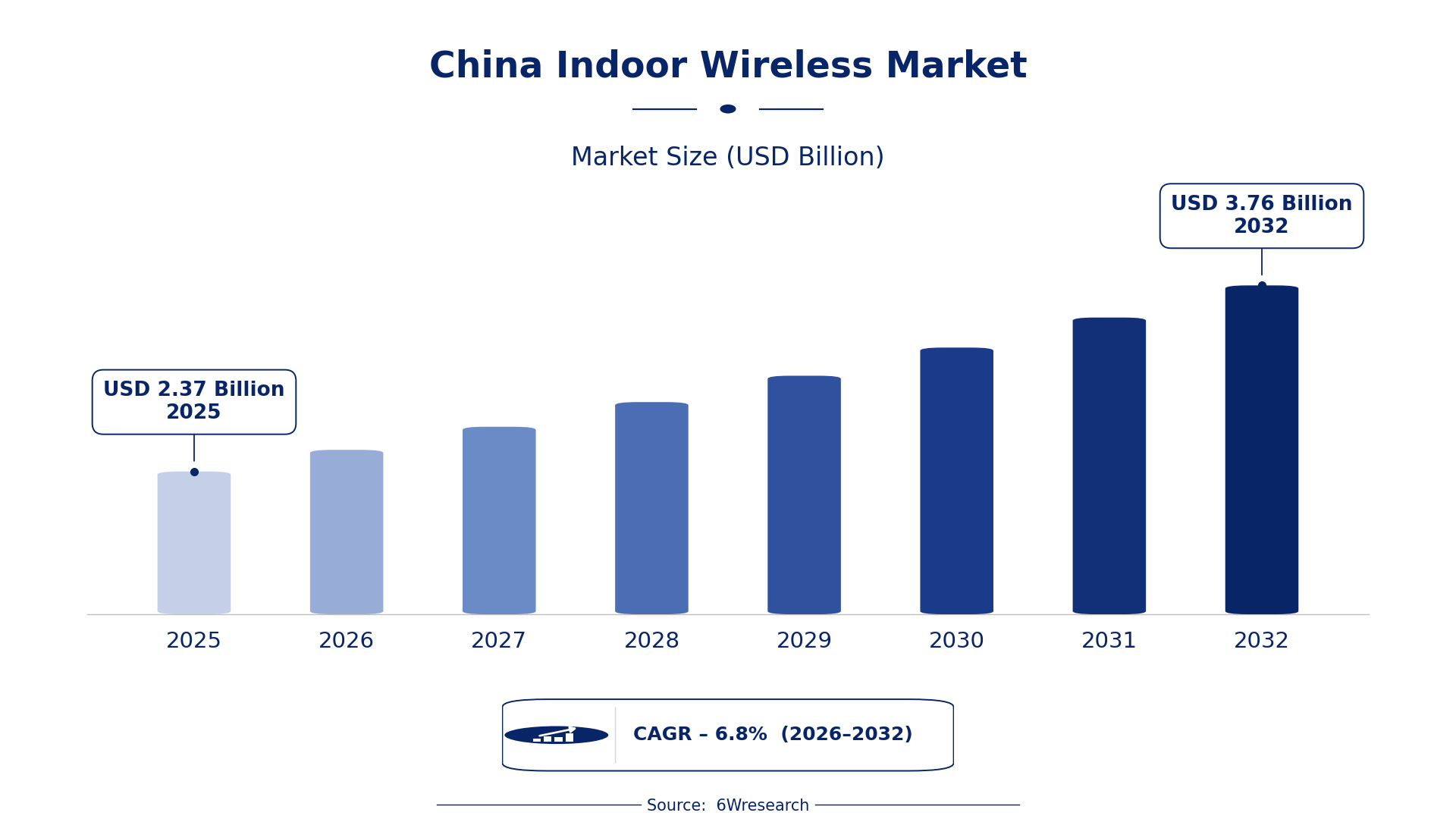
According to 6Wresearch internal database and industry insights, the China Indoor Wireless Market was valued at USD 2.37 billion in 2025 and is projected to reach USD 3.76 billion by 2032, growing at a CAGR of approximately 6.8% during 2026–2032.
China Indoor Wireless Market Highlights
| Report Metric | Details |
| Report Name | China Indoor Wireless Market |
| Market Size 2025 | USD 2.37 billion |
| Market Size 2032 | USD 3.76 billion |
| Absolute Growth 2025–2032 | USD 1.39 billion |
| CAGR 2026–2032 | 6.8% |
| Peak Annual Growth | 8.7% in 2027 |
| Forecast Period | 2026–2032 |
| Historical Data | 2022–2025 |
| Base Year | 2025 |
| Leading Technology Type, 2025 | Wi-Fi 6/6E (54% share) |
| Leading Coverage Area, 2025 | Enterprise/Residential (38% share) |
| Leading Use Case, 2025 | High-Speed Internet (46% share) |
| Leading End User, 2025 | Telecom Service Providers (38% share) |
| Fastest-Growing Technology Type | mmWave 5G (9.5% CAGR) |
| Fastest-Growing Coverage Area | High-Capacity Spots (8.1% CAGR) |
| Fastest-Growing End User | IT Infrastructure Providers (8.9% CAGR) |
| Growing Sector | Smart Buildings |
| Key End Users | Telecom Service Providers, Smart Building Planners, IT Infrastructure Providers, Industrial Facilities |
China Indoor Wireless Market Year-wise Growth Rate and Key Drivers (2022–2032)
This graph illustrates the annual growth rates of the market from 2022 to 2032, highlighting a steady upward trajectory and projected market expansion over the forecast period.
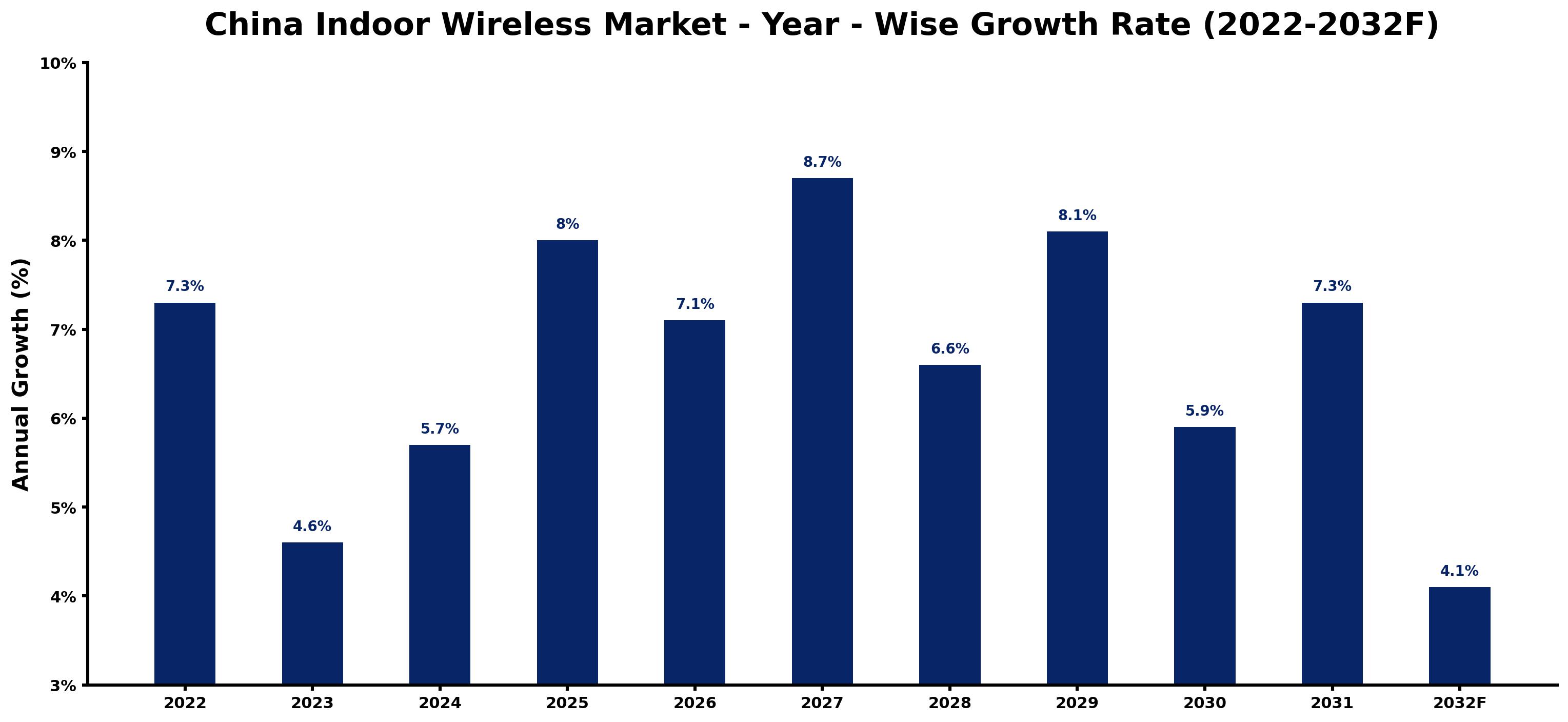
The following table presents the estimated annual growth rate for each year together with the principal factor influencing market performance.
| Year | Estimated Annual Growth (%) | Market Rationale |
| 2022 | 7.3 | The market showed strong demand due to urbanisation and increased internet usage. |
| 2023 | 4.6 | Growth slowed as the market adjusted to the updated National Standard for Indoor Wireless Systems. |
| 2024 | 5.7 | Demand rose as enterprises adopted more advanced wireless technologies. |
| 2025 | 8.0 | A surge in smart building projects drove market expansion. |
| 2026 | 7.1 | Growth is expected to slow as the market adjusts after the peak in 2025. |
| 2027 | 8.7 | The introduction of mmWave 5G technology spurred renewed demand. |
| 2028 | 6.6 | Market growth is anticipated to decelerate as the adoption of existing technologies matures. |
| 2029 | 8.1 | Increased urban population and connectivity needs will boost demand again. |
| 2030 | 5.9 | Growth is expected to slow as competition intensifies among service providers. |
| 2031 | 7.3 | Demand will increase with the rise of smart home technologies. |
| 2032 | 4.1 | The market is projected to grow steadily as urban areas expand. |
Note: Market size estimations and growth projections presented in this report are based on 6Wresearch's proprietary forecasting methodology, utilizing the latest available industry data, government publications, and primary research inputs.
China Indoor Wireless Market Synopsis
Indoor Wireless in China includes systems that provide wireless connectivity within buildings, using advanced radio frequency technologies. This market is thriving, driven by the increasing demand for smart homes and enterprises. The '5G Indoor Coverage Plan' and the rise of smart buildings contribute to this growth, with urban connectivity needs driving investments.
Market Dynamics Impact Analysis (2026–2032)
| Factor | Type | Impact | Primary Segment Affected |
| Urbanisation and the growing number of smart buildings drive demand for indoor wireless solutions. | Driver | High | Enterprise/Residential |
| The adoption of Wi-Fi 6 technology enhances connectivity in homes and businesses. | Driver | High | High-Speed Internet |
| The increasing urban population creates a demand for enhanced indoor connectivity solutions. | Opportunity | High | Enterprise/Residential |
| Investment in smart city projects is expected to exceed $1 trillion by 2025, offering new opportunities. | Opportunity | High | Smart Building Planners |
| The market faces challenges in standardisation and interoperability of technologies. | Restraint | Medium | Wi-Fi 6/6E |
| The high cost of implementing advanced indoor wireless systems can deter some buyers. | Restraint | Medium | Private LTE |
| Competition among service providers can lead to price wars, impacting profitability. | Challenge | Medium | Telecom Service Providers |
| Rapid technological advancements require continuous investment, posing a challenge for suppliers. | Challenge | Medium | IT Infrastructure Providers |
Evaluation of Drivers in China Indoor Wireless Market (2026–2032)
The table below links each growth driver to the segment it affects and the evidence for it.
| Drivers | Primary Segment Affected | Why It Matters (Evidence) |
| Urbanisation and the growth of smart buildings increase demand for indoor wireless solutions. | Enterprise/Residential | China's urban population reached 900 million in 2022, driving demand. |
| The adoption of Wi-Fi 6 technology improves connectivity in homes and businesses. | High-Speed Internet | Wi-Fi 6 technology adoption in enterprises increased by 30% in 2023. |
| Investment in smart city projects boosts demand for advanced connectivity solutions. | Smart Building Planners | Investment in smart city projects is expected to exceed $1 trillion by 2025. |
| The introduction of mmWave 5G technology provides ultra-fast connectivity. | mmWave 5G | The number of 5G base stations in China reached 2 million by 2023. |
| The growing number of IoT devices increases the need for reliable indoor connectivity. | High-Speed Internet | The number of IoT devices in China is projected to reach 1.5 billion by 2025. |
Market growth for Indoor Wireless in China is underpinned by urbanisation, increased investment in smart buildings and the adoption of advanced technologies. The urban population reached 900 million in 2022, driving demand for reliable connectivity. Wi-Fi 6 technology adoption in enterprises increased by 30% in 2023, improving user experience. Investment in smart city projects will exceed $1 trillion by 2025, creating new opportunities for suppliers. The number of 5G base stations reached 2 million in 2023, facilitating faster connectivity. The projected growth of IoT devices to 1.5 billion by 2025 indicates a strong demand for indoor wireless solutions.
Evaluation of Restraints in China Indoor Wireless Market
The following restraints limit how fast demand can grow.
| Market Restraint | Primary Segment Affected | Why It Matters (Evidence) |
| Standardisation issues hinder the integration of various technologies. | Wi-Fi 6/6E | The National Standard for Indoor Wireless Systems was updated in 2022. |
| High implementation costs can deter investment in advanced systems. | Private LTE | The average cost of deploying advanced indoor wireless systems can be substantial. |
| Limited awareness of the benefits of indoor wireless solutions affects adoption rates. | Enterprise/Residential | Many potential buyers remain unaware of the advantages of modern connectivity. |
| Intense competition among service providers can lead to price wars, impacting profitability. | Telecom Service Providers | The telecom sector generated $200 billion in revenue in 2022. |
| Technological advancements require continuous investment, posing a challenge for suppliers. | IT Infrastructure Providers | Rapid changes in technology necessitate ongoing financial commitment. |
China Indoor Wireless Market Challenges
The China Indoor Wireless Market still has to solve a few problems, and the first is the high cost of advanced indoor wireless systems. Buyers face increased expenses due to the rapid adoption of Wi-Fi 6 technology, which rose by 30% in 2023, leading to higher installation costs for enterprises. Regulatory hurdles complicate market entry, as compliance with the updated National Standard for Indoor Wireless Systems can delay project timelines for distributors, resulting in potential revenue loss. Competition from alternative connectivity solutions is intensifying, forcing buyers to navigate a crowded market and possibly leading to service quality issues as the number of smart buildings is projected to exceed 1 million by 2025.
Trends in the China Indoor Wireless Market
Several trends are reshaping the China Indoor Wireless Market; the most important are set out below.
- Shift from Traditional to Smart Building Technologies: In 2021, the Smart City Development Plan initiated a transition towards integrating advanced wireless technologies in urban infrastructure. By 2025, the total number of smart buildings in China is expected to exceed 1 million, reflecting this shift.
- Transition from 4G to 5G Connectivity: The introduction of the 5G Indoor Coverage Plan in 2023 marked a change in connectivity standards. With 2 million 5G base stations in place, urban areas are experiencing enhanced connectivity capabilities.
- Emergence of High-Capacity Spots: The demand for High-Capacity Spots has surged as more users require connectivity in large spaces. This segment is expected to grow at a CAGR of 8.1% from 2026 to 2032, driven by urbanisation.
- Prioritisation of Secure Connectivity Solutions: The need for secure connectivity in industrial settings has become paramount. The rise of Private LTE solutions reflects this trend, addressing the demand for dedicated and secure networks.
Investment Opportunities in the China Indoor Wireless Market
Some of the investment opportunities in the China Indoor Wireless Market are mentioned below.
- Telecom Service Providers Seeking Advanced Solutions: With over 300 million broadband subscribers as of 2023, telecom service providers are looking for advanced indoor wireless solutions. Investing in high-capacity technologies can meet this growing need.
- Smart Building Planners Focusing on Connectivity: The expected investment in smart city projects exceeding $1 trillion by 2025 presents an opportunity for suppliers. Collaborating with smart building planners can facilitate access to this expanding market.
- Urban Areas Needing Improved Connectivity: China's urban population reached 900 million in 2022, highlighting the need for indoor wireless solutions. Suppliers can target urban residential and commercial sectors to fulfil this demand.
- Industrial Facilities Requiring Reliable Networks: As industrial facilities increasingly adopt advanced technologies, the demand for secure connectivity solutions is rising. Suppliers can enter this market by providing tailored solutions for industrial applications.
Government Initiatives in the China Indoor Wireless Market
The '5G Indoor Coverage Plan' launched by the Ministry of Industry and Information Technology in 2023 focuses on improving indoor connectivity, particularly in urban areas. This plan encourages the deployment of advanced wireless technologies in buildings, enabling better service for users. The National Telecommunications and Information Administration oversees indoor wireless standards, ensuring compliance with regulations. This oversight helps buyers ensure that the products they use meet the necessary quality and performance standards.
The Ministry of Housing and Urban-Rural Development promotes investment in smart buildings through the 'Smart City Development Plan' initiated in 2021. This initiative facilitates the adoption of indoor wireless solutions, ensuring that buyers have access to the latest technologies. The Ministry of Industry and Information Technology also supports various projects to enhance connectivity in urban areas, with funding aimed at improving infrastructure and services.
Future Insight of the China Indoor Wireless Market
By 2032, buyers and suppliers in the China Indoor Wireless Market can anticipate substantial advancements driven by key initiatives. The '5G Indoor Coverage Plan' launched in 2023 aims to enhance connectivity, with the government targeting 80% urban coverage by 2025. Investment in smart city projects will exceed $1 trillion, creating new opportunities for suppliers to innovate. The number of IoT devices is expected to reach 1.5 billion by 2025, further driving demand for advanced indoor wireless solutions that support smart building applications.
Market Segmentation Analysis
Each segment group is reviewed below, with the leader by share and the fastest grower by CAGR.
By Technology Type – Wi-Fi 6/6E Dominated, mmWave 5G Expected to Grow Fastest
According to Sachin Kumar Rai, Senior Research Analyst at 6Wresearch, in 2025, Wi-Fi 6/6E led the technology type split with a 54% share. Wi-Fi 6/6E holds the largest share in the China Indoor Wireless Market due to its essential role in providing high-speed internet access for both homes and businesses. The significant increase in urban population, reaching 900 million in 2022, has heightened the demand for reliable connectivity solutions. Over 2026–2032, mmWave 5G is expected to post the fastest growth, at a CAGR of 9.5%. The mmWave 5G segment is experiencing rapid growth as it caters to high-capacity applications that require ultra-fast connectivity. The government's launch of the '5G Indoor Coverage Plan' in 2023 is expected to further accelerate the adoption of this technology. Suppliers should focus on enhancing Wi-Fi 6/6E offerings while also investing in mmWave 5G solutions to meet the growing demand.
By Coverage Area – Enterprise/Residential Dominated, High-Capacity Spots Expected to Grow Fastest
With a 38% revenue share in 2025, Enterprise/Residential was the largest coverage area category. The Enterprise/Residential segment leads the market as it serves as the primary user base for indoor wireless solutions, addressing both commercial and domestic requirements. The anticipated increase in smart buildings, expected to exceed 1 million by 2025, will likely expand this segment's share. High-Capacity Spots are projected to grow fastest, at a CAGR of 8.1% during 2026–2032. High-Capacity Spots are experiencing the fastest growth as they require robust connectivity to support numerous users simultaneously. This demand is particularly driven by urbanisation and the expected rise in IoT devices, projected to reach 1.5 billion by 2025. Buyers in high-capacity areas should prioritise solutions that ensure reliable connectivity to support their growing user base.
By Use Case – High-Speed Internet Dominated and Is Expected to Record the Fastest Growth
High-Speed Internet held a 46% share of the China Indoor Wireless Market by use case in 2025. High-Speed Internet is the leading use case in the China Indoor Wireless Market, as it is a fundamental application driving demand for indoor wireless solutions. The average household internet usage in urban areas is 5 hours per day as of 2023, underscoring the necessity for fast and reliable connections. High-Speed Internet is also forecast to expand faster than any other category, at a CAGR of 9.4% over 2026–2032. High-Speed Internet is also the fastest-growing use case, with increasing adoption of technologies like Wi-Fi 6 and 5G enhancing connectivity. This dual role ensures that as demand rises, the technology's relevance and market share will continue to expand. Suppliers must ensure their indoor wireless solutions are optimised for high-speed internet to capture the growing market.
By End User – Telecom Service Providers Dominated, IT Infrastructure Providers Expected to Grow Fastest
Telecom Service Providers took a 38% share of end user in 2025, more than any other category. Telecom Service Providers dominate the market as they are key players in deploying indoor wireless solutions across various sectors. Their substantial revenue contribution of $200 billion in 2022 highlights their pivotal role in the indoor wireless ecosystem. IT Infrastructure Providers are set to record the highest CAGR in this split, 8.9% over 2026–2032. IT Infrastructure Providers are experiencing rapid growth as they implement and manage indoor wireless systems, driven by the increasing complexity of connectivity needs in smart buildings. Their role is becoming more critical as urban areas push for enhanced digital infrastructure. Suppliers should cultivate partnerships with IT Infrastructure Providers to better align their offerings with evolving market demands.
Key Attractiveness of the Report
- 10 Years of Market Numbers
- Historical Data Starting from 2022 to 2025
- Base Year 2025
- Forecast Data until 2032
- Key Performance Indicators Impacting the Market
- Major Upcoming Developments and Projects
Key Highlights of the Report:
- China Indoor Wireless Market Outlook
- Market Size of China Indoor Wireless Market, 2025
- Forecast of China Indoor Wireless Market, 2032
- Historical Data and Forecast of China Indoor Wireless Revenues & Volume for the Period 2022 - 2032F
- China Indoor Wireless Market Trend Evolution
- China Indoor Wireless Market Drivers and Challenges
- China Indoor Wireless Price Trends
- China Indoor Wireless Porter's Five Forces
- China Indoor Wireless Industry Life Cycle
- Historical Data and Forecast of China Indoor Wireless Market Revenues & Volume By Technology Type for the Period 2022 - 2032F
- Historical Data and Forecast of China Indoor Wireless Market Revenues & Volume By Wi-Fi 6/6E for the Period 2022 - 2032F
- Historical Data and Forecast of China Indoor Wireless Market Revenues & Volume By mmWave 5G for the Period 2022 - 2032F
- Historical Data and Forecast of China Indoor Wireless Market Revenues & Volume By Mesh Networks for the Period 2022 - 2032F
- Historical Data and Forecast of China Indoor Wireless Market Revenues & Volume By Private LTE for the Period 2022 - 2032F
- Historical Data and Forecast of China Indoor Wireless Market Revenues & Volume By Coverage Area for the Period 2022 - 2032F
- Historical Data and Forecast of China Indoor Wireless Market Revenues & Volume By Enterprise/Residential for the Period 2022 - 2032F
- Historical Data and Forecast of China Indoor Wireless Market Revenues & Volume By High-Capacity Spots for the Period 2022 - 2032F
- Historical Data and Forecast of China Indoor Wireless Market Revenues & Volume By Large Homes/Buildings for the Period 2022 - 2032F
- Historical Data and Forecast of China Indoor Wireless Market Revenues & Volume By Industrial Facilities for the Period 2022 - 2032F
- Historical Data and Forecast of China Indoor Wireless Market Revenues & Volume By Use Case for the Period 2022 - 2032F
- Historical Data and Forecast of China Indoor Wireless Market Revenues & Volume By High-Speed Internet for the Period 2022 - 2032F
- Historical Data and Forecast of China Indoor Wireless Market Revenues & Volume By Ultra-HD Streaming for the Period 2022 - 2032F
- Historical Data and Forecast of China Indoor Wireless Market Revenues & Volume By Seamless Roaming for the Period 2022 - 2032F
- Historical Data and Forecast of China Indoor Wireless Market Revenues & Volume By Secure Connectivity for the Period 2022 - 2032F
- Historical Data and Forecast of China Indoor Wireless Market Revenues & Volume By End User for the Period 2022 - 2032F
- Historical Data and Forecast of China Indoor Wireless Market Revenues & Volume By Smart Building Planners for the Period 2022 - 2032F
- Historical Data and Forecast of China Indoor Wireless Market Revenues & Volume By Telecom Service Providers for the Period 2022 - 2032F
- Historical Data and Forecast of China Indoor Wireless Market Revenues & Volume By Consumer Electronics Brands for the Period 2022 - 2032F
- Historical Data and Forecast of China Indoor Wireless Market Revenues & Volume By IT Infrastructure Providers for the Period 2022 - 2032F
- China Indoor Wireless Import Export Trade Statistics
- Market Opportunity Assessment By Technology Type
- Market Opportunity Assessment By Coverage Area
- Market Opportunity Assessment By Use Case
- Market Opportunity Assessment By End User
- China Indoor Wireless Top Companies Market Share
- China Indoor Wireless Competitive Benchmarking By Technical and Operational Parameters
- China Indoor Wireless Company Profiles
- China Indoor Wireless Key Strategic Recommendations
Market Covered
The report offers an extensive study of the following market segments.
By Technology Type
- Wi-Fi 6/6E
- mmWave 5G
- Mesh Networks
- Private LTE
By Coverage Area
- Enterprise/Residential
- High-Capacity Spots
- Large Homes/Buildings
- Industrial Facilities
By Use Case
- High-Speed Internet
- Ultra-HD Streaming
- Seamless Roaming
- Secure Connectivity
By End User
- Smart Building Planners
- Telecom Service Providers
- Consumer Electronics Brands
- IT Infrastructure Providers































