India Industrial Automation Components Market Size & Growth Rate
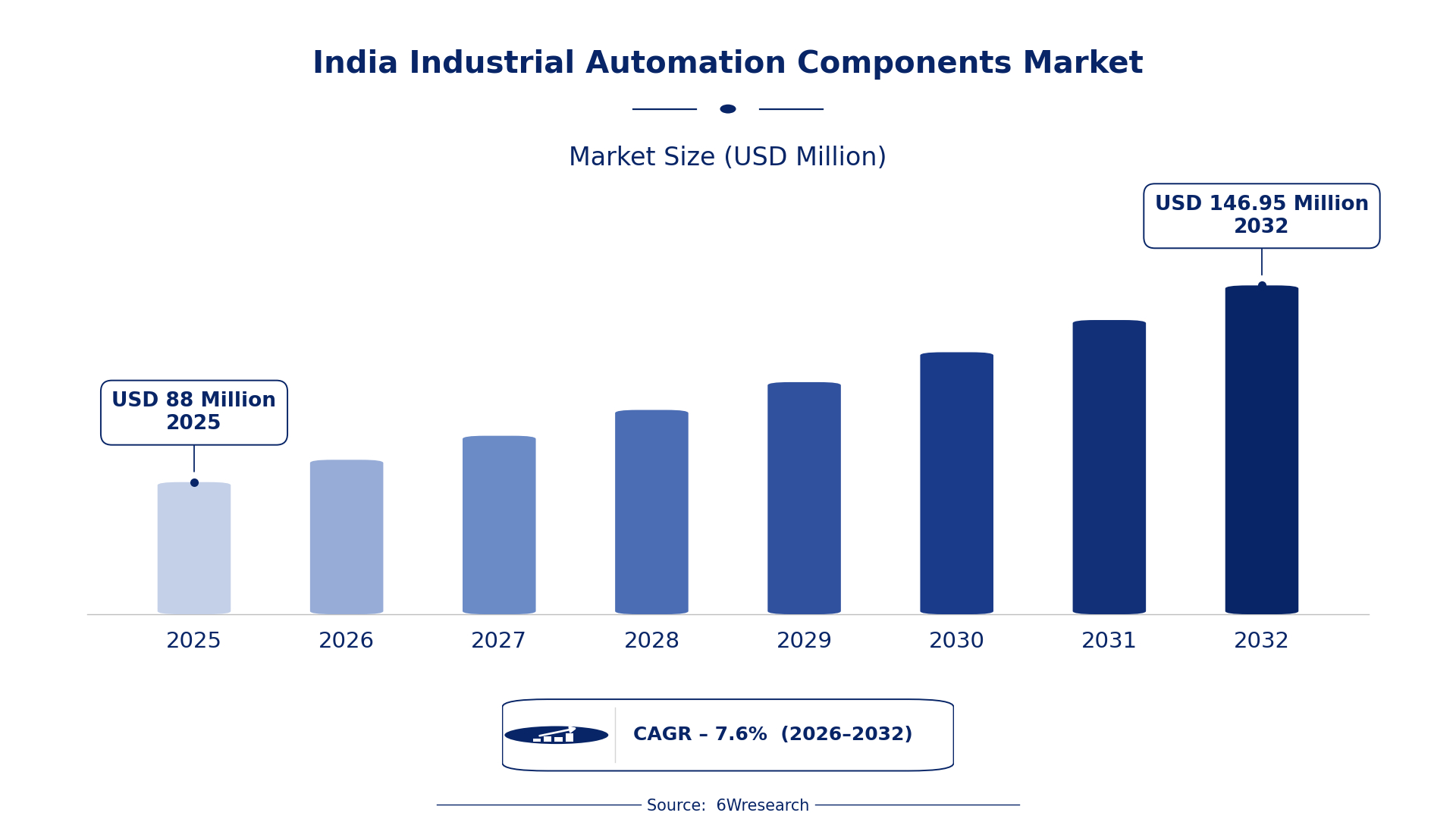
According to 6Wresearch internal database and industry insights, the India Industrial Automation Components Market was valued at USD 88.0 million in 2025 and is projected to reach USD 146.95 million by 2032, growing at a CAGR of approximately 7.6% during 2026–2032.
India Industrial Automation Components Market Highlights
| Report Metric | Details |
| Report Name | India Industrial Automation Components Market |
| Market Size 2025 | USD 88.0 million |
| Market Size 2032 | USD 146.95 million |
| Absolute Growth 2025–2032 | USD 58.95 million |
| CAGR 2026–2032 | 7.6% |
| Peak Annual Growth | 10.1% in 2028 |
| Forecast Period | 2026–2032 |
| Historical Data | 2022–2025 |
| Base Year | 2025 |
| Leading Component Type, 2025 | Sensors (35% share) |
| Leading Functionality, 2025 | Measurement (44% share) |
| Leading Integration Level, 2025 | Embedded/External (40% share) |
| Leading End User, 2025 | Machine Builders (40% share) |
| Fastest-Growing Component Type | PLCs (9.0% CAGR) |
| Fastest-Growing Functionality | Motion Control (9.7% CAGR) |
| Fastest-Growing Integration Level | Modular/Compact (9.1% CAGR) |
| Fastest-Growing End User | Robotics OEMs (8.9% CAGR) |
| Growing Sector | Robotics OEMs |
| Key End Users | Machine Builders, Robotics OEMs, Assembly Lines, Control Panel Makers |
India Industrial Automation Components Market Year-wise Growth Rate and Key Drivers (2022–2032)
This graph illustrates the annual growth rates of the market from 2022 to 2032, highlighting a steady upward trajectory and projected market expansion over the forecast period.
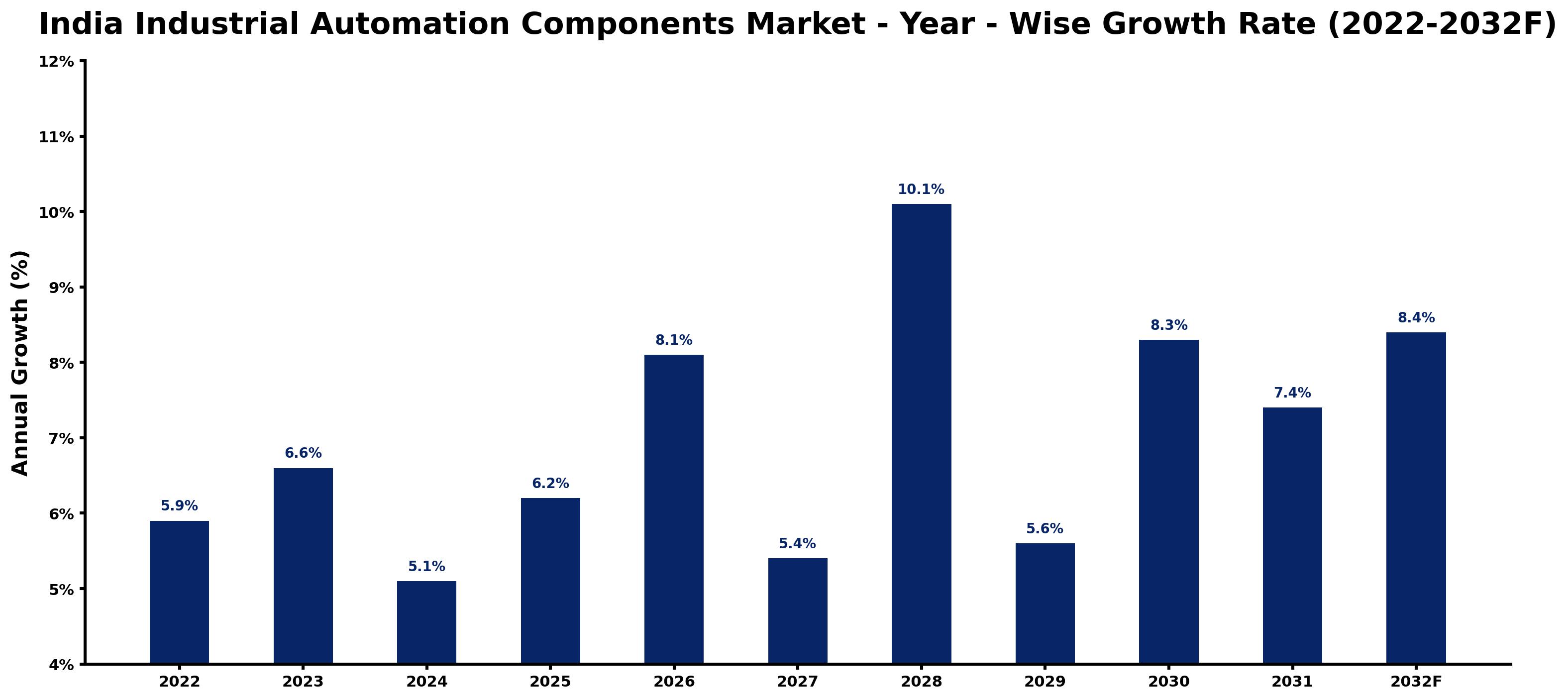
Annual growth estimates for each year appear below with the principal reason behind them, explaining the shifts that set the pace of the market.
| Year | Estimated Annual Growth (%) | Market Rationale |
| 2022 | 5.9 | The market experienced steady growth as manufacturing companies increasingly adopted automation technologies, particularly in the automotive sector. |
| 2023 | 6.6 | Demand surged due to heightened investments in the automotive sector, which accounts for a significant share of automation components. |
| 2024 | 5.1 | Growth slowed as companies adjusted to previous investments and focused on optimising existing automation systems. |
| 2025 | 6.2 | A resurgence in demand was noted as manufacturing sectors ramped up production following the 'Make in India' initiative. |
| 2026 | 8.1 | The market is expected to receive a boost from the 'Digital India' program promoting technology adoption in various sectors. |
| 2027 | 5.4 | A slowdown is projected as firms face challenges in sourcing advanced automation technologies. |
| 2028 | 10.1 | Growth is expected to accelerate due to rising demand for automation in manufacturing, particularly in electronics and automotive sectors. |
| 2029 | 5.6 | The market may see a deceleration as companies reassess their automation strategies amid changing economic conditions. |
| 2030 | 8.3 | Demand is projected to rebound as manufacturers invest in upgrading their automation systems to enhance efficiency. |
| 2031 | 7.4 | Growth is expected to slow as the market stabilises after a period of rapid expansion and investment. |
| 2032 | 8.4 | A resurgence in demand is anticipated as new automation technologies gain traction across various industries. |
Note: Market size estimations and growth projections presented in this report are based on 6Wresearch's proprietary forecasting methodology, utilizing the latest available industry data, government publications, and primary research inputs.
India Industrial Automation Components Market Synopsis
The Industrial Automation Components Market in India encompasses essential technologies that improve manufacturing efficiency and precision. These components, produced through advanced engineering processes, are vital for automating machinery and improving production lines. The market is growing due to the increasing demand from sectors like automotive, which accounts for 30% of the demand. Initiatives such as 'Make in India' and 'Digital India' are further driving this growth by boosting domestic manufacturing capabilities and encouraging local production.
Market Dynamics Impact Analysis (2026–2032)
| Factor | Type | Impact | Primary Segment Affected |
| Increased adoption of automation technologies in manufacturing processes | Driver | High | Sensors |
| Growing demand for precision and efficiency in production lines | Driver | High | PLCs |
| Expansion of the electronics manufacturing sector in Tamil Nadu | Opportunity | High | Actuators |
| Rising investments in automation training and skills development | Opportunity | High | Relays & Timers |
| Challenges in sourcing advanced automation technologies | Restraint | High | Measurement |
| High initial costs associated with implementing automation solutions | Restraint | Medium | Motion Control |
| Limited awareness among small manufacturers regarding automation benefits | Challenge | Medium | Embedded/External |
| Dependence on imported components for advanced automation solutions | Challenge | High | PLC-Connected |
Evaluation of Drivers in India Industrial Automation Components Market (2026–2032)
The main growth drivers and the segments they affect most are set out below.
| Drivers | Primary Segment Affected | Why It Matters (Evidence) |
| Increased investment in the automotive sector | Sensors | This sector accounts for 30% of demand, driving higher purchases of automation components. |
| Growing emphasis on efficiency in production lines | PLCs | Over 50% of manufacturing companies have adopted automation technologies, increasing demand for PLCs. |
| Expansion of electronics manufacturing clusters | Actuators | The Electronics Manufacturing Cluster in Tamil Nadu is boosting demand for automation components. |
| Government initiatives promoting automation | Relays & Timers | The 'Make in India' initiative encourages local production and adoption of automation technologies. |
| Rising installed base of industrial robots | Measurement | The installed base is projected to exceed 50,000 units by 2025, increasing demand for measurement functionalities. |
The automotive sector accounts for 30% of demand, driving higher purchases of automation components. More than half of manufacturing companies have adopted automation technologies, which increases demand for various components. The installed base of industrial robots is projected to exceed 50,000 units by 2025, leading to higher demand for measurement functionalities. The Electronics Manufacturing Cluster in Tamil Nadu is also boosting demand as manufacturers seek to improve production efficiency.
Evaluation of Restraints in India Industrial Automation Components Market
The following restraints limit how fast demand can grow.
| Market Restraint | Primary Segment Affected | Why It Matters (Evidence) |
| Challenges in sourcing advanced automation technologies | Measurement | Limited availability of advanced technologies can hinder the adoption of automation solutions. |
| High initial costs associated with implementing automation solutions | Motion Control | Many manufacturers are deterred by the upfront investment required for advanced automation systems. |
| Limited awareness among small manufacturers regarding automation benefits | Embedded/External | Small manufacturers often lack knowledge about the advantages of automation, affecting demand. |
| Dependence on imported components for advanced automation solutions | PLC-Connected | Relying on imports can lead to supply chain vulnerabilities and increased costs. |
| Inconsistent quality of locally produced automation components | Relays & Timers | Quality issues can deter manufacturers from fully adopting local automation solutions. |
India Industrial Automation Components Market Challenges
The India Industrial Automation Components Market still faces several key issues, starting with regulatory compliance. Adherence to IS 9001:2015 set by the Bureau of Indian Standards can delay product launches for manufacturers by up to six months, hindering their market entry. Rising raw material prices increase production costs by 15% for producers, which ultimately raises prices for buyers. Local manufacturers encounter fierce competition from international suppliers, compelling them to lower margins and spend more on marketing. Supply chain disruptions in regions like Tamil Nadu can cause delivery delays for producers, negatively affecting their production schedules.
Trends in the India Industrial Automation Components Market
The trends below show where the India Industrial Automation Components Market is heading.
- Shift towards Smart Manufacturing: The 'Smart Manufacturing' initiative, launched in 2023, encourages the adoption of advanced automation technologies. This shift is expected to improve production efficiency across various sectors, with over 50% of manufacturers adopting new technologies.
- Transition from Traditional to Modular Automation: Manufacturers are increasingly adopting modular automation solutions for flexibility and scalability. This trend is occurring in Maharashtra, where modular systems are gaining popularity, with a projected growth rate of 9.1% through 2032.
- Emergence of Robotics in Manufacturing: The National Robotics Mission, established in 2020, promotes research and development in robotics. This initiative is anticipated to boost the installed base of industrial robots, projected to exceed 50,000 units by 2025.
- Focus on Automation Skills Development: The 'Skill India' initiative aims to train 1 million workers in automation technologies by 2025. This focus on skills development is essential for meeting the growing demand for automation components.
Investment Opportunities in the India Industrial Automation Components Market
Some of the investment opportunities in the India Industrial Automation Components Market are mentioned below.
- Machine Builders seeking automation solutions: With the automotive sector driving demand, machine builders are in search of advanced automation components. The market gap is apparent, with a projected growth of 10.1% in 2028, indicating a strong opportunity for suppliers.
- Electronics manufacturers investing in automation: The Electronics Manufacturing Cluster in Tamil Nadu is expanding, creating a demand for automation components. This presents an opportunity for suppliers to engage with a growing market, with an estimated demand increase of 30% by 2025.
- Robotics OEMs enhancing capabilities: Robotics OEMs are increasingly incorporating automation components into their systems. With a projected growth rate of 8.9% for this segment, suppliers can focus on delivering tailored solutions to meet this demand.
- Assembly Lines adopting automation technologies: Assembly lines are progressively automating processes to boost efficiency. The demand for automation components is expected to rise, with a notable increase projected over the next five years.
Government Initiatives in the India Industrial Automation Components Market
The 'Production Linked Incentive Scheme', launched in 2021, aims to boost domestic manufacturing of electronic components, including automation technologies, with a budget of ₹40,000 crores. This initiative complements the 'Atmanirbhar Bharat' initiative from 2020, which promotes self-reliance in manufacturing, including automation. Together, these measures improve the production capabilities of automation component manufacturers in India.
The Ministry of Heavy Industries actively promotes automation in small and medium enterprises through various schemes. Funding for automation projects is provided to improve productivity and competitiveness. Additionally, the ministry supports initiatives that encourage the adoption of automation technologies across different manufacturing sectors.
Future Insight of the India Industrial Automation Components Market
Several forward-looking factors are likely to support the India Industrial Automation Components Market in the coming years. The 'Make in India' initiative will boost domestic manufacturing capabilities, while the 'Digital India' programme will encourage technology adoption across various sectors. By 2032, the National Policy on Electronics is expected to substantially increase the production of electronic components, driving demand for automation technologies. The 'Skill India' initiative aims to equip 1 million workers with automation skills, creating a robust workforce to address future industry needs.
Market Segmentation Analysis
The analysis below covers each segmentation, its leading category in 2025 and its fastest-growing category through 2032.
By Component Type – Sensors Dominated, PLCs Expected to Grow Fastest
According to Sachin Kumar Rai, Senior Research Analyst at 6Wresearch, the largest component type category in 2025 was Sensors, with a 35% share of total revenue. Sensors hold a significant market share because they are essential for measuring physical parameters in automation systems. Their critical role in the automotive sector, which accounts for 30% of demand, illustrates their widespread adoption and importance. The quickest growth will come from PLCs, forecast to expand at a CAGR of 9.0% between 2026 and 2032. PLCs are witnessing rapid growth due to their fundamental role in controlling automated processes in industrial settings. The increasing implementation of automation technologies, particularly through initiatives like 'Make in India', is further propelling this demand. Suppliers should enhance their PLC offerings to leverage the growing market share and demand.
By Functionality – Measurement Dominated, Motion Control Expected to Grow Fastest
With a 44% revenue share in 2025, Measurement was the largest functionality category. Measurement functionalities dominate the market share as they are vital for ensuring accuracy in automated systems. This importance is particularly pronounced in sectors like electronics manufacturing, where precision is crucial for operational success. Over 2026–2032, Motion Control is expected to post the fastest growth, at a CAGR of 9.7%. Motion control is the fastest-growing segment due to its necessity for precise movement in automated machinery. The rise in robotics applications, supported by government initiatives, is significantly driving this growth. Buyers should invest in advanced motion control solutions to maintain competitiveness in the industrial sector.
By Integration Level – Embedded/External Dominated, Modular/Compact Expected to Grow Fastest
Embedded/External held a 40% share of the India Industrial Automation Components Market by integration level in 2025. Embedded/External systems lead the market share as they provide integral solutions for compact automation while offering flexibility. Their adoption by over 50% of manufacturing companies highlights their essential role in enhancing automation capabilities. Modular/Compact is set to record the highest CAGR in this split, 9.1% over 2026–2032. Modular/Compact systems are rapidly growing as they facilitate scalable automation solutions across various industries. The increasing demand for efficiency in manufacturing processes is a key factor influencing this trend. Suppliers must focus on developing modular solutions to cater to the rising demand for flexible automation systems.
By End User – Machine Builders Dominated, Robotics OEMs Expected to Grow Fastest
Machine Builders accounted for a 40% market share by end user in 2025. Machine builders command the largest market share as they heavily depend on automation components to create efficient machinery. Their pivotal role in the manufacturing sector reinforces their dominant market position. Robotics OEMs are projected to grow fastest, at a CAGR of 8.9% during 2026–2032. Robotics OEMs represent the fastest-growing segment, leveraging automation components to improve robotic functionalities. The surge in robotics applications, supported by initiatives like 'Skill India', is driving this growth. Suppliers should tailor their products to meet the specific requirements of robotics OEMs to capture this expanding market.
Key Attractiveness of the Report
- 10 Years of Market Numbers
- Historical Data Starting from 2022 to 2025
- Base Year 2025
- Forecast Data until 2032
- Key Performance Indicators Impacting the Market
- Major Upcoming Developments and Projects
Key Highlights of the Report:
- India Industrial Automation Components Market Outlook
- Market Size of India Industrial Automation Components Market, 2025
- Forecast of India Industrial Automation Components Market, 2032
- Historical Data and Forecast of India Industrial Automation Components Revenues & Volume for the Period 2022 - 2032F
- India Industrial Automation Components Market Trend Evolution
- India Industrial Automation Components Market Drivers and Challenges
- India Industrial Automation Components Price Trends
- India Industrial Automation Components Porter's Five Forces
- India Industrial Automation Components Industry Life Cycle
- Historical Data and Forecast of India Industrial Automation Components Market Revenues & Volume By Component Type for the Period 2022 - 2032F
- Historical Data and Forecast of India Industrial Automation Components Market Revenues & Volume By Sensors for the Period 2022 - 2032F
- Historical Data and Forecast of India Industrial Automation Components Market Revenues & Volume By Actuators for the Period 2022 - 2032F
- Historical Data and Forecast of India Industrial Automation Components Market Revenues & Volume By PLCs for the Period 2022 - 2032F
- Historical Data and Forecast of India Industrial Automation Components Market Revenues & Volume By Relays & Timers for the Period 2022 - 2032F
- Historical Data and Forecast of India Industrial Automation Components Market Revenues & Volume By Functionality for the Period 2022 - 2032F
- Historical Data and Forecast of India Industrial Automation Components Market Revenues & Volume By Measurement for the Period 2022 - 2032F
- Historical Data and Forecast of India Industrial Automation Components Market Revenues & Volume By Motion Control for the Period 2022 - 2032F
- Historical Data and Forecast of India Industrial Automation Components Market Revenues & Volume By Process Control for the Period 2022 - 2032F
- Historical Data and Forecast of India Industrial Automation Components Market Revenues & Volume By Switching Functions for the Period 2022 - 2032F
- Historical Data and Forecast of India Industrial Automation Components Market Revenues & Volume By Integration Level for the Period 2022 - 2032F
- Historical Data and Forecast of India Industrial Automation Components Market Revenues & Volume By Embedded/External for the Period 2022 - 2032F
- Historical Data and Forecast of India Industrial Automation Components Market Revenues & Volume By PLC-Connected for the Period 2022 - 2032F
- Historical Data and Forecast of India Industrial Automation Components Market Revenues & Volume By Modular/Compact for the Period 2022 - 2032F
- Historical Data and Forecast of India Industrial Automation Components Market Revenues & Volume By Panel-Mounted for the Period 2022 - 2032F
- Historical Data and Forecast of India Industrial Automation Components Market Revenues & Volume By End User for the Period 2022 - 2032F
- Historical Data and Forecast of India Industrial Automation Components Market Revenues & Volume By Machine Builders for the Period 2022 - 2032F
- Historical Data and Forecast of India Industrial Automation Components Market Revenues & Volume By Robotics OEMs for the Period 2022 - 2032F
- Historical Data and Forecast of India Industrial Automation Components Market Revenues & Volume By Assembly Lines for the Period 2022 - 2032F
- Historical Data and Forecast of India Industrial Automation Components Market Revenues & Volume By Control Panel Makers for the Period 2022 - 2032F
- India Industrial Automation Components Import Export Trade Statistics
- Market Opportunity Assessment By Component Type
- Market Opportunity Assessment By Functionality
- Market Opportunity Assessment By Integration Level
- Market Opportunity Assessment By End User
- India Industrial Automation Components Top Companies Market Share
- India Industrial Automation Components Competitive Benchmarking By Technical and Operational Parameters
- India Industrial Automation Components Company Profiles
- India Industrial Automation Components Key Strategic Recommendations
Market Covered
Segments analysed in this report are listed below.
By Component Type
- Sensors
- Actuators
- PLCs
- Relays & Timers
By Functionality
- Measurement
- Motion Control
- Process Control
- Switching Functions
By Integration Level
- Embedded/External
- PLC-Connected
- Modular/Compact
- Panel-Mounted
By End User
- Machine Builders
- Robotics OEMs
- Assembly Lines
- Control Panel Makers































