India Industrial Automation IC Market Size & Growth Rate
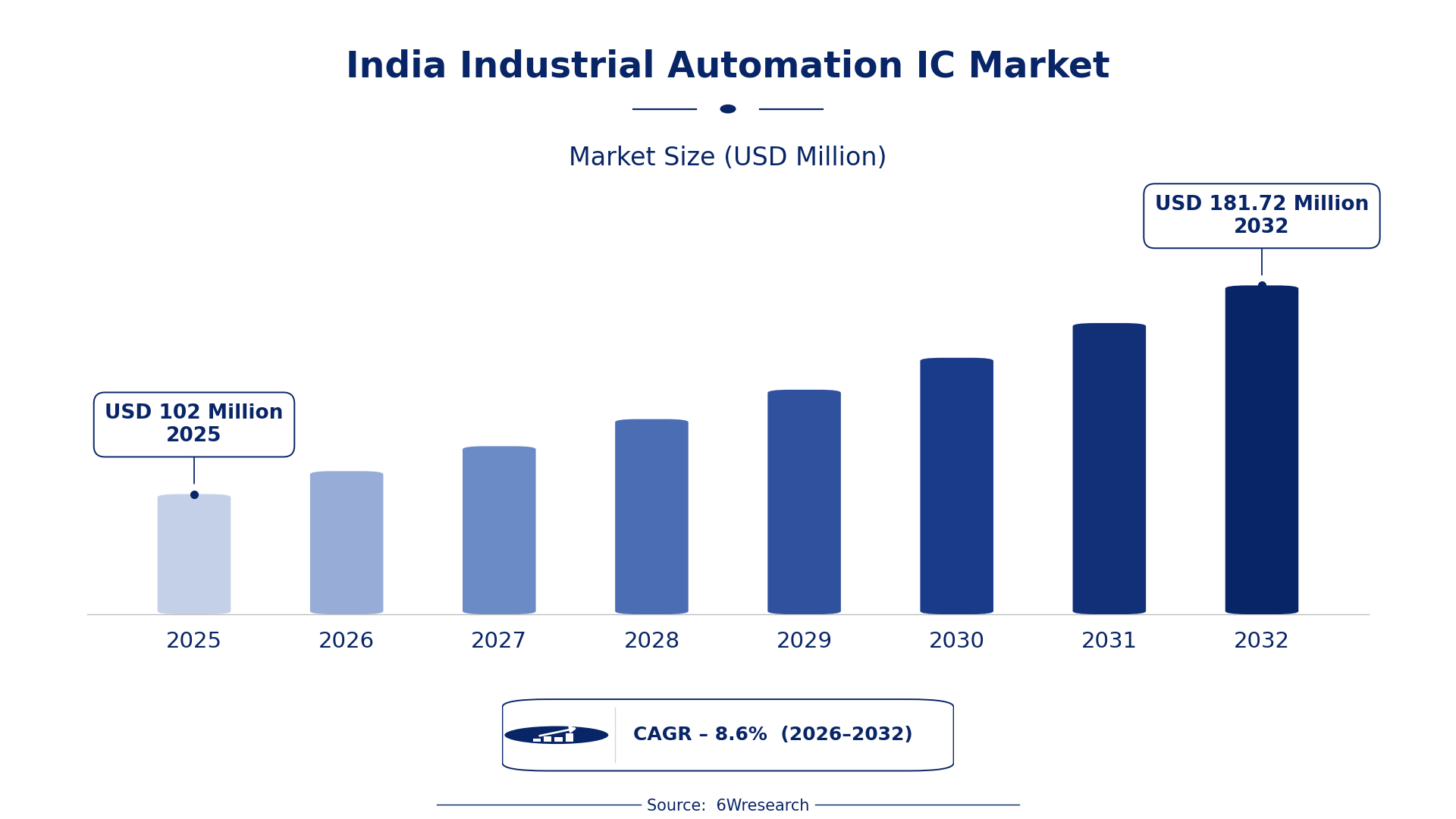
According to 6Wresearch internal database and industry insights, the India Industrial Automation IC Market was valued at USD 102.0 million in 2025 and is projected to reach USD 181.72 million by 2032, growing at a CAGR of approximately 8.6% during 2026–2032.
India Industrial Automation IC Market Highlights
| Report Metric | Details |
| Report Name | India Industrial Automation IC Market |
| Market Size 2025 | USD 102.0 million |
| Market Size 2032 | USD 181.72 million |
| Absolute Growth 2025–2032 | USD 79.72 million |
| CAGR 2026–2032 | 8.6% |
| Peak Annual Growth | 10.9% in 2028 |
| Forecast Period | 2026–2032 |
| Historical Data | 2022–2025 |
| Base Year | 2025 |
| Leading IC Type, 2025 | Microcontrollers (MCUs) (45% share) |
| Leading Application Segment, 2025 | Motor Drives (49% share) |
| Leading Packaging Type, 2025 | SMD/Through-Hole (41% share) |
| Leading End User, 2025 | Automation Hardware OEMs (38% share) |
| Fastest-Growing IC Type | ASICs for Automation (11.4% CAGR) |
| Fastest-Growing Application Segment | Process Control (10.0% CAGR) |
| Fastest-Growing Packaging Type | QFP/BGA (10.0% CAGR) |
| Fastest-Growing End User | Robotics Integrators (11.0% CAGR) |
| Growing Sector | Manufacturing |
| Key End Users | Automation Hardware OEMs, Robotics Integrators, PLC Manufacturers |
India Industrial Automation IC Market Year-wise Growth Rate and Key Drivers (2022–2032)
This graph illustrates the annual growth rates of the market from 2022 to 2032, highlighting a steady upward trajectory and projected market expansion over the forecast period.
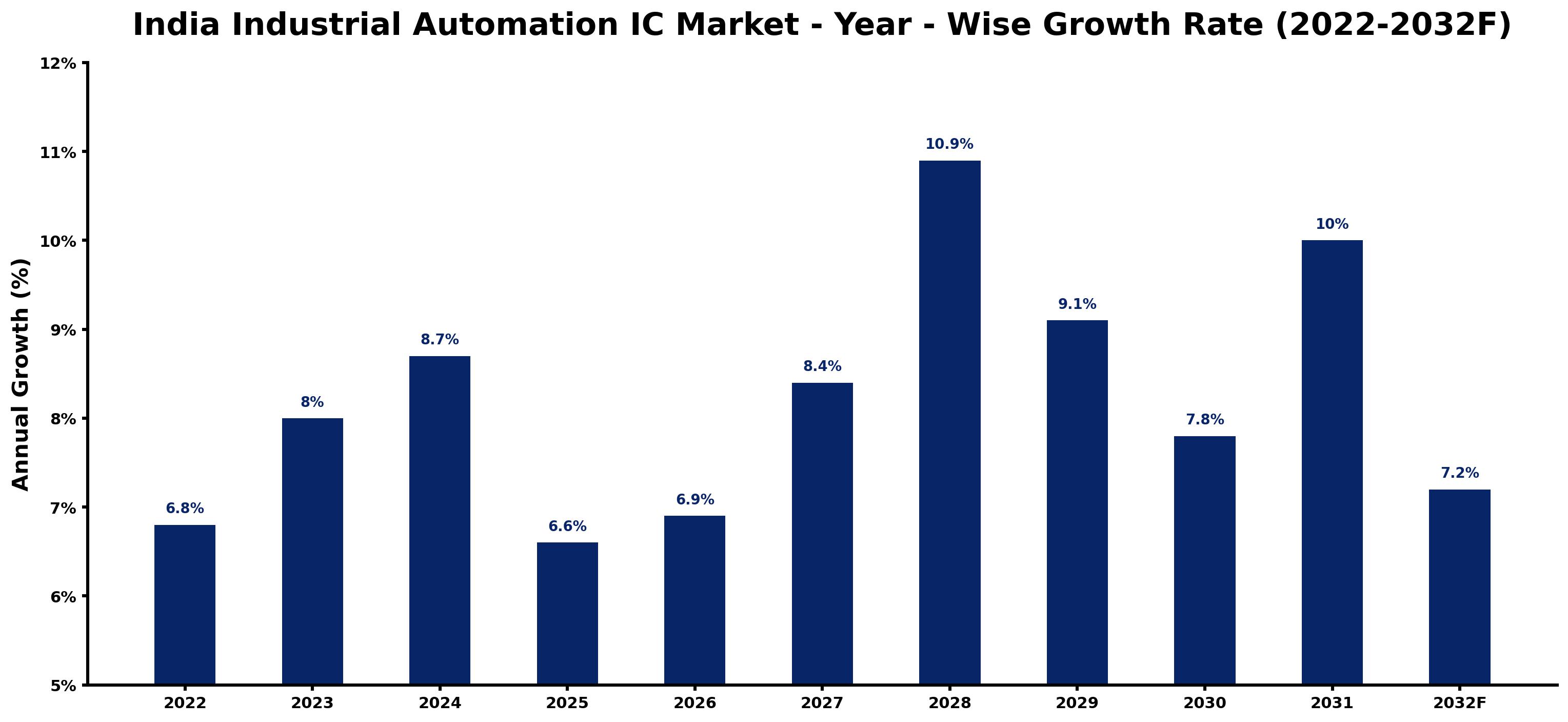
The table below sets out the estimated growth rate for each year and the main factor behind it.
| Year | Estimated Annual Growth (%) | Market Rationale |
| 2022 | 6.8 | The market experienced steady growth due to ongoing investments in automation technologies. |
| 2023 | 8.0 | Demand surged as the manufacturing sector continued to expand, requiring more automation solutions. |
| 2024 | 8.7 | Growth accelerated with increased adoption of industrial robots, enhancing automation capabilities. |
| 2025 | 6.6 | The market saw a slowdown as growth rates normalised after previous high performance. |
| 2026 | 6.9 | Investment in semiconductor manufacturing began to rise, supporting automation IC demand. |
| 2027 | 8.4 | Growing interest in smart factories drove demand for advanced automation solutions. |
| 2028 | 10.9 | The market peaked as major initiatives boosted investment in automation technologies. |
| 2029 | 9.1 | A slight slowdown occurred as growth rates adjusted from the previous peak. |
| 2030 | 7.8 | Demand continued to grow, albeit at a reduced rate, as market conditions stabilised. |
| 2031 | 10.0 | The market rebounded with renewed interest in automation from various sectors. |
| 2032 | 7.2 | Growth slowed again as the market adjusted to increased production capacities. |
Note: Market size estimations and growth projections presented in this report are based on 6Wresearch's proprietary forecasting methodology, utilizing the latest available industry data, government publications, and primary research inputs.
India Industrial Automation IC Market Synopsis
Industrial Automation IC Market in India includes semiconductor devices that control machinery and processes in industrial settings. These ICs play a crucial role in motor control, process automation, and data processing. The market is expanding due to investments in manufacturing and automation technologies. The National Policy on Electronics 2019 aims to enhance domestic manufacturing, further driving demand. With a target of $300 billion in electronics manufacturing by 2025, the market is set for considerable growth.
Market Dynamics Impact Analysis (2026–2032)
| Factor | Type | Impact | Primary Segment Affected |
| Increasing domestic manufacturing capabilities | Driver | High | Power Management ICs |
| Rising demand for automation in manufacturing | Driver | High | Motor Drives |
| Expanding industrial sectors in Maharashtra | Opportunity | High | Automation Hardware OEMs |
| Growing interest in smart manufacturing technologies | Opportunity | High | Robotics Integrators |
| Limited availability of skilled workforce | Restraint | High | Microcontrollers (MCUs) |
| High initial investment costs for automation systems | Restraint | Medium | ASICs for Automation |
| Supply chain disruptions affecting semiconductor availability | Challenge | High | Logic ICs |
| Technological obsolescence in automation solutions | Challenge | Medium | Process Control |
Evaluation of Drivers in India Industrial Automation IC Market (2026–2032)
The table below links each growth driver to the segment it affects and the evidence for it.
| Drivers | Primary Segment Affected | Why It Matters (Evidence) |
| Increasing investments in semiconductor manufacturing | Microcontrollers (MCUs) | The Indian government aims for a $10 billion investment in semiconductor manufacturing, boosting demand for MCUs. |
| Growth in the manufacturing sector | Motor Drives | With over 50 million people employed in manufacturing, demand for motor drives is rising. |
| Support from government initiatives | Power Management ICs | The Production Linked Incentive Scheme encourages local production of electronic components, driving demand. |
| Adoption of smart manufacturing practices | ASICs for Automation | The Smart Manufacturing initiative is driving demand for custom automation solutions. |
| Rising installed base of industrial robots | Process Control | In 2022, around 30,000 industrial robots were installed, increasing the need for process control ICs. |
The aim for a $10 billion investment in the semiconductor sector is expected to boost production capabilities. The manufacturing sector employs over 50 million people, creating a strong demand for automation solutions. The installed base of industrial robots reached approximately 30,000 units in 2022, increasing the need for automation ICs.
Evaluation of Restraints in India Industrial Automation IC Market
The following restraints limit how fast demand can grow.
| Market Restraint | Primary Segment Affected | Why It Matters (Evidence) |
| Limited skilled workforce in automation technologies | Microcontrollers (MCUs) | The shortage of skilled professionals hampers the growth of the MCU segment, affecting production capabilities. |
| High initial investment costs for automation systems | ASICs for Automation | Many manufacturers find it challenging to invest in automation due to high upfront costs. |
| Supply chain disruptions affecting semiconductor availability | Logic ICs | Ongoing supply chain issues have led to delays in the availability of essential ICs for automation. |
| Technological obsolescence in automation solutions | Process Control | Rapid advancements in technology can render existing solutions obsolete, impacting demand. |
| Regulatory compliance costs | Power Management ICs | Compliance with quality standards like ISO 9001 increases operational costs for manufacturers. |
India Industrial Automation IC Market Challenges
Buyers in the India Industrial Automation IC market encounter fierce competition from both domestic and international manufacturers, which drives prices down and squeezes profit margins. This competition arises from the swift entry of new players, compelling existing manufacturers to reduce prices while maintaining quality, ultimately impacting their profitability. Rising costs of semiconductor materials burden producers, potentially increasing production expenses by 15%, which they may pass on to buyers, resulting in higher prices. Many manufacturers grapple with rapid technological advancements; failure to innovate can lead to lost market share, affecting buyers who require the latest automation solutions. Regulatory compliance with ISO 9001 standards introduces challenges that can delay product launches, impacting buyers who depend on timely access to new technologies.
Trends in the India Industrial Automation IC Market
Four trends stand out in the India Industrial Automation IC Market.
- Shift towards Smart Manufacturing: Automation Hardware OEMs are increasingly embracing smart manufacturing technologies, with the Smart Manufacturing initiative driving this transition. In 2022, over 20% of manufacturers began implementing smart technologies.
- Increased focus on Robotics Integration: Maharashtra is becoming a hub for robotics integration in industrial automation. The state has experienced a 15% rise in robotics integrators over the past year.
- Adoption of QFP/BGA Packaging: The QFP/BGA packaging type is gaining traction among manufacturers, with a projected CAGR of 10.0% from 2026 to 2032, driven by demand for high-density applications.
- Growth in Electric Vehicle Manufacturing: The launch of the electric vehicle manufacturing scheme in 2023 is boosting demand for automation ICs, with an anticipated increase of 25% in related automation solutions.
Investment Opportunities in the India Industrial Automation IC Market
Below are the investment opportunities with the strongest case in the India Industrial Automation IC Market.
- Expansion in Maharashtra's Industrial Sector: Maharashtra's industrial sector is growing, creating a demand for automation solutions. The state aims for a $300 billion electronics manufacturing market by 2025.
- Investment in Custom Automation Solutions: There is a gap in the market for ASICs for Automation, with a projected CAGR of 11.4%. Robotics Integrators are seeking tailored solutions.
- Growing Demand for Process Control Solutions: The Process Control segment offers an opportunity for suppliers to address rising automation needs across various industries, with a CAGR of 10.0%.
- Increased Adoption of Quality Standards: The widespread adoption of ISO 9001 standards in the automation sector presents opportunities for suppliers of compliant automation ICs.
Government Initiatives in the India Industrial Automation IC Market
In 2021, the Ministry of Electronics and Information Technology launched the Semiconductor Mission to promote semiconductor manufacturing in India, targeting a $10 billion investment. This initiative builds on the National Electronics Policy 2021, which aims for a $300 billion electronics manufacturing market by 2025, boosting the production of automation ICs.
The Electronics and Information Technology Ministry oversees the Production Linked Incentive Scheme for Large Scale Electronics Manufacturing, which incentivises local production of electronic components, including automation ICs. This scheme supports manufacturers in achieving compliance with quality standards and boosts domestic production.
Future Insight of the India Industrial Automation IC Market
By 2032, buyers and suppliers in the India Industrial Automation IC market can expect substantial changes driven by government initiatives and technological advancements. The National Policy on Electronics aims to strengthen domestic manufacturing, which will enhance local supply chains and reduce reliance on imports. The Production Linked Incentive Scheme is expected to increase semiconductor production, potentially raising local output by 20%. The Smart Manufacturing initiative will promote automation across various industries, encouraging investments in new technologies. These elements will create a more competitive environment for producers and buyers, driving innovation and improving operational efficiency.
Market Segmentation Analysis
The analysis below covers each segmentation, its leading category in 2025 and its fastest-growing category through 2032.
By IC Type – Microcontrollers (MCUs) Dominated, ASICs for Automation Expected to Grow Fastest
According to Sachin Kumar Rai, Senior Research Analyst at 6Wresearch, in 2025, Microcontrollers (MCUs) led the ic type split with a 45% share. Microcontrollers (MCUs) dominate the market share because they are fundamental in controlling various automation tasks across multiple sectors. Their widespread use in applications like motor control exemplifies their importance in the industrial automation landscape. ASICs for Automation is set to record the highest CAGR in this split, 11.4% over 2026–2032. ASICs for Automation are experiencing rapid growth due to the rising demand for tailored solutions that meet specific automation requirements. As industries increasingly seek specialised functionalities, the adoption of ASICs is expected to accelerate, further widening the gap with other segments. This trend suggests that suppliers must focus on developing customised solutions to cater to the unique needs of diverse industrial applications.
By Application Segment – Motor Drives Dominated, Process Control Expected to Grow Fastest
Motor Drives held a 49% share of the India Industrial Automation IC Market by application segment in 2025. Motor Drives hold the largest market share as they are essential for controlling electric motors in automation systems. Their critical role in improving operational efficiency and performance across manufacturing processes reinforces their dominance in the market. Over 2026–2032, Process Control is expected to post the fastest growth, at a CAGR of 10.0%. Process Control is the fastest-growing segment, driven by the urgent need to manage and optimise industrial processes effectively. As industries prioritise efficiency and productivity, the demand for advanced process control solutions is set to increase significantly. Suppliers should concentrate on enhancing technologies that improve process control capabilities to capitalise on the expanding market opportunities.
By Packaging Type – SMD/Through-Hole Dominated, QFP/BGA Expected to Grow Fastest
With a 41% revenue share in 2025, SMD/Through-Hole was the largest packaging type category. SMD/Through-Hole packaging types lead the market due to their common usage in automation ICs, providing reliability and ease of integration. Their established presence in the industry makes them the go-to choice for many manufacturers. The quickest growth will come from QFP/BGA, forecast to expand at a CAGR of 10.0% between 2026 and 2032. QFP/BGA packaging is growing rapidly as it is preferred for high-density applications, allowing for more complex designs in automation systems. This shift towards miniaturisation and efficiency will continue to drive demand for these packaging types. Manufacturers should consider expanding their offerings in QFP/BGA packaging to align with the market's evolving needs.
By End User – Automation Hardware OEMs Dominated, Robotics Integrators Expected to Grow Fastest
Automation Hardware OEMs took a 38% share of end user in 2025, more than any other category. Automation Hardware OEMs represent the largest market share as they are the primary users of automation ICs, integrating these components into their systems. Their pivotal role in the supply chain ensures a steady demand for automation ICs across various applications. Robotics Integrators are projected to grow fastest, at a CAGR of 11.0% during 2026–2032. Robotics Integrators are the fastest-growing end user segment, increasingly relying on ICs for the development of sophisticated robotic control systems. The surge in automation across different sectors is propelling this segment's rapid growth. Suppliers should aim to provide tailored solutions to Robotics Integrators to take advantage of the expanding opportunities within the robotics market.
Key Attractiveness of the Report
- 10 Years of Market Numbers
- Historical Data Starting from 2022 to 2025
- Base Year 2025
- Forecast Data until 2032
- Key Performance Indicators Impacting the Market
- Major Upcoming Developments and Projects
Key Highlights of the Report:
- India Industrial Automation IC Market Outlook
- Market Size of India Industrial Automation IC Market, 2025
- Forecast of India Industrial Automation IC Market, 2032
- Historical Data and Forecast of India Industrial Automation IC Revenues & Volume for the Period 2022 - 2032F
- India Industrial Automation IC Market Trend Evolution
- India Industrial Automation IC Market Drivers and Challenges
- India Industrial Automation IC Price Trends
- India Industrial Automation IC Porter's Five Forces
- India Industrial Automation IC Industry Life Cycle
- Historical Data and Forecast of India Industrial Automation IC Market Revenues & Volume By IC Type for the Period 2022 - 2032F
- Historical Data and Forecast of India Industrial Automation IC Market Revenues & Volume By Power Management ICs for the Period 2022 - 2032F
- Historical Data and Forecast of India Industrial Automation IC Market Revenues & Volume By Microcontrollers (MCUs) for the Period 2022 - 2032F
- Historical Data and Forecast of India Industrial Automation IC Market Revenues & Volume By Logic ICs for the Period 2022 - 2032F
- Historical Data and Forecast of India Industrial Automation IC Market Revenues & Volume By ASICs for Automation for the Period 2022 - 2032F
- Historical Data and Forecast of India Industrial Automation IC Market Revenues & Volume By Application Segment for the Period 2022 - 2032F
- Historical Data and Forecast of India Industrial Automation IC Market Revenues & Volume By Motor Drives for the Period 2022 - 2032F
- Historical Data and Forecast of India Industrial Automation IC Market Revenues & Volume By Process Control for the Period 2022 - 2032F
- Historical Data and Forecast of India Industrial Automation IC Market Revenues & Volume By Signal Processing for the Period 2022 - 2032F
- Historical Data and Forecast of India Industrial Automation IC Market Revenues & Volume By Custom Tasks for the Period 2022 - 2032F
- Historical Data and Forecast of India Industrial Automation IC Market Revenues & Volume By Packaging Type for the Period 2022 - 2032F
- Historical Data and Forecast of India Industrial Automation IC Market Revenues & Volume By SMD/Through-Hole for the Period 2022 - 2032F
- Historical Data and Forecast of India Industrial Automation IC Market Revenues & Volume By QFP/BGA for the Period 2022 - 2032F
- Historical Data and Forecast of India Industrial Automation IC Market Revenues & Volume By SOIC/DIP for the Period 2022 - 2032F
- Historical Data and Forecast of India Industrial Automation IC Market Revenues & Volume By Die-Level/SIP for the Period 2022 - 2032F
- Historical Data and Forecast of India Industrial Automation IC Market Revenues & Volume By End User for the Period 2022 - 2032F
- Historical Data and Forecast of India Industrial Automation IC Market Revenues & Volume By Automation Hardware OEMs for the Period 2022 - 2032F
- Historical Data and Forecast of India Industrial Automation IC Market Revenues & Volume By Industrial PC Makers for the Period 2022 - 2032F
- Historical Data and Forecast of India Industrial Automation IC Market Revenues & Volume By PLC Manufacturers for the Period 2022 - 2032F
- Historical Data and Forecast of India Industrial Automation IC Market Revenues & Volume By Robotics Integrators for the Period 2022 - 2032F
- India Industrial Automation IC Import Export Trade Statistics
- Market Opportunity Assessment By IC Type
- Market Opportunity Assessment By Application Segment
- Market Opportunity Assessment By Packaging Type
- Market Opportunity Assessment By End User
- India Industrial Automation IC Top Companies Market Share
- India Industrial Automation IC Competitive Benchmarking By Technical and Operational Parameters
- India Industrial Automation IC Company Profiles
- India Industrial Automation IC Key Strategic Recommendations
Market Covered
This report examines the market across the segments below.
By IC Type
- Power Management ICs
- Microcontrollers (MCUs)
- Logic ICs
- ASICs for Automation
By Application Segment
- Motor Drives
- Process Control
- Signal Processing
- Custom Tasks
By Packaging Type
- SMD/Through-Hole
- QFP/BGA
- SOIC/DIP
- Die-Level/SIP
By End User
- Automation Hardware OEMs
- Industrial PC Makers
- PLC Manufacturers
- Robotics Integrators































