India Industrial Automation in Developing Countries Market Size & Growth Rate
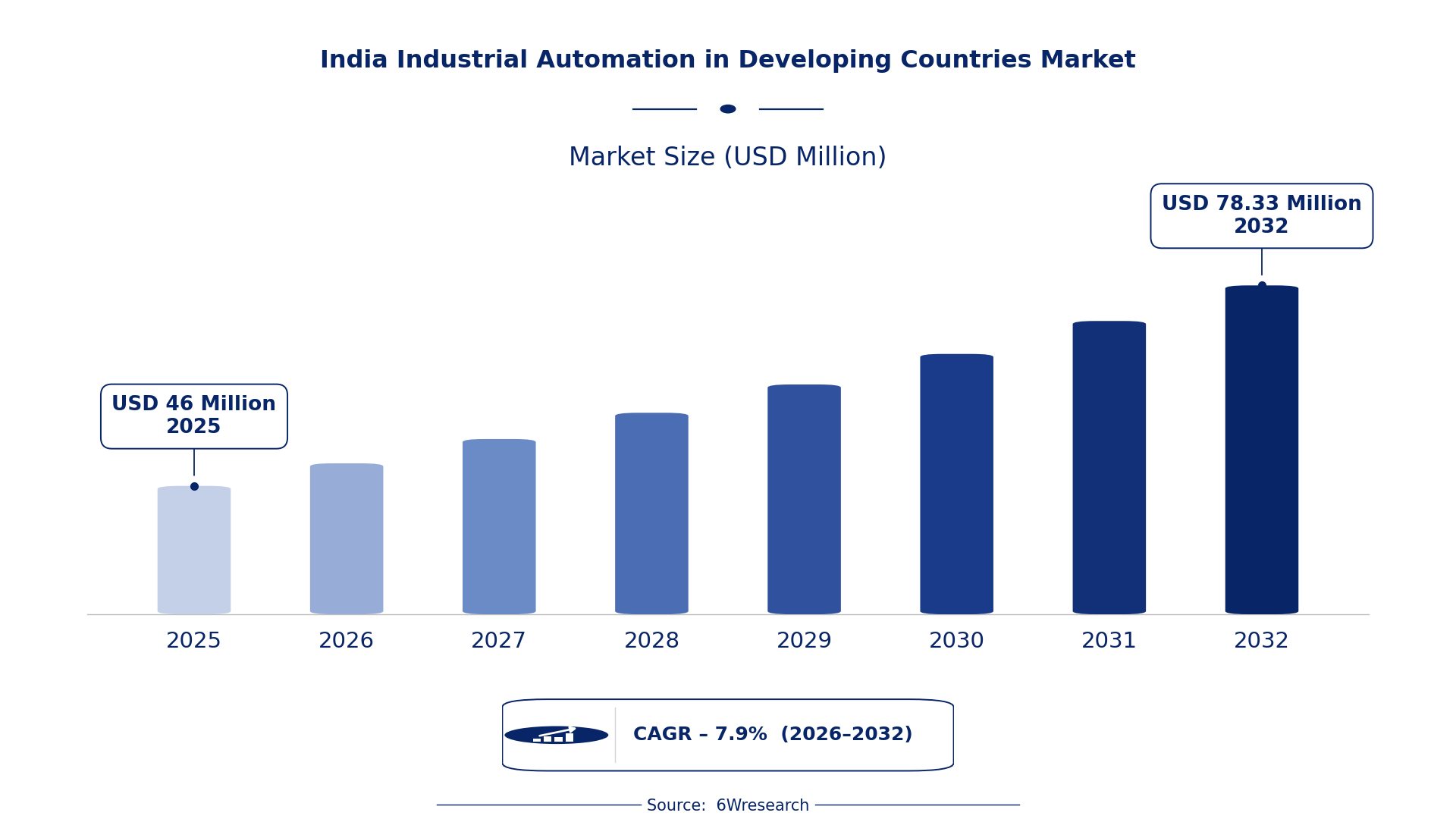
According to 6Wresearch internal database and industry insights, the India Industrial Automation in Developing Countries Market was valued at USD 46.0 million in 2025 and is projected to reach USD 78.33 million by 2032, growing at a CAGR of approximately 7.9% during 2026–2032.
India Industrial Automation in Developing Countries Market Highlights
| Report Metric | Details |
| Report Name | India Industrial Automation in Developing Countries Market |
| Market Size 2025 | USD 46.0 million |
| Market Size 2032 | USD 78.33 million |
| Absolute Growth 2025–2032 | USD 32.33 million |
| CAGR 2026–2032 | 7.9% |
| Peak Annual Growth | 10.3% in 2030 |
| Forecast Period | 2026–2032 |
| Historical Data | 2022–2025 |
| Base Year | 2025 |
| Leading Automation Type, 2025 | Robotics Integration (41% share) |
| Leading Adoption Barrier, 2025 | High CapEx (39% share) |
| Leading Industry Focus, 2025 | FMCG Manufacturing (45% share) |
| Leading End User, 2025 | Mid-Sized Factories (44% share) |
| Fastest-Growing Adoption Barrier | Cost & Skills Gap (10.2% CAGR) |
| Fastest-Growing Industry Focus | Food Processing (10.0% CAGR) |
| Fastest-Growing End User | Local Plants (9.0% CAGR) |
| Growing Sector | Food Processing |
| Key End Users | FMCG Manufacturers, Automotive Component Manufacturers, Mid-Sized Factories, Local Plants |
India Industrial Automation in Developing Countries Market Year-wise Growth Rate and Key Drivers (2022–2032)
This graph illustrates the annual growth rates of the market from 2022 to 2032, highlighting a steady upward trajectory and projected market expansion over the forecast period.
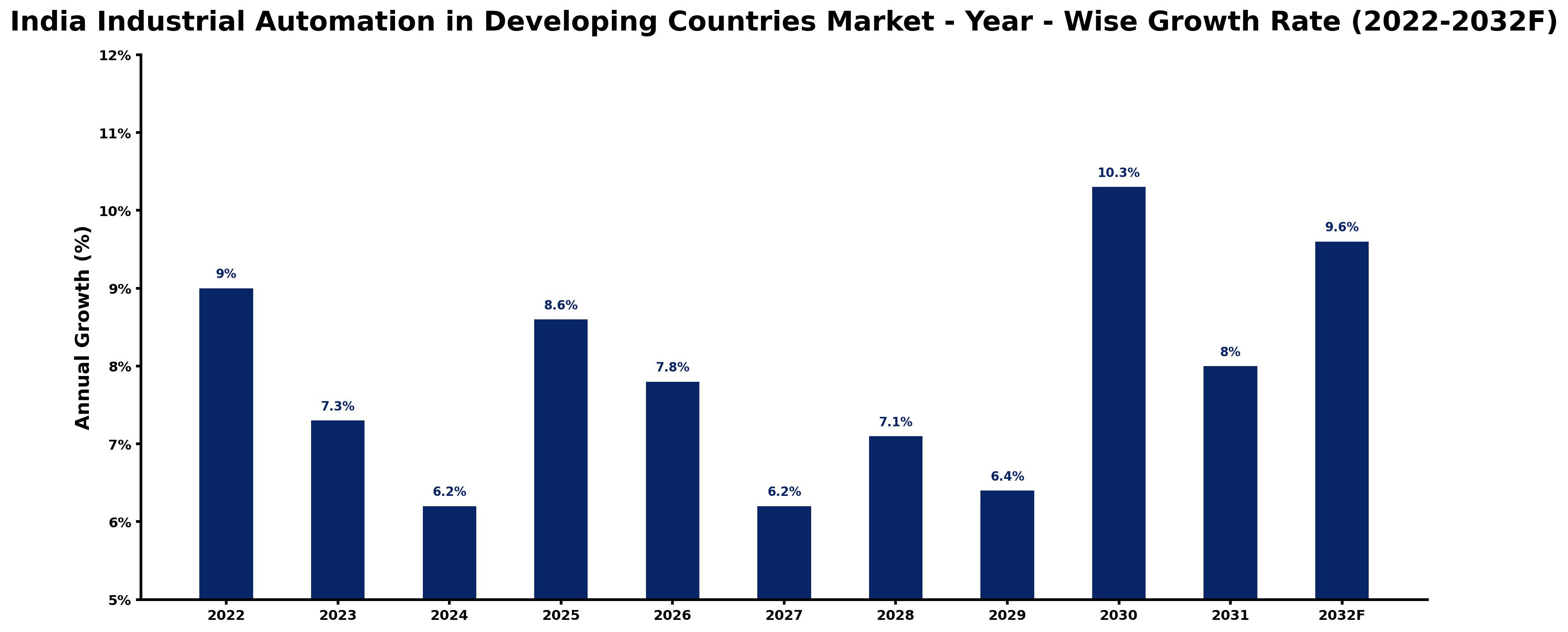
The following table presents the estimated annual growth rate for each year together with the principal factor influencing market performance.
| Year | Estimated Annual Growth (%) | Market Rationale |
| 2022 | 9.0 | The market experienced strong demand from the FMCG sector, driving automation adoption. |
| 2023 | 7.3 | Investment in robotics integration continued, although at a slower pace compared to 2022. |
| 2024 | 6.2 | The growth rate declined as manufacturers faced challenges in implementing advanced technologies. |
| 2025 | 8.6 | A resurgence in demand from mid-sized factories led to increased automation investments. |
| 2026 | 7.8 | Growth slowed as high capital expenditure remained a significant barrier for many manufacturers. |
| 2027 | 6.2 | The market saw a further slowdown as the skills gap hindered technology adoption. |
| 2028 | 7.1 | Increased investments in food processing automation spurred growth in this year. |
| 2029 | 6.4 | Demand growth slowed again as infrastructure deficits continued to limit automation implementation. |
| 2030 | 10.3 | The market peaked due to significant investments in robotics and process control automation. |
| 2031 | 8.0 | A slight slowdown occurred as manufacturers adjusted to new operational standards. |
| 2032 | 9.6 | Demand for automation technologies surged as the industry focused on efficiency and productivity. |
Note: Market size estimations and growth projections presented in this report are based on 6Wresearch's proprietary forecasting methodology, utilizing the latest available industry data, government publications, and primary research inputs.
India Industrial Automation in Developing Countries Market Synopsis
Industrial Automation in Developing Countries Market in India encompasses various technologies that enhance manufacturing processes. This includes systems like PLCs, robotics, and process control tools, which improve efficiency and reduce human intervention. The market is growing due to strong demand from sectors such as FMCG, automotive, and food processing. The FMCG sector alone accounts for approximately 30% of automation demand, while the automotive sector is increasingly investing in robotics integration. Overall, these factors are driving significant growth in the market.
Market Dynamics Impact Analysis (2026–2032)
| Factor | Type | Impact | Primary Segment Affected |
| Strong demand from the FMCG sector drives automation investments. | Driver | High | FMCG Manufacturing |
| Increasing investments in robotics integration enhance production efficiency. | Driver | High | Robotics Integration |
| Growing demand for automation in food processing presents new opportunities. | Opportunity | High | Food Processing |
| Investment in local plants is rising to meet quality standards. | Opportunity | Medium | Local Plants |
| High capital expenditure limits adoption for small manufacturers. | Restraint | High | High CapEx |
| The skills gap restricts the workforce's ability to implement advanced technologies. | Restraint | Medium | Cost & Skills Gap |
| Limited infrastructure hinders the implementation of automation solutions. | Challenge | High | Infrastructure Deficit |
| Connectivity limitations affect the use of cloud-based automation tools. | Challenge | Medium | Connectivity Limitation |
Evaluation of Drivers in India Industrial Automation in Developing Countries Market (2026–2032)
The main growth drivers and the segments they affect most are set out below.
| Drivers | Primary Segment Affected | Why It Matters (Evidence) |
| Strong demand from the FMCG sector drives automation investments. | FMCG Manufacturing | The FMCG sector accounts for approximately 30% of the automation demand in India. |
| Increasing investments in robotics integration improve production efficiency. | Robotics Integration | Over 70% of automotive component manufacturers are investing in robotics integration to enhance precision. |
| The 'Make in India' initiative promotes automation across sectors. | Robotics Integration | This initiative aims to boost manufacturing capabilities and encourage automation technologies, targeting $400 billion by 2025. |
| Growth in the Food Processing sector fuels demand for automation technologies. | Food Processing | This sector is projected to grow at a rate of 8% from 2023 to 2028, driving automation adoption. |
| The establishment of the National Institute of Industrial Engineering supports automation education. | Robotics Integration | This institution aims to improve the skills needed for effective automation implementation, targeting 1 million trainees by 2025. |
Market growth in India for Industrial Automation in Developing Countries is driven by robust demand from the FMCG sector, rising investments in robotics, and expansion in the Food Processing sector. The FMCG sector plays a crucial role in automation demand, prompting increased investments in technology. More than 70% of automotive component manufacturers are now integrating robotics to boost production efficiency. The food processing sector is expected to grow at 8% from 2023 to 2028, further accelerating automation adoption. The establishment of the National Institute of Industrial Engineering supports the development of skills necessary for this evolving market.
Evaluation of Restraints in India Industrial Automation in Developing Countries Market
The table below lists the restraints and the evidence behind each.
| Market Restraint | Primary Segment Affected | Why It Matters (Evidence) |
| High capital expenditure limits adoption for small manufacturers. | High CapEx | Many small and mid-sized manufacturers struggle to invest in automation technologies due to costs exceeding $500 million. |
| The skills gap restricts the workforce's ability to implement advanced technologies. | Cost & Skills Gap | Limited training and expertise hinder effective adoption of automation solutions, affecting productivity. |
| Limited infrastructure hinders the implementation of automation solutions. | Infrastructure Deficit | Rural areas face challenges in adopting advanced automation due to inadequate infrastructure, impacting overall efficiency. |
| Connectivity limitations affect the use of cloud-based automation tools. | Connectivity Limitation | Remote locations struggle with internet access, impacting cloud automation implementation and data management capabilities. |
| Regulatory hurdles can delay automation project approvals. | Robotics Integration | Complex regulations can slow down the implementation of new automation technologies, affecting timelines for manufacturers. |
India Industrial Automation in Developing Countries Market Challenges
Producers in the India industrial automation market encounter high integration costs, with many projects requiring investments exceeding $500 million, potentially delaying timelines for manufacturers. Buyers face supply challenges due to limited local production of advanced automation technologies, compelling them to rely on imports that raise costs and extend lead times. Compliance with new standards from the Bureau of Indian Standards demands costly upgrades for manufacturers, impacting their operational budgets. The skills gap in the workforce complicates matters further, leading to increased training expenses for companies striving to implement new technologies effectively.
Trends in the India Industrial Automation in Developing Countries Market
Four trends stand out in the India Industrial Automation in Developing Countries Market.
- Shift towards Robotics Integration in Manufacturing: India is increasingly embracing robotics integration in manufacturing processes, especially within the automotive sector. Over 70% of automotive component manufacturers are investing in robotics, enhancing precision and efficiency.
- Growing Focus on Food Processing Automation: The food processing sector is undergoing a notable shift towards automation to ensure hygiene and efficiency. This sector is projected to grow at a rate of 8% from 2023 to 2028, prompting further investments.
- Increased Adoption of PLCs in Textile Manufacturing: The textile industry in India is progressively adopting PLCs to boost operational efficiency. This trend is becoming more apparent as manufacturers integrate these systems into their processes.
- Expansion of the 'Make in India' Initiative: The 'Make in India' initiative continues to drive investments in automation technologies across various sectors. This initiative aims to enhance manufacturing capabilities, targeting $400 billion by 2025.
Investment Opportunities in the India Industrial Automation in Developing Countries Market
Investors looking at the India Industrial Automation in Developing Countries Market should consider the following areas.
- Investment in Local Plants: Local plants are increasingly implementing automation to enhance competitiveness. With projected growth in demand, investing in automation technologies for these facilities can yield substantial returns.
- Growing Demand for Food Processing Automation: The food processing sector is set to grow at a rate of 8% from 2023 to 2028. Suppliers can take advantage of this by offering advanced automation solutions tailored for this industry.
- Partnerships for Robotics Integration: Collaborating with robotics manufacturers can assist local firms in improving their production efficiency. This strategy is particularly advantageous for automotive component manufacturers aiming to adopt advanced technologies.
- Supply of Automation Training Services: With the skills gap hindering technology adoption, there is an increasing demand for training services in automation technologies. Targeting educational institutions can create new opportunities.
Government Initiatives in the India Industrial Automation in Developing Countries Market
The Ministry of Heavy Industries plays a key role in funding automation initiatives. In 2023, it allocated $500 million for automation in small-scale industries, aiding their transition to advanced technologies. The Bureau of Indian Standards is also involved in establishing new standards for automation technologies in manufacturing, ensuring compliance and quality. These measures aim to enhance the competitiveness of Indian manufacturers in the global market.
The Ministry of Electronics and Information Technology manages the 'Production Linked Incentive Scheme', which promotes automation in electronics manufacturing. This scheme seeks to boost local production and reduce reliance on imports, fostering a more robust manufacturing environment. Additionally, the 'Skill India Mission' centres on training for automation technologies, targeting 1 million trainees by 2025, thereby enhancing workforce capabilities.
Future Insight of the India Industrial Automation in Developing Countries Market
Several forward-looking factors should support the industrial automation market in India over the coming years. The 'Make in India' initiative will enhance local manufacturing capabilities, while the 'Digital India' programme aims to improve connectivity for industrial applications. By 2025, the integration of robotics in manufacturing is expected to create over 1 million jobs, transforming the workforce landscape. The National Institute of Industrial Engineering will contribute significantly by promoting automation education, ensuring a skilled workforce ready to meet future demands.
Market Segmentation Analysis
The analysis below covers each segmentation, its leading category in 2025 and its fastest-growing category through 2032.
By Automation Type – Robotics Integration Dominated and Is Expected to Record the Fastest Growth
According to Sachin Kumar Rai, Senior Research Analyst at 6Wresearch, with a 41% revenue share in 2025, Robotics Integration was the largest automation type category. Robotics integration commands the largest share in the market as it is crucial for enhancing precision and efficiency in manufacturing processes. Its widespread adoption in sectors like automotive manufacturing exemplifies its significance in streamlining operations. Robotics Integration is also forecast to expand faster than any other category, at a CAGR of 9.2% over 2026–2032. The robotics integration segment is set for rapid growth as manufacturers increasingly recognise the benefits of automation. The government's push for Industry 4.0 technologies will further accelerate this trend, ensuring robotics integration remains at the forefront of industrial automation. Suppliers should focus on advancing robotics solutions to meet the surging demand in the industrial automation market.
By Adoption Barrier – High CapEx Dominated, Cost & Skills Gap Expected to Grow Fastest
High CapEx accounted for a 39% market share by adoption barrier in 2025. High capital expenditure remains the leading barrier for many small and mid-sized manufacturers looking to adopt automation technologies. This challenge is particularly pronounced in sectors where budget constraints limit investment in advanced systems. Cost & Skills Gap is set to record the highest CAGR in this split, 10.2% over 2026–2032. The cost and skills gap is the fastest-growing barrier, as companies struggle to find skilled workers to implement and maintain automation technologies. This gap may hinder overall market growth if not addressed promptly. Understanding these barriers can help suppliers tailor their offerings to assist manufacturers in overcoming financial and skill-related challenges.
By Industry Focus – FMCG Manufacturing Dominated, Food Processing Expected to Grow Fastest
The largest industry focus category in 2025 was FMCG Manufacturing, with a 45% share of total revenue. FMCG manufacturing is the leading sector for automation due to its high demand for efficiency and productivity in production processes. This sector accounts for approximately 30% of the overall automation demand in India, highlighting its significance. Over 2026–2032, Food Processing is expected to post the fastest growth, at a CAGR of 10.0%. The food processing sector is experiencing the fastest growth in automation adoption, driven by the need for improved hygiene and efficiency in production. This trend is expected to continue as consumer demand for processed foods rises. Suppliers should prioritise solutions tailored to the specific needs of the food processing sector to capitalise on this growth opportunity.
By End User – Mid-Sized Factories Dominated, Local Plants Expected to Grow Fastest
In 2025, Mid-Sized Factories led the end user split with a 44% share. Mid-sized factories dominate the market share as they are actively investing in automation to improve operational efficiency and competitiveness. This trend illustrates a significant shift towards modernisation within India's manufacturing sector. The quickest growth will come from Local Plants, forecast to expand at a CAGR of 9.0% between 2026 and 2032. Local plants are witnessing the fastest growth as they implement automation technologies to boost their market competitiveness. This shift indicates a growing emphasis on efficient and localised production processes. Suppliers need to customise their automation offerings to address the unique needs of local plants and mid-sized factories to seize market opportunities.
Key Attractiveness of the Report
- 10 Years of Market Numbers
- Historical Data Starting from 2022 to 2025
- Base Year 2025
- Forecast Data until 2032
- Key Performance Indicators Impacting the Market
- Major Upcoming Developments and Projects
Key Highlights of the Report:
- India Industrial Automation in Developing Countries Market Outlook
- Market Size of India Industrial Automation in Developing Countries Market, 2025
- Forecast of India Industrial Automation in Developing Countries Market, 2032
- Historical Data and Forecast of India Industrial Automation in Developing Countries Revenues & Volume for the Period 2022 - 2032F
- India Industrial Automation in Developing Countries Market Trend Evolution
- India Industrial Automation in Developing Countries Market Drivers and Challenges
- India Industrial Automation in Developing Countries Price Trends
- India Industrial Automation in Developing Countries Porter's Five Forces
- India Industrial Automation in Developing Countries Industry Life Cycle
- Historical Data and Forecast of India Industrial Automation in Developing Countries Market Revenues & Volume By Automation Type for the Period 2022 - 2032F
- Historical Data and Forecast of India Industrial Automation in Developing Countries Market Revenues & Volume By Basic PLC-based Automation for the Period 2022 - 2032F
- Historical Data and Forecast of India Industrial Automation in Developing Countries Market Revenues & Volume By Robotics Integration for the Period 2022 - 2032F
- Historical Data and Forecast of India Industrial Automation in Developing Countries Market Revenues & Volume By Process Control Automation for the Period 2022 - 2032F
- Historical Data and Forecast of India Industrial Automation in Developing Countries Market Revenues & Volume By Cloud Automation Tools for the Period 2022 - 2032F
- Historical Data and Forecast of India Industrial Automation in Developing Countries Market Revenues & Volume By Adoption Barrier for the Period 2022 - 2032F
- Historical Data and Forecast of India Industrial Automation in Developing Countries Market Revenues & Volume By Cost & Skills Gap for the Period 2022 - 2032F
- Historical Data and Forecast of India Industrial Automation in Developing Countries Market Revenues & Volume By High CapEx for the Period 2022 - 2032F
- Historical Data and Forecast of India Industrial Automation in Developing Countries Market Revenues & Volume By Infrastructure Deficit for the Period 2022 - 2032F
- Historical Data and Forecast of India Industrial Automation in Developing Countries Market Revenues & Volume By Connectivity Limitation for the Period 2022 - 2032F
- Historical Data and Forecast of India Industrial Automation in Developing Countries Market Revenues & Volume By Industry Focus for the Period 2022 - 2032F
- Historical Data and Forecast of India Industrial Automation in Developing Countries Market Revenues & Volume By FMCG Manufacturing for the Period 2022 - 2032F
- Historical Data and Forecast of India Industrial Automation in Developing Countries Market Revenues & Volume By Auto Component Assembly for the Period 2022 - 2032F
- Historical Data and Forecast of India Industrial Automation in Developing Countries Market Revenues & Volume By Oil Refining & Cement for the Period 2022 - 2032F
- Historical Data and Forecast of India Industrial Automation in Developing Countries Market Revenues & Volume By Food Processing for the Period 2022 - 2032F
- Historical Data and Forecast of India Industrial Automation in Developing Countries Market Revenues & Volume By End User for the Period 2022 - 2032F
- Historical Data and Forecast of India Industrial Automation in Developing Countries Market Revenues & Volume By Small Industrial Units for the Period 2022 - 2032F
- Historical Data and Forecast of India Industrial Automation in Developing Countries Market Revenues & Volume By Tier-2 Suppliers for the Period 2022 - 2032F
- Historical Data and Forecast of India Industrial Automation in Developing Countries Market Revenues & Volume By Local Plants for the Period 2022 - 2032F
- Historical Data and Forecast of India Industrial Automation in Developing Countries Market Revenues & Volume By Mid-Sized Factories for the Period 2022 - 2032F
- India Industrial Automation in Developing Countries Import Export Trade Statistics
- Market Opportunity Assessment By Automation Type
- Market Opportunity Assessment By Adoption Barrier
- Market Opportunity Assessment By Industry Focus
- Market Opportunity Assessment By End User
- India Industrial Automation in Developing Countries Top Companies Market Share
- India Industrial Automation in Developing Countries Competitive Benchmarking By Technical and Operational Parameters
- India Industrial Automation in Developing Countries Company Profiles
- India Industrial Automation in Developing Countries Key Strategic Recommendations
Market Covered
Segments analysed in this report are listed below.
By Automation Type
- Basic PLC-based Automation
- Robotics Integration
- Process Control Automation
- Cloud Automation Tools
By Adoption Barrier
- Cost & Skills Gap
- High CapEx
- Infrastructure Deficit
- Connectivity Limitation
By Industry Focus
- FMCG Manufacturing
- Auto Component Assembly
- Oil Refining & Cement
- Food Processing
By End User
- Small Industrial Units
- Tier-2 Suppliers
- Local Plants
- Mid-Sized Factories































