China Industrial Automation in Developing Countries Market Size & Growth Rate
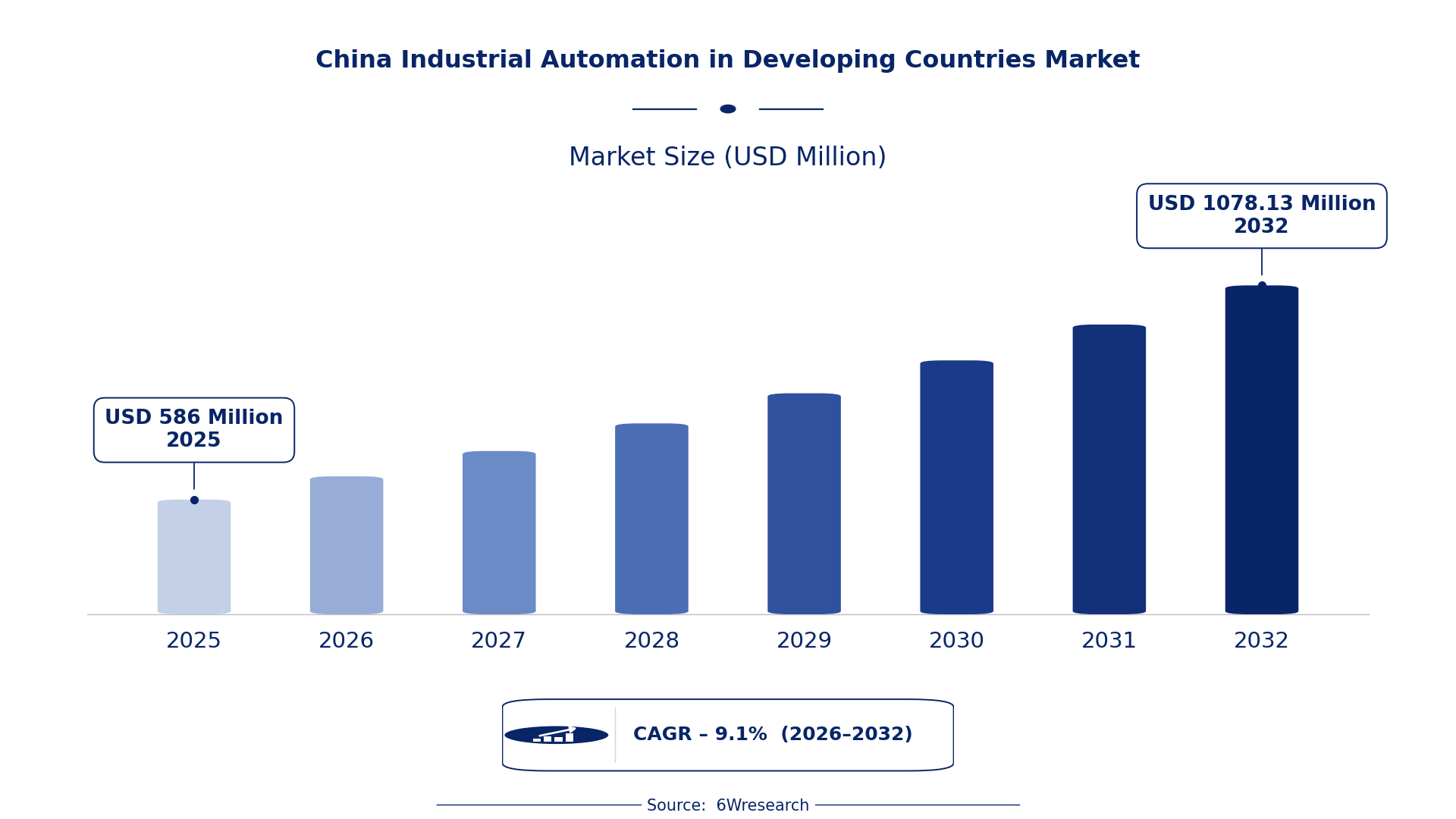
According to 6Wresearch internal database and industry insights, the China Industrial Automation in Developing Countries Market was valued at USD 586.0 million in 2025 and is projected to reach USD 1,078.13 million by 2032, growing at a CAGR of approximately 9.1% during 2026–2032.
China Industrial Automation in Developing Countries Market Highlights
| Report Metric | Details |
| Report Name | China Industrial Automation in Developing Countries Market |
| Market Size 2025 | USD 586.0 million |
| Market Size 2032 | USD 1,078.13 million |
| Absolute Growth 2025–2032 | USD 492.13 million |
| CAGR 2026–2032 | 9.1% |
| Peak Annual Growth | 11.6% in 2030 |
| Forecast Period | 2026–2032 |
| Historical Data | 2022–2025 |
| Base Year | 2025 |
| Leading Automation Type, 2025 | Robotics Integration (48% share) |
| Leading Adoption Barrier, 2025 | Cost & Skills Gap (39% share) |
| Leading Industry Focus, 2025 | FMCG Manufacturing (40% share) |
| Leading End User, 2025 | Mid-Sized Factories (46% share) |
| Fastest-Growing Adoption Barrier | High CapEx (11.5% CAGR) |
| Fastest-Growing Industry Focus | Food Processing (11.4% CAGR) |
| Fastest-Growing End User | Local Plants (11.7% CAGR) |
| Growing Sector | Food Processing |
| Key End Users | FMCG Manufacturing, Auto Component Assembly, Food Processing, Oil Refining & Cement |
China Industrial Automation in Developing Countries Market Year-wise Growth Rate and Key Drivers (2022–2032)
This graph illustrates the annual growth rates of the market from 2022 to 2032, highlighting a steady upward trajectory and projected market expansion over the forecast period.
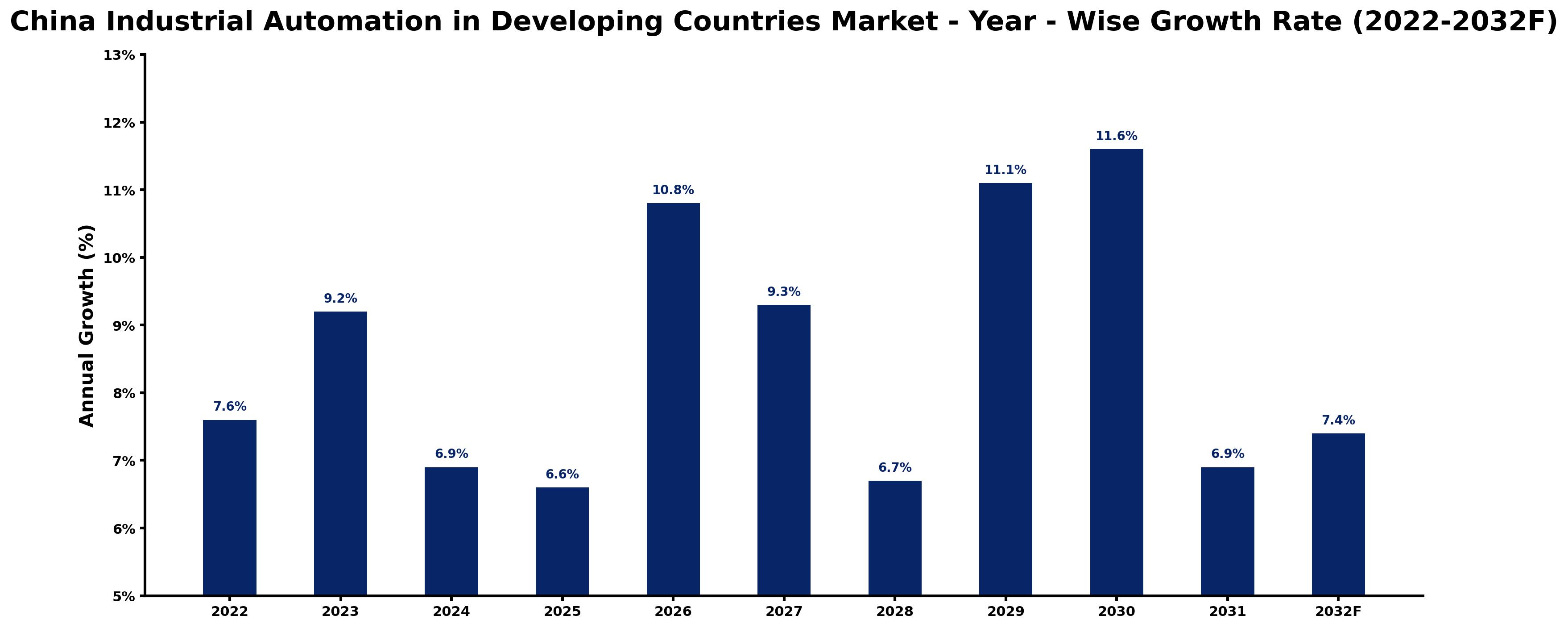
The following table presents the estimated annual growth rate for each year together with the principal factor influencing market performance.
| Year | Estimated Annual Growth (%) | Market Rationale |
| 2022 | 7.6 | The market experienced steady growth due to ongoing investments in automation technologies, particularly in the manufacturing sector. |
| 2023 | 9.2 | Demand surged as more manufacturing plants implemented automation solutions, driven by the 'Made in China 2025' initiative. |
| 2024 | 6.9 | Growth slowed slightly as some sectors faced challenges in adopting advanced technologies, particularly in local plants. |
| 2025 | 6.6 | The market continued to grow, albeit at a slower pace, influenced by investment hesitancy among mid-sized factories. |
| 2026 | 10.8 | A rebound occurred as industries ramped up automation efforts to meet production demands, particularly in FMCG manufacturing. |
| 2027 | 9.3 | Growth decelerated as companies reassessed their automation strategies amid economic shifts affecting local plants. |
| 2028 | 6.7 | The market saw further slowdown as firms focused on consolidating existing automation systems, especially in small industrial units. |
| 2029 | 11.1 | Renewed interest in automation emerged, driven by technological advancements and demand from the automotive sector. |
| 2030 | 11.6 | The market peaked as industries aggressively adopted automation to improve productivity, particularly in food processing. |
| 2031 | 6.9 | Growth slowed as the market matured and companies focused on optimizing existing systems in mid-sized factories. |
| 2032 | 7.4 | A resurgence in demand is expected as new technologies and initiatives, such as the 'Smart Manufacturing Pilot Program', gain traction. |
Note: Market size estimations and growth projections presented in this report are based on 6Wresearch's proprietary forecasting methodology, utilizing the latest available industry data, government publications, and primary research inputs.
China Industrial Automation in Developing Countries Market Synopsis
Industrial Automation in Developing Countries in China involves the use of technology to control industrial processes, improving efficiency and productivity. This sector integrates hardware and software systems that automate tasks. Key factors include the 'Made in China 2025' initiative and increasing automation adoption across industries like FMCG and automotive components. The growing focus on automation is clear as over 60% of manufacturing plants have implemented some form of automation by 2023.
Market Dynamics Impact Analysis (2026–2032)
| Factor | Type | Impact | Primary Segment Affected |
| Growing adoption of robotics in manufacturing processes | Driver | High | Robotics Integration |
| Investment in automation technologies by the automotive sector | Driver | High | Auto Component Assembly |
| Increased funding for automation projects in small manufacturers | Opportunity | High | Small Industrial Units |
| Rising demand for automation in food processing to meet safety standards | Opportunity | High | Food Processing |
| High capital expenditure limiting small manufacturers' automation investments | Restraint | High | Cost & Skills Gap |
| Skills gap hindering the effective implementation of automation technologies | Restraint | Medium | Cost & Skills Gap |
| Regulatory hurdles delaying automation project approvals | Challenge | High | Mid-Sized Factories |
| Economic fluctuations affecting investment in automation technologies | Challenge | Medium | Local Plants |
Evaluation of Drivers in China Industrial Automation in Developing Countries Market (2026–2032)
The factors lifting demand, and the evidence behind each, are summarised below.
| Drivers | Primary Segment Affected | Why It Matters (Evidence) |
| Increased investment in automation technologies by manufacturers | FMCG Manufacturing | This investment reflects the need to improve production efficiency and meet rising consumer demand, with over 60% of plants adopting automation by 2023. |
| Government initiatives promoting automation adoption | Food Processing | These initiatives encourage manufacturers to implement advanced automation solutions, improving food safety and quality standards, with a growth rate of 11.4% by 2032. |
| Rising demand for robotics in production lines | Robotics Integration | The automotive industry is increasingly adopting robotics to improve precision and speed in manufacturing processes, with significant investments expected in the coming years. |
| Growing workforce in industrial sectors | Mid-Sized Factories | A larger workforce supports expanded production capabilities, leading to increased automation adoption, particularly in mid-sized factories with 46% market share in 2025. |
| Technological advancements in automation solutions | Process Control Automation | These advancements enable manufacturers to improve quality and efficiency in operations, with ongoing updates to national standards ensuring safety. |
Market growth for Industrial Automation in Developing Countries in China is underpinned by increased investment in automation technologies, particularly in the FMCG sector. As of 2023, over 60% of manufacturing plants have implemented automation, reflecting a shift in operational strategies. The automotive industry is expected to invest heavily in automation technologies, driving demand for robotics integration. The growing workforce in industrial sectors contributes to the demand for automation solutions, facilitating production efficiency.
Evaluation of Restraints in China Industrial Automation in Developing Countries Market
Below mentioned are some major restraints and their influence on market dynamics.
| Market Restraint | Primary Segment Affected | Why It Matters (Evidence) |
| High capital expenditure limiting automation investments | Cost & Skills Gap | In 2022, many small manufacturers faced challenges in funding automation projects due to high upfront costs, which can exceed 20% of operational budgets. |
| Skills gap hindering automation implementation | Cost & Skills Gap | A lack of skilled workers in China has been a barrier to effective automation adoption across industries, delaying projects by months. |
| Regulatory hurdles delaying project approvals | Mid-Sized Factories | Complex regulations have slowed down the approval process for automation projects, impacting investment timelines and causing delays. |
| Economic fluctuations affecting investment decisions | Local Plants | Economic uncertainty has led to cautious spending on automation technologies among local manufacturers, affecting their growth potential. |
| Infrastructure deficits limiting automation deployment | Small Industrial Units | Many small industrial units struggle with inadequate infrastructure, hindering their ability to implement automation effectively. |
China Industrial Automation in Developing Countries Market Challenges
In the China Industrial Automation in Developing Countries market, over 60% of manufacturing plants face a skills gap, as training programs have not kept pace with technological advancements, delaying automation for buyers. High initial costs are another hurdle; investments in automation technology can exceed 20% of a plant's operational budget, straining financial resources for manufacturers. Suppliers encounter supply chain disruptions due to inconsistent availability of components, which can lead to project delays of up to six months, affecting timelines for buyers. Compliance with evolving national standards complicates integration, imposing additional costs on suppliers and creating obstacles for manufacturers.
Trends in the China Industrial Automation in Developing Countries Market
Several trends are reshaping the China Industrial Automation in Developing Countries Market; the most important are set out below.
- Shift towards Robotics Integration in Manufacturing: Shanghai is leading the charge in robotics integration, with over 40% of manufacturing plants adopting robotic solutions as of 2023. This trend is reshaping production lines, improving efficiency and productivity.
- Increased Focus on Food Safety Automation: The food processing sector is increasingly adopting automation technologies to meet stringent food safety standards, with a projected growth rate of 11.4% by 2032. This shift is essential for ensuring compliance and quality.
- Rise of Automation in Mid-Sized Factories: Mid-sized factories are increasingly investing in automation technologies, accounting for 46% of the market share in 2025. This trend reflects their need to scale operations efficiently and respond to market demands.
- Government Support for Automation Initiatives: The 'Smart Manufacturing Pilot Program' initiated in 2022 has a budget of 500 million yuan to support automation projects. This funding is vital for driving innovation and adoption in the sector.
Investment Opportunities in the China Industrial Automation in Developing Countries Market
The following opportunities in the China Industrial Automation in Developing Countries Market pair current demand with a clear way in.
- Timing for Investment in Automation Technologies: With the market expected to reach USD 586.0 million by 2025, now is the time for investment in automation technologies. Small manufacturers in Guangdong province are actively seeking solutions to improve efficiency.
- Growing Demand from Food Processing Sector: The food processing sector is increasingly adopting automation to meet safety standards, presenting a notable opportunity for suppliers. Investing in automation solutions can help local plants improve productivity and compliance.
- Automation Adoption in Local Plants: Local plants are increasingly looking to automate processes, with a projected growth rate of 11.7% by 2032. Suppliers can enter this market by partnering with local manufacturers to provide tailored solutions.
- Gap in Automation for Small Industrial Units: As of 2023, many small industrial units have yet to adopt automation, presenting a gap worth addressing. Suppliers can target this segment by offering customized automation solutions to meet their specific needs.
Government Initiatives in the China Industrial Automation in Developing Countries Market
In 2021, the State Council approved the '14th Five-Year Plan for the Development of Manufacturing', aiming to increase automation adoption by 20% by 2025. This plan highlights the government's commitment to advancing automation in key sectors, benefiting manufacturers by streamlining processes. The 'Digital Economy Development Plan' introduced in 2021 focuses on integrating digital technologies into manufacturing, further promoting automation initiatives across various industries.
The National Development and Reform Commission oversees the implementation of various automation initiatives, including the 'Smart Manufacturing Pilot Program' launched in 2022. This program allocates 500 million yuan to support automation initiatives across the country, enabling manufacturers to adopt advanced technologies. The Ministry of Industry and Information Technology also supports the 'Robotics Industry Development Plan', which aims to boost local robotics manufacturing and application, providing funding and support for automation projects.
Future Insight of the China Industrial Automation in Developing Countries Market
The China Industrial Automation in Developing Countries market will experience notable changes by 2032, with the 'Made in China 2025' initiative aiming for a 30% increase in robotics adoption. Government subsidies will facilitate the transition for small manufacturers, making automation more accessible. The automotive sector is expected to heavily invest in advanced automation solutions, improving production efficiency. Regular updates to national standards will emphasise safety and efficiency, creating a more supportive environment for both buyers and suppliers.
Market Segmentation Analysis
Each segment group is reviewed below, with the leader by share and the fastest grower by CAGR.
By Automation Type – Robotics Integration Dominated and Is Expected to Record the Fastest Growth
According to Sachin Kumar Rai, Senior Research Analyst at 6Wresearch, Robotics Integration held a 48% share of the China Industrial Automation in Developing Countries Market by automation type in 2025. Robotics integration commands the largest share in China's industrial automation market because it is vital for automating repetitive tasks in production lines. For example, over 60% of manufacturing plants have integrated robotics to boost efficiency and lower labour costs. The same category is also set to grow fastest, at a CAGR of 10.6% during 2026–2032. The robotics integration segment is projected to sustain its rapid growth as government initiatives like 'Made in China 2025' promote automation. This initiative aims for a 30% increase in robotics adoption in manufacturing by 2025, reinforcing its market dominance. Suppliers should prioritise the development of advanced robotics solutions to cater to the increasing demand from manufacturers.
By Adoption Barrier – Cost & Skills Gap Dominated, High CapEx Expected to Grow Fastest
Cost & Skills Gap took a 39% share of adoption barrier in 2025, more than any other category. Cost and skills gap is the primary barrier to automation adoption in China, as many manufacturers face challenges in investing in advanced technologies due to high initial costs and a shortage of skilled workers. This issue is particularly pronounced among smaller manufacturers who struggle to transition to automated processes. Over 2026–2032, High CapEx is expected to post the fastest growth, at a CAGR of 11.5%. High capital expenditure is the fastest-growing barrier, as manufacturers encounter rising costs linked to implementing automation technologies. This trend is likely to influence investment decisions, especially in sectors with limited budgets. Recognising these barriers can assist suppliers in tailoring their offerings to meet the specific challenges faced by manufacturers.
By Industry Focus – FMCG Manufacturing Dominated, Food Processing Expected to Grow Fastest
With a 40% revenue share in 2025, FMCG Manufacturing was the largest industry focus category. FMCG manufacturing holds the largest share in China's industrial automation market, as this sector relies heavily on automation to boost efficiency and meet rising consumer demand. The need for consistent quality and speed in production processes makes automation indispensable for these manufacturers. The quickest growth will come from Food Processing, forecast to expand at a CAGR of 11.4% between 2026 and 2032. Food processing is experiencing the fastest growth in automation adoption, largely due to the industry's focus on enhancing productivity while adhering to stringent food safety regulations. This sector's shift towards automation is driven by the increasing consumer demand for safer and higher-quality food products. Suppliers should prioritise the food processing sector to leverage its rapid growth and evolving needs.
By End User – Mid-Sized Factories Dominated, Local Plants Expected to Grow Fastest
Mid-Sized Factories accounted for a 46% market share by end user in 2025. Mid-sized factories represent the largest share of end users in China's industrial automation market, as these facilities typically invest in automation to scale operations and improve efficiency. Their significant operational demands make them key players in driving market growth. Local Plants are set to record the highest CAGR in this split, 11.7% over 2026–2032. Local plants are rapidly adopting automation solutions to enhance operational efficiency and remain competitive in the market. This trend indicates a growing preference for localised manufacturing, which may alter the dynamics of the industrial automation landscape. Suppliers should focus on local plants to tap into the increasing demand for automation solutions in this segment.
Key Attractiveness of the Report
- 10 Years of Market Numbers
- Historical Data Starting from 2022 to 2025
- Base Year 2025
- Forecast Data until 2032
- Key Performance Indicators Impacting the Market
- Major Upcoming Developments and Projects
Key Highlights of the Report:
- China Industrial Automation in Developing Countries Market Outlook
- Market Size of China Industrial Automation in Developing Countries Market, 2025
- Forecast of China Industrial Automation in Developing Countries Market, 2032
- Historical Data and Forecast of China Industrial Automation in Developing Countries Revenues & Volume for the Period 2022 - 2032F
- China Industrial Automation in Developing Countries Market Trend Evolution
- China Industrial Automation in Developing Countries Market Drivers and Challenges
- China Industrial Automation in Developing Countries Price Trends
- China Industrial Automation in Developing Countries Porter's Five Forces
- China Industrial Automation in Developing Countries Industry Life Cycle
- Historical Data and Forecast of China Industrial Automation in Developing Countries Market Revenues & Volume By Automation Type for the Period 2022 - 2032F
- Historical Data and Forecast of China Industrial Automation in Developing Countries Market Revenues & Volume By Basic PLC-based Automation for the Period 2022 - 2032F
- Historical Data and Forecast of China Industrial Automation in Developing Countries Market Revenues & Volume By Robotics Integration for the Period 2022 - 2032F
- Historical Data and Forecast of China Industrial Automation in Developing Countries Market Revenues & Volume By Process Control Automation for the Period 2022 - 2032F
- Historical Data and Forecast of China Industrial Automation in Developing Countries Market Revenues & Volume By Cloud Automation Tools for the Period 2022 - 2032F
- Historical Data and Forecast of China Industrial Automation in Developing Countries Market Revenues & Volume By Adoption Barrier for the Period 2022 - 2032F
- Historical Data and Forecast of China Industrial Automation in Developing Countries Market Revenues & Volume By Cost & Skills Gap for the Period 2022 - 2032F
- Historical Data and Forecast of China Industrial Automation in Developing Countries Market Revenues & Volume By High CapEx for the Period 2022 - 2032F
- Historical Data and Forecast of China Industrial Automation in Developing Countries Market Revenues & Volume By Infrastructure Deficit for the Period 2022 - 2032F
- Historical Data and Forecast of China Industrial Automation in Developing Countries Market Revenues & Volume By Connectivity Limitation for the Period 2022 - 2032F
- Historical Data and Forecast of China Industrial Automation in Developing Countries Market Revenues & Volume By Industry Focus for the Period 2022 - 2032F
- Historical Data and Forecast of China Industrial Automation in Developing Countries Market Revenues & Volume By FMCG Manufacturing for the Period 2022 - 2032F
- Historical Data and Forecast of China Industrial Automation in Developing Countries Market Revenues & Volume By Auto Component Assembly for the Period 2022 - 2032F
- Historical Data and Forecast of China Industrial Automation in Developing Countries Market Revenues & Volume By Oil Refining & Cement for the Period 2022 - 2032F
- Historical Data and Forecast of China Industrial Automation in Developing Countries Market Revenues & Volume By Food Processing for the Period 2022 - 2032F
- Historical Data and Forecast of China Industrial Automation in Developing Countries Market Revenues & Volume By End User for the Period 2022 - 2032F
- Historical Data and Forecast of China Industrial Automation in Developing Countries Market Revenues & Volume By Small Industrial Units for the Period 2022 - 2032F
- Historical Data and Forecast of China Industrial Automation in Developing Countries Market Revenues & Volume By Tier-2 Suppliers for the Period 2022 - 2032F
- Historical Data and Forecast of China Industrial Automation in Developing Countries Market Revenues & Volume By Local Plants for the Period 2022 - 2032F
- Historical Data and Forecast of China Industrial Automation in Developing Countries Market Revenues & Volume By Mid-Sized Factories for the Period 2022 - 2032F
- China Industrial Automation in Developing Countries Import Export Trade Statistics
- Market Opportunity Assessment By Automation Type
- Market Opportunity Assessment By Adoption Barrier
- Market Opportunity Assessment By Industry Focus
- Market Opportunity Assessment By End User
- China Industrial Automation in Developing Countries Top Companies Market Share
- China Industrial Automation in Developing Countries Competitive Benchmarking By Technical and Operational Parameters
- China Industrial Automation in Developing Countries Company Profiles
- China Industrial Automation in Developing Countries Key Strategic Recommendations
Market Covered
Segments analysed in this report are listed below.
By Automation Type
- Basic PLC-based Automation
- Robotics Integration
- Process Control Automation
- Cloud Automation Tools
By Adoption Barrier
- Cost & Skills Gap
- High CapEx
- Infrastructure Deficit
- Connectivity Limitation
By Industry Focus
- FMCG Manufacturing
- Auto Component Assembly
- Oil Refining & Cement
- Food Processing
By End User
- Small Industrial Units
- Tier-2 Suppliers
- Local Plants
- Mid-Sized Factories































