India Industrial Automation Robot Market Size & Growth Rate
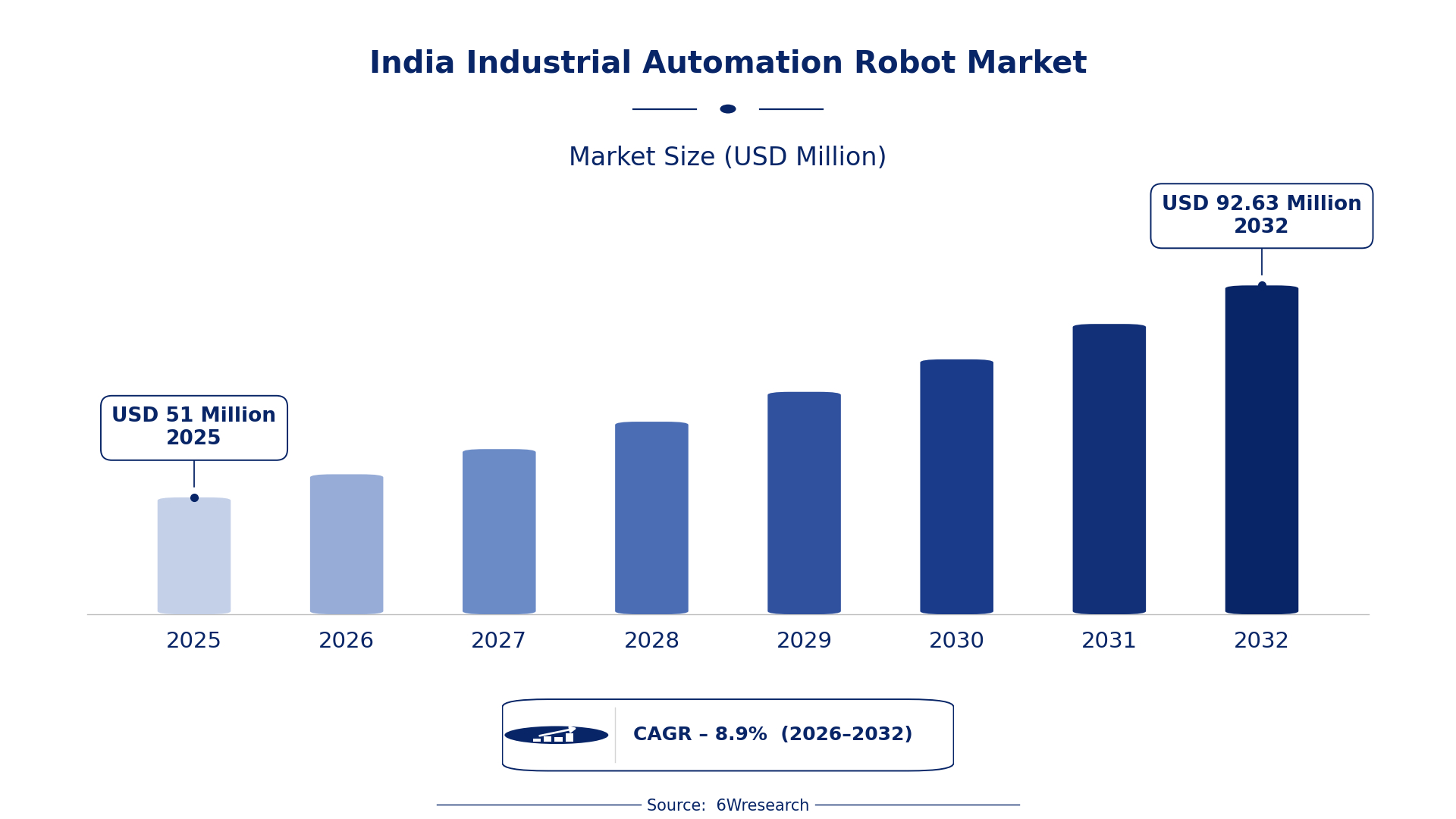
According to 6Wresearch internal database and industry insights, the India Industrial Automation Robot Market was valued at USD 51.0 million in 2025 and is projected to reach USD 92.63 million by 2032, growing at a CAGR of approximately 8.9% during 2026–2032.
India Industrial Automation Robot Market Highlights
| Report Metric | Details |
| Report Name | India Industrial Automation Robot Market |
| Market Size 2025 | USD 51.0 million |
| Market Size 2032 | USD 92.63 million |
| Absolute Growth 2025–2032 | USD 41.63 million |
| CAGR 2026–2032 | 8.9% |
| Peak Annual Growth | 11.2% in 2030 |
| Forecast Period | 2026–2032 |
| Historical Data | 2022–2025 |
| Base Year | 2025 |
| Leading Robot Type, 2025 | Articulated Robots (48% share) |
| Leading Axis Configuration, 2025 | 6-Axis (39% share) |
| Leading Application Area, 2025 | Welding (31% share) |
| Leading End User, 2025 | Automotive Industry (45% share) |
| Fastest-Growing Robot Type | Delta Robots (10.3% CAGR) |
| Fastest-Growing Application Area | High-Speed Sorting (11.4% CAGR) |
| Fastest-Growing End User | Electronics Assembly (10.1% CAGR) |
| Growing Sector | Automotive Industry |
| Key End Users | Automotive Industry, Electronics Assembly, Food & Pharma Plants, Custom Machinery OEMs |
India Industrial Automation Robot Market Year-wise Growth Rate and Key Drivers (2022–2032)
This graph illustrates the annual growth rates of the market from 2022 to 2032, highlighting a steady upward trajectory and projected market expansion over the forecast period.
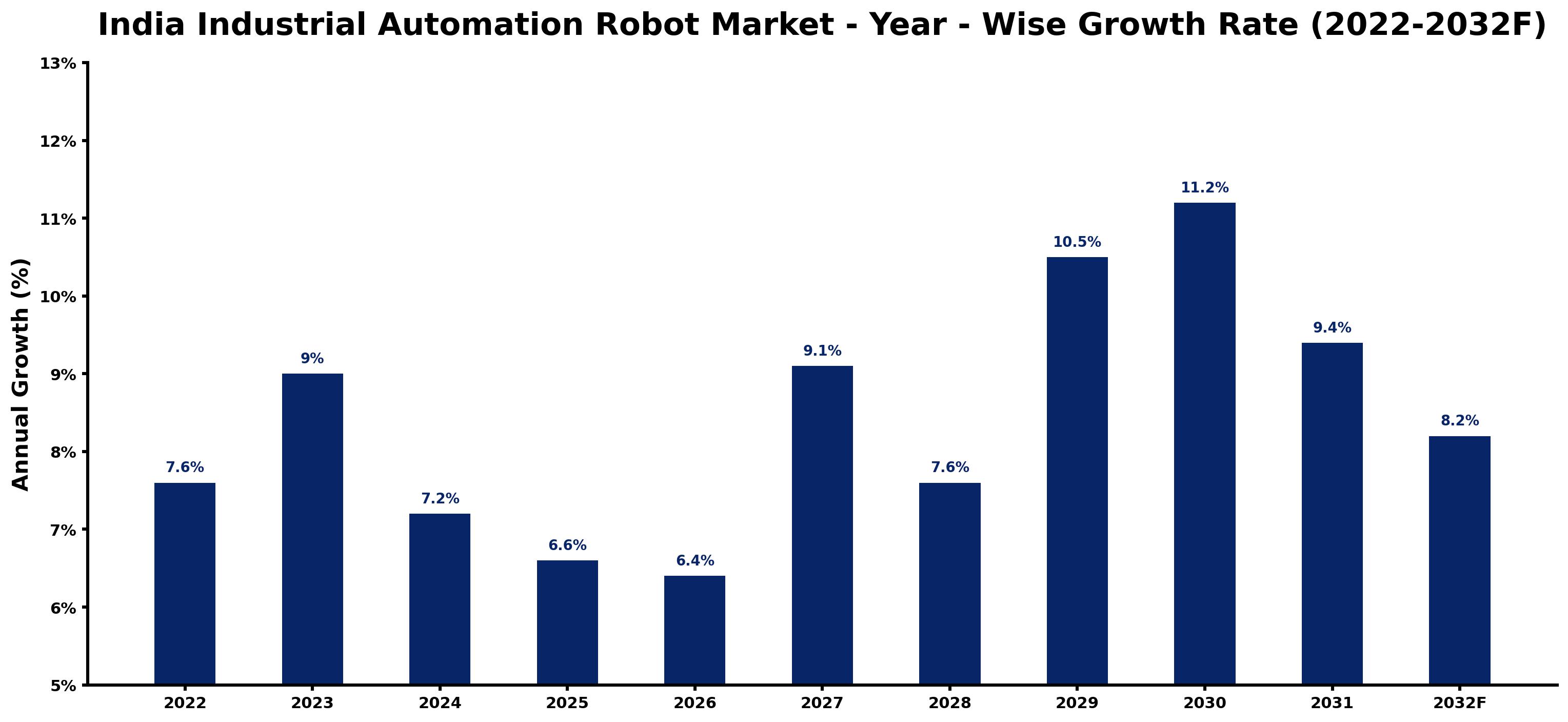
Annual growth estimates for each year appear below with the principal reason behind them, explaining the shifts that set the pace of the market.
| Year | Estimated Annual Growth (%) | Market Rationale |
| 2022 | 7.6 | The market showed steady activity, reflecting ongoing investments in automation technologies. |
| 2023 | 9.0 | Demand surged due to increased automation adoption in the electronics sector, driven by government initiatives. |
| 2024 | 7.2 | The pace slowed as companies adjusted to the previous year's rapid expansion in automation. |
| 2025 | 6.6 | Growth continued but at a reduced rate as the National Policy on Robotics began to take effect. |
| 2026 | 6.4 | A further slowdown occurred as firms focused on optimising existing automation systems and technologies. |
| 2027 | 9.1 | Demand rebounded as manufacturers sought to enhance productivity through robotics and automation. |
| 2028 | 7.6 | Growth decelerated again as market conditions normalised after the previous surge in investments. |
| 2029 | 10.5 | A resurgence in demand was noted, particularly from the automotive sector, which drives automation. |
| 2030 | 11.2 | The market peaked with significant investments in advanced robotics technologies, particularly in manufacturing. |
| 2031 | 9.4 | Growth moderated as the market adjusted to the high levels of previous years and stabilised. |
| 2032 | 8.2 | A slight slowdown occurred as the market stabilised after reaching its peak, reflecting maturity. |
Note: Market size estimations and growth projections presented in this report are based on 6Wresearch's proprietary forecasting methodology, utilizing the latest available industry data, government publications, and primary research inputs.
India Industrial Automation Robot Market Synopsis
The India Industrial Automation Robot Market includes advanced machines that automate manufacturing processes, improving production efficiency and precision. Valued at approximately 1.5 billion USD in 2022, the market sees strong demand from the automotive industry, which represents about 30% of total demand. The Electronics and Electrical Equipment sector is expected to increase automation adoption by 10% in 2023. The National Policy on Robotics 2022 further fuels this growth by offering funding and support for robotics technology in manufacturing, promoting innovation and accessibility.
Market Dynamics Impact Analysis (2026–2032)
| Factor | Type | Impact | Primary Segment Affected |
| Increased adoption of automation technologies in manufacturing processes. | Driver | High | Welding |
| Growing demand for precision in manufacturing tasks. | Driver | High | Electronics Assembly |
| Investment in robotics technology by small and medium enterprises. | Opportunity | High | Food & Pharma Plants |
| Expansion of manufacturing facilities in key regions like Maharashtra. | Opportunity | Medium | Automotive Industry |
| High initial investment costs for automation technologies. | Restraint | High | SCARA Robots |
| Limited availability of skilled workforce for operating advanced robots. | Restraint | Medium | Delta Robots |
| Delays in regulatory approvals for new robotics technologies. | Challenge | High | Articulated Robots |
| Supply chain disruptions affecting the availability of components. | Challenge | Medium | Cartesian Robots |
Evaluation of Drivers in India Industrial Automation Robot Market (2026–2032)
The main growth drivers and the segments they affect most are set out below.
| Drivers | Primary Segment Affected | Why It Matters (Evidence) |
| Rising demand for automation in the automotive sector. | Welding | This sector accounts for about 30% of total demand, driving purchases of industrial robots. |
| Increased focus on precision in electronics manufacturing. | Electronics Assembly | The sector is projected to grow by 10% in automation adoption, leading to higher robot sales. |
| Investment in robotics by small and medium enterprises. | Food & Pharma Plants | With a budget of 1 billion INR for automation technologies, more SMEs are adopting robots. |
| Expansion of manufacturing hubs in Maharashtra. | Automotive Industry | This region hosts numerous manufacturing facilities, increasing the demand for industrial robots. |
| Support from government initiatives like the National Policy on Robotics 2022. | SCARA Robots | Funding and support for robotics technology encourage the adoption of automation solutions. |
Growth in the Industrial Automation Robot market in India comes from substantial end-use demand, particularly in the automotive sector, which drives about 30% of total demand. The Electronics and Electrical Equipment sector is projected to increase automation adoption by 10% in 2023, prompting manufacturers to invest in robotics. Investment in robotics by SMEs is expected to boost market growth significantly.
Evaluation of Restraints in India Industrial Automation Robot Market
The table below lists the restraints and the evidence behind each.
| Market Restraint | Primary Segment Affected | Why It Matters (Evidence) |
| High initial investment costs for industrial robots. | SCARA Robots | These costs can deter smaller manufacturers from adopting automation solutions, limiting market growth. |
| Limited availability of skilled workforce for operating advanced robots. | Delta Robots | A shortage of trained personnel can hinder effective implementation and use of automation technologies. |
| Delays in regulatory approvals for new robotics technologies. | Articulated Robots | Such delays can slow down the introduction of new products, affecting manufacturers' competitiveness. |
| Supply chain disruptions affecting the availability of components. | Cartesian Robots | These disruptions can lead to longer lead times and increased costs for manufacturers, impacting operations. |
| Concerns over the reliability and safety of automation technologies. | Welding | Manufacturers may hesitate to invest in automation due to fears of operational risks and liabilities. |
India Industrial Automation Robot Market Challenges
India's industrial automation robot market encounters a technology gap, as many manufacturers struggle to access advanced robotics, hindering production efficiency. Regulatory challenges arise from stringent guidelines set by the Bureau of Indian Standards, which prolong the approval process for new robots and cost buyers valuable time in a fast-paced environment. Supply chain issues stem from reliance on imported components, raising costs for producers by about 15%. High initial investment costs deter many small manufacturers from embracing automation, limiting their growth potential and competitiveness in the market.
Trends in the India Industrial Automation Robot Market
Below mentioned are some of the trends shaping the India Industrial Automation Robot Market growth.
- Shift towards Advanced Robotics in Manufacturing: India is increasingly adopting advanced robotics technologies to enhance manufacturing efficiency. The National Policy on Robotics 2022 supports this transition with funding, aiming to boost productivity across sectors. In 2023, the government allocated 500 million INR for robotics development.
- Growth of Automation in Food Processing: Food processing plants in India are adopting automation to elevate safety standards and efficiency. The Food Safety and Standards Authority of India is promoting this trend, resulting in heightened demand for industrial robots. The sector is poised for substantial growth in the coming years.
- Rise of High-Speed Sorting Applications: High-speed sorting applications are becoming popular in logistics and packaging industries. With a CAGR of 11.4% projected for this segment, manufacturers are investing in advanced robotics to enhance operational efficiency and accuracy.
- Increased Focus on Electronics Assembly Automation: The electronics assembly sector is prioritising automation to address rising production demands. With a projected growth rate of 10.1% for this segment, manufacturers are increasingly investing in robotics to boost precision and efficiency.
Investment Opportunities in the India Industrial Automation Robot Market
Some of the investment opportunities in the India Industrial Automation Robot Market are mentioned below.
- Ideal Timing for Robotics Investment: Now presents a prime opportunity to invest in industrial automation robots, as the market is expected to grow substantially. The government has allocated 500 million INR for robotics technology development, creating avenues for suppliers.
- Supply of Advanced Robotics Solutions: A strong demand exists for advanced robotics solutions in the automotive industry, which constitutes 30% of total demand. Entering this market through partnerships with local manufacturers can provide access to key buyers.
- Addressing the Skilled Workforce Gap: With a target of training 1 million youth by 2025 under the Skill India Mission, there is a notable gap in the skilled workforce for automation. Investing in training programmes can help bridge this gap and meet market demand.
- Utilising Government Schemes for Growth: Leveraging government schemes like the Production Linked Incentive Scheme can offer financial support for manufacturers adopting automation technologies. This initiative aims to boost local manufacturing and automation, creating growth opportunities.
Government Initiatives in the India Industrial Automation Robot Market
The National Policy on Robotics 2022 impacts buyers by providing funding and support for robotics technology in manufacturing. This policy aims to improve the capabilities of Indian manufacturers, facilitating the adoption of advanced automation solutions. By encouraging investment in robotics, it seeks to enhance efficiency and productivity across various sectors. The government allocated 500 million INR to support this initiative, benefiting small and medium enterprises adopting automation technologies. This funding alleviates the financial burden on manufacturers and promotes the growth of the robotics sector.
The Department of Heavy Industry administers the National Robotics Mission, which promotes research and development in robotics. With a budget of 200 million INR, this mission supports projects aimed at advancing robotics technology. The Ministry of Micro, Small and Medium Enterprises (MSME) has initiated a subsidy programme for MSMEs adopting automation technologies, with a budget of 1 billion INR. These initiatives strengthen the capabilities of small manufacturers, enabling them to compete effectively in the market.
Future Insight of the India Industrial Automation Robot Market
The industrial automation robot market in India will evolve by 2032, influenced by several key factors. The National Policy on Robotics 2022 aims to promote technology adoption by providing critical funding and support across various sectors. The government has allocated 500 million INR for developing robotics technology in small and medium enterprises, encouraging innovation and accessibility. Additionally, the Robotics and Automation Society of India will promote research and development, benefiting both buyers and suppliers in the changing market.
Market Segmentation Analysis
The analysis below covers each segmentation, its leading category in 2025 and its fastest-growing category through 2032.
By Robot Type – Articulated Robots Dominated, Delta Robots Expected to Grow Fastest
According to Sachin Kumar Rai, Senior Research Analyst at 6Wresearch, in 2025, Articulated Robots led the robot type split with a 48% share. Articulated Robots lead the market due to their capability to perform intricate manufacturing tasks, particularly in the automotive sector which relies heavily on their versatility. Their widespread use across various applications solidifies their strong market share in India. Over 2026–2032, Delta Robots are expected to post the fastest growth, at a CAGR of 10.3%. Delta Robots are growing rapidly as they are specifically designed for high-speed sorting and packaging, which are increasingly essential in modern manufacturing. Their efficiency in these tasks is driving adoption, particularly in sectors prioritising speed and accuracy. Suppliers should prioritise the development of Delta Robots to cater to the increasing demand in sorting and packaging applications.
By Axis Configuration – 6-Axis Dominated and Is Expected to Record the Fastest Growth
6-Axis took a 39% share of axis configuration in 2025, more than any other category. The 6-Axis configuration holds the largest market share due to its versatility in handling a variety of manufacturing tasks. Its widespread adoption in sectors like automotive, which accounts for 30% of total demand, reinforces its strong presence in the market. Its lead should widen, with a projected CAGR of 10.5% during 2026–2032, the highest in this split. The 6-Axis configuration is also the fastest growing segment, driven by increasing automation adoption in the Electronics and Electrical Equipment sector, which is expected to grow by 10% in 2023. This consistent demand will further widen its lead as manufacturers seek adaptable solutions for complex applications. Suppliers should focus on promoting 6-Axis robots, as their versatility aligns with the growing needs of manufacturers looking to enhance efficiency and productivity.
By Application Area – Welding Dominated, High-Speed Sorting Expected to Grow Fastest
Welding accounted for a 31% market share by application area in 2025. Welding applications lead the market, primarily due to their extensive use in the automotive and manufacturing sectors, where precision and reliability are critical. The established demand for welding robots ensures a substantial market share in this area. High-Speed Sorting is set to record the highest CAGR in this split, 11.4% over 2026–2032. High-Speed Sorting is the fastest growing application area, driven by the increasing need for efficiency in logistics and packaging industries. The rise in e-commerce and demand for quick turnaround times is propelling this segment's growth. Suppliers should consider expanding their offerings in high-speed sorting robots to capture emerging opportunities in logistics.
By End User – Automotive Industry Dominated, Electronics Assembly Expected to Grow Fastest
The largest end user category in 2025 was Automotive Industry, with a 45% share of total revenue. The Automotive Industry is the primary end user of industrial robots, extensively employing them on assembly lines to boost productivity and precision. This sector's substantial demand for robotics solutions ensures a commanding market share for automation technologies. Electronics Assembly is projected to grow fastest, at a CAGR of 10.1% during 2026–2032. Electronics Assembly is the fastest growing end user, driven by the need for high precision in assembly tasks, which is increasing the demand for advanced robotics. The rise in electronic device production is further propelling this growth. Suppliers should focus on robotics solutions tailored for electronics assembly to capitalise on this rapidly expanding market.
Key Attractiveness of the Report
- 10 Years of Market Numbers
- Historical Data Starting from 2022 to 2025
- Base Year 2025
- Forecast Data until 2032
- Key Performance Indicators Impacting the Market
- Major Upcoming Developments and Projects
Key Highlights of the Report:
- India Industrial Automation Robot Market Outlook
- Market Size of India Industrial Automation Robot Market, 2025
- Forecast of India Industrial Automation Robot Market, 2032
- Historical Data and Forecast of India Industrial Automation Robot Revenues & Volume for the Period 2022 - 2032F
- India Industrial Automation Robot Market Trend Evolution
- India Industrial Automation Robot Market Drivers and Challenges
- India Industrial Automation Robot Price Trends
- India Industrial Automation Robot Porter's Five Forces
- India Industrial Automation Robot Industry Life Cycle
- Historical Data and Forecast of India Industrial Automation Robot Market Revenues & Volume By Robot Type for the Period 2022 - 2032F
- Historical Data and Forecast of India Industrial Automation Robot Market Revenues & Volume By Articulated Robots for the Period 2022 - 2032F
- Historical Data and Forecast of India Industrial Automation Robot Market Revenues & Volume By SCARA Robots for the Period 2022 - 2032F
- Historical Data and Forecast of India Industrial Automation Robot Market Revenues & Volume By Delta Robots for the Period 2022 - 2032F
- Historical Data and Forecast of India Industrial Automation Robot Market Revenues & Volume By Cartesian Robots for the Period 2022 - 2032F
- Historical Data and Forecast of India Industrial Automation Robot Market Revenues & Volume By Axis Configuration for the Period 2022 - 2032F
- Historical Data and Forecast of India Industrial Automation Robot Market Revenues & Volume By 6-Axis for the Period 2022 - 2032F
- Historical Data and Forecast of India Industrial Automation Robot Market Revenues & Volume By 4-Axis for the Period 2022 - 2032F
- Historical Data and Forecast of India Industrial Automation Robot Market Revenues & Volume By Parallel-Arm for the Period 2022 - 2032F
- Historical Data and Forecast of India Industrial Automation Robot Market Revenues & Volume By Linear Movement for the Period 2022 - 2032F
- Historical Data and Forecast of India Industrial Automation Robot Market Revenues & Volume By Application Area for the Period 2022 - 2032F
- Historical Data and Forecast of India Industrial Automation Robot Market Revenues & Volume By Welding, Assembly for the Period 2022 - 2032F
- Historical Data and Forecast of India Industrial Automation Robot Market Revenues & Volume By Pick & Place for the Period 2022 - 2032F
- Historical Data and Forecast of India Industrial Automation Robot Market Revenues & Volume By High-Speed Sorting for the Period 2022 - 2032F
- Historical Data and Forecast of India Industrial Automation Robot Market Revenues & Volume By 3D Printing & Packaging for the Period 2022 - 2032F
- Historical Data and Forecast of India Industrial Automation Robot Market Revenues & Volume By End User for the Period 2022 - 2032F
- Historical Data and Forecast of India Industrial Automation Robot Market Revenues & Volume By Automotive Industry for the Period 2022 - 2032F
- Historical Data and Forecast of India Industrial Automation Robot Market Revenues & Volume By Electronics Assembly for the Period 2022 - 2032F
- Historical Data and Forecast of India Industrial Automation Robot Market Revenues & Volume By Food & Pharma Plants for the Period 2022 - 2032F
- Historical Data and Forecast of India Industrial Automation Robot Market Revenues & Volume By Custom Machinery OEMs for the Period 2022 - 2032F
- India Industrial Automation Robot Import Export Trade Statistics
- Market Opportunity Assessment By Robot Type
- Market Opportunity Assessment By Axis Configuration
- Market Opportunity Assessment By Application Area
- Market Opportunity Assessment By End User
- India Industrial Automation Robot Top Companies Market Share
- India Industrial Automation Robot Competitive Benchmarking By Technical and Operational Parameters
- India Industrial Automation Robot Company Profiles
- India Industrial Automation Robot Key Strategic Recommendations
Market Covered
Segments analysed in this report are listed below.
By Robot Type
- Articulated Robots
- SCARA Robots
- Delta Robots
- Cartesian Robots
By Axis Configuration
- 6-Axis
- 4-Axis
- Parallel-Arm
- Linear Movement
By Application Area
- Welding
- Assembly
- Pick & Place
- High-Speed Sorting
- 3D Printing & Packaging
By End User
- Automotive Industry
- Electronics Assembly
- Food & Pharma Plants
- Custom Machinery OEMs































