China Industrial Automation Robot Market Size & Growth Rate
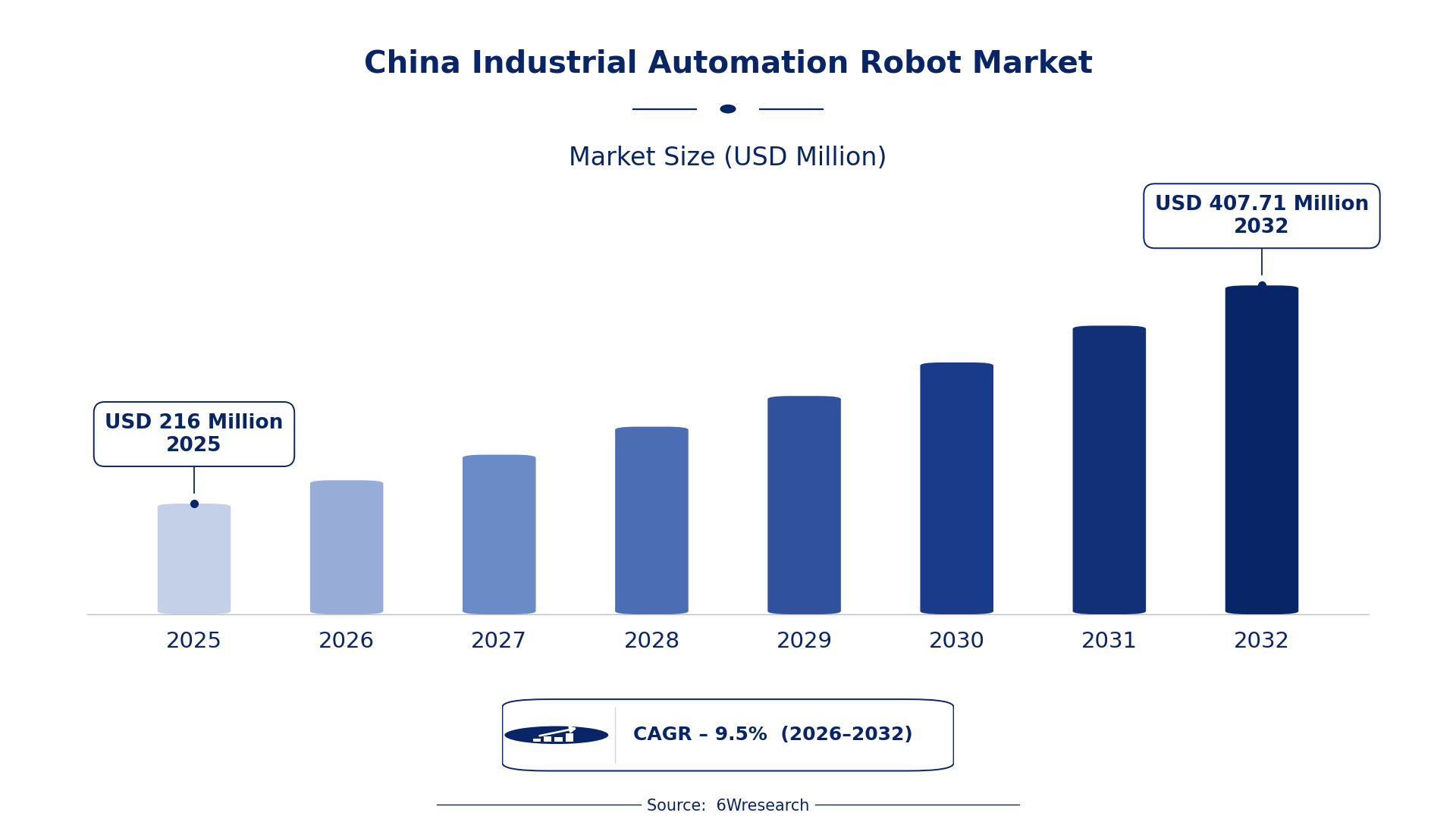
According to 6Wresearch internal database and industry insights, the China Industrial Automation Robot Market was valued at USD 216.0 million in 2025 and is projected to reach USD 407.71 million by 2032, growing at a CAGR of approximately 9.5% during 2026–2032.
China Industrial Automation Robot Market Highlights
| Report Metric | Details |
| Report Name | China Industrial Automation Robot Market |
| Market Size 2025 | USD 216.0 million |
| Market Size 2032 | USD 407.71 million |
| Absolute Growth 2025–2032 | USD 191.71 million |
| CAGR 2026–2032 | 9.5% |
| Peak Annual Growth | 11.6% in 2026 |
| Forecast Period | 2026–2032 |
| Historical Data | 2022–2025 |
| Base Year | 2025 |
| Leading Robot Type, 2025 | Articulated Robots (49% share) |
| Leading Axis Configuration, 2025 | 6-Axis (50% share) |
| Leading Application Area, 2025 | Welding (40% share) |
| Leading End User, 2025 | Automotive Industry (41% share) |
| Fastest-Growing Robot Type | Delta Robots (11.9% CAGR) |
| Fastest-Growing Application Area | High-Speed Sorting (11.2% CAGR) |
| Fastest-Growing End User | Electronics Assembly (11.6% CAGR) |
| Growing Sector | Automotive Industry |
| Key End Users | Automotive Industry, Electronics Assembly, Food & Pharma Plants, SMEs |
China Industrial Automation Robot Market Year-wise Growth Rate and Key Drivers (2022–2032)
This graph illustrates the annual growth rates of the market from 2022 to 2032, highlighting a steady upward trajectory and projected market expansion over the forecast period.
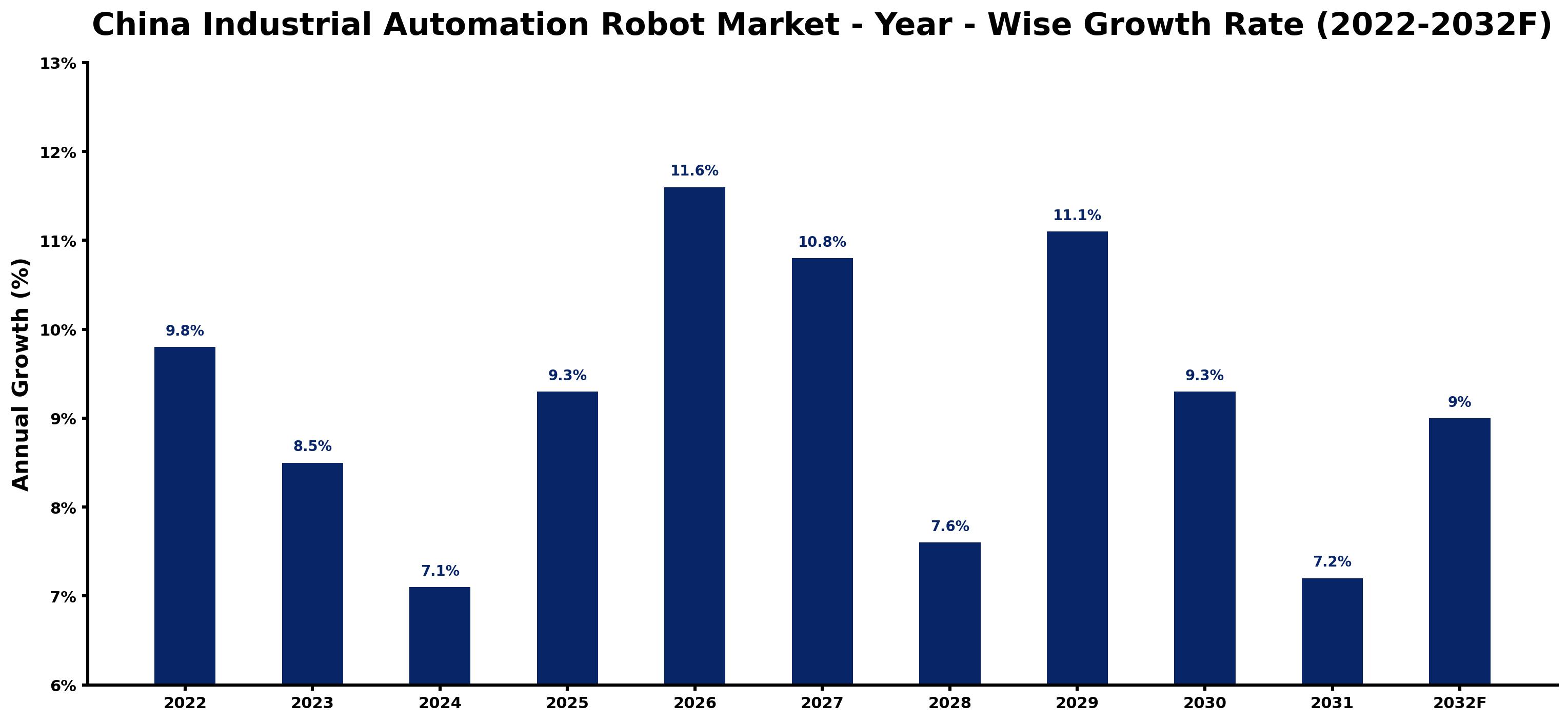
Year by year, the estimates below pair each growth rate with the development that shaped it.
| Year | Estimated Annual Growth (%) | Market Rationale |
| 2022 | 9.8 | The market experienced strong growth due to high demand from the automotive industry, which accounted for 35% of total demand. |
| 2023 | 8.5 | Demand growth slowed as companies adjusted to supply chain challenges, particularly in the automotive sector. |
| 2024 | 7.1 | Investment in automation technologies continued, but growth rates slowed as companies focused on efficiency improvements. |
| 2025 | 9.3 | A resurgence in automotive production led to increased demand for industrial robots, particularly in Guangdong. |
| 2026 | 11.6 | The market is expected to peak as the 'Smart Manufacturing 2025' initiative drives automation across sectors. |
| 2027 | 10.8 | Growth is projected to slow as the market begins to stabilise after reaching peak levels in 2026. |
| 2028 | 7.6 | A slowdown in growth rates is anticipated as companies focus on optimising existing automation technologies. |
| 2029 | 11.1 | Demand is expected to accelerate again as new technologies and applications emerge in the electronics assembly sector. |
| 2030 | 9.3 | Growth rates are projected to moderate as the market adjusts to advancements in robotics technology. |
| 2031 | 7.2 | The market will continue to grow, albeit at a slower pace, reflecting maturity in automation adoption across industries. |
| 2032 | 9.0 | A resurgence in demand is expected as industries seek to improve productivity further, particularly in food and pharma. |
Note: Market size estimations and growth projections presented in this report are based on 6Wresearch's proprietary forecasting methodology, utilizing the latest available industry data, government publications, and primary research inputs.
China Industrial Automation Robot Market Synopsis
The China Industrial Automation Robot Market includes advanced machines designed to automate repetitive tasks across various industries. These robots boost productivity, improve quality, and lower labor costs in manufacturing processes. The market is expanding due to robust domestic demand, particularly from the automotive sector, alongside increased investments highlighted by the 'Smart Manufacturing 2025' initiative launched in 2023. With a population of around 1.4 billion, the push for automation is intensifying, leading to further investments in robotics technology.
Market Dynamics Impact Analysis (2026–2032)
| Factor | Type | Impact | Primary Segment Affected |
| Growing demand from the automotive industry drives the need for automation solutions. | Driver | High | Automotive Industry |
| The rise of electronics assembly demands precision and efficiency in manufacturing processes. | Driver | High | Electronics Assembly |
| The Guangdong province is rapidly expanding its industrial robot manufacturing capabilities. | Opportunity | High | Articulated Robots |
| The food and pharmaceutical industries are increasingly adopting automation technologies for packaging. | Opportunity | Medium | Food & Pharma Plants |
| High initial investment costs can deter smaller companies from adopting automation. | Restraint | High | Articulated Robots |
| Limited availability of skilled workforce affects the implementation of automation solutions. | Restraint | Medium | Articulated Robots |
| Buyers face challenges in integrating new technologies with existing systems. | Challenge | High | Articulated Robots |
| Suppliers encounter delays in production due to supply chain disruptions. | Challenge | Medium | Articulated Robots |
Evaluation of Drivers in China Industrial Automation Robot Market (2026–2032)
Key forces behind demand, with the segment each one moves most, are listed below.
| Drivers | Primary Segment Affected | Why It Matters (Evidence) |
| Increased production capacity in the automotive sector boosts demand for industrial robots. | Automotive Industry | In 2022, the automotive industry accounted for 35% of total industrial robot demand. |
| Growing electronics assembly requires advanced automation for efficiency and precision. | Electronics Assembly | The electronics assembly sector is expected to see a 15% increase in robot adoption by 2025. |
| The 'Smart Manufacturing 2025' initiative promotes automation across various sectors. | Articulated Robots | Launched in 2023, this initiative aims to improve manufacturing capabilities and efficiency. |
| Rising investments in the Guangdong province drive local robot production. | Articulated Robots | In 2023, Guangdong saw significant investments in automation technologies, enhancing local production capabilities. |
| The food and pharmaceutical sectors are increasingly adopting robots for hygiene-sensitive applications. | Food & Pharma Plants | These industries are focusing on automation to improve processing efficiency and compliance with safety standards. |
Expansion of the Industrial Automation Robot market in China is backed by increasing production capacity in the automotive sector, which accounted for 35% of total industrial robot demand in 2022. The electronics assembly sector is projected to see a 15% increase in robot adoption by 2025, driven by the need for precision. In 2023, significant investments in Guangdong are enhancing local production capabilities. The food and pharmaceutical sectors are adopting robots to improve efficiency in hygiene-sensitive applications, reflecting a broader trend towards automation across diverse industries.
Evaluation of Restraints in China Industrial Automation Robot Market
The main factors holding the market back are set out below.
| Market Restraint | Primary Segment Affected | Why It Matters (Evidence) |
| High initial investment costs can deter smaller companies from automation. | Articulated Robots | Many SMEs struggle to afford the upfront costs associated with industrial robots, limiting their adoption. |
| Limited availability of skilled workforce affects the implementation of automation solutions. | Articulated Robots | A shortage of skilled workers hampers the effective deployment of robotics, delaying projects. |
| Integration challenges with existing systems can slow down automation adoption. | Articulated Robots | Buyers face difficulties in aligning new technologies with legacy systems, complicating implementation. |
| Supply chain disruptions lead to delays in robot production and delivery. | Articulated Robots | Current global supply chain issues affect the availability of critical components, impacting timelines. |
| Regulatory compliance can complicate the adoption of new automation technologies. | Articulated Robots | Manufacturers must navigate complex regulations that govern robot safety and use, increasing costs. |
China Industrial Automation Robot Market Challenges
Buyers and suppliers in the China Industrial Automation Robot Market encounter regulatory challenges, as compliance with national standard GB/T 19000 can postpone product launches by up to six months, restricting producers' ability to meet orders. Rising costs present another issue; manufacturers in the automotive sector may face a 10% increase in robot prices due to material shortages, impacting their profit margins. Skills shortages impede progress, with a lack of trained technicians causing project delays of up to three months for producers, diminishing operational efficiency. Rapid technological advancements require substantial R&D investments, with the government allocating $1 billion in 2023, which can strain smaller firms financially.
Trends in the China Industrial Automation Robot Market
The trends below show where the China Industrial Automation Robot Market is heading.
- Shift from Traditional to Smart Automation: Since 2023, the automotive industry has increasingly adopted smart automation technologies, improving production efficiency. This trend is evidenced by a 20% growth in industrial robot sales reported in 2022.
- Increased Adoption of Robotics in Food Processing: In 2022, food and pharmaceutical industries began embracing automation for packaging and processing tasks. This shift is driven by a growing need for efficiency, with substantial investments in robotics technology.
- Rise of High-Speed Sorting Robots: In 2026, high-speed sorting robots gained traction in logistics and distribution centres. This change is important for improving operational efficiency, with a projected growth rate of 11.2% in this application area.
- Expansion of Robotics in Electronics Assembly: By 2025, the electronics assembly sector is projected to see a 15% increase in robot adoption. This trend reflects a growing demand for precision and efficiency in manufacturing processes.
Investment Opportunities in the China Industrial Automation Robot Market
Several openings in the China Industrial Automation Robot Market merit attention from investors.
- Timing for Investment in Automation: With the government allocating $1 billion in 2023 to support robotics innovation, there is an opportunity for investment in automation technologies. This funding aims to improve the capabilities of small and medium enterprises.
- Growing Demand from the Food Industry: The food and pharmaceutical sectors are increasingly adopting automation technologies, creating a demand for robotic solutions. This trend is particularly strong in hygiene-sensitive environments, offering opportunities for suppliers.
- Investment in Guangdong's Manufacturing Hub: Guangdong province is a key area for industrial robot manufacturing and usage, with substantial investments expected. Suppliers can enter this market by partnering with local manufacturers.
- Need for Automation in Electronics Assembly: The electronics assembly sector presents a growing opportunity, with a projected 15% increase in robot adoption by 2025. Suppliers should focus on providing precision automation solutions to meet this demand.
Government Initiatives in the China Industrial Automation Robot Market
The 'Robotics Industry Development Plan' launched by the Ministry of Industry and Information Technology in 2022 aims to increase production capacity by 30% by 2025. This initiative encourages manufacturers to invest in advanced technologies and improve their production capabilities. The '14th Five-Year Plan for Intelligent Manufacturing' approved by the National Development and Reform Commission in 2021 focuses on automation in key industries, promoting the integration of robotics into manufacturing processes. These policies are essential for driving growth in the industrial automation sector.
In 2023, the Ministry of Finance announced a $500 million subsidy program for SMEs to adopt industrial automation technologies. This program aims to ease the financial burden on smaller companies looking to invest in robotics. The 'Robot Innovation Fund', established by the Ministry of Industry and Information Technology in 2021, supports research and development in robotics with a budget of $100 million. These initiatives are vital for improving the competitiveness of the robotics industry in China.
Future Insight of the China Industrial Automation Robot Market
The China Industrial Automation Robot Market is set to evolve significantly by 2032, driven by initiatives like 'Smart Manufacturing 2025' and increased government support for robotics innovation. The electronics assembly sector is projected to see a 15% increase in robot adoption by 2025, indicating a shift towards greater automation. Subsidies for small and medium enterprises will facilitate broader integration of automation technologies across industries. As manufacturing hubs such as Guangdong advance, suppliers will need to comply with new safety standards like ISO 10218 to maintain competitiveness.
Market Segmentation Analysis
The report offers a comprehensive study of the following market segments and their leading categories in the market.
By Robot Type – Articulated Robots Dominated, Delta Robots Expected to Grow Fastest
According to Sachin Kumar Rai, Senior Research Analyst at 6Wresearch, Articulated Robots held a 49% share of the China Industrial Automation Robot Market by robot type in 2025. Articulated robots hold the largest market share because they are crucial for complex tasks across various industries, particularly in automotive manufacturing where flexibility is essential. Their widespread use in the Guangdong province, a significant hub for industrial automation, highlights their dominance in the market. The quickest growth will come from Delta Robots, forecast to expand at a CAGR of 11.9% between 2026 and 2032. Delta robots are experiencing rapid growth due to their efficiency in high-speed sorting and packaging tasks, especially within the electronics sector. The anticipated 15% increase in robot adoption in this area by 2025 indicates a rising demand for these advanced solutions. Suppliers should enhance delta robots' capabilities to meet the growing needs of the packaging and sorting sectors.
By Axis Configuration – 6-Axis Dominated and Is Expected to Record the Fastest Growth
6-Axis accounted for a 50% market share by axis configuration in 2025. The 6-axis configuration commands the largest market share due to its versatility, enabling it to serve a wide range of applications in various manufacturing processes. This adaptability makes it the preferred choice for many industries, ensuring its continued market dominance. 6-Axis is also forecast to expand faster than any other category, at a CAGR of 11.2% over 2026–2032. As the leader, the 6-axis configuration is also the fastest-growing segment, with its versatility attracting new applications in automation. This trend suggests that its market share will likely expand further as industries seek more adaptable solutions. Suppliers must invest in developing advanced 6-axis robots to maintain a competitive edge in a rapidly changing market.
By Application Area – Welding Dominated, High-Speed Sorting Expected to Grow Fastest
The largest application area category in 2025 was Welding, with a 40% share of total revenue. Welding applications dominate the market share, primarily due to their critical role in the automotive and metal fabrication industries where precision and reliability are essential. The established demand in these sectors ensures that welding remains a pivotal area for industrial automation. High-Speed Sorting is projected to grow fastest, at a CAGR of 11.2% during 2026–2032. High-speed sorting is the fastest-growing application area, driven by the increasing need for efficiency in distribution centres. The surge in e-commerce and logistics operations is significantly propelling this segment's growth. Suppliers should prioritise innovations in high-speed sorting technologies to capitalise on the expanding logistics and distribution market.
By End User – Automotive Industry Dominated, Electronics Assembly Expected to Grow Fastest
In 2025, Automotive Industry led the end user split with a 41% share. The automotive industry leads the market share as the dominant sector for automation technologies, accounting for 35% of total demand for industrial robots. This strong reliance on automation for manufacturing processes solidifies its position as the primary end user. Electronics Assembly is set to record the highest CAGR in this split, 11.6% over 2026–2032. Electronics assembly is the fastest-growing end user, with a notable increase in demand for precision and efficiency in production lines. This growth is indicative of the sector's ongoing transformation towards more automated solutions. Suppliers should focus on tailoring their offerings to meet the specific needs of the electronics assembly sector to capture emerging opportunities.
Key Attractiveness of the Report
- 10 Years of Market Numbers
- Historical Data Starting from 2022 to 2025
- Base Year 2025
- Forecast Data until 2032
- Key Performance Indicators Impacting the Market
- Major Upcoming Developments and Projects
Key Highlights of the Report:
- China Industrial Automation Robot Market Outlook
- Market Size of China Industrial Automation Robot Market, 2025
- Forecast of China Industrial Automation Robot Market, 2032
- Historical Data and Forecast of China Industrial Automation Robot Revenues & Volume for the Period 2022 - 2032F
- China Industrial Automation Robot Market Trend Evolution
- China Industrial Automation Robot Market Drivers and Challenges
- China Industrial Automation Robot Price Trends
- China Industrial Automation Robot Porter's Five Forces
- China Industrial Automation Robot Industry Life Cycle
- Historical Data and Forecast of China Industrial Automation Robot Market Revenues & Volume By Robot Type for the Period 2022 - 2032F
- Historical Data and Forecast of China Industrial Automation Robot Market Revenues & Volume By Articulated Robots for the Period 2022 - 2032F
- Historical Data and Forecast of China Industrial Automation Robot Market Revenues & Volume By SCARA Robots for the Period 2022 - 2032F
- Historical Data and Forecast of China Industrial Automation Robot Market Revenues & Volume By Delta Robots for the Period 2022 - 2032F
- Historical Data and Forecast of China Industrial Automation Robot Market Revenues & Volume By Cartesian Robots for the Period 2022 - 2032F
- Historical Data and Forecast of China Industrial Automation Robot Market Revenues & Volume By Axis Configuration for the Period 2022 - 2032F
- Historical Data and Forecast of China Industrial Automation Robot Market Revenues & Volume By 6-Axis for the Period 2022 - 2032F
- Historical Data and Forecast of China Industrial Automation Robot Market Revenues & Volume By 4-Axis for the Period 2022 - 2032F
- Historical Data and Forecast of China Industrial Automation Robot Market Revenues & Volume By Parallel-Arm for the Period 2022 - 2032F
- Historical Data and Forecast of China Industrial Automation Robot Market Revenues & Volume By Linear Movement for the Period 2022 - 2032F
- Historical Data and Forecast of China Industrial Automation Robot Market Revenues & Volume By Application Area for the Period 2022 - 2032F
- Historical Data and Forecast of China Industrial Automation Robot Market Revenues & Volume By Welding, Assembly for the Period 2022 - 2032F
- Historical Data and Forecast of China Industrial Automation Robot Market Revenues & Volume By Pick & Place for the Period 2022 - 2032F
- Historical Data and Forecast of China Industrial Automation Robot Market Revenues & Volume By High-Speed Sorting for the Period 2022 - 2032F
- Historical Data and Forecast of China Industrial Automation Robot Market Revenues & Volume By 3D Printing & Packaging for the Period 2022 - 2032F
- Historical Data and Forecast of China Industrial Automation Robot Market Revenues & Volume By End User for the Period 2022 - 2032F
- Historical Data and Forecast of China Industrial Automation Robot Market Revenues & Volume By Automotive Industry for the Period 2022 - 2032F
- Historical Data and Forecast of China Industrial Automation Robot Market Revenues & Volume By Electronics Assembly for the Period 2022 - 2032F
- Historical Data and Forecast of China Industrial Automation Robot Market Revenues & Volume By Food & Pharma Plants for the Period 2022 - 2032F
- Historical Data and Forecast of China Industrial Automation Robot Market Revenues & Volume By Custom Machinery OEMs for the Period 2022 - 2032F
- China Industrial Automation Robot Import Export Trade Statistics
- Market Opportunity Assessment By Robot Type
- Market Opportunity Assessment By Axis Configuration
- Market Opportunity Assessment By Application Area
- Market Opportunity Assessment By End User
- China Industrial Automation Robot Top Companies Market Share
- China Industrial Automation Robot Competitive Benchmarking By Technical and Operational Parameters
- China Industrial Automation Robot Company Profiles
- China Industrial Automation Robot Key Strategic Recommendations
Market Covered
The report offers an extensive study of the following market segments.
By Robot Type
- Articulated Robots
- SCARA Robots
- Delta Robots
- Cartesian Robots
By Axis Configuration
- 6-Axis
- 4-Axis
- Parallel-Arm
- Linear Movement
By Application Area
- Welding
- Assembly
- Pick & Place
- High-Speed Sorting
- 3D Printing & Packaging
By End User
- Automotive Industry
- Electronics Assembly
- Food & Pharma Plants
- Custom Machinery OEMs































