India Industrial Automation Systems Market Size & Growth Rate
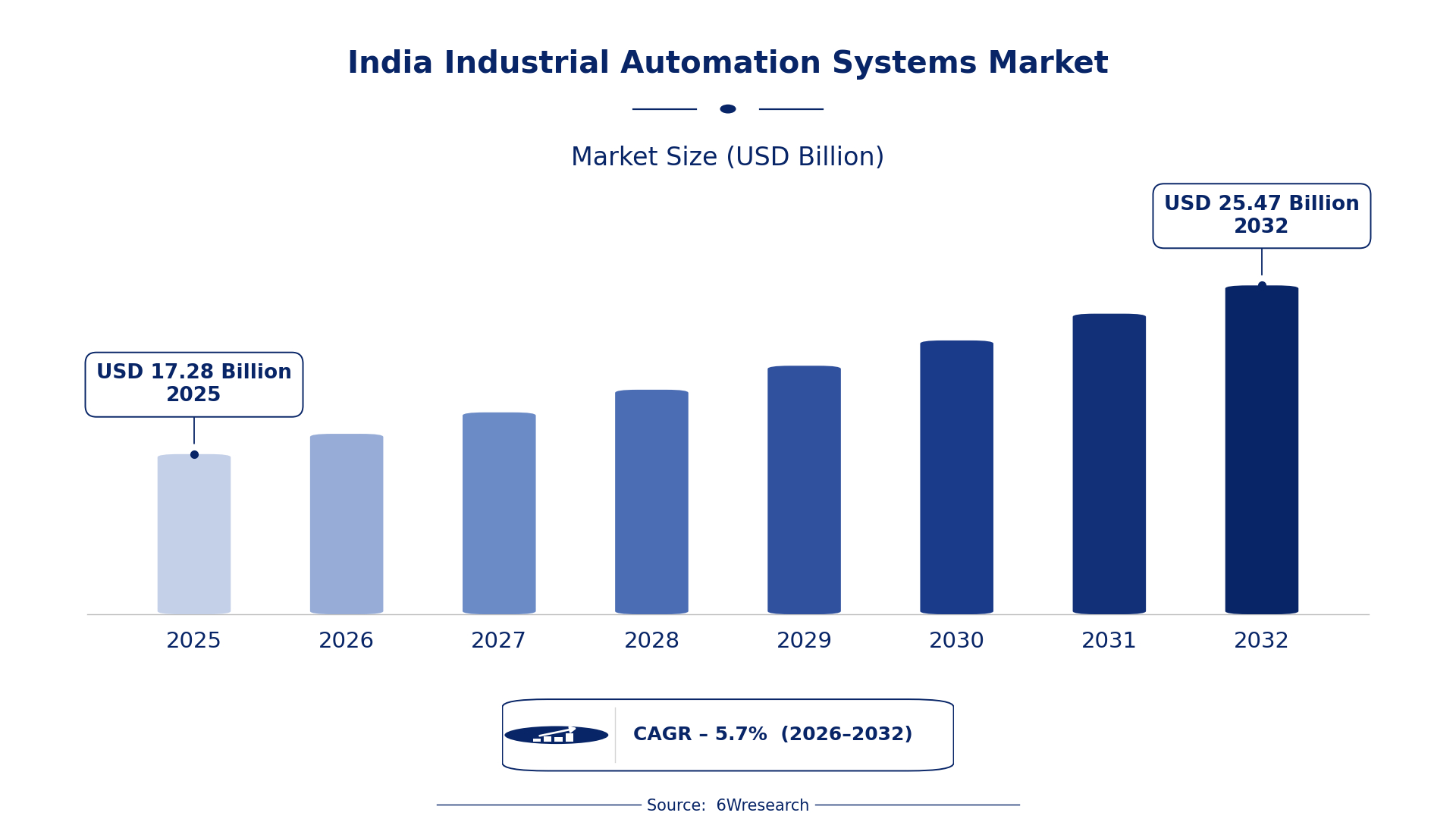
According to 6Wresearch internal database and industry insights, the India Industrial Automation Systems Market was valued at USD 17.28 billion in 2025 and is projected to reach USD 25.47 billion by 2032, growing at a CAGR of approximately 5.7% during 2026–2032.
India Industrial Automation Systems Market Highlights
| Report Metric | Details |
| Report Name | India Industrial Automation Systems Market |
| Market Size 2025 | USD 17.28 billion |
| Market Size 2032 | USD 25.47 billion |
| Absolute Growth 2025–2032 | USD 8.19 billion |
| CAGR 2026–2032 | 5.7% |
| Peak Annual Growth | 8.0% in 2029 |
| Forecast Period | 2026–2032 |
| Historical Data | 2022–2025 |
| Base Year | 2025 |
| Leading System Type, 2025 | Process Automation Systems (53% share) |
| Leading Integration Level, 2025 | Centralized (39% share) |
| Leading Control Scope, 2025 | Continuous Control (41% share) |
| Leading End User, 2025 | Petrochemical Plants (48% share) |
| Fastest-Growing System Type | Discrete Automation Systems (7.7% CAGR) |
| Fastest-Growing Integration Level | Modular (8.3% CAGR) |
| Fastest-Growing Control Scope | Event-Based Control (7.3% CAGR) |
| Fastest-Growing End User | Automotive Assembly Lines (7.0% CAGR) |
| Growing Sector | Automotive Assembly Lines |
| Key End Users | Petrochemical Plants, Automotive Assembly Lines, Pharmaceuticals, Water Treatment Facilities |
India Industrial Automation Systems Market Year-wise Growth Rate and Key Drivers (2022–2032)
This graph illustrates the annual growth rates of the market from 2022 to 2032, highlighting a steady upward trajectory and projected market expansion over the forecast period.
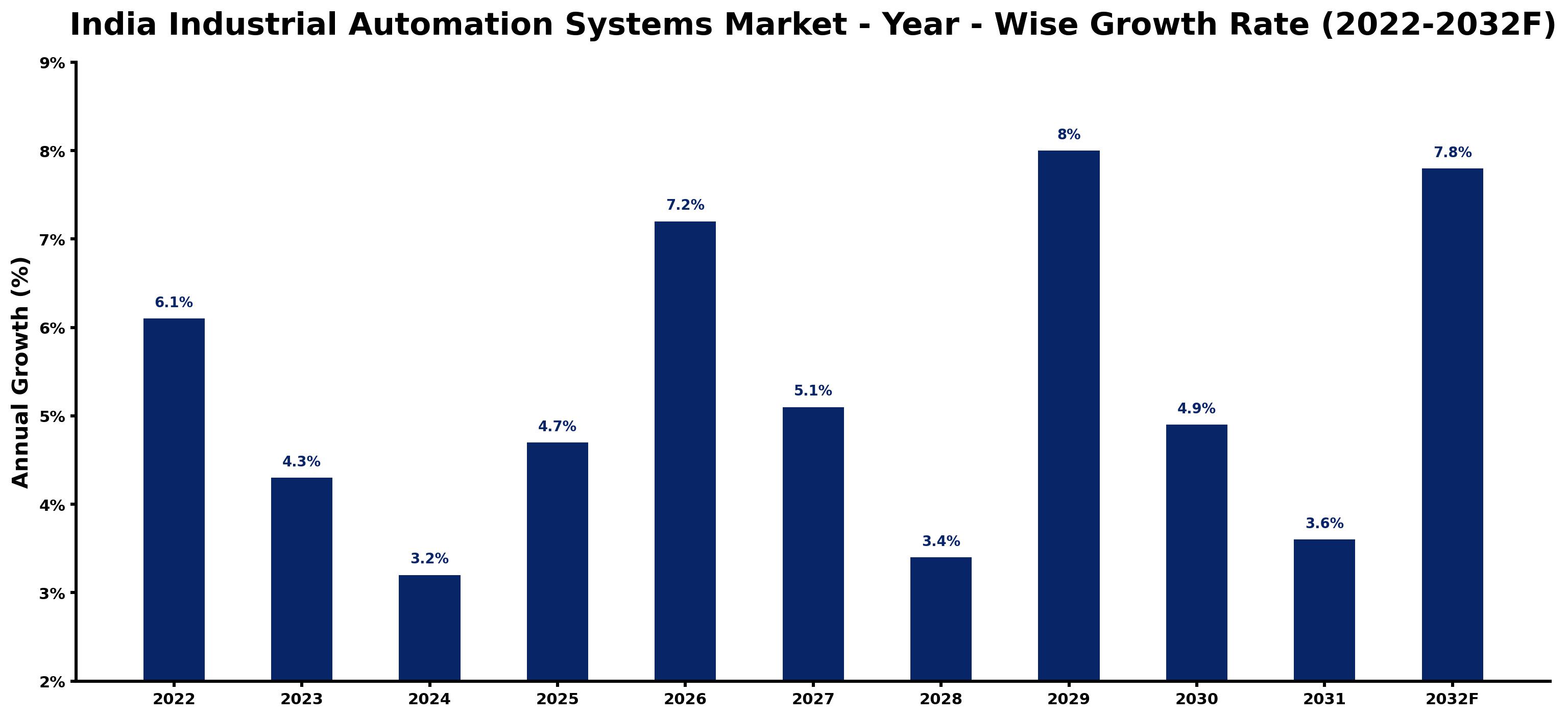
The following table presents the estimated annual growth rate for each year together with the principal factor influencing market performance.
| Year | Estimated Annual Growth (%) | Market Rationale |
| 2022 | 6.1 | The market experienced strong demand from various sectors, particularly manufacturing and process industries. |
| 2023 | 4.3 | Growth slowed due to rising costs of imported components affecting project budgets. |
| 2024 | 3.2 | Demand continued to decelerate as companies faced challenges in sourcing skilled technicians. |
| 2025 | 4.7 | A rebound in growth occurred as investments in smart manufacturing initiatives gained momentum. |
| 2026 | 7.2 | Increased automation adoption in the automotive sector propelled growth rates higher. |
| 2027 | 5.1 | Growth slowed again as supply chain disruptions impacted the availability of automation parts. |
| 2028 | 3.4 | Demand decelerated further as companies adjusted to market conditions and competition intensified. |
| 2029 | 8.0 | The market peaked with substantial investments in automation technologies across multiple sectors. |
| 2030 | 4.9 | Growth moderated as the market stabilised following the peak year of investment. |
| 2031 | 3.6 | Demand continued to slow as the market adjusted to previous high levels of growth. |
| 2032 | 7.8 | An uptick in automation needs from urban infrastructure projects is expected to stimulate growth. |
Note: Market size estimations and growth projections presented in this report are based on 6Wresearch's proprietary forecasting methodology, utilizing the latest available industry data, government publications, and primary research inputs.
India Industrial Automation Systems Market Synopsis
Industrial Automation Systems in India encompass technologies that automate industrial processes to improve efficiency and productivity. These systems integrate hardware and software components, optimising manufacturing processes and enhancing quality control. The India Industrial Automation Systems Market is expanding due to increasing domestic demand and substantial investments in infrastructure. The automotive sector, which produced over 4 million vehicles in 2023, illustrates this trend.
Market Dynamics Impact Analysis (2026–2032)
| Factor | Type | Impact | Primary Segment Affected |
| Increasing investment in manufacturing infrastructure | Driver | High | Process Automation Systems |
| Demand for improved safety and efficiency in operations | Driver | High | SCADA + HMI Systems |
| Growing need for automation in urban infrastructure projects | Opportunity | High | Modular |
| Rising demand for automation in the automotive sector | Opportunity | High | Discrete Automation Systems |
| Challenges in integrating new systems with legacy infrastructure | Restraint | High | Hybrid Automation Systems |
| Limited skilled workforce in automation technologies | Restraint | Medium | Continuous Control |
| The Industrial Automation Systems market in India faces regulatory hurdles | Challenge | High | Discrete Automation Systems |
| High initial investment costs deter smaller manufacturers | Challenge | Medium | Process Automation Systems |
Evaluation of Drivers in India Industrial Automation Systems Market (2026–2032)
The factors lifting demand, and the evidence behind each, are summarised below.
| Drivers | Primary Segment Affected | Why It Matters (Evidence) |
| Rising domestic demand for automation technologies | Discrete Automation Systems | The automotive industry produced over 4 million vehicles in 2023, increasing demand for automation solutions. |
| Investment in smart manufacturing initiatives | SCADA + HMI Systems | The Indian government allocated 10 billion INR for smart manufacturing initiatives in 2022, boosting system adoption. |
| Focus on improving operational efficiency | Process Automation Systems | The pharmaceutical sector is projected to grow significantly, driving automation needs for compliance and quality assurance. |
| Adoption of advanced technologies in urban projects | Modular | Urban infrastructure projects are increasingly incorporating automation technologies to improve efficiency and service delivery. |
| Implementation of industry standards for quality control | Continuous Control | ISO 9001 certification is increasingly sought by automation system providers, ensuring quality assurance. |
Market growth for Industrial Automation Systems in India is underpinned by rising domestic demand for automation technologies, investment in smart manufacturing, and a focus on operational efficiency. The automotive industry produced over 4 million vehicles in 2023, driving demand for automation solutions. The pharmaceutical sector's projected growth is creating further needs for automation. Urban infrastructure projects are increasingly incorporating automation technologies to improve efficiency and service delivery.
Evaluation of Restraints in India Industrial Automation Systems Market
The following restraints limit how fast demand can grow.
| Market Restraint | Primary Segment Affected | Why It Matters (Evidence) |
| Integration challenges with legacy systems | Hybrid Automation Systems | Many manufacturers struggle to integrate new automation technologies with existing legacy systems, limiting efficiency gains. |
| Shortage of skilled workforce in automation | Continuous Control | The lack of adequately trained personnel in automation technologies hampers effective implementation and operation. |
| High initial investment costs for automation systems | Process Automation Systems | Smaller manufacturers are deterred by the upfront costs associated with implementing automation solutions. |
| Regulatory hurdles affecting system deployment | Discrete Automation Systems | Complex regulations can delay the approval and deployment of new automation technologies in various sectors. |
| Market fragmentation leading to inconsistent standards | Modular | The lack of unified standards across the industry complicates the adoption of modular automation solutions. |
India Industrial Automation Systems Market Challenges
The India Industrial Automation Systems market encounters significant hurdles, starting with high costs for buyers due to reliance on imported components, inflating project budgets by approximately 30%. A lack of skilled technicians hampers effective implementation, causing delays of up to six months for manufacturers. Supply chain disruptions are common, particularly for essential automation parts, resulting in production downtimes that can cost plants millions in lost revenue. Fierce competition among local suppliers pressures prices downward, which can compromise quality and reliability for buyers over time.
Trends in the India Industrial Automation Systems Market
Below mentioned are some of the trends shaping the India Industrial Automation Systems Market growth.
- Shift towards Modular Automation Solutions: India is increasingly adopting modular automation solutions, particularly in manufacturing. This trend is supported by the Smart Cities Mission, which promotes flexible automation in urban projects, with an estimated investment of 10 billion INR.
- Transition to Continuous Control Systems: Since 2022, there has been a notable shift towards continuous control systems in various industries. The push for improved efficiency and safety in operations is driving this trend, particularly in petrochemical plants with over 1,000 operational facilities.
- Emergence of Advanced SCADA Systems: The demand for advanced SCADA systems has risen significantly since 2023, driven by the need for real-time monitoring. Over 4 million vehicles produced in the automotive sector highlight this growing need for enhanced monitoring capabilities.
- Prioritisation of Quality Assurance Standards: The focus on quality assurance in automation systems has intensified, especially in pharmaceuticals. Compliance with ISO 9001 certification is becoming increasingly critical as the sector grows.
Investment Opportunities in the India Industrial Automation Systems Market
Below are the investment opportunities with the strongest case in the India Industrial Automation Systems Market.
- Investment in Modular Automation Solutions: With the automotive sector projected to grow, there is a substantial opportunity to invest in modular automation solutions. The automotive assembly lines require flexible systems to improve production efficiency, creating demand for innovative solutions.
- Expansion in Pharmaceutical Automation: The pharmaceutical sector is experiencing rapid growth, creating opportunities for automation providers. Investing in automation technologies tailored for drug manufacturing can meet the rising compliance and quality demands.
- Development of Smart Manufacturing Facilities: The Indian government's focus on smart manufacturing presents opportunities for suppliers. Collaborating with local manufacturers to provide automation solutions can facilitate entry into this expanding market.
- Enhancing Automation in Water Treatment: The water treatment sector is projected to reach 2.5 billion USD by 2025, indicating a need for advanced automation systems. Suppliers can enter this market by partnering with local municipalities to implement automation solutions.
Government Initiatives in the India Industrial Automation Systems Market
The National Policy on Electronics 2019, by the Ministry of Electronics and Information Technology, aims to increase domestic manufacturing of automation systems and components. This policy encourages local production, reducing reliance on imports and promoting innovation in the automation sector. By promoting research and development, it supports the growth of automation technologies in various industries. The policy has allocated substantial funding to enhance capabilities and infrastructure in the automation sector.
The Smart Cities Mission, initiated in 2015, encourages the adoption of automation technologies in urban infrastructure projects across India. The Ministry of Housing and Urban Affairs oversees this initiative, ensuring alignment with national development goals. The mission has allocated significant funding to support the implementation of smart solutions, enhancing urban living standards and creating opportunities for automation providers. This initiative has led to increased demand for automation technologies in various urban projects.
Future Insight of the India Industrial Automation Systems Market
By 2032, buyers and suppliers in the India Industrial Automation Systems market can expect considerable advancements driven by several key initiatives. The National Policy on Electronics 2019 will encourage broader adoption of automation technologies, improving productivity across multiple sectors. The automotive industry is set to produce over 5 million vehicles annually, increasingly relying on automation to meet rising demand. The Smart Cities Mission will integrate automation in urban infrastructure, creating fresh opportunities for suppliers and promoting innovation.
Market Segmentation Analysis
The analysis below covers each segmentation, its leading category in 2025 and its fastest-growing category through 2032.
By System Type – Process Automation Systems Dominated, Discrete Automation Systems Expected to Grow Fastest
According to Sachin Kumar Rai, Senior Research Analyst at 6Wresearch, in 2025, Process Automation Systems led the system type split with a 53% share. Process Automation Systems dominate the market share due to their essential role in continuous monitoring and control of industrial processes, particularly in petrochemical plants. The extensive use of these systems in over 1,000 operational facilities highlights their importance for safety and operational efficiency. Discrete Automation Systems are set to record the highest CAGR in this split, 7.7% over 2026–2032. Discrete Automation Systems are witnessing rapid growth driven by the automotive industry's demand for precision and speed, with over 4 million vehicles produced in 2023. This trend indicates a shift towards more adaptable manufacturing processes that can quickly respond to market fluctuations. Suppliers should focus on developing tailored solutions for discrete automation to capitalise on this increasing demand.
By Integration Level – Centralized Dominated, Modular Expected to Grow Fastest
Centralized held a 39% share of the India Industrial Automation Systems Market by integration level in 2025. Centralized automation systems hold the largest share as they are widely implemented in large manufacturing facilities across Maharashtra, ensuring streamlined control of various processes. This integration is crucial for enhancing operational efficiency and minimising downtime in complex industrial environments. The quickest growth will come from Modular, forecast to expand at a CAGR of 8.3% between 2026 and 2032. Modular automation systems are experiencing the fastest growth due to their inherent flexibility and scalability, which allow manufacturers to adapt to changing production needs. This trend aligns with government initiatives that promote domestic manufacturing capabilities. Buyers may achieve a competitive advantage by investing in modular solutions that improve operational agility.
By Control Scope – Continuous Control Dominated, Event-Based Control Expected to Grow Fastest
Continuous Control took a 41% share of control scope in 2025, more than any other category. Continuous Control systems lead the market share as they are vital for processes requiring uninterrupted operation, especially in sectors like petrochemicals. Their reliability in maintaining consistent output is a significant factor for many manufacturers seeking efficiency. Event-Based Control is projected to grow fastest, at a CAGR of 7.3% during 2026–2032. Event-Based Control is rapidly growing as it enables more responsive automation solutions that activate based on specific events in production lines. This adaptability is increasingly essential in dynamic manufacturing environments where responsiveness is key. Suppliers should enhance their event-based control offerings to better meet the evolving demands of manufacturers.
By End User – Petrochemical Plants Dominated, Automotive Assembly Lines Expected to Grow Fastest
Petrochemical Plants accounted for a 48% market share by end user in 2025. Petrochemical Plants represent the largest market share in industrial automation, heavily relying on these systems for safety and efficiency in their operations. The sector's substantial investment in automation technologies highlights its significance in the overall market. Over 2026–2032, Automotive Assembly Lines are expected to post the fastest growth, at a CAGR of 7.0%. Automotive Assembly Lines are the fastest-growing segment, driven by the demand for precision and speed in production, particularly with over 4 million vehicles produced in 2023. This growth reflects the industry's shift towards more efficient manufacturing practices. Suppliers should prioritise solutions tailored for automotive assembly to capture this expanding market.
Key Attractiveness of the Report
- 10 Years of Market Numbers
- Historical Data Starting from 2022 to 2025
- Base Year 2025
- Forecast Data until 2032
- Key Performance Indicators Impacting the Market
- Major Upcoming Developments and Projects
Key Highlights of the Report:
- India Industrial Automation Systems Market Outlook
- Market Size of India Industrial Automation Systems Market, 2025
- Forecast of India Industrial Automation Systems Market, 2032
- Historical Data and Forecast of India Industrial Automation Systems Revenues & Volume for the Period 2022 - 2032F
- India Industrial Automation Systems Market Trend Evolution
- India Industrial Automation Systems Market Drivers and Challenges
- India Industrial Automation Systems Price Trends
- India Industrial Automation Systems Porter's Five Forces
- India Industrial Automation Systems Industry Life Cycle
- Historical Data and Forecast of India Industrial Automation Systems Market Revenues & Volume By System Type for the Period 2022 - 2032F
- Historical Data and Forecast of India Industrial Automation Systems Market Revenues & Volume By Process Automation Systems for the Period 2022 - 2032F
- Historical Data and Forecast of India Industrial Automation Systems Market Revenues & Volume By Discrete Automation Systems for the Period 2022 - 2032F
- Historical Data and Forecast of India Industrial Automation Systems Market Revenues & Volume By Hybrid Automation Systems for the Period 2022 - 2032F
- Historical Data and Forecast of India Industrial Automation Systems Market Revenues & Volume By SCADA + HMI Systems for the Period 2022 - 2032F
- Historical Data and Forecast of India Industrial Automation Systems Market Revenues & Volume By Integration Level for the Period 2022 - 2032F
- Historical Data and Forecast of India Industrial Automation Systems Market Revenues & Volume By Centralized for the Period 2022 - 2032F
- Historical Data and Forecast of India Industrial Automation Systems Market Revenues & Volume By Modular for the Period 2022 - 2032F
- Historical Data and Forecast of India Industrial Automation Systems Market Revenues & Volume By Combined (Batch + Discrete) for the Period 2022 - 2032F
- Historical Data and Forecast of India Industrial Automation Systems Market Revenues & Volume By Supervisory + Interface for the Period 2022 - 2032F
- Historical Data and Forecast of India Industrial Automation Systems Market Revenues & Volume By Control Scope for the Period 2022 - 2032F
- Historical Data and Forecast of India Industrial Automation Systems Market Revenues & Volume By Continuous Control for the Period 2022 - 2032F
- Historical Data and Forecast of India Industrial Automation Systems Market Revenues & Volume By Event-Based Control for the Period 2022 - 2032F
- Historical Data and Forecast of India Industrial Automation Systems Market Revenues & Volume By Custom Workflow for the Period 2022 - 2032F
- Historical Data and Forecast of India Industrial Automation Systems Market Revenues & Volume By Remote/Real-Time for the Period 2022 - 2032F
- Historical Data and Forecast of India Industrial Automation Systems Market Revenues & Volume By End User for the Period 2022 - 2032F
- Historical Data and Forecast of India Industrial Automation Systems Market Revenues & Volume By Petrochemical Plants for the Period 2022 - 2032F
- Historical Data and Forecast of India Industrial Automation Systems Market Revenues & Volume By Automotive Assembly Lines for the Period 2022 - 2032F
- Historical Data and Forecast of India Industrial Automation Systems Market Revenues & Volume By Pharmaceuticals for the Period 2022 - 2032F
- Historical Data and Forecast of India Industrial Automation Systems Market Revenues & Volume By Water Treatment Facilities for the Period 2022 - 2032F
- India Industrial Automation Systems Import Export Trade Statistics
- Market Opportunity Assessment By System Type
- Market Opportunity Assessment By Integration Level
- Market Opportunity Assessment By Control Scope
- Market Opportunity Assessment By End User
- India Industrial Automation Systems Top Companies Market Share
- India Industrial Automation Systems Competitive Benchmarking By Technical and Operational Parameters
- India Industrial Automation Systems Company Profiles
- India Industrial Automation Systems Key Strategic Recommendations
Market Covered
Segments analysed in this report are listed below.
By System Type
- Process Automation Systems
- Discrete Automation Systems
- Hybrid Automation Systems
- SCADA + HMI Systems
By Integration Level
- Centralized
- Modular
- Combined (Batch + Discrete)
- Supervisory + Interface
By Control Scope
- Continuous Control
- Event-Based Control
- Custom Workflow
- Remote/Real-Time
By End User
- Petrochemical Plants
- Automotive Assembly Lines
- Pharmaceuticals
- Water Treatment Facilities































