China Industrial Automation Systems Market Size & Growth Rate
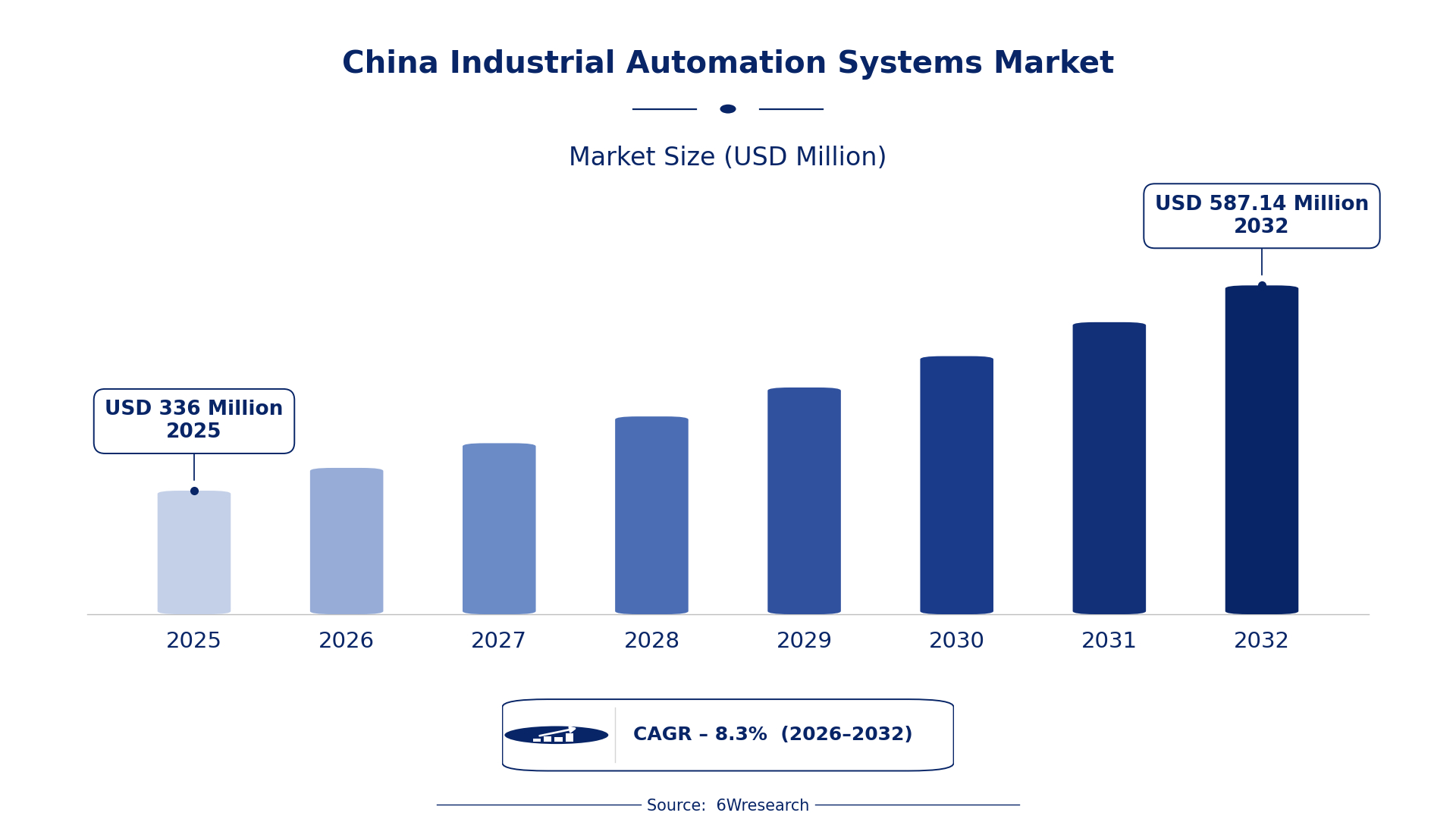
According to 6Wresearch internal database and industry insights, the China Industrial Automation Systems Market was valued at USD 336.0 million in 2025 and is projected to reach USD 587.14 million by 2032, growing at a CAGR of approximately 8.3% during 2026–2032.
China Industrial Automation Systems Market Highlights
| Report Metric | Details |
| Report Name | China Industrial Automation Systems Market |
| Market Size 2025 | USD 336.0 million |
| Market Size 2032 | USD 587.14 million |
| Absolute Growth 2025–2032 | USD 251.14 million |
| CAGR 2026–2032 | 8.3% |
| Peak Annual Growth | 10.4% in 2029 |
| Forecast Period | 2026–2032 |
| Historical Data | 2022–2025 |
| Base Year | 2025 |
| Leading System Type, 2025 | Process Automation Systems (41% share) |
| Leading Integration Level, 2025 | Centralized (53% share) |
| Leading Control Scope, 2025 | Continuous Control (46% share) |
| Leading End User, 2025 | Automotive Assembly Lines (46% share) |
| Fastest-Growing System Type | Hybrid Automation Systems (9.3% CAGR) |
| Fastest-Growing Integration Level | Modular (9.7% CAGR) |
| Fastest-Growing Control Scope | Remote/Real-Time (10.0% CAGR) |
| Fastest-Growing End User | Pharmaceuticals (9.9% CAGR) |
| Growing Sector | Pharmaceuticals |
| Key End Users | Automotive manufacturers, petrochemical plants, pharmaceutical companies, water treatment facilities |
China Industrial Automation Systems Market Year-wise Growth Rate and Key Drivers (2022–2032)
This graph illustrates the annual growth rates of the market from 2022 to 2032, highlighting a steady upward trajectory and projected market expansion over the forecast period.
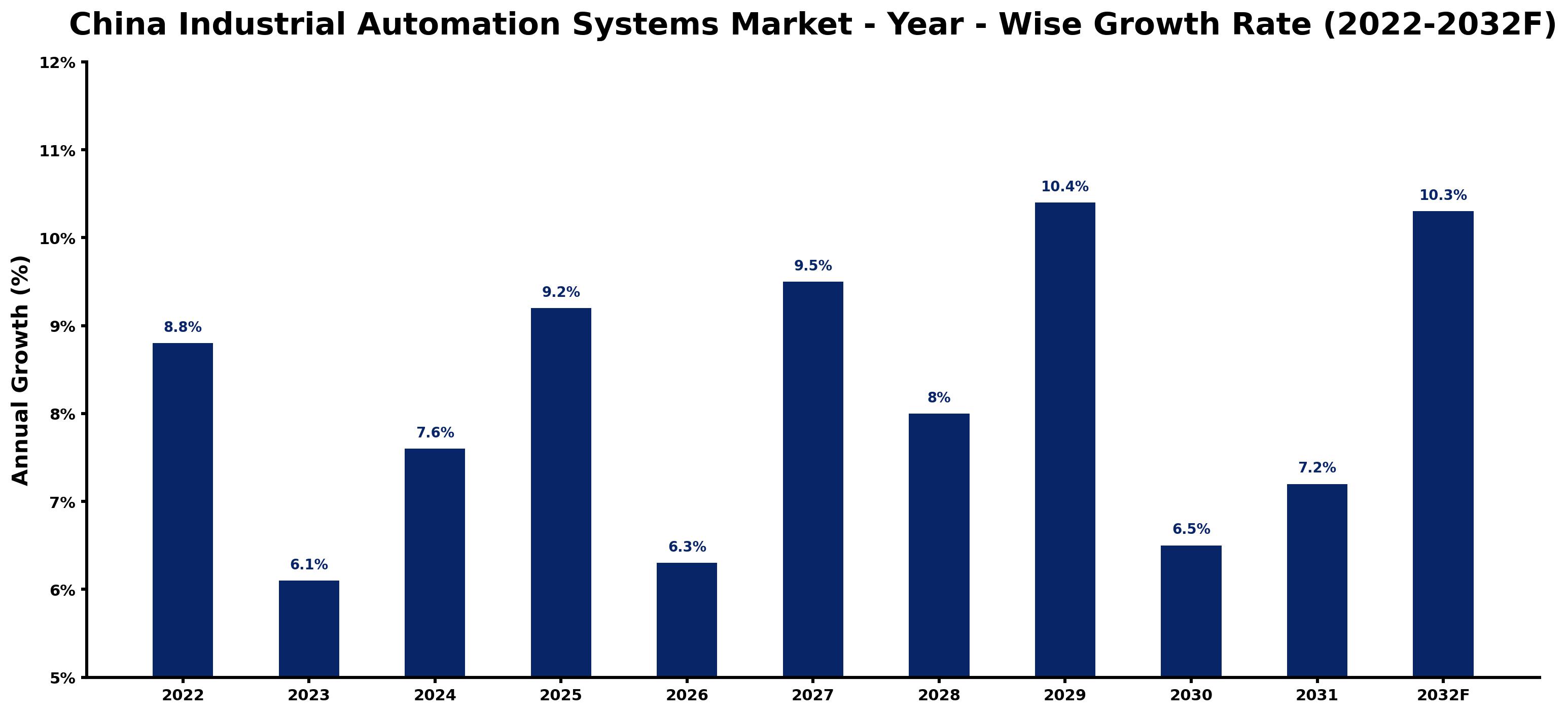
Each row of the following table gives one year's estimated growth and the event or demand shift that explains it.
| Year | Estimated Annual Growth (%) | Market Rationale |
| 2022 | 8.8 | The market experienced solid growth driven by increasing domestic manufacturing demands. |
| 2023 | 6.1 | Growth slowed as companies adjusted to supply chain disruptions from global events. |
| 2024 | 7.6 | Demand increased as manufacturers sought to optimise operational efficiency through automation. |
| 2025 | 9.2 | The market peaked with significant investments in automation technologies across sectors. |
| 2026 | 6.3 | Growth is expected to slow as the market begins to stabilise after rapid expansion in prior years. |
| 2027 | 9.5 | Demand is projected to surge again as industries embrace advanced automation solutions. |
| 2028 | 8.0 | Growth is anticipated to decelerate slightly as the market adjusts to new technology integrations. |
| 2029 | 10.4 | The market is expected to peak again, driven by a major push towards smart manufacturing initiatives. |
| 2030 | 6.5 | Growth is projected to slow as the market matures and competition intensifies. |
| 2031 | 7.2 | Demand will increase as industries focus on optimising productivity and reducing costs. |
| 2032 | 10.3 | The market is expected to grow steadily as automation becomes essential across various sectors. |
Note: Market size estimations and growth projections presented in this report are based on 6Wresearch's proprietary forecasting methodology, utilizing the latest available industry data, government publications, and primary research inputs.
China Industrial Automation Systems Market Synopsis
The China Industrial Automation Systems market includes technologies that automate industrial processes, enhancing efficiency and precision. These systems combine hardware and software solutions to optimise production lines and improve safety. The market is growing due to increasing demand from key sectors such as automotive and petrochemicals. In 2022, the automotive sector alone produced over 25 million vehicles, creating a strong need for automation. Initiatives like 'Smart Manufacturing 2025' aim for a 20% efficiency boost by 2025, driving further growth.
Market Dynamics Impact Analysis (2026–2032)
| Factor | Type | Impact | Primary Segment Affected |
| Increasing demand for automation in manufacturing processes | Driver | High | Process Automation Systems |
| Growth in the automotive sector requiring advanced automation | Driver | High | Automotive Assembly Lines |
| Investment in smart factories to enhance operational efficiency | Opportunity | High | Centralized |
| Rising demand for automation in pharmaceuticals to ensure compliance | Opportunity | High | Pharmaceuticals |
| High initial investment costs for automation technologies | Restraint | Medium | Discrete Automation Systems |
| Limited skilled workforce to implement and maintain automation systems | Restraint | Medium | Hybrid Automation Systems |
| The Industrial Automation Systems market in China faces high initial costs for implementation | Challenge | High | SCADA + HMI Systems |
| Technological integration challenges hinder smooth transitions to automation | Challenge | High | Remote/Real-Time |
Evaluation of Drivers in China Industrial Automation Systems Market (2026–2032)
Key forces behind demand, with the segment each one moves most, are listed below.
| Drivers | Primary Segment Affected | Why It Matters (Evidence) |
| Rising domestic manufacturing demands | Process Automation Systems | This demand is driven by the need for efficiency in production lines, with the automotive sector producing over 25 million vehicles in 2022. |
| Investment in smart manufacturing initiatives | Centralized | The 'Smart Manufacturing 2025' initiative aims to enhance automation, targeting a 20% efficiency increase by 2025. |
| Growth in the pharmaceutical sector | Pharmaceuticals | With a projected market value of 1 trillion CNY by 2025, automation is essential for compliance and precision. |
| Expansion of petrochemical plants | Discrete Automation Systems | China has over 30 major petrochemical plants relying on automation for efficiency and safety. |
| Increasing adoption of AI in manufacturing | Hybrid Automation Systems | The government aims for a 30% increase in AI adoption by 2025, driving demand for advanced automation solutions. |
The Industrial Automation Systems market in China is expanding as rising domestic manufacturing demands, substantial investments in smart manufacturing initiatives, and growth in the automotive sector fuel demand. In 2022, the automotive sector produced over 25 million vehicles, leading to a greater need for automation to achieve efficiency. The 'Smart Manufacturing 2025' initiative targets a 20% increase in efficiency by 2025, further accelerating automation adoption. With over 30 major petrochemical plants in China utilising automation technologies, the focus on efficiency and safety is critical. The government aims for a 30% increase in AI adoption by 2025, driving demand for advanced automation solutions across various sectors.
Evaluation of Restraints in China Industrial Automation Systems Market
The following restraints limit how fast demand can grow.
| Market Restraint | Primary Segment Affected | Why It Matters (Evidence) |
| High initial investment costs for automation technologies | Discrete Automation Systems | These costs can deter smaller manufacturers from adopting advanced automation solutions, limiting market growth. |
| Limited skilled workforce for automation implementation | Hybrid Automation Systems | A shortage of trained professionals hampers the effective deployment and maintenance of automation systems, affecting productivity. |
| Technological integration challenges | SCADA + HMI Systems | Difficulties in integrating new automation technologies with existing systems can delay implementation, impacting operational efficiency. |
| Regulatory compliance costs | Process Automation Systems | Meeting stringent regulations can increase operational costs for manufacturers, affecting adoption rates and profitability. |
| Market competition leading to price pressures | Centralized | Increased competition among automation providers can drive down prices, impacting profitability and investment in new technologies. |
China Industrial Automation Systems Market Challenges
In the China Industrial Automation Systems market, rising competition from low-cost alternatives pressures suppliers to lower prices, which compromises product quality and reduces operational efficiency for buyers. Regulatory compliance with ISO 9001 standards requires significant investment, causing delays in project timelines for producers. Increasing raw material costs, exacerbated by global supply chain disruptions, inflate operational expenses for manufacturers, limiting their ability to invest in new technologies. Supply chain vulnerabilities arise from reliance on specific components, which can disrupt production schedules for buyers and result in missed revenue opportunities.
Trends in the China Industrial Automation Systems Market
Below mentioned are some of the trends shaping the China Industrial Automation Systems Market growth.
- Shift from Traditional to Smart Manufacturing: Since 2023, China has been moving from traditional manufacturing methods to smart manufacturing technologies. The 'Smart Manufacturing 2025' initiative aims for a 20% efficiency increase by 2025, prompting suppliers to innovate.
- Growing Adoption of AI in Automation: The integration of AI in automation systems is gaining momentum, particularly in the automotive sector. The Chinese government targets a 30% increase in AI adoption by 2025, influencing purchasing decisions.
- Increased Focus on Sustainability: The push for greener manufacturing processes is leading to greater automation adoption. The 'Green Manufacturing Program' aims for a 15% reduction in emissions by 2025, prompting investments in automation technologies.
- Expansion of Modular Automation Solutions: Modular automation systems are becoming increasingly popular, allowing for scalability in production. This trend is evident in sectors like pharmaceuticals, which are projected to grow significantly by 2025.
Investment Opportunities in the China Industrial Automation Systems Market
Several openings in the China Industrial Automation Systems Market merit attention from investors.
- Investment in Smart Factories: Shanghai is emerging as a hub for smart factories, with substantial investments expected in automation solutions. Engaging with local manufacturers can yield promising returns as the market grows.
- Pharmaceutical Sector Automation: The pharmaceutical industry, projected to reach 1 trillion CNY by 2025, presents a strong opportunity for automation suppliers. Collaborating with local manufacturers can facilitate market entry and growth.
- Partnerships for AI Integration: Forming joint ventures with technology firms can improve automation capabilities. The government’s push for a 30% increase in AI adoption by 2025 supports this opportunity for suppliers.
- Supply of Modular Automation Systems: With increasing demand for flexibility, supplying modular automation solutions can meet market needs. Engaging with automotive assembly lines in Guangdong can provide entry points.
Government Initiatives in the China Industrial Automation Systems Market
The 'Intelligent Manufacturing Development Plan' launched by the Ministry of Industry and Information Technology in 2023 aims to boost automation in key industries. This plan targets a 20% increase in efficiency by 2025, compelling manufacturers to adopt advanced automation technologies. Additionally, the 'Digital Economy Development Strategy' introduced in 2021 promotes the adoption of automation technologies across various sectors, aiming for a 50% increase in automation levels by 2025, which further supports market growth.
In 2023, the National Development and Reform Commission approved a budget of 5 billion CNY for automation technology research. This funding aims to support the development of innovative automation solutions, improving the capabilities of local manufacturers. Agencies like the Ministry of Ecology and Environment are also encouraging automation adoption through the 'Green Manufacturing Program', which targets a 15% reduction in emissions by 2025, promoting sustainable practices in industrial processes.
Future Insight of the China Industrial Automation Systems Market
The China Industrial Automation Systems market is set for transformative changes by 2032, supported by several key initiatives. The 'Smart Manufacturing 2025' initiative aims to enhance automation across industries, with a target of 30% AI integration by 2025. The automotive sector, which produced over 25 million vehicles in 2022, will continue to drive demand for sophisticated automation solutions. A budget of 5 billion CNY for automation technology research will encourage innovation, allowing suppliers to meet the evolving needs of buyers.
Market Segmentation Analysis
The report offers a comprehensive study of the following market segments and their leading categories in the market.
By System Type – Process Automation Systems Dominated, Hybrid Automation Systems Expected to Grow Fastest
According to Sachin Kumar Rai, Senior Research Analyst at 6Wresearch, Process Automation Systems took a 41% share of system type in 2025, more than any other category. Process Automation Systems dominate the market due to their essential role in industries that require continuous monitoring and control, especially in petrochemical plants. With over 30 major facilities in China employing these systems, their widespread adoption is evident. Hybrid Automation Systems are set to record the highest CAGR in this split, 9.3% over 2026–2032. Hybrid Automation Systems are experiencing rapid growth as they cater to the increasing demand for solutions that merge both process and discrete automation. The automotive sector's evolving complexity serves as a significant driver for this trend. Suppliers should focus on developing hybrid automation solutions to meet the diverse needs of manufacturers seeking flexibility in their operations.
By Integration Level – Centralized Dominated, Modular Expected to Grow Fastest
With a 53% revenue share in 2025, Centralized was the largest integration level category. Centralized systems hold a substantial share in the market as they are commonly used in large-scale operations, allowing for streamlined control across extensive facilities. Their implementation in major manufacturing hubs like Shanghai reinforces their importance in the sector. Over 2026–2032, Modular is expected to post the fastest growth, at a CAGR of 9.7%. Modular systems are growing quickly due to their ability to provide flexibility and scalability, which is increasingly sought after by manufacturers looking to adapt to changing production requirements. The push for more customised automation solutions fuels this trend. Buyers will benefit from modular systems that offer tailored solutions to meet specific operational needs.
By Control Scope – Continuous Control Dominated, Remote/Real-Time Expected to Grow Fastest
In 2025, Continuous Control led the control scope split with a 46% share. Continuous Control systems are crucial for industries that demand constant adjustments, making them particularly essential in the automotive sector. Their role in maintaining production efficiency solidifies their leading market share. The quickest growth will come from Remote/Real-Time, forecast to expand at a CAGR of 10.0% between 2026 and 2032. Remote/Real-Time control systems are growing swiftly as modern industrial operations increasingly require immediate data access and quick response times. This trend is fuelled by the heightened focus on operational efficiency and the need for real-time monitoring. Suppliers must enhance remote control capabilities to align with the industry's escalating demand for real-time operational insights.
By End User – Automotive Assembly Lines Dominated, Pharmaceuticals Expected to Grow Fastest
The largest end user category in 2025 was Automotive Assembly Lines, with a 46% share of total revenue. Automotive Assembly Lines represent the largest share of the market due to their critical role in achieving high production rates and maintaining quality standards in vehicle manufacturing. The production of over 25 million vehicles in 2022 underscores the importance of automation in this sector. Pharmaceuticals are projected to grow fastest, at a CAGR of 9.9% during 2026–2032. The Pharmaceuticals sector is experiencing the fastest growth as the industry emphasises compliance and precision in manufacturing processes. With the pharmaceutical market projected to reach 1 trillion CNY by 2025, the demand for automation will continue to rise. Suppliers should prioritise solutions tailored for the pharmaceutical sector to capitalise on this growing demand.
Key Attractiveness of the Report
- 10 Years of Market Numbers
- Historical Data Starting from 2022 to 2025
- Base Year 2025
- Forecast Data until 2032
- Key Performance Indicators Impacting the Market
- Major Upcoming Developments and Projects
Key Highlights of the Report:
- China Industrial Automation Systems Market Outlook
- Market Size of China Industrial Automation Systems Market, 2025
- Forecast of China Industrial Automation Systems Market, 2032
- Historical Data and Forecast of China Industrial Automation Systems Revenues & Volume for the Period 2022 - 2032F
- China Industrial Automation Systems Market Trend Evolution
- China Industrial Automation Systems Market Drivers and Challenges
- China Industrial Automation Systems Price Trends
- China Industrial Automation Systems Porter's Five Forces
- China Industrial Automation Systems Industry Life Cycle
- Historical Data and Forecast of China Industrial Automation Systems Market Revenues & Volume By System Type for the Period 2022 - 2032F
- Historical Data and Forecast of China Industrial Automation Systems Market Revenues & Volume By Process Automation Systems for the Period 2022 - 2032F
- Historical Data and Forecast of China Industrial Automation Systems Market Revenues & Volume By Discrete Automation Systems for the Period 2022 - 2032F
- Historical Data and Forecast of China Industrial Automation Systems Market Revenues & Volume By Hybrid Automation Systems for the Period 2022 - 2032F
- Historical Data and Forecast of China Industrial Automation Systems Market Revenues & Volume By SCADA + HMI Systems for the Period 2022 - 2032F
- Historical Data and Forecast of China Industrial Automation Systems Market Revenues & Volume By Integration Level for the Period 2022 - 2032F
- Historical Data and Forecast of China Industrial Automation Systems Market Revenues & Volume By Centralized for the Period 2022 - 2032F
- Historical Data and Forecast of China Industrial Automation Systems Market Revenues & Volume By Modular for the Period 2022 - 2032F
- Historical Data and Forecast of China Industrial Automation Systems Market Revenues & Volume By Combined (Batch + Discrete) for the Period 2022 - 2032F
- Historical Data and Forecast of China Industrial Automation Systems Market Revenues & Volume By Supervisory + Interface for the Period 2022 - 2032F
- Historical Data and Forecast of China Industrial Automation Systems Market Revenues & Volume By Control Scope for the Period 2022 - 2032F
- Historical Data and Forecast of China Industrial Automation Systems Market Revenues & Volume By Continuous Control for the Period 2022 - 2032F
- Historical Data and Forecast of China Industrial Automation Systems Market Revenues & Volume By Event-Based Control for the Period 2022 - 2032F
- Historical Data and Forecast of China Industrial Automation Systems Market Revenues & Volume By Custom Workflow for the Period 2022 - 2032F
- Historical Data and Forecast of China Industrial Automation Systems Market Revenues & Volume By Remote/Real-Time for the Period 2022 - 2032F
- Historical Data and Forecast of China Industrial Automation Systems Market Revenues & Volume By End User for the Period 2022 - 2032F
- Historical Data and Forecast of China Industrial Automation Systems Market Revenues & Volume By Petrochemical Plants for the Period 2022 - 2032F
- Historical Data and Forecast of China Industrial Automation Systems Market Revenues & Volume By Automotive Assembly Lines for the Period 2022 - 2032F
- Historical Data and Forecast of China Industrial Automation Systems Market Revenues & Volume By Pharmaceuticals for the Period 2022 - 2032F
- Historical Data and Forecast of China Industrial Automation Systems Market Revenues & Volume By Water Treatment Facilities for the Period 2022 - 2032F
- China Industrial Automation Systems Import Export Trade Statistics
- Market Opportunity Assessment By System Type
- Market Opportunity Assessment By Integration Level
- Market Opportunity Assessment By Control Scope
- Market Opportunity Assessment By End User
- China Industrial Automation Systems Top Companies Market Share
- China Industrial Automation Systems Competitive Benchmarking By Technical and Operational Parameters
- China Industrial Automation Systems Company Profiles
- China Industrial Automation Systems Key Strategic Recommendations
Market Covered
This report examines the market across the segments below.
By System Type
- Process Automation Systems
- Discrete Automation Systems
- Hybrid Automation Systems
- SCADA + HMI Systems
By Integration Level
- Centralized
- Modular
- Combined (Batch + Discrete)
- Supervisory + Interface
By Control Scope
- Continuous Control
- Event-Based Control
- Custom Workflow
- Remote/Real-Time
By End User
- Petrochemical Plants
- Automotive Assembly Lines
- Pharmaceuticals
- Water Treatment Facilities































