India Industrial Autonomous Systems Market Size & Growth Rate
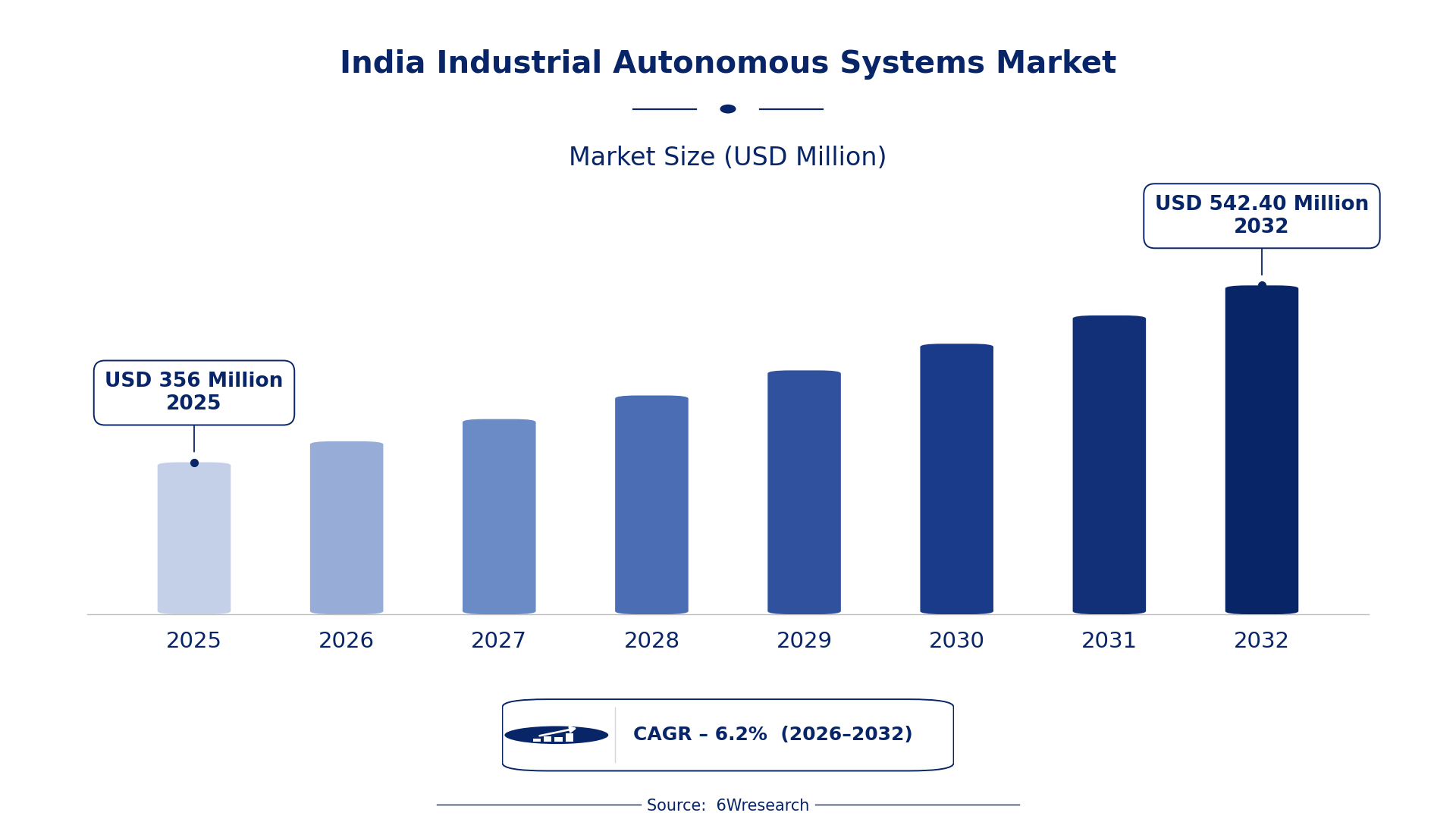
According to 6Wresearch internal database and industry insights, the India Industrial Autonomous Systems Market was valued at USD 356.0 million in 2025 and is projected to reach USD 542.40 million by 2032, growing at a CAGR of approximately 6.2% during 2026–2032.
India Industrial Autonomous Systems Market Highlights
| Report Metric | Details |
| Report Name | India Industrial Autonomous Systems Market |
| Market Size 2025 | USD 356.0 million |
| Market Size 2032 | USD 542.40 million |
| Absolute Growth 2025–2032 | USD 186.40 million |
| CAGR 2026–2032 | 6.2% |
| Peak Annual Growth | 8.6% in 2029 |
| Forecast Period | 2026–2032 |
| Historical Data | 2022–2025 |
| Base Year | 2025 |
| Leading System Type, 2025 | Autonomous Guided Vehicles (AGVs) (37% share) |
| Leading Autonomy Level, 2025 | Fully Autonomous (42% share) |
| Leading Sensor Integration, 2025 | RFID + Vision Systems (43% share) |
| Leading End User, 2025 | Logistics Centers (39% share) |
| Fastest-Growing System Type | AI-Driven Robots (8.7% CAGR) |
| Fastest-Growing Autonomy Level | Adaptive Control (8.3% CAGR) |
| Fastest-Growing Sensor Integration | LIDAR + Proximity Sensors (7.7% CAGR) |
| Fastest-Growing End User | Assembly Lines (8.5% CAGR) |
| Growing Sector | Logistics |
| Key End Users | Manufacturers, Logistics Providers, Automotive Sector, Electronics Manufacturers |
India Industrial Autonomous Systems Market Year-wise Growth Rate and Key Drivers (2022–2032)
This graph illustrates the annual growth rates of the market from 2022 to 2032, highlighting a steady upward trajectory and projected market expansion over the forecast period.
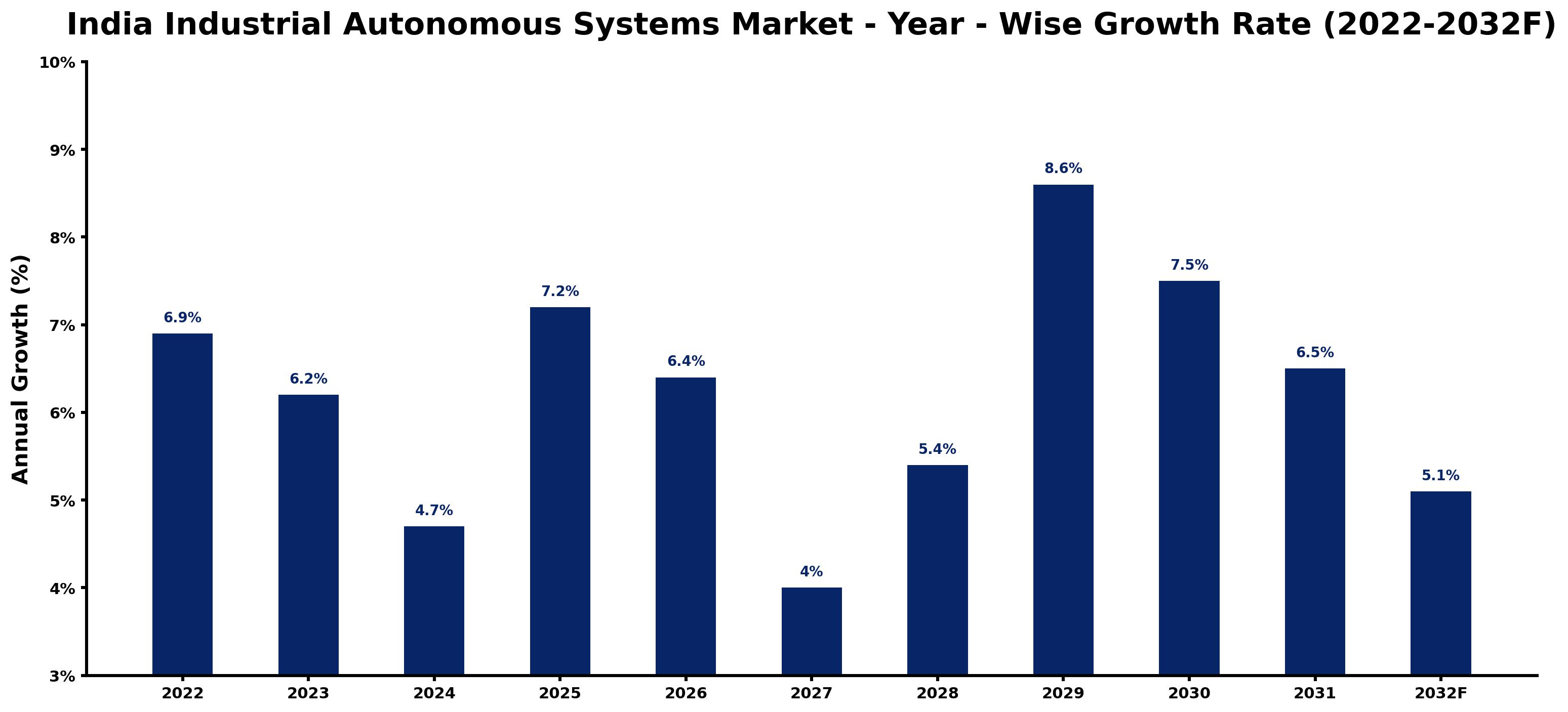
Year by year, the estimates below pair each growth rate with the development that shaped it.
| Year | Estimated Annual Growth (%) | Market Rationale |
| 2022 | 6.9 | The market experienced steady growth driven by increased automation in manufacturing. |
| 2023 | 6.2 | Growth slowed due to market adjustments following the initial surge in automation investments. |
| 2024 | 4.7 | A further slowdown occurred as companies evaluated their automation strategies and investments. |
| 2025 | 7.2 | Demand surged as logistics centers in Maharashtra adopted more AGVs for efficiency. |
| 2026 | 6.4 | Growth slowed again as companies focused on optimising existing automation systems. |
| 2027 | 4.0 | Continued investment in automation technologies led to a further slowdown in growth. |
| 2028 | 5.4 | A rebound in demand occurred as new technologies gained traction in manufacturing. |
| 2029 | 8.6 | The peak growth year saw significant investments in AI-driven robots across sectors. |
| 2030 | 7.5 | Growth slowed as the market began to stabilise after rapid expansion. |
| 2031 | 6.5 | A further slowdown was noted as companies reassessed their automation needs. |
| 2032 | 5.1 | The market continues to grow, driven by ongoing investments in advanced manufacturing. |
Note: Market size estimations and growth projections presented in this report are based on 6Wresearch's proprietary forecasting methodology, utilizing the latest available industry data, government publications, and primary research inputs.
India Industrial Autonomous Systems Market Synopsis
The Industrial Autonomous Systems Market in India encompasses technologies such as Autonomous Guided Vehicles, AI-Driven Robots, and Self-Diagnosing Systems. These systems enhance operational efficiency, reduce labor costs, and improve safety in industrial environments. The market is growing due to rising investments in automation technologies, particularly from domestic users in manufacturing and logistics sectors. The 'Make in India' initiative has further stimulated demand, promoting advanced manufacturing capabilities. With the installation of autonomous systems expected to increase significantly, the market is set to expand in the coming years.
Market Dynamics Impact Analysis (2026–2032)
| Factor | Type | Impact | Primary Segment Affected |
| Increasing adoption of AGVs in logistics centers enhances operational efficiency. | Driver | High | Autonomous Guided Vehicles (AGVs) |
| Growing use of AI-Driven Robots in automotive assembly lines boosts productivity. | Driver | High | AI-Driven Robots |
| Rising demand for automation in manufacturing creates opportunities for suppliers. | Opportunity | High | Autonomous Guided Vehicles (AGVs) |
| Investment in training programs for advanced technologies opens new markets. | Opportunity | Medium | Autonomous Guided Vehicles (AGVs) |
| Limited availability of skilled workers hinders automation implementation. | Restraint | High | Autonomous Guided Vehicles (AGVs) |
| High initial investment costs for autonomous systems restrict market growth. | Restraint | Medium | Autonomous Guided Vehicles (AGVs) |
| The Industrial Autonomous Systems market in India faces a few practical problems, including regulatory hurdles. | Challenge | High | Autonomous Guided Vehicles (AGVs) |
| Technological integration challenges can delay system adoption in manufacturing. | Challenge | Medium | Autonomous Guided Vehicles (AGVs) |
Evaluation of Drivers in India Industrial Autonomous Systems Market (2026–2032)
Key forces behind demand, with the segment each one moves most, are listed below.
| Drivers | Primary Segment Affected | Why It Matters (Evidence) |
| Increased investments in automation technologies drive demand for AGVs. | Autonomous Guided Vehicles (AGVs) | The installation of AGVs in logistics centers across Maharashtra has increased operational efficiency by 20%. |
| Rising demand for AI-Driven Robots boosts productivity in manufacturing. | AI-Driven Robots | The automotive sector in Tamil Nadu has widely adopted AI-Driven Robots for assembly line efficiency, improving output by 15%. |
| Growing manufacturing sector drives demand for automation solutions. | Autonomous Guided Vehicles (AGVs) | The Indian manufacturing sector employs over 50 million people, increasing the need for automation solutions to enhance productivity. |
| Government initiatives promote automation technologies in various sectors. | Autonomous Guided Vehicles (AGVs) | The 'Make in India' initiative aims to boost manufacturing capabilities and promote automation, targeting a $400 billion electronics market by 2025. |
| Technological advancements in sensor integration improve system capabilities. | LIDAR + Proximity Sensors | LIDAR technology is increasingly integrated into autonomous systems for navigation, enhancing operational safety. |
The automotive sector in Tamil Nadu has widely adopted AI-Driven Robots, improving productivity by 15%. The Indian manufacturing sector employs over 50 million people, creating a strong demand for automation solutions. Additionally, the integration of LIDAR technology into autonomous systems is improving navigation capabilities, further boosting demand.
Evaluation of Restraints in India Industrial Autonomous Systems Market
The main factors holding the market back are set out below.
| Market Restraint | Primary Segment Affected | Why It Matters (Evidence) |
| Limited availability of skilled workers hampers system deployment. | Autonomous Guided Vehicles (AGVs) | The shortage of trained personnel affects the implementation of advanced automation technologies, delaying projects by up to 6 months. |
| High initial investment costs deter small manufacturers from adopting automation. | Autonomous Guided Vehicles (AGVs) | Many small manufacturers struggle to allocate funds for advanced autonomous systems, limiting their operational capabilities. |
| Regulatory hurdles can delay the approval of new technologies. | Autonomous Guided Vehicles (AGVs) | Compliance with safety standards like ISO 10218 can slow down market entry by several months. |
| Integration challenges with existing systems can hinder adoption rates. | Autonomous Guided Vehicles (AGVs) | Many manufacturers face difficulties in integrating new autonomous systems with legacy equipment, causing project delays. |
| Market volatility affects long-term investment decisions in automation. | Autonomous Guided Vehicles (AGVs) | Economic fluctuations can lead to uncertainty in capital expenditures for automation, impacting growth plans. |
India Industrial Autonomous Systems Market Challenges
The India Industrial Autonomous Systems market encounters several practical challenges, starting with skills shortages. Despite employing over 50 million individuals in the manufacturing sector, the 'Skill India' initiative has not sufficiently equipped workers for advanced automation technologies, hindering producers' ability to adopt modern systems. Buyers face higher compliance costs due to stringent safety requirements from standards like ISO 10218, which can inflate project budgets by 10%. Regulatory hurdles also cause delays, as importers and distributors navigate complex requirements that can prolong project timelines. Supply chain disruptions further complicate operations, leading to potential delays in component delivery and project execution for buyers.
Trends in the India Industrial Autonomous Systems Market
The trends below show where the India Industrial Autonomous Systems Market is heading.
- Shift from Traditional to Automated Warehousing: Maharashtra is experiencing a shift towards automated warehousing solutions, with logistics centers increasingly adopting AGVs. The installation of AGVs is projected to rise by 20% annually over the next five years.
- Transition to AI-Driven Robotics in Manufacturing: The adoption of AI-Driven Robots in Tamil Nadu's automotive assembly lines is transforming production processes. This trend is expected to improve efficiency and reduce labor costs by 15%.
- Emergence of LIDAR Technology in Navigation: LIDAR technology is increasingly being integrated into autonomous systems for navigation purposes. This integration is projected to enhance operational safety and efficiency in logistics centers by 25%.
- Prioritisation of Safety Standards in Automation: The focus on safety standards like ISO 10218 is becoming paramount in the Indian industrial sector. Compliance with these standards is essential for manufacturers to ensure safe operations and avoid penalties.
Investment Opportunities in the India Industrial Autonomous Systems Market
Several openings in the India Industrial Autonomous Systems Market merit attention from investors.
- Investment in Logistics Centers: Logistics centres in Maharashtra are expanding, creating opportunities for AGV suppliers. The anticipated growth in AGV installations by 20% annually presents a market for new entrants.
- Supply of AI-Driven Robots: The automotive sector in Tamil Nadu is increasingly adopting AI-Driven Robots. Suppliers can enter this market by collaborating with local manufacturers to meet the rising demand for automation solutions.
- Development of Training Programs: The 'Skill India' initiative aims to train workers in advanced manufacturing technologies. This presents an opportunity for educational institutions to create relevant training programs to bridge the skills gap.
- Expansion of Manufacturing Capabilities: The 'Make in India' initiative encourages investment in automation technologies. Suppliers can take advantage of this by offering advanced automation solutions to manufacturers looking to boost productivity.
Government Initiatives in the India Industrial Autonomous Systems Market
The 'Make in India' initiative, launched by the Ministry of Commerce and Industry in 2014, aims to improve manufacturing capabilities and promote automation technologies across various sectors. This initiative has led to increased investments in automation, targeting a boost in the manufacturing sector's contribution to GDP. The National Policy on Electronics 2019, introduced by the Ministry of Electronics and Information Technology, encourages investment in automation technologies, aiming to elevate electronics manufacturing to $400 billion by 2025. Additionally, the 'Digital India' programme, initiated in 2015, promotes the adoption of automation in industries, transforming India into a digitally empowered society. These measures support the growth of the Industrial Autonomous Systems market by creating a conducive environment for technological advancements.
The Ministry of Heavy Industries and Public Enterprises oversees the 'Production Linked Incentive Scheme', launched in 2020, which incentivises manufacturing and encourages automation in various sectors. This scheme supports manufacturers by providing financial incentives tied to production targets, thereby promoting the adoption of advanced technologies. The Bureau of Indian Standards (BIS) establishes safety and efficiency standards for industrial automation systems, ensuring compliance for producers. Adhering to these standards enables buyers to trust the safety and reliability of the systems they implement, facilitating smoother project execution and operational efficiency. These government initiatives play a crucial role in shaping the environment for Industrial Autonomous Systems in India.
Future Insight of the India Industrial Autonomous Systems Market
By 2032, the India Industrial Autonomous Systems market will witness transformative changes that will benefit both buyers and suppliers. The 'Make in India' initiative will strengthen local manufacturing capabilities, ensuring a consistent supply of automation technologies. The installation of autonomous systems will rise significantly, with projections indicating a 20% annual increase over the next five years. The 'Digital India' program will enhance technology adoption, allowing manufacturers to improve operational efficiency and remain competitive in the global market.
Market Segmentation Analysis
The report offers a comprehensive study of the following market segments and their leading categories in the market.
By System Type – Autonomous Guided Vehicles (AGVs) Dominated, AI-Driven Robots Expected to Grow Fastest
According to Sachin Kumar Rai, Senior Research Analyst at 6Wresearch, the largest system type category in 2025 was Autonomous Guided Vehicles (AGVs), with a 37% share of total revenue. Autonomous Guided Vehicles (AGVs) dominate the market share because they are vital for material handling in logistics centres, particularly in Maharashtra and Gujarat. Their ability to streamline operations and improve efficiency makes them a preferred choice for businesses in these regions. AI-Driven Robots are set to record the highest CAGR in this split, 8.7% over 2026–2032. AI-Driven Robots are experiencing rapid growth as they become more prevalent in automotive assembly lines in Tamil Nadu, where they significantly improve productivity. This growth is expected to continue as manufacturers increasingly adopt automation to enhance operational efficiency. Suppliers should focus on advancing AGV technologies while also expanding their AI-Driven Robot solutions to address the rising demand in the market.
By Autonomy Level – Fully Autonomous Dominated, Adaptive Control Expected to Grow Fastest
Fully Autonomous held a 42% share of the India Industrial Autonomous Systems Market by autonomy level in 2025. Fully Autonomous systems dominate the market as they provide complete operational independence, allowing industries to function without human intervention. This capability is especially beneficial in sectors prioritising safety and efficiency, leading to their widespread adoption. Adaptive Control is projected to grow fastest, at a CAGR of 8.3% during 2026–2032. Adaptive Control is experiencing swift growth because it enables systems to adjust based on real-time data, making them suitable for dynamic manufacturing environments. As industries adopt more complex processes, this flexibility will become increasingly essential. Buyers should consider investing in Adaptive Control systems to improve their operational flexibility and responsiveness in a competitive market.
By Sensor Integration – RFID + Vision Systems Dominated, LIDAR + Proximity Sensors Expected to Grow Fastest
RFID + Vision Systems accounted for a 43% market share by sensor integration in 2025. RFID + Vision Systems lead the market due to their effectiveness in tracking and navigation, which is critical for efficient operations in various industrial applications. Their widespread integration in autonomous systems ensures accurate data processing and operational reliability. Over 2026–2032, LIDAR + Proximity Sensors are expected to post the fastest growth, at a CAGR of 7.7%. LIDAR + Proximity Sensors are seeing the fastest growth as they improve navigation and obstacle detection, essential for safety in automated environments. This technology is becoming increasingly important as industries expand their automation capabilities. Suppliers should prioritise the development of LIDAR + Proximity Sensors to meet the rising demand for advanced navigation solutions.
By End User – Logistics Centers Dominated, Assembly Lines Expected to Grow Fastest
Logistics Centers took a 39% share of end user in 2025, more than any other category. Logistics Centers hold the largest market share as they are crucial for automated material handling, which greatly enhances operational efficiency. The expansion of logistics facilities across India is a significant factor contributing to the growth of this segment. The quickest growth will come from Assembly Lines, forecast to expand at a CAGR of 8.5% between 2026 and 2032. Assembly Lines represent the fastest-growing end user segment, driven by the increasing need for improved production line efficiency through automation. The ongoing emphasis on boosting productivity in manufacturing is propelling this trend forward. Suppliers should concentrate on creating customised solutions for assembly lines to leverage the growing demand for automation in the manufacturing sector.
Key Attractiveness of the Report
- 10 Years of Market Numbers
- Historical Data Starting from 2022 to 2025
- Base Year 2025
- Forecast Data until 2032
- Key Performance Indicators Impacting the Market
- Major Upcoming Developments and Projects
Key Highlights of the Report:
- India Industrial Autonomous Systems Market Outlook
- Market Size of India Industrial Autonomous Systems Market, 2025
- Forecast of India Industrial Autonomous Systems Market, 2032
- Historical Data and Forecast of India Industrial Autonomous Systems Revenues & Volume for the Period 2022 - 2032F
- India Industrial Autonomous Systems Market Trend Evolution
- India Industrial Autonomous Systems Market Drivers and Challenges
- India Industrial Autonomous Systems Price Trends
- India Industrial Autonomous Systems Porter's Five Forces
- India Industrial Autonomous Systems Industry Life Cycle
- Historical Data and Forecast of India Industrial Autonomous Systems Market Revenues & Volume By System Type for the Period 2022 - 2032F
- Historical Data and Forecast of India Industrial Autonomous Systems Market Revenues & Volume By Autonomous Guided Vehicles (AGVs) for the Period 2022 - 2032F
- Historical Data and Forecast of India Industrial Autonomous Systems Market Revenues & Volume By Autonomous CNC Machines for the Period 2022 - 2032F
- Historical Data and Forecast of India Industrial Autonomous Systems Market Revenues & Volume By AI-Driven Robots for the Period 2022 - 2032F
- Historical Data and Forecast of India Industrial Autonomous Systems Market Revenues & Volume By Self-Diagnosing Systems for the Period 2022 - 2032F
- Historical Data and Forecast of India Industrial Autonomous Systems Market Revenues & Volume By Autonomy Level for the Period 2022 - 2032F
- Historical Data and Forecast of India Industrial Autonomous Systems Market Revenues & Volume By Partial/Predefined for the Period 2022 - 2032F
- Historical Data and Forecast of India Industrial Autonomous Systems Market Revenues & Volume By Adaptive Control for the Period 2022 - 2032F
- Historical Data and Forecast of India Industrial Autonomous Systems Market Revenues & Volume By Fully Autonomous for the Period 2022 - 2032F
- Historical Data and Forecast of India Industrial Autonomous Systems Market Revenues & Volume By Predictive Failure for the Period 2022 - 2032F
- Historical Data and Forecast of India Industrial Autonomous Systems Market Revenues & Volume By Sensor Integration for the Period 2022 - 2032F
- Historical Data and Forecast of India Industrial Autonomous Systems Market Revenues & Volume By RFID + Vision Systems for the Period 2022 - 2032F
- Historical Data and Forecast of India Industrial Autonomous Systems Market Revenues & Volume By Load + Thermal Sensors for the Period 2022 - 2032F
- Historical Data and Forecast of India Industrial Autonomous Systems Market Revenues & Volume By LIDAR + Proximity Sensors for the Period 2022 - 2032F
- Historical Data and Forecast of India Industrial Autonomous Systems Market Revenues & Volume By Embedded Health Sensors for the Period 2022 - 2032F
- Historical Data and Forecast of India Industrial Autonomous Systems Market Revenues & Volume By End User for the Period 2022 - 2032F
- Historical Data and Forecast of India Industrial Autonomous Systems Market Revenues & Volume By Logistics Centers for the Period 2022 - 2032F
- Historical Data and Forecast of India Industrial Autonomous Systems Market Revenues & Volume By Metalworking Facilities for the Period 2022 - 2032F
- Historical Data and Forecast of India Industrial Autonomous Systems Market Revenues & Volume By Assembly Lines for the Period 2022 - 2032F
- Historical Data and Forecast of India Industrial Autonomous Systems Market Revenues & Volume By Power Equipment OEMs for the Period 2022 - 2032F
- India Industrial Autonomous Systems Import Export Trade Statistics
- Market Opportunity Assessment By System Type
- Market Opportunity Assessment By Autonomy Level
- Market Opportunity Assessment By Sensor Integration
- Market Opportunity Assessment By End User
- India Industrial Autonomous Systems Top Companies Market Share
- India Industrial Autonomous Systems Competitive Benchmarking By Technical and Operational Parameters
- India Industrial Autonomous Systems Company Profiles
- India Industrial Autonomous Systems Key Strategic Recommendations
Market Covered
The report offers an extensive study of the following market segments.
By System Type
- Autonomous Guided Vehicles (AGVs)
- Autonomous CNC Machines
- AI-Driven Robots
- Self-Diagnosing Systems
By Autonomy Level
- Partial/Predefined
- Adaptive Control
- Fully Autonomous
- Predictive Failure
By Sensor Integration
- RFID + Vision Systems
- Load + Thermal Sensors
- LIDAR + Proximity Sensors
- Embedded Health Sensors
By End User
- Logistics Centers
- Metalworking Facilities
- Assembly Lines
- Power Equipment OEMs































