China Industrial Autonomous Systems Market Size & Growth Rate
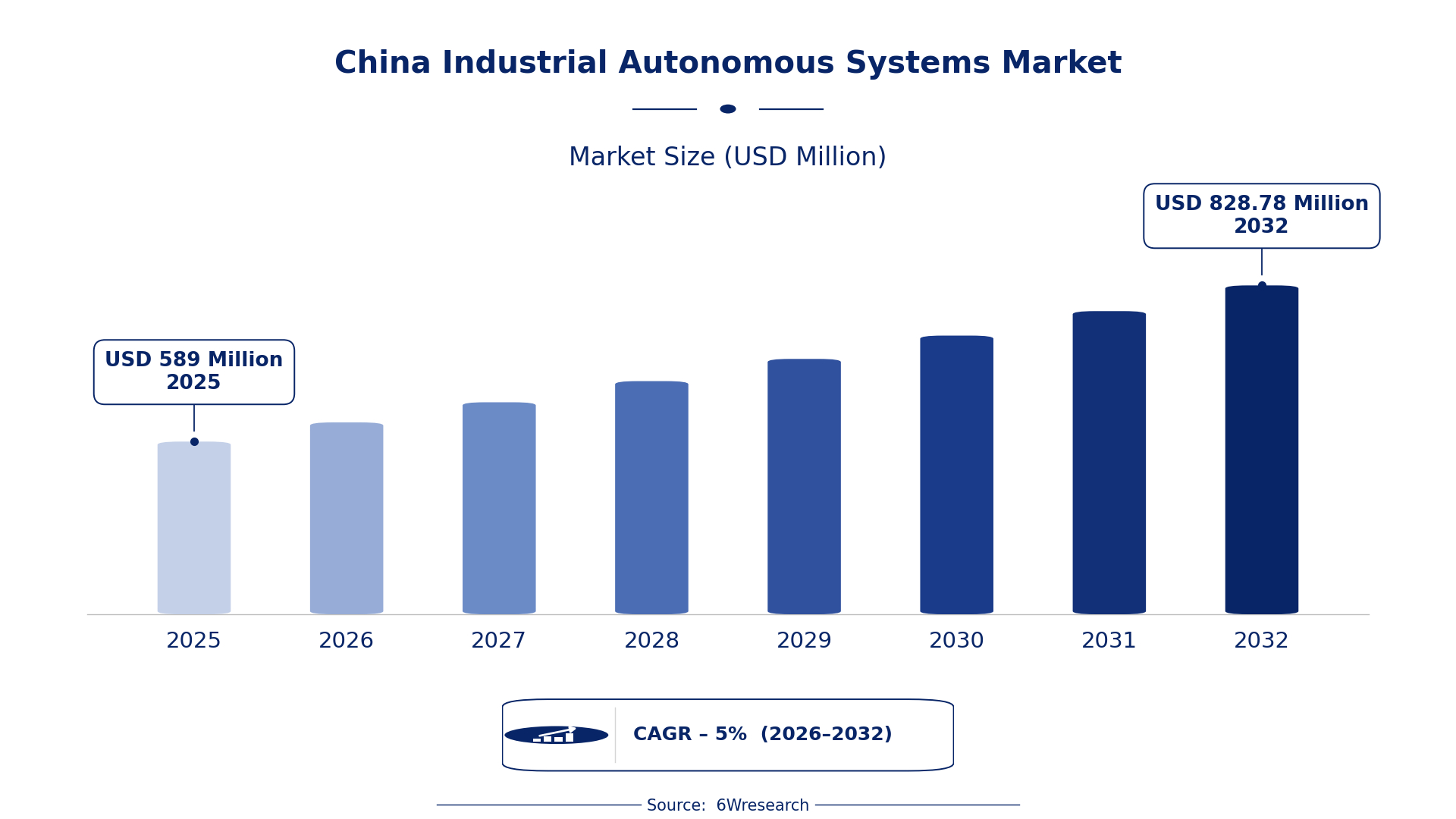
According to 6Wresearch internal database and industry insights, the China Industrial Autonomous Systems Market was valued at USD 589.0 million in 2025 and is projected to reach USD 828.78 million by 2032, growing at a CAGR of approximately 5% during 2026–2032.
China Industrial Autonomous Systems Market Highlights
| Report Metric | Details |
| Report Name | China Industrial Autonomous Systems Market |
| Market Size 2025 | USD 589.0 million |
| Market Size 2032 | USD 828.78 million |
| Absolute Growth 2025–2032 | USD 239.78 million |
| CAGR 2026–2032 | 5% |
| Peak Annual Growth | 6.4% in 2031 |
| Forecast Period | 2026–2032 |
| Historical Data | 2022–2025 |
| Base Year | 2025 |
| Leading System Type, 2025 | Autonomous Guided Vehicles (AGVs) (41% share) |
| Leading Autonomy Level, 2025 | Fully Autonomous (45% share) |
| Leading Sensor Integration, 2025 | RFID + Vision Systems (43% share) |
| Leading End User, 2025 | Logistics Centers (41% share) |
| Fastest-Growing System Type | AI-Driven Robots (7.7% CAGR) |
| Fastest-Growing Autonomy Level | Adaptive Control (6.4% CAGR) |
| Fastest-Growing Sensor Integration | LIDAR + Proximity Sensors (6.5% CAGR) |
| Fastest-Growing End User | Assembly Lines (7.2% CAGR) |
| Growing Sector | Logistics Centers |
| Key End Users | Manufacturers, Logistics Providers, Assembly Facilities, Metalworking Companies |
China Industrial Autonomous Systems Market Year-wise Growth Rate and Key Drivers (2022–2032)
This graph illustrates the annual growth rates of the market from 2022 to 2032, highlighting a steady upward trajectory and projected market expansion over the forecast period.
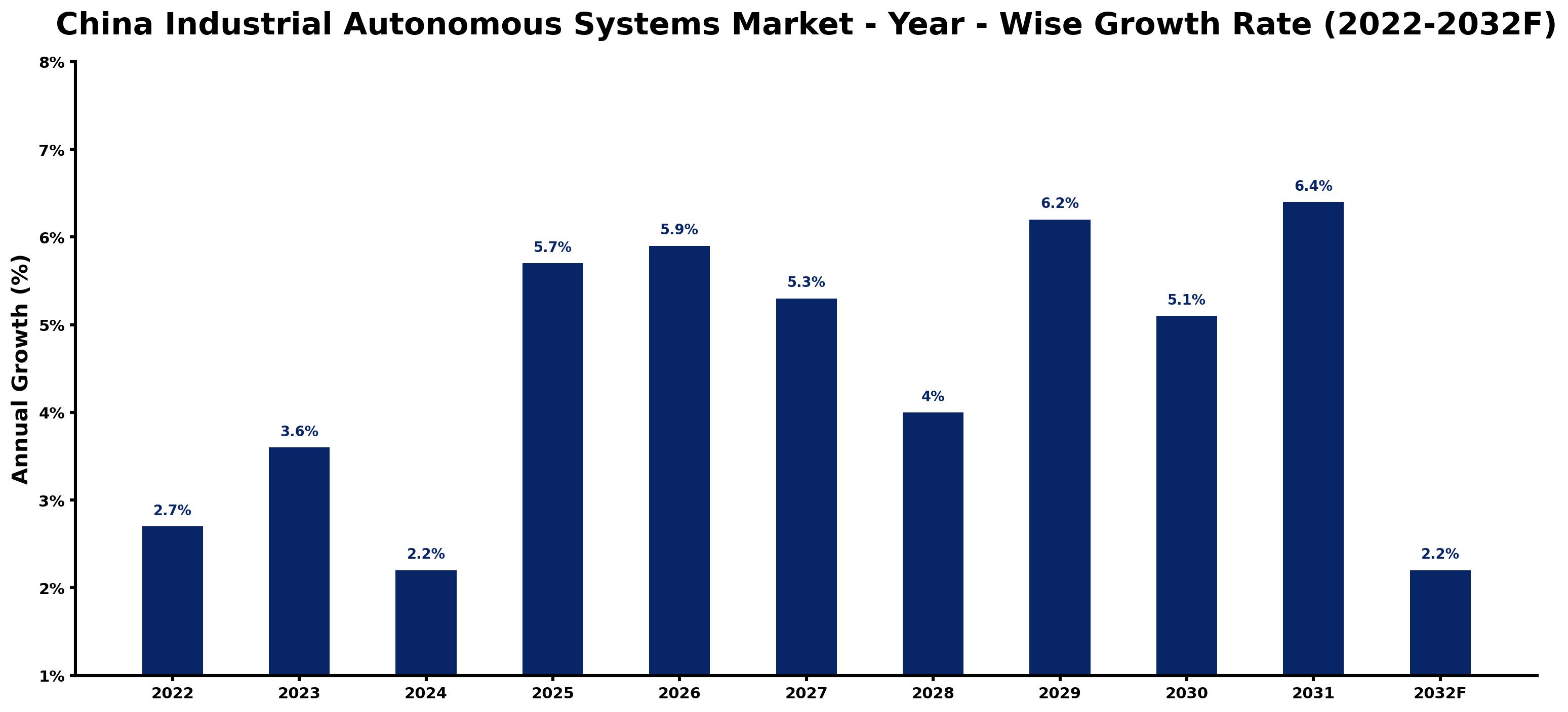
Year by year, the estimates below pair each growth rate with the development that shaped it.
| Year | Estimated Annual Growth (%) | Market Rationale |
| 2022 | 2.7 | The market exhibited steady demand from logistics centers and manufacturing facilities. |
| 2023 | 3.6 | Growth accelerated due to increased automation in manufacturing processes across various sectors. |
| 2024 | 2.2 | Demand growth slowed as the market adjusted to previous rapid expansions. |
| 2025 | 5.7 | The logistics sector's expansion boosted the adoption of autonomous systems, driven by the 'Made in China 2025' strategy. |
| 2026 | 5.9 | Increased investments in smart manufacturing technologies will further drive demand for automation, supported by the 'Smart Manufacturing 2025' initiative. |
| 2027 | 5.3 | Growth is expected to moderate as the market matures and competition intensifies among suppliers, particularly in logistics. |
| 2028 | 4.0 | Demand is projected to continue slowing as companies focus on optimising existing automation systems, aligning with the 'AI Innovation Action Plan'. |
| 2029 | 6.2 | A resurgence in logistics demand is anticipated to lead to renewed interest in autonomous systems, influenced by the growing logistics sector. |
| 2030 | 5.1 | Growth is expected to slow again as market saturation begins to affect new investments, particularly in manufacturing. |
| 2031 | 6.4 | The market is projected to peak with a surge in AI integration across manufacturing sectors, as targeted by the 'New Infrastructure Plan'. |
| 2032 | 2.2 | Demand growth is expected to normalise as the market stabilises after rapid expansions, reflecting the outcomes of recent government initiatives. |
Note: Market size estimations and growth projections presented in this report are based on 6Wresearch's proprietary forecasting methodology, utilizing the latest available industry data, government publications, and primary research inputs.
China Industrial Autonomous Systems Market Synopsis
Industrial Autonomous Systems in China encompass advanced technologies designed to improve operational efficiency across various industries. These systems include robotics and automated vehicles that streamline logistics and enhance manufacturing processes. The China Industrial Autonomous Systems Market is growing due to substantial investments in automation and the expanding logistics sector. With the logistics sector projected to reach 12 trillion yuan by 2025, demand for these systems is on the rise. Government initiatives, such as the 'Smart Manufacturing 2025', further support this growth by promoting the adoption of automation.
Market Dynamics Impact Analysis (2026–2032)
| Factor | Type | Impact | Primary Segment Affected |
| Increased demand for automation in logistics centers | Driver | High | Logistics Centers |
| Growing integration of AI technologies in manufacturing | Driver | High | Autonomous Guided Vehicles (AGVs) |
| Investment in automation technologies in manufacturing | Opportunity | High | Autonomous Guided Vehicles (AGVs) |
| Rising need for efficient inventory management solutions | Opportunity | High | Logistics Centers |
| High initial investment costs for autonomous systems | Restraint | High | Autonomous Guided Vehicles (AGVs) |
| Limited awareness of automation benefits among smaller manufacturers | Restraint | Medium | Autonomous Guided Vehicles (AGVs) |
| Challenges in integrating new technologies with legacy systems | Challenge | High | AI-Driven Robots |
| Regulatory hurdles in the approval of autonomous systems | Challenge | Medium | Autonomous CNC Machines |
Evaluation of Drivers in China Industrial Autonomous Systems Market (2026–2032)
The factors lifting demand, and the evidence behind each, are summarised below.
| Drivers | Primary Segment Affected | Why It Matters (Evidence) |
| Increased automation in logistics | Logistics Centers | The logistics sector is projected to grow to 12 trillion yuan by 2025, driving demand for autonomous systems. |
| Adoption of AI technologies | Autonomous Guided Vehicles (AGVs) | The government aims for a 30% increase in AI adoption in manufacturing by 2025, leading to more automation. |
| Growing demand for precision in manufacturing | Autonomous CNC Machines | Over 50% of manufacturing facilities in China have adopted automation, enhancing efficiency and precision. |
| Investment in smart manufacturing technologies | Autonomous Guided Vehicles (AGVs) | The Chinese government allocated 50 billion yuan for smart manufacturing technologies, boosting automation adoption. |
| Integration of robotics in assembly lines | Assembly Lines | The automotive industry is rapidly integrating autonomous systems, with over 30% of new plants featuring automation. |
Growth in the Industrial Autonomous Systems market in China stems from increased automation in logistics, rising adoption of AI technologies, and substantial investments in smart manufacturing. The logistics sector is projected to reach 12 trillion yuan by 2025, driving demand for autonomous solutions. More than 50% of manufacturing facilities have embraced automation, improving operational efficiency. The automotive industry is integrating autonomous systems, with over 30% of new plants featuring automation, indicating strong future demand.
Evaluation of Restraints in China Industrial Autonomous Systems Market
The main factors holding the market back are set out below.
| Market Restraint | Primary Segment Affected | Why It Matters (Evidence) |
| High initial investment costs | Autonomous Guided Vehicles (AGVs) | The high costs associated with implementing autonomous systems deter smaller manufacturers from investing, with initial costs reaching up to 1 million yuan per unit. |
| Limited awareness of automation benefits | Autonomous Guided Vehicles (AGVs) | Many smaller manufacturers lack knowledge about the advantages of automation, hindering market growth and preventing them from transitioning to automated solutions. |
| Challenges in technology integration | AI-Driven Robots | Integrating new autonomous technologies with existing legacy systems poses challenges for manufacturers, often resulting in delays of several months. |
| Regulatory hurdles in approvals | Autonomous CNC Machines | The regulatory environment can delay the approval process for new autonomous systems, affecting market entry and increasing time to deployment. |
| Supply chain disruptions | Logistics Centers | Global supply chain issues can impact the availability of components needed for autonomous systems, potentially delaying projects by several months. |
China Industrial Autonomous Systems Market Challenges
The China Industrial Autonomous Systems market faces high costs that significantly limit adoption, with advanced robotics priced up to 1 million yuan per unit, making it prohibitive for smaller manufacturers. Limited technological infrastructure hampers automation integration, causing production delays that can extend timelines by up to six weeks for companies relying on outdated systems. Buyers in the logistics sector encounter inefficiencies due to inadequate automation, inflating operational costs by as much as 20% of total logistics expenses. Supply chain disruptions, particularly in sourcing critical components, can delay project timelines for manufacturers by several months, threatening their competitiveness.
Trends in the China Industrial Autonomous Systems Market
Several trends are reshaping the China Industrial Autonomous Systems Market; the most important are set out below.
- Shift from Manual to Automated Logistics: Since 2021, logistics centres in China have increasingly adopted automated systems, improving efficiency. The logistics sector is projected to grow to 12 trillion yuan by 2025, driving further automation.
- Transition to AI-Driven Manufacturing: In 2020, the focus on AI technologies in manufacturing intensified, leading to greater automation. The government aims for a 30% increase in AI adoption by 2025, impacting production processes.
- Emergence of Fully Autonomous Systems: As of 2023, fully autonomous systems are gaining traction in various industries. With a projected growth rate of 6.4% by 2031, these systems are set to transform operational efficiency.
- Prioritisation of Robotics in Assembly Lines: Since 2021, assembly lines are increasingly integrating robotics for faster production. Over 30% of new automotive plants feature automation, reflecting this growing trend.
Investment Opportunities in the China Industrial Autonomous Systems Market
Below are the investment opportunities with the strongest case in the China Industrial Autonomous Systems Market.
- Logistics Centers Expanding Automation: Logistics centres in China are investing heavily in automation technologies, with the sector expected to reach 12 trillion yuan by 2025. Local partnerships can facilitate entry into this growing market.
- Supply of AI-Driven Solutions: The Chinese government allocated 50 billion yuan for smart manufacturing technologies, creating opportunities for suppliers. Collaborating with local manufacturers can improve market penetration.
- Assembly Lines Upgrading Automation: Assembly lines are increasingly integrating robotics for efficiency. With a projected growth of 7.2% in this sector, suppliers can focus on providing advanced robotic solutions.
- Integration of Autonomous CNC Machines: Manufacturers are looking to upgrade their CNC machines to autonomous models. The growing demand for precision in manufacturing supports investments in these technologies.
Government Initiatives in the China Industrial Autonomous Systems Market
The 'Smart Manufacturing 2025' initiative, launched by the Ministry of Industry and Information Technology in 2021, aims to improve automation in manufacturing. This initiative targets a 30% increase in AI adoption by 2025, encouraging manufacturers to invest in advanced technologies. The 'Made in China 2025' strategy, updated in 2023, focuses on boosting the industrial robotics sector, aiming for a 50% increase in domestic robot production by 2025. These measures directly impact the adoption of industrial autonomous systems in China.
The 'New Infrastructure Plan', introduced in 2020, allocates 1 trillion yuan over five years for the development of AI and robotics technologies. This funding supports the integration of AI in logistics, facilitating a 20% increase in efficiency by 2025. The National Development and Reform Commission oversees this plan, ensuring that funds are directed towards projects that improve automation. The Ministry of Science and Technology's 'AI Innovation Action Plan', launched in 2020, focuses on enhancing AI capabilities in industrial applications, with a budget of 100 billion yuan.
Future Insight of the China Industrial Autonomous Systems Market
By 2032, buyers and suppliers in the China Industrial Autonomous Systems market can expect substantial advancements driven by key initiatives. The government's 'Made in China 2025' plan will promote the adoption of advanced manufacturing technologies, improving operational efficiency. The logistics sector is projected to grow to 12 trillion yuan, further driving demand for automation solutions. With the average installed base of industrial robots reaching around 200,000 units, the shift towards automation will lead to improved productivity and reduced costs for manufacturers, transforming operational strategies across various industries.
Market Segmentation Analysis
Each segment group is reviewed below, with the leader by share and the fastest grower by CAGR.
By System Type – Autonomous Guided Vehicles (AGVs) Dominated, AI-Driven Robots Expected to Grow Fastest
According to Sachin Kumar Rai, Senior Research Analyst at 6Wresearch, Autonomous Guided Vehicles (AGVs) took a 41% share of system type in 2025, more than any other category. Autonomous Guided Vehicles (AGVs) hold the largest market share as they are extensively used for material transport in warehouses and factories. Their integration into over 50% of manufacturing facilities demonstrates their essential role in improving operational efficiency across various sectors. AI-Driven Robots are projected to grow fastest, at a CAGR of 7.7% during 2026–2032. AI-Driven Robots are rapidly gaining popularity as industries adopt advanced robotics for assembly and quality control tasks, driven by government initiatives promoting automation. This trend will likely continue as manufacturers strive to enhance productivity and operational efficiency. Suppliers should focus on developing advanced robotic solutions to meet the growing demand in the industrial sector.
By Autonomy Level – Fully Autonomous Dominated, Adaptive Control Expected to Grow Fastest
With a 45% revenue share in 2025, Fully Autonomous was the largest autonomy level category. Fully Autonomous systems dominate the market as they represent the pinnacle of automation, appealing to manufacturers seeking cutting-edge solutions to improve productivity. The government's push for initiatives like 'Smart Manufacturing 2025' further encourages the adoption of these advanced technologies. Over 2026–2032, Adaptive Control is expected to post the fastest growth, at a CAGR of 6.4%. Adaptive Control is the fastest-growing segment, allowing systems to adjust based on real-time data, which is crucial for optimising operations in dynamic environments. This capability is increasingly sought after as industries face diverse operational challenges. Buyers should invest in adaptive technologies to ensure their operations remain resilient to market fluctuations.
By Sensor Integration – RFID + Vision Systems Dominated, LIDAR + Proximity Sensors Expected to Grow Fastest
RFID + Vision Systems held a 43% share of the China Industrial Autonomous Systems Market by sensor integration in 2025. RFID + Vision Systems lead the market due to their effectiveness in inventory management and tracking, which are vital for logistics and manufacturing operations. Their established presence across various facilities highlights their importance in streamlining processes and enhancing efficiency. The quickest growth will come from LIDAR + Proximity Sensors, forecast to expand at a CAGR of 6.5% between 2026 and 2032. LIDAR + Proximity Sensors are experiencing rapid growth as they significantly improve navigation and obstacle detection, essential for the safe operation of autonomous systems in complex environments. This demand is driven by the increasing complexities within logistics and manufacturing settings. Suppliers must advance sensor technologies to remain competitive and address the evolving market needs.
By End User – Logistics Centers Dominated, Assembly Lines Expected to Grow Fastest
The largest end user category in 2025 was Logistics Centers, with a 41% share of total revenue. Logistics Centers are the primary users of autonomous systems, leveraging them to improve efficiency in material handling and distribution processes. With the logistics sector projected to grow significantly, reliance on these systems will continue to increase. Assembly Lines are set to record the highest CAGR in this split, 7.2% over 2026–2032. Assembly Lines are witnessing the fastest growth as manufacturers integrate robots to accelerate production cycles and enhance quality control. This trend reflects the broader movement towards automation in manufacturing processes. Manufacturers should prioritise automation solutions to boost production efficiency and maintain a competitive edge.
Key Attractiveness of the Report
- 10 Years of Market Numbers
- Historical Data Starting from 2022 to 2025
- Base Year 2025
- Forecast Data until 2032
- Key Performance Indicators Impacting the Market
- Major Upcoming Developments and Projects
Key Highlights of the Report:
- China Industrial Autonomous Systems Market Outlook
- Market Size of China Industrial Autonomous Systems Market, 2025
- Forecast of China Industrial Autonomous Systems Market, 2032
- Historical Data and Forecast of China Industrial Autonomous Systems Revenues & Volume for the Period 2022 - 2032F
- China Industrial Autonomous Systems Market Trend Evolution
- China Industrial Autonomous Systems Market Drivers and Challenges
- China Industrial Autonomous Systems Price Trends
- China Industrial Autonomous Systems Porter's Five Forces
- China Industrial Autonomous Systems Industry Life Cycle
- Historical Data and Forecast of China Industrial Autonomous Systems Market Revenues & Volume By System Type for the Period 2022 - 2032F
- Historical Data and Forecast of China Industrial Autonomous Systems Market Revenues & Volume By Autonomous Guided Vehicles (AGVs) for the Period 2022 - 2032F
- Historical Data and Forecast of China Industrial Autonomous Systems Market Revenues & Volume By Autonomous CNC Machines for the Period 2022 - 2032F
- Historical Data and Forecast of China Industrial Autonomous Systems Market Revenues & Volume By AI-Driven Robots for the Period 2022 - 2032F
- Historical Data and Forecast of China Industrial Autonomous Systems Market Revenues & Volume By Self-Diagnosing Systems for the Period 2022 - 2032F
- Historical Data and Forecast of China Industrial Autonomous Systems Market Revenues & Volume By Autonomy Level for the Period 2022 - 2032F
- Historical Data and Forecast of China Industrial Autonomous Systems Market Revenues & Volume By Partial/Predefined for the Period 2022 - 2032F
- Historical Data and Forecast of China Industrial Autonomous Systems Market Revenues & Volume By Adaptive Control for the Period 2022 - 2032F
- Historical Data and Forecast of China Industrial Autonomous Systems Market Revenues & Volume By Fully Autonomous for the Period 2022 - 2032F
- Historical Data and Forecast of China Industrial Autonomous Systems Market Revenues & Volume By Predictive Failure for the Period 2022 - 2032F
- Historical Data and Forecast of China Industrial Autonomous Systems Market Revenues & Volume By Sensor Integration for the Period 2022 - 2032F
- Historical Data and Forecast of China Industrial Autonomous Systems Market Revenues & Volume By RFID + Vision Systems for the Period 2022 - 2032F
- Historical Data and Forecast of China Industrial Autonomous Systems Market Revenues & Volume By Load + Thermal Sensors for the Period 2022 - 2032F
- Historical Data and Forecast of China Industrial Autonomous Systems Market Revenues & Volume By LIDAR + Proximity Sensors for the Period 2022 - 2032F
- Historical Data and Forecast of China Industrial Autonomous Systems Market Revenues & Volume By Embedded Health Sensors for the Period 2022 - 2032F
- Historical Data and Forecast of China Industrial Autonomous Systems Market Revenues & Volume By End User for the Period 2022 - 2032F
- Historical Data and Forecast of China Industrial Autonomous Systems Market Revenues & Volume By Logistics Centers for the Period 2022 - 2032F
- Historical Data and Forecast of China Industrial Autonomous Systems Market Revenues & Volume By Metalworking Facilities for the Period 2022 - 2032F
- Historical Data and Forecast of China Industrial Autonomous Systems Market Revenues & Volume By Assembly Lines for the Period 2022 - 2032F
- Historical Data and Forecast of China Industrial Autonomous Systems Market Revenues & Volume By Power Equipment OEMs for the Period 2022 - 2032F
- China Industrial Autonomous Systems Import Export Trade Statistics
- Market Opportunity Assessment By System Type
- Market Opportunity Assessment By Autonomy Level
- Market Opportunity Assessment By Sensor Integration
- Market Opportunity Assessment By End User
- China Industrial Autonomous Systems Top Companies Market Share
- China Industrial Autonomous Systems Competitive Benchmarking By Technical and Operational Parameters
- China Industrial Autonomous Systems Company Profiles
- China Industrial Autonomous Systems Key Strategic Recommendations
Market Covered
This report examines the market across the segments below.
By System Type
- Autonomous Guided Vehicles (AGVs)
- Autonomous CNC Machines
- AI-Driven Robots
- Self-Diagnosing Systems
By Autonomy Level
- Partial/Predefined
- Adaptive Control
- Fully Autonomous
- Predictive Failure
By Sensor Integration
- RFID + Vision Systems
- Load + Thermal Sensors
- LIDAR + Proximity Sensors
- Embedded Health Sensors
By End User
- Logistics Centers
- Metalworking Facilities
- Assembly Lines
- Power Equipment OEMs































