India Industrial Bleaching Agents Market Size & Growth Rate
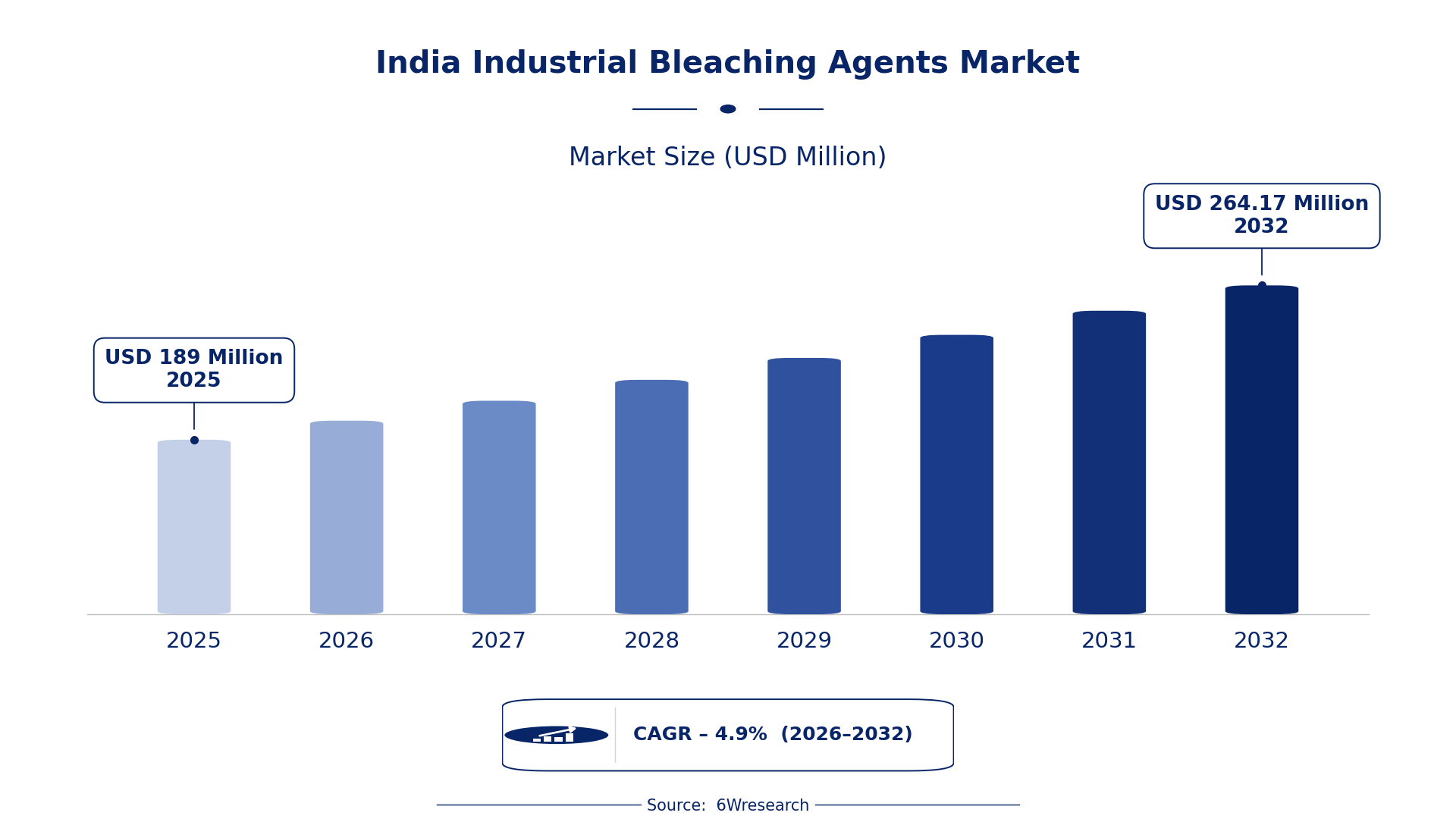
According to 6Wresearch internal database and industry insights, the India Industrial Bleaching Agents Market was valued at USD 189.0 million in 2025 and is projected to reach USD 264.17 million by 2032, growing at a CAGR of approximately 4.9% during 2026–2032.
India Industrial Bleaching Agents Market Highlights
| Report Metric | Details |
| Report Name | India Industrial Bleaching Agents Market |
| Market Size 2025 | USD 189.0 million |
| Market Size 2032 | USD 264.17 million |
| Absolute Growth 2025–2032 | USD 75.17 million |
| CAGR 2026–2032 | 4.9% |
| Peak Annual Growth | 7.4% in 2028 |
| Forecast Period | 2026–2032 |
| Historical Data | 2022–2025 |
| Base Year | 2025 |
| Leading Bleaching Agent Type, 2025 | Hydrogen Peroxide (40% share) |
| Leading Base Compound, 2025 | Oxygen-Based (43% share) |
| Leading Industry Application, 2025 | Pulp & Paper (43% share) |
| Leading End User, 2025 | Paper Manufacturers (35% share) |
| Fastest-Growing Bleaching Agent Type | Chlorine-Based Agents (7.7% CAGR) |
| Fastest-Growing Base Compound | Sodium Hypochlorite (6.1% CAGR) |
| Fastest-Growing Industry Application | Textile Whitening (5.9% CAGR) |
| Fastest-Growing End User | Fabric Processing Plants (7.2% CAGR) |
| Growing Sector | Textile Industry |
| Key End Users | Textile Manufacturers, Paper Manufacturers, Fabric Processing Plants |
India Industrial Bleaching Agents Market Year-wise Growth Rate and Key Drivers (2022–2032)
This graph illustrates the annual growth rates of the market from 2022 to 2032, highlighting a steady upward trajectory and projected market expansion over the forecast period.
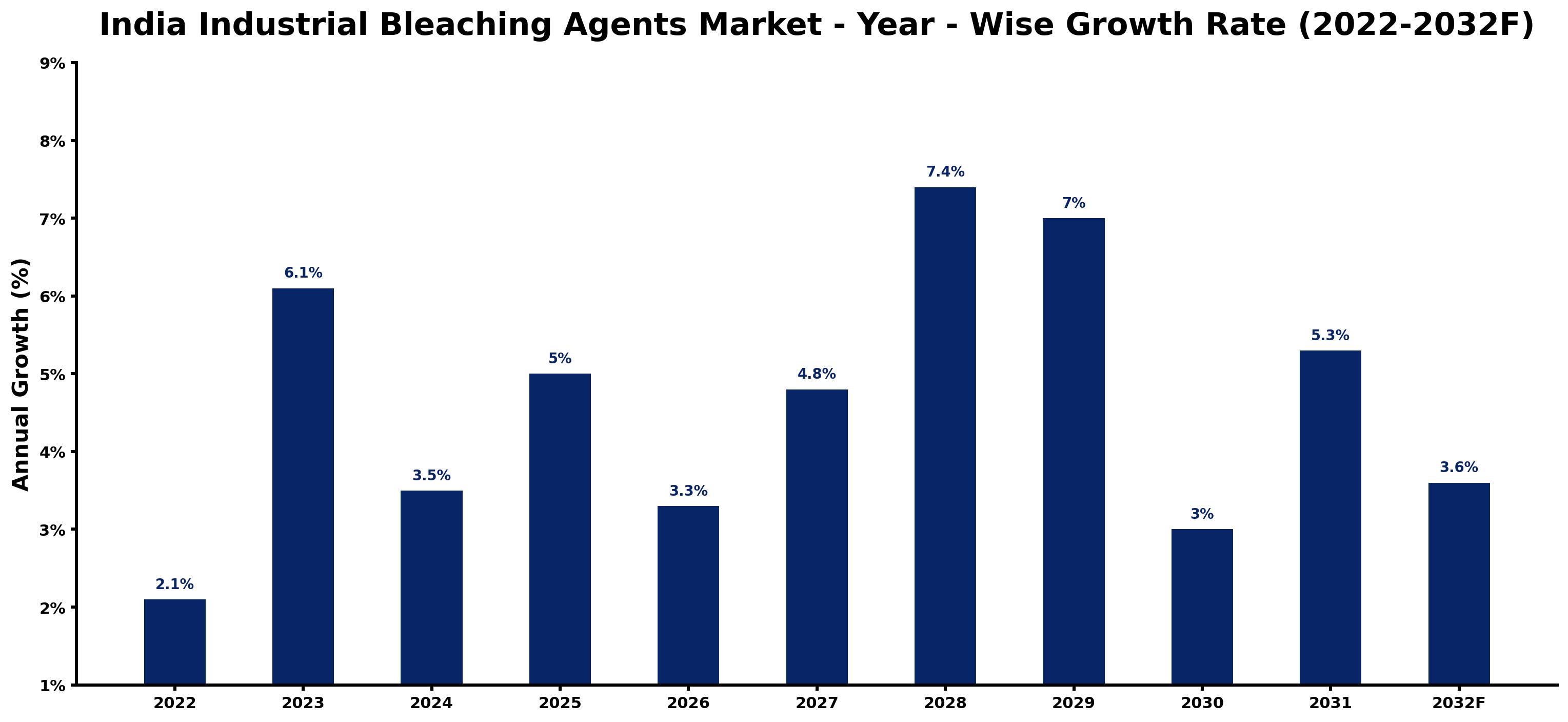
The following table presents the estimated annual growth rate for each year together with the principal factor influencing market performance.
| Year | Estimated Annual Growth (%) | Market Rationale |
| 2022 | 2.1 | The market showed steady growth with established demand from the textile sector. |
| 2023 | 6.1 | Growth accelerated due to increased production in the textile industry, valued at approximately $150 billion. |
| 2024 | 3.5 | A slowdown occurred as production stabilised, reflecting adjustments in the textile sector. |
| 2025 | 5.0 | Demand surged again as the Pulp and Paper industry projected to reach 20 million tons by 2025. |
| 2026 | 3.3 | Growth is expected to slow as producers face challenges in meeting environmental standards. |
| 2027 | 4.8 | Increased investments in sustainable practices are projected to boost demand for eco-friendly bleaching agents. |
| 2028 | 7.4 | The market is expected to peak due to heightened demand from both textile and paper manufacturers. |
| 2029 | 7.0 | A slight slowdown is projected as the market adjusts to previous high growth rates. |
| 2030 | 3.0 | Continued growth is expected, driven by ongoing investments in sustainable production methods. |
| 2031 | 5.3 | Demand is projected to rise again as the market adapts to changing consumer preferences for eco-friendly products. |
| 2032 | 3.6 | Growth is expected to slow as the market stabilises, reflecting a mature phase in production and consumption. |
Note: Market size estimations and growth projections presented in this report are based on 6Wresearch's proprietary forecasting methodology, utilizing the latest available industry data, government publications, and primary research inputs.
India Industrial Bleaching Agents Market Synopsis
The India Industrial Bleaching Agents Market encompasses chemical compounds used to whiten materials across various industries. These agents are primarily produced through chemical synthesis and are important in pulp and paper production, textile whitening, and food processing. The market is growing due to strong demand from domestic users, particularly in textiles and paper, which are vital sectors of the economy. The National Policy on Textiles aims to increase the sector's contribution to GDP by 2025, further driving growth in this market.
Market Dynamics Impact Analysis (2026–2032)
| Factor | Type | Impact | Primary Segment Affected |
| Rising demand from the textile industry due to increased production and exports. | Driver | High | Hydrogen Peroxide |
| Growing adoption of eco-friendly bleaching agents in various applications. | Driver | High | Enzymatic Bleaching Agents |
| Investment in sustainable practices by textile manufacturers seeking ISO 14001 certification. | Opportunity | High | Eco-Friendly Alternatives |
| Increased production capacity in Maharashtra and Gujarat to meet rising demand. | Opportunity | High | Chlorine-Based Agents |
| Stringent environmental regulations affecting production processes. | Restraint | High | Sodium Hypochlorite |
| Limited awareness of eco-friendly alternatives among smaller manufacturers. | Restraint | Medium | Enzymatic Bleaching Agents |
| Buyers face challenges in sourcing sustainable bleaching agents due to strict compliance requirements. | Challenge | High | Fabric Processing Plants |
| Suppliers struggle with fluctuating raw material costs impacting production efficiency. | Challenge | Medium | Pulp & Paper |
Evaluation of Drivers in India Industrial Bleaching Agents Market (2026–2032)
Below mentioned are some major drivers and their influence on market dynamics.
| Drivers | Primary Segment Affected | Why It Matters (Evidence) |
| Increased production in the textile industry, valued at $150 billion, drives demand for bleaching agents. | Hydrogen Peroxide | Textile manufacturers require effective bleaching solutions to maintain fabric quality. |
| The shift towards sustainable practices encourages the use of eco-friendly bleaching agents. | Enzymatic Bleaching Agents | Producers are adopting these agents to comply with ISO 14001 environmental standards. |
| Investment in modernisation of production facilities boosts output of bleaching agents. | Chlorine-Based Agents | Manufacturers are expanding capacity to meet growing domestic and export demand. |
| The push for ISO 14001 certification among producers promotes the market for eco-friendly products. | Eco-Friendly Alternatives | This certification drives manufacturers to adopt sustainable practices. |
| Growing demand from the Pulp and Paper industry, expected to reach 20 million tons by 2025, increases consumption. | Sodium Hypochlorite | Paper manufacturers require bleaching agents to maintain product quality. |
Growth in the Industrial Bleaching Agents market in India is driven by rising investments in production capacity and increasing end-use demand from major sectors. The textile industry, valued at around $150 billion, propels the need for effective bleaching solutions. The Pulp and Paper industry is expected to reach 20 million tons by 2025, heightening the demand for bleaching agents. Investment in modernising production facilities improves output, enabling manufacturers to satisfy both domestic and export demand. The move towards eco-friendly practices encourages producers to adopt sustainable bleaching agents to meet environmental standards.
Evaluation of Restraints in India Industrial Bleaching Agents Market
The table below lists the restraints and the evidence behind each.
| Market Restraint | Primary Segment Affected | Why It Matters (Evidence) |
| Stringent environmental regulations limit production methods for bleaching agents. | Sodium Hypochlorite | Manufacturers must comply with regulations, increasing operational costs and complexity. |
| Limited awareness of eco-friendly bleaching alternatives among smaller manufacturers restricts market growth. | Enzymatic Bleaching Agents | This lack of knowledge prevents smaller players from adopting sustainable practices. |
| High raw material costs affect the pricing of bleaching agents, impacting buyer decisions. | Hydrogen Peroxide | Increased costs lead to higher prices, making it challenging for buyers to maintain budgets. |
| Supply chain disruptions can delay the availability of key bleaching agents. | Chlorine-Based Agents | Manufacturers face challenges in sourcing materials, affecting production timelines. |
| Competition from alternative bleaching technologies may divert demand away from traditional agents. | Eco-Friendly Alternatives | As new technologies emerge, buyers may opt for sustainable solutions over conventional agents. |
India Industrial Bleaching Agents Market Challenges
Producers in the India Industrial Bleaching Agents market encounter challenges from strict regulations imposed by the Bureau of Indian Standards, which can delay product approvals and raise compliance costs by 15%. Importers face supply chain disruptions stemming from fluctuations in raw material availability, leading to delays that affect production schedules for textile and paper manufacturers. Rising raw material prices exert cost pressures, with producers reporting increases of 10-12% over the past year, ultimately influencing pricing strategies for end-users. Competition intensifies as traditional producers must adapt to the demand for eco-friendly alternatives, risking market share if they do not evolve.
Trends in the India Industrial Bleaching Agents Market
Four trends stand out in the India Industrial Bleaching Agents Market.
- Shift towards Eco-Friendly Practices in Maharashtra: Maharashtra is increasingly adopting eco-friendly bleaching agents, supported by the 'Textile Technology Mission' launched in 2021. This initiative promotes sustainable practices, with an expected increase in eco-friendly product adoption by 30%.
- Transition from Traditional to Sustainable Bleaching Agents: Since 2021, the textile sector has seen a shift towards sustainable bleaching agents, reflecting changing consumer preferences for environmentally safe products. This trend is expected to increase the demand for eco-friendly alternatives by 25%.
- Emergence of Enzymatic Bleaching Agents: Enzymatic bleaching agents are gaining traction in India, with a 15% increase in adoption among textile manufacturers. This shift is driven by the need for lower environmental impact and compliance with sustainability standards.
- Growing Demand from Pulp and Paper Industry: The Pulp and Paper industry is increasingly relying on bleaching agents, with a projected growth of 20 million tons by 2025. This demand is pushing manufacturers to enhance production capabilities.
Investment Opportunities in the India Industrial Bleaching Agents Market
Some of the investment opportunities in the India Industrial Bleaching Agents Market are mentioned below.
- Investment in Sustainable Production: With the Indian textile industry valued at $150 billion, there is an opportunity to invest in sustainable bleaching agents. Manufacturers can tap into this market by partnering with local producers to promote eco-friendly practices.
- Supply of Eco-Friendly Alternatives: The growing interest in sustainable practices creates a demand for eco-friendly bleaching agents. Suppliers can focus on providing these alternatives to textile manufacturers seeking ISO 14001 certification.
- Entry into the Pulp and Paper Sector: The Pulp and Paper industry, projected to reach 20 million tons by 2025, presents an opportunity for suppliers. Collaborating with key players in this sector can facilitate market entry and growth.
- Expansion in Gujarat's Textile Market: Gujarat's textile industry is expanding rapidly, providing an opportunity for suppliers of bleaching agents. Establishing joint ventures with local manufacturers can enhance market presence.
Government Initiatives in the India Industrial Bleaching Agents Market
The 'Swachh Bharat Mission' promotes the use of environmentally safe bleaching agents in sanitation and hygiene applications, launched by the Ministry of Housing and Urban Affairs in 2020. This initiative encourages manufacturers to adopt safe practices and improve product quality.
The 'Make in India' initiative, launched in 2014, has been updated to include incentives for the production of industrial chemicals, including bleaching agents, to reduce import dependency. This initiative supports local manufacturers in enhancing their production capabilities.
Future Insight of the India Industrial Bleaching Agents Market
The India Industrial Bleaching Agents market will shift towards eco-friendly solutions by 2032, with the Textile Technology Mission promoting sustainable practices. The 'Make in India' initiative will strengthen local manufacturing capabilities, reducing reliance on imports and bolstering supply chain resilience. As the pulp and paper industry is projected to reach 20 million tons by 2025, demand for efficient bleaching agents will rise, positively impacting both suppliers and end-users. Producers will need to continuously innovate to meet market requirements and maintain their competitive edge.
Market Segmentation Analysis
Each segment group is reviewed below, with the leader by share and the fastest grower by CAGR.
By Bleaching Agent Type – Hydrogen Peroxide Dominated, Chlorine-Based Agents Expected to Grow Fastest
According to Sachin Kumar Rai, Senior Research Analyst at 6Wresearch, Hydrogen Peroxide accounted for a 40% market share by bleaching agent type in 2025. Hydrogen Peroxide commands the largest share in the India Industrial Bleaching Agents Market due to its widespread application in both textile and paper industries. Its effectiveness in achieving desired bleaching results makes it a staple for manufacturers, particularly in states like Maharashtra and Gujarat. Over 2026–2032, Chlorine-Based Agents are expected to post the fastest growth, at a CAGR of 7.7%. Chlorine-Based Agents are witnessing rapid growth, driven by their superior efficiency in bleaching processes, especially in textiles. The increasing demand for effective bleaching solutions is reflected in the higher adoption rates reported in recent years. Suppliers should prioritise the production and distribution of Chlorine-Based Agents to effectively meet the rising demand.
By Base Compound – Oxygen-Based Dominated, Sodium Hypochlorite Expected to Grow Fastest
Oxygen-Based held a 43% share of the India Industrial Bleaching Agents Market by base compound in 2025. Oxygen-Based compounds lead the market share as they are fundamental to many bleaching agents, extensively used across various applications. Their established role in the textile and paper sectors ensures a steady demand, particularly as industries expand. Sodium Hypochlorite is set to record the highest CAGR in this split, 6.1% over 2026–2032. Sodium Hypochlorite is growing quickly due to its prevalent use in textile and paper industries, where efficient bleaching is essential. The rising production capacities in these sectors significantly contribute to the demand for Sodium Hypochlorite. Buyers should secure long-term contracts with Sodium Hypochlorite suppliers to guarantee availability as demand increases.
By Industry Application – Pulp & Paper Dominated, Textile Whitening Expected to Grow Fastest
With a 43% revenue share in 2025, Pulp & Paper was the largest industry application category. Pulp & Paper is the primary application area for bleaching agents, capturing a significant share of the market due to the extensive bleaching needs in paper production. The industry's projected growth to 20 million tons by 2025 reinforces its dominant position. The quickest growth will come from Textile Whitening, forecast to expand at a CAGR of 5.9% between 2026 and 2032. Textile Whitening is the fastest-growing application, spurred by the textile industry's value of approximately $150 billion, which increasingly requires effective bleaching solutions. This growth is further supported by initiatives promoting sustainable practices in textile processing. Suppliers should focus marketing efforts on the textile sector to capitalise on the rapid growth in textile whitening applications.
By End User – Paper Manufacturers Dominated, Fabric Processing Plants Expected to Grow Fastest
Paper Manufacturers took a 35% share of end user in 2025, more than any other category. Paper Manufacturers constitute the largest share of end users for bleaching agents, primarily due to their crucial role in producing high-quality paper products. The ongoing expansion of the pulp and paper industry in India further strengthens the demand from this sector. Fabric Processing Plants are projected to grow fastest, at a CAGR of 7.2% during 2026–2032. Fabric Processing Plants are the fastest-growing end users as the textile industry increases production and seeks efficient bleaching methods. This growth is bolstered by government initiatives aimed at promoting sustainable textile practices. Suppliers need to tailor their offerings to meet the specific requirements of Fabric Processing Plants to seize this expanding market segment.
Key Attractiveness of the Report
- 10 Years of Market Numbers
- Historical Data Starting from 2022 to 2025
- Base Year 2025
- Forecast Data until 2032
- Key Performance Indicators Impacting the Market
- Major Upcoming Developments and Projects
Key Highlights of the Report:
- India Industrial Bleaching Agents Market Outlook
- Market Size of India Industrial Bleaching Agents Market, 2025
- Forecast of India Industrial Bleaching Agents Market, 2032
- Historical Data and Forecast of India Industrial Bleaching Agents Revenues & Volume for the Period 2022 - 2032F
- India Industrial Bleaching Agents Market Trend Evolution
- India Industrial Bleaching Agents Market Drivers and Challenges
- India Industrial Bleaching Agents Price Trends
- India Industrial Bleaching Agents Porter's Five Forces
- India Industrial Bleaching Agents Industry Life Cycle
- Historical Data and Forecast of India Industrial Bleaching Agents Market Revenues & Volume By Bleaching Agent Type for the Period 2022 - 2032F
- Historical Data and Forecast of India Industrial Bleaching Agents Market Revenues & Volume By Hydrogen Peroxide for the Period 2022 - 2032F
- Historical Data and Forecast of India Industrial Bleaching Agents Market Revenues & Volume By Chlorine-Based Agents for the Period 2022 - 2032F
- Historical Data and Forecast of India Industrial Bleaching Agents Market Revenues & Volume By Sulfur Dioxide for the Period 2022 - 2032F
- Historical Data and Forecast of India Industrial Bleaching Agents Market Revenues & Volume By Enzymatic Bleaching Agents for the Period 2022 - 2032F
- Historical Data and Forecast of India Industrial Bleaching Agents Market Revenues & Volume By Base Compound for the Period 2022 - 2032F
- Historical Data and Forecast of India Industrial Bleaching Agents Market Revenues & Volume By Oxygen-Based for the Period 2022 - 2032F
- Historical Data and Forecast of India Industrial Bleaching Agents Market Revenues & Volume By Sodium Hypochlorite for the Period 2022 - 2032F
- Historical Data and Forecast of India Industrial Bleaching Agents Market Revenues & Volume By Gas Phase for the Period 2022 - 2032F
- Historical Data and Forecast of India Industrial Bleaching Agents Market Revenues & Volume By Laccases, Peroxidases for the Period 2022 - 2032F
- Historical Data and Forecast of India Industrial Bleaching Agents Market Revenues & Volume By Industry Application for the Period 2022 - 2032F
- Historical Data and Forecast of India Industrial Bleaching Agents Market Revenues & Volume By Pulp & Paper for the Period 2022 - 2032F
- Historical Data and Forecast of India Industrial Bleaching Agents Market Revenues & Volume By Textile Whitening for the Period 2022 - 2032F
- Historical Data and Forecast of India Industrial Bleaching Agents Market Revenues & Volume By Sugar & Food Processing for the Period 2022 - 2032F
- Historical Data and Forecast of India Industrial Bleaching Agents Market Revenues & Volume By Eco-Friendly Alternatives for the Period 2022 - 2032F
- Historical Data and Forecast of India Industrial Bleaching Agents Market Revenues & Volume By End User for the Period 2022 - 2032F
- Historical Data and Forecast of India Industrial Bleaching Agents Market Revenues & Volume By Paper Manufacturers for the Period 2022 - 2032F
- Historical Data and Forecast of India Industrial Bleaching Agents Market Revenues & Volume By Fabric Processing Plants for the Period 2022 - 2032F
- Historical Data and Forecast of India Industrial Bleaching Agents Market Revenues & Volume By Sugar Mills for the Period 2022 - 2032F
- Historical Data and Forecast of India Industrial Bleaching Agents Market Revenues & Volume By Bio-based Textiles for the Period 2022 - 2032F
- India Industrial Bleaching Agents Import Export Trade Statistics
- Market Opportunity Assessment By Bleaching Agent Type
- Market Opportunity Assessment By Base Compound
- Market Opportunity Assessment By Industry Application
- Market Opportunity Assessment By End User
- India Industrial Bleaching Agents Top Companies Market Share
- India Industrial Bleaching Agents Competitive Benchmarking By Technical and Operational Parameters
- India Industrial Bleaching Agents Company Profiles
- India Industrial Bleaching Agents Key Strategic Recommendations
Market Covered
This report examines the market across the segments below.
By Bleaching Agent Type
- Hydrogen Peroxide
- Chlorine-Based Agents
- Sulfur Dioxide
- Enzymatic Bleaching Agents
By Base Compound
- Oxygen-Based
- Sodium Hypochlorite
- Gas Phase
- Laccases
- Peroxidases
By Industry Application
- Pulp & Paper
- Textile Whitening
- Sugar & Food Processing
- Eco-Friendly Alternatives
By End User
- Paper Manufacturers
- Fabric Processing Plants
- Sugar Mills
- Bio-based Textiles































