China Industrial Bleaching Agents Market Size & Growth Rate
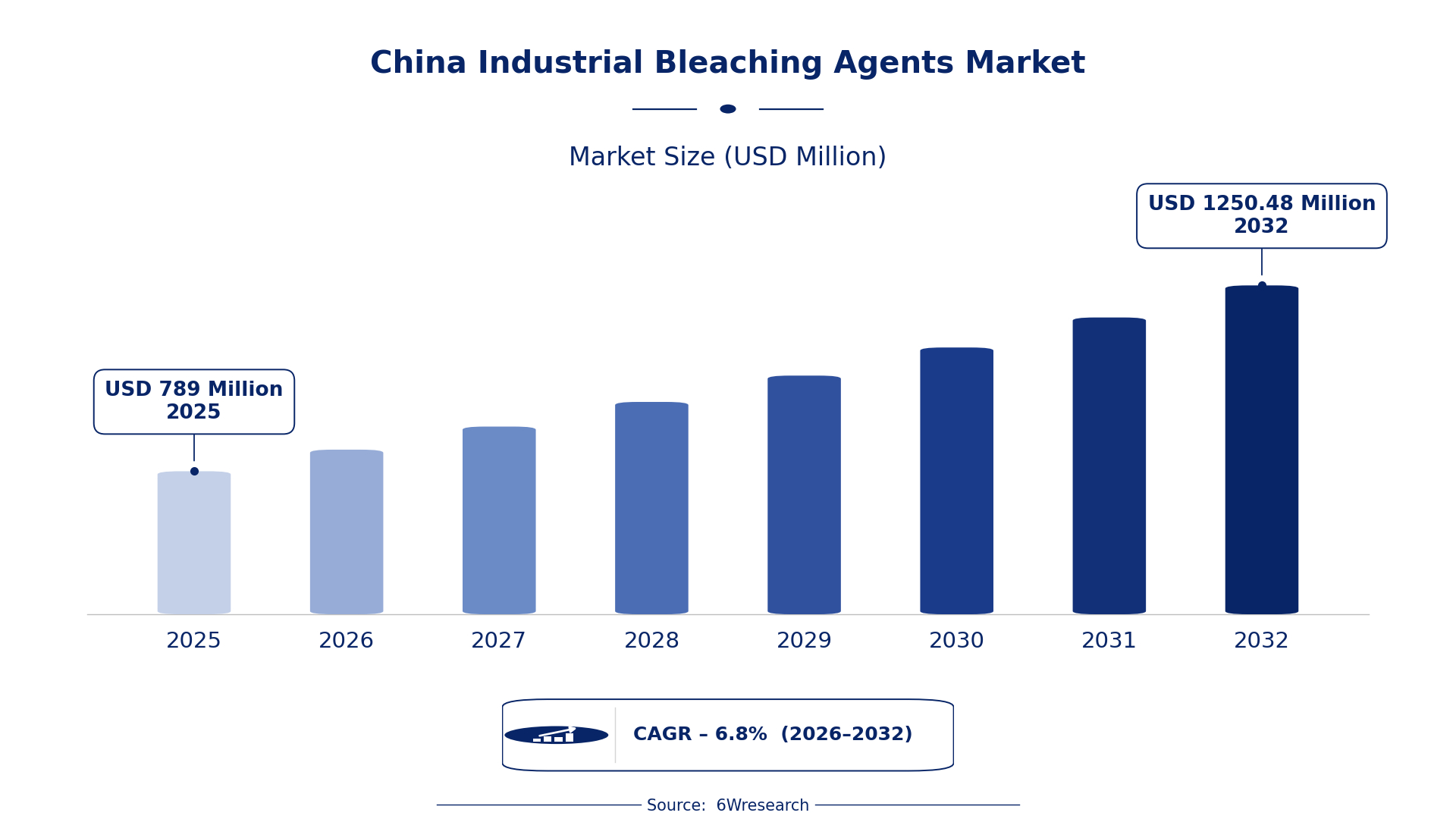
According to 6Wresearch internal database and industry insights, the China Industrial Bleaching Agents Market was valued at USD 789.0 million in 2025 and is projected to reach USD 1,250.48 million by 2032, growing at a CAGR of approximately 6.8% during 2026–2032.
China Industrial Bleaching Agents Market Highlights
| Report Metric | Details |
| Report Name | China Industrial Bleaching Agents Market |
| Market Size 2025 | USD 789.0 million |
| Market Size 2032 | USD 1,250.48 million |
| Absolute Growth 2025–2032 | USD 461.48 million |
| CAGR 2026–2032 | 6.8% |
| Peak Annual Growth | 9.2% in 2026 |
| Forecast Period | 2026–2032 |
| Historical Data | 2022–2025 |
| Base Year | 2025 |
| Leading Bleaching Agent Type, 2025 | Hydrogen Peroxide (40% share) |
| Leading Base Compound, 2025 | Oxygen-Based (43% share) |
| Leading Industry Application, 2025 | Pulp & Paper (46% share) |
| Leading End User, 2025 | Paper Manufacturers (45% share) |
| Fastest-Growing Bleaching Agent Type | Chlorine-Based Agents (9.3% CAGR) |
| Fastest-Growing Base Compound | Sodium Hypochlorite (9.5% CAGR) |
| Fastest-Growing Industry Application | Textile Whitening (9.5% CAGR) |
| Fastest-Growing End User | Fabric Processing Plants (8.8% CAGR) |
| Growing Sector | Textile Whitening |
| Key End Users | Pulp & Paper, Textile Whitening, Sugar & Food Processing, Eco-Friendly Alternatives |
China Industrial Bleaching Agents Market Year-wise Growth Rate and Key Drivers (2022–2032)
This graph illustrates the annual growth rates of the market from 2022 to 2032, highlighting a steady upward trajectory and projected market expansion over the forecast period.
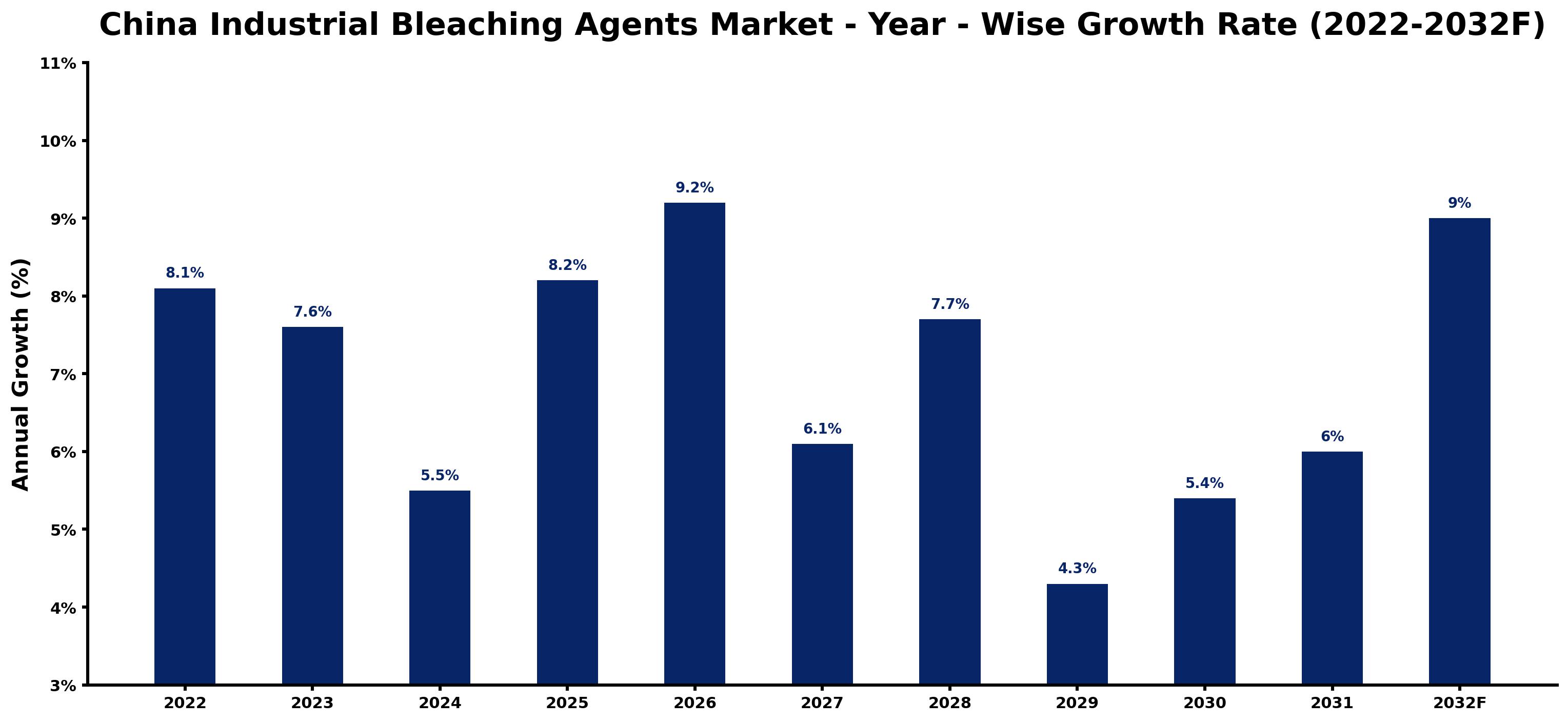
Year by year, the estimates below pair each growth rate with the development that shaped it.
| Year | Estimated Annual Growth (%) | Market Rationale |
| 2022 | 8.1 | The market experienced steady growth, driven by strong demand from the pulp and paper industry. |
| 2023 | 7.6 | Growth slowed slightly as the textile sector adjusted to the 'National Standard for Environmental Protection in Chemical Manufacturing'. |
| 2024 | 5.5 | The market continued to grow, albeit at a slower pace due to increased competition among suppliers in the pulp and paper sector. |
| 2025 | 8.2 | Demand surged as manufacturers ramped up production in response to rising consumer needs for sustainable products. |
| 2026 | 9.2 | The market peaked with investments in sustainable bleaching technologies, particularly in Jiangsu province, as production capacity reached 1.5 million tons annually. |
| 2027 | 6.1 | Growth slowed as producers faced challenges in meeting stringent environmental regulations outlined in the '13th Five-Year Plan'. |
| 2028 | 7.7 | Demand increased again, driven by innovations in eco-friendly bleaching processes in Guangdong province, where the textile industry is focusing on sustainability. |
| 2029 | 4.3 | Growth slowed as market saturation began to affect new investments in the textile sector, limiting expansion opportunities. |
| 2030 | 5.4 | The market rebounded with renewed interest in sustainable practices among manufacturers in the pulp and paper industry, supported by the 'Green Manufacturing Program'. |
| 2031 | 6.0 | Growth continued as the pulp and paper sector expanded its production capacity, particularly in Shandong province, which is vital for the industry. |
| 2032 | 9.0 | The market is projected to grow, supported by advancements in eco-friendly bleaching agents and the continued impact of the 'Green Manufacturing Program'. |
Note: Market size estimations and growth projections presented in this report are based on 6Wresearch's proprietary forecasting methodology, utilizing the latest available industry data, government publications, and primary research inputs.
China Industrial Bleaching Agents Market Synopsis
Industrial Bleaching Agents in China are chemical substances primarily used to remove colour from materials in industries such as pulp and paper, textiles, and food processing. They are produced through various chemical processes, including oxidation and chlorination. The China Industrial Bleaching Agents Market is growing due to strong domestic manufacturing, particularly in the pulp and paper and textile sectors. The pulp and paper industry alone accounts for over 20% of the global market share in 2023, driving demand for effective bleaching solutions. The adoption of sustainable practices further boosts market growth.
Market Dynamics Impact Analysis (2026–2032)
| Factor | Type | Impact | Primary Segment Affected |
| Rising demand for hydrogen peroxide in textile whitening applications | Driver | High | Hydrogen Peroxide |
| Increased production capacity in the pulp and paper sector | Driver | High | Pulp & Paper |
| Growing interest in eco-friendly alternatives among manufacturers | Opportunity | High | Eco-Friendly Alternatives |
| Expansion of the textile industry in Guangdong province | Opportunity | Medium | Textile Whitening |
| Stringent environmental regulations affecting production processes | Restraint | High | Chlorine-Based Agents |
| Competition from alternative bleaching technologies | Restraint | Medium | Enzymatic Bleaching Agents |
| High costs associated with compliance to new environmental standards | Challenge | High | Oxygen-Based |
| Delays in obtaining necessary certifications for new products | Challenge | Medium | Sodium Hypochlorite |
Evaluation of Drivers in China Industrial Bleaching Agents Market (2026–2032)
Key forces behind demand, with the segment each one moves most, are listed below.
| Drivers | Primary Segment Affected | Why It Matters (Evidence) |
| Increased demand for hydrogen peroxide in textile whitening applications | Hydrogen Peroxide | This demand is driven by the textile industry's growth, employing over 30 million workers in China. |
| Expansion of pulp and paper production capacity | Pulp & Paper | The industry accounts for over 20% of the global market share, leading to higher purchases of bleaching agents. |
| Rising adoption of eco-friendly bleaching agents | Eco-Friendly Alternatives | The demand for these alternatives is projected to grow by 20% by 2026, prompting manufacturers to invest in sustainable practices. |
| Investments in sustainable practices in Guangdong province | Textile Whitening | This region is focusing on sustainable practices, increasing the need for effective bleaching solutions, with over 15% of plants adopting eco-friendly methods. |
| Implementation of the 'Green Manufacturing Program' | Enzymatic Bleaching Agents | This initiative promotes sustainable practices, encouraging manufacturers to adopt eco-friendly bleaching technologies, with funding of 500 million RMB. |
Market growth for Industrial Bleaching Agents in China is underpinned by rising demand for hydrogen peroxide in textile whitening applications, linked to the textile industry's expansion, which employs over 30 million workers. The pulp and paper sector accounts for over 20% of the global market share, prompting increased purchases of bleaching agents. The adoption of eco-friendly alternatives is expected to grow by 20% by 2026, leading manufacturers to invest in sustainable practices.
Evaluation of Restraints in China Industrial Bleaching Agents Market
Below mentioned are some major restraints and their influence on market dynamics.
| Market Restraint | Primary Segment Affected | Why It Matters (Evidence) |
| Technological limitations in adopting eco-friendly alternatives | Eco-Friendly Alternatives | Many manufacturers rely on traditional bleaching methods, increasing production costs by up to 15% due to compliance with environmental standards. |
| Competition from imported bleaching agents | Hydrogen Peroxide | Cheaper imports force local suppliers to lower prices, impacting profit margins significantly, with local prices dropping by 10%. |
| Skills gap in the workforce | Enzymatic Bleaching Agents | Only 15% of textile processing plants have adopted these agents, delaying the transition to sustainable practices, which hinders growth opportunities. |
| Regulatory pressures on traditional bleaching methods | Chlorine-Based Agents | Stricter regulations increase compliance costs for local manufacturers, affecting their competitiveness by approximately 12%. |
| Market saturation affecting new investments | Textile Whitening | As the market matures, fewer new entrants are willing to invest, slowing growth and limiting innovation. |
China Industrial Bleaching Agents Market Challenges
In China, the industrial bleaching agents market faces notable technological hurdles, particularly in adopting eco-friendly alternatives. Many manufacturers still rely on traditional bleaching methods, resulting in production costs that can increase by 15% due to compliance with the national standard GB/T 20945-2007. Local producers also contend with imported products that can offer lower prices, which pressures profit margins for domestic suppliers. Furthermore, a skills gap exists, with only 15% of textile processing plants using enzymatic bleaching agents, limiting the ability of buyers in the textile sector to implement sustainable practices.
Trends in the China Industrial Bleaching Agents Market
Several trends are reshaping the China Industrial Bleaching Agents Market; the most important are set out below.
- Shift towards Eco-Friendly Alternatives: Textile manufacturers are increasingly adopting eco-friendly bleaching agents, with a projected 20% growth by 2026. This shift is evident in Guangdong province, where sustainable practices are becoming standard, reflecting a broader industry trend.
- Transition from Traditional to Innovative Practices: The textile industry is moving away from conventional methods, with over 15% of processing plants adopting enzymatic bleaching agents as of 2023. This trend reflects a growing focus on sustainability and efficiency in production.
- Emergence of Sustainable Standards: The implementation of the 'Green Manufacturing Program' in 2021 encourages manufacturers to adopt eco-friendly practices. This initiative is reshaping the bleaching agents market towards sustainability, with significant investments in new technologies.
- Growth of the Pulp and Paper Sector: The pulp and paper industry remains a significant consumer of bleaching agents, accounting for over 20% of the global market share. This sector's expansion drives demand for effective bleaching solutions, particularly in Jiangsu province.
Investment Opportunities in the China Industrial Bleaching Agents Market
Several openings in the China Industrial Bleaching Agents Market merit attention from investors.
- Investment in Eco-Friendly Bleaching Solutions: With a projected 20% growth in eco-friendly alternatives by 2026, there is a substantial opportunity for investment in sustainable bleaching technologies, particularly for textile manufacturers in Guangdong province, where demand is rising.
- Partnerships for Sustainable Practices: The increasing focus on sustainability presents opportunities for joint ventures with local manufacturers to develop eco-friendly bleaching agents, especially in Jiangsu province, where production is concentrated and supported by government initiatives.
- Supply of Enzymatic Bleaching Agents: As only 15% of textile processing plants have adopted enzymatic bleaching agents, there is a gap for suppliers to meet this demand, particularly in the growing textile sector in Zhejiang province, which is expanding rapidly.
- Expansion into the Pulp and Paper Industry: With the pulp and paper sector accounting for over 20% of the global market share, suppliers can focus on providing innovative bleaching solutions to meet this growing demand, particularly in regions like Shandong.
Government Initiatives in the China Industrial Bleaching Agents Market
The 'Green Manufacturing Program' launched by the Ministry of Ecology and Environment in 2021 promotes sustainable practices in the chemical industry, including bleaching agents. This program encourages manufacturers to adopt eco-friendly alternatives, enhancing compliance with environmental standards and supporting innovation in production processes. Additionally, the 'National Standard for Environmental Protection in Chemical Manufacturing', approved in 2022, sets quality benchmarks for bleaching agents, ensuring safer production methods.
The National Development and Reform Commission's '13th Five-Year Plan for Ecological and Environmental Protection', effective since 2020, includes measures to enhance the production of eco-friendly bleaching agents. This plan aims to support manufacturers in adopting sustainable practices and reducing harmful chemicals in their processes, with a focus on funding innovative projects that meet environmental standards.
Future Insight of the China Industrial Bleaching Agents Market
The industrial bleaching agents market in China will undergo significant changes by 2032, driven by the growing emphasis on sustainable solutions. The Ministry of Ecology and Environment's 'Green Manufacturing Program' will encourage the development of innovative eco-friendly bleaching methods. With over 50% of sugar mills adopting these agents for enhanced processing, acceptance of these products is expected to rise. The Jiangsu Provincial Government's investment of 500 million RMB in sustainable chemical production will further facilitate this transition, requiring buyers and suppliers to stay ahead of market trends.
Market Segmentation Analysis
The report offers a comprehensive study of the following market segments and their leading categories in the market.
By Bleaching Agent Type – Hydrogen Peroxide Dominated, Chlorine-Based Agents Expected to Grow Fastest
According to Sachin Kumar Rai, Senior Research Analyst at 6Wresearch, with a 40% revenue share in 2025, Hydrogen Peroxide was the largest bleaching agent type category. Hydrogen peroxide holds the largest market share in the China Industrial Bleaching Agents Market due to its widespread application in the pulp and paper industry, which significantly influences global production. Its versatility in various bleaching processes makes it a preferred choice for manufacturers across multiple sectors. The quickest growth will come from Chlorine-Based Agents, forecast to expand at a CAGR of 9.3% between 2026 and 2032. Chlorine-based agents are witnessing rapid growth, particularly in textile whitening applications in Zhejiang province, where the demand for effective bleaching solutions is on the rise. This trend is likely to persist as manufacturers increasingly seek efficient alternatives for their bleaching requirements. This indicates that suppliers must prioritise the production and distribution of chlorine-based agents to meet the growing needs of the textile sector.
By Base Compound – Oxygen-Based Dominated, Sodium Hypochlorite Expected to Grow Fastest
The largest base compound category in 2025 was Oxygen-Based, with a 43% share of total revenue. Oxygen-based compounds dominate the market share as they are crucial for bleaching processes in the pulp and paper industry, a key player in China's manufacturing landscape. Their established reliability and effectiveness contribute to their leading position in the market. Sodium Hypochlorite is projected to grow fastest, at a CAGR of 9.5% during 2026–2032. Sodium hypochlorite is rapidly gaining traction, particularly in textile whitening, as manufacturers look for effective solutions to enhance fabric brightness. This growth is fuelled by the expanding scale of textile production and the demand for efficient bleaching agents. Suppliers need to adapt their offerings to include sodium hypochlorite, as its rising popularity in textile applications presents new opportunities for market growth.
By Industry Application – Pulp & Paper Dominated, Textile Whitening Expected to Grow Fastest
In 2025, Pulp & Paper led the industry application split with a 46% share. The pulp and paper industry commands the largest market share for bleaching agents in China, accounting for a significant portion of overall demand. This sector's importance is highlighted by its substantial global market share, exceeding 20%, indicating a strong reliance on effective bleaching solutions. Textile Whitening is set to record the highest CAGR in this split, 9.5% over 2026–2032. Textile whitening is the fastest-growing application for bleaching agents, driven by the substantial workforce and production capacity within the textile industry. The increasing emphasis on quality and efficiency in textile manufacturing is boosting the demand for effective bleaching agents. This trend suggests that suppliers should enhance their product lines to cater to the specific needs of the textile industry, ensuring they remain competitive.
By End User – Paper Manufacturers Dominated, Fabric Processing Plants Expected to Grow Fastest
Paper Manufacturers took a 45% share of end user in 2025, more than any other category. Paper manufacturers represent the largest share of end users in the China Industrial Bleaching Agents Market, as they heavily depend on bleaching agents for producing high-quality paper products. Their significant consumption patterns highlight the critical role of these agents in maintaining product standards. Over 2026–2032, Fabric Processing Plants are expected to post the fastest growth, at a CAGR of 8.8%. Fabric processing plants are rapidly increasing their use of bleaching agents, driven by the expanding textile market and the need for efficient production processes. This growth is creating a surge in demand for effective bleaching solutions. Suppliers should focus on building strong relationships with fabric processing plants to capitalise on the growing demand for bleaching agents in the textile industry.
Key Attractiveness of the Report
- 10 Years of Market Numbers
- Historical Data Starting from 2022 to 2025
- Base Year 2025
- Forecast Data until 2032
- Key Performance Indicators Impacting the Market
- Major Upcoming Developments and Projects
Key Highlights of the Report:
- China Industrial Bleaching Agents Market Outlook
- Market Size of China Industrial Bleaching Agents Market, 2025
- Forecast of China Industrial Bleaching Agents Market, 2032
- Historical Data and Forecast of China Industrial Bleaching Agents Revenues & Volume for the Period 2022 - 2032F
- China Industrial Bleaching Agents Market Trend Evolution
- China Industrial Bleaching Agents Market Drivers and Challenges
- China Industrial Bleaching Agents Price Trends
- China Industrial Bleaching Agents Porter's Five Forces
- China Industrial Bleaching Agents Industry Life Cycle
- Historical Data and Forecast of China Industrial Bleaching Agents Market Revenues & Volume By Bleaching Agent Type for the Period 2022 - 2032F
- Historical Data and Forecast of China Industrial Bleaching Agents Market Revenues & Volume By Hydrogen Peroxide for the Period 2022 - 2032F
- Historical Data and Forecast of China Industrial Bleaching Agents Market Revenues & Volume By Chlorine-Based Agents for the Period 2022 - 2032F
- Historical Data and Forecast of China Industrial Bleaching Agents Market Revenues & Volume By Sulfur Dioxide for the Period 2022 - 2032F
- Historical Data and Forecast of China Industrial Bleaching Agents Market Revenues & Volume By Enzymatic Bleaching Agents for the Period 2022 - 2032F
- Historical Data and Forecast of China Industrial Bleaching Agents Market Revenues & Volume By Base Compound for the Period 2022 - 2032F
- Historical Data and Forecast of China Industrial Bleaching Agents Market Revenues & Volume By Oxygen-Based for the Period 2022 - 2032F
- Historical Data and Forecast of China Industrial Bleaching Agents Market Revenues & Volume By Sodium Hypochlorite for the Period 2022 - 2032F
- Historical Data and Forecast of China Industrial Bleaching Agents Market Revenues & Volume By Gas Phase for the Period 2022 - 2032F
- Historical Data and Forecast of China Industrial Bleaching Agents Market Revenues & Volume By Laccases, Peroxidases for the Period 2022 - 2032F
- Historical Data and Forecast of China Industrial Bleaching Agents Market Revenues & Volume By Industry Application for the Period 2022 - 2032F
- Historical Data and Forecast of China Industrial Bleaching Agents Market Revenues & Volume By Pulp & Paper for the Period 2022 - 2032F
- Historical Data and Forecast of China Industrial Bleaching Agents Market Revenues & Volume By Textile Whitening for the Period 2022 - 2032F
- Historical Data and Forecast of China Industrial Bleaching Agents Market Revenues & Volume By Sugar & Food Processing for the Period 2022 - 2032F
- Historical Data and Forecast of China Industrial Bleaching Agents Market Revenues & Volume By Eco-Friendly Alternatives for the Period 2022 - 2032F
- Historical Data and Forecast of China Industrial Bleaching Agents Market Revenues & Volume By End User for the Period 2022 - 2032F
- Historical Data and Forecast of China Industrial Bleaching Agents Market Revenues & Volume By Paper Manufacturers for the Period 2022 - 2032F
- Historical Data and Forecast of China Industrial Bleaching Agents Market Revenues & Volume By Fabric Processing Plants for the Period 2022 - 2032F
- Historical Data and Forecast of China Industrial Bleaching Agents Market Revenues & Volume By Sugar Mills for the Period 2022 - 2032F
- Historical Data and Forecast of China Industrial Bleaching Agents Market Revenues & Volume By Bio-based Textiles for the Period 2022 - 2032F
- China Industrial Bleaching Agents Import Export Trade Statistics
- Market Opportunity Assessment By Bleaching Agent Type
- Market Opportunity Assessment By Base Compound
- Market Opportunity Assessment By Industry Application
- Market Opportunity Assessment By End User
- China Industrial Bleaching Agents Top Companies Market Share
- China Industrial Bleaching Agents Competitive Benchmarking By Technical and Operational Parameters
- China Industrial Bleaching Agents Company Profiles
- China Industrial Bleaching Agents Key Strategic Recommendations
Market Covered
The report offers an extensive study of the following market segments.
By Bleaching Agent Type
- Hydrogen Peroxide
- Chlorine-Based Agents
- Sulfur Dioxide
- Enzymatic Bleaching Agents
By Base Compound
- Oxygen-Based
- Sodium Hypochlorite
- Gas Phase
- Laccases
- Peroxidases
By Industry Application
- Pulp & Paper
- Textile Whitening
- Sugar & Food Processing
- Eco-Friendly Alternatives
By End User
- Paper Manufacturers
- Fabric Processing Plants
- Sugar Mills
- Bio-based Textiles































