India Industrial Collaborative Robots Market Size & Growth Rate
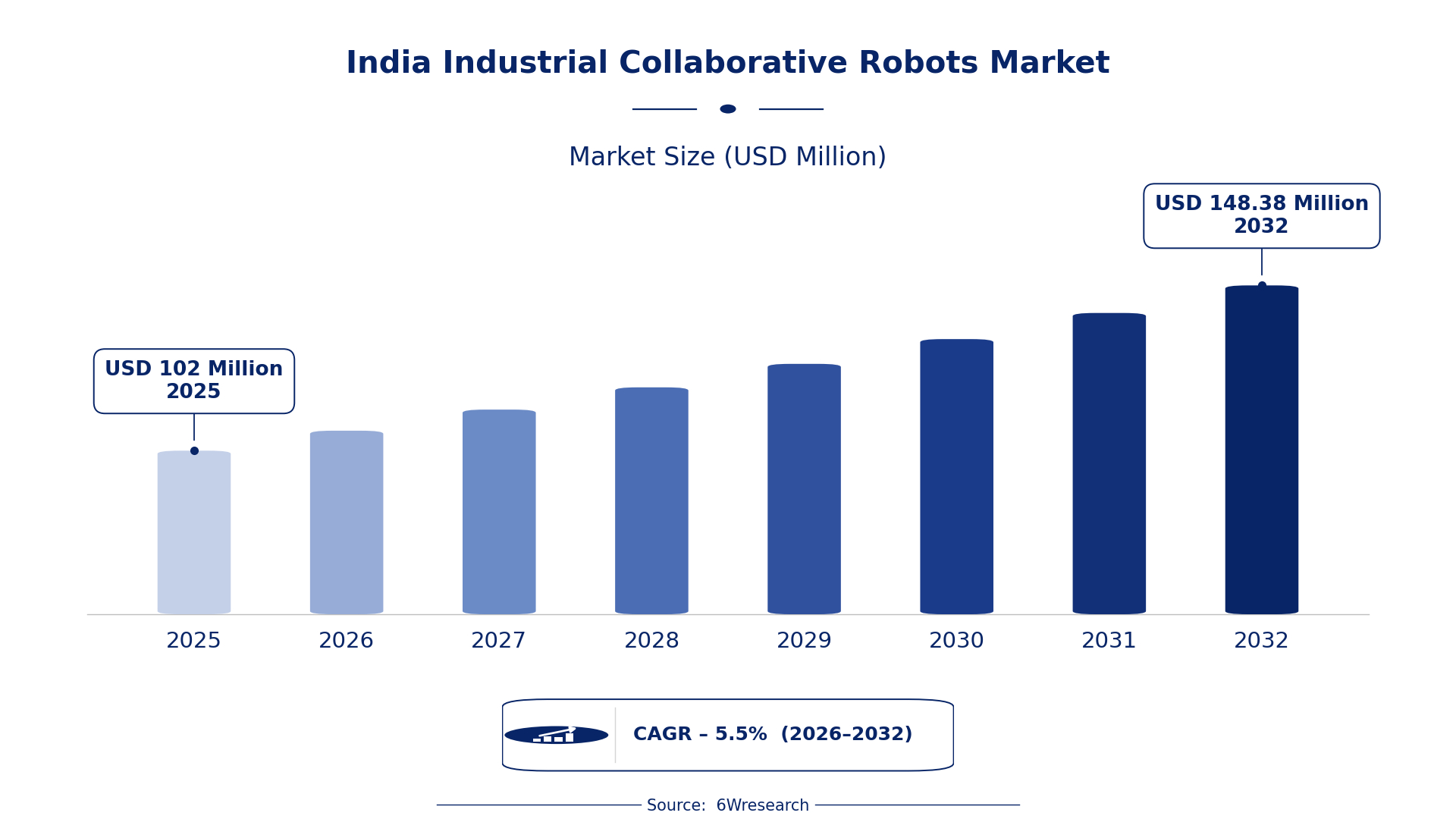
According to 6Wresearch internal database and industry insights, the India Industrial Collaborative Robots Market was valued at USD 102.0 million in 2025 and is projected to reach USD 148.38 million by 2032, growing at a CAGR of approximately 5.5% during 2026–2032.
India Industrial Collaborative Robots Market Highlights
| Report Metric | Details |
| Report Name | India Industrial Collaborative Robots Market |
| Market Size 2025 | USD 102.0 million |
| Market Size 2032 | USD 148.38 million |
| Absolute Growth 2025–2032 | USD 46.38 million |
| CAGR 2026–2032 | 5.5% |
| Peak Annual Growth | 8.1% in 2031 |
| Forecast Period | 2026–2032 |
| Historical Data | 2022–2025 |
| Base Year | 2025 |
| Leading Robot Type, 2025 | Lightweight Cobots (41% share) |
| Leading Payload Range, 2025 | 15 kg (66% share) |
| Leading Application, 2025 | Lab & Electronics Assembly (47% share) |
| Leading End User, 2025 | Electronics Sector (41% share) |
| Fastest-Growing Robot Type | Mobile Cobots (8.0% CAGR) |
| Fastest-Growing Payload Range | Autonomous Navigation (6.8% CAGR) |
| Fastest-Growing Application | Logistics Collaboration (7.4% CAGR) |
| Fastest-Growing End User | Warehouse Automation Firms (7.7% CAGR) |
| Growing Sector | Electronics Sector |
| Key End Users | Electronics manufacturers, automotive industry, logistics firms, warehouse automation companies |
India Industrial Collaborative Robots Market Year-wise Growth Rate and Key Drivers (2022–2032)
This graph illustrates the annual growth rates of the market from 2022 to 2032, highlighting a steady upward trajectory and projected market expansion over the forecast period.
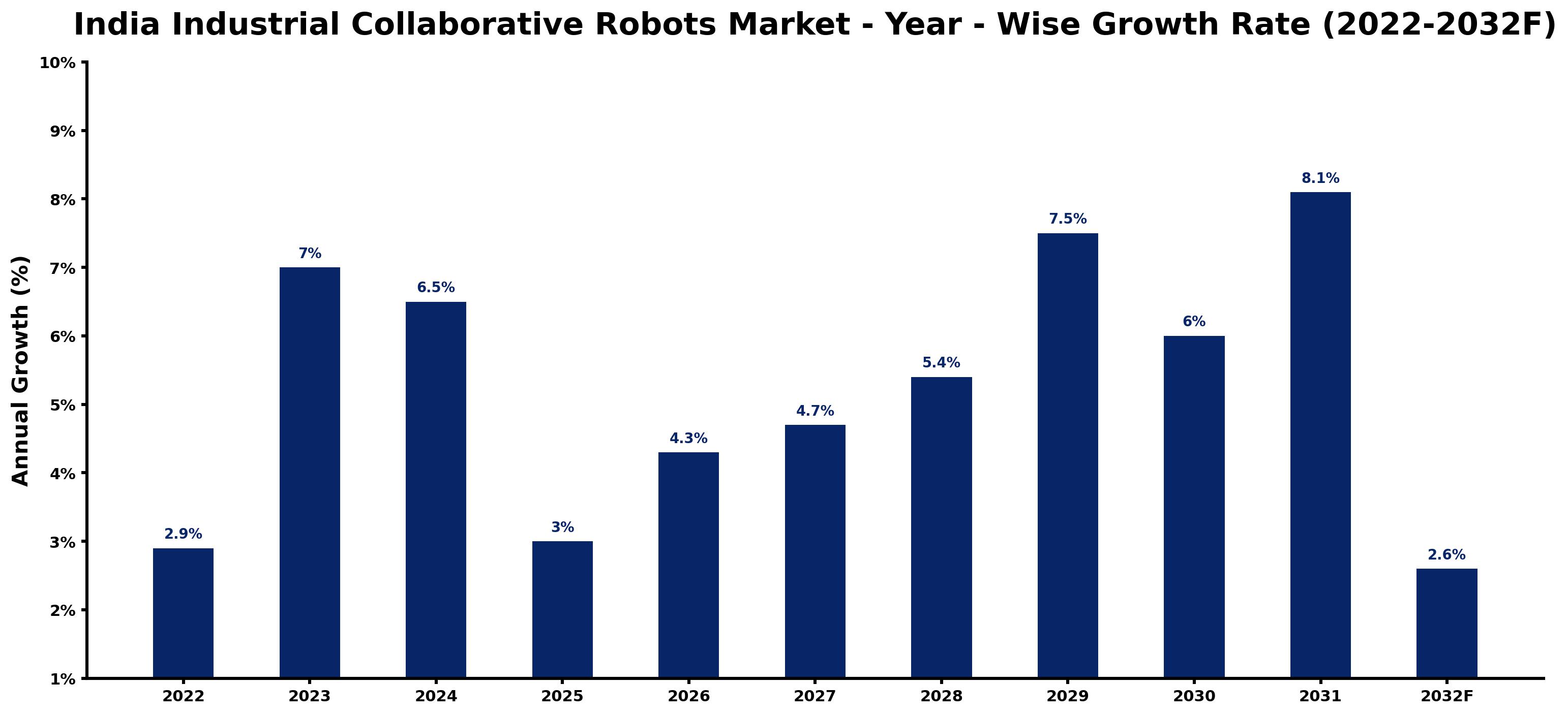
Year by year, the estimates below pair each growth rate with the development that shaped it.
| Year | Estimated Annual Growth (%) | Market Rationale |
| 2022 | 2.9 | The market experienced steady growth due to initial investments in automation technologies. |
| 2023 | 7.0 | Demand surged as the automotive industry ramped up production and automation efforts. |
| 2024 | 6.5 | Growth slowed as manufacturers adjusted to supply chain challenges and economic conditions. |
| 2025 | 3.0 | The market continued to grow, albeit at a slower pace, as investments in robotics matured. |
| 2026 | 4.3 | Increased demand from the electronics sector is expected to drive a rebound in growth rates. |
| 2027 | 4.7 | The automotive sector's expansion will contribute to rising demand for collaborative robots. |
| 2028 | 5.4 | Growth is projected to accelerate as logistics firms adopt automation for efficiency improvements. |
| 2029 | 7.5 | Demand is expected to surge again, driven by advancements in robotics technology and applications. |
| 2030 | 6.0 | Growth will slow as the market begins to stabilise after a period of rapid expansion. |
| 2031 | 8.1 | The market is projected to peak with substantial investments in robotics and automation technologies. |
| 2032 | 2.6 | Growth is expected to slow as the market matures and competition intensifies. |
Note: Market size estimations and growth projections presented in this report are based on 6Wresearch's proprietary forecasting methodology, utilizing the latest available industry data, government publications, and primary research inputs.
India Industrial Collaborative Robots Market Synopsis
Industrial Collaborative Robots in India are sophisticated robotic systems designed to work alongside humans, automating tasks in manufacturing and logistics. These robots incorporate sensors, actuators, and AI algorithms to improve their functionality. The India Industrial Collaborative Robots Market is on an upward trend, driven by strong demand from the electronics and automotive sectors. Initiatives like the 'Make in India' programme and the 'Production Linked Incentive' are enhancing domestic manufacturing capabilities, further increasing the need for these technologies. With the automotive industry producing over 4 million vehicles annually, the push for automation is more critical than ever.
Market Dynamics Impact Analysis (2026–2032)
| Factor | Type | Impact | Primary Segment Affected |
| Growing investments in automation technologies in manufacturing facilities. | Driver | High | Lightweight Cobots |
| Increased demand for efficient assembly processes in electronics manufacturing. | Driver | High | Lab & Electronics Assembly |
| Electronics manufacturers seeking to enhance production efficiency and quality. | Opportunity | High | Electronics Sector |
| Logistics firms looking to improve operational efficiency through automation. | Opportunity | Medium | Warehouse Automation Firms |
| High initial costs associated with implementing collaborative robots. | Restraint | Medium | Medium Duty Cobots |
| Limited awareness and understanding of collaborative robotics among potential users. | Restraint | Medium | Heavy Payload Cobots |
| Supply chain disruptions affecting the availability of components for robots. | Challenge | High | Mobile Cobots |
| Regulatory hurdles in obtaining necessary approvals for new technologies. | Challenge | Medium | Autonomous Navigation |
Evaluation of Drivers in India Industrial Collaborative Robots Market (2026–2032)
The table below links each growth driver to the segment it affects and the evidence for it.
| Drivers | Primary Segment Affected | Why It Matters (Evidence) |
| Increased investments in automation technologies by manufacturers. | Lightweight Cobots | The electronics sector is projected to grow, driving demand for automation solutions with a focus on efficiency. |
| Demand for precision in assembly processes in the electronics sector. | Lab & Electronics Assembly | The automotive industry, producing over 4 million vehicles annually, is pushing for higher precision in assembly. |
| The push for efficient logistics operations by warehouse automation firms. | Warehouse Automation Firms | This demand is reflected in the growing need for automation in logistics, particularly in sorting and packaging. |
| The rise of e-commerce leading to higher demand for sorting and packaging solutions. | Logistics Collaboration | This trend is supported by the increasing volume of online transactions, necessitating efficient operations. |
| Government initiatives promoting domestic manufacturing capabilities in robotics. | Medium Duty Cobots | The 'Production Linked Incentive' scheme aims to enhance manufacturing capabilities in robotics, fostering growth. |
Market growth for Industrial Collaborative Robots in India is underpinned by increased investments in automation technologies, particularly in the electronics sector. The automotive industry, producing over 4 million vehicles annually, drives demand for precision in assembly processes, pushing manufacturers to adopt collaborative robots. Warehouse automation firms are seeking efficient logistics operations, reflecting the growing need for automation in this area. The rise of e-commerce is boosting demand for sorting and packaging solutions, further stimulating market growth.
Evaluation of Restraints in India Industrial Collaborative Robots Market
The following restraints limit how fast demand can grow.
| Market Restraint | Primary Segment Affected | Why It Matters (Evidence) |
| High initial costs associated with implementing collaborative robots. | Medium Duty Cobots | This cost can deter smaller manufacturers from investing in automation technologies, limiting market growth. |
| Limited awareness and understanding of collaborative robotics among potential users. | Heavy Payload Cobots | This lack of knowledge can slow adoption rates in various industries, affecting overall market penetration. |
| Supply chain disruptions affecting the availability of components for robots. | Mobile Cobots | These disruptions can delay projects and increase costs for manufacturers, impacting delivery timelines. |
| Regulatory hurdles in obtaining necessary approvals for new technologies. | Autonomous Navigation | These hurdles can slow down the introduction of new solutions, affecting market entry for innovative products. |
| Concerns regarding job displacement due to increased automation. | Lightweight Cobots | This concern can lead to resistance from workers and unions, hindering the adoption of collaborative robots. |
India Industrial Collaborative Robots Market Challenges
Producers in the India Industrial Collaborative Robots market face regulatory hurdles, as compliance with the Bureau of Indian Standards can delay product approvals by up to six months, impacting time-to-market for new technologies. Importers encounter supply chain disruptions, which can extend lead times for advanced robotic systems by 20%, complicating inventory management for distributors. Buyers experience challenges in integrating cobots into existing workflows, resulting in inefficiencies that can lower productivity by 15%. Additionally, high initial investment costs for collaborative robots deter small manufacturers, limiting their ability to adopt automation and hindering overall market growth.
Trends in the India Industrial Collaborative Robots Market
Below mentioned are some of the trends shaping the India Industrial Collaborative Robots Market growth.
- Shift towards Autonomous Navigation in Collaborative Robots: The trend towards autonomous navigation is gaining momentum, especially in logistics applications. The National Robotics Mission's emphasis on R&D has resulted in a 6.8% growth in this area, enhancing operational efficiency for logistics firms.
- Growing Adoption of Collaborative Robots in Electronics Manufacturing: Electronics manufacturers are increasingly embracing collaborative robots for assembly tasks, with a projected 47% share in 2025. This shift stems from the need for precision and efficiency in production processes.
- Increased Focus on Robotics Training Programs: The 'Skill India' initiative has played a crucial role in advancing training in robotics and automation technologies. This programme aims to equip workers with the necessary skills for a rapidly changing job market, addressing workforce gaps.
- Expansion of Robotics in Automotive Sector: The automotive industry is broadening its use of collaborative robots, particularly for assembly line tasks. With over 4 million vehicles produced annually, this sector is a key driver of robotics adoption, improving production capabilities.
Investment Opportunities in the India Industrial Collaborative Robots Market
Several openings in the India Industrial Collaborative Robots Market merit attention from investors.
- Electronics Sector Seeking Automation Solutions: The electronics sector is currently making substantial investments in automation technologies, with a projected growth rate of 5.5% by 2032. Collaborating with local manufacturers can facilitate entry into this expanding market, driving demand for collaborative robots.
- Logistics Firms Adopting Robotics for Efficiency: Logistics firms are increasingly pursuing automation solutions to enhance operational efficiency. With a rising demand for sorting and packaging, there is a notable opportunity for suppliers to enter this market, particularly in urban centres.
- Government Support for Robotics Research: The Indian government has allocated ₹1,500 crore to support robotics and automation research. This funding presents an opportunity for companies to engage in innovative projects and partnerships, advancing technological progress.
- Training Initiatives for Robotics Skills: With the 'Skill India' initiative promoting robotics training, there is a growing need for educational programmes. Collaborating with educational institutions can help meet this demand and create a skilled workforce ready for the automation era.
Government Initiatives in the India Industrial Collaborative Robots Market
The 'Make in India' initiative, launched in 2014 and updated in 2021, aims to boost manufacturing and attract investments in robotics and automation. This initiative encourages local production and innovation in the robotics sector, improving competitiveness and market growth. The 'Production Linked Incentive Scheme', introduced in 2020, incentivises manufacturing in various sectors, including robotics, with a target of ₹1.97 lakh crore over five years. This scheme aims to enhance domestic manufacturing capabilities and create jobs in the robotics industry, benefiting producers and buyers alike.
In 2023, the Indian government announced a budget of ₹1,500 crore to support robotics and automation research, administered by the Ministry of Electronics and Information Technology. This funding is intended to promote innovation and development in robotics technologies, supporting both producers and buyers in the market. The National Robotics Mission, established to enhance research and development in robotics, also plays a significant role in facilitating projects and collaborations in this field, ensuring a competitive edge for Indian manufacturers.
Future Insight of the India Industrial Collaborative Robots Market
The India Industrial Collaborative Robots market is set to evolve considerably by 2032, driven by the 'Make in India' initiative and the 'Production Linked Incentive' scheme. The National Robotics Mission will promote research and development, improving technological capabilities. By 2025, the manufacturing sector is projected to contribute 25% to GDP, increasing demand for collaborative robots across various industries. The 'Skill India' initiative will ensure a workforce skilled in robotics, facilitating smoother adoption of automation technologies.
Market Segmentation Analysis
The analysis below covers each segmentation, its leading category in 2025 and its fastest-growing category through 2032.
By Robot Type – Lightweight Cobots Dominated, Mobile Cobots Expected to Grow Fastest
According to Sachin Kumar Rai, Senior Research Analyst at 6Wresearch, Lightweight Cobots held a 41% share of the India Industrial Collaborative Robots Market by robot type in 2025. Lightweight Cobots hold the largest market share due to their versatility in assembly tasks that require close human-robot interaction. Their prevalent use in electronics manufacturing facilities underscores their critical role in achieving precision and safety during production. The quickest growth will come from Mobile Cobots, forecast to expand at a CAGR of 8.0% between 2026 and 2032. Mobile Cobots are experiencing rapid growth as they enhance material transportation within facilities, a vital component for operational efficiency. The increasing emphasis on optimising workflows and reducing manual handling is driving their demand significantly. This trend suggests that suppliers should focus on advancing Mobile Cobots' capabilities to meet the evolving operational needs of manufacturers.
By Payload Range – 15 kg Dominated, Autonomous Navigation Expected to Grow Fastest
In 2025, 15 kg led the payload range split with a 66% share. The 15 kg payload range dominates the market as it caters to a wide array of lightweight tasks across various applications, making it highly sought after. Its adaptability in sectors like electronics and assembly processes solidifies its position. Over 2026–2032, Autonomous Navigation is expected to post the fastest growth, at a CAGR of 6.8%. Autonomous Navigation is the fastest-growing segment, driven by the need for robots to operate independently in dynamic environments, particularly in logistics. This capability is becoming essential as businesses aim for greater automation and efficiency. Suppliers must invest in developing advanced navigation technologies to capitalise on this growing demand.
By Application – Lab & Electronics Assembly Dominated, Logistics Collaboration Expected to Grow Fastest
With a 47% revenue share in 2025, Lab & Electronics Assembly was the largest application category. Lab & Electronics Assembly commands the largest share as it is essential for precision tasks in the electronics manufacturing sector, where cobots are extensively utilised. The growing complexity of electronic devices further fuels the demand for these collaborative solutions. Logistics Collaboration is set to record the highest CAGR in this split, 7.4% over 2026–2032. Logistics Collaboration is the fastest-growing application, with firms increasingly adopting cobots to work alongside human workers for improved logistics efficiency. The surge in e-commerce and the urgent need for effective inventory management are crucial growth drivers. This indicates that suppliers should prioritise developing solutions that facilitate seamless collaboration between humans and robots in logistics settings.
By End User – Electronics Sector Dominated, Warehouse Automation Firms Expected to Grow Fastest
The largest end user category in 2025 was Electronics Sector, with a 41% share of total revenue. The Electronics Sector captures the largest market share as it heavily relies on cobots for assembly and testing, reflecting the industry's strong growth trajectory. The ongoing transition towards automation in electronics manufacturing solidifies this sector's leading position. Warehouse Automation Firms are projected to grow fastest, at a CAGR of 7.7% during 2026–2032. Warehouse Automation Firms represent the fastest-growing end user segment, as they increasingly deploy cobots for efficient inventory management and order fulfilment. The rise in online shopping has heightened the demand for streamlined warehouse operations. This presents a significant opportunity for suppliers to tailor their offerings to meet the specific requirements of warehouse automation.
Key Attractiveness of the Report
- 10 Years of Market Numbers
- Historical Data Starting from 2022 to 2025
- Base Year 2025
- Forecast Data until 2032
- Key Performance Indicators Impacting the Market
- Major Upcoming Developments and Projects
Key Highlights of the Report:
- India Industrial Collaborative Robots Market Outlook
- Market Size of India Industrial Collaborative Robots Market, 2025
- Forecast of India Industrial Collaborative Robots Market, 2032
- Historical Data and Forecast of India Industrial Collaborative Robots Revenues & Volume for the Period 2022 - 2032F
- India Industrial Collaborative Robots Market Trend Evolution
- India Industrial Collaborative Robots Market Drivers and Challenges
- India Industrial Collaborative Robots Price Trends
- India Industrial Collaborative Robots Porter's Five Forces
- India Industrial Collaborative Robots Industry Life Cycle
- Historical Data and Forecast of India Industrial Collaborative Robots Market Revenues & Volume By Robot Type for the Period 2022 - 2032F
- Historical Data and Forecast of India Industrial Collaborative Robots Market Revenues & Volume By Lightweight Cobots for the Period 2022 - 2032F
- Historical Data and Forecast of India Industrial Collaborative Robots Market Revenues & Volume By Medium Duty Cobots for the Period 2022 - 2032F
- Historical Data and Forecast of India Industrial Collaborative Robots Market Revenues & Volume By Heavy Payload Cobots for the Period 2022 - 2032F
- Historical Data and Forecast of India Industrial Collaborative Robots Market Revenues & Volume By Mobile Cobots for the Period 2022 - 2032F
- Historical Data and Forecast of India Industrial Collaborative Robots Market Revenues & Volume By Payload Range for the Period 2022 - 2032F
- Historical Data and Forecast of India Industrial Collaborative Robots Market Revenues & Volume By 5 kg for the Period 2022 - 2032F
- Historical Data and Forecast of India Industrial Collaborative Robots Market Revenues & Volume By 5 15 kg for the Period 2022 - 2032F
- Historical Data and Forecast of India Industrial Collaborative Robots Market Revenues & Volume By 15 kg for the Period 2022 - 2032F
- Historical Data and Forecast of India Industrial Collaborative Robots Market Revenues & Volume By Autonomous Navigation for the Period 2022 - 2032F
- Historical Data and Forecast of India Industrial Collaborative Robots Market Revenues & Volume By Application for the Period 2022 - 2032F
- Historical Data and Forecast of India Industrial Collaborative Robots Market Revenues & Volume By Lab & Electronics Assembly for the Period 2022 - 2032F
- Historical Data and Forecast of India Industrial Collaborative Robots Market Revenues & Volume By Packaging, Sorting for the Period 2022 - 2032F
- Historical Data and Forecast of India Industrial Collaborative Robots Market Revenues & Volume By Metal Handling for the Period 2022 - 2032F
- Historical Data and Forecast of India Industrial Collaborative Robots Market Revenues & Volume By Logistics Collaboration for the Period 2022 - 2032F
- Historical Data and Forecast of India Industrial Collaborative Robots Market Revenues & Volume By End User for the Period 2022 - 2032F
- Historical Data and Forecast of India Industrial Collaborative Robots Market Revenues & Volume By Electronics Sector for the Period 2022 - 2032F
- Historical Data and Forecast of India Industrial Collaborative Robots Market Revenues & Volume By Consumer Goods Manufacturing for the Period 2022 - 2032F
- Historical Data and Forecast of India Industrial Collaborative Robots Market Revenues & Volume By Automotive Industry for the Period 2022 - 2032F
- Historical Data and Forecast of India Industrial Collaborative Robots Market Revenues & Volume By Warehouse Automation Firms for the Period 2022 - 2032F
- India Industrial Collaborative Robots Import Export Trade Statistics
- Market Opportunity Assessment By Robot Type
- Market Opportunity Assessment By Payload Range
- Market Opportunity Assessment By Application
- Market Opportunity Assessment By End User
- India Industrial Collaborative Robots Top Companies Market Share
- India Industrial Collaborative Robots Competitive Benchmarking By Technical and Operational Parameters
- India Industrial Collaborative Robots Company Profiles
- India Industrial Collaborative Robots Key Strategic Recommendations
Market Covered
Segments analysed in this report are listed below.
By Robot Type
- Lightweight Cobots
- Medium Duty Cobots
- Heavy Payload Cobots
- Mobile Cobots
By Payload Range
- 15 kg
- Autonomous Navigation
By Application
- Lab & Electronics Assembly
- Packaging
- Sorting
- Metal Handling
- Logistics Collaboration
By End User
- Electronics Sector
- Consumer Goods Manufacturing
- Automotive Industry
- Warehouse Automation Firms































