India Industrial Control MCU Market Size & Growth Rate
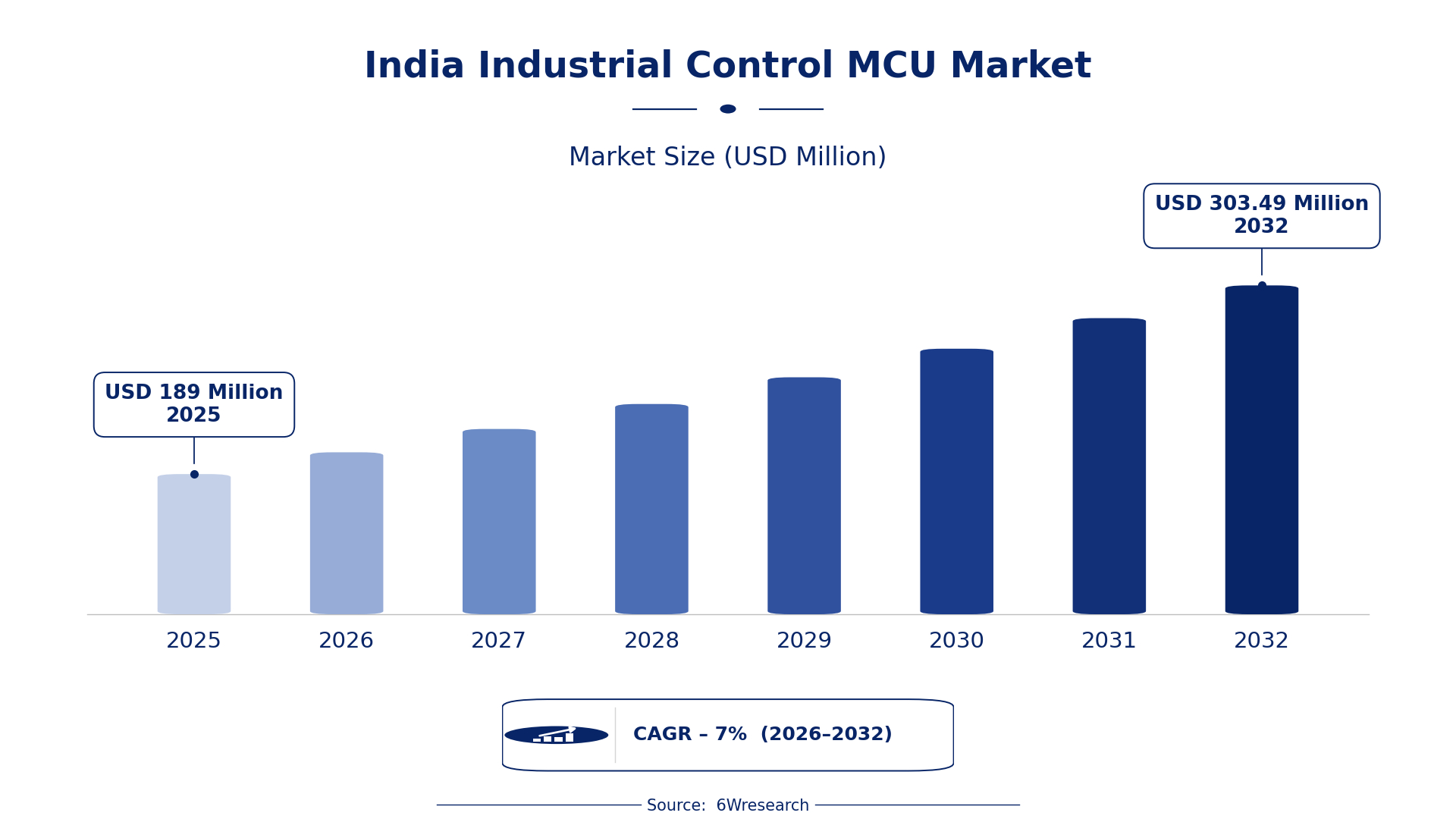
According to 6Wresearch internal database and industry insights, the India Industrial Control MCU Market was valued at USD 189.0 million in 2025 and is projected to reach USD 303.49 million by 2032, growing at a CAGR of approximately 7% during 2026–2032.
India Industrial Control MCU Market Highlights
| Report Metric | Details |
| Report Name | India Industrial Control MCU Market |
| Market Size 2025 | USD 189.0 million |
| Market Size 2032 | USD 303.49 million |
| Absolute Growth 2025–2032 | USD 114.49 million |
| CAGR 2026–2032 | 7% |
| Peak Annual Growth | 9.4% in 2029 |
| Forecast Period | 2026–2032 |
| Historical Data | 2022–2025 |
| Base Year | 2025 |
| Leading MCU Type, 2025 | 32-Bit MCUs (45% share) |
| Leading Architecture, 2025 | High-Performance (36% share) |
| Leading Application Area, 2025 | Industrial Automation (52% share) |
| Leading End User, 2025 | Automotive Tier-1s (39% share) |
| Fastest-Growing MCU Type | 16-Bit MCUs (8.7% CAGR) |
| Fastest-Growing Architecture | Low-Power (8.2% CAGR) |
| Fastest-Growing Application Area | Robotics & AI (9.7% CAGR) |
| Fastest-Growing End User | HVAC Controllers (8.1% CAGR) |
| Growing Sector | Automotive |
| Key End Users | Automotive Tier-1s, Industrial Automation providers, Robotics manufacturers, HVAC system producers |
India Industrial Control MCU Market Year-wise Growth Rate and Key Drivers (2022–2032)
This graph illustrates the annual growth rates of the market from 2022 to 2032, highlighting a steady upward trajectory and projected market expansion over the forecast period.
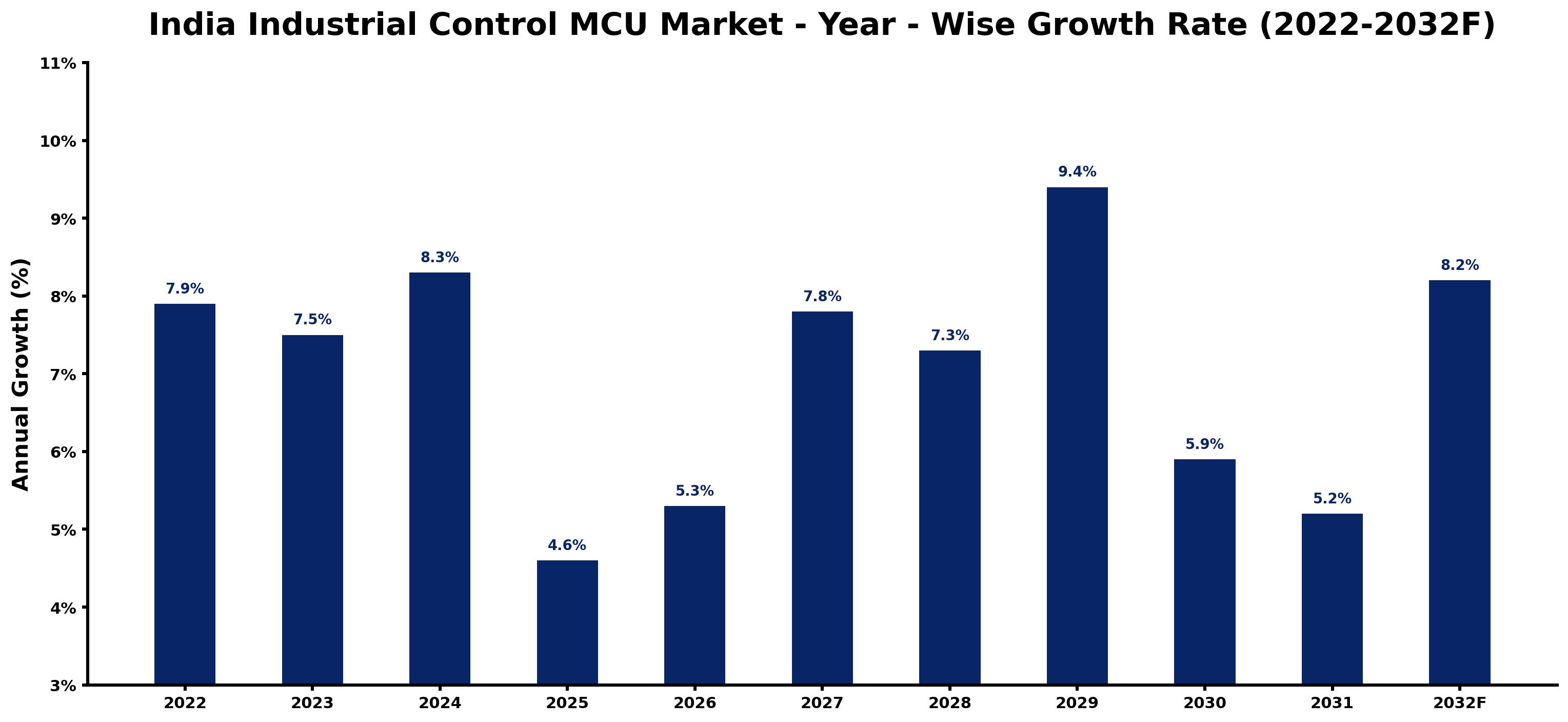
The table below sets out the estimated growth rate for each year and the main factor behind it.
| Year | Estimated Annual Growth (%) | Market Rationale |
| 2022 | 7.9 | The market experienced steady growth due to ongoing industrial automation initiatives. |
| 2023 | 7.5 | Growth slowed slightly as the automotive sector adjusted to new safety standards. |
| 2024 | 8.3 | Increased demand for automotive-grade MCUs drove faster growth this year. |
| 2025 | 4.6 | Growth slowed again as manufacturers faced supply chain challenges in semiconductor production. |
| 2026 | 5.3 | A resurgence in industrial automation projects is expected to contribute to growth this year. |
| 2027 | 7.8 | The automotive sector's expansion will continue to drive demand for MCUs. |
| 2028 | 7.3 | Growth is projected to slow as the market adjusts to previous years' rapid expansion. |
| 2029 | 9.4 | A peak in demand for high-performance MCUs will mark a significant growth year. |
| 2030 | 5.9 | Growth will slow as the market stabilises after reaching peak demand levels. |
| 2031 | 5.2 | Continued demand from automotive Tier-1s will contribute to a slower growth rate. |
| 2032 | 8.2 | A resurgence in industrial automation projects is projected to boost growth. |
Note: Market size estimations and growth projections presented in this report are based on 6Wresearch's proprietary forecasting methodology, utilizing the latest available industry data, government publications, and primary research inputs.
India Industrial Control MCU Market Synopsis
The India Industrial Control MCU Market includes semiconductor devices specifically designed for machinery and process control. These devices are produced through photolithography and etching on silicon wafers, primarily serving industrial automation and automotive applications. Growth in this market stems from the expanding automotive sector, which is projected to reach $300 billion by 2026, alongside the National Policy on Electronics 2019 that targets a $400 billion electronics manufacturing industry by 2025. The increasing demand for industrial automation further propels the need for MCUs.
Market Dynamics Impact Analysis (2026–2032)
| Factor | Type | Impact | Primary Segment Affected |
| Rising demand for automotive-grade MCUs due to the automotive sector's growth. | Driver | High | Automotive Grade MCUs |
| Increased investments in industrial automation projects are boosting MCU demand. | Driver | High | Industrial Automation |
| The growing automotive sector presents opportunities for MCU suppliers to expand. | Opportunity | High | Automotive Grade MCUs |
| The push for local manufacturing creates openings for new entrants in the MCU market. | Opportunity | Medium | 32-Bit MCUs |
| Supply chain disruptions in semiconductor production can limit MCU availability. | Restraint | High | 32-Bit MCUs |
| High production costs may deter new manufacturers from entering the MCU market. | Restraint | Medium | 32-Bit MCUs |
| Competition from imported MCUs may pressure local manufacturers' pricing. | Challenge | High | 32-Bit MCUs |
| Technological advancements require constant updates in MCU designs, challenging producers. | Challenge | Medium | 32-Bit MCUs |
Evaluation of Drivers in India Industrial Control MCU Market (2026–2032)
The factors lifting demand, and the evidence behind each, are summarised below.
| Drivers | Primary Segment Affected | Why It Matters (Evidence) |
| Growing automotive production requiring advanced safety features. | Automotive Grade MCUs | The automotive sector in India is projected to grow to $300 billion by 2026, increasing MCU demand. |
| Increased investment in industrial automation initiatives. | Industrial Automation | The demand for industrial automation in India is expected to rise, driving MCU purchases. |
| The push for local manufacturing under the Make in India initiative. | 32-Bit MCUs | The National Policy on Electronics 2019 aims to achieve a $400 billion electronics manufacturing industry by 2025. |
| Rising demand for robotics and AI applications. | Robotics & AI | The growing focus on advanced robotics is increasing the need for high-performance MCUs. |
| Expansion of HVAC systems requiring efficient control solutions. | HVAC Controllers | The demand for energy-efficient HVAC solutions is driving the need for Low-Power MCUs. |
Growth across the Industrial Control MCU market in India is anchored in rising automotive production, increased investments in industrial automation, and the push for local manufacturing. Demand for industrial automation is anticipated to rise, with MCUs playing a vital role in this transition. Robotics and AI applications are also driving the need for high-performance MCUs, as manufacturers seek to improve efficiency and capabilities.
Evaluation of Restraints in India Industrial Control MCU Market
The key brakes on demand, and where they bite hardest, are shown below.
| Market Restraint | Primary Segment Affected | Why It Matters (Evidence) |
| Supply chain disruptions affecting semiconductor availability. | 32-Bit MCUs | The semiconductor market faced challenges, limiting the availability of critical components for production. |
| High production costs impacting local MCU manufacturing. | 32-Bit MCUs | Rising costs of raw materials and production processes deter new manufacturers from entering the market. |
| Competition from imported MCUs affecting pricing strategies. | 32-Bit MCUs | Imported MCUs often offer lower prices, pressuring local manufacturers to reduce their costs. |
| Technological advancements necessitating constant design updates. | 32-Bit MCUs | Producers must invest in R&D to keep pace with evolving technology demands in the automotive sector. |
| Regulatory compliance costs for automotive-grade MCUs. | Automotive Grade MCUs | Meeting ISO 26262 safety standards increases production costs for manufacturers, affecting pricing. |
India Industrial Control MCU Market Challenges
Intense competition among producers in India’s Industrial Control MCU market leads to reduced prices, costing manufacturers approximately 15% in profit margins and limiting their capacity to invest in research and development. Rapid technological advancements create a gap between current MCU offerings and the ISO 26262 safety standard, complicating compliance for suppliers in the automotive sector. Rising production costs, influenced by a 10% increase in raw material prices, force buyers to absorb these expenses, potentially delaying project timelines by up to three months. A shortage of skilled engineers in the semiconductor field, with a reported 20% vacancy rate, restricts firms' ability to innovate, ultimately impacting product quality available to consumers.
Trends in the India Industrial Control MCU Market
Several trends are reshaping the India Industrial Control MCU Market; the most important are set out below.
- Shift towards Low-Power MCUs: The demand for energy-efficient applications is driving a shift towards Low-Power MCUs, which are widely used in various sectors. The market for Low-Power MCUs is projected to grow at a CAGR of 8.2% from 2026 to 2032.
- Rise of Robotics and AI applications: Robotics and AI are increasingly being integrated into industrial processes, leading to a surge in demand for MCUs. The Robotics & AI segment is expected to grow at a CAGR of 9.7% from 2026 to 2032.
- Expansion of Automotive Grade MCUs: The automotive sector's growth is pushing the demand for Automotive Grade MCUs, essential for safety and reliability. This segment is projected to see substantial growth as the automotive industry expands to $300 billion by 2026.
- Increased focus on Industrial Automation: The industrial sector is increasingly adopting automation solutions, driving demand for MCUs. The Industrial Automation application area holds a 52% market share, reflecting its importance in the MCU market.
Investment Opportunities in the India Industrial Control MCU Market
Some of the investment opportunities in the India Industrial Control MCU Market are mentioned below.
- Local Manufacturing Partnerships: Now is the time for local partnerships to boost MCU manufacturing capabilities, with the government promoting local production. The Production Linked Incentive Scheme for Electronics supports this initiative, with a target of $10 billion in investment.
- Investment in Robotics and AI: The growing focus on robotics presents an opportunity for suppliers to invest in high-performance MCUs. The Robotics & AI segment is projected to grow significantly from 2026 to 2032.
- Expansion in Automotive Tier-1s: With the automotive sector set for substantial growth, suppliers should target Automotive Tier-1s for MCU sales. The automotive industry is expected to reach 5 million units of production by 2025.
- Energy-Efficient HVAC Solutions: The demand for energy-efficient HVAC systems is rising, creating an opportunity for MCU suppliers. The HVAC Controllers segment is growing rapidly, with a significant increase expected.
Government Initiatives in the India Industrial Control MCU Market
The Production Linked Incentive Scheme for Electronics, launched in 2020, aims to boost local manufacturing and reduce import dependency. This initiative complements the National Policy on Electronics 2019, which targets a $400 billion electronics manufacturing industry by 2025, thereby enhancing MCU production capabilities.
The Electronics Development Fund established in 2020 supports innovation in the electronics sector. This fund promotes development in MCU technology and production, while the Semiconductor Mission approved in 2021 encourages semiconductor manufacturing with a target investment of $10 billion.
Future Insight of the India Industrial Control MCU Market
By 2032, the India Industrial Control MCU market will experience notable changes driven by the National Policy on Electronics, which aims to enhance electronics manufacturing. The expansion of the automotive sector will increase demand for automotive-grade MCUs, with production expected to reach 5 million units by 2025. A recent $1 billion investment in semiconductor manufacturing will strengthen local capabilities and spur innovation. The Make in India initiative will further promote local manufacturing, creating a more competitive environment for suppliers and buyers alike.
Market Segmentation Analysis
The analysis below covers each segmentation, its leading category in 2025 and its fastest-growing category through 2032.
By MCU Type – 32-Bit MCUs Dominated, 16-Bit MCUs Expected to Grow Fastest
According to Sachin Kumar Rai, Senior Research Analyst at 6Wresearch, the largest mcu type category in 2025 was 32-Bit MCUs, with a 45% share of total revenue. The 32-Bit MCUs command the largest market share as they are essential for controlling complex machinery that demands high performance and speed. Their widespread application in industrial automation processes solidifies their position as the preferred choice among manufacturers. Over 2026–2032, 16-Bit MCUs is expected to post the fastest growth, at a CAGR of 8.7%. The 16-Bit MCUs are witnessing rapid growth due to their suitability for mid-range applications that require enhanced processing capabilities, particularly in industrial automation. This segment's expansion is supported by the increasing demand for efficient solutions across various sectors. Suppliers should focus on developing 16-Bit MCUs to take advantage of the growing market opportunities.
By Architecture – High-Performance Dominated, Low-Power Expected to Grow Fastest
With a 36% revenue share in 2025, High-Performance was the largest architecture category. High-Performance MCUs lead the market as they are essential for demanding applications that require fast processing capabilities, particularly in automation and robotics. Their ability to handle complex tasks makes them indispensable for manufacturers aiming for efficiency. Low-Power is set to record the highest CAGR in this split, 8.2% over 2026–2032. Low-Power MCUs are the fastest-growing segment, driven by the increasing need for energy-efficient solutions in various applications, including consumer electronics. Their popularity is set to rise as industries prioritise sustainability and cost reduction. Buyers will benefit from investing in Low-Power MCUs to achieve energy efficiency and cost savings in their operations.
By Application Area – Industrial Automation Dominated, Robotics & AI Expected to Grow Fastest
Industrial Automation took a 52% share of application area in 2025, more than any other category. Industrial Automation is the leading application area for MCUs, driven by a strong emphasis on enhancing operational efficiency within manufacturing environments. The ongoing demand for automation solutions ensures a substantial market share for these devices in factories. The quickest growth will come from Robotics & AI, forecast to expand at a CAGR of 9.7% between 2026 and 2032. Robotics is the fastest-growing application area, propelled by the increasing adoption of automation technologies in numerous industries. The rising need for sophisticated robotics in manufacturing processes significantly fuels this growth. Suppliers should seek to expand their product offerings to align with the growing demands in Robotics applications.
By End User – Automotive Tier-1s Dominated, HVAC Controllers Expected to Grow Fastest
Automotive Tier-1s held a 39% share of the India Industrial Control MCU Market by end user in 2025. Automotive Tier-1s represent the largest end-user segment, relying on MCUs for essential components supplied to vehicle manufacturers in the expanding automotive sector. Their considerable demand for advanced electronic solutions secures a prominent market share. HVAC Controllers are projected to grow fastest, at a CAGR of 8.1% during 2026–2032. HVAC Controllers are experiencing the fastest growth due to the rising need for effective management of heating, ventilation, and air conditioning systems across various settings. This trend is driven by the emphasis on improved energy efficiency in both residential and commercial buildings. Suppliers should adapt their strategies to cater to the increasing demand from HVAC Controllers in the market.
Key Attractiveness of the Report
- 10 Years of Market Numbers
- Historical Data Starting from 2022 to 2025
- Base Year 2025
- Forecast Data until 2032
- Key Performance Indicators Impacting the Market
- Major Upcoming Developments and Projects
Key Highlights of the Report:
- India Industrial Control MCU Market Outlook
- Market Size of India Industrial Control MCU Market, 2025
- Forecast of India Industrial Control MCU Market, 2032
- Historical Data and Forecast of India Industrial Control MCU Revenues & Volume for the Period 2022 - 2032F
- India Industrial Control MCU Market Trend Evolution
- India Industrial Control MCU Market Drivers and Challenges
- India Industrial Control MCU Price Trends
- India Industrial Control MCU Porter's Five Forces
- India Industrial Control MCU Industry Life Cycle
- Historical Data and Forecast of India Industrial Control MCU Market Revenues & Volume By MCU Type for the Period 2022 - 2032F
- Historical Data and Forecast of India Industrial Control MCU Market Revenues & Volume By 8-Bit MCUs for the Period 2022 - 2032F
- Historical Data and Forecast of India Industrial Control MCU Market Revenues & Volume By 16-Bit MCUs for the Period 2022 - 2032F
- Historical Data and Forecast of India Industrial Control MCU Market Revenues & Volume By 32-Bit MCUs for the Period 2022 - 2032F
- Historical Data and Forecast of India Industrial Control MCU Market Revenues & Volume By Automotive Grade MCUs for the Period 2022 - 2032F
- Historical Data and Forecast of India Industrial Control MCU Market Revenues & Volume By Architecture for the Period 2022 - 2032F
- Historical Data and Forecast of India Industrial Control MCU Market Revenues & Volume By Low-Power for the Period 2022 - 2032F
- Historical Data and Forecast of India Industrial Control MCU Market Revenues & Volume By Mid-Level Control for the Period 2022 - 2032F
- Historical Data and Forecast of India Industrial Control MCU Market Revenues & Volume By High-Performance for the Period 2022 - 2032F
- Historical Data and Forecast of India Industrial Control MCU Market Revenues & Volume By ISO-26262 Compliant for the Period 2022 - 2032F
- Historical Data and Forecast of India Industrial Control MCU Market Revenues & Volume By Application Area for the Period 2022 - 2032F
- Historical Data and Forecast of India Industrial Control MCU Market Revenues & Volume By Simple Control Loops for the Period 2022 - 2032F
- Historical Data and Forecast of India Industrial Control MCU Market Revenues & Volume By Industrial Automation for the Period 2022 - 2032F
- Historical Data and Forecast of India Industrial Control MCU Market Revenues & Volume By Robotics & AI for the Period 2022 - 2032F
- Historical Data and Forecast of India Industrial Control MCU Market Revenues & Volume By Vehicle Control Units for the Period 2022 - 2032F
- Historical Data and Forecast of India Industrial Control MCU Market Revenues & Volume By End User for the Period 2022 - 2032F
- Historical Data and Forecast of India Industrial Control MCU Market Revenues & Volume By HVAC Controllers for the Period 2022 - 2032F
- Historical Data and Forecast of India Industrial Control MCU Market Revenues & Volume By Drives & Motor Systems for the Period 2022 - 2032F
- Historical Data and Forecast of India Industrial Control MCU Market Revenues & Volume By Embedded System Designers for the Period 2022 - 2032F
- Historical Data and Forecast of India Industrial Control MCU Market Revenues & Volume By Automotive Tier-1s for the Period 2022 - 2032F
- India Industrial Control MCU Import Export Trade Statistics
- Market Opportunity Assessment By MCU Type
- Market Opportunity Assessment By Architecture
- Market Opportunity Assessment By Application Area
- Market Opportunity Assessment By End User
- India Industrial Control MCU Top Companies Market Share
- India Industrial Control MCU Competitive Benchmarking By Technical and Operational Parameters
- India Industrial Control MCU Company Profiles
- India Industrial Control MCU Key Strategic Recommendations
Market Covered
Segments analysed in this report are listed below.
By MCU Type
- 8-Bit MCUs
- 16-Bit MCUs
- 32-Bit MCUs
- Automotive Grade MCUs
By Architecture
- Low-Power
- Mid-Level Control
- High-Performance
- ISO-26262 Compliant
By Application Area
- Simple Control Loops
- Industrial Automation
- Robotics & AI
- Vehicle Control Units
By End User
- HVAC Controllers
- Drives & Motor Systems
- Embedded System Designers
- Automotive Tier-1s































