China Industrial Control MCU Market Size & Growth Rate
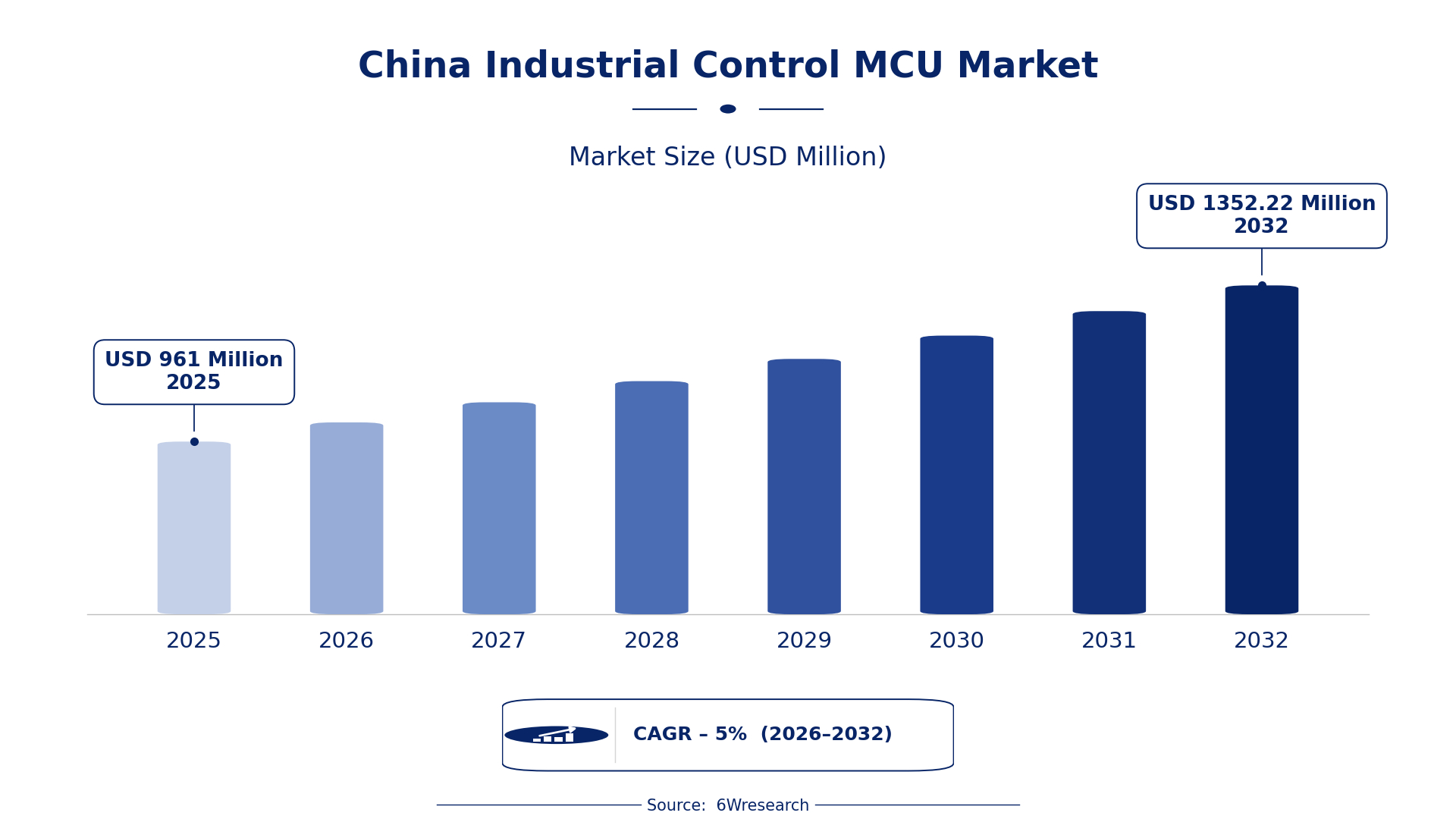
According to 6Wresearch internal database and industry insights, the China Industrial Control MCU Market was valued at USD 961.0 million in 2025 and is projected to reach USD 1,352.22 million by 2032, growing at a CAGR of approximately 5% during 2026–2032.
China Industrial Control MCU Market Highlights
| Report Metric | Details |
| Report Name | China Industrial Control MCU Market |
| Market Size 2025 | USD 961.0 million |
| Market Size 2032 | USD 1,352.22 million |
| Absolute Growth 2025–2032 | USD 391.22 million |
| CAGR 2026–2032 | 5% |
| Peak Annual Growth | 7.6% in 2029 |
| Forecast Period | 2026–2032 |
| Historical Data | 2022–2025 |
| Base Year | 2025 |
| Leading MCU Type, 2025 | 32-Bit MCUs (37% share) |
| Leading Architecture, 2025 | High-Performance (42% share) |
| Leading Application Area, 2025 | Industrial Automation (40% share) |
| Leading End User, 2025 | Automotive Tier-1s (49% share) |
| Fastest-Growing MCU Type | 16-Bit MCUs (6.9% CAGR) |
| Fastest-Growing Architecture | Low-Power (7.3% CAGR) |
| Fastest-Growing Application Area | Robotics & AI (6.4% CAGR) |
| Fastest-Growing End User | HVAC Controllers (7.4% CAGR) |
| Growing Sector | Automotive |
| Key End Users | Automotive Tier-1s, Embedded System Designers, Robotics & AI Developers |
China Industrial Control MCU Market Year-wise Growth Rate and Key Drivers (2022–2032)
This graph illustrates the annual growth rates of the market from 2022 to 2032, highlighting a steady upward trajectory and projected market expansion over the forecast period.
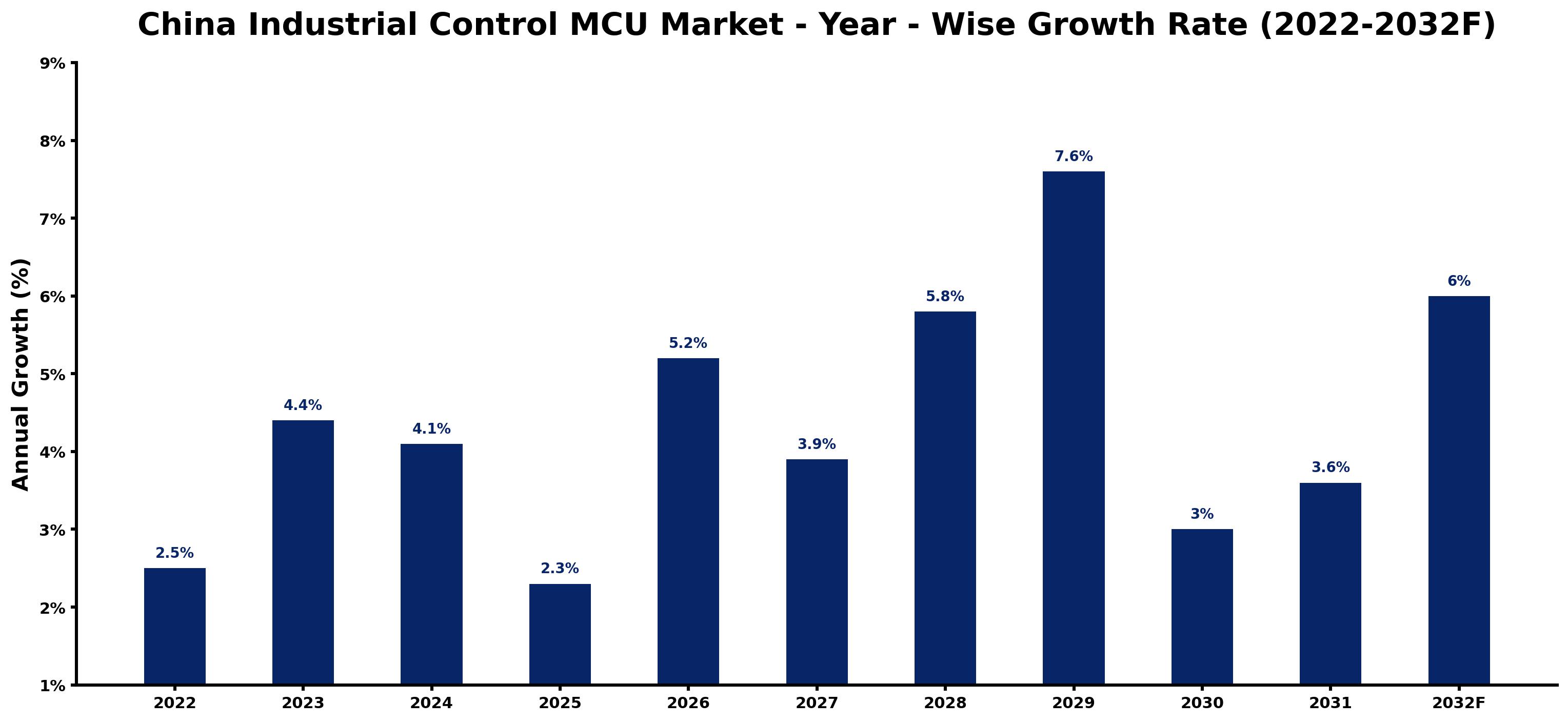
Year by year, the estimates below pair each growth rate with the development that shaped it.
| Year | Estimated Annual Growth (%) | Market Rationale |
| 2022 | 2.5 | The market exhibited steady growth supported by increased demand from the automotive sector. |
| 2023 | 4.4 | Growth accelerated due to rising investments in industrial automation technologies. |
| 2024 | 4.1 | The market saw a slowdown as demand stabilised following previous rapid growth in automotive applications. |
| 2025 | 2.3 | Growth continued to slow as the market adjusted to evolving technological needs in industrial automation. |
| 2026 | 5.2 | Investment in semiconductor technology surged, driving renewed demand for Automotive Grade MCUs. |
| 2027 | 3.9 | Growth decelerated as supply chain challenges impacted production timelines for high-performance MCUs. |
| 2028 | 5.8 | Demand increased with advancements in robotics and AI applications, enhancing MCU requirements. |
| 2029 | 7.6 | The market peaked with high demand for high-performance MCUs in automotive applications driven by safety standards. |
| 2030 | 3.0 | Growth slowed as the market began to normalise after peak demand for Automotive Grade MCUs. |
| 2031 | 3.6 | Demand rose again, driven by innovations in industrial automation technologies and robotics. |
| 2032 | 6.0 | The market will grow as investments in semiconductor self-sufficiency yield results, boosting local production. |
Note: Market size estimations and growth projections presented in this report are based on 6Wresearch's proprietary forecasting methodology, utilizing the latest available industry data, government publications, and primary research inputs.
China Industrial Control MCU Market Synopsis
The China Industrial Control MCU Market includes semiconductor devices tailored for managing industrial processes. These microcontroller units play a crucial role in automation, robotics, and automotive applications. The market is expanding due to robust demand from the automotive sector, which is expected to require 300 million MCUs by 2025. Investments in semiconductor technology and initiatives aimed at self-sufficiency are driving market growth. The Yangtze River Delta region stands out as a key manufacturing hub, bolstering local production capabilities.
Market Dynamics Impact Analysis (2026–2032)
| Factor | Type | Impact | Primary Segment Affected |
| Rising demand from the automotive sector drives the need for high-performance MCUs. | Driver | High | Automotive Grade MCUs |
| Increased investments in robotics and AI applications boost MCU requirements. | Driver | High | Robotics & AI |
| The automotive sector's projected need for 300 million MCUs by 2025 presents a significant opportunity. | Opportunity | High | Automotive Grade MCUs |
| The growing embedded systems market, expected to reach $100 billion by 2025, offers new avenues for MCU suppliers. | Opportunity | High | Embedded System Designers |
| Supply chain disruptions have been a significant challenge for MCU manufacturers. | Restraint | High | 32-Bit MCUs |
| Compliance with ISO-26262 standards can increase production costs for automotive MCUs. | Restraint | Medium | Automotive Grade MCUs |
| The Industrial Control MCU Market in China faces challenges from fluctuating raw material prices. | Challenge | Medium | 32-Bit MCUs |
| Competition from international manufacturers may limit market share for local producers. | Challenge | High | 32-Bit MCUs |
Evaluation of Drivers in China Industrial Control MCU Market (2026–2032)
Below mentioned are some major drivers and their influence on market dynamics.
| Drivers | Primary Segment Affected | Why It Matters (Evidence) |
| Increased automotive production drives demand for Automotive Grade MCUs. | Automotive Grade MCUs | The automotive sector is projected to require 300 million MCUs by 2025. |
| Growing investments in AI technologies increase the need for Robotics & AI MCUs. | Robotics & AI | Robotics & AI applications are set to grow significantly, increasing MCU demand. |
| The push for semiconductor self-sufficiency increases local MCU production. | 32-Bit MCUs | In 2023, the government announced a $30 billion investment in semiconductor technology. |
| Expansion of industrial automation initiatives boosts demand for Industrial Automation MCUs. | Industrial Automation | China produced over 1 billion MCUs in 2022, with a significant share for industrial applications. |
| Rising demand for energy-efficient solutions drives Low-Power MCU adoption. | Low-Power | The embedded systems market is expected to reach $100 billion by 2025, driving further demand. |
Expansion of the Industrial Control MCU market in China is backed by increased automotive production, growing investments in robotics and AI technologies, and expansion of industrial automation initiatives. The automotive sector will require 300 million MCUs by 2025, stimulating demand across various applications. In 2023, the government announced a $30 billion investment in semiconductor technology, boosting local production capabilities. The embedded systems market is expected to reach $100 billion by 2025, driving further demand for MCUs. The growing focus on energy-efficient solutions is increasing the adoption of Low-Power MCUs across various sectors.
Evaluation of Restraints in China Industrial Control MCU Market
The table below lists the restraints and the evidence behind each.
| Market Restraint | Primary Segment Affected | Why It Matters (Evidence) |
| Supply chain disruptions impact MCU availability and production timelines. | 32-Bit MCUs | Manufacturers faced delays and increased costs due to global supply chain issues. |
| Compliance with ISO-26262 standards raises production costs for automotive MCUs. | Automotive Grade MCUs | Meeting safety standards can increase the overall cost of MCU production. |
| Fluctuating raw material prices affect manufacturing costs and profitability. | 32-Bit MCUs | Rising prices of semiconductor materials can squeeze profit margins for producers. |
| Limited access to advanced manufacturing technologies hampers local production. | 32-Bit MCUs | Local manufacturers may struggle to compete with advanced foreign technology. |
| Intense competition from international manufacturers can limit market share. | 32-Bit MCUs | Local producers face challenges in pricing and innovation against global players. |
China Industrial Control MCU Market Challenges
The China Industrial Control MCU market confronts several pressing issues, starting with the overwhelming demand from automotive buyers, which is anticipated to require 300 million MCUs by 2025. This high demand places pressure on manufacturers, potentially causing production delays that could disrupt supply for local industries. Adhering to ISO-26262 regulations for safety-critical applications raises development costs for producers, resulting in higher prices for end-users. Intense competition from global semiconductor firms compels local suppliers to innovate quickly, often stretching resources and delaying new product launches, which limits options for manufacturers and automation sectors.
Trends in the China Industrial Control MCU Market
Four trends stand out in the China Industrial Control MCU Market.
- Automotive Tier-1s Adopting Advanced MCUs: Automotive Tier-1s are increasingly implementing high-performance MCUs to comply with safety standards. The market for Automotive Grade MCUs is set to grow, enhancing vehicle safety and performance as demand escalates.
- Shift Towards Robotics & AI Solutions: A notable shift towards integrating Robotics & AI solutions in manufacturing processes is occurring. Demand for MCUs is on the rise as automation becomes more widespread, with substantial growth anticipated in this sector.
- Yangtze River Delta Region Leading MCU Production: The Yangtze River Delta region is emerging as a central hub for MCU manufacturing. With over 1 billion MCUs produced in 2022, this area is crucial for supporting local industrial automation and MCU demand.
- Increased Focus on Energy Efficiency: The market is experiencing a growing emphasis on energy-efficient solutions. By 2025, the embedded systems market is projected to reach $100 billion, driving demand for Low-Power MCUs.
Investment Opportunities in the China Industrial Control MCU Market
The following opportunities in the China Industrial Control MCU Market pair current demand with a clear way in.
- Supply of High-Performance MCUs: The demand for high-performance MCUs is on the rise, particularly within the automotive sector. With the automotive industry expected to require 300 million MCUs by 2025, suppliers can capitalise on this growing need.
- Investment in Low-Power MCUs: The increasing trend towards energy efficiency offers an opportunity for Low-Power MCU suppliers. The embedded systems market is anticipated to reach $100 billion by 2025, indicating strong demand for energy-efficient solutions.
- Expansion into Robotics & AI Applications: The rise of Robotics & AI applications is creating demand for specialised MCUs. Suppliers focusing on this sector can tap into a rapidly growing market, supported by rising investments in automation technologies.
- Engagement with Automotive Tier-1s: Automotive Tier-1s are actively seeking advanced MCU solutions to enhance vehicle safety. Suppliers can penetrate this market by forming partnerships or joint ventures with local manufacturers, boosting their market presence.
Government Initiatives in the China Industrial Control MCU Market
The Ministry of Science and Technology announced the 'AI and Robotics Development Initiative' in 2023 to promote innovation in robotics, impacting MCU applications. This initiative aims to support research and development in robotics, ensuring that local manufacturers can compete effectively in the global market. The National Development and Reform Commission initiated the 'National Semiconductor Manufacturing Support Program' in 2022 with a budget of $20 billion to enhance local manufacturing capabilities. This funding is designed to support producers in meeting the growing demand for MCUs and improving production efficiency.
The Ministry of Industry and Information Technology oversees semiconductor development programs, approving initiatives that support local production. They also play a vital role in aligning local manufacturing with national semiconductor strategies, fostering a conducive environment for local manufacturers. The National Development and Reform Commission funds various projects aimed at enhancing MCU production capabilities, ensuring that producers can meet the increasing demand for MCUs across sectors.
Future Insight of the China Industrial Control MCU Market
Several forward-looking factors are expected to support the China Industrial Control MCU market in the coming years. The anticipated growth in the embedded systems market, projected to reach $100 billion by 2025, will drive demand for MCUs across various applications. Government initiatives aimed at promoting semiconductor self-sufficiency will strengthen the domestic supply chain, ensuring reliable access to components. Investments in robotics and AI will further increase the need for advanced MCUs, enabling suppliers to provide more integrated solutions to meet evolving market demands.
Market Segmentation Analysis
Each segment group is reviewed below, with the leader by share and the fastest grower by CAGR.
By MCU Type – 32-Bit MCUs Dominated, 16-Bit MCUs Expected to Grow Fastest
According to Sachin Kumar Rai, Senior Research Analyst at 6Wresearch, the largest mcu type category in 2025 was 32-Bit MCUs, with a 37% share of total revenue. The 32-Bit MCUs hold the largest share as they are essential for managing complex control systems in sectors like automotive and industrial automation. Their high processing power is crucial for advanced applications, supported by the production of over 1 billion MCUs in China in 2022. Over 2026–2032, 16-Bit MCUs is expected to post the fastest growth, at a CAGR of 6.9%. The 16-Bit MCUs are experiencing rapid growth due to their suitability for mid-range applications requiring moderate processing capabilities, particularly in industrial automation. This segment's demand is expected to surge as manufacturers increasingly seek efficient solutions for their processes. Suppliers should focus on enhancing their offerings in 16-Bit MCUs to capture the growing market share.
By Architecture – High-Performance Dominated, Low-Power Expected to Grow Fastest
High-Performance held a 42% share of the China Industrial Control MCU Market by architecture in 2025. High-Performance MCUs dominate the market as they are vital for applications requiring high processing speeds, particularly in complex industrial automation systems. Their widespread use in the automotive sector, projected to require 300 million MCUs by 2025, underscores their significance. The quickest growth will come from Low-Power, forecast to expand at a CAGR of 7.3% between 2026 and 2032. Low-Power MCUs are the fastest-growing segment, driven by the rising demand for energy-efficient solutions in battery-operated devices. As the embedded systems market in China is expected to reach $100 billion by 2025, this segment will likely see substantial growth. Buyers should consider investing in Low-Power MCUs to align with the trend towards energy efficiency.
By Application Area – Industrial Automation Dominated, Robotics & AI Expected to Grow Fastest
In 2025, Industrial Automation led the application area split with a 40% share. Industrial Automation leads the market share due to its critical role in streamlining manufacturing processes, essential for China's robust industrial sector. The reliance on this application area is underscored by the substantial production of over 1 billion MCUs in 2022. Robotics & AI is projected to grow fastest, at a CAGR of 6.4% during 2026–2032. Robotics is the fastest-growing application area, driven by the increasing integration of automation across various industries. The demand for MCUs in these sectors reflects a shift towards advanced technological solutions, indicating strong future growth. Suppliers should prioritise the development of solutions tailored for Robotics to capture emerging opportunities.
By End User – Automotive Tier-1s Dominated, HVAC Controllers Expected to Grow Fastest
Automotive Tier-1s took a 49% share of end user in 2025, more than any other category. Automotive Tier-1s command the largest market share as they incorporate MCUs into the development of essential automotive components and systems. The automotive industry's prominence as one of the largest globally significantly influences MCU demand. HVAC Controllers are set to record the highest CAGR in this split, 7.4% over 2026–2032. HVAC Controllers are the fastest-growing end-user segment, driven by the increasing need for efficient heating, ventilation, and air conditioning systems in both residential and commercial applications. This growth mirrors a broader trend towards smart building technologies, indicating a shift in market focus. Suppliers should enhance their product offerings for HVAC Controllers to meet the rising demand in this sector.
Key Attractiveness of the Report
- 10 Years of Market Numbers
- Historical Data Starting from 2022 to 2025
- Base Year 2025
- Forecast Data until 2032
- Key Performance Indicators Impacting the Market
- Major Upcoming Developments and Projects
Key Highlights of the Report:
- China Industrial Control MCU Market Outlook
- Market Size of China Industrial Control MCU Market, 2025
- Forecast of China Industrial Control MCU Market, 2032
- Historical Data and Forecast of China Industrial Control MCU Revenues & Volume for the Period 2022 - 2032F
- China Industrial Control MCU Market Trend Evolution
- China Industrial Control MCU Market Drivers and Challenges
- China Industrial Control MCU Price Trends
- China Industrial Control MCU Porter's Five Forces
- China Industrial Control MCU Industry Life Cycle
- Historical Data and Forecast of China Industrial Control MCU Market Revenues & Volume By MCU Type for the Period 2022 - 2032F
- Historical Data and Forecast of China Industrial Control MCU Market Revenues & Volume By 8-Bit MCUs for the Period 2022 - 2032F
- Historical Data and Forecast of China Industrial Control MCU Market Revenues & Volume By 16-Bit MCUs for the Period 2022 - 2032F
- Historical Data and Forecast of China Industrial Control MCU Market Revenues & Volume By 32-Bit MCUs for the Period 2022 - 2032F
- Historical Data and Forecast of China Industrial Control MCU Market Revenues & Volume By Automotive Grade MCUs for the Period 2022 - 2032F
- Historical Data and Forecast of China Industrial Control MCU Market Revenues & Volume By Architecture for the Period 2022 - 2032F
- Historical Data and Forecast of China Industrial Control MCU Market Revenues & Volume By Low-Power for the Period 2022 - 2032F
- Historical Data and Forecast of China Industrial Control MCU Market Revenues & Volume By Mid-Level Control for the Period 2022 - 2032F
- Historical Data and Forecast of China Industrial Control MCU Market Revenues & Volume By High-Performance for the Period 2022 - 2032F
- Historical Data and Forecast of China Industrial Control MCU Market Revenues & Volume By ISO-26262 Compliant for the Period 2022 - 2032F
- Historical Data and Forecast of China Industrial Control MCU Market Revenues & Volume By Application Area for the Period 2022 - 2032F
- Historical Data and Forecast of China Industrial Control MCU Market Revenues & Volume By Simple Control Loops for the Period 2022 - 2032F
- Historical Data and Forecast of China Industrial Control MCU Market Revenues & Volume By Industrial Automation for the Period 2022 - 2032F
- Historical Data and Forecast of China Industrial Control MCU Market Revenues & Volume By Robotics & AI for the Period 2022 - 2032F
- Historical Data and Forecast of China Industrial Control MCU Market Revenues & Volume By Vehicle Control Units for the Period 2022 - 2032F
- Historical Data and Forecast of China Industrial Control MCU Market Revenues & Volume By End User for the Period 2022 - 2032F
- Historical Data and Forecast of China Industrial Control MCU Market Revenues & Volume By HVAC Controllers for the Period 2022 - 2032F
- Historical Data and Forecast of China Industrial Control MCU Market Revenues & Volume By Drives & Motor Systems for the Period 2022 - 2032F
- Historical Data and Forecast of China Industrial Control MCU Market Revenues & Volume By Embedded System Designers for the Period 2022 - 2032F
- Historical Data and Forecast of China Industrial Control MCU Market Revenues & Volume By Automotive Tier-1s for the Period 2022 - 2032F
- China Industrial Control MCU Import Export Trade Statistics
- Market Opportunity Assessment By MCU Type
- Market Opportunity Assessment By Architecture
- Market Opportunity Assessment By Application Area
- Market Opportunity Assessment By End User
- China Industrial Control MCU Top Companies Market Share
- China Industrial Control MCU Competitive Benchmarking By Technical and Operational Parameters
- China Industrial Control MCU Company Profiles
- China Industrial Control MCU Key Strategic Recommendations
Market Covered
This report examines the market across the segments below.
By MCU Type
- 8-Bit MCUs
- 16-Bit MCUs
- 32-Bit MCUs
- Automotive Grade MCUs
By Architecture
- Low-Power
- Mid-Level Control
- High-Performance
- ISO-26262 Compliant
By Application Area
- Simple Control Loops
- Industrial Automation
- Robotics & AI
- Vehicle Control Units
By End User
- HVAC Controllers
- Drives & Motor Systems
- Embedded System Designers
- Automotive Tier-1s































