India Industrial Electronics Market Size & Growth Rate
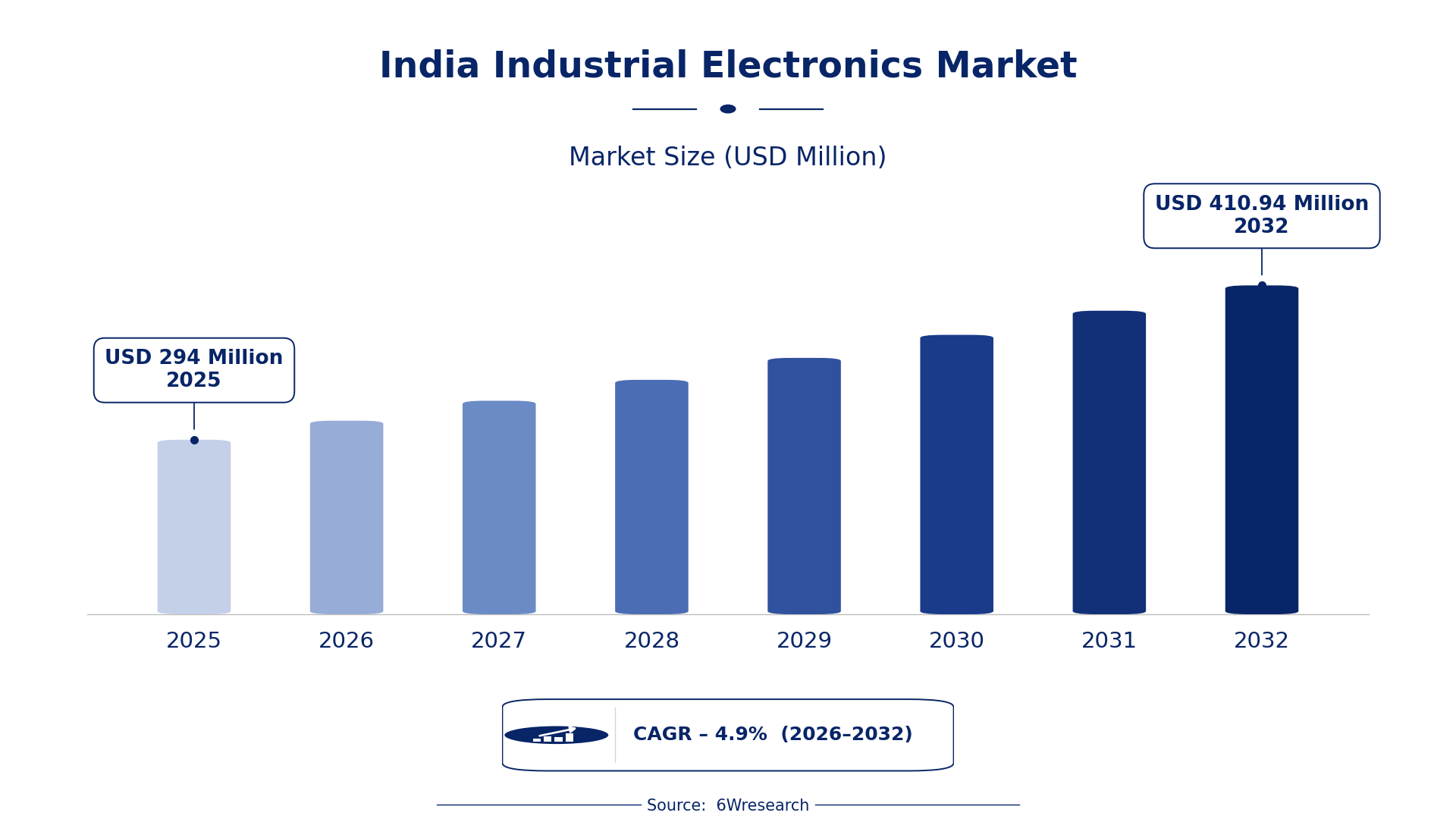
According to 6Wresearch internal database and industry insights, the India Industrial Electronics Market was valued at USD 294.0 million in 2025 and is projected to reach USD 410.94 million by 2032, growing at a CAGR of approximately 4.9% during 2026–2032.
India Industrial Electronics Market Highlights
| Report Metric | Details |
| Report Name | India Industrial Electronics Market |
| Market Size 2025 | USD 294.0 million |
| Market Size 2032 | USD 410.94 million |
| Absolute Growth 2025–2032 | USD 116.94 million |
| CAGR 2026–2032 | 4.9% |
| Peak Annual Growth | 6.9% in 2031 |
| Forecast Period | 2026–2032 |
| Historical Data | 2022–2025 |
| Base Year | 2025 |
| Leading Product Category, 2025 | Power Electronics (46% share) |
| Leading Functionality, 2025 | Conversion/Control (52% share) |
| Leading Integration Use, 2025 | PLCs (39% share) |
| Leading End User, 2025 | Industrial Automation (47% share) |
| Fastest-Growing Product Category | Embedded Controllers (6.2% CAGR) |
| Fastest-Growing Functionality | Process Control (6.5% CAGR) |
| Fastest-Growing Integration Use | Robotics (6.9% CAGR) |
| Fastest-Growing End User | Smart Factories (7.0% CAGR) |
| Growing Sector | Industrial Automation |
| Key End Users | Manufacturers, OEM Assemblers, Smart Factory Operators, Electronics Exporters |
India Industrial Electronics Market Year-wise Growth Rate and Key Drivers (2022–2032)
This graph illustrates the annual growth rates of the market from 2022 to 2032, highlighting a steady upward trajectory and projected market expansion over the forecast period.
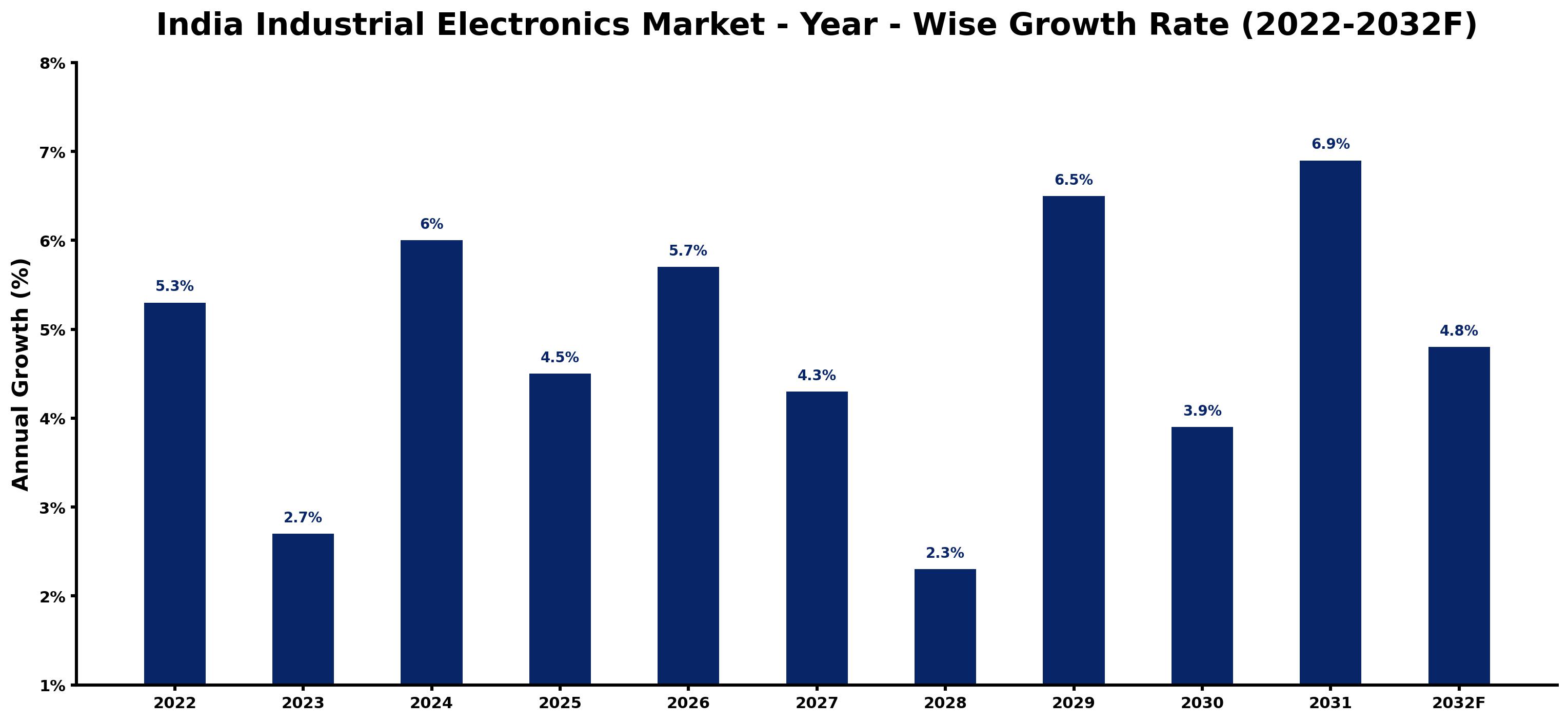
Year by year, the estimates below pair each growth rate with the development that shaped it.
| Year | Estimated Annual Growth (%) | Market Rationale |
| 2022 | 5.3 | The manufacturing sector's strong performance drove demand for industrial electronics in this year. |
| 2023 | 2.7 | Growth slowed due to market adjustments following the previous year's surge in demand. |
| 2024 | 6.0 | Increased investments in automation technologies spurred faster growth in industrial electronics. |
| 2025 | 4.5 | Demand growth slowed as manufacturers adjusted to supply chain challenges. |
| 2026 | 5.7 | Renewable energy initiatives boosted demand for power electronics, leading to faster growth. |
| 2027 | 4.3 | Growth slowed as the market faced challenges in sourcing critical components. |
| 2028 | 2.3 | Demand growth slowed due to market saturation in certain electronics segments. |
| 2029 | 6.5 | Renewed investments in smart factories drove faster growth in industrial electronics. |
| 2030 | 3.9 | Growth slowed as the market adjusted to new regulatory requirements and standards. |
| 2031 | 6.9 | Increased adoption of Industry 4.0 technologies led to the peak growth rate. |
| 2032 | 4.8 | Growth slowed as the market stabilised after rapid expansion in previous years. |
Note: Market size estimations and growth projections presented in this report are based on 6Wresearch's proprietary forecasting methodology, utilizing the latest available industry data, government publications, and primary research inputs.
India Industrial Electronics Market Synopsis
Industrial Electronics in India includes a range of devices essential for automation and control in various industrial applications. These products improve manufacturing efficiency, enhance safety, and facilitate real-time monitoring. The India Industrial Electronics Market is growing due to strong domestic demand and active government initiatives. The 'Make in India' initiative supports local manufacturing, while the National Policy on Electronics aims for $400 billion in electronics production by 2025. With a manufacturing workforce exceeding 50 million, the demand for industrial electronics remains robust and on the rise.
Market Dynamics Impact Analysis (2026–2032)
| Factor | Type | Impact | Primary Segment Affected |
| Strong domestic demand for automation solutions | Driver | High | Industrial Automation |
| Government initiatives promoting local manufacturing | Driver | High | Power Electronics |
| Growing investment in smart factories | Opportunity | High | Smart Factories |
| Emerging demand for energy-efficient electronics | Opportunity | High | Power Electronics |
| Supply chain disruptions affecting component availability | Restraint | High | Embedded Controllers |
| High competition leading to price pressures | Restraint | Medium | Industrial Sensors |
| Lack of skilled workforce in advanced electronics | Challenge | High | Industrial Automation |
| Regulatory compliance costs for manufacturers | Challenge | Medium | Power Electronics |
Evaluation of Drivers in India Industrial Electronics Market (2026–2032)
The factors lifting demand, and the evidence behind each, are summarised below.
| Drivers | Primary Segment Affected | Why It Matters (Evidence) |
| Increased investments in automation technologies | Industrial Automation | This drives demand as manufacturers seek to improve operational efficiency and productivity. |
| Government support for local manufacturing | Power Electronics | This encourages investments in production facilities, boosting demand for components. |
| Growth in renewable energy projects | Power Electronics | This leads to higher demand for power electronics used in energy conversion. |
| Expansion of smart factories | Smart Factories | This increases the need for advanced industrial electronics for automation. |
| Rising demand for energy-efficient solutions | Embedded Controllers | This is driven by government targets for energy consumption reduction. |
The manufacturing sector employs over 50 million people, creating a pressing need for efficient solutions. The shift towards smart factories further accelerates the demand for advanced industrial electronics, while rising energy efficiency requirements compel manufacturers to adopt new components.
Evaluation of Restraints in India Industrial Electronics Market
The main factors holding the market back are set out below.
| Market Restraint | Primary Segment Affected | Why It Matters (Evidence) |
| Supply chain disruptions affecting component availability | Embedded Controllers | This has led to delays in production schedules, increasing costs for manufacturers by up to 15%. |
| High competition leading to price pressures | Industrial Sensors | This impacts profit margins for producers, forcing them to reduce prices by approximately 10%. |
| Regulatory compliance costs for manufacturers | Power Electronics | This increases operational expenses, affecting pricing strategies and competitiveness by around 15%. |
| Limited availability of skilled workforce | Industrial Automation | This hampers the ability to implement advanced technologies effectively, delaying project timelines. |
| Market saturation in certain electronics segments | Smart Factories | This leads to slower growth as demand stabilises, impacting new investments. |
India Industrial Electronics Market Challenges
The India Industrial Electronics market faces a pressing technology challenge as outdated manufacturing processes limit efficiency for producers. This situation arises from a lack of investment in modern equipment, which can delay production timelines by up to six months for manufacturers. Regulatory compliance with the Bureau of Indian Standards complicates operations, increasing time and costs for suppliers, often adding 15% to production expenses. Supply chain disruptions, exacerbated by global semiconductor shortages, hinder the availability of critical components, forcing buyers to wait longer for essential products. Rising raw material costs are also impacting margins, with some producers reporting a 20% increase in input prices, affecting their competitiveness in the market.
Trends in the India Industrial Electronics Market
Several trends are reshaping the India Industrial Electronics Market; the most important are set out below.
- Shift towards Smart Factories: The trend towards smart factories began in 2020, with many facilities adopting advanced industrial electronics. This shift supports automation and real-time monitoring, improving operational efficiency and productivity in the manufacturing sector.
- Transition from Traditional to Energy-Efficient Solutions: Starting in 2021, manufacturers are increasingly adopting energy-efficient electronics to meet government targets. The aim is a 25% reduction in energy consumption by 2030, driving demand for sustainable products across industries.
- Emergence of Robotics in Manufacturing: Robotics is becoming integral in industrial automation, with a projected CAGR of 6.9% from 2026 to 2032. This trend is evident in the growing number of facilities implementing robotic solutions to enhance productivity.
- Prioritisation of Local Manufacturing: The 'Make in India' initiative, launched in 2014, has led to a significant increase in local manufacturing capabilities. By 2025, the target is $400 billion in electronics production, reshaping the market for domestic suppliers.
Investment Opportunities in the India Industrial Electronics Market
Some of the investment opportunities in the India Industrial Electronics Market are mentioned below.
- Timing for Investment in Smart Factories: With a projected growth rate of 7.0% for smart factories, this is an ideal time for investment. Local manufacturers in Maharashtra are seeking advanced automation solutions to improve productivity and efficiency.
- Gap in Energy-Efficient Electronics: The demand for energy-efficient electronics is rising, with a target of 25% reduction in energy consumption by 2030. This presents an opportunity for suppliers to meet this growing need effectively with innovative products.
- Entry into the Robotics Market: The robotics segment is expanding rapidly, with a projected growth rate of 6.9%. Collaborating with local manufacturers in Tamil Nadu could facilitate market entry and growth in this sector, meeting increasing demand.
- Focus on Embedded Controllers: The embedded controllers segment is expected to grow at 6.2%, driven by the automotive sector's demand for advanced technologies. Establishing partnerships with OEM assemblers can strengthen market presence and capture opportunities.
Government Initiatives in the India Industrial Electronics Market
The Ministry of Electronics and Information Technology implements various initiatives aimed at boosting electronics manufacturing. The Skill India Mission focuses on enhancing skills in the electronics sector, ensuring a skilled workforce is available to meet industry demands. The Electronics and Computer Software Export Promotion Council supports exports of industrial electronics, facilitating international market access for local manufacturers. Funding for skill development and infrastructure projects is also provided through various government schemes, improving the overall ecosystem for producers and buyers alike.
The Production Linked Incentive (PLI) scheme for electronics manufacturing was launched in 2020, aiming to boost domestic production and attract investments. The National Policy on Electronics 2019 targets $400 billion in electronics manufacturing by 2025, enhancing local production capabilities. The Electronics Manufacturing Cluster (EMC) scheme supports the establishment of manufacturing hubs for electronics, including industrial electronics, fostering growth in the sector.
Future Insight of the India Industrial Electronics Market
The India Industrial Electronics market will experience transformative changes by 2032, driven by advancements in automation and energy-efficient technologies. The 'Make in India' initiative will bolster local manufacturing capabilities, enabling buyers to source products domestically and reduce lead times. The government's target of $1 billion for semiconductor manufacturing will unlock new opportunities for suppliers in the electronics sector. The integration of real-time monitoring systems in over 200 smart factories will optimise production processes, ensuring better resource management and cost savings for end users.
Market Segmentation Analysis
The report offers a comprehensive study of the following market segments and their leading categories in the market.
By Product Category – Power Electronics Dominated, Embedded Controllers Expected to Grow Fastest
According to Sachin Kumar Rai, Senior Research Analyst at 6Wresearch, Power Electronics accounted for a 46% market share by product category in 2025. Power Electronics holds the largest share due to its critical role in controlling electrical energy across various industrial applications. Its extensive adoption in manufacturing processes, particularly in Maharashtra, underscores its importance in the industrial electronics market. Over 2026–2032, Embedded Controllers are expected to post the fastest growth, at a CAGR of 6.2%. Embedded Controllers are experiencing rapid growth as they are vital for automating processes in sectors such as automotive and consumer electronics. The increasing push for automation solutions across industries in India is propelling this sub-segment's growth. Suppliers should focus on enhancing their embedded controller offerings to leverage the growing trend towards automation.
By Functionality – Conversion/Control Dominated, Process Control Expected to Grow Fastest
With a 52% revenue share in 2025, Conversion/Control was the largest functionality category. Conversion/Control leads the functionality segment as it is vital for converting and managing electrical signals in industrial settings. Its critical role in manufacturing processes across India underscores its importance in the market. Process Control is projected to grow fastest, at a CAGR of 6.5% during 2026–2032. Process Control is the fastest-growing functionality due to the increasing need for effective management of industrial processes. The focus on efficiency and optimisation in manufacturing is propelling this segment's rapid expansion. Buyers will benefit from investing in advanced process control technologies to improve operational efficiency.
By Integration Use – PLCs Dominated, Robotics Expected to Grow Fastest
PLCs took a 39% share of integration use in 2025, more than any other category. PLCs lead the integration use segment as they are fundamental to automation and control in diverse industrial settings. Their widespread application in manufacturing facilities throughout India reinforces their dominant market position. The quickest growth will come from Robotics, forecast to expand at a CAGR of 6.9% between 2026 and 2032. Robotics is the fastest-growing integration use segment, driven by the rising demand for precision and automation in industrial applications. The establishment of smart factories is significantly contributing to the rapid expansion of this segment. Suppliers should consider broadening their robotics product lines to address the increasing demand for advanced automation solutions.
By End User – Industrial Automation Dominated, Smart Factories Expected to Grow Fastest
The largest end user category in 2025 was Industrial Automation, with a 47% share of total revenue. Industrial Automation is the largest end user segment, representing the core application area for industrial electronics and generating substantial demand. The widespread implementation of automation technologies across various sectors solidifies its dominant market share. Smart Factories are set to record the highest CAGR in this split, 7.0% over 2026–2032. Smart Factories are the fastest-growing end user segment, propelled by government initiatives aimed at fostering digital transformation in industries. The shift towards advanced manufacturing technologies is significantly boosting this segment's growth. Buyers should investigate smart factory solutions to maintain competitiveness in the rapidly changing industrial environment.
Key Attractiveness of the Report
- 10 Years of Market Numbers
- Historical Data Starting from 2022 to 2025
- Base Year 2025
- Forecast Data until 2032
- Key Performance Indicators Impacting the Market
- Major Upcoming Developments and Projects
Key Highlights of the Report:
- India Industrial Electronics Market Outlook
- Market Size of India Industrial Electronics Market, 2025
- Forecast of India Industrial Electronics Market, 2032
- Historical Data and Forecast of India Industrial Electronics Revenues & Volume for the Period 2022 - 2032F
- India Industrial Electronics Market Trend Evolution
- India Industrial Electronics Market Drivers and Challenges
- India Industrial Electronics Price Trends
- India Industrial Electronics Porter's Five Forces
- India Industrial Electronics Industry Life Cycle
- Historical Data and Forecast of India Industrial Electronics Market Revenues & Volume By Product Category for the Period 2022 - 2032F
- Historical Data and Forecast of India Industrial Electronics Market Revenues & Volume By Power Electronics for the Period 2022 - 2032F
- Historical Data and Forecast of India Industrial Electronics Market Revenues & Volume By Embedded Controllers for the Period 2022 - 2032F
- Historical Data and Forecast of India Industrial Electronics Market Revenues & Volume By Industrial Sensors for the Period 2022 - 2032F
- Historical Data and Forecast of India Industrial Electronics Market Revenues & Volume By Signal Conditioners for the Period 2022 - 2032F
- Historical Data and Forecast of India Industrial Electronics Market Revenues & Volume By Functionality for the Period 2022 - 2032F
- Historical Data and Forecast of India Industrial Electronics Market Revenues & Volume By Conversion/Control for the Period 2022 - 2032F
- Historical Data and Forecast of India Industrial Electronics Market Revenues & Volume By Process Control for the Period 2022 - 2032F
- Historical Data and Forecast of India Industrial Electronics Market Revenues & Volume By Input Detection for the Period 2022 - 2032F
- Historical Data and Forecast of India Industrial Electronics Market Revenues & Volume By Analog/Digital Input for the Period 2022 - 2032F
- Historical Data and Forecast of India Industrial Electronics Market Revenues & Volume By Integration Use for the Period 2022 - 2032F
- Historical Data and Forecast of India Industrial Electronics Market Revenues & Volume By Drives, Inverters for the Period 2022 - 2032F
- Historical Data and Forecast of India Industrial Electronics Market Revenues & Volume By Robotics, PLCs for the Period 2022 - 2032F
- Historical Data and Forecast of India Industrial Electronics Market Revenues & Volume By Motion/Temp/Proximity for the Period 2022 - 2032F
- Historical Data and Forecast of India Industrial Electronics Market Revenues & Volume By Field Devices for the Period 2022 - 2032F
- Historical Data and Forecast of India Industrial Electronics Market Revenues & Volume By End User for the Period 2022 - 2032F
- Historical Data and Forecast of India Industrial Electronics Market Revenues & Volume By Industrial Automation for the Period 2022 - 2032F
- Historical Data and Forecast of India Industrial Electronics Market Revenues & Volume By OEM Assemblers for the Period 2022 - 2032F
- Historical Data and Forecast of India Industrial Electronics Market Revenues & Volume By Smart Factories for the Period 2022 - 2032F
- Historical Data and Forecast of India Industrial Electronics Market Revenues & Volume By Control Room Equipment for the Period 2022 - 2032F
- India Industrial Electronics Import Export Trade Statistics
- Market Opportunity Assessment By Product Category
- Market Opportunity Assessment By Functionality
- Market Opportunity Assessment By Integration Use
- Market Opportunity Assessment By End User
- India Industrial Electronics Top Companies Market Share
- India Industrial Electronics Competitive Benchmarking By Technical and Operational Parameters
- India Industrial Electronics Company Profiles
- India Industrial Electronics Key Strategic Recommendations
Market Covered
This report examines the market across the segments below.
By Product Category
- Power Electronics
- Embedded Controllers
- Industrial Sensors
- Signal Conditioners
By Functionality
- Conversion/Control
- Process Control
- Input Detection
- Analog/Digital Input
By Integration Use
- Drives
- Inverters
- Robotics
- PLCs
- Motion/Temp/Proximity
- Field Devices
By End User
- Industrial Automation
- OEM Assemblers
- Smart Factories
- Control Room Equipment































