China Industrial Electronics Market Size & Growth Rate
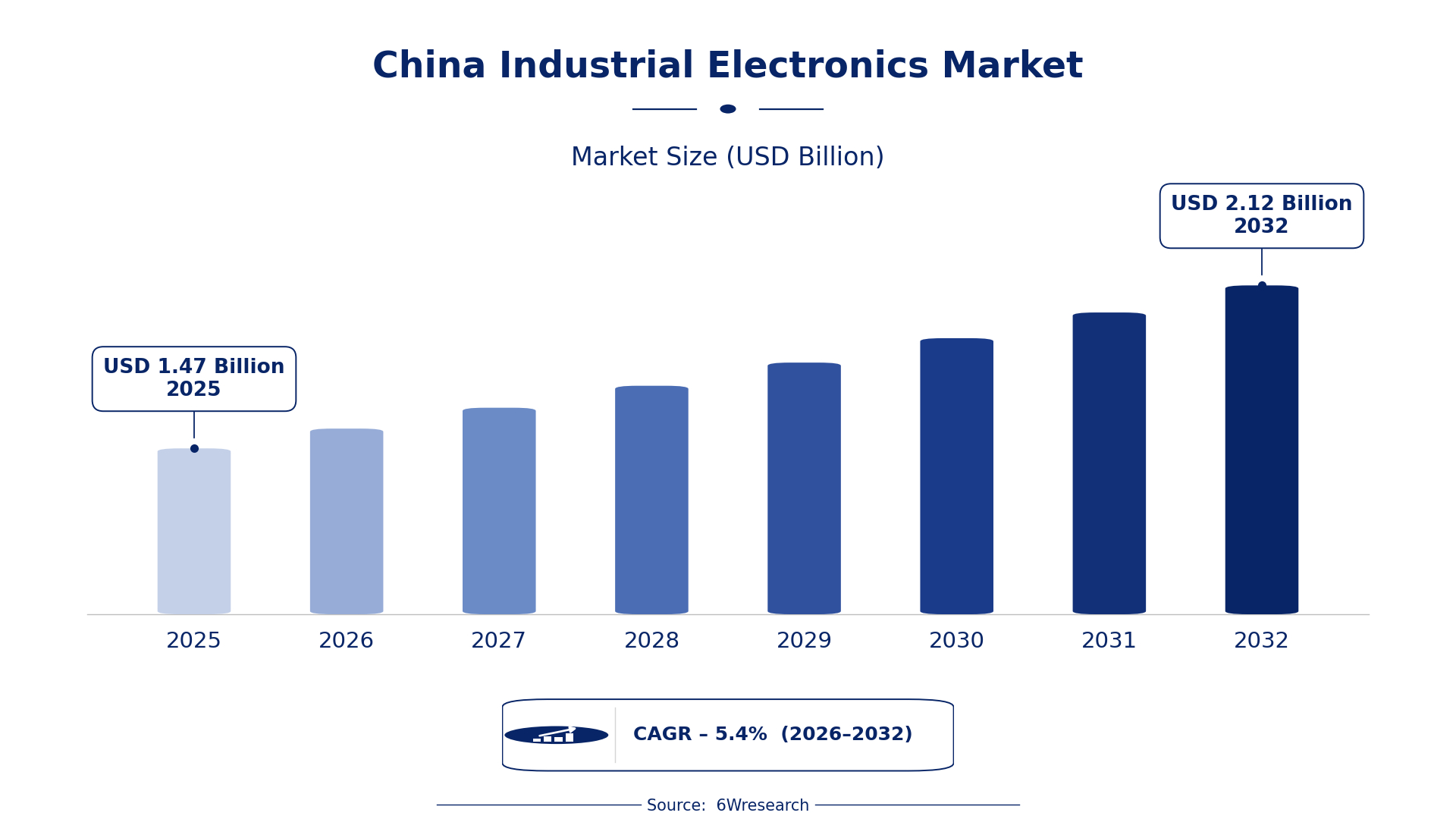
According to 6Wresearch internal database and industry insights, the China Industrial Electronics Market was valued at USD 1.47 billion in 2025 and is projected to reach USD 2.12 billion by 2032, growing at a CAGR of approximately 5.4% during 2026–2032.
China Industrial Electronics Market Highlights
| Report Metric | Details |
| Report Name | China Industrial Electronics Market |
| Market Size 2025 | USD 1.47 billion |
| Market Size 2032 | USD 2.12 billion |
| Absolute Growth 2025–2032 | USD 0.65 billion |
| CAGR 2026–2032 | 5.4% |
| Peak Annual Growth | 7.0% in 2026 |
| Forecast Period | 2026–2032 |
| Historical Data | 2022–2025 |
| Base Year | 2025 |
| Leading Product Category, 2025 | Power Electronics (53% share) |
| Leading Functionality, 2025 | Conversion/Control (43% share) |
| Leading Integration Use, 2025 | Drives (36% share) |
| Leading End User, 2025 | Industrial Automation (46% share) |
| Fastest-Growing Product Category | Embedded Controllers (7.3% CAGR) |
| Fastest-Growing Functionality | Process Control (7.5% CAGR) |
| Fastest-Growing Integration Use | Inverters (6.7% CAGR) |
| Fastest-Growing End User | OEM Assemblers (7.4% CAGR) |
| Growing Sector | Industrial Automation |
| Key End Users | OEM Assemblers, Industrial Automation Companies, Smart Factories |
China Industrial Electronics Market Year-wise Growth Rate and Key Drivers (2022–2032)
This graph illustrates the annual growth rates of the market from 2022 to 2032, highlighting a steady upward trajectory and projected market expansion over the forecast period.
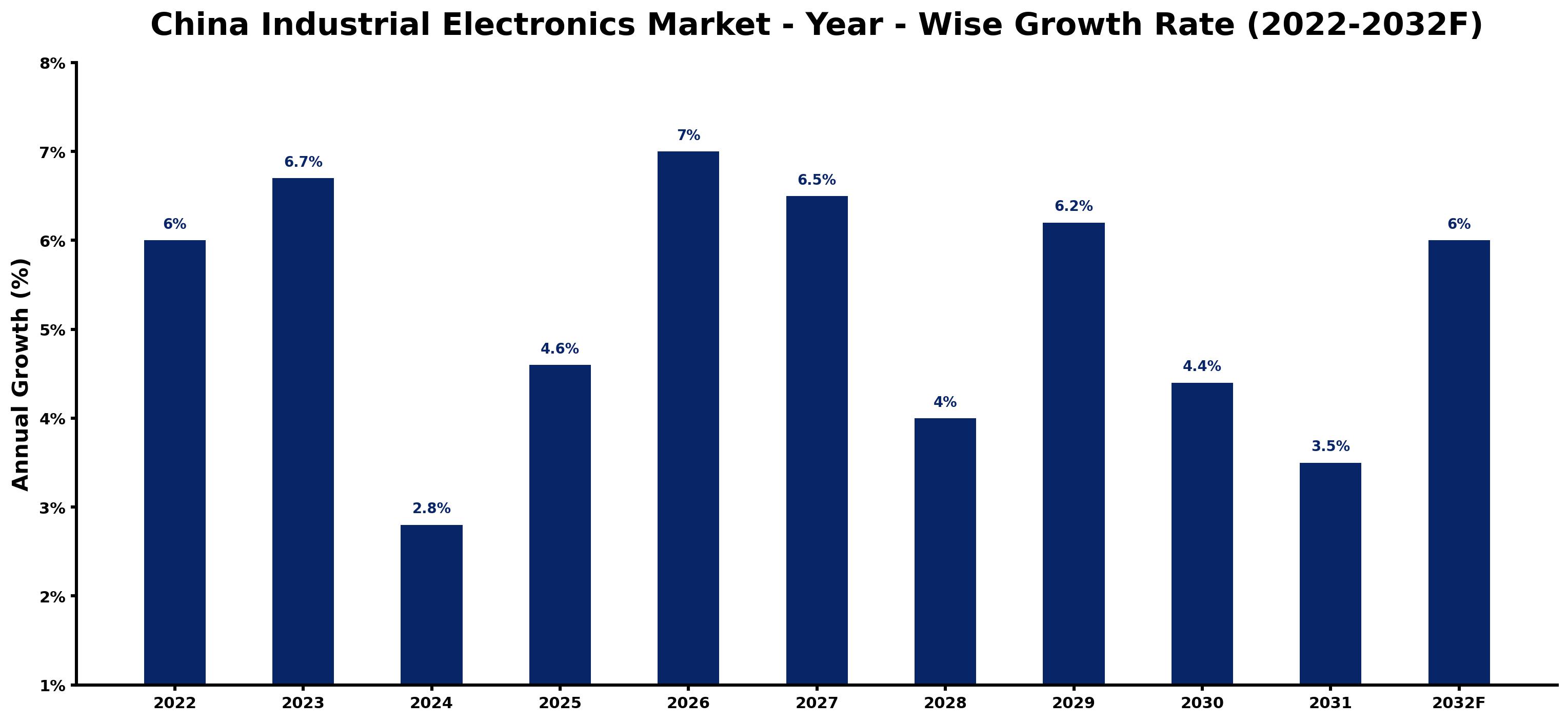
The table below sets out the estimated growth rate for each year and the main factor behind it.
| Year | Estimated Annual Growth (%) | Market Rationale |
| 2022 | 6.0 | The market experienced solid growth due to rising domestic manufacturing needs. |
| 2023 | 6.7 | Demand surged as automation initiatives gained traction across various sectors. |
| 2024 | 2.8 | Growth slowed as some companies faced challenges in scaling operations effectively. |
| 2025 | 4.6 | Increased investments in automation technologies revitalised market growth. |
| 2026 | 7.0 | The peak growth rate is expected to be driven by the launch of new industrial automation projects. |
| 2027 | 6.5 | A slight slowdown is projected as the market adjusts to new operational standards. |
| 2028 | 4.0 | Continued investments in smart manufacturing technologies will contribute to slower growth. |
| 2029 | 6.2 | Demand is expected to rebound as industrial automation expands in key manufacturing hubs. |
| 2030 | 4.4 | Growth will decelerate as companies focus on optimising existing systems. |
| 2031 | 3.5 | The market is projected to continue growing, albeit at a slower pace, due to stabilising demand from industrial automation. |
| 2032 | 6.0 | A resurgence in automation projects is expected to drive growth in the coming year. |
Note: Market size estimations and growth projections presented in this report are based on 6Wresearch's proprietary forecasting methodology, utilizing the latest available industry data, government publications, and primary research inputs.
China Industrial Electronics Market Synopsis
Industrial Electronics in China encompasses devices and systems that control and automate industrial processes. These products are manufactured using advanced technologies, including semiconductor fabrication and software development. The China Industrial Electronics Market is valued at approximately 1 trillion CNY as of 2023, driven by strong domestic manufacturing and automation needs. Initiatives like 'Smart Manufacturing 2025' and the production of over 50 million industrial robots are further boosting demand, leading to increased purchases across various sectors.
Market Dynamics Impact Analysis (2026–2032)
| Factor | Type | Impact | Primary Segment Affected |
| Rising investments in automation technologies are boosting demand for industrial electronics. | Driver | High | Industrial Automation |
| The growing need for energy management solutions drives the demand for power electronics. | Driver | High | Power Electronics |
| OEM assemblers are increasingly seeking advanced automation solutions to enhance production efficiency. | Opportunity | High | OEM Assemblers |
| The increasing number of smart factories creates a demand for integrated industrial electronics solutions. | Opportunity | High | Smart Factories |
| High competition among manufacturers can lead to pricing pressures in the market. | Restraint | Medium | Industrial Sensors |
| The complexity of integrating new technologies can hinder adoption rates among end-users. | Restraint | Medium | Embedded Controllers |
| This market still has to solve a few problems, including the need for skilled workforce. | Challenge | High | Industrial Automation |
| Supply chain disruptions can delay the delivery of critical components for production. | Challenge | Medium | Power Electronics |
Evaluation of Drivers in China Industrial Electronics Market (2026–2032)
Key forces behind demand, with the segment each one moves most, are listed below.
| Drivers | Primary Segment Affected | Why It Matters (Evidence) |
| Increased investment in automation technologies is driving demand for industrial electronics. | Industrial Automation | The government allocated 5 billion CNY for research and development in industrial automation technologies. |
| Growing energy management needs are boosting the demand for power electronics. | Power Electronics | The Yangtze River Delta region is a key area for industrial electronics manufacturing, contributing significantly to overall output. |
| The rise of smart factories is increasing the demand for integrated solutions. | Smart Factories | China produced 15 million units of PLCs in 2022, reflecting high domestic demand for automation solutions. |
| The expansion of industrial automation companies is creating new opportunities. | OEM Assemblers | Over 200 industrial automation companies operate in various provinces across China. |
| The push for quality standards is increasing the demand for industrial sensors. | Industrial Sensors | The National Standard GB/T 12345-2020 governs the quality of industrial sensors in China. |
Market growth for Industrial Electronics in China is underpinned by increased investment in automation technologies, rising energy management needs, and the expansion of smart factories. In 2022, China produced 15 million units of PLCs, reflecting high domestic demand for automation solutions. The presence of over 200 industrial automation companies across various provinces further fuels the market's expansion. Additionally, the National Standard GB/T 12345-2020 is driving improvements in product quality, benefiting both producers and buyers.
Evaluation of Restraints in China Industrial Electronics Market
The table below lists the restraints and the evidence behind each.
| Market Restraint | Primary Segment Affected | Why It Matters (Evidence) |
| High competition among manufacturers can lead to pricing pressures. | Industrial Sensors | The presence of numerous manufacturers can drive down prices, impacting profitability. |
| The complexity of integrating new technologies can hinder adoption rates. | Embedded Controllers | Many end-users struggle with the technical challenges of implementing advanced systems. |
| Supply chain disruptions can delay the delivery of critical components. | Power Electronics | Global supply chain issues have affected the availability of key electronic components, extending lead times. |
| Skilled workforce shortages can limit operational efficiency. | Industrial Automation | The need for trained personnel in automation technologies is growing but remains unmet. |
| Regulatory compliance can increase operational costs for manufacturers. | Industrial Sensors | Manufacturers must adhere to stringent quality standards, raising production costs. |
China Industrial Electronics Market Challenges
The China Industrial Electronics Market still has to solve a few problems, starting with rising production costs for manufacturers. Increased raw material prices have led to a 15% hike in expenses, forcing producers to either absorb costs or raise prices. Next, supply chain delays plague importers, particularly for critical components, which can extend lead times by up to three months, affecting their ability to meet customer demands. Buyers face challenges with outdated technology, as many still rely on legacy systems, which can hinder efficiency and increase operational costs by 20%. The rapid pace of technological advancement means that many manufacturers struggle to keep up, risking obsolescence and lost market share.
Trends in the China Industrial Electronics Market
Buyers and suppliers in the China Industrial Electronics Market are adjusting to the following trends.
- Shift towards Smart Manufacturing: China's industrial sector is increasingly adopting smart manufacturing practices, driven by the 'Smart Manufacturing 2025' initiative. This shift is evidenced by the production of over 50 million industrial robots in operation as of 2023, improving automation capabilities.
- Increased Use of Embedded Controllers: OEM assemblers are prioritising embedded controllers to improve automation in production lines. This trend is reflected in the growing demand, with a projected CAGR of 7.3% for embedded controllers from 2026 to 2032.
- Rise of Energy Management Solutions: The focus on energy efficiency is leading to a surge in demand for power electronics in industrial applications. The National Standard GB/T 12345-2020, governing industrial sensors, supports this trend by ensuring quality in energy management solutions.
- Expansion of Industrial Automation Companies: The number of industrial automation companies in China is increasing, with over 200 currently operating. This growth is encouraging innovation and competition, significantly impacting the market.
Investment Opportunities in the China Industrial Electronics Market
Below are the investment opportunities with the strongest case in the China Industrial Electronics Market.
- OEM Assemblers Seeking Advanced Solutions: OEM assemblers are increasingly looking for advanced automation solutions to improve production efficiency. The demand for innovative technologies is significant, especially with the projected growth in the sector.
- Investment in Smart Factories: The timing is ripe for investments in smart factories, as the market is projected to grow significantly. The Yangtze River Delta region is a prime area for such investments, offering numerous opportunities for suppliers.
- Growing Demand for Energy Management Technologies: The demand for energy management technologies is increasing, driven by regulatory pressures. Manufacturers in the energy sector are actively seeking solutions to comply with standards, creating opportunities for suppliers.
- Automation Technologies in High Demand: With the production of 15 million PLCs in 2022, there is a clear gap in the market for automation technologies. Suppliers can enter by partnering with local firms to meet this demand.
Government Initiatives in the China Industrial Electronics Market
The regulatory framework governing industrial electronics in China includes several key laws and initiatives. The 'Made in China 2025' plan, launched in 2015, emphasises advancements in industrial electronics and automation technologies. In 2020, the National Standard GB/T 12345-2020 was established to ensure the quality of industrial sensors. These measures aim to improve the competitiveness of the industrial electronics sector and drive innovation.
The Ministry of Industry and Information Technology oversees various schemes supporting industrial electronics manufacturers. The 'Smart Manufacturing 2025' initiative funds projects aimed at boosting automation across sectors. Additionally, the government provides approvals for research and development projects, allocating 5 billion CNY to enhance technological capabilities in the industry.
Future Insight of the China Industrial Electronics Market
Several forward-looking factors should support the China Industrial Electronics Market over the coming years. The 'Smart Manufacturing 2025' initiative will boost automation, potentially increasing the number of industrial robots to over 70 million. The implementation of standards like GB/T 12345-2020 will enhance product quality, benefiting both producers and buyers. A government investment of 5 billion CNY in research and development will stimulate innovation in industrial electronics, allowing manufacturers to adopt advanced technologies and improve competitiveness.
Market Segmentation Analysis
Each segment group is reviewed below, with the leader by share and the fastest grower by CAGR.
By Product Category – Power Electronics Dominated, Embedded Controllers Expected to Grow Fastest
According to Sachin Kumar Rai, Senior Research Analyst at 6Wresearch, Power Electronics accounted for a 53% market share by product category in 2025. Power electronics hold the largest market share because they are crucial for energy management and conversion in various industrial applications. Their extensive use in facilities adhering to standards like GB/T 12345-2020 demonstrates their importance in ensuring quality and efficiency in production processes. Over 2026–2032, Embedded Controllers are expected to post the fastest growth, at a CAGR of 7.3%. Embedded controllers are experiencing rapid growth as they play an integral role in automation and control tasks within machinery, driven by initiatives such as 'Smart Manufacturing 2025'. This focus on automation will likely allow power electronics to maintain their lead, as both segments are interconnected in enhancing operational efficiency. Suppliers should prioritise advancements in embedded controller technologies to align with the increasing demand for automation solutions.
By Functionality – Conversion/Control Dominated, Process Control Expected to Grow Fastest
Conversion/Control took a 43% share of functionality in 2025, more than any other category. The conversion/control functionality leads the market due to its vital role in transforming and managing electrical energy across industrial settings. This capability is essential for optimising energy usage and ensuring operational efficiency in various manufacturing processes. Process Control is set to record the highest CAGR in this split, 7.5% over 2026–2032. Process control is the fastest-growing functionality, as it is key for maintaining operational efficiency in manufacturing, particularly with companies striving for higher productivity levels. The growing emphasis on automation will likely sustain this growth trajectory in process control. Buyers should consider investing in process control technologies to enhance operational efficiency and remain competitive in the market.
By Integration Use – Drives Dominated, Inverters Expected to Grow Fastest
The largest integration use category in 2025 was Drives, with a 36% share of total revenue. Drives dominate the market share as they are critical for controlling motor functions in machinery, which is essential for various industrial operations. Their widespread application in manufacturing processes solidifies their leading position. The quickest growth will come from Inverters, forecast to expand at a CAGR of 6.7% between 2026 and 2032. Inverters are rapidly growing in demand as they are necessary for converting DC to AC for industrial applications, especially with the rise of renewable energy sources. This trend indicates a shift towards more sustainable energy solutions in the industry. Suppliers must focus on developing advanced inverter technologies to meet the increasing demand for efficient energy conversion.
By End User – Industrial Automation Dominated, OEM Assemblers Expected to Grow Fastest
Industrial Automation held a 46% share of the China Industrial Electronics Market by end user in 2025. Industrial automation is the leading end user of industrial electronics, representing the primary sector that extensively utilises these technologies. The presence of over 200 industrial automation companies in China highlights the strong demand within this sector. OEM Assemblers are projected to grow fastest, at a CAGR of 7.4% during 2026–2032. OEM assemblers are the fastest-growing end user group, as they heavily rely on industrial electronics for product assembly, driven by the need for efficiency and precision in manufacturing. This trend suggests a shift towards more integrated production processes in the industry. Manufacturers should tailor their offerings to meet the specific needs of OEM assemblers to capitalise on this expanding market.
Key Attractiveness of the Report
- 10 Years of Market Numbers
- Historical Data Starting from 2022 to 2025
- Base Year 2025
- Forecast Data until 2032
- Key Performance Indicators Impacting the Market
- Major Upcoming Developments and Projects
Key Highlights of the Report:
- China Industrial Electronics Market Outlook
- Market Size of China Industrial Electronics Market, 2025
- Forecast of China Industrial Electronics Market, 2032
- Historical Data and Forecast of China Industrial Electronics Revenues & Volume for the Period 2022 - 2032F
- China Industrial Electronics Market Trend Evolution
- China Industrial Electronics Market Drivers and Challenges
- China Industrial Electronics Price Trends
- China Industrial Electronics Porter's Five Forces
- China Industrial Electronics Industry Life Cycle
- Historical Data and Forecast of China Industrial Electronics Market Revenues & Volume By Product Category for the Period 2022 - 2032F
- Historical Data and Forecast of China Industrial Electronics Market Revenues & Volume By Power Electronics for the Period 2022 - 2032F
- Historical Data and Forecast of China Industrial Electronics Market Revenues & Volume By Embedded Controllers for the Period 2022 - 2032F
- Historical Data and Forecast of China Industrial Electronics Market Revenues & Volume By Industrial Sensors for the Period 2022 - 2032F
- Historical Data and Forecast of China Industrial Electronics Market Revenues & Volume By Signal Conditioners for the Period 2022 - 2032F
- Historical Data and Forecast of China Industrial Electronics Market Revenues & Volume By Functionality for the Period 2022 - 2032F
- Historical Data and Forecast of China Industrial Electronics Market Revenues & Volume By Conversion/Control for the Period 2022 - 2032F
- Historical Data and Forecast of China Industrial Electronics Market Revenues & Volume By Process Control for the Period 2022 - 2032F
- Historical Data and Forecast of China Industrial Electronics Market Revenues & Volume By Input Detection for the Period 2022 - 2032F
- Historical Data and Forecast of China Industrial Electronics Market Revenues & Volume By Analog/Digital Input for the Period 2022 - 2032F
- Historical Data and Forecast of China Industrial Electronics Market Revenues & Volume By Integration Use for the Period 2022 - 2032F
- Historical Data and Forecast of China Industrial Electronics Market Revenues & Volume By Drives, Inverters for the Period 2022 - 2032F
- Historical Data and Forecast of China Industrial Electronics Market Revenues & Volume By Robotics, PLCs for the Period 2022 - 2032F
- Historical Data and Forecast of China Industrial Electronics Market Revenues & Volume By Motion/Temp/Proximity for the Period 2022 - 2032F
- Historical Data and Forecast of China Industrial Electronics Market Revenues & Volume By Field Devices for the Period 2022 - 2032F
- Historical Data and Forecast of China Industrial Electronics Market Revenues & Volume By End User for the Period 2022 - 2032F
- Historical Data and Forecast of China Industrial Electronics Market Revenues & Volume By Industrial Automation for the Period 2022 - 2032F
- Historical Data and Forecast of China Industrial Electronics Market Revenues & Volume By OEM Assemblers for the Period 2022 - 2032F
- Historical Data and Forecast of China Industrial Electronics Market Revenues & Volume By Smart Factories for the Period 2022 - 2032F
- Historical Data and Forecast of China Industrial Electronics Market Revenues & Volume By Control Room Equipment for the Period 2022 - 2032F
- China Industrial Electronics Import Export Trade Statistics
- Market Opportunity Assessment By Product Category
- Market Opportunity Assessment By Functionality
- Market Opportunity Assessment By Integration Use
- Market Opportunity Assessment By End User
- China Industrial Electronics Top Companies Market Share
- China Industrial Electronics Competitive Benchmarking By Technical and Operational Parameters
- China Industrial Electronics Company Profiles
- China Industrial Electronics Key Strategic Recommendations
Market Covered
The report offers an extensive study of the following market segments.
By Product Category
- Power Electronics
- Embedded Controllers
- Industrial Sensors
- Signal Conditioners
By Functionality
- Conversion/Control
- Process Control
- Input Detection
- Analog/Digital Input
By Integration Use
- Drives
- Inverters
- Robotics
- PLCs
- Motion/Temp/Proximity
- Field Devices
By End User
- Industrial Automation
- OEM Assemblers
- Smart Factories
- Control Room Equipment































