India Industrial Fillers Market Size & Growth Rate
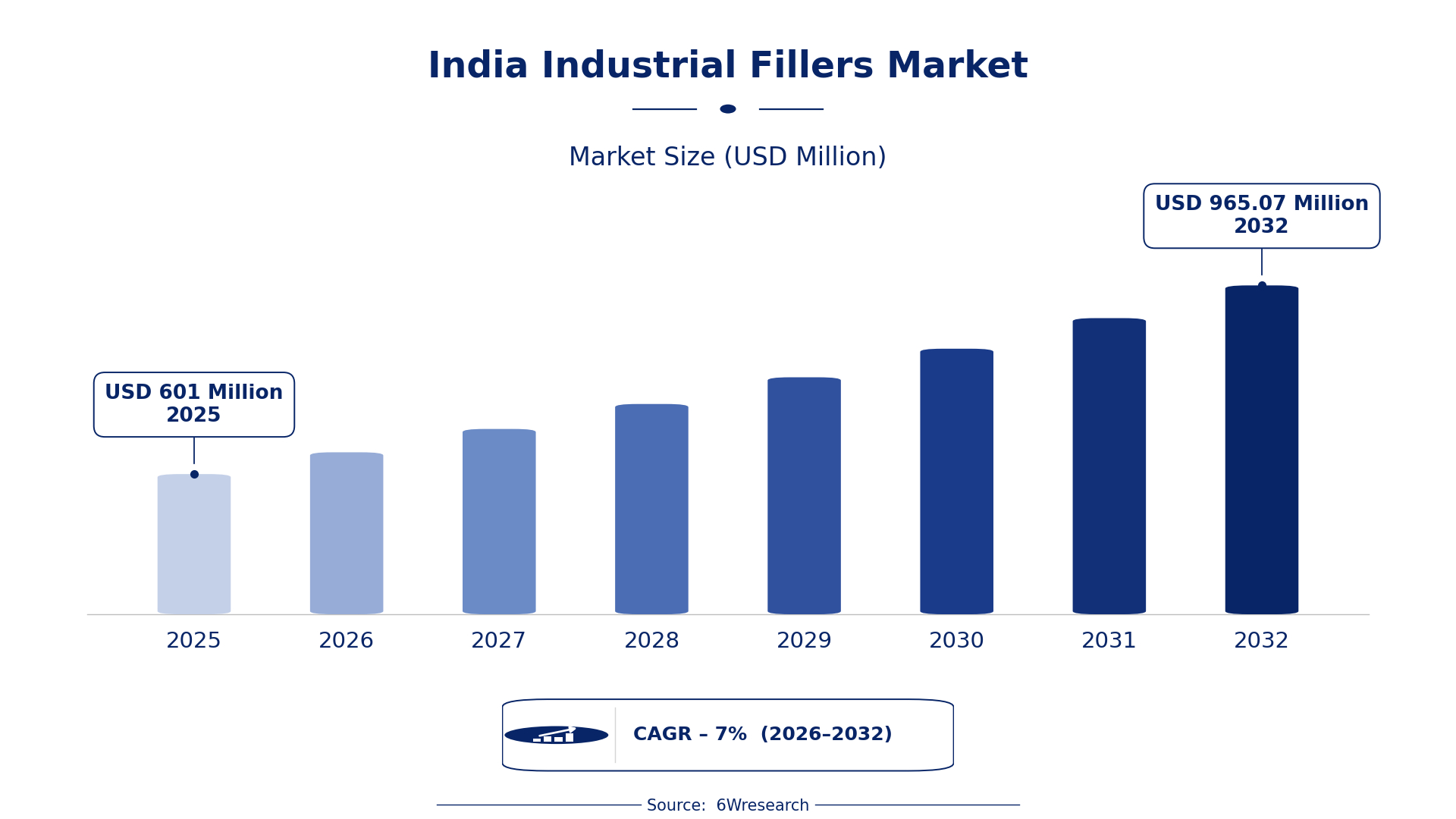
According to 6Wresearch internal database and industry insights, the India Industrial Fillers Market was valued at USD 601.0 million in 2025 and is projected to reach USD 965.07 million by 2032, growing at a CAGR of approximately 7% during 2026–2032.
India Industrial Fillers Market Highlights
| Report Metric | Details |
| Report Name | India Industrial Fillers Market |
| Market Size 2025 | USD 601.0 million |
| Market Size 2032 | USD 965.07 million |
| Absolute Growth 2025–2032 | USD 364.07 million |
| CAGR 2026–2032 | 7% |
| Peak Annual Growth | 8.9% in 2027 |
| Forecast Period | 2026–2032 |
| Historical Data | 2022–2025 |
| Base Year | 2025 |
| Leading Filler Type, 2025 | Calcium Carbonate (41% share) |
| Leading Base Material, 2025 | Mineral-Based (46% share) |
| Leading Functionality, 2025 | Volume Enhancement (45% share) |
| Leading End User, 2025 | Paint & Plastics Industry (42% share) |
| Fastest-Growing Filler Type | Silica Fillers (9.1% CAGR) |
| Fastest-Growing Base Material | Synthetic/Natural (8.4% CAGR) |
| Fastest-Growing Functionality | Rheology Control (8.3% CAGR) |
| Fastest-Growing End User | Adhesives & Sealants (8.2% CAGR) |
| Growing Sector | Adhesives & Sealants |
| Key End Users | Paint & Plastics Industry, Adhesives & Sealants, Rubber Manufacturing, Tire & Electronics Industry |
India Industrial Fillers Market Year-wise Growth Rate and Key Drivers (2022–2032)
This graph illustrates the annual growth rates of the market from 2022 to 2032, highlighting a steady upward trajectory and projected market expansion over the forecast period.
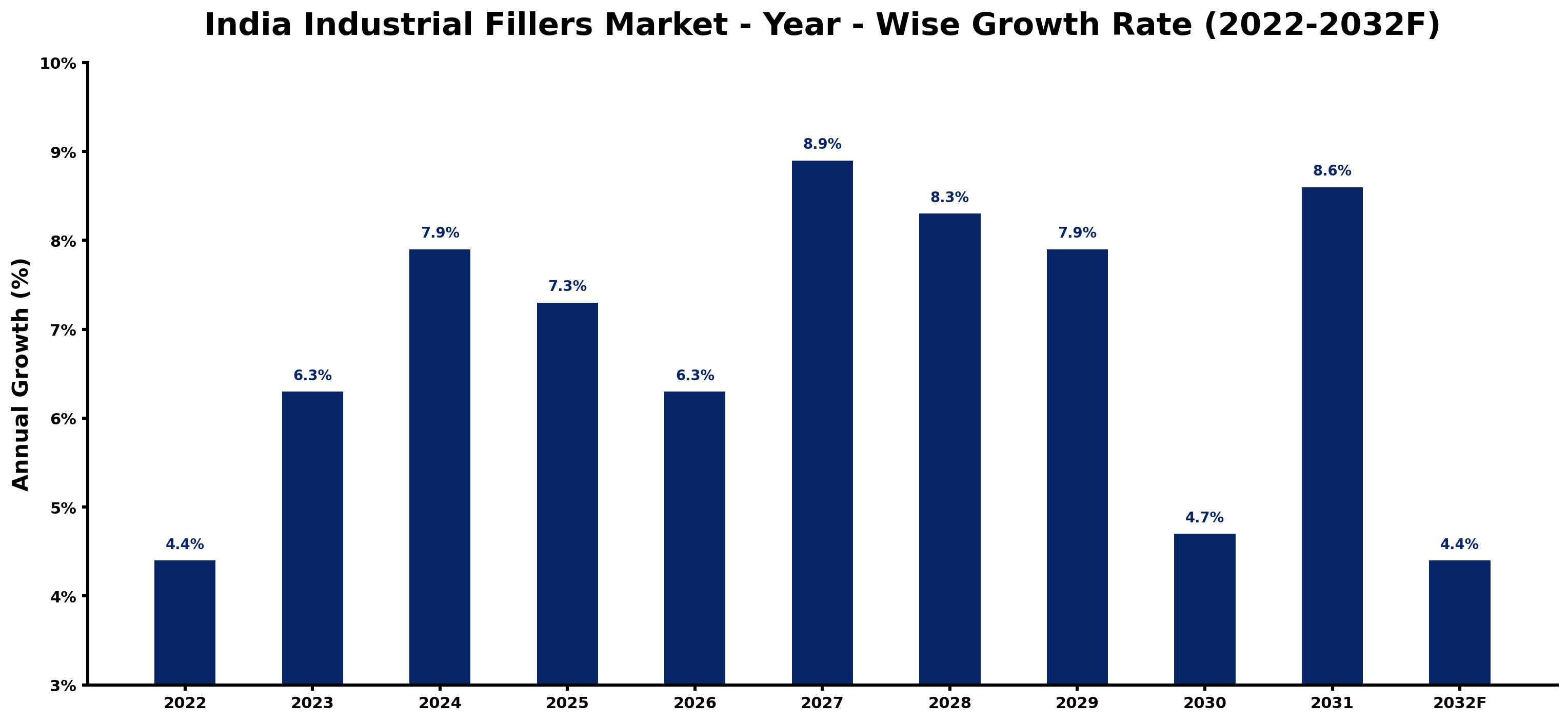
The following table presents the estimated annual growth rate for each year together with the principal factor influencing market performance.
| Year | Estimated Annual Growth (%) | Market Rationale |
| 2022 | 4.4 | The market experienced steady demand from the paint and plastics industries. |
| 2023 | 6.3 | Demand increased due to the growth in the domestic plastics sector. |
| 2024 | 7.9 | The paint industry expanded, boosting filler requirements due to rising construction activities. |
| 2025 | 7.3 | Growth slowed as the market adjusted to previous high demand levels. |
| 2026 | 6.3 | The construction sector's growth is expected to support filler demand from various industries. |
| 2027 | 8.9 | A surge in demand from the rubber manufacturing sector will drive growth in fillers. |
| 2028 | 8.3 | Demand from the adhesives sector is projected to contribute to continued expansion. |
| 2029 | 7.9 | The market will grow as the ceramics industry seeks more fillers for production. |
| 2030 | 4.7 | Growth is expected to slow as the market stabilises after rapid expansion in prior years. |
| 2031 | 8.6 | The rubber manufacturing sector's needs will drive a resurgence in demand for fillers. |
| 2032 | 4.4 | Demand will stabilise as the market adjusts to new production capacities and standards. |
Note: Market size estimations and growth projections presented in this report are based on 6Wresearch's proprietary forecasting methodology, utilizing the latest available industry data, government publications, and primary research inputs.
India Industrial Fillers Market Synopsis
The India Industrial Fillers Market encompasses materials that improve product properties like strength and durability. These fillers, primarily mineral-based, are essential for industries such as paint, plastics, and rubber. The market is growing due to the expanding Indian paint industry projected to reach USD 1.5 billion by 2025 and the increasing demand from the plastics sector valued at USD 50 billion in 2022. The ongoing growth in construction and manufacturing sectors further fuels this demand.
Market Dynamics Impact Analysis (2026–2032)
| Factor | Type | Impact | Primary Segment Affected |
| Growing demand from the paint industry driven by new construction projects. | Driver | High | Paint & Plastics Industry |
| Expansion of the rubber manufacturing sector requiring silica fillers. | Driver | High | Rubber Manufacturing |
| Increasing production capacity in the ceramics industry creates demand for magnesium silicate fillers. | Opportunity | Medium | Magnesium Silicate |
| The rise of the cosmetics sector boosts the need for talc-based fillers. | Opportunity | Medium | Talc-Based Fillers |
| Regulatory compliance costs for fillers can limit producer margins. | Restraint | High | Calcium Carbonate |
| Environmental regulations may restrict production capabilities of fillers. | Restraint | High | Silica Fillers |
| High raw material costs can impact pricing strategies for producers. | Challenge | Medium | Carbon Black |
| Supply chain disruptions can delay the availability of essential fillers. | Challenge | Medium | Synthetic/Natural |
Evaluation of Drivers in India Industrial Fillers Market (2026–2032)
The factors lifting demand, and the evidence behind each, are summarised below.
| Drivers | Primary Segment Affected | Why It Matters (Evidence) |
| Investment in new production technologies for fillers. | Calcium Carbonate | This investment increases production efficiency, enabling manufacturers to meet demand from the construction sector, projected to grow substantially. |
| Growing demand for high-performance rubber products. | Carbon Black | The rubber industry, with an annual production capacity of 1 million tons, drives the need for carbon black fillers, crucial for product durability. |
| Expansion of the Indian plastics industry. | Silica Fillers | The plastics sector, valued at USD 50 billion in 2022, increases the need for silica fillers to improve product properties. |
| Growth in the paint industry due to new construction. | Paint & Plastics Industry | The paint industry is expected to reach USD 1.5 billion by 2025, leading to increased demand for fillers that improve performance. |
| Development of sustainable practices in the chemicals industry. | Mineral-Based | The National Policy on Chemicals, 2020, promotes sustainable practices, driving demand for mineral-based fillers that meet new standards. |
Expansion of the Industrial Fillers market in India is backed by increased investment in production technologies, improving efficiency and capacity. The Indian plastics industry, valued at USD 50 billion in 2022, drives the demand for fillers that improve product properties. The paint industry is expected to reach USD 1.5 billion by 2025, further increasing filler requirements. The rubber manufacturing sector, with a production capacity exceeding 1 million tons annually, boosts the need for carbon black fillers, essential for durability.
Evaluation of Restraints in India Industrial Fillers Market
The key brakes on demand, and where they bite hardest, are shown below.
| Market Restraint | Primary Segment Affected | Why It Matters (Evidence) |
| High compliance costs associated with regulatory standards. | Calcium Carbonate | Producers face increased costs due to the Bureau of Indian Standards' regulations, impacting profitability. |
| Environmental regulations limiting production processes. | Silica Fillers | Regulations from the Central Pollution Control Board can restrict production capabilities, affecting supply. |
| Volatility in raw material prices impacting production costs. | Carbon Black | Fluctuating prices of raw materials can lead to unpredictable production costs for manufacturers. |
| Supply chain disruptions affecting material availability. | Synthetic/Natural | Disruptions in supply chains can delay the procurement of essential fillers, impacting production schedules. |
| Limited market awareness of new filler technologies. | Talc-Based Fillers | Producers may struggle to adopt new filler solutions due to a lack of awareness in the cosmetics sector. |
India Industrial Fillers Market Challenges
Producers in the India Industrial Fillers Market face rising costs due to fluctuating raw material prices, which can increase production expenses by up to 15%. Importers struggle with fierce competition from local manufacturers, forcing them to lower prices and reducing profit margins by approximately 10%. Buyers encounter challenges related to skills shortages, as the lack of trained personnel in filler manufacturing leads to inefficiencies, delaying product delivery timelines. Compliance with the Bureau of Indian Standards can extend approval times, impacting supply chains and causing delays for both suppliers and buyers.
Trends in the India Industrial Fillers Market
Four trends stand out in the India Industrial Fillers Market.
- Shift towards Sustainable Fillers: The Indian fillers market is increasingly adopting sustainable practices, driven by the National Policy on Chemicals, 2020. This shift is expected to improve the quality and safety of fillers, contributing to a market size of USD 965.07 million by 2032.
- Growth in Rubber Manufacturing: The rubber manufacturing sector is expanding rapidly, with production capacity exceeding 1 million tons annually. This growth is increasing the demand for silica fillers, which improve mechanical properties and durability in rubber products.
- Increase in Talc-Based Fillers in Cosmetics: The cosmetics sector is experiencing a rise in the use of talc-based fillers, driven by increasing consumer demand for high-quality products. The market for cosmetics in India is growing, presenting opportunities for filler producers.
- Increased Use of Mineral-Based Fillers: Mineral-based fillers are gaining traction in various industries due to their cost-effectiveness and performance. The paint industry, projected to reach USD 1.5 billion by 2025, is a key driver of this trend.
Investment Opportunities in the India Industrial Fillers Market
Several openings in the India Industrial Fillers Market merit attention from investors.
- Paint & Plastics Industry Expansion: The paint and plastics industry is expanding rapidly, projected to reach USD 1.5 billion by 2025. Suppliers can enter this market by partnering with local manufacturers to meet increasing filler demands.
- Growth in Ceramics Sector: The ceramics industry is experiencing growth, increasing the demand for magnesium silicate fillers. Suppliers can explore opportunities by collaborating with local manufacturers for product supply.
- Demand for Talc-Based Fillers: The cosmetics sector is growing, creating a demand for talc-based fillers. Suppliers can tap into this opportunity by establishing partnerships with cosmetics manufacturers to provide high-quality fillers.
- Investment in Sustainable Filler Solutions: The push for sustainable practices in the chemicals industry presents an opportunity for suppliers of mineral-based fillers. Collaborating with local firms can facilitate market entry and compliance with new standards.
Government Initiatives in the India Industrial Fillers Market
The Bureau of Indian Standards (BIS) has established regulations for industrial fillers to ensure quality and safety. The National Policy on Chemicals, 2020, promotes sustainable practices in the chemicals industry, including fillers. These measures require producers to adhere to stringent quality standards, impacting production processes and costs. The BIS has set specific guidelines that producers must follow, ensuring product safety and compliance.
The Central Pollution Control Board (CPCB) oversees the environmental impact of filler production, ensuring compliance with environmental standards. The Indian Rubber Manufacturers Research Association (IRMRA) supports research and development in rubber fillers, funding projects that improve product performance and sustainability. The CPCB's regulations require producers to implement environmentally friendly practices, enhancing market competitiveness.
Future Insight of the India Industrial Fillers Market
The India Industrial Fillers Market will experience notable changes by 2032, driven by several key factors. The government's 'Make in India' initiative will strengthen domestic production capabilities, promoting local sourcing of fillers. The construction sector's expansion will elevate demand for fillers, supporting a projected market size of 1.5 billion USD in the paint industry by 2025. Innovations in sustainable practices, as outlined in the National Policy on Chemicals, will improve product quality and safety for buyers.
Market Segmentation Analysis
The report offers a comprehensive study of the following market segments and their leading categories in the market.
By Filler Type – Calcium Carbonate Dominated, Silica Fillers Expected to Grow Fastest
According to Sachin Kumar Rai, Senior Research Analyst at 6Wresearch, the largest filler type category in 2025 was Calcium Carbonate, with a 41% share of total revenue. Calcium carbonate fillers hold the largest market share owing to their extensive use in the paint and plastics industries, where they effectively improve performance and reduce costs. The projected growth of India's paint industry to 1.5 billion USD by 2025 highlights the strong demand for these fillers. The quickest growth will come from Silica Fillers, forecast to expand at a CAGR of 9.1% between 2026 and 2032. Silica fillers are witnessing rapid growth as they are increasingly employed in the rubber manufacturing sector, which boasts a production capacity exceeding 1 million tons annually. This trend indicates a rising preference for silica fillers to enhance mechanical properties and durability in rubber products. Suppliers should focus on developing silica fillers to cater to the growing needs of the rubber industry.
By Base Material – Mineral-Based Dominated, Synthetic/Natural Expected to Grow Fastest
Mineral-Based held a 46% share of the India Industrial Fillers Market by base material in 2025. Mineral-based fillers dominate the market share as they are widely used in traditional applications across various industries, ensuring their continued relevance. Their established presence in sectors like paint and plastics reinforces their leading position. Synthetic/Natural is projected to grow fastest, at a CAGR of 8.4% during 2026–2032. The synthetic/natural fillers segment is growing quickly, driven by their application in specialized industries that require tailored solutions. This growth is indicative of a shift towards more advanced materials in niche markets, creating opportunities for suppliers. Buyers should consider diversifying their filler sources to include synthetic options as demand for specialized applications increases.
By Functionality – Volume Enhancement Dominated, Rheology Control Expected to Grow Fastest
With a 45% revenue share in 2025, Volume Enhancement was the largest functionality category. Volume enhancement fillers command the largest market share because they are essential for increasing product bulk without significantly raising costs. Their critical role across various sectors ensures a consistent demand for these fillers. Over 2026–2032, Rheology Control is expected to post the fastest growth, at a CAGR of 8.3%. Rheology control fillers are experiencing the fastest growth due to their significance in maintaining material flow characteristics, which is increasingly vital in contemporary manufacturing. This trend suggests a strong need for suppliers to innovate within this segment. Suppliers must prioritise advancements in rheology control solutions to meet the evolving demands of manufacturers.
By End User – Paint & Plastics Industry Dominated, Adhesives & Sealants Expected to Grow Fastest
Paint & Plastics Industry took a 42% share of end user in 2025, more than any other category. The paint and plastics industry represents the largest market share for industrial fillers, utilising them to enhance product performance and adhere to strict quality standards. This sector's substantial market size significantly drives the demand for various types of fillers. Adhesives & Sealants are set to record the highest CAGR in this split, 8.2% over 2026–2032. Adhesives and sealants are the fastest-growing end-user segment, as these products increasingly rely on fillers to improve adhesion properties. The ongoing expansion of construction and manufacturing activities is propelling this growth. Suppliers should target the adhesives and sealants market to capitalise on the rising demand for high-performance fillers.
Key Attractiveness of the Report
- 10 Years of Market Numbers
- Historical Data Starting from 2022 to 2025
- Base Year 2025
- Forecast Data until 2032
- Key Performance Indicators Impacting the Market
- Major Upcoming Developments and Projects
Key Highlights of the Report:
- India Industrial Fillers Market Outlook
- Market Size of India Industrial Fillers Market, 2025
- Forecast of India Industrial Fillers Market, 2032
- Historical Data and Forecast of India Industrial Fillers Revenues & Volume for the Period 2022 - 2032F
- India Industrial Fillers Market Trend Evolution
- India Industrial Fillers Market Drivers and Challenges
- India Industrial Fillers Price Trends
- India Industrial Fillers Porter's Five Forces
- India Industrial Fillers Industry Life Cycle
- Historical Data and Forecast of India Industrial Fillers Market Revenues & Volume By Filler Type for the Period 2022 - 2032F
- Historical Data and Forecast of India Industrial Fillers Market Revenues & Volume By Calcium Carbonate for the Period 2022 - 2032F
- Historical Data and Forecast of India Industrial Fillers Market Revenues & Volume By Silica Fillers for the Period 2022 - 2032F
- Historical Data and Forecast of India Industrial Fillers Market Revenues & Volume By Talc-Based Fillers for the Period 2022 - 2032F
- Historical Data and Forecast of India Industrial Fillers Market Revenues & Volume By Carbon Black for the Period 2022 - 2032F
- Historical Data and Forecast of India Industrial Fillers Market Revenues & Volume By Base Material for the Period 2022 - 2032F
- Historical Data and Forecast of India Industrial Fillers Market Revenues & Volume By Mineral-Based for the Period 2022 - 2032F
- Historical Data and Forecast of India Industrial Fillers Market Revenues & Volume By Synthetic/Natural for the Period 2022 - 2032F
- Historical Data and Forecast of India Industrial Fillers Market Revenues & Volume By Magnesium Silicate for the Period 2022 - 2032F
- Historical Data and Forecast of India Industrial Fillers Market Revenues & Volume By Carbonaceous for the Period 2022 - 2032F
- Historical Data and Forecast of India Industrial Fillers Market Revenues & Volume By Functionality for the Period 2022 - 2032F
- Historical Data and Forecast of India Industrial Fillers Market Revenues & Volume By Volume Enhancement for the Period 2022 - 2032F
- Historical Data and Forecast of India Industrial Fillers Market Revenues & Volume By Rheology Control for the Period 2022 - 2032F
- Historical Data and Forecast of India Industrial Fillers Market Revenues & Volume By Opacity & Texture for the Period 2022 - 2032F
- Historical Data and Forecast of India Industrial Fillers Market Revenues & Volume By Conductivity for the Period 2022 - 2032F
- Historical Data and Forecast of India Industrial Fillers Market Revenues & Volume By End User for the Period 2022 - 2032F
- Historical Data and Forecast of India Industrial Fillers Market Revenues & Volume By Paint & Plastics Industry for the Period 2022 - 2032F
- Historical Data and Forecast of India Industrial Fillers Market Revenues & Volume By Adhesives & Sealants for the Period 2022 - 2032F
- Historical Data and Forecast of India Industrial Fillers Market Revenues & Volume By Rubber Manufacturing for the Period 2022 - 2032F
- Historical Data and Forecast of India Industrial Fillers Market Revenues & Volume By Tire & Electronics Industry for the Period 2022 - 2032F
- India Industrial Fillers Import Export Trade Statistics
- Market Opportunity Assessment By Filler Type
- Market Opportunity Assessment By Base Material
- Market Opportunity Assessment By Functionality
- Market Opportunity Assessment By End User
- India Industrial Fillers Top Companies Market Share
- India Industrial Fillers Competitive Benchmarking By Technical and Operational Parameters
- India Industrial Fillers Company Profiles
- India Industrial Fillers Key Strategic Recommendations
Market Covered
Segments analysed in this report are listed below.
By Filler Type
- Calcium Carbonate
- Silica Fillers
- Talc-Based Fillers
- Carbon Black
By Base Material
- Mineral-Based
- Synthetic/Natural
- Magnesium Silicate
- Carbonaceous
By Functionality
- Volume Enhancement
- Rheology Control
- Opacity & Texture
- Conductivity
By End User
- Paint & Plastics Industry
- Adhesives & Sealants
- Rubber Manufacturing
- Tire & Electronics Industry































