China Industrial Fillers Market Size & Growth Rate
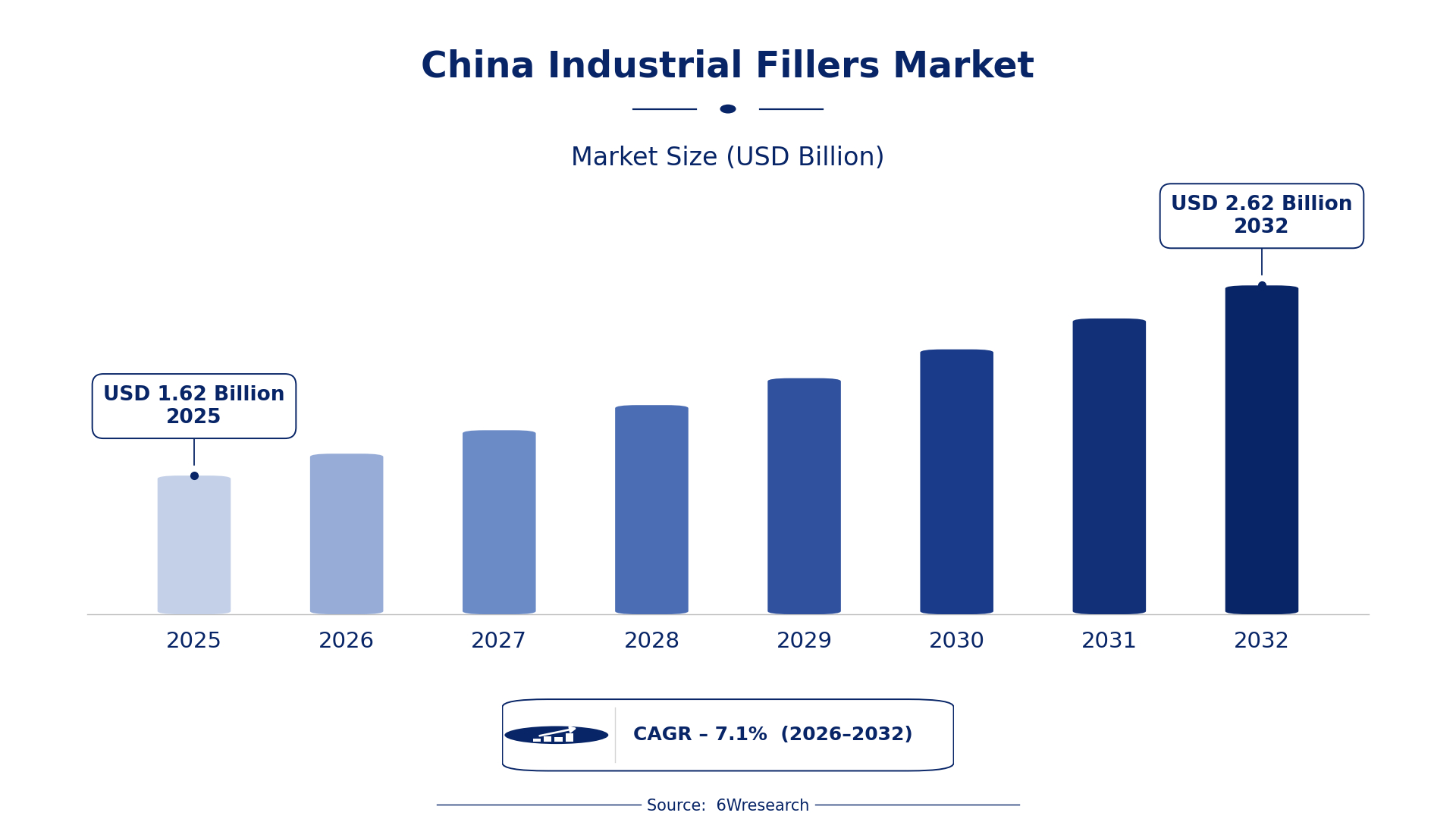
According to 6Wresearch internal database and industry insights, the China Industrial Fillers Market was valued at USD 1.62 billion in 2025 and is projected to reach USD 2.62 billion by 2032, growing at a CAGR of approximately 7.1% during 2026–2032.
China Industrial Fillers Market Highlights
| Report Metric | Details |
| Report Name | China Industrial Fillers Market |
| Market Size 2025 | USD 1.62 billion |
| Market Size 2032 | USD 2.62 billion |
| Absolute Growth 2025–2032 | USD 1 billion |
| CAGR 2026–2032 | 7.1% |
| Peak Annual Growth | 8.8% in 2027 |
| Forecast Period | 2026–2032 |
| Historical Data | 2022–2025 |
| Base Year | 2025 |
| Leading Filler Type, 2025 | Calcium Carbonate (46% share) |
| Leading Base Material, 2025 | Mineral-Based (49% share) |
| Leading Functionality, 2025 | Volume Enhancement (43% share) |
| Leading End User, 2025 | Paint & Plastics Industry (39% share) |
| Fastest-Growing Filler Type | Silica Fillers (9.3% CAGR) |
| Fastest-Growing Base Material | Synthetic/Natural (9.3% CAGR) |
| Fastest-Growing Functionality | Rheology Control (9.0% CAGR) |
| Fastest-Growing End User | Adhesives & Sealants (8.6% CAGR) |
| Growing Sector | Paint & Plastics Industry |
| Key End Users | Paint manufacturers, Rubber producers, Adhesives and sealants suppliers, Electronics manufacturers |
China Industrial Fillers Market Year-wise Growth Rate and Key Drivers (2022–2032)
This graph illustrates the annual growth rates of the market from 2022 to 2032, highlighting a steady upward trajectory and projected market expansion over the forecast period.
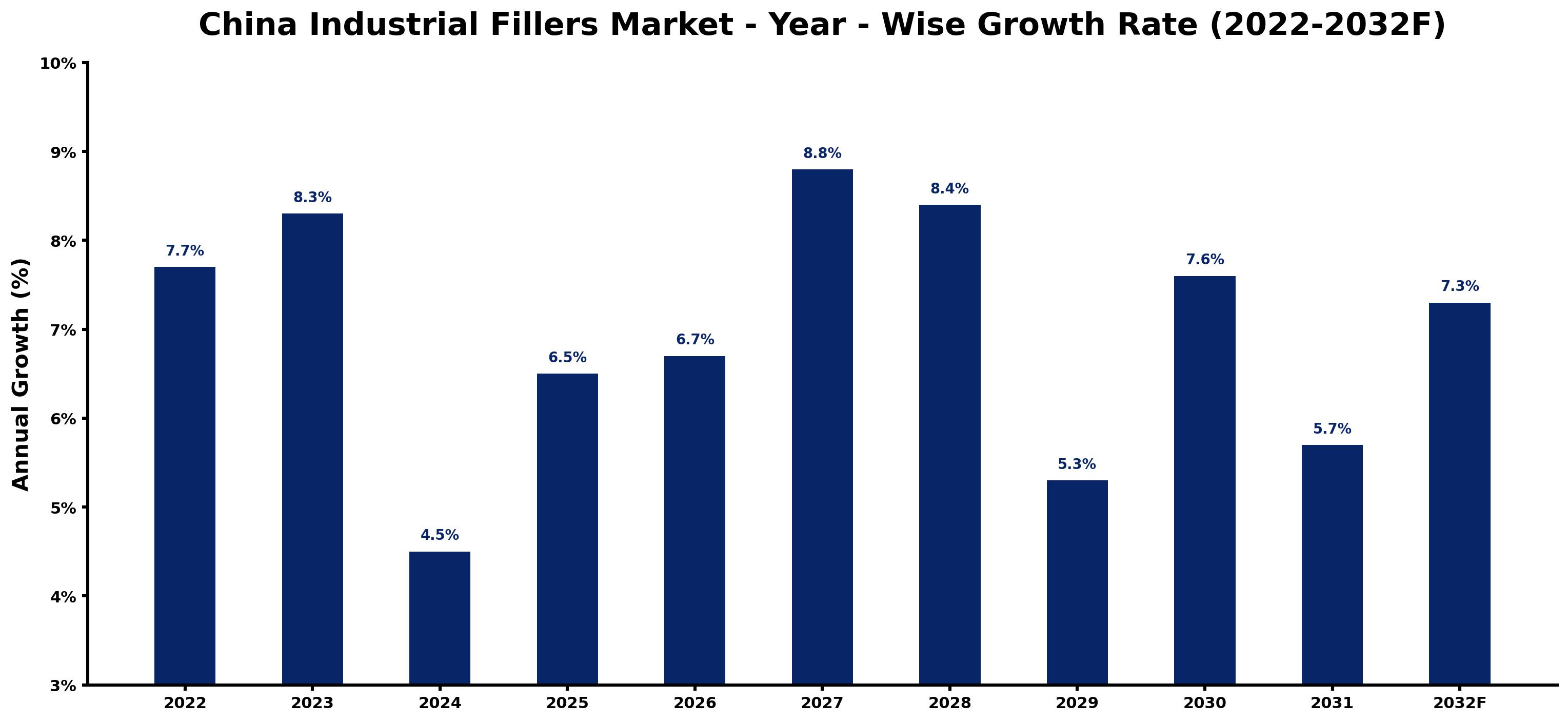
Annual growth estimates for each year appear below with the principal reason behind them, explaining the shifts that set the pace of the market.
| Year | Estimated Annual Growth (%) | Market Rationale |
| 2022 | 7.7 | The market saw strong demand from the paint and coatings sector, driving growth. |
| 2023 | 8.3 | Increased production capacities in the rubber industry contributed to faster growth. |
| 2024 | 4.5 | Growth slowed due to temporary supply chain disruptions affecting filler availability. |
| 2025 | 6.5 | The paint and plastics industry continued to expand, boosting filler consumption. |
| 2026 | 6.7 | Rising automotive production will increase demand for fillers in the rubber sector. |
| 2027 | 8.8 | The market peaked as demand surged from electronics and automotive industries. |
| 2028 | 8.4 | Growth slowed as the market adjusted to previous high demand levels. |
| 2029 | 5.3 | A decrease in construction activities will lead to a slowdown in filler usage. |
| 2030 | 7.6 | The rubber manufacturing sector is projected to experience renewed demand, driving growth again. |
| 2031 | 5.7 | Demand decelerated as the National Standard for Calcium Carbonate compliance began to affect filler consumption. |
| 2032 | 7.3 | Increased production of consumer goods will support a recovery in demand. |
Note: Market size estimations and growth projections presented in this report are based on 6Wresearch's proprietary forecasting methodology, utilizing the latest available industry data, government publications, and primary research inputs.
China Industrial Fillers Market Synopsis
Industrial Fillers in China encompass materials that enhance the properties of products such as strength and durability. These fillers are primarily mineral or synthetic-based, used in paints, plastics, rubber, and adhesives. The China Industrial Fillers Market is projected to grow due to strong demand from the paint and coatings industry, which is expected to consume over 30% of industrial fillers by 2025. Additionally, the rubber manufacturing sector's increasing reliance on silica fillers further drives market expansion. The total annual demand for talc-based fillers is around 10 million tons, highlighting the active nature of this market.
Market Dynamics Impact Analysis (2026–2032)
| Factor | Type | Impact | Primary Segment Affected |
| Growing demand from the paint and coatings sector drives filler consumption. | Driver | High | Paint & Plastics Industry |
| Increased production capacities in the rubber industry enhance filler usage. | Driver | High | Rubber Manufacturing |
| Investment in sustainable filler production methods presents new opportunities. | Opportunity | High | Synthetic/Natural |
| The rising demand for high-performance adhesives creates a supply gap. | Opportunity | Medium | Adhesives & Sealants |
| Stricter compliance measures may raise production costs for manufacturers. | Restraint | High | Calcium Carbonate |
| Quality control requirements could limit market entry for new producers. | Restraint | Medium | Silica Fillers |
| Production inefficiencies can lead to increased operational costs for suppliers. | Challenge | High | Talc-Based Fillers |
| Technological advancements may require significant investment from producers. | Challenge | Medium | Carbon Black |
Evaluation of Drivers in China Industrial Fillers Market (2026–2032)
The table below links each growth driver to the segment it affects and the evidence for it.
| Drivers | Primary Segment Affected | Why It Matters (Evidence) |
| Strong demand from the paint and coatings industry drives filler usage. | Calcium Carbonate | The paint industry is projected to consume over 30% of industrial fillers by 2025. |
| Increased automotive production boosts demand for rubber fillers. | Silica Fillers | The rubber manufacturing sector utilized approximately 40% of silica fillers in 2022. |
| Growing electronics sector increases the need for conductive fillers. | Carbon Black | China's electronics industry remains a major consumer of carbon black, driven by component growth. |
| Rising construction activities increase demand for fillers in various applications. | Talc-Based Fillers | The annual demand for talc-based fillers in China is around 10 million tons. |
| Investment in sustainable production methods supports market growth. | Synthetic/Natural | The Chinese government promotes the development of synthetic fillers through subsidies. |
Market growth for Industrial Fillers in China is underpinned by strong demand from the paint and coatings sector, which is projected to consume over 30% of industrial fillers by 2025. Automotive production also boosts demand for fillers, with approximately 40% of silica fillers utilized in the rubber manufacturing sector in 2022. The electronics industry, a key consumer of carbon black, continues to expand due to the growth of electronic components, while the annual demand for talc-based fillers remains around 10 million tons.
Evaluation of Restraints in China Industrial Fillers Market
Below mentioned are some major restraints and their influence on market dynamics.
| Market Restraint | Primary Segment Affected | Why It Matters (Evidence) |
| Stricter compliance measures may increase production costs. | Calcium Carbonate | The State Administration for Market Regulation implemented stricter compliance measures in 2022. |
| Quality control requirements could limit market entry for new producers. | Silica Fillers | ISO 9001 certification is increasingly required for manufacturers to ensure quality. |
| Production inefficiencies can lead to increased operational costs for suppliers. | Talc-Based Fillers | The annual demand for talc-based fillers in China is around 10 million tons. |
| Market saturation may hinder growth opportunities for existing players. | Carbon Black | China's electronics industry remains a major consumer, but competition is intensifying. |
| Rising raw material costs can affect profitability for manufacturers. | Synthetic/Natural | The total trade volume of industrial fillers in China reached 3 billion yuan in 2022. |
China Industrial Fillers Market Challenges
The China Industrial Fillers Market still has to solve a few problems, starting with rising costs that impact buyers in the rubber manufacturing sector. Increasing raw material prices can inflate production costs by up to 15%, making it challenging for manufacturers to maintain profit margins. Competition among suppliers is intensifying, particularly in the paint and coatings sector, which will consume over 30% of industrial fillers by 2025, leading to price wars that can compromise quality. Technological advancements lag behind demand, as many manufacturers lack ISO 9001 certification, risking compliance with the National Standard for Calcium Carbonate. Supply chain disruptions remain a concern, with total installed capacity for industrial fillers at 15 million tons, which may not meet the growing needs of the electronics industry, causing delays in fulfilling orders.
Trends in the China Industrial Fillers Market
Four trends stand out in the China Industrial Fillers Market.
- Shift from Traditional to Sustainable Fillers: Since 2021, the Chinese government has promoted sustainable practices in filler production through the 'Green Manufacturing Program'. This initiative aims to improve environmental standards, with funding allocated to support new technologies, impacting producers across the industry.
- Emergence of High-Performance Adhesives: The adhesives and sealants market is projected to exceed 200 billion yuan by 2025, driving demand for high-performance fillers. This trend reflects the growing need for advanced materials in construction and automotive applications, influencing supplier strategies.
- Transition from Mineral-Based to Synthetic Fillers: The market is experiencing a shift towards synthetic fillers, with a CAGR of 9.3% for this segment. This trend is driven by advancements in technology and demand for specialized applications in various industries, reshaping supplier offerings.
- Growth in the Electronics Sector: The electronics industry increasingly relies on carbon black for conductivity, with demand driven by the growth of electronic components. This sector's expansion is likely to influence filler production strategies in the coming years.
Investment Opportunities in the China Industrial Fillers Market
Below are the investment opportunities with the strongest case in the China Industrial Fillers Market.
- Forming Joint Ventures for Sustainable Production: Establishing partnerships with local manufacturers can ease entry into the sustainable filler market, projected for rapid growth. The Ministry of Industry and Information Technology aims to boost production capabilities by 20% by 2025.
- Supply of High-Performance Fillers: The adhesives and sealants industry offers a promising opportunity for suppliers of high-performance fillers. With the market expected to exceed 200 billion yuan by 2025, entering this sector can yield substantial returns.
- Investment in Innovative Technologies: Investing in the development of synthetic fillers can address the rising demand for specialised applications. The 'New Materials Industry Promotion Plan' supports innovative technologies with a budget of 500 million yuan.
- Expansion Opportunities in the Guangdong Region: The Guangdong province, known for its high concentration of filler manufacturing facilities, presents a significant opportunity for investment. The region's established infrastructure can facilitate market entry and growth.
Government Initiatives in the China Industrial Fillers Market
The '14th Five-Year Plan for the Development of New Materials Industry', released by the Ministry of Industry and Information Technology in 2021, aims to improve production capabilities by 20% by 2025. This plan focuses on improving technology and production efficiency, which is vital for manufacturers in the industrial fillers market. Furthermore, the 'National Standard for Plastic Fillers' (GB/T 20000.1-2018) was updated in 2022 to enhance product quality and safety, ensuring that manufacturers adhere to stringent guidelines. These measures collectively support the growth and sustainability of the industrial fillers sector in China.
In 2023, the Ministry of Ecology and Environment launched the 'Green Manufacturing Program' to promote sustainable practices in the production of industrial fillers. This program encourages manufacturers to adopt environmentally friendly processes and technologies. The National Development and Reform Commission initiated the 'New Materials Industry Promotion Plan' in 2021, allocating a budget of 500 million yuan to support innovative filler technologies. These efforts are designed to improve the competitiveness of China's industrial fillers market and ensure compliance with international standards.
Future Insight of the China Industrial Fillers Market
By 2032, buyers and suppliers in the China Industrial Fillers Market can expect significant changes driven by several key factors. The Ministry of Industry and Information Technology's 'Advanced Materials Industry Development Plan' will improve production capabilities, allowing suppliers to meet rising demand more effectively. The rubber sector is set to see a 5% increase in filler usage by 2025, spurred by automotive demand, creating new opportunities for producers. The total trade volume of industrial fillers in China reached 3 billion yuan in 2022, indicating a growing market that will support further innovations in filler applications.
Market Segmentation Analysis
The analysis below covers each segmentation, its leading category in 2025 and its fastest-growing category through 2032.
By Filler Type – Calcium Carbonate Dominated, Silica Fillers Expected to Grow Fastest
According to Sachin Kumar Rai, Senior Research Analyst at 6Wresearch, Calcium Carbonate held a 46% share of the China Industrial Fillers Market by filler type in 2025. Calcium carbonate fillers dominate the market because they are essential for enhancing the volume of paints and plastics, which are significant consumer sectors in China. With a production volume exceeding 50 million tons annually, their established presence reinforces their leading market share. The quickest growth will come from Silica Fillers, forecast to expand at a CAGR of 9.3% between 2026 and 2032. Silica fillers are experiencing rapid growth due to their critical role in providing rheology control in adhesives and sealants. As the demand for high-performance adhesives continues to rise, this segment is poised for substantial expansion. Suppliers should focus on developing silica fillers to address the increasing demands of the adhesives and sealants market.
By Base Material – Mineral-Based Dominated, Synthetic/Natural Expected to Grow Fastest
Mineral-Based accounted for a 49% market share by base material in 2025. Mineral-based fillers hold the largest market share as they are extensively used across various industrial applications, delivering vital properties to numerous products. Their established presence in sectors like paints and plastics ensures their leading position in the market. Synthetic/Natural is set to record the highest CAGR in this split, 9.3% over 2026–2032. The synthetic and natural filler segment is growing swiftly, driven by their application in specialised sectors that require enhanced performance characteristics. This trend reflects a shift towards advanced materials within the industry. Suppliers must adapt to the rising demand for synthetic and natural fillers to maintain competitiveness in specialised markets.
By Functionality – Volume Enhancement Dominated, Rheology Control Expected to Grow Fastest
Volume Enhancement took a 43% share of functionality in 2025, more than any other category. Volume enhancement functionality leads the market as it is crucial for improving the bulk and performance of products across multiple industries. Its essential role in applications such as paints and plastics secures its dominant market share. Over 2026–2032, Rheology Control is expected to post the fastest growth, at a CAGR of 9.0%. Rheology control functionality is the fastest-growing segment, particularly in adhesives and sealants, where consistency is vital for product performance. The increasing demand for high-quality formulations is propelling this segment's growth. Manufacturers should prioritise the development of fillers that improve rheology control to meet the changing needs of the adhesives market.
By End User – Paint & Plastics Industry Dominated, Adhesives & Sealants Expected to Grow Fastest
With a 39% revenue share in 2025, Paint & Plastics Industry was the largest end user category. The paint and plastics industry is the largest consumer of industrial fillers, accounting for a substantial share of the market. This sector's extensive use of fillers to enhance product properties solidifies its leading position. Adhesives & Sealants are projected to grow fastest, at a CAGR of 8.6% during 2026–2032. The adhesives and sealants sector is witnessing the fastest growth, driven by the escalating need for performance enhancement in various applications. As this market expands, the demand for fillers tailored for adhesives will increase significantly. Suppliers should concentrate on fulfilling the specific requirements of the adhesives and sealants market to capitalise on growth opportunities.
Key Attractiveness of the Report
- 10 Years of Market Numbers
- Historical Data Starting from 2022 to 2025
- Base Year 2025
- Forecast Data until 2032
- Key Performance Indicators Impacting the Market
- Major Upcoming Developments and Projects
Key Highlights of the Report:
- China Industrial Fillers Market Outlook
- Market Size of China Industrial Fillers Market, 2025
- Forecast of China Industrial Fillers Market, 2032
- Historical Data and Forecast of China Industrial Fillers Revenues & Volume for the Period 2022 - 2032F
- China Industrial Fillers Market Trend Evolution
- China Industrial Fillers Market Drivers and Challenges
- China Industrial Fillers Price Trends
- China Industrial Fillers Porter's Five Forces
- China Industrial Fillers Industry Life Cycle
- Historical Data and Forecast of China Industrial Fillers Market Revenues & Volume By Filler Type for the Period 2022 - 2032F
- Historical Data and Forecast of China Industrial Fillers Market Revenues & Volume By Calcium Carbonate for the Period 2022 - 2032F
- Historical Data and Forecast of China Industrial Fillers Market Revenues & Volume By Silica Fillers for the Period 2022 - 2032F
- Historical Data and Forecast of China Industrial Fillers Market Revenues & Volume By Talc-Based Fillers for the Period 2022 - 2032F
- Historical Data and Forecast of China Industrial Fillers Market Revenues & Volume By Carbon Black for the Period 2022 - 2032F
- Historical Data and Forecast of China Industrial Fillers Market Revenues & Volume By Base Material for the Period 2022 - 2032F
- Historical Data and Forecast of China Industrial Fillers Market Revenues & Volume By Mineral-Based for the Period 2022 - 2032F
- Historical Data and Forecast of China Industrial Fillers Market Revenues & Volume By Synthetic/Natural for the Period 2022 - 2032F
- Historical Data and Forecast of China Industrial Fillers Market Revenues & Volume By Magnesium Silicate for the Period 2022 - 2032F
- Historical Data and Forecast of China Industrial Fillers Market Revenues & Volume By Carbonaceous for the Period 2022 - 2032F
- Historical Data and Forecast of China Industrial Fillers Market Revenues & Volume By Functionality for the Period 2022 - 2032F
- Historical Data and Forecast of China Industrial Fillers Market Revenues & Volume By Volume Enhancement for the Period 2022 - 2032F
- Historical Data and Forecast of China Industrial Fillers Market Revenues & Volume By Rheology Control for the Period 2022 - 2032F
- Historical Data and Forecast of China Industrial Fillers Market Revenues & Volume By Opacity & Texture for the Period 2022 - 2032F
- Historical Data and Forecast of China Industrial Fillers Market Revenues & Volume By Conductivity for the Period 2022 - 2032F
- Historical Data and Forecast of China Industrial Fillers Market Revenues & Volume By End User for the Period 2022 - 2032F
- Historical Data and Forecast of China Industrial Fillers Market Revenues & Volume By Paint & Plastics Industry for the Period 2022 - 2032F
- Historical Data and Forecast of China Industrial Fillers Market Revenues & Volume By Adhesives & Sealants for the Period 2022 - 2032F
- Historical Data and Forecast of China Industrial Fillers Market Revenues & Volume By Rubber Manufacturing for the Period 2022 - 2032F
- Historical Data and Forecast of China Industrial Fillers Market Revenues & Volume By Tire & Electronics Industry for the Period 2022 - 2032F
- China Industrial Fillers Import Export Trade Statistics
- Market Opportunity Assessment By Filler Type
- Market Opportunity Assessment By Base Material
- Market Opportunity Assessment By Functionality
- Market Opportunity Assessment By End User
- China Industrial Fillers Top Companies Market Share
- China Industrial Fillers Competitive Benchmarking By Technical and Operational Parameters
- China Industrial Fillers Company Profiles
- China Industrial Fillers Key Strategic Recommendations
Market Covered
The report offers an extensive study of the following market segments.
By Filler Type
- Calcium Carbonate
- Silica Fillers
- Talc-Based Fillers
- Carbon Black
By Base Material
- Mineral-Based
- Synthetic/Natural
- Magnesium Silicate
- Carbonaceous
By Functionality
- Volume Enhancement
- Rheology Control
- Opacity & Texture
- Conductivity
By End User
- Paint & Plastics Industry
- Adhesives & Sealants
- Rubber Manufacturing
- Tire & Electronics Industry































