India Industrial Processing Additives Market Size & Growth Rate
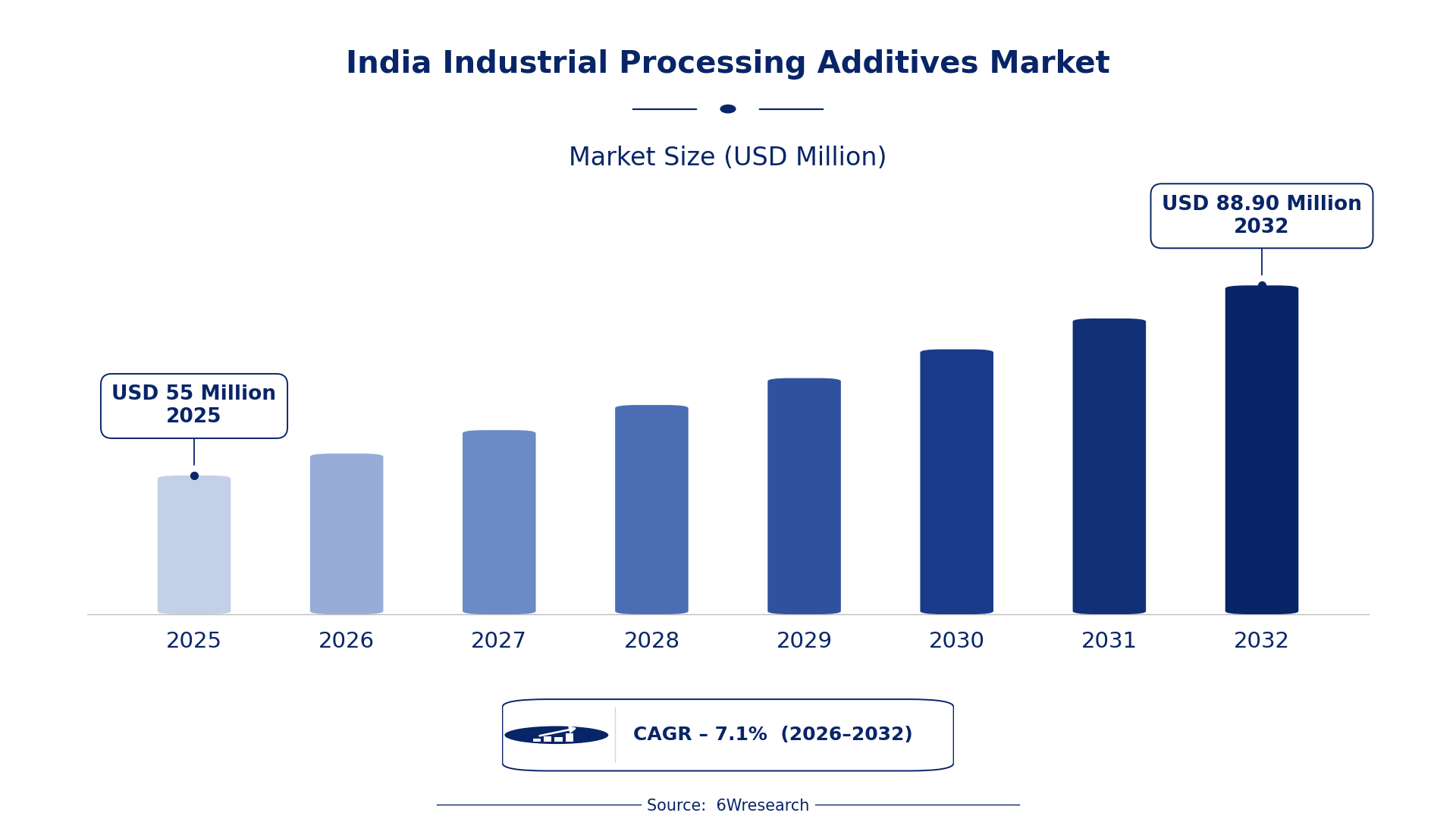
According to 6Wresearch internal database and industry insights, the India Industrial Processing Additives Market was valued at USD 55.0 million in 2025 and is projected to reach USD 88.90 million by 2032, growing at a CAGR of approximately 7.1% during 2026–2032.
India Industrial Processing Additives Market Highlights
| Report Metric | Details |
| Report Name | India Industrial Processing Additives Market |
| Market Size 2025 | USD 55.0 million |
| Market Size 2032 | USD 88.90 million |
| Absolute Growth 2025–2032 | USD 33.90 million |
| CAGR 2026–2032 | 7.1% |
| Peak Annual Growth | 8.5% in 2029 |
| Forecast Period | 2026–2032 |
| Historical Data | 2022–2025 |
| Base Year | 2025 |
| Leading Additive Type, 2025 | Lubricity Additives (42% share) |
| Leading Material Base, 2025 | Synthetic (37% share) |
| Leading Application Process, 2025 | Metal Forming (41% share) |
| Leading Form, 2025 | Liquid (47% share) |
| Leading End User Industry, 2025 | Manufacturing (40% share) |
| Fastest-Growing Additive Type | Anti-Scorch Agents (9.1% CAGR) |
| Fastest-Growing Material Base | Organic (9.4% CAGR) |
| Fastest-Growing Application Process | Injection Molding (9.6% CAGR) |
| Fastest-Growing Form | Powder (9.3% CAGR) |
| Fastest-Growing End User Industry | Automotive (9.8% CAGR) |
| Growing Sector | Automotive |
| Key End Users | Manufacturers, Automotive sector, Chemical producers, Packaging industry |
India Industrial Processing Additives Market Year-wise Growth Rate and Key Drivers (2022–2032)
This graph illustrates the annual growth rates of the market from 2022 to 2032, highlighting a steady upward trajectory and projected market expansion over the forecast period.
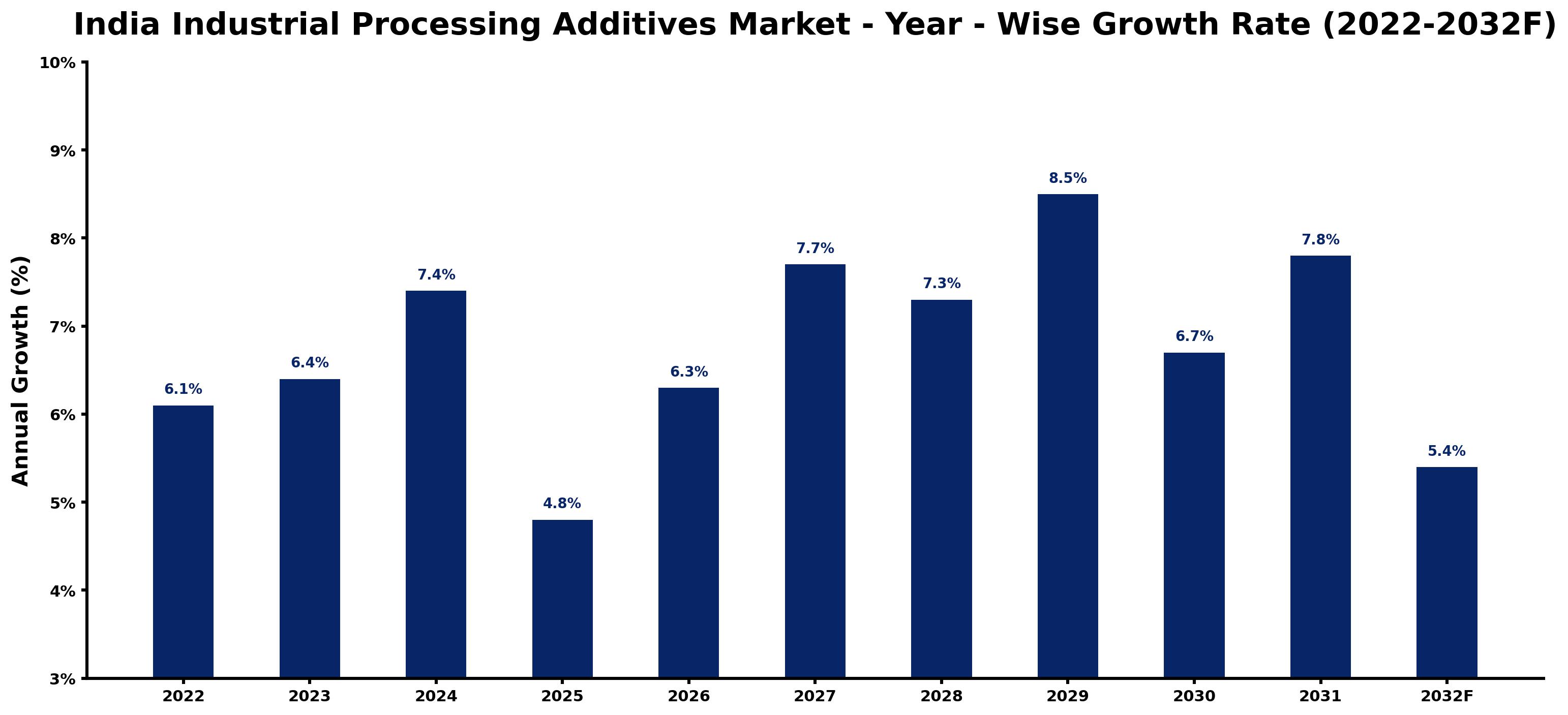
Each row of the following table gives one year's estimated growth and the event or demand shift that explains it.
| Year | Estimated Annual Growth (%) | Market Rationale |
| 2022 | 6.1 | The market experienced steady growth due to increasing manufacturing activities across sectors. |
| 2023 | 6.4 | Demand for industrial processing additives rose as the automotive industry expanded significantly. |
| 2024 | 7.4 | The automotive sector's growth accelerated, driving higher consumption of lubricity additives. |
| 2025 | 4.8 | Growth slowed as manufacturers adjusted to supply chain challenges and fluctuating costs. |
| 2026 | 6.3 | Investment in specialty chemicals increased, leading to higher demand for industrial additives. |
| 2027 | 7.7 | The automotive industry's expansion continued to boost demand for processing additives. |
| 2028 | 7.3 | Growth moderated as manufacturers faced challenges in sourcing raw materials. |
| 2029 | 8.5 | The peak growth year saw a surge in demand driven by innovative manufacturing processes. |
| 2030 | 6.7 | Demand growth slowed as market conditions stabilised after the peak year. |
| 2031 | 7.8 | The market rebounded with renewed interest in high-performance formulations. |
| 2032 | 5.4 | Growth continued at a slower pace as the market matured and competition intensified. |
Note: Market size estimations and growth projections presented in this report are based on 6Wresearch's proprietary forecasting methodology, utilizing the latest available industry data, government publications, and primary research inputs.
India Industrial Processing Additives Market Synopsis
Industrial Processing Additives in India are chemical compounds that improve material performance during manufacturing. These additives, produced through various techniques, find primary applications in the automotive and manufacturing sectors. The India Industrial Processing Additives Market is expanding due to rising demand from the automotive industry, projected to reach $300 billion by 2026. Additionally, the National Manufacturing Policy aims to increase manufacturing's share in GDP to 25% by 2025, further driving the need for these additives.
Market Dynamics Impact Analysis (2026–2032)
| Factor | Type | Impact | Primary Segment Affected |
| Growing automotive production drives demand for lubricity additives. | Driver | High | Lubricity Additives |
| Investment in specialty chemicals increases production capacity. | Driver | High | Anti-Scorch Agents |
| The automotive sector's expansion presents opportunities for additive suppliers. | Opportunity | High | Mold Release Agents |
| The packaging industry's rapid growth creates demand for processing additives. | Opportunity | Medium | Synthetic |
| Supply chain disruptions impact the availability of raw materials. | Restraint | High | Organic |
| Quality control regulations may limit the introduction of new products. | Restraint | Medium | Liquid |
| High production costs affect profit margins for manufacturers. | Challenge | High | Powder |
| Approval delays for new additives hinder market entry for suppliers. | Challenge | Medium | Aerosol |
Evaluation of Drivers in India Industrial Processing Additives Market (2026–2032)
The table below links each growth driver to the segment it affects and the evidence for it.
| Drivers | Primary Segment Affected | Why It Matters (Evidence) |
| Rising automotive production | Lubricity Additives | This growth increases demand for lubricity additives, with the automotive industry projected to reach $300 billion by 2026. |
| Investment in specialty chemicals | Anti-Scorch Agents | Increased funding leads to enhanced production capabilities, driving demand for anti-scorch agents in rubber processing. |
| Expansion of manufacturing capabilities | Mold Release Agents | The manufacturing sector's contribution to GDP at approximately 16% boosts the need for mold release agents. |
| Focus on high-performance formulations | Synthetic | The widespread adoption of quality standards, such as ISO 9001, supports demand for high-performance synthetic additives. |
| Growth in the packaging industry | Packaging Industry | The packaging industry is projected to grow at a CAGR of 26.7% from 2021 to 2026, increasing demand for resin-based additives. |
Market growth in India for Industrial Processing Additives relies on increasing automotive production, expanding manufacturing sectors, and heightened investment in specialty chemicals. The automotive industry is expected to reach $300 billion by 2026, significantly boosting demand for lubricity additives. Anticipated investment in specialty chemicals will enhance production capabilities for various additives. With India's manufacturing sector contributing around 16% to GDP, the demand for mold release agents is also on the rise.
Evaluation of Restraints in India Industrial Processing Additives Market
The main factors holding the market back are set out below.
| Market Restraint | Primary Segment Affected | Why It Matters (Evidence) |
| High production costs | Lubricity Additives | Expensive raw materials raise prices by up to 15%, affecting buyers in the automotive sector. |
| Supply chain disruptions | Anti-Scorch Agents | Delays in Maharashtra and Gujarat can disrupt production schedules by an average of three weeks. |
| Intense competition among suppliers | Mold Release Agents | Cost pressures force suppliers to lower prices, potentially compromising quality and reliability. |
| Limited availability of quality additives | Automotive | Challenges in sourcing quality additives can hinder production efficiency for buyers in the automotive industry. |
| Regulatory compliance costs | Resin-Based | Stricter regulations from the Bureau of Indian Standards increase compliance costs for manufacturers. |
India Industrial Processing Additives Market Challenges
Producers of industrial processing additives in India face high production costs due to expensive raw materials, which can raise prices by up to 15% for buyers in the automotive sector. This cost pressure intensifies competition among suppliers, compelling them to lower prices, potentially compromising the quality of additives and affecting manufacturers' reliability. Supply chain disruptions in Maharashtra and Gujarat, where most production occurs, can delay deliveries by an average of three weeks, disrupting manufacturers' production schedules. Buyers in the automotive industry encounter challenges in sourcing quality additives, which can hinder their production efficiency and increase operational costs.
Trends in the India Industrial Processing Additives Market
Several trends are reshaping the India Industrial Processing Additives Market; the most important are set out below.
- Shift from Traditional to Sustainable Additives: India is increasingly adopting sustainable additives in manufacturing processes, driven by the National Policy on Chemical Industry initiated in 2021. This shift aims for eco-friendly solutions, with the organic additives segment projected to grow at 9.4%.
- Transition from Liquid to Powder Additives: The market is experiencing a transition from liquid to powder additives, particularly in the automotive sector. This change, noted in 2026, is driven by the need for more efficient formulations, with powder additives growing at a CAGR of 9.3%.
- Emergence of High-Performance Additives: High-performance additives are becoming increasingly important in the manufacturing sector, particularly in automotive applications. This trend started in 2020, with demand for specialty chemicals rising, reflecting a shift towards quality and performance.
- Prioritisation of Quality Control Standards: Manufacturers are prioritising adherence to quality control standards, particularly ISO 9001, to enhance product reliability. This trend has been evident since 2022, as companies seek to meet stringent market requirements.
Investment Opportunities in the India Industrial Processing Additives Market
Investors looking at the India Industrial Processing Additives Market should consider the following areas.
- Supply of Specialty Lubricity Additives: The demand for specialty lubricity additives is rising due to increased automotive production, with the automotive industry projected to reach $300 billion by 2026. Suppliers can enter through partnerships with local manufacturers to meet this demand.
- Investment in Sustainable Additives: There is a growing opportunity to invest in sustainable additives as industries shift towards eco-friendly solutions. The National Policy on Chemical Industry encourages innovation, making it an ideal time for local partnerships and investments.
- Expansion into the Automotive Sector: The automotive sector presents a significant opportunity for additive suppliers, with a projected growth rate of 9.8%. Suppliers should consider joint ventures with automotive manufacturers to meet rising demand for high-performance additives.
- Development of High-Performance Formulations: Investing in high-performance formulations is essential as industries seek advanced solutions. The focus on quality and performance provides an opportunity for suppliers to develop innovative products that meet market needs.
Government Initiatives in the India Industrial Processing Additives Market
The Bureau of Indian Standards established new guidelines for quality control of industrial processing additives in 2022, which enhances product safety and reliability. This measure complements the National Manufacturing Policy, launched in 2020, which promotes investment and innovation in the manufacturing sector, aiming to increase its contribution to GDP by 25% by 2025.
The Production-Linked Incentive Scheme, launched in 2021 by the Ministry of Chemicals and Fertilizers, aims to boost domestic production of specialty chemicals, including industrial additives. This initiative supports manufacturers by providing financial incentives for increased production, thereby enhancing the overall market potential.
Future Insight of the India Industrial Processing Additives Market
The India Industrial Processing Additives Market is set to transform by 2032, driven by the National Manufacturing Policy, which aims to elevate manufacturing's GDP share to 25%. The automotive sector's anticipated growth will significantly boost demand for high-performance additives. The Chemicals and Petrochemicals Investment Regions initiative is expected to attract substantial investments, enhancing production capabilities. As the Bureau of Indian Standards implements stricter regulations, suppliers will likely focus on improving quality assurance, resulting in more reliable products for buyers.
Market Segmentation Analysis
The analysis below covers each segmentation, its leading category in 2025 and its fastest-growing category through 2032.
By Additive Type – Lubricity Additives Dominated, Anti-Scorch Agents Expected to Grow Fastest
According to Sachin Kumar Rai, Senior Research Analyst at 6Wresearch, in 2025, Lubricity Additives led the additive type split with a 42% share. Lubricity additives hold the largest market share due to their critical role in enhancing lubrication during metal forming processes, essential for sectors like automotive and manufacturing. The automotive industry's anticipated growth to $300 billion by 2026 will sustain the demand for these additives. Anti-Scorch Agents are projected to grow fastest, at a CAGR of 9.1% during 2026–2032. Anti-scorch agents are rapidly gaining traction as they are vital for preventing premature curing in rubber processing, particularly benefiting the automotive sector. The increasing output from the rubber processing industry, supported by the Rubber Board of India, propels this demand further. Suppliers should focus on developing anti-scorch agents to align with the automotive sector's growing needs.
By Material Base – Synthetic Dominated, Organic Expected to Grow Fastest
The largest material base category in 2025 was Synthetic, with a 37% share of total revenue. Synthetic additives dominate the market share because they are commonly used in high-performance formulations across various industrial applications. Their effectiveness in enhancing product performance makes them a preferred choice among manufacturers in India. The quickest growth will come from Organic, forecast to expand at a CAGR of 9.4% between 2026 and 2032. Organic additives are witnessing the fastest growth as they are increasingly adopted in diverse applications, appealing to environmentally conscious consumers. The rising demand for sustainable and natural products across industries fuels this trend. Suppliers should expand their organic additive offerings to meet the increasing preference for sustainable materials in manufacturing.
By Application Process – Metal Forming Dominated, Injection Molding Expected to Grow Fastest
Metal Forming took a 41% share of application process in 2025, more than any other category. Metal forming processes represent the largest application area for industrial processing additives, integral to producing automotive and machinery components. The ongoing expansion of India's manufacturing sector reinforces this segment's dominance. Injection Molding is set to record the highest CAGR in this split, 9.6% over 2026–2032. Injection molding is the fastest-growing application process due to its essential role in ensuring smooth production across various industries, especially in consumer goods. The adoption of advanced manufacturing techniques drives this rapid growth. Suppliers should enhance their focus on injection molding additives to capture expanding opportunities within this application process.
By Form – Liquid Dominated, Powder Expected to Grow Fastest
With a 47% revenue share in 2025, Liquid was the largest form category. Liquid additives command a significant market share as they are the most popular form for easy application in various manufacturing processes. Their versatility and effectiveness in enhancing performance make them a preferred choice among users. Over 2026–2032, Powder is expected to post the fastest growth, at a CAGR of 9.3%. Powder additives are growing rapidly as they are widely used in various formulations, particularly in sectors requiring precise measurements and controlled applications. This trend reflects the industry's shift towards more efficient production methods. Suppliers need to invest in developing powder additives to meet the increasing demand for precise and efficient formulations in manufacturing.
By End User Industry – Manufacturing Dominated, Automotive Expected to Grow Fastest
Manufacturing accounted for a 40% market share by end user industry in 2025. The manufacturing sector is the largest end-user of industrial processing additives, driven by its substantial contribution to India's GDP and the ongoing expansion of various manufacturing activities. This sector's diverse needs for additives ensure a steady demand. Automotive is projected to grow fastest, at a CAGR of 9.8% during 2026–2032. The automotive industry is the fastest-growing end user of additives, significantly driving the demand for high-performance materials in vehicle production. The sector's projected growth to $300 billion by 2026 highlights its increasing consumption of additives. Suppliers should strategically target the automotive sector to leverage its growth potential and enhance their market share.
Key Attractiveness of the Report
- 10 Years of Market Numbers
- Historical Data Starting from 2022 to 2025
- Base Year 2025
- Forecast Data until 2032
- Key Performance Indicators Impacting the Market
- Major Upcoming Developments and Projects
Key Highlights of the Report:
- India Industrial Processing Additives Market Outlook
- Market Size of India Industrial Processing Additives Market, 2025
- Forecast of India Industrial Processing Additives Market, 2032
- Historical Data and Forecast of India Industrial Processing Additives Revenues & Volume for the Period 2022 - 2032F
- India Industrial Processing Additives Market Trend Evolution
- India Industrial Processing Additives Market Drivers and Challenges
- India Industrial Processing Additives Price Trends
- India Industrial Processing Additives Porter's Five Forces
- India Industrial Processing Additives Industry Life Cycle
- Historical Data and Forecast of India Industrial Processing Additives Market Revenues & Volume By Additive Type for the Period 2022 - 2032F
- Historical Data and Forecast of India Industrial Processing Additives Market Revenues & Volume By Lubricity Additives for the Period 2022 - 2032F
- Historical Data and Forecast of India Industrial Processing Additives Market Revenues & Volume By Anti-Scorch Agents for the Period 2022 - 2032F
- Historical Data and Forecast of India Industrial Processing Additives Market Revenues & Volume By Mold Release Agents for the Period 2022 - 2032F
- Historical Data and Forecast of India Industrial Processing Additives Market Revenues & Volume By Tackifiers for the Period 2022 - 2032F
- Historical Data and Forecast of India Industrial Processing Additives Market Revenues & Volume By Material Base for the Period 2022 - 2032F
- Historical Data and Forecast of India Industrial Processing Additives Market Revenues & Volume By Organic for the Period 2022 - 2032F
- Historical Data and Forecast of India Industrial Processing Additives Market Revenues & Volume By Synthetic for the Period 2022 - 2032F
- Historical Data and Forecast of India Industrial Processing Additives Market Revenues & Volume By Silicone for the Period 2022 - 2032F
- Historical Data and Forecast of India Industrial Processing Additives Market Revenues & Volume By Resin-Based for the Period 2022 - 2032F
- Historical Data and Forecast of India Industrial Processing Additives Market Revenues & Volume By Application Process for the Period 2022 - 2032F
- Historical Data and Forecast of India Industrial Processing Additives Market Revenues & Volume By Metal Forming for the Period 2022 - 2032F
- Historical Data and Forecast of India Industrial Processing Additives Market Revenues & Volume By Rubber Vulcanization for the Period 2022 - 2032F
- Historical Data and Forecast of India Industrial Processing Additives Market Revenues & Volume By Injection Molding for the Period 2022 - 2032F
- Historical Data and Forecast of India Industrial Processing Additives Market Revenues & Volume By Adhesive Formulation for the Period 2022 - 2032F
- Historical Data and Forecast of India Industrial Processing Additives Market Revenues & Volume By Form for the Period 2022 - 2032F
- Historical Data and Forecast of India Industrial Processing Additives Market Revenues & Volume By Liquid for the Period 2022 - 2032F
- Historical Data and Forecast of India Industrial Processing Additives Market Revenues & Volume By Powder for the Period 2022 - 2032F
- Historical Data and Forecast of India Industrial Processing Additives Market Revenues & Volume By Aerosol for the Period 2022 - 2032F
- Historical Data and Forecast of India Industrial Processing Additives Market Revenues & Volume By Pellet for the Period 2022 - 2032F
- Historical Data and Forecast of India Industrial Processing Additives Market Revenues & Volume By End User Industry for the Period 2022 - 2032F
- Historical Data and Forecast of India Industrial Processing Additives Market Revenues & Volume By Manufacturing for the Period 2022 - 2032F
- Historical Data and Forecast of India Industrial Processing Additives Market Revenues & Volume By Automotive for the Period 2022 - 2032F
- Historical Data and Forecast of India Industrial Processing Additives Market Revenues & Volume By Consumer Goods for the Period 2022 - 2032F
- Historical Data and Forecast of India Industrial Processing Additives Market Revenues & Volume By Packaging Industry for the Period 2022 - 2032F
- India Industrial Processing Additives Import Export Trade Statistics
- Market Opportunity Assessment By Additive Type
- Market Opportunity Assessment By Material Base
- Market Opportunity Assessment By Application Process
- Market Opportunity Assessment By Form
- Market Opportunity Assessment By End User Industry
- India Industrial Processing Additives Top Companies Market Share
- India Industrial Processing Additives Competitive Benchmarking By Technical and Operational Parameters
- India Industrial Processing Additives Company Profiles
- India Industrial Processing Additives Key Strategic Recommendations
Market Covered
The report offers an extensive study of the following market segments.
By Additive Type
- Lubricity Additives
- Anti-Scorch Agents
- Mold Release Agents
- Tackifiers
By Material Base
- Organic
- Synthetic
- Silicone
- Resin-Based
By Application Process
- Metal Forming
- Rubber Vulcanization
- Injection Molding
- Adhesive Formulation
By Form
- Liquid
- Powder
- Aerosol
- Pellet
By End User Industry
- Manufacturing
- Automotive
- Consumer Goods
- Packaging Industry































