China Industrial Processing Additives Market Size & Growth Rate
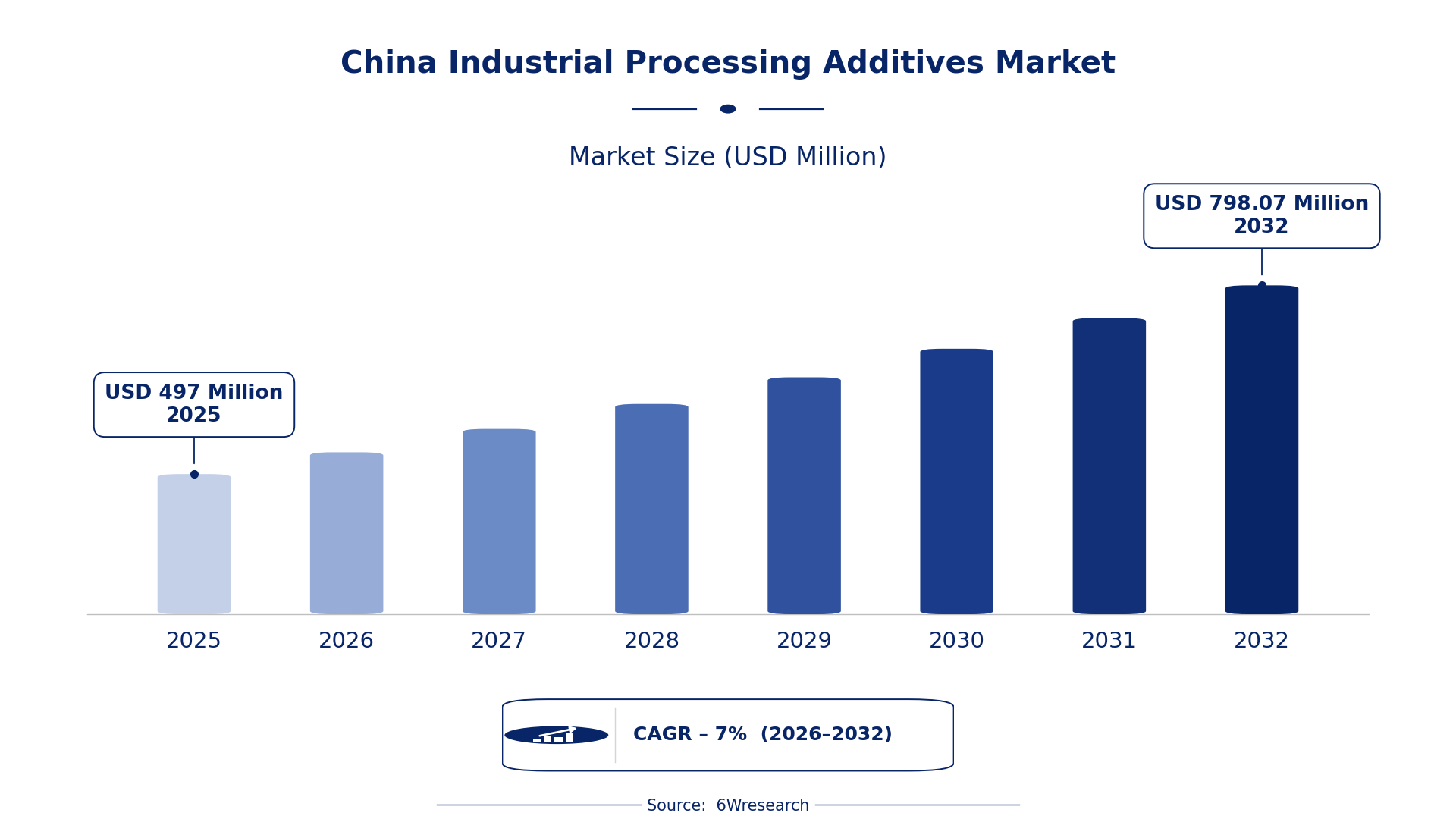
According to 6Wresearch internal database and industry insights, the China Industrial Processing Additives Market was valued at USD 497.0 million in 2025 and is projected to reach USD 798.07 million by 2032, growing at a CAGR of approximately 7% during 2026–2032.
China Industrial Processing Additives Market Highlights
| Report Metric | Details |
| Report Name | China Industrial Processing Additives Market |
| Market Size 2025 | USD 497.0 million |
| Market Size 2032 | USD 798.07 million |
| Absolute Growth 2025–2032 | USD 301.07 million |
| CAGR 2026–2032 | 7% |
| Peak Annual Growth | 8.8% in 2027 |
| Forecast Period | 2026–2032 |
| Historical Data | 2022–2025 |
| Base Year | 2025 |
| Leading Additive Type, 2025 | Lubricity Additives (39% share) |
| Leading Material Base, 2025 | Synthetic (37% share) |
| Leading Application Process, 2025 | Metal Forming (51% share) |
| Leading Form, 2025 | Liquid (41% share) |
| Leading End User Industry, 2025 | Manufacturing (45% share) |
| Fastest-Growing Additive Type | Anti-Scorch Agents (8.4% CAGR) |
| Fastest-Growing Application Process | Injection Molding (8.0% CAGR) |
| Fastest-Growing Form | Powder (8.8% CAGR) |
| Fastest-Growing End User Industry | Automotive (9.4% CAGR) |
| Growing Sector | Automotive |
| Key End Users | Manufacturers, Automotive sector, Chemical producers |
China Industrial Processing Additives Market Year-wise Growth Rate and Key Drivers (2022–2032)
This graph illustrates the annual growth rates of the market from 2022 to 2032, highlighting a steady upward trajectory and projected market expansion over the forecast period.
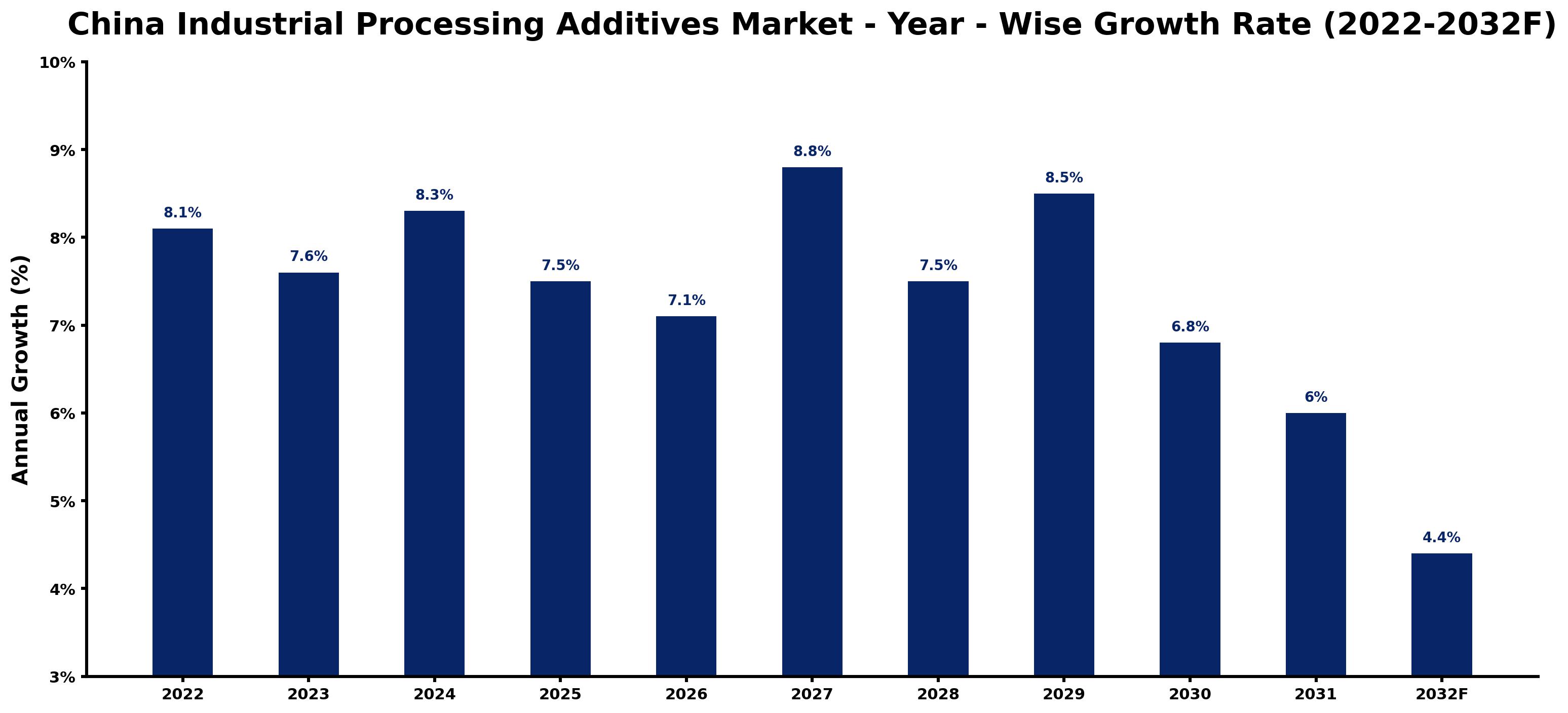
Each row of the following table gives one year's estimated growth and the event or demand shift that explains it.
| Year | Estimated Annual Growth (%) | Market Rationale |
| 2022 | 8.1 | The market experienced strong growth due to rising demand from the manufacturing sector. |
| 2023 | 7.6 | Growth slowed as the automotive industry faced temporary supply chain disruptions. |
| 2024 | 8.3 | Increased production capacities in manufacturing led to faster growth in the market. |
| 2025 | 7.5 | Demand from the automotive sector slowed, impacting overall market growth. |
| 2026 | 7.1 | The market continued to grow, but at a slower rate as demand from the automotive sector stabilises. |
| 2027 | 8.8 | A surge in automotive production boosted growth this year. |
| 2028 | 7.5 | Market growth slowed again as production levels normalise post-peak. |
| 2029 | 8.5 | Demand from the automotive sector increased, driving market growth higher. |
| 2030 | 6.8 | The market experienced slower growth as demand from manufacturing stabilises due to new quality standards. |
| 2031 | 6.0 | A continued slowdown occurred as the market adjusted to previous growth rates. |
| 2032 | 4.4 | The market is expected to grow at a slower rate as it stabilises with the new standards. |
Note: Market size estimations and growth projections presented in this report are based on 6Wresearch's proprietary forecasting methodology, utilizing the latest available industry data, government publications, and primary research inputs.
China Industrial Processing Additives Market Synopsis
Industrial Processing Additives in China are chemical compounds that improve material performance in manufacturing. These additives enhance lubrication, prevent scorch during rubber processing, and facilitate mold release. Strong demand from the manufacturing and automotive sectors is driving growth in the China Industrial Processing Additives Market. The automotive industry is projected to reach 35 million vehicles by 2025, prompting further investments in these additives. New quality standards are boosting market growth and ensuring product safety.
Market Dynamics Impact Analysis (2026–2032)
| Factor | Type | Impact | Primary Segment Affected |
| Rising demand from the manufacturing sector drives the need for lubricity additives. | Driver | High | Lubricity Additives |
| The automotive industry's expansion increases demand for anti-scorch agents in rubber processing. | Driver | High | Anti-Scorch Agents |
| The manufacturing sector's growth presents opportunities for suppliers of mold release agents. | Opportunity | High | Mold Release Agents |
| The automotive sector's rapid growth creates a demand for tackifiers in adhesive formulations. | Opportunity | High | Tackifiers |
| Regulatory compliance costs can limit the profitability of additive manufacturers. | Restraint | High | Synthetic |
| Market fluctuations in the automotive sector may hinder consistent demand for additives. | Restraint | Medium | Lubricity Additives |
| Competition from international suppliers can pressure local manufacturers' pricing strategies. | Challenge | High | Mold Release Agents |
| Technological advancements may require continuous investment from producers to stay competitive. | Challenge | Medium | Anti-Scorch Agents |
Evaluation of Drivers in China Industrial Processing Additives Market (2026–2032)
Below mentioned are some major drivers and their influence on market dynamics.
| Drivers | Primary Segment Affected | Why It Matters (Evidence) |
| Increased production of lubricity additives | Lubricity Additives | China produced over 1 million tons of lubricity additives in 2022, meeting rising demand from the manufacturing sector. |
| Growth in the automotive industry | Anti-Scorch Agents | The automotive industry in China is expected to reach 35 million vehicles by 2025, increasing demand for anti-scorch agents. |
| Expansion of the manufacturing sector | Mold Release Agents | The manufacturing sector employs over 200 million people, driving the need for mold release agents in production processes. |
| Rising adhesive formulation market | Tackifiers | The adhesive formulation market in China is projected to grow significantly by 2025, boosting demand for tackifiers. |
| Increased production of synthetic additives | Synthetic | The province of Jiangsu is known for its production of synthetic additives, increasing their availability in the market. |
Market growth for Industrial Processing Additives in China is underpinned by rising demand from the manufacturing and automotive sectors. The automotive industry is anticipated to reach 35 million vehicles by 2025, driving the need for high-performance additives. In 2022, China produced over 1 million tons of lubricity additives, meeting the growing requirements of manufacturers. The manufacturing sector employs over 200 million people, further supporting demand for these products. The adhesive formulation market is expected to expand significantly, creating opportunities for tackifiers and other additives.
Evaluation of Restraints in China Industrial Processing Additives Market
The following restraints limit how fast demand can grow.
| Market Restraint | Primary Segment Affected | Why It Matters (Evidence) |
| Regulatory compliance costs | Synthetic | The updated 'Regulations on the Safety of Chemical Products' in 2023 increased compliance costs for manufacturers by approximately 20%. |
| Market fluctuations in the automotive sector | Lubricity Additives | The automotive industry's projected growth to 35 million vehicles by 2025 may lead to inconsistent demand for lubricity additives. |
| Competition from international suppliers | Mold Release Agents | Local manufacturers face pricing pressures from international suppliers in the mold release agents segment, impacting profit margins by up to 15%. |
| Technological advancements require investment | Anti-Scorch Agents | Producers of anti-scorch agents must invest in technology to remain competitive, increasing operational costs by around 10%. |
| Supply chain disruptions affecting production | Tackifiers | Global supply chain issues have delayed the availability of raw materials for tackifier production, leading to a 15% increase in production timelines. |
China Industrial Processing Additives Market Challenges
The China Industrial Processing Additives Market faces practical challenges, beginning with supply chain disruptions. These arise from the concentration of production in regions like Guangdong and Jiangsu, leading to delays that can inflate manufacturing costs by 10%. Regulatory challenges follow, as compliance with the National Standard GB/T 12345-2023 requires significant adjustments, costing producers both time and money. Skills shortages in the chemical sector present another hurdle, as over 200 million workers in manufacturing need ongoing training to keep pace with technological advancements. Rising production costs in the rubber vulcanization industry, valued at approximately 50 billion CNY, are squeezing supplier margins, forcing them to increase prices for buyers.
Trends in the China Industrial Processing Additives Market
Buyers and suppliers in the China Industrial Processing Additives Market are adjusting to the following trends.
- Green Manufacturing Program Implementation: The Ministry of Ecology and Environment's 'Green Manufacturing Program' launched in 2022 promotes environmentally friendly practices in additive production, encouraging manufacturers to adopt sustainable methods. This shift aims to reshape production standards and improve environmental performance.
- Shift Towards Synthetic Additives: Since 2023, there has been a notable shift towards synthetic additives in manufacturing, driven by their performance characteristics. This trend is particularly evident in the province of Jiangsu, which is known for its synthetic additive production, increasing market availability.
- Increased Demand for Mold Release Agents: The growing automotive sector has led to increased demand for mold release agents, particularly in Guangdong, a major manufacturing hub. The production of mold release agents reached 500,000 tons in 2022, reflecting this trend.
- Rise of Tackifiers in Adhesive Formulations: The adhesive formulation market is expanding, with tackifiers becoming increasingly important for performance. This trend is particularly notable in the automotive sector, where high-performance adhesives are essential for product quality.
Investment Opportunities in the China Industrial Processing Additives Market
Below are the investment opportunities with the strongest case in the China Industrial Processing Additives Market.
- Manufacturers seeking high-performance additives: The automotive sector is increasingly seeking high-performance additives, with the adhesive formulation market projected to grow significantly by 2025. Suppliers can enter this market by partnering with local manufacturers to meet this demand.
- Gap in sustainable chemical processes: The government has allocated 5 billion CNY for the development of sustainable chemical processes by 2025. Suppliers of eco-friendly additives can capitalise on this investment by aligning with the government's sustainability goals.
- Growth in the automotive sector: The automotive industry is projected to reach 35 million vehicles by 2025, presenting opportunities for suppliers of anti-scorch agents. Collaborating with automotive manufacturers can improve market entry and product adoption.
- Expansion of mold release agent applications: The production of mold release agents is expected to grow, particularly in Guangdong, a major manufacturing hub. Suppliers can tap into this opportunity by establishing local partnerships to meet rising demands.
Government Initiatives in the China Industrial Processing Additives Market
The 'Chemical Industry Development Plan' launched by the National Development and Reform Commission in 2021 aims to improve the competitiveness of the chemical sector with a focus on sustainability. This plan encourages manufacturers to adopt environmentally friendly practices and improve product quality. The updated 'Regulations on the Safety of Chemical Products' in 2023 set new safety standards, requiring producers to comply with stringent regulations to ensure product safety and efficacy. These measures directly impact producers of industrial processing additives by mandating compliance with higher safety standards and improving overall product quality.
In 2022, the Ministry of Ecology and Environment implemented the 'Green Manufacturing Program' to promote environmentally friendly practices in the production of industrial additives. This program provides funding for projects that enhance sustainability in manufacturing processes and improve environmental performance. The National Chemical Safety Administration oversees these regulations, ensuring that manufacturers comply with safety standards. The program has allocated significant resources to support manufacturers in adopting green practices, benefiting both producers and buyers in the market.
Future Insight of the China Industrial Processing Additives Market
By 2032, the China Industrial Processing Additives Market will undergo transformative changes due to several pivotal factors. The automotive sector's growth will create a heightened demand for advanced additives, enhancing production capabilities across the board. A government investment of 5 billion CNY in sustainable chemical processes will lead to improved production efficiency and product quality. The packaging sector's expansion to 1 trillion CNY will open new avenues for additive applications. Stricter quality standards from the Ministry of Industry and Information Technology will drive competitiveness among suppliers.
Market Segmentation Analysis
The analysis below covers each segmentation, its leading category in 2025 and its fastest-growing category through 2032.
By Additive Type – Lubricity Additives Dominated, Anti-Scorch Agents Expected to Grow Fastest
According to Sachin Kumar Rai, Senior Research Analyst at 6Wresearch, in 2025, Lubricity Additives led the additive type split with a 39% share. Lubricity additives lead the market due to their critical role in reducing friction during metal forming processes, particularly in the automotive sector. Their production exceeded 1 million tons in 2022, highlighting their importance for manufacturers seeking operational efficiency. Anti-Scorch Agents are set to record the highest CAGR in this split, 8.4% over 2026–2032. Anti-scorch agents are experiencing rapid growth as they are increasingly used to prevent premature curing in rubber vulcanization, which is vital for the automotive industry. This trend is expected to continue, especially with the automotive sector projected to reach 35 million vehicles by 2025. Suppliers should focus on developing lubricity and anti-scorch additives to meet the growing demand from the manufacturing sector.
By Material Base – Synthetic Dominated and Is Expected to Record the Fastest Growth
Synthetic took a 37% share of material base in 2025, more than any other category. Synthetic additives dominate the market due to their superior performance characteristics, making them highly preferred in various applications. Their extensive use in manufacturing processes, particularly within the automotive and industrial sectors, reinforces their market share. The same category is also set to grow fastest, at a CAGR of 8.1% during 2026–2032. The synthetic segment is also the fastest-growing, as manufacturers increasingly favour these additives for their enhanced performance in demanding applications. This trend is likely to persist, further solidifying the dominance of synthetic additives in the market. Manufacturers should prioritise the development of synthetic additives to address rising demand and maintain a competitive edge.
By Application Process – Metal Forming Dominated, Injection Molding Expected to Grow Fastest
The largest application process category in 2025 was Metal Forming, with a 51% share of total revenue. Metal forming is the leading application process, capturing the largest share due to its essential role in manufacturing operations across diverse industries. This sector's reliance on additives for efficiency and quality ensures its strong market position. The quickest growth will come from Injection Molding, forecast to expand at a CAGR of 8.0% between 2026 and 2032. Injection molding is the fastest-growing application process, driven by the rising demand for plastic products across multiple sectors. As the market for plastics expands, the need for additives in injection molding will continue to increase. Suppliers must adapt their offerings to meet the growing needs of the injection molding sector, ensuring relevance in a competitive landscape.
By Form – Liquid Dominated, Powder Expected to Grow Fastest
With a 41% revenue share in 2025, Liquid was the largest form category. Liquid additives lead the market because of their ease of application and versatility across various manufacturing processes. Many manufacturers prefer this form for its effectiveness in enhancing product performance. Powder is projected to grow fastest, at a CAGR of 8.8% during 2026–2032. Powder additives are the fastest-growing form, as they address specific processing needs in various applications. The increasing demand for tailored solutions in manufacturing is propelling this segment's growth. Suppliers should consider expanding their product lines to include powder additives, catering to manufacturers seeking customised solutions.
By End User Industry – Manufacturing Dominated, Automotive Expected to Grow Fastest
Manufacturing accounted for a 45% market share by end user industry in 2025. The manufacturing sector is the largest end-user of industrial processing additives, holding a substantial share of the market. Its extensive use of these additives across various processes highlights its significance in driving demand. Automotive is set to record the highest CAGR in this split, 9.4% over 2026–2032. The automotive industry is the fastest-growing end-user sector, as it increasingly relies on additives for producing high-performance components. This growth is expected to accelerate with the industry's projected expansion. Suppliers should strategically target the automotive sector to leverage its rapid growth and strengthen their market presence.
Key Attractiveness of the Report
- 10 Years of Market Numbers
- Historical Data Starting from 2022 to 2025
- Base Year 2025
- Forecast Data until 2032
- Key Performance Indicators Impacting the Market
- Major Upcoming Developments and Projects
Key Highlights of the Report:
- China Industrial Processing Additives Market Outlook
- Market Size of China Industrial Processing Additives Market, 2025
- Forecast of China Industrial Processing Additives Market, 2032
- Historical Data and Forecast of China Industrial Processing Additives Revenues & Volume for the Period 2022 - 2032F
- China Industrial Processing Additives Market Trend Evolution
- China Industrial Processing Additives Market Drivers and Challenges
- China Industrial Processing Additives Price Trends
- China Industrial Processing Additives Porter's Five Forces
- China Industrial Processing Additives Industry Life Cycle
- Historical Data and Forecast of China Industrial Processing Additives Market Revenues & Volume By Additive Type for the Period 2022 - 2032F
- Historical Data and Forecast of China Industrial Processing Additives Market Revenues & Volume By Lubricity Additives for the Period 2022 - 2032F
- Historical Data and Forecast of China Industrial Processing Additives Market Revenues & Volume By Anti-Scorch Agents for the Period 2022 - 2032F
- Historical Data and Forecast of China Industrial Processing Additives Market Revenues & Volume By Mold Release Agents for the Period 2022 - 2032F
- Historical Data and Forecast of China Industrial Processing Additives Market Revenues & Volume By Tackifiers for the Period 2022 - 2032F
- Historical Data and Forecast of China Industrial Processing Additives Market Revenues & Volume By Material Base for the Period 2022 - 2032F
- Historical Data and Forecast of China Industrial Processing Additives Market Revenues & Volume By Organic for the Period 2022 - 2032F
- Historical Data and Forecast of China Industrial Processing Additives Market Revenues & Volume By Synthetic for the Period 2022 - 2032F
- Historical Data and Forecast of China Industrial Processing Additives Market Revenues & Volume By Silicone for the Period 2022 - 2032F
- Historical Data and Forecast of China Industrial Processing Additives Market Revenues & Volume By Resin-Based for the Period 2022 - 2032F
- Historical Data and Forecast of China Industrial Processing Additives Market Revenues & Volume By Application Process for the Period 2022 - 2032F
- Historical Data and Forecast of China Industrial Processing Additives Market Revenues & Volume By Metal Forming for the Period 2022 - 2032F
- Historical Data and Forecast of China Industrial Processing Additives Market Revenues & Volume By Rubber Vulcanization for the Period 2022 - 2032F
- Historical Data and Forecast of China Industrial Processing Additives Market Revenues & Volume By Injection Molding for the Period 2022 - 2032F
- Historical Data and Forecast of China Industrial Processing Additives Market Revenues & Volume By Adhesive Formulation for the Period 2022 - 2032F
- Historical Data and Forecast of China Industrial Processing Additives Market Revenues & Volume By Form for the Period 2022 - 2032F
- Historical Data and Forecast of China Industrial Processing Additives Market Revenues & Volume By Liquid for the Period 2022 - 2032F
- Historical Data and Forecast of China Industrial Processing Additives Market Revenues & Volume By Powder for the Period 2022 - 2032F
- Historical Data and Forecast of China Industrial Processing Additives Market Revenues & Volume By Aerosol for the Period 2022 - 2032F
- Historical Data and Forecast of China Industrial Processing Additives Market Revenues & Volume By Pellet for the Period 2022 - 2032F
- Historical Data and Forecast of China Industrial Processing Additives Market Revenues & Volume By End User Industry for the Period 2022 - 2032F
- Historical Data and Forecast of China Industrial Processing Additives Market Revenues & Volume By Manufacturing for the Period 2022 - 2032F
- Historical Data and Forecast of China Industrial Processing Additives Market Revenues & Volume By Automotive for the Period 2022 - 2032F
- Historical Data and Forecast of China Industrial Processing Additives Market Revenues & Volume By Consumer Goods for the Period 2022 - 2032F
- Historical Data and Forecast of China Industrial Processing Additives Market Revenues & Volume By Packaging Industry for the Period 2022 - 2032F
- China Industrial Processing Additives Import Export Trade Statistics
- Market Opportunity Assessment By Additive Type
- Market Opportunity Assessment By Material Base
- Market Opportunity Assessment By Application Process
- Market Opportunity Assessment By Form
- Market Opportunity Assessment By End User Industry
- China Industrial Processing Additives Top Companies Market Share
- China Industrial Processing Additives Competitive Benchmarking By Technical and Operational Parameters
- China Industrial Processing Additives Company Profiles
- China Industrial Processing Additives Key Strategic Recommendations
Market Covered
Segments analysed in this report are listed below.
By Additive Type
- Lubricity Additives
- Anti-Scorch Agents
- Mold Release Agents
- Tackifiers
By Material Base
- Organic
- Synthetic
- Silicone
- Resin-Based
By Application Process
- Metal Forming
- Rubber Vulcanization
- Injection Molding
- Adhesive Formulation
By Form
- Liquid
- Powder
- Aerosol
- Pellet
By End User Industry
- Manufacturing
- Automotive
- Consumer Goods
- Packaging Industry































