India Industrial Robot AI Market Size & Growth Rate
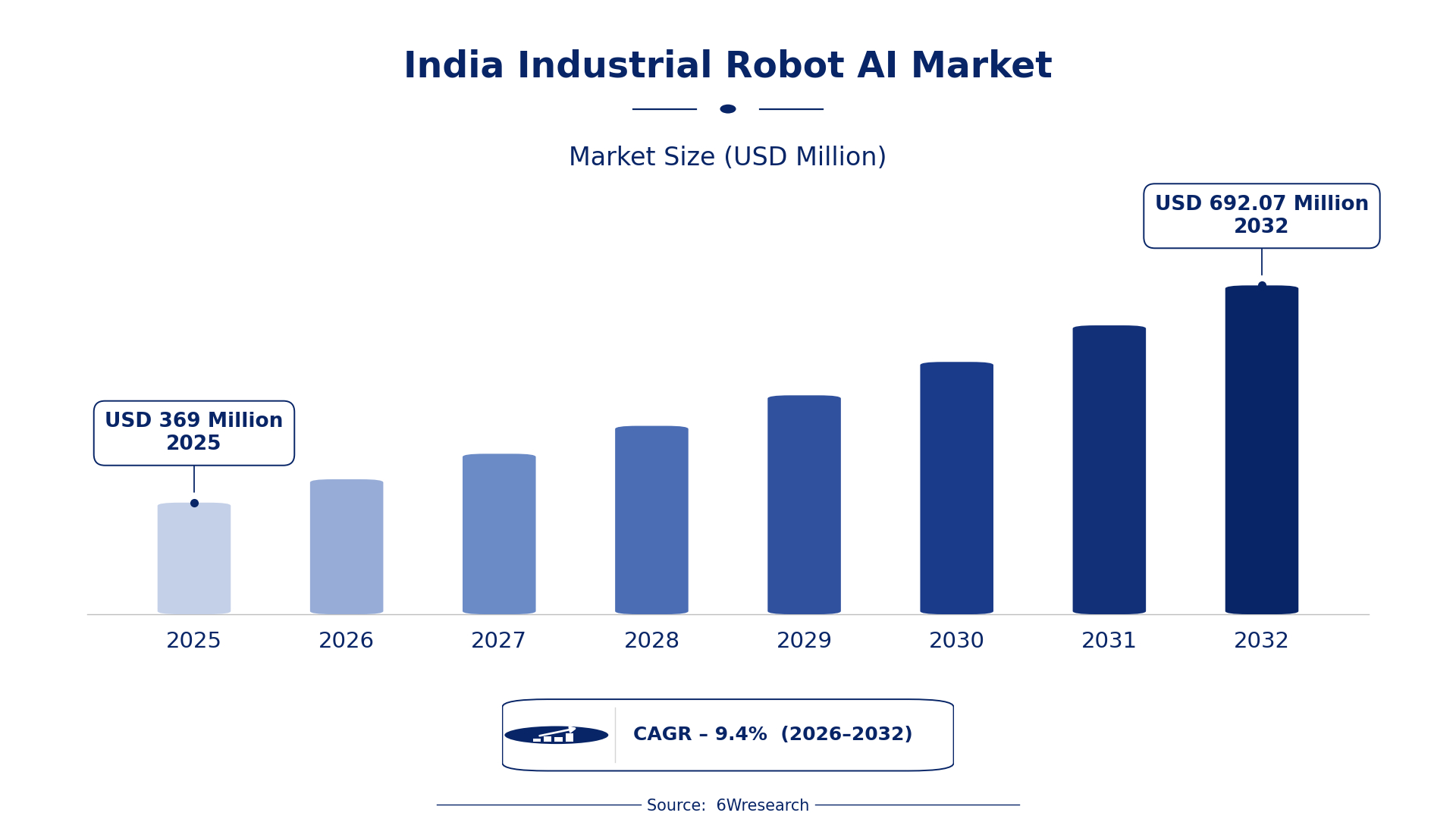
According to 6Wresearch internal database and industry insights, the India Industrial Robot AI Market was valued at USD 369.0 million in 2025 and is projected to reach USD 692.07 million by 2032, growing at a CAGR of approximately 9.4% during 2026–2032.
India Industrial Robot AI Market Highlights
| Report Metric | Details |
| Report Name | India Industrial Robot AI Market |
| Market Size 2025 | USD 369.0 million |
| Market Size 2032 | USD 692.07 million |
| Absolute Growth 2025–2032 | USD 323.07 million |
| CAGR 2026–2032 | 9.4% |
| Peak Annual Growth | 11.8% in 2026 |
| Forecast Period | 2026–2032 |
| Historical Data | 2022–2025 |
| Base Year | 2025 |
| Leading Robot Type, 2025 | Articulated Robots (47% share) |
| Leading AI Functionality, 2025 | Vision Recognition (44% share) |
| Leading Control Type, 2025 | Centralized AI Control (50% share) |
| Leading Application Area, 2025 | Assembly Lines (36% share) |
| Leading End User Industry, 2025 | Automotive Manufacturing (53% share) |
| Fastest-Growing Robot Type | Collaborative Robots (11.3% CAGR) |
| Fastest-Growing AI Functionality | Path Optimization (10.9% CAGR) |
| Fastest-Growing Control Type | Edge AI (11.8% CAGR) |
| Fastest-Growing Application Area | Packaging Tasks (12.2% CAGR) |
| Fastest-Growing End User Industry | Electronics (11.9% CAGR) |
| Growing Sector | Automotive Manufacturing |
| Key End Users | Automotive Manufacturers, Electronics Manufacturers, Robotics Startups, Quality Control Firms |
India Industrial Robot AI Market Year-wise Growth Rate and Key Drivers (2022–2032)
This graph illustrates the annual growth rates of the market from 2022 to 2032, highlighting a steady upward trajectory and projected market expansion over the forecast period.
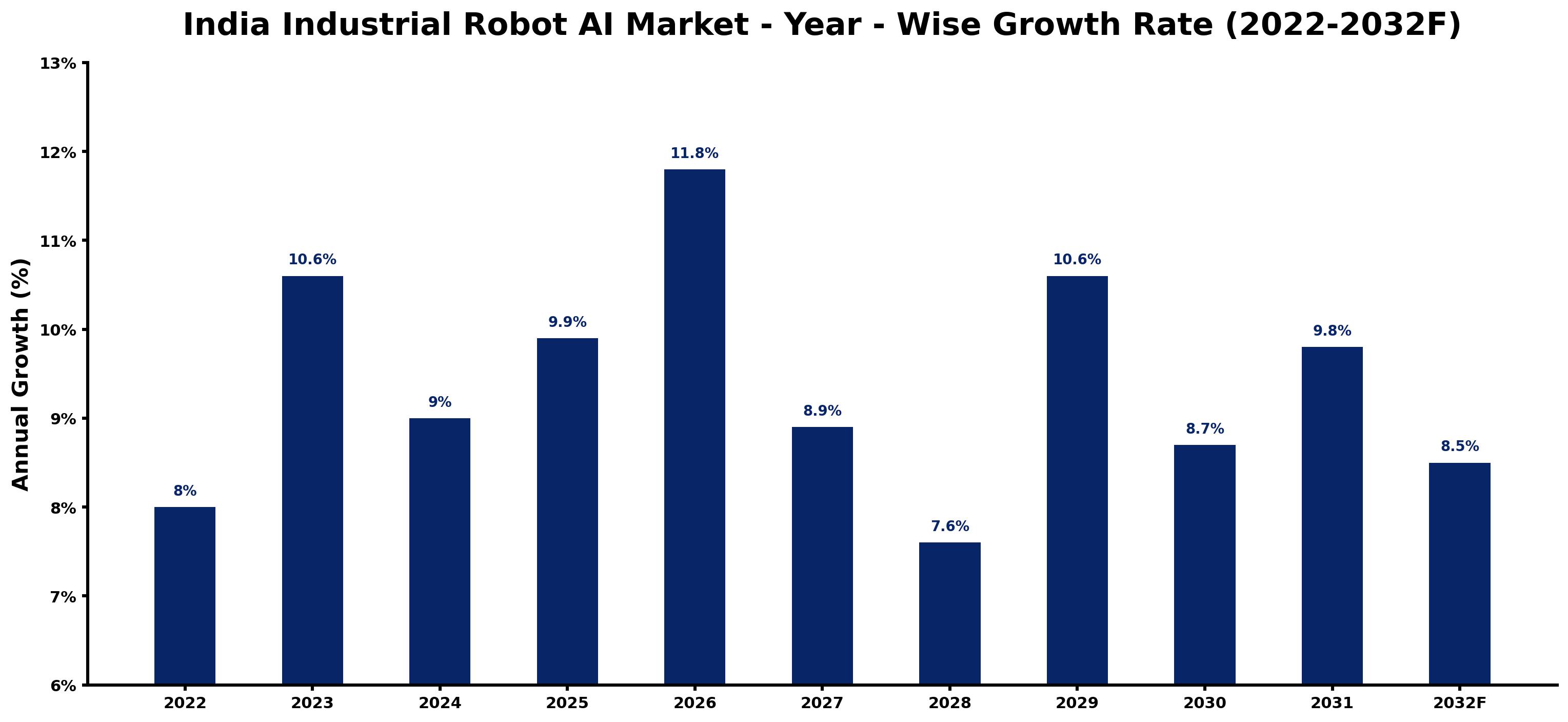
Annual growth estimates for each year appear below with the principal reason behind them, explaining the shifts that set the pace of the market.
| Year | Estimated Annual Growth (%) | Market Rationale |
| 2022 | 8.0 | The market experienced steady growth driven by increased automation needs in manufacturing. |
| 2023 | 10.6 | Demand accelerated as the automotive sector expanded production capabilities with robotics. |
| 2024 | 9.0 | Growth slowed slightly due to market adjustments following rapid previous expansion. |
| 2025 | 9.9 | A resurgence in demand occurred as the electronics sector ramped up automation efforts. |
| 2026 | 11.8 | The peak growth year saw substantial investments in AI and robotics technologies. |
| 2027 | 8.9 | Growth decelerated as the market adjusted to previous high levels of investment. |
| 2028 | 7.6 | Further slowdown was noted as companies reassessed their automation strategies. |
| 2029 | 10.6 | Demand rebounded as new applications for robotics emerged in various sectors. |
| 2030 | 8.7 | Growth slowed again as companies focused on optimising existing robotic systems. |
| 2031 | 9.8 | A faster growth rate returned as the automotive industry increased its robotics adoption. |
| 2032 | 8.5 | Growth moderated as the market stabilised with established technologies. |
Note: Market size estimations and growth projections presented in this report are based on 6Wresearch's proprietary forecasting methodology, utilizing the latest available industry data, government publications, and primary research inputs.
India Industrial Robot AI Market Synopsis
Industrial Robot AI in India encompasses robots equipped with artificial intelligence for manufacturing processes. These robots are integral to automation in assembly lines, quality inspection, and material handling. The India Industrial Robot AI Market is expanding due to rising demand from the automotive and electronics industries, driven by initiatives like 'Make in India' and the National Robotics Mission. With the electronics manufacturing sector projected to grow to $100 billion by 2025, the need for automation is set to rise as well.
Market Dynamics Impact Analysis (2026–2032)
| Factor | Type | Impact | Primary Segment Affected |
| Rising automation in manufacturing processes | Driver | High | Articulated Robots |
| Increased investment in robotics technology | Driver | High | Articulated Robots |
| Growing demand for automation in the electronics sector | Opportunity | High | Electronics |
| Expansion of automotive manufacturing capabilities | Opportunity | High | Automotive Manufacturing |
| Limited skilled workforce for robotics operation | Restraint | High | Articulated Robots |
| High initial investment costs for robotics integration | Restraint | High | Articulated Robots |
| Need for continuous technological updates | Challenge | Medium | Articulated Robots |
| Competition from low-cost automation solutions | Challenge | Medium | Articulated Robots |
Evaluation of Drivers in India Industrial Robot AI Market (2026–2032)
The factors lifting demand, and the evidence behind each, are summarised below.
| Drivers | Primary Segment Affected | Why It Matters (Evidence) |
| Increased automation in assembly lines | Assembly Lines | This trend is supported by the automotive industry's need for efficiency, employing over 37 million people. |
| Investment in AI technology for robotics | Vision Recognition | The electronics manufacturing sector is expected to grow to $100 billion by 2025, fuelling demand for advanced robotics. |
| Government initiatives supporting robotics | Collaborative Robots | The 'Make in India' initiative launched in 2014 aims to boost manufacturing and robotics adoption across sectors. |
| Growth in the electronics sector | Electronics | The sector's expansion increases the need for automation, driving higher purchases of industrial robots. |
| Demand for quality inspection solutions | Articulated Robots | The Bureau of Indian Standards has set safety standards, increasing the need for compliant robotics in manufacturing. |
The Industrial Robot AI market in India is expanding as demand from the automotive and electronics sectors increases. With the electronics manufacturing sector projected to grow to $100 billion by 2025, the need for automation is accelerating. Investments totalling $1 billion in AI technology are enhancing the capabilities of industrial robots, particularly in assembly lines. The automotive industry, which employs over 37 million people, is a key driver of demand for robotics solutions, especially in quality inspection and assembly tasks.
Evaluation of Restraints in India Industrial Robot AI Market
The main factors holding the market back are set out below.
| Market Restraint | Primary Segment Affected | Why It Matters (Evidence) |
| Limited availability of skilled workforce | Collaborative Robots | The shortage of trained personnel in robotics limits operational efficiency, affecting productivity in manufacturing. |
| High initial costs of robotic systems | Articulated Robots | The substantial investment required for advanced robotic systems can deter smaller manufacturers from adopting automation. |
| Need for continuous technological upgrades | Vision Recognition | Rapid advancements in AI technology necessitate frequent updates, increasing operational costs for manufacturers. |
| Complex integration processes | SCARA Robots | Integrating robots into existing manufacturing systems can be challenging, causing delays and increased costs. |
| Competition from low-cost automation solutions | Delta Robots | The presence of cheaper alternatives can hinder the adoption of advanced robotics in cost-sensitive sectors. |
India Industrial Robot AI Market Challenges
Buyers in the India Industrial Robot AI market contend with fierce competition from international suppliers, which drives up prices and limits options. Electronics and automotive manufacturers face production delays due to inconsistent supply chains, resulting in an estimated 15% reduction in output. A shortage of skilled workers in robotics leads to operational inefficiencies, extending training periods for new hires by as much as 30%. Rising costs for advanced materials and AI integration inflate prices for producers, potentially dampening demand from cost-sensitive end-users.
Trends in the India Industrial Robot AI Market
Below mentioned are some of the trends shaping the India Industrial Robot AI Market growth.
- Shift from Traditional to AI-Integrated Robotics: India is experiencing a shift towards AI-integrated robotics in manufacturing processes. The National Robotics Mission, established in 2020, promotes research and development, with a projected funding of $1 billion for AI and robotics startups by 2023.
- Transition from Centralized to Edge AI Control: The market is transitioning towards Edge AI control systems, enabling real-time data processing at the robot's location. This shift is reflected in the projection that Centralized AI Control will hold a 50% market share by 2025.
- Emergence of Collaborative Robots in Manufacturing: Collaborative robots are gaining popularity as they work alongside humans to boost productivity. This segment is expected to grow at a CAGR of 11.3% from 2026 to 2032, indicating increased adoption across various industries.
- Growing Demand for Automation in Electronics: The electronics sector is increasingly embracing automation solutions to meet production demands. With the sector anticipated to grow to $100 billion by 2025, the need for industrial robots is poised to rise.
Investment Opportunities in the India Industrial Robot AI Market
Some of the investment opportunities in the India Industrial Robot AI Market are mentioned below.
- Automotive Manufacturers Seeking Automation: Automotive manufacturers in Maharashtra are looking to invest in robotics to improve production efficiency. With over 37 million employed in the sector, the potential market for automation solutions is substantial.
- Electronics Sector Expanding Automation Needs: The electronics manufacturing hub in India is rapidly growing, creating a demand for advanced robotics. With the sector projected to grow to $100 billion by 2025, suppliers can enter this market through local partnerships.
- Investment in Robotics for Quality Inspection: The need for quality inspection solutions is rising as standards are enforced by the Bureau of Indian Standards. Companies can supply advanced robotics to help manufacturers comply with safety regulations.
- Growth in Packaging Automation: The packaging tasks segment is set to grow rapidly. Suppliers can target this opportunity by developing efficient robotic solutions for the packaging industry.
Government Initiatives in the India Industrial Robot AI Market
In 2021, the Ministry of Electronics and Information Technology launched the 'National Policy on Electronics' to promote domestic manufacturing and innovation in robotics. This policy builds on previous initiatives by providing a structured framework for investment and development in the robotics sector, ensuring manufacturers adhere to safety and efficiency standards. The initiative aims to strengthen local production capabilities and reduce dependency on imports. Additionally, the 'Make in India 2.0' strategy was revised in 2023 to enhance the role of robotics in various sectors, further supporting manufacturers.
The Department of Heavy Industries backs the 'Atmanirbhar Bharat' initiative with a $500 million investment plan to support robotics in manufacturing industries. This funding enables producers to invest in advanced technologies, boosting their production capabilities and competitiveness in the market. Furthermore, the 'Skill India Mission' was updated in 2021 to include training programs for robotics and AI skills, addressing the workforce gap in the sector.
Future Insight of the India Industrial Robot AI Market
Several forward-looking factors should support the India Industrial Robot AI market in the coming years. The $1 billion fund for AI and robotics startups will stimulate innovation and development in the field. The 'Production Linked Incentive' scheme will strengthen local manufacturing capabilities, improving supply chain resilience. As the National Robotics Mission promotes research, advancements in robotics technology will accelerate. With the 'Digital India' program encouraging greater technology adoption, automation will increasingly permeate various industries, creating new opportunities for buyers and suppliers.
Market Segmentation Analysis
The analysis below covers each segmentation, its leading category in 2025 and its fastest-growing category through 2032.
By Robot Type – Articulated Robots Dominated, Collaborative Robots Expected to Grow Fastest
According to Sachin Kumar Rai, Senior Research Analyst at 6Wresearch, Articulated Robots held a 47% share of the India Industrial Robot AI Market by robot type in 2025. Articulated robots lead the India Industrial Robot AI market due to their flexibility and extensive use in manufacturing processes. Their significant role in automotive assembly lines highlights their importance in boosting productivity and operational efficiency. Collaborative Robots are set to record the highest CAGR in this split, 11.3% over 2026–2032. Collaborative robots are experiencing rapid growth as they are designed to work alongside human operators, enhancing productivity in various tasks. The increasing focus on automation in sectors like electronics is driving their adoption and integration into workflows. Suppliers should prioritise the development of collaborative solutions to address the rising demand from manufacturers seeking improved efficiency.
By AI Functionality – Vision Recognition Dominated, Path Optimization Expected to Grow Fastest
Vision Recognition accounted for a 44% market share by ai functionality in 2025. Vision recognition technology commands the largest share, as it is essential for quality control and inspection processes in manufacturing. Its critical role in ensuring products meet stringent quality standards, especially in the automotive sector, underpins its market dominance. Over 2026–2032, Path Optimization is expected to post the fastest growth, at a CAGR of 10.9%. Path optimization is the fastest-growing segment, driven by the increasing need for improved efficiency in robotic movements during operations. As manufacturers strive to streamline processes, the demand for this functionality is rapidly rising. Suppliers should prioritise advancements in path optimization to capture the growing interest from manufacturers aiming for operational efficiency.
By Control Type – Centralized AI Control Dominated, Edge AI Expected to Grow Fastest
Centralized AI Control took a 50% share of control type in 2025, more than any other category. Centralized control is at the forefront of the market as it enables comprehensive management of multiple robots from a single point, enhancing operational efficiency. This system is particularly beneficial in large manufacturing facilities where coordination and oversight are essential. Edge AI is projected to grow fastest, at a CAGR of 11.8% during 2026–2032. Edge control is witnessing rapid growth due to its ability to facilitate real-time data processing at the robot's location, thus reducing latency. This capability is becoming increasingly important as industries demand faster and more responsive automation solutions. For suppliers, investing in edge technology could be a strategic move to align with the industry's shift towards decentralised control systems.
By Application Area – Assembly Lines Dominated, Packaging Tasks Expected to Grow Fastest
In 2025, Assembly Lines led the application area split with a 36% share. Assembly lines account for the largest share as they are a primary application area for industrial robots, especially in the automotive sector. The efficiency gains from automation in these lines are crucial for meeting production demands and enhancing throughput. The quickest growth will come from Packaging Tasks, forecast to expand at a CAGR of 12.2% between 2026 and 2032. Packaging tasks are experiencing the fastest growth, propelled by the need for increased speed and efficiency in packaging processes across various industries. This surge is particularly noticeable as companies strive to optimise their supply chains and reduce time to market. This indicates that suppliers should enhance their offerings for packaging applications to capitalise on the growing demand from manufacturers.
By End User Industry – Automotive Manufacturing Dominated, Electronics Expected to Grow Fastest
The largest end user industry category in 2025 was Automotive Manufacturing, with a 53% share of total revenue. Automotive manufacturing is the leading sector in the industrial robot AI market, employing robots for various processes to improve productivity. The industry's scale and complexity require advanced automation solutions to maintain competitiveness and efficiency. Electronics is set to record the highest CAGR in this split, 11.9% over 2026–2032. The electronics industry is the fastest-growing segment, with substantial demand for automation driven by the expected growth in electronics manufacturing, projected to reach $100 billion by 2025. This growth is fuelled by the push for increased production capabilities and efficiency. Suppliers should consider tailoring their solutions to meet the specific needs of the electronics sector to leverage this growth opportunity.
Key Attractiveness of the Report
- 10 Years of Market Numbers
- Historical Data Starting from 2022 to 2025
- Base Year 2025
- Forecast Data until 2032
- Key Performance Indicators Impacting the Market
- Major Upcoming Developments and Projects
Key Highlights of the Report:
- India Industrial Robot AI Market Outlook
- Market Size of India Industrial Robot AI Market, 2025
- Forecast of India Industrial Robot AI Market, 2032
- Historical Data and Forecast of India Industrial Robot AI Revenues & Volume for the Period 2022 - 2032F
- India Industrial Robot AI Market Trend Evolution
- India Industrial Robot AI Market Drivers and Challenges
- India Industrial Robot AI Price Trends
- India Industrial Robot AI Porter's Five Forces
- India Industrial Robot AI Industry Life Cycle
- Historical Data and Forecast of India Industrial Robot AI Market Revenues & Volume By Robot Type for the Period 2022 - 2032F
- Historical Data and Forecast of India Industrial Robot AI Market Revenues & Volume By Articulated Robots for the Period 2022 - 2032F
- Historical Data and Forecast of India Industrial Robot AI Market Revenues & Volume By SCARA Robots for the Period 2022 - 2032F
- Historical Data and Forecast of India Industrial Robot AI Market Revenues & Volume By Delta Robots for the Period 2022 - 2032F
- Historical Data and Forecast of India Industrial Robot AI Market Revenues & Volume By Collaborative Robots for the Period 2022 - 2032F
- Historical Data and Forecast of India Industrial Robot AI Market Revenues & Volume By AI Functionality for the Period 2022 - 2032F
- Historical Data and Forecast of India Industrial Robot AI Market Revenues & Volume By Vision Recognition for the Period 2022 - 2032F
- Historical Data and Forecast of India Industrial Robot AI Market Revenues & Volume By Path Optimization for the Period 2022 - 2032F
- Historical Data and Forecast of India Industrial Robot AI Market Revenues & Volume By Object Sorting for the Period 2022 - 2032F
- Historical Data and Forecast of India Industrial Robot AI Market Revenues & Volume By Human Interaction for the Period 2022 - 2032F
- Historical Data and Forecast of India Industrial Robot AI Market Revenues & Volume By Control Type for the Period 2022 - 2032F
- Historical Data and Forecast of India Industrial Robot AI Market Revenues & Volume By Centralized AI Control for the Period 2022 - 2032F
- Historical Data and Forecast of India Industrial Robot AI Market Revenues & Volume By Edge AI for the Period 2022 - 2032F
- Historical Data and Forecast of India Industrial Robot AI Market Revenues & Volume By Cloud-Based AI for the Period 2022 - 2032F
- Historical Data and Forecast of India Industrial Robot AI Market Revenues & Volume By Onboard AI for the Period 2022 - 2032F
- Historical Data and Forecast of India Industrial Robot AI Market Revenues & Volume By Application Area for the Period 2022 - 2032F
- Historical Data and Forecast of India Industrial Robot AI Market Revenues & Volume By Assembly Lines for the Period 2022 - 2032F
- Historical Data and Forecast of India Industrial Robot AI Market Revenues & Volume By PCB Handling for the Period 2022 - 2032F
- Historical Data and Forecast of India Industrial Robot AI Market Revenues & Volume By Packaging Tasks for the Period 2022 - 2032F
- Historical Data and Forecast of India Industrial Robot AI Market Revenues & Volume By Welding/Inspection for the Period 2022 - 2032F
- Historical Data and Forecast of India Industrial Robot AI Market Revenues & Volume By End User Industry for the Period 2022 - 2032F
- Historical Data and Forecast of India Industrial Robot AI Market Revenues & Volume By Automotive Manufacturing for the Period 2022 - 2032F
- Historical Data and Forecast of India Industrial Robot AI Market Revenues & Volume By Electronics for the Period 2022 - 2032F
- Historical Data and Forecast of India Industrial Robot AI Market Revenues & Volume By Consumer Goods for the Period 2022 - 2032F
- Historical Data and Forecast of India Industrial Robot AI Market Revenues & Volume By Aerospace and Defense for the Period 2022 - 2032F
- India Industrial Robot AI Import Export Trade Statistics
- Market Opportunity Assessment By Robot Type
- Market Opportunity Assessment By AI Functionality
- Market Opportunity Assessment By Control Type
- Market Opportunity Assessment By Application Area
- Market Opportunity Assessment By End User Industry
- India Industrial Robot AI Top Companies Market Share
- India Industrial Robot AI Competitive Benchmarking By Technical and Operational Parameters
- India Industrial Robot AI Company Profiles
- India Industrial Robot AI Key Strategic Recommendations
Market Covered
This report examines the market across the segments below.
By Robot Type
- Articulated Robots
- SCARA Robots
- Delta Robots
- Collaborative Robots
By AI Functionality
- Vision Recognition
- Path Optimization
- Object Sorting
- Human Interaction
By Control Type
- Centralized AI Control
- Edge AI
- Cloud-Based AI
- Onboard AI
By Application Area
- Assembly Lines
- PCB Handling
- Packaging Tasks
- Welding/Inspection
By End User Industry
- Automotive Manufacturing
- Electronics
- Consumer Goods
- Aerospace and Defense































