China Industrial Robot AI Market Size & Growth Rate
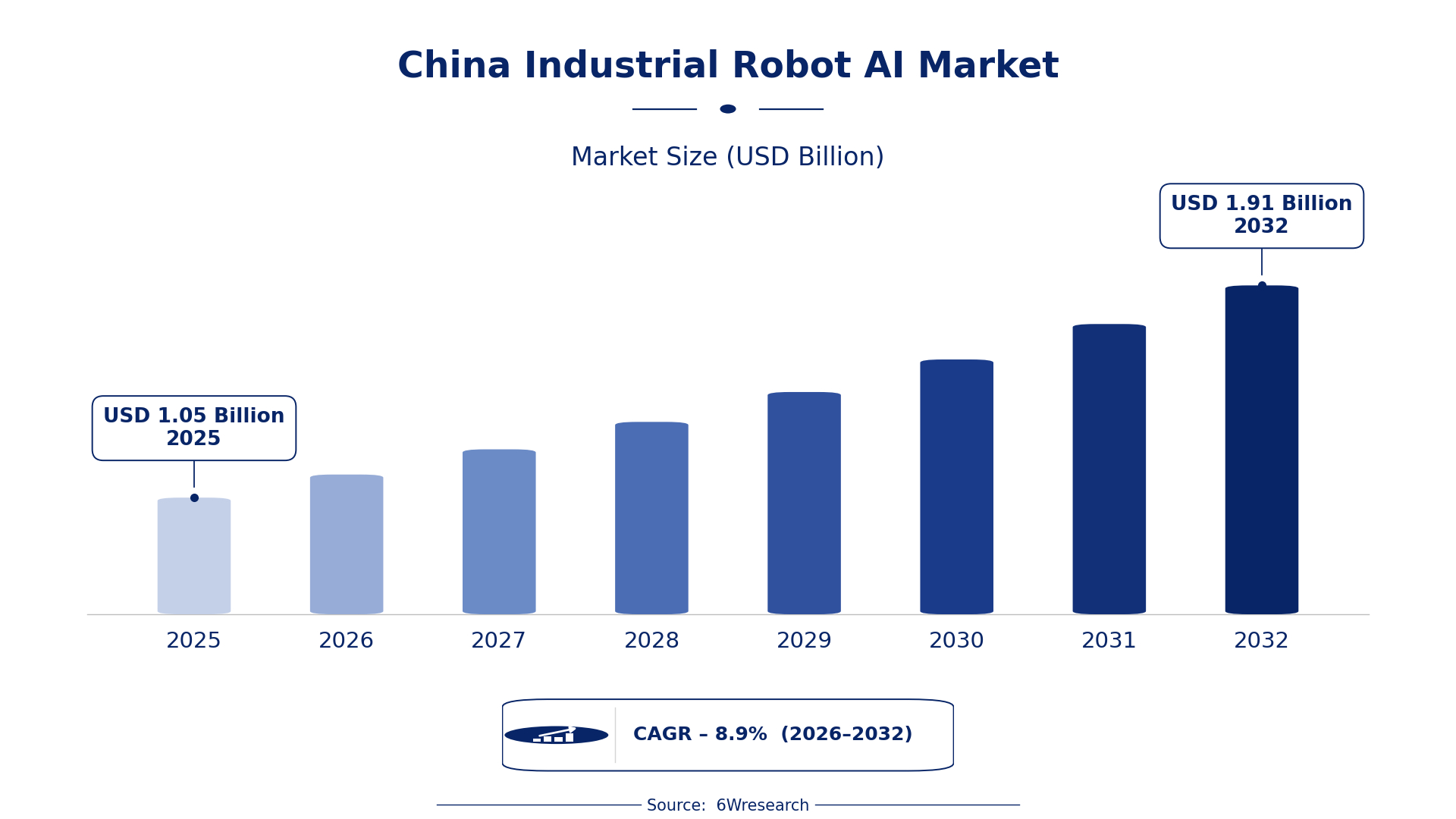
According to 6Wresearch internal database and industry insights, the China Industrial Robot AI Market was valued at USD 1.05 billion in 2025 and is projected to reach USD 1.91 billion by 2032, growing at a CAGR of approximately 8.9% during 2026–2032.
China Industrial Robot AI Market Highlights
| Report Metric | Details |
| Report Name | China Industrial Robot AI Market |
| Market Size 2025 | USD 1.05 billion |
| Market Size 2032 | USD 1.91 billion |
| Absolute Growth 2025–2032 | USD 0.86 billion |
| CAGR 2026–2032 | 8.9% |
| Peak Annual Growth | 11.0% in 2027 |
| Forecast Period | 2026–2032 |
| Historical Data | 2022–2025 |
| Base Year | 2025 |
| Leading Robot Type, 2025 | Articulated Robots (45% share) |
| Leading AI Functionality, 2025 | Vision Recognition (43% share) |
| Leading Control Type, 2025 | Centralized AI Control (37% share) |
| Leading Application Area, 2025 | Assembly Lines (48% share) |
| Leading End User Industry, 2025 | Automotive Manufacturing (44% share) |
| Fastest-Growing Robot Type | SCARA Robots (11.7% CAGR) |
| Fastest-Growing AI Functionality | Path Optimization (10.7% CAGR) |
| Fastest-Growing Control Type | Edge AI (11.7% CAGR) |
| Fastest-Growing Application Area | PCB Handling (11.2% CAGR) |
| Fastest-Growing End User Industry | Electronics (11.7% CAGR) |
| Growing Sector | Automotive Manufacturing |
| Key End Users | Automotive Manufacturers, Electronics Producers, Consumer Goods Manufacturers, Logistics Providers |
China Industrial Robot AI Market Year-wise Growth Rate and Key Drivers (2022–2032)
This graph illustrates the annual growth rates of the market from 2022 to 2032, highlighting a steady upward trajectory and projected market expansion over the forecast period.
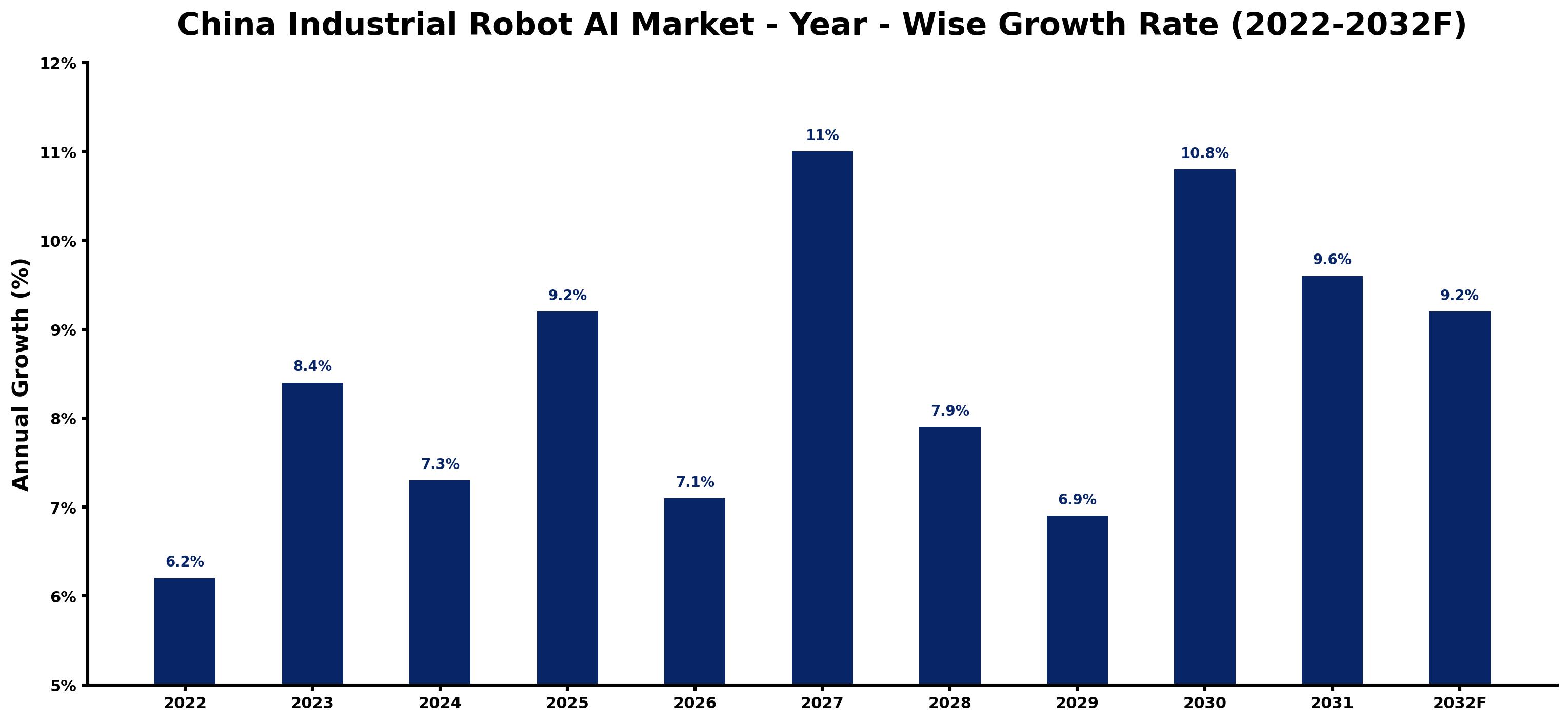
The following table presents the estimated annual growth rate for each year together with the principal factor influencing market performance.
| Year | Estimated Annual Growth (%) | Market Rationale |
| 2022 | 6.2 | The market exhibited steady growth as industries began to adopt automation technologies. |
| 2023 | 8.4 | Increased demand from the automotive sector drove faster growth than the previous year. |
| 2024 | 7.3 | A slight slowdown occurred as the market adjusted to previous rapid expansions. |
| 2025 | 9.2 | The automotive sector's strong performance led to growth faster than the prior year. |
| 2026 | 7.1 | Growth slowed as the market stabilised after peak demand in automotive manufacturing. |
| 2027 | 11.0 | A surge in automation needs resulted in the highest growth rate during this period. |
| 2028 | 7.9 | The market experienced another slowdown as growth rates normalised after the peak. |
| 2029 | 6.9 | Continued demand from electronics manufacturing contributed to a further slowdown. |
| 2030 | 10.8 | The automotive sector's ongoing investment in robotics spurred faster growth again. |
| 2031 | 9.6 | Growth slowed as the market matured, reflecting stabilisation in demand patterns. |
| 2032 | 9.2 | The market maintained a steady growth rate, supported by ongoing automation trends. |
Note: Market size estimations and growth projections presented in this report are based on 6Wresearch's proprietary forecasting methodology, utilizing the latest available industry data, government publications, and primary research inputs.
China Industrial Robot AI Market Synopsis
The Industrial Robot AI Market in China encompasses the integration of artificial intelligence with industrial robotics to enhance manufacturing efficiency. This technology automates repetitive tasks and improves precision in production lines. The market is experiencing significant growth, driven by strong demand from the automotive and electronics sectors. In 2023, the automotive sector accounted for approximately 30% of total industrial robot sales. Additionally, the 'AI 2.0 Plan' aims to integrate AI into manufacturing processes by 2025, further boosting market expansion.
Market Dynamics Impact Analysis (2026–2032)
| Factor | Type | Impact | Primary Segment Affected |
| Rising demand for automation in manufacturing processes | Driver | High | Automotive Manufacturing |
| Increased adoption of AI technologies in robotics | Driver | High | Vision Recognition |
| Growing need for efficient production in electronics | Opportunity | High | Electronics |
| Investment in smart manufacturing technologies | Opportunity | High | Consumer Goods |
| High initial investment costs for robotics implementation | Restraint | Medium | Collaborative Robots |
| Limited skilled workforce for advanced robotics | Restraint | Medium | Articulated Robots |
| The Industrial Robot AI market faces regulatory hurdles | Challenge | High | Centralized AI Control |
| Technological integration challenges hinder market growth | Challenge | Medium | Edge AI |
Evaluation of Drivers in China Industrial Robot AI Market (2026–2032)
The main growth drivers and the segments they affect most are set out below.
| Drivers | Primary Segment Affected | Why It Matters (Evidence) |
| Increased automation in the automotive sector | Automotive Manufacturing | The automotive sector accounted for approximately 30% of total industrial robot sales in 2023, driving demand for robotics. |
| Growing adoption of AI technologies in manufacturing | Vision Recognition | The electronics industry has seen a 25% increase in robot adoption since 2021, improving quality control. |
| Demand for efficient production in consumer goods | Consumer Goods | The average annual growth rate for industrial robots in China is projected at 15% through 2025, reflecting rising efficiency needs. |
| Investment in smart manufacturing initiatives | Electronics | China allocated $1 billion in 2022 for smart manufacturing technologies, boosting robotics integration. |
| Technological advancements in robotics | Collaborative Robots | The 'Robot+AI' program promotes the integration of AI technologies, improving operational capabilities. |
Growth in the Industrial Robot AI market in China comes from rising demand for automation in manufacturing processes and increased adoption of AI technologies. The automotive sector accounted for approximately 30% of total industrial robot sales in 2023, driving demand. The electronics industry has seen a 25% increase in robot adoption since 2021, improving quality control and production efficiency. These factors encourage manufacturers to invest in advanced robotics solutions to meet growing production needs.
Evaluation of Restraints in China Industrial Robot AI Market
The table below lists the restraints and the evidence behind each.
| Market Restraint | Primary Segment Affected | Why It Matters (Evidence) |
| High initial investment costs for robotics implementation | Collaborative Robots | The cost of implementing advanced robotics can deter smaller manufacturers from investing. |
| Limited skilled workforce for advanced robotics | Articulated Robots | A shortage of skilled workers in robotics limits operational efficiency and growth potential. |
| Regulatory hurdles impacting robotics deployment | Centralized AI Control | Compliance with updated safety standards can delay the implementation of new robotics technologies. |
| Technological integration challenges | Edge AI | Integrating AI with existing manufacturing systems can be complex and resource-intensive. |
| Market saturation in certain sectors | Electronics | As the market matures, growth rates may slow due to increased competition and saturation. |
China Industrial Robot AI Market Challenges
The China Industrial Robot AI market encounters regulatory hurdles that complicate compliance with the updated National Standard for Industrial Robots, leading to delays in product launches for producers. Many manufacturers face technological challenges, as integrating advanced AI algorithms demands substantial investment and expertise, which can impede their market competitiveness. Suppliers contend with intense competition from both local and foreign firms, compelling them to reduce prices and affecting their profit margins. Furthermore, the increasing costs of advanced components for industrial robots can elevate production expenses by up to 20%, prompting buyers to reassess their automation investments.
Trends in the China Industrial Robot AI Market
The trends below show where the China Industrial Robot AI Market is heading.
- Shift towards AI-Driven Automation: In 2022, the 'AI 2.0 Plan' initiated by the State Council aims to integrate AI into manufacturing processes, targeting a 30% increase in efficiency by 2025. This shift is driving investment in AI technologies across various sectors.
- Emergence of Collaborative Robots: The demand for Collaborative Robots has surged since 2021, particularly in automotive manufacturing, where safety and efficiency are paramount. This segment is projected to grow as industries seek to improve human-robot collaboration.
- Increased Focus on Safety Standards: The updated National Standard for Industrial Robots in 2023 emphasises improved safety protocols for manufacturers. This change is important for enhancing operational safety and compliance in robotics applications.
- Growth in Robotics for Electronics Manufacturing: Shenzhen has become a leading region for robotics innovation, with a 25% increase in robot adoption in the electronics sector since 2021. This trend reflects the industry's push for greater automation and efficiency.
Investment Opportunities in the China Industrial Robot AI Market
The following opportunities in the China Industrial Robot AI Market pair current demand with a clear way in.
- Partnerships for Robotics Integration: Now is an ideal time to explore joint ventures with local manufacturers in Guangdong province, where over 50% of China's industrial robot manufacturers are based. This region offers potential for growth and collaboration.
- Investment in Smart Manufacturing Facilities: The recent allocation of $1 billion for smart manufacturing technologies presents an opportunity for suppliers to invest in advanced robotics solutions. Targeting automotive manufacturers can yield substantial returns.
- Expanding Robotics in Consumer Goods: Consumer goods manufacturers are increasingly adopting robotics for production efficiency, driven by the need to streamline operations. This sector represents a growing market for innovative robotics solutions.
- Focus on AI-Enhanced Robotics: With the 'Robot+AI' program promoting AI technologies, suppliers can capitalise on the demand for AI-enhanced robotics across various sectors. This initiative encourages investment in advanced robotics capabilities.
Government Initiatives in the China Industrial Robot AI Market
The 'Robotics Industry Development Plan' by the Ministry of Industry and Information Technology, launched in 2021, aims to improve the competitiveness of China's robotics sector. This initiative focuses on encouraging innovation and enhancing production capabilities among local manufacturers. It promotes investment in R&D and supports the development of advanced robotics technologies. The 'Made in China 2025' initiative highlights robotics as a key technology for industrial upgrade, targeting a 50% increase in robot production by 2025.
In 2022, the National Development and Reform Commission introduced the 'Smart Manufacturing Development Strategy' with a budget of $500 million to promote AI integration in manufacturing. This strategy aims to boost productivity and efficiency across various industries. The Ministry of Science and Technology oversees the implementation of this strategy, ensuring effective allocation of funds to support technological advancements in robotics. The 'AI 2.0 Plan' initiated in 2022 by the State Council further encourages the application of AI in industrial automation, targeting a 30% increase in efficiency by 2025.
Future Insight of the China Industrial Robot AI Market
The China Industrial Robot AI market is set for transformative changes by 2032, driven by the 'AI 2.0 Plan' aimed at achieving comprehensive AI integration in production processes. The government's $1 billion allocation for smart manufacturing technologies will boost automation across key sectors. By 2025, the installation base of industrial robots is expected to exceed 1 million units, reflecting strong growth potential. The 'Smart Manufacturing Innovation Strategy' will further improve operational efficiency, providing notable benefits for both buyers and suppliers.
Market Segmentation Analysis
The report offers a comprehensive study of the following market segments and their leading categories in the market.
By Robot Type – Articulated Robots Dominated, SCARA Robots Expected to Grow Fastest
According to Sachin Kumar Rai, Senior Research Analyst at 6Wresearch, the largest robot type category in 2025 was Articulated Robots, with a 45% share of total revenue. Articulated robots dominate the market due to their versatility in performing complex tasks across diverse manufacturing sectors. Their extensive use in automotive assembly lines showcases their importance in boosting production efficiency. Over 2026–2032, SCARA Robots are expected to post the fastest growth, at a CAGR of 11.7%. SCARA robots are experiencing rapid growth as they are ideal for high-speed assembly tasks, particularly in the electronics sector. The increasing demand for automation in assembly processes is propelling their swift adoption, suggesting a promising future for this sub-segment. Suppliers should focus on enhancing SCARA robot capabilities to meet the rising demand for speed and efficiency in manufacturing.
By AI Functionality – Vision Recognition Dominated, Path Optimization Expected to Grow Fastest
In 2025, Vision Recognition led the ai functionality split with a 43% share. Vision recognition leads the market as it plays a crucial role in quality control and inspection tasks, ensuring that products adhere to strict standards. Its integration into industrial robots significantly improves operational accuracy, especially in the automotive sector. Path Optimization is set to record the highest CAGR in this split, 10.7% over 2026–2032. Path optimization is rapidly gaining traction due to its ability to enhance efficiency in robotic movements, which is vital in fast-paced production environments. The growing complexity of manufacturing processes necessitates this functionality for optimal operational performance. Buyers should prioritise robots with advanced path optimization features to improve productivity and lower operational costs.
By Control Type – Centralized AI Control Dominated, Edge AI Expected to Grow Fastest
Centralized AI Control accounted for a 37% market share by control type in 2025. Centralized AI control captures the largest market share as it facilitates unified management of multiple robots, streamlining operations across manufacturing lines. This system is particularly advantageous in large-scale production facilities where coordination is vital. The quickest growth will come from Edge AI, forecast to expand at a CAGR of 11.7% between 2026 and 2032. Edge AI is quickly gaining popularity as it enables real-time processing at the device level, improving responsiveness in dynamic manufacturing settings. The shift towards decentralised processing directly addresses the need for faster decision-making. Suppliers must invest in edge AI technologies to meet the increasing demand for real-time processing capabilities in robotics.
By Application Area – Assembly Lines Dominated, PCB Handling Expected to Grow Fastest
With a 48% revenue share in 2025, Assembly Lines was the largest application area category. Assembly lines represent the primary application area for industrial robots, serving as a cornerstone of the manufacturing process across various industries. The extensive utilisation of robots in this domain highlights their importance in improving production efficiency and consistency. PCB Handling is projected to grow fastest, at a CAGR of 11.2% during 2026–2032. PCB handling is experiencing the fastest growth due to its critical importance in electronics manufacturing, where precision is essential. The increasing complexity of electronic devices drives the demand for advanced robotic solutions in this area. Manufacturers should consider investing in robots specifically designed for PCB handling to maintain competitiveness in the electronics market.
By End User Industry – Automotive Manufacturing Dominated, Electronics Expected to Grow Fastest
Automotive Manufacturing took a 44% share of end user industry in 2025, more than any other category. Automotive manufacturing is the foremost industry for industrial robot utilisation, holding a substantial share of the market. The sector's heavy dependence on automation for assembly and quality control highlights the essential role of robotics in improving production efficiency. Over 2026–2032, Electronics is expected to post the fastest growth, at a CAGR of 11.7%. The electronics industry is witnessing the fastest growth in robot adoption as it increasingly incorporates robotics into assembly and testing processes. This trend is driven by the rising demand for electronic devices and the need for efficient production techniques. Suppliers should customise their products to address the specific requirements of the electronics industry to leverage this growth opportunity.
Key Attractiveness of the Report
- 10 Years of Market Numbers
- Historical Data Starting from 2022 to 2025
- Base Year 2025
- Forecast Data until 2032
- Key Performance Indicators Impacting the Market
- Major Upcoming Developments and Projects
Key Highlights of the Report:
- China Industrial Robot AI Market Outlook
- Market Size of China Industrial Robot AI Market, 2025
- Forecast of China Industrial Robot AI Market, 2032
- Historical Data and Forecast of China Industrial Robot AI Revenues & Volume for the Period 2022 - 2032F
- China Industrial Robot AI Market Trend Evolution
- China Industrial Robot AI Market Drivers and Challenges
- China Industrial Robot AI Price Trends
- China Industrial Robot AI Porter's Five Forces
- China Industrial Robot AI Industry Life Cycle
- Historical Data and Forecast of China Industrial Robot AI Market Revenues & Volume By Robot Type for the Period 2022 - 2032F
- Historical Data and Forecast of China Industrial Robot AI Market Revenues & Volume By Articulated Robots for the Period 2022 - 2032F
- Historical Data and Forecast of China Industrial Robot AI Market Revenues & Volume By SCARA Robots for the Period 2022 - 2032F
- Historical Data and Forecast of China Industrial Robot AI Market Revenues & Volume By Delta Robots for the Period 2022 - 2032F
- Historical Data and Forecast of China Industrial Robot AI Market Revenues & Volume By Collaborative Robots for the Period 2022 - 2032F
- Historical Data and Forecast of China Industrial Robot AI Market Revenues & Volume By AI Functionality for the Period 2022 - 2032F
- Historical Data and Forecast of China Industrial Robot AI Market Revenues & Volume By Vision Recognition for the Period 2022 - 2032F
- Historical Data and Forecast of China Industrial Robot AI Market Revenues & Volume By Path Optimization for the Period 2022 - 2032F
- Historical Data and Forecast of China Industrial Robot AI Market Revenues & Volume By Object Sorting for the Period 2022 - 2032F
- Historical Data and Forecast of China Industrial Robot AI Market Revenues & Volume By Human Interaction for the Period 2022 - 2032F
- Historical Data and Forecast of China Industrial Robot AI Market Revenues & Volume By Control Type for the Period 2022 - 2032F
- Historical Data and Forecast of China Industrial Robot AI Market Revenues & Volume By Centralized AI Control for the Period 2022 - 2032F
- Historical Data and Forecast of China Industrial Robot AI Market Revenues & Volume By Edge AI for the Period 2022 - 2032F
- Historical Data and Forecast of China Industrial Robot AI Market Revenues & Volume By Cloud-Based AI for the Period 2022 - 2032F
- Historical Data and Forecast of China Industrial Robot AI Market Revenues & Volume By Onboard AI for the Period 2022 - 2032F
- Historical Data and Forecast of China Industrial Robot AI Market Revenues & Volume By Application Area for the Period 2022 - 2032F
- Historical Data and Forecast of China Industrial Robot AI Market Revenues & Volume By Assembly Lines for the Period 2022 - 2032F
- Historical Data and Forecast of China Industrial Robot AI Market Revenues & Volume By PCB Handling for the Period 2022 - 2032F
- Historical Data and Forecast of China Industrial Robot AI Market Revenues & Volume By Packaging Tasks for the Period 2022 - 2032F
- Historical Data and Forecast of China Industrial Robot AI Market Revenues & Volume By Welding/Inspection for the Period 2022 - 2032F
- Historical Data and Forecast of China Industrial Robot AI Market Revenues & Volume By End User Industry for the Period 2022 - 2032F
- Historical Data and Forecast of China Industrial Robot AI Market Revenues & Volume By Automotive Manufacturing for the Period 2022 - 2032F
- Historical Data and Forecast of China Industrial Robot AI Market Revenues & Volume By Electronics for the Period 2022 - 2032F
- Historical Data and Forecast of China Industrial Robot AI Market Revenues & Volume By Consumer Goods for the Period 2022 - 2032F
- Historical Data and Forecast of China Industrial Robot AI Market Revenues & Volume By Aerospace and Defense for the Period 2022 - 2032F
- China Industrial Robot AI Import Export Trade Statistics
- Market Opportunity Assessment By Robot Type
- Market Opportunity Assessment By AI Functionality
- Market Opportunity Assessment By Control Type
- Market Opportunity Assessment By Application Area
- Market Opportunity Assessment By End User Industry
- China Industrial Robot AI Top Companies Market Share
- China Industrial Robot AI Competitive Benchmarking By Technical and Operational Parameters
- China Industrial Robot AI Company Profiles
- China Industrial Robot AI Key Strategic Recommendations
Market Covered
Segments analysed in this report are listed below.
By Robot Type
- Articulated Robots
- SCARA Robots
- Delta Robots
- Collaborative Robots
By AI Functionality
- Vision Recognition
- Path Optimization
- Object Sorting
- Human Interaction
By Control Type
- Centralized AI Control
- Edge AI
- Cloud-Based AI
- Onboard AI
By Application Area
- Assembly Lines
- PCB Handling
- Packaging Tasks
- Welding/Inspection
By End User Industry
- Automotive Manufacturing
- Electronics
- Consumer Goods
- Aerospace and Defense































