India Industrial Robotics for Logistics Market Size & Growth Rate
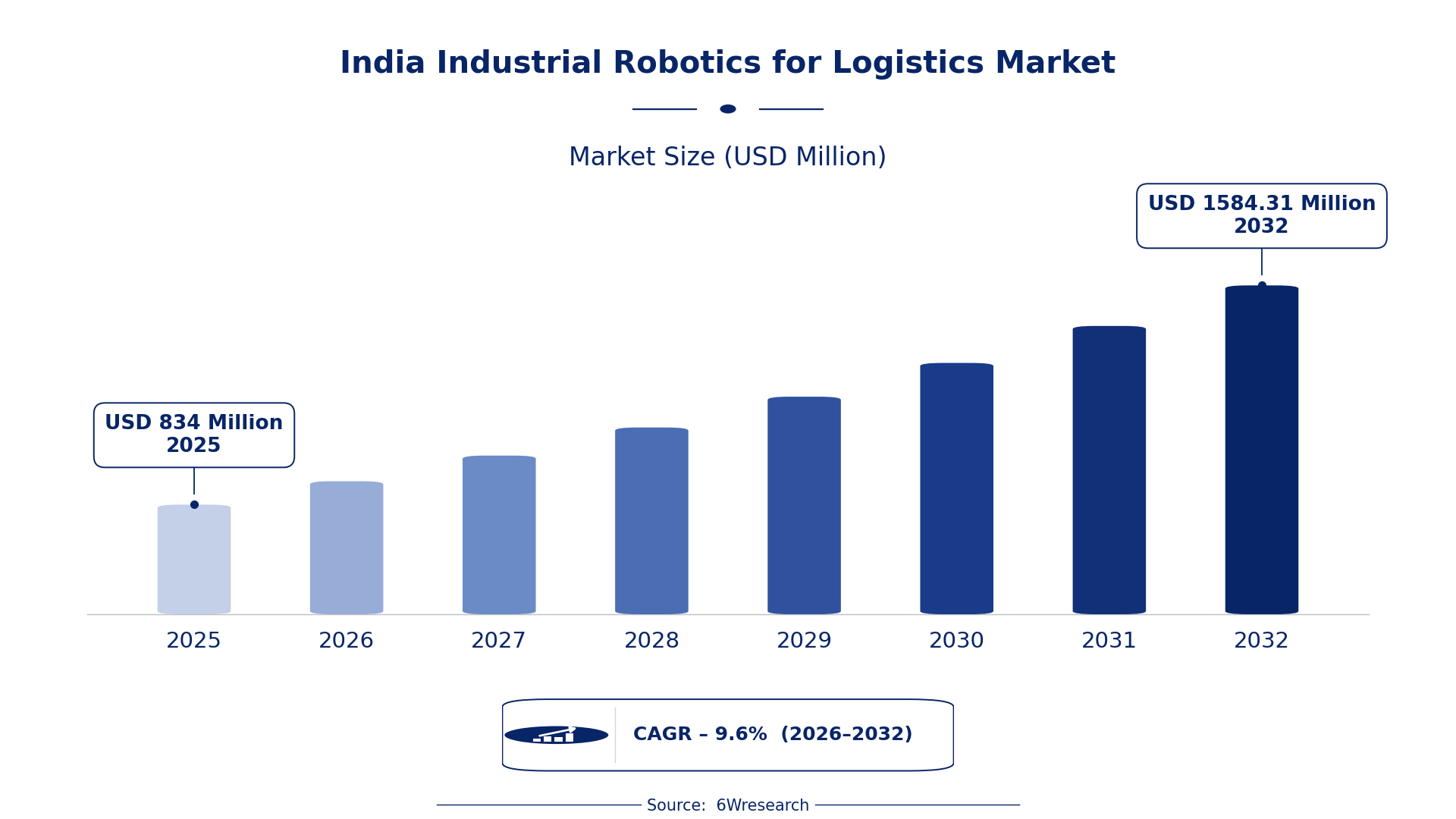
According to 6Wresearch internal database and industry insights, the India Industrial Robotics for Logistics Market was valued at USD 834.0 million in 2025 and is projected to reach USD 1,584.31 million by 2032, growing at a CAGR of approximately 9.6% during 2026–2032.
India Industrial Robotics for Logistics Market Highlights
| Report Metric | Details |
| Report Name | India Industrial Robotics for Logistics Market |
| Market Size 2025 | USD 834.0 million |
| Market Size 2032 | USD 1,584.31 million |
| Absolute Growth 2025–2032 | USD 750.31 million |
| CAGR 2026–2032 | 9.6% |
| Peak Annual Growth | 12.2% in 2031 |
| Forecast Period | 2026–2032 |
| Historical Data | 2022–2025 |
| Base Year | 2025 |
| Leading Robot Type, 2025 | Automated Guided Vehicles (AGVs) (39% share) |
| Leading Application, 2025 | Order Picking (46% share) |
| Leading End User, 2025 | E-commerce Warehouses (50% share) |
| Leading Distribution Channel, 2025 | Direct Sales (47% share) |
| Fastest-Growing Robot Type | Autonomous Mobile Robots (AMRs) (12.2% CAGR) |
| Fastest-Growing Application | Last-Mile Delivery (10.6% CAGR) |
| Fastest-Growing Distribution Channel | Online Distributors (11.3% CAGR) |
| Growing Sector | Last-Mile Delivery |
| Key End Users | Order Picking, Inventory Management, Palletizing, Last-Mile Delivery |
India Industrial Robotics for Logistics Market Year-wise Growth Rate and Key Drivers (2022–2032)
This graph illustrates the annual growth rates of the market from 2022 to 2032, highlighting a steady upward trajectory and projected market expansion over the forecast period.
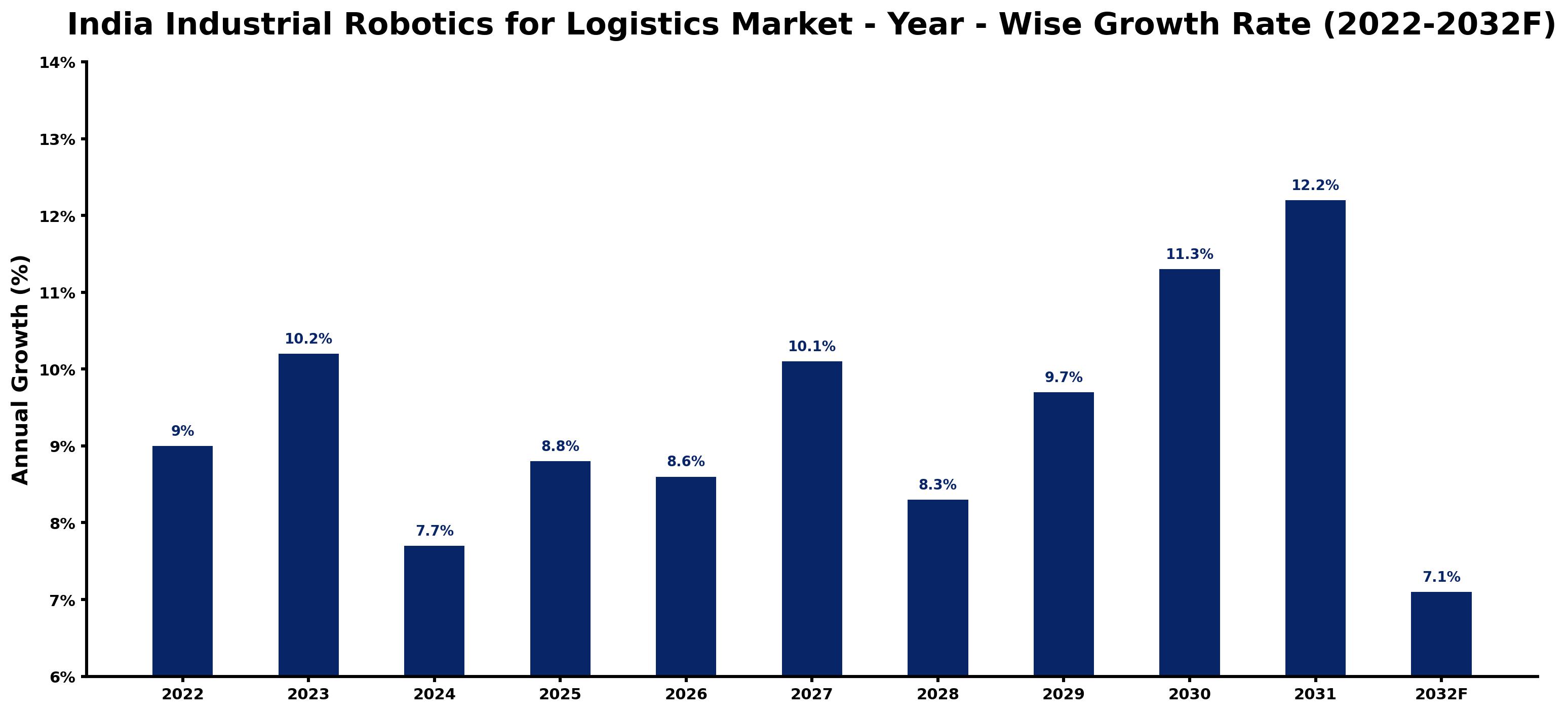
Each row of the following table gives one year's estimated growth and the event or demand shift that explains it.
| Year | Estimated Annual Growth (%) | Market Rationale |
| 2022 | 9.0 | The market experienced solid growth due to rising automation in logistics operations. |
| 2023 | 10.2 | Growth accelerated as e-commerce demand surged, driving robotics adoption in warehouses. |
| 2024 | 7.7 | A slowdown occurred as companies adjusted to previous investments in automation technologies. |
| 2025 | 8.8 | Growth rebounded with increased automation investments in logistics and distribution centers. |
| 2026 | 8.6 | A slight slowdown was noted as businesses focused on optimising existing robotic systems. |
| 2027 | 10.1 | Growth resumed as e-commerce warehouses expanded operations, increasing robotics demand. |
| 2028 | 8.3 | The market saw a slowdown as companies reassessed their automation strategies. |
| 2029 | 9.7 | Growth picked up again with rising demand for efficient inventory management solutions. |
| 2030 | 11.3 | The market accelerated as technological advancements in robotics gained traction in distribution centers. |
| 2031 | 12.2 | Peak growth was driven by substantial investments in logistics automation technologies. |
| 2032 | 7.1 | A slowdown occurred as the 'Digital India' program continued to enhance technology adoption. |
Note: Market size estimations and growth projections presented in this report are based on 6Wresearch's proprietary forecasting methodology, utilizing the latest available industry data, government publications, and primary research inputs.
India Industrial Robotics for Logistics Market Synopsis
Industrial Robotics for Logistics in India involves automated systems designed to improve efficiency in material handling and transportation. These robots are primarily used for order fulfillment, inventory management, and last-mile delivery. The India Industrial Robotics for Logistics Market is expanding due to the booming e-commerce sector and rising automation needs in warehouses. With over 50% of large e-commerce warehouses adopting automation by 2023, growth is expected to continue. The 'National Logistics Policy' launched in 2022 further supports this expansion by streamlining operations and reducing costs for businesses.
Market Dynamics Impact Analysis (2026–2032)
| Factor | Type | Impact | Primary Segment Affected |
| Rising e-commerce demand drives automation in logistics, leading to increased orders for robotics solutions. | Driver | High | E-commerce Warehouses |
| Investment in logistics automation technologies is expanding, creating opportunities for robotics suppliers. | Driver | High | Distribution Centers |
| Growing e-commerce warehouses require advanced robotics solutions to enhance operational efficiency. | Opportunity | High | E-commerce Warehouses |
| The push for local manufacturing of robotics components opens avenues for new suppliers. | Opportunity | High | Automated Guided Vehicles (AGVs) |
| High costs associated with advanced robotics systems may deter smaller logistics companies from investing. | Restraint | High | Robotic Arms |
| Limited awareness of robotics benefits among traditional logistics players hampers adoption rates. | Restraint | Medium | Last-Mile Delivery |
| Supply chain disruptions can delay the availability of robotics components for manufacturers. | Challenge | High | Autonomous Mobile Robots (AMRs) |
| Regulatory compliance for robotics safety standards can slow down the approval process. | Challenge | Medium | Inventory Management |
Evaluation of Drivers in India Industrial Robotics for Logistics Market (2026–2032)
The main growth drivers and the segments they affect most are set out below.
| Drivers | Primary Segment Affected | Why It Matters (Evidence) |
| Increasing e-commerce activity drives demand for automation in logistics. | E-commerce Warehouses | Over 50% of large e-commerce warehouses have adopted automation as of 2023. |
| Investment in logistics infrastructure boosts the need for robotics solutions. | Distribution Centers | The logistics sector is projected to grow at a CAGR of 10% from 2021 to 2026. |
| Technological advancements in robotics improve operational efficiency in warehouses. | Automated Guided Vehicles (AGVs) | AGVs are widely used in automotive manufacturing hubs like Pune and Chennai. |
| Government initiatives support local manufacturing of robotics technologies. | Robotic Arms | The 'Make in India' initiative encourages domestic production of robotics technology. |
| Growing demand for efficient inventory management solutions boosts robotics adoption. | Inventory Management | Robotic arms are increasingly used in FMCG distribution centers across Maharashtra. |
Market growth in India for Industrial Robotics for Logistics rests on rising e-commerce activity, increasing investments in logistics infrastructure, and technological advancements in robotics. Over 50% of large e-commerce warehouses have adopted automation as of 2023, leading to higher demand for robotics solutions. The logistics sector is projected to grow at a CAGR of 10% from 2021 to 2026, driving the need for efficient operations. Advanced technologies are widely deployed in automotive manufacturing hubs, reflecting the growing reliance on automation.
Evaluation of Restraints in India Industrial Robotics for Logistics Market
The following restraints limit how fast demand can grow.
| Market Restraint | Primary Segment Affected | Why It Matters (Evidence) |
| High costs of advanced robotics systems may deter smaller logistics companies from investing. | Robotic Arms | The initial investment for robotic systems can exceed several million rupees. |
| Limited awareness of robotics benefits among traditional logistics players hampers adoption rates. | Last-Mile Delivery | Many logistics companies are still reliant on manual processes, slowing automation uptake. |
| Supply chain disruptions can delay the availability of robotics components for manufacturers. | Autonomous Mobile Robots (AMRs) | Global supply chain issues have led to shortages of essential robotics parts. |
| Regulatory compliance for robotics safety standards can slow down the approval process. | Inventory Management | Manufacturers must navigate complex regulations, delaying product launches. |
| Technological complexity may require extensive training for staff, limiting immediate adoption. | Automated Guided Vehicles (AGVs) | Training costs can be substantial, impacting smaller logistics firms. |
India Industrial Robotics for Logistics Market Challenges
Producers in the India Industrial Robotics for Logistics market encounter significant challenges due to outdated technology, which can inflate operational costs by up to 20%. Regulatory complexities hinder the swift approval of innovative solutions, resulting in delays that can lead to lost revenue opportunities for suppliers. A shortage of skilled professionals in robotics engineering limits manufacturers' capacity to innovate, causing slower adaptation to market demands for buyers. Fierce competition among local and international firms drives prices down, compelling producers to compromise on quality, ultimately diminishing buyer satisfaction.
Trends in the India Industrial Robotics for Logistics Market
Several trends are reshaping the India Industrial Robotics for Logistics Market; the most important are set out below.
- Shift towards Automation in Logistics: The logistics sector is increasingly embracing automation technologies, with over 50% of large e-commerce warehouses implementing robotics solutions by 2023. This trend underscores the demand for operational efficiency, spurred by rising e-commerce activity.
- Growth of Last-Mile Delivery Robotics: Last-mile delivery solutions are gaining momentum, especially in urban areas like Bangalore, where drones are being tested for logistics. This shift is expected to enhance delivery speed and efficiency, supported by substantial investments in technology.
- Expansion of Robotics in FMCG Distribution: FMCG distribution centres across Maharashtra are progressively employing robotic arms to optimise operations. This trend reflects the growing necessity for efficiency in high-volume environments, with adoption rates increasing significantly.
- Government Support for Robotics Development: The 'National Logistics Policy' launched in 2022 seeks to boost logistics efficiency through technology adoption. This initiative is anticipated to stimulate further investments in robotics, benefiting the broader logistics sector.
Investment Opportunities in the India Industrial Robotics for Logistics Market
Investors looking at the India Industrial Robotics for Logistics Market should consider the following areas.
- Collaborate with Local Manufacturers: Investing in partnerships with local manufacturers can strengthen the supply chain for robotics components. The 'Make in India' initiative supports local production, creating opportunities for collaboration.
- Provide Robotics for E-commerce Warehouses: E-commerce warehouses are major users of robotics, with over 50% adopting automation. Suppliers can enter this market through direct sales or partnerships with logistics providers.
- Invest in Last-Mile Delivery Solutions: The rising demand for last-mile delivery solutions presents an opportunity for suppliers to provide drones and automation technologies. Urban areas like Bangalore are ideal for trials and deployments.
- Target Robotics for Inventory Management: With increasing demand for efficient inventory management, suppliers can focus on distribution centers. The adoption of robotic arms in FMCG distribution centers highlights this opportunity.
Government Initiatives in the India Industrial Robotics for Logistics Market
The 'National Logistics Policy' launched by the Ministry of Commerce and Industry in 2022 aims to streamline logistics operations and reduce costs for businesses. This policy builds on previous initiatives by providing a structured framework for logistics efficiency, promoting the adoption of technology in the sector. Additionally, the 'Make in India' initiative continues to support local manufacturing of robotics technologies, encouraging domestic production and innovation. The Ministry of Electronics and Information Technology announced a budget of ₹1,500 crores in 2021 to promote AI and robotics in various sectors, including logistics, improving operational capabilities.
The Ministry of Electronics and Information Technology oversees funding for AI and robotics initiatives, with a budget of ₹1,500 crores announced in 2021. This funding aims to promote the integration of advanced technologies in logistics, improving operational capabilities. The 'Production Linked Incentive Scheme' also encourages domestic manufacturing of robotics components, further supporting the growth of the logistics sector by ensuring a steady supply of essential technologies.
Future Insight of the India Industrial Robotics for Logistics Market
The India Industrial Robotics for Logistics market will undergo transformative changes by 2032, driven by the integration of advanced AI and machine learning technologies. The National Logistics Policy will streamline regulations, making it easier for suppliers to introduce new products. As the 'Make in India' initiative advances, domestic production of robotics technology will increase, reducing costs for buyers. By 2026, over 50% of large e-commerce warehouses are anticipated to implement automation, enhancing efficiency and service delivery across the logistics sector.
Market Segmentation Analysis
The report offers a comprehensive study of the following market segments and their leading categories in the market.
By Robot Type – Automated Guided Vehicles (AGVs) Dominated, Autonomous Mobile Robots (AMRs) Expected to Grow Fastest
According to Sachin Kumar Rai, Senior Research Analyst at 6Wresearch, Automated Guided Vehicles (AGVs) took a 39% share of robot type in 2025, more than any other category. Automated Guided Vehicles (AGVs) lead the market share due to their widespread use in automotive manufacturing hubs like Pune and Chennai, where they efficiently transport materials. Their proven effectiveness in these critical environments ensures their continued dominance in the logistics sector. Over 2026–2032, Autonomous Mobile Robots (AMRs) is expected to post the fastest growth, at a CAGR of 12.2%. The growth of Autonomous Mobile Robots (AMRs) is propelled by their ability to navigate autonomously in dynamic settings, making them ideal for various applications. As industries increasingly implement these robots, their market position is expected to strengthen further. Suppliers should focus on enhancing AMR capabilities to capitalise on the increasing demand across diverse sectors.
By Application – Order Picking Dominated, Last-Mile Delivery Expected to Grow Fastest
Order Picking held a 46% share of the India Industrial Robotics for Logistics Market by application in 2025. Order Picking holds the largest market share as it is crucial for optimising warehouse operations and fulfilment processes, especially in the booming e-commerce sector. The necessity for speed and accuracy in order fulfilment drives the extensive adoption of this application. Last-Mile Delivery is projected to grow fastest, at a CAGR of 10.6% during 2026–2032. Last-Mile Delivery is experiencing rapid growth due to rising e-commerce demands, with businesses striving for effective solutions to improve customer satisfaction. This trend indicates a strategic shift towards quicker delivery methods in logistics. Buyers must invest in last-mile delivery technologies to stay competitive in the evolving logistics landscape.
By End User – E-commerce Warehouses Dominated and Is Expected to Record the Fastest Growth
In 2025, E-commerce Warehouses led the end user split with a 50% share. E-commerce Warehouses dominate the market as they are the primary users of robotics, employing these technologies to streamline operations and meet growing customer expectations. The push for automation in these facilities significantly boosts their market share. The same category are also set to grow fastest, at a CAGR of 11.4% during 2026–2032. E-commerce Warehouses are also the fastest-growing segment, driven by the increase in online shopping that necessitates more efficient logistics solutions. Their continuous investment in robotics ensures sustained growth in this area. Suppliers should tailor their offerings to meet the specific needs of e-commerce warehouses to leverage this growth opportunity.
By Distribution Channel – Direct Sales Dominated, Online Distributors Expected to Grow Fastest
Direct Sales accounted for a 47% market share by distribution channel in 2025. Direct Sales is the leading channel for acquiring robotic solutions, enabling manufacturers to establish strong relationships with clients and provide customised support. This direct engagement fosters trust and loyalty, solidifying its market share. Online Distributors are set to record the highest CAGR in this split, 11.3% over 2026–2032. Online Distributors are rapidly gaining traction as e-commerce platforms facilitate the sale of robotic solutions, reaching a broader customer base. The convenience of online purchasing is driving the growth of this distribution channel. Suppliers should enhance their online presence to effectively capture the growing market through digital distribution channels.
Key Attractiveness of the Report
- 10 Years of Market Numbers
- Historical Data Starting from 2022 to 2025
- Base Year 2025
- Forecast Data until 2032
- Key Performance Indicators Impacting the Market
- Major Upcoming Developments and Projects
Key Highlights of the Report:
- India Industrial Robotics for Logistics Market Outlook
- Market Size of India Industrial Robotics for Logistics Market, 2025
- Forecast of India Industrial Robotics for Logistics Market, 2032
- Historical Data and Forecast of India Industrial Robotics for Logistics Revenues & Volume for the Period 2022 - 2032F
- India Industrial Robotics for Logistics Market Trend Evolution
- India Industrial Robotics for Logistics Market Drivers and Challenges
- India Industrial Robotics for Logistics Price Trends
- India Industrial Robotics for Logistics Porter's Five Forces
- India Industrial Robotics for Logistics Industry Life Cycle
- Historical Data and Forecast of India Industrial Robotics for Logistics Market Revenues & Volume By Robot Type for the Period 2022 - 2032F
- Historical Data and Forecast of India Industrial Robotics for Logistics Market Revenues & Volume By Automated Guided Vehicles (AGVs) for the Period 2022 - 2032F
- Historical Data and Forecast of India Industrial Robotics for Logistics Market Revenues & Volume By Autonomous Mobile Robots (AMRs) for the Period 2022 - 2032F
- Historical Data and Forecast of India Industrial Robotics for Logistics Market Revenues & Volume By Robotic Arms for the Period 2022 - 2032F
- Historical Data and Forecast of India Industrial Robotics for Logistics Market Revenues & Volume By Drones for Logistics for the Period 2022 - 2032F
- Historical Data and Forecast of India Industrial Robotics for Logistics Market Revenues & Volume By Application for the Period 2022 - 2032F
- Historical Data and Forecast of India Industrial Robotics for Logistics Market Revenues & Volume By Order Picking for the Period 2022 - 2032F
- Historical Data and Forecast of India Industrial Robotics for Logistics Market Revenues & Volume By Inventory Management for the Period 2022 - 2032F
- Historical Data and Forecast of India Industrial Robotics for Logistics Market Revenues & Volume By Palletizing for the Period 2022 - 2032F
- Historical Data and Forecast of India Industrial Robotics for Logistics Market Revenues & Volume By Last-Mile Delivery for the Period 2022 - 2032F
- Historical Data and Forecast of India Industrial Robotics for Logistics Market Revenues & Volume By End User for the Period 2022 - 2032F
- Historical Data and Forecast of India Industrial Robotics for Logistics Market Revenues & Volume By E-commerce Warehouses for the Period 2022 - 2032F
- Historical Data and Forecast of India Industrial Robotics for Logistics Market Revenues & Volume By Retail Chains for the Period 2022 - 2032F
- Historical Data and Forecast of India Industrial Robotics for Logistics Market Revenues & Volume By Distribution Centers for the Period 2022 - 2032F
- Historical Data and Forecast of India Industrial Robotics for Logistics Market Revenues & Volume By Postal Services for the Period 2022 - 2032F
- Historical Data and Forecast of India Industrial Robotics for Logistics Market Revenues & Volume By Distribution Channel for the Period 2022 - 2032F
- Historical Data and Forecast of India Industrial Robotics for Logistics Market Revenues & Volume By Direct Sales for the Period 2022 - 2032F
- Historical Data and Forecast of India Industrial Robotics for Logistics Market Revenues & Volume By OEM Partnerships for the Period 2022 - 2032F
- Historical Data and Forecast of India Industrial Robotics for Logistics Market Revenues & Volume By Online Distributors for the Period 2022 - 2032F
- Historical Data and Forecast of India Industrial Robotics for Logistics Market Revenues & Volume By Logistics System Providers for the Period 2022 - 2032F
- India Industrial Robotics for Logistics Import Export Trade Statistics
- Market Opportunity Assessment By Robot Type
- Market Opportunity Assessment By Application
- Market Opportunity Assessment By End User
- Market Opportunity Assessment By Distribution Channel
- India Industrial Robotics for Logistics Top Companies Market Share
- India Industrial Robotics for Logistics Competitive Benchmarking By Technical and Operational Parameters
- India Industrial Robotics for Logistics Company Profiles
- India Industrial Robotics for Logistics Key Strategic Recommendations
Market Covered
This report examines the market across the segments below.
By Robot Type
- Automated Guided Vehicles (AGVs)
- Autonomous Mobile Robots (AMRs)
- Robotic Arms
- Drones for Logistics
By Application
- Order Picking
- Inventory Management
- Palletizing
- Last-Mile Delivery
By End User
- E-commerce Warehouses
- Retail Chains
- Distribution Centers
- Postal Services
By Distribution Channel
- Direct Sales
- OEM Partnerships
- Online Distributors
- Logistics System Providers































