China Industrial Robotics for Logistics Market Size & Growth Rate
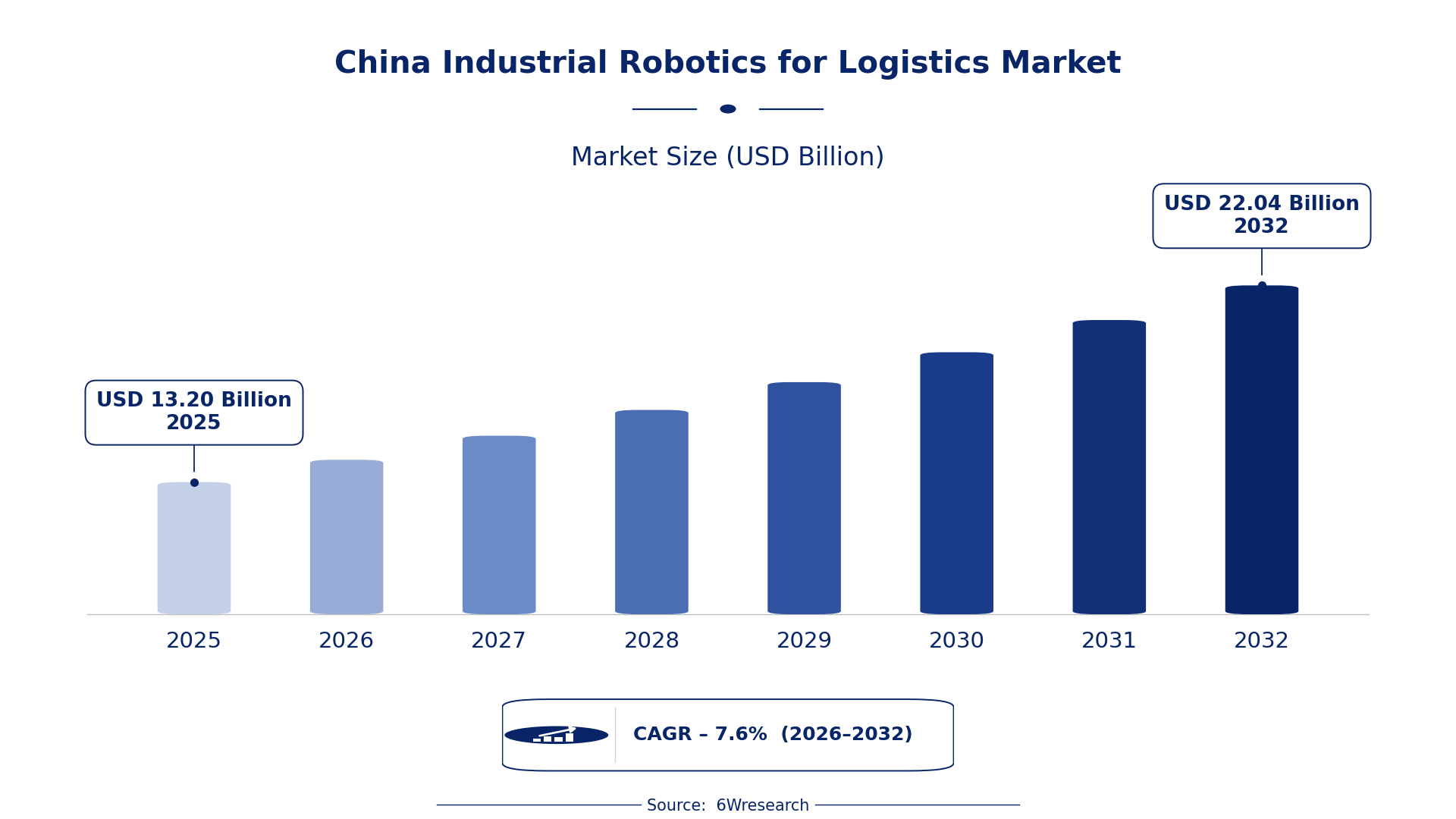
According to 6Wresearch internal database and industry insights, the China Industrial Robotics for Logistics Market was valued at USD 13.20 billion in 2025 and is projected to reach USD 22.04 billion by 2032, growing at a CAGR of approximately 7.6% during 2026–2032.
China Industrial Robotics for Logistics Market Highlights
| Report Metric | Details |
| Report Name | China Industrial Robotics for Logistics Market |
| Market Size 2025 | USD 13.20 billion |
| Market Size 2032 | USD 22.04 billion |
| Absolute Growth 2025–2032 | USD 8.84 billion |
| CAGR 2026–2032 | 7.6% |
| Peak Annual Growth | 9.8% in 2026 |
| Forecast Period | 2026–2032 |
| Historical Data | 2022–2025 |
| Base Year | 2025 |
| Leading Robot Type, 2025 | Automated Guided Vehicles (AGVs) (43% share) |
| Leading Application, 2025 | Order Picking (48% share) |
| Leading End User, 2025 | E-commerce Warehouses (49% share) |
| Leading Distribution Channel, 2025 | Direct Sales (44% share) |
| Fastest-Growing Robot Type | Autonomous Mobile Robots (AMRs) (9.3% CAGR) |
| Fastest-Growing Application | Inventory Management (9.3% CAGR) |
| Fastest-Growing End User | Retail Chains (8.9% CAGR) |
| Fastest-Growing Distribution Channel | OEM Partnerships (10.2% CAGR) |
| Growing Sector | E-commerce |
| Key End Users | E-commerce Warehouses, Distribution Centers, Retail Chains |
China Industrial Robotics for Logistics Market Year-wise Growth Rate and Key Drivers (2022–2032)
This graph illustrates the annual growth rates of the market from 2022 to 2032, highlighting a steady upward trajectory and projected market expansion over the forecast period.
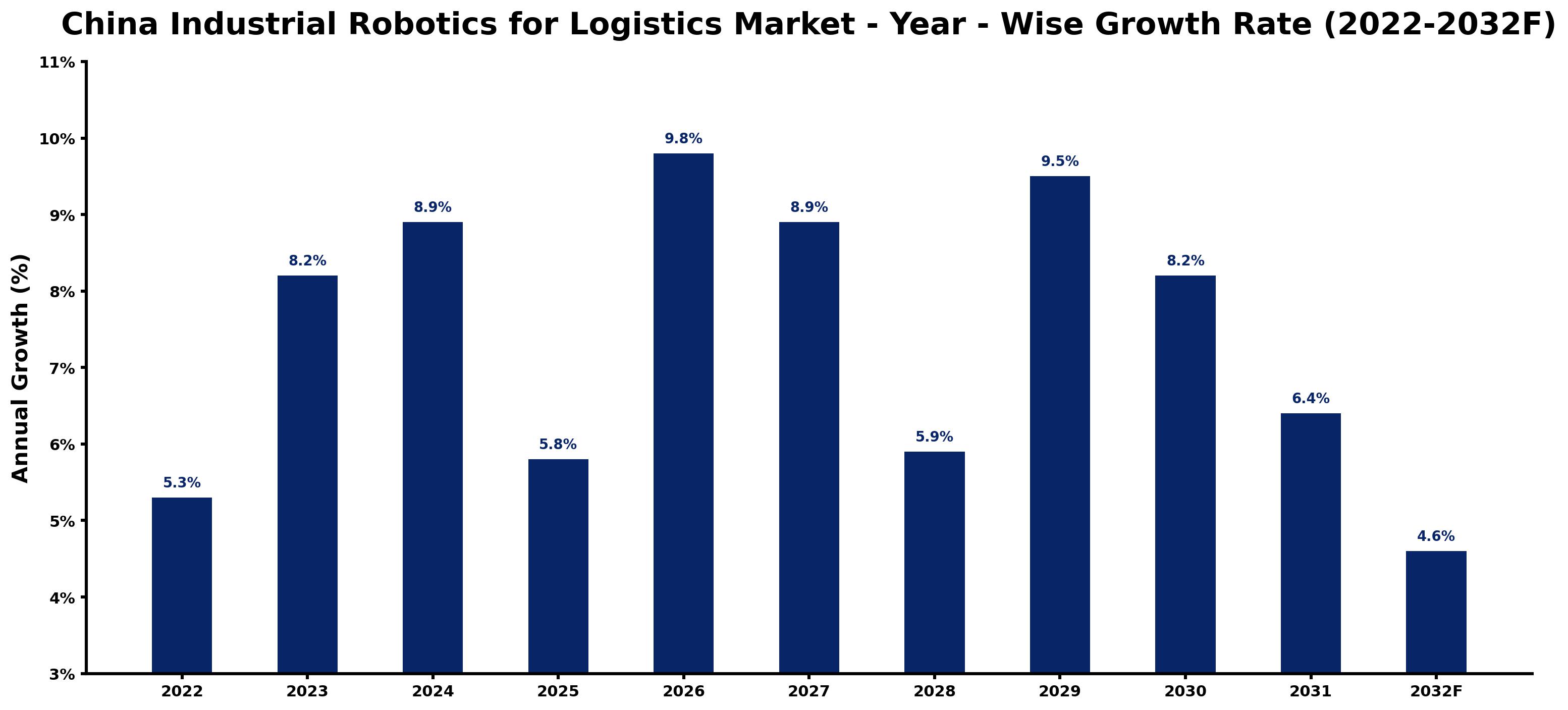
The table below sets out the estimated growth rate for each year and the main factor behind it.
| Year | Estimated Annual Growth (%) | Market Rationale |
| 2022 | 5.3 | The market experienced steady growth due to increasing logistics demands driven by e-commerce. |
| 2023 | 8.2 | Demand surged as e-commerce sales rose, prompting greater automation needs in logistics operations. |
| 2024 | 8.9 | Growth continued with advancements in robotics technology and increased urbanisation driving demand. |
| 2025 | 5.8 | Growth slowed as the market adjusted to previous rapid expansions and evolving demands. |
| 2026 | 9.8 | The market is expected to peak due to significant investments in robotics and automation technologies. |
| 2027 | 8.9 | Growth will decelerate as the market stabilises after peak levels of investment. |
| 2028 | 5.9 | Demand for logistics automation is projected to continue, albeit at a slower pace. |
| 2029 | 9.5 | A resurgence in demand for automation technologies is anticipated to boost growth rates in logistics. |
| 2030 | 8.2 | Growth will slow as market conditions normalise following the peak in investments. |
| 2031 | 6.4 | The market is expected to continue growing, but at a slower pace than previous years due to market maturity. |
| 2032 | 4.6 | Growth is projected to slow further as the market matures and competition increases. |
Note: Market size estimations and growth projections presented in this report are based on 6Wresearch's proprietary forecasting methodology, utilizing the latest available industry data, government publications, and primary research inputs.
China Industrial Robotics for Logistics Market Synopsis
Industrial Robotics for Logistics in China includes automated guided vehicles, autonomous mobile robots, and robotic arms designed for material handling and transport. These technologies are manufactured using advanced AI and machine learning algorithms. The China Industrial Robotics for Logistics Market is projected to grow, driven by the booming e-commerce sector and urbanisation, with the logistics industry value expected to reach 3 trillion RMB by 2025. Over 70% of large e-commerce warehouses in China now utilise robotics, reflecting strong demand for automation solutions.
Market Dynamics Impact Analysis (2026–2032)
| Factor | Type | Impact | Primary Segment Affected |
| Increasing e-commerce sales drive demand for logistics automation. | Driver | High | Automated Guided Vehicles (AGVs) |
| Growing urban population necessitates efficient logistics solutions. | Driver | High | Autonomous Mobile Robots (AMRs) |
| High demand for automation in e-commerce warehouses presents opportunities. | Opportunity | High | E-commerce Warehouses |
| Investment in logistics technology is rising, creating new market openings. | Opportunity | High | Distribution Centers |
| High costs of robotics technology can limit adoption rates. | Restraint | High | Robotic Arms |
| Approval processes for new technologies can delay implementation. | Restraint | Medium | Drones for Logistics |
| Supply chain disruptions can affect the availability of components. | Challenge | High | Automated Guided Vehicles (AGVs) |
| Competition from traditional logistics methods can hinder market growth. | Challenge | Medium | Autonomous Mobile Robots (AMRs) |
Evaluation of Drivers in China Industrial Robotics for Logistics Market (2026–2032)
Below mentioned are some major drivers and their influence on market dynamics.
| Drivers | Primary Segment Affected | Why It Matters (Evidence) |
| Surge in e-commerce demand drives the adoption of AGVs. | Automated Guided Vehicles (AGVs) | In 2022, e-commerce accounted for 24% of total retail sales, increasing AGV demand. |
| Urbanisation increases the need for efficient logistics solutions. | Autonomous Mobile Robots (AMRs) | China's urban population reached 64% in 2023, necessitating logistics automation. |
| Investment in logistics technology boosts operational efficiency. | Distribution Centers | China's investment in logistics technology reached 200 billion RMB in 2022, improving robotics efficiency. |
| Robotics improve last-mile delivery efficiency. | Last-Mile Delivery | The 'Smart Logistics' initiative aims for a 20% increase in efficiency by 2025. |
| Growing automation in inventory management drives robotics adoption. | Inventory Management | Over 70% of large e-commerce warehouses in China utilise robotics for inventory tasks. |
The Industrial Robotics for Logistics market in China is growing on the back of rising e-commerce demand, urbanisation, and substantial investments in logistics technology. In 2022, e-commerce accounted for 24% of total retail sales, boosting demand for automated guided vehicles. With China's urban population reaching 64% in 2023, the need for efficient logistics solutions has intensified. China's investment in logistics technology hit 200 billion RMB in 2022, improving operational efficiency across distribution centres.
Evaluation of Restraints in China Industrial Robotics for Logistics Market
Below mentioned are some major restraints and their influence on market dynamics.
| Market Restraint | Primary Segment Affected | Why It Matters (Evidence) |
| High costs of implementing robotics can deter investment. | Robotic Arms | The initial investment for robotic arms can be substantial, limiting their adoption. |
| Approval delays for new technologies can hinder market growth. | Drones for Logistics | Regulatory approval processes can slow the integration of drones in logistics, delaying deployment. |
| Supply chain disruptions can affect component availability. | Automated Guided Vehicles (AGVs) | Global supply chain issues can delay the production of AGVs, impacting supply chains. |
| Competition from traditional logistics methods limits market expansion. | Autonomous Mobile Robots (AMRs) | Established logistics practices may resist adopting new robotic solutions, hindering growth. |
| Limited awareness of robotics benefits can slow adoption rates. | Inventory Management | Some sectors remain unaware of the efficiency gains from robotics, affecting demand. |
China Industrial Robotics for Logistics Market Challenges
Producers in the China Industrial Robotics for Logistics market encounter a skills shortage, which raises operational costs as they struggle to recruit qualified personnel for robotic systems. This issue arises from the rapid pace of technological advancements that outstrip workforce training initiatives, causing delays in efficiency that can extend project timelines by up to six months. Importers face challenges with technology integration, as many existing logistics systems lack compatibility with newer robotic solutions, leading to additional costs that can exceed 20% of project budgets. Regulatory compliance with the ISO 10218 safety standard adds approximately 15% to overall investment costs, complicating technology adoption for buyers.
Trends in the China Industrial Robotics for Logistics Market
Buyers and suppliers in the China Industrial Robotics for Logistics Market are adjusting to the following trends.
- E-commerce Warehouses Increasing Robotics Utilisation: E-commerce warehouses are increasingly adopting robotics for efficiency, with over 70% currently utilising these technologies. This shift reflects a growing trend in logistics automation as companies seek to optimise operations.
- Yangtze River Delta as Robotics Innovation Hub: The Yangtze River Delta region is emerging as a key hub for logistics robotics innovation, with investments in technology exceeding 200 billion RMB. This area is set to lead advancements in automation solutions, contributing to market growth.
- Rise in Automated Guided Vehicles Adoption: The number of automated guided vehicles in China is expected to exceed 100,000 units by 2025. This trend highlights the increasing reliance on AGVs for material transport in logistics operations.
- Integration of AI in Logistics Robotics: The 'Smart Logistics' program aims to integrate AI and robotics in supply chain operations by 2025. This integration is expected to enhance efficiency and effectiveness in logistics management.
Investment Opportunities in the China Industrial Robotics for Logistics Market
Several openings in the China Industrial Robotics for Logistics Market merit attention from investors.
- E-commerce Warehouses Seeking Advanced Robotics Solutions: E-commerce warehouses are actively seeking advanced robotics solutions to improve efficiency, with the logistics industry projected to reach 3 trillion RMB by 2025. Collaborating with local partners can facilitate market entry.
- Investment in Robotics for Distribution Centers: Distribution centers are looking to invest in robotics to improve operational efficiency, with a significant gap in automation currently. Establishing joint ventures can help suppliers enter this growing market.
- Growing Demand for Inventory Management Robotics: The demand for robotics in inventory management is increasing, driven by the need for efficiency. Suppliers can target e-commerce warehouses to meet this demand effectively.
- Funding Opportunities for Robotics Technology Adoption: The Ministry of Transport announced a funding scheme of 500 million RMB to support robotics integration in postal services. This funding presents an opportunity for suppliers to develop solutions for this sector.
Government Initiatives in the China Industrial Robotics for Logistics Market
The 'Robotics Industry Development Plan' launched by the National Development and Reform Commission in 2021 aims to increase market size by 30% by 2025. This measure builds on existing regulations to promote automation in logistics. Additionally, the '14th Five-Year Plan' includes specific goals for increasing robotics adoption in logistics, ensuring ongoing support for the sector's growth. The 'Digital Economy Development Plan' launched in 2022 encourages the use of AI and robotics in logistics, targeting a 25% increase in automation by 2025.
The Ministry of Industry and Information Technology oversees the 'Smart Logistics' program, which promotes automation in logistics with a target of a 20% increase in efficiency by 2025. This program funds various initiatives aimed at integrating robotics into logistics operations, helping to streamline processes and improve productivity. The Ministry of Transport's funding scheme supports technology upgrades in postal services, facilitating the adoption of robotics in this sector.
Future Insight of the China Industrial Robotics for Logistics Market
The China Industrial Robotics for Logistics market will see transformative changes by 2032, primarily driven by the 'Smart Logistics' initiative, which aims to integrate AI and robotics into supply chain operations. This programme is expected to boost logistics efficiency, with projections indicating a 15% increase in operational productivity by 2023. Suppliers will gain from government subsidies promoting robotic technology adoption, facilitating wider implementation across sectors. The 'National Robotics Industry Development Strategy' aims to double production capacity by 2025, ensuring the market meets the rising demands from e-commerce and urbanization.
Market Segmentation Analysis
Each segment group is reviewed below, with the leader by share and the fastest grower by CAGR.
By Robot Type – Automated Guided Vehicles (AGVs) Dominated, Autonomous Mobile Robots (AMRs) Expected to Grow Fastest
According to Sachin Kumar Rai, Senior Research Analyst at 6Wresearch, the largest robot type category in 2025 was Automated Guided Vehicles (AGVs), with a 43% share of total revenue. Automated Guided Vehicles (AGVs) dominate the market due to their extensive use in material transport within warehouses, with estimates suggesting over 100,000 units will be in operation by 2025. Their established reliability makes them the go-to choice for logistics operators across various sectors in China. Autonomous Mobile Robots (AMRs) is projected to grow fastest, at a CAGR of 9.3% during 2026–2032. The rapid growth of Autonomous Mobile Robots (AMRs) is driven by their capacity to enable flexible and efficient goods movement within facilities, particularly as e-commerce continues to expand. This trend indicates that AMRs will increasingly meet the demands of modern logistics operations. Suppliers should focus on developing advanced AMR solutions to capture the growing demand for flexible logistics automation.
By Application – Order Picking Dominated, Inventory Management Expected to Grow Fastest
In 2025, Order Picking led the application split with a 48% share. Order Picking commands a substantial share as it is a fundamental application for various robotic solutions, crucial for optimising warehouse operations. This application is especially vital in e-commerce warehouses, where speed and accuracy are paramount to success. The quickest growth will come from Inventory Management, forecast to expand at a CAGR of 9.3% between 2026 and 2032. Inventory Management is seeing rapid growth due to the increasing necessity for automated tracking and management of stock levels in warehouses. As logistics operations expand, the demand for efficient inventory management solutions will continue to rise. Buyers should invest in advanced robotics for inventory management to enhance efficiency and accuracy in their logistics operations.
By End User – E-commerce Warehouses Dominated, Retail Chains Expected to Grow Fastest
E-commerce Warehouses took a 49% share of end user in 2025, more than any other category. E-commerce Warehouses represent the largest segment of the market, extensively utilising logistics robotics to streamline operations and meet high consumer demand. The growth of e-commerce in China has led to significant investments in automation within these facilities. Retail Chains are set to record the highest CAGR in this split, 8.9% over 2026–2032. Retail Chains are experiencing the fastest growth in robotics adoption, primarily for inventory management purposes. As these chains aim to optimise their operations, the integration of robotics will become increasingly essential. Suppliers should tailor their robotics solutions to meet the specific needs of retail chains, focusing on inventory management capabilities.
By Distribution Channel – Direct Sales Dominated, OEM Partnerships Expected to Grow Fastest
Direct Sales accounted for a 44% market share by distribution channel in 2025. Direct Sales is the leading distribution channel for robotics providers, allowing for personalised service and direct engagement with clients. This approach enables suppliers to better understand and address the unique needs of their customers in the logistics sector. Over 2026–2032, OEM Partnerships are expected to post the fastest growth, at a CAGR of 10.2%. OEM Partnerships are rapidly gaining popularity as manufacturers seek to integrate robotics into their existing systems. This trend underscores the increasing collaboration between robotics providers and equipment manufacturers to enhance product offerings. Companies should explore OEM partnerships to broaden their market reach and improve product integration capabilities.
Key Attractiveness of the Report
- 10 Years of Market Numbers
- Historical Data Starting from 2022 to 2025
- Base Year 2025
- Forecast Data until 2032
- Key Performance Indicators Impacting the Market
- Major Upcoming Developments and Projects
Key Highlights of the Report:
- China Industrial Robotics for Logistics Market Outlook
- Market Size of China Industrial Robotics for Logistics Market, 2025
- Forecast of China Industrial Robotics for Logistics Market, 2032
- Historical Data and Forecast of China Industrial Robotics for Logistics Revenues & Volume for the Period 2022 - 2032F
- China Industrial Robotics for Logistics Market Trend Evolution
- China Industrial Robotics for Logistics Market Drivers and Challenges
- China Industrial Robotics for Logistics Price Trends
- China Industrial Robotics for Logistics Porter's Five Forces
- China Industrial Robotics for Logistics Industry Life Cycle
- Historical Data and Forecast of China Industrial Robotics for Logistics Market Revenues & Volume By Robot Type for the Period 2022 - 2032F
- Historical Data and Forecast of China Industrial Robotics for Logistics Market Revenues & Volume By Automated Guided Vehicles (AGVs) for the Period 2022 - 2032F
- Historical Data and Forecast of China Industrial Robotics for Logistics Market Revenues & Volume By Autonomous Mobile Robots (AMRs) for the Period 2022 - 2032F
- Historical Data and Forecast of China Industrial Robotics for Logistics Market Revenues & Volume By Robotic Arms for the Period 2022 - 2032F
- Historical Data and Forecast of China Industrial Robotics for Logistics Market Revenues & Volume By Drones for Logistics for the Period 2022 - 2032F
- Historical Data and Forecast of China Industrial Robotics for Logistics Market Revenues & Volume By Application for the Period 2022 - 2032F
- Historical Data and Forecast of China Industrial Robotics for Logistics Market Revenues & Volume By Order Picking for the Period 2022 - 2032F
- Historical Data and Forecast of China Industrial Robotics for Logistics Market Revenues & Volume By Inventory Management for the Period 2022 - 2032F
- Historical Data and Forecast of China Industrial Robotics for Logistics Market Revenues & Volume By Palletizing for the Period 2022 - 2032F
- Historical Data and Forecast of China Industrial Robotics for Logistics Market Revenues & Volume By Last-Mile Delivery for the Period 2022 - 2032F
- Historical Data and Forecast of China Industrial Robotics for Logistics Market Revenues & Volume By End User for the Period 2022 - 2032F
- Historical Data and Forecast of China Industrial Robotics for Logistics Market Revenues & Volume By E-commerce Warehouses for the Period 2022 - 2032F
- Historical Data and Forecast of China Industrial Robotics for Logistics Market Revenues & Volume By Retail Chains for the Period 2022 - 2032F
- Historical Data and Forecast of China Industrial Robotics for Logistics Market Revenues & Volume By Distribution Centers for the Period 2022 - 2032F
- Historical Data and Forecast of China Industrial Robotics for Logistics Market Revenues & Volume By Postal Services for the Period 2022 - 2032F
- Historical Data and Forecast of China Industrial Robotics for Logistics Market Revenues & Volume By Distribution Channel for the Period 2022 - 2032F
- Historical Data and Forecast of China Industrial Robotics for Logistics Market Revenues & Volume By Direct Sales for the Period 2022 - 2032F
- Historical Data and Forecast of China Industrial Robotics for Logistics Market Revenues & Volume By OEM Partnerships for the Period 2022 - 2032F
- Historical Data and Forecast of China Industrial Robotics for Logistics Market Revenues & Volume By Online Distributors for the Period 2022 - 2032F
- Historical Data and Forecast of China Industrial Robotics for Logistics Market Revenues & Volume By Logistics System Providers for the Period 2022 - 2032F
- China Industrial Robotics for Logistics Import Export Trade Statistics
- Market Opportunity Assessment By Robot Type
- Market Opportunity Assessment By Application
- Market Opportunity Assessment By End User
- Market Opportunity Assessment By Distribution Channel
- China Industrial Robotics for Logistics Top Companies Market Share
- China Industrial Robotics for Logistics Competitive Benchmarking By Technical and Operational Parameters
- China Industrial Robotics for Logistics Company Profiles
- China Industrial Robotics for Logistics Key Strategic Recommendations
Market Covered
Segments analysed in this report are listed below.
By Robot Type
- Automated Guided Vehicles (AGVs)
- Autonomous Mobile Robots (AMRs)
- Robotic Arms
- Drones for Logistics
By Application
- Order Picking
- Inventory Management
- Palletizing
- Last-Mile Delivery
By End User
- E-commerce Warehouses
- Retail Chains
- Distribution Centers
- Postal Services
By Distribution Channel
- Direct Sales
- OEM Partnerships
- Online Distributors
- Logistics System Providers































