India Infant Carriers Market Size & Growth Rate
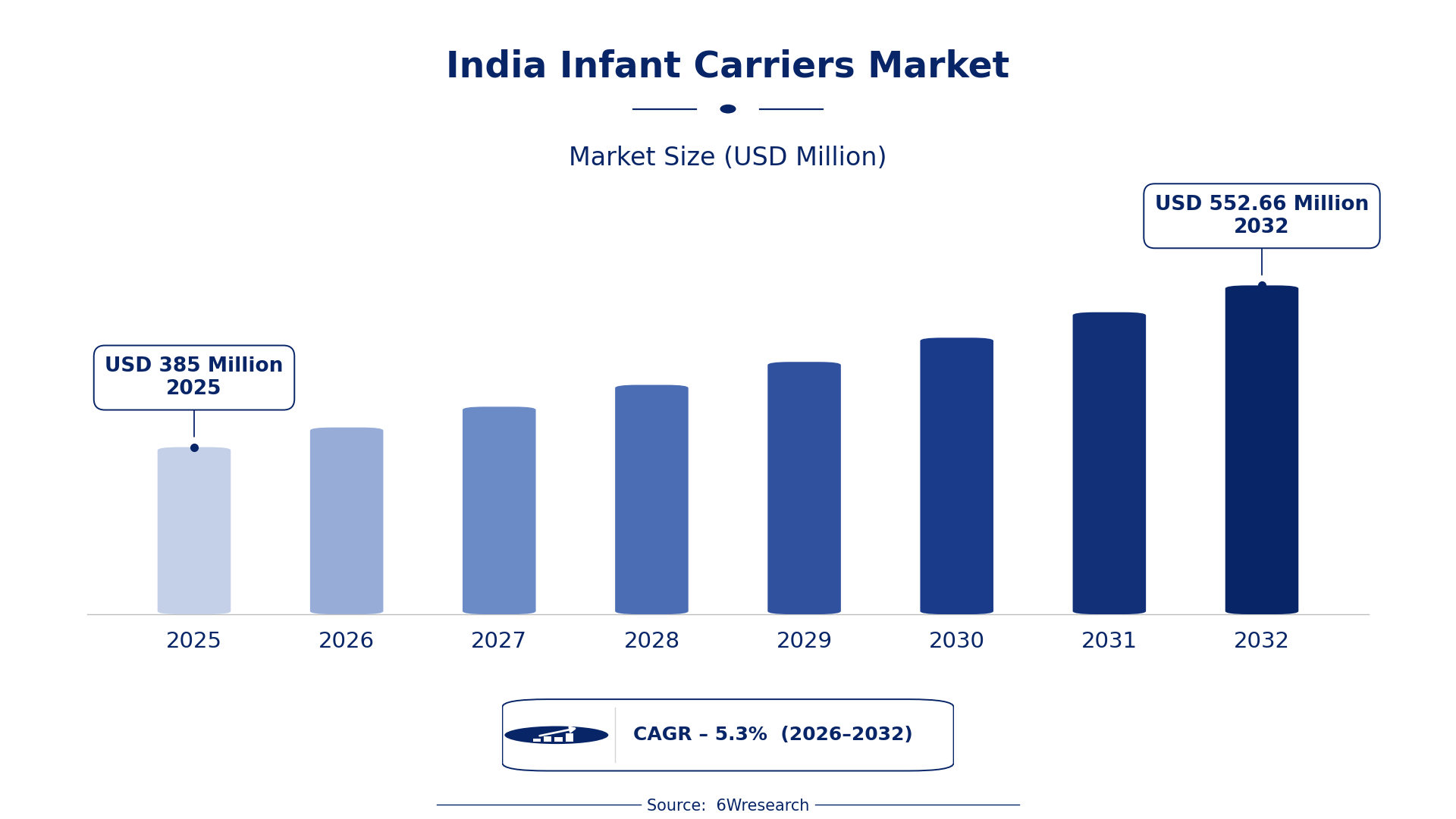
According to 6Wresearch internal database and industry insights, the India Infant Carriers Market was valued at USD 385.0 million in 2025 and is projected to reach USD 552.66 million by 2032, growing at a CAGR of approximately 5.3% during 2026–2032.
India Infant Carriers Market Highlights
| Report Metric | Details |
| Report Name | India Infant Carriers Market |
| Market Size 2025 | USD 385.0 million |
| Market Size 2032 | USD 552.66 million |
| Absolute Growth 2025–2032 | USD 167.66 million |
| CAGR 2026–2032 | 5.3% |
| Peak Annual Growth | 7.7% in 2028 |
| Forecast Period | 2026–2032 |
| Historical Data | 2022–2025 |
| Base Year | 2025 |
| Leading Carrier Type, 2025 | Soft Structured Carriers (44% share) |
| Leading Material Type, 2025 | Cotton/Elastane (49% share) |
| Leading Age Group, 2025 | 0–6 Months (37% share) |
| Leading Distribution Channel, 2025 | E-commerce Platforms (45% share) |
| Fastest-Growing Carrier Type | Wrap Carriers (6.8% CAGR) |
| Fastest-Growing Material Type | Organic Cotton (7.1% CAGR) |
| Fastest-Growing Age Group | Toddlers (Outdoor Use) (6.7% CAGR) |
| Fastest-Growing Distribution Channel | Baby Boutiques (7.9% CAGR) |
| Growing Sector | Baby Products |
| Key End Users | Urban families, first-time parents, eco-conscious consumers, caregivers |
India Infant Carriers Market Year-wise Growth Rate and Key Drivers (2022–2032)
This graph illustrates the annual growth rates of the market from 2022 to 2032, highlighting a steady upward trajectory and projected market expansion over the forecast period.
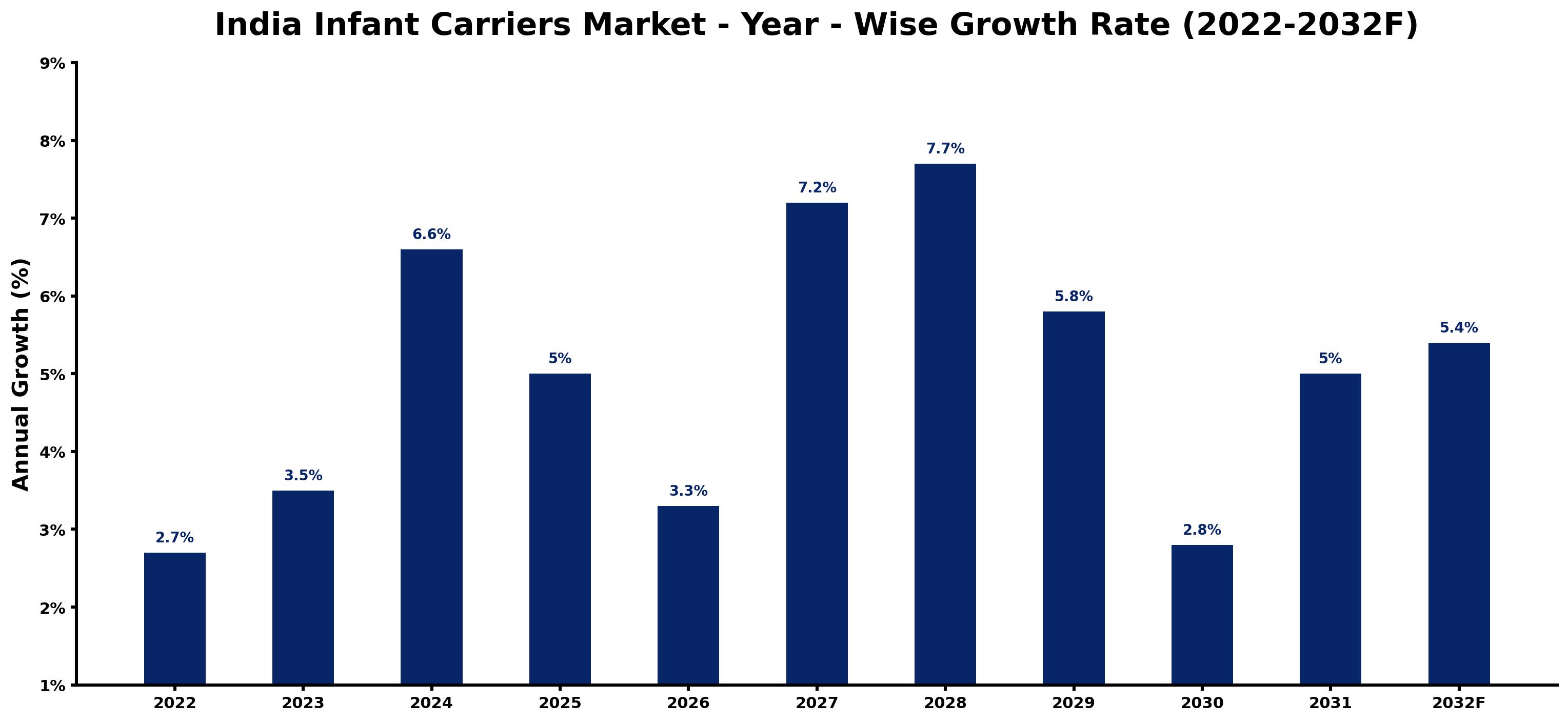
Below, each year's estimated growth is shown next to the factor that most influenced it.
| Year | Estimated Annual Growth (%) | Market Rationale |
| 2022 | 2.7 | The market experienced steady growth as urbanization increased and lifestyles changed, driven by the rising birth rate. |
| 2023 | 3.5 | Demand for infant carriers rose due to the 'Safe Baby Transport Initiative' promoting safe infant transport practices. |
| 2024 | 6.6 | The introduction of updated safety standards in 2022 boosted consumer confidence and sales of infant carriers. |
| 2025 | 5.0 | Sales growth slowed as the market adjusted to the previous year's surge in demand for carriers. |
| 2026 | 3.3 | Growth is projected to moderate as competition increases in the sector. |
| 2027 | 7.2 | Demand is expected to rise as urban families increasingly seek ergonomic baby-wearing solutions. |
| 2028 | 7.7 | The market is anticipated to peak as consumer preferences shift towards organic and eco-friendly options in infant carriers. |
| 2029 | 5.8 | Growth is likely to slow as the market begins to stabilise after peak demand. |
| 2030 | 2.8 | The market is expected to continue growing at a slower pace as new entrants emerge in the industry. |
| 2031 | 5.0 | Sales are projected to rise again as urbanisation and changing lifestyles continue to drive demand for carriers. |
| 2032 | 5.4 | The market is expected to maintain growth as awareness of infant safety remains high among consumers. |
Note: Market size estimations and growth projections presented in this report are based on 6Wresearch's proprietary forecasting methodology, utilizing the latest available industry data, government publications, and primary research inputs.
India Infant Carriers Market Synopsis
Infant carriers in India are baby-wearing devices designed to securely hold infants while allowing caregivers to move freely. These carriers are typically made from fabric, ensuring comfort and support for both the infant and the caregiver. The India Infant Carriers Market is growing due to increasing urbanisation, with a birth rate of approximately 22.9 births per 1,000 people in 2022. Urban families are driving demand, particularly for ergonomic and eco-friendly options, as seen in the rising popularity of organic cotton carriers.
Market Dynamics Impact Analysis (2026–2032)
| Factor | Type | Impact | Primary Segment Affected |
| Urbanisation and changing lifestyles are driving demand for infant carriers. | Driver | High | Soft Structured Carriers |
| E-commerce platforms are expanding access to a wider range of products. | Driver | High | E-commerce Platforms |
| The growing trend towards eco-friendly products presents new opportunities. | Opportunity | High | Organic Cotton |
| The rise of urban families creates a demand for convenient baby transport solutions. | Opportunity | High | Wrap Carriers |
| Competition from alternative baby transport solutions may limit market growth. | Restraint | Medium | Sling Carriers |
| Price sensitivity among consumers can restrict premium product purchases. | Restraint | Medium | Backpack Carriers |
| Regulatory compliance can slow down product launches and increase costs. | Challenge | High | Soft Structured Carriers |
| Supply chain disruptions can lead to delays in product availability. | Challenge | Medium | E-commerce Platforms |
Evaluation of Drivers in India Infant Carriers Market (2026–2032)
The table below links each growth driver to the segment it affects and the evidence for it.
| Drivers | Primary Segment Affected | Why It Matters (Evidence) |
| Increasing urbanisation drives demand for convenient baby transport solutions. | Wrap Carriers | Urban families seek hands-free carrying options, leading to higher sales. |
| The rise of e-commerce platforms improves product accessibility. | E-commerce Platforms | Over 40% of sales occur online, making it easier for consumers to purchase infant carriers. |
| Growing awareness of child safety enhances market demand. | Soft Structured Carriers | Parents are increasingly prioritising safety features in their purchasing decisions. |
| The rising birth rate creates a larger customer base for infant carriers. | Sling Carriers | The birth rate in India was approximately 22.9 births per 1,000 people in 2022. |
| The popularity of organic products is driving demand for eco-friendly carriers. | Organic Cotton | Eco-conscious consumers are increasingly seeking sustainable options for baby products. |
The Infant Carriers market in India is growing due to increasing urbanisation, changing lifestyles and heightened awareness of child safety. In 2022, the birth rate was approximately 22.9 births per 1,000 people, creating a larger customer base for these products. E-commerce platforms account for over 40% of sales, providing easier access for urban families. The introduction of updated safety standards in 2022 has encouraged parents to invest in reliable options. Growing awareness of child safety is influencing market demand as parents prioritise safety features in their purchasing decisions.
Evaluation of Restraints in India Infant Carriers Market
The following restraints limit how fast demand can grow.
| Market Restraint | Primary Segment Affected | Why It Matters (Evidence) |
| Regulatory compliance can delay product launches and increase costs. | Soft Structured Carriers | Producers must adhere to updated safety standards, impacting time-to-market. |
| Price sensitivity among consumers can restrict premium product purchases. | Backpack Carriers | Higher prices deter budget-conscious families from investing in quality carriers. |
| Competition from alternative baby transport solutions may limit market growth. | Sling Carriers | Parents may opt for strollers or other options, affecting carrier sales. |
| Supply chain disruptions can lead to delays in product availability. | E-commerce Platforms | Logistical challenges hinder timely deliveries, impacting sales performance. |
| Limited awareness of safety standards may affect consumer confidence. | Wrap Carriers | Parents may hesitate to purchase without understanding safety certifications. |
India Infant Carriers Market Challenges
The India Infant Carriers Market faces a skills gap, as many caregivers lack training in proper usage, resulting in safety concerns for infants. This issue arises from limited educational resources, which can lead to increased accidents and injuries for children. Supply chain disruptions hinder the market, with suppliers experiencing inconsistent availability of materials, causing delays in production and extending lead times for retailers. Cost pressures emerge from rising raw material prices, particularly for organic cotton, which can increase retail prices by up to 20%, impacting affordability for urban families. Technology adoption is slow, as many suppliers do not utilise advanced manufacturing techniques, limiting product innovation and quality improvements.
Trends in the India Infant Carriers Market
Four trends stand out in the India Infant Carriers Market.
- Urban Families Opting for Eco-Friendly Solutions: Urban families are increasingly choosing organic cotton infant carriers, reflecting a growing trend towards sustainability. In 2023, the Indian government introduced a subsidy program for eco-friendly baby products, encouraging manufacturers to innovate. This shift is expected to attract more environmentally conscious consumers.
- E-commerce Platforms Leading Sales Growth: E-commerce platforms have become the primary distribution channel for infant carriers, accounting for over 40% of sales. The convenience of online shopping is particularly appealing to urban families in major cities like Mumbai and Delhi, where demand is high.
- Heightened Focus on Child Safety: The 'Safe Baby Transport Initiative' launched in 2021 has significantly raised awareness about safe carrying practices for infants. This initiative is influencing consumer choices, leading to a greater emphasis on safety features in infant carriers.
- Demand for Ergonomic Solutions Rising: More parents are seeking ergonomic infant carriers that provide comfort for both the caregiver and the child. The average age of first-time parents is rising, increasing the demand for products that support modern parenting needs.
Investment Opportunities in the India Infant Carriers Market
Several openings in the India Infant Carriers Market merit attention from investors.
- Collaborations with E-commerce Platforms: Partnering with major e-commerce platforms can expand market reach, especially as they account for over 40% of sales. This presents an opportunity for manufacturers to increase visibility and sales significantly.
- Focus on Sustainable Materials: The growing demand for organic cotton products represents a significant opportunity. With the Indian government promoting eco-friendly baby products, manufacturers can concentrate on sustainable materials to attract environmentally conscious consumers.
- Targeting Urban Family Segments: Urban families are increasingly looking for convenient baby transport solutions. Focusing on this demographic can lead to higher sales, especially in densely populated areas like Mumbai and Delhi.
- Entering Specialty Stores: Specialty stores focusing on high-quality, ergonomic carriers are gaining traction. Expanding into this niche market can attract premium buyers who are willing to pay more for superior products.
Government Initiatives in the India Infant Carriers Market
The 'Safe Baby Transport Initiative' launched by the Ministry of Women and Child Development in 2021 promotes safe carrying practices for infants. This initiative has raised awareness among parents about the importance of using safe infant carriers. Additionally, the Bureau of Indian Standards updated safety standards for baby carriers in 2022, ensuring better quality and safety measures for consumers. These measures have positively impacted the market by boosting consumer confidence in infant carriers.
In 2023, the Indian government introduced a subsidy program for manufacturers of eco-friendly baby products, including organic infant carriers. The Ministry of Consumer Affairs oversees this program, which aims to encourage the production of sustainable products. Furthermore, the National Health Mission has included infant safety in its maternal and child health programs since 2020, emphasising the importance of safe transport. These initiatives support the market by promoting safety and sustainability.
Future Insight of the India Infant Carriers Market
Several forward-looking factors are expected to support the India Infant Carriers Market over the coming years. Government initiatives promoting child safety will likely enhance awareness and demand for compliant products. E-commerce growth will improve accessibility, allowing buyers to easily purchase a diverse range of infant carriers. By 2025, sales could increase by 30% due to urbanisation trends and the rising number of first-time parents. The introduction of ergonomic designs will attract health-conscious consumers, further driving market expansion.
Market Segmentation Analysis
The analysis below covers each segmentation, its leading category in 2025 and its fastest-growing category through 2032.
By Carrier Type – Soft Structured Carriers Dominated, Wrap Carriers Expected to Grow Fastest
According to Shubham Deep, Research Manager at 6Wresearch, Soft Structured Carriers accounted for a 44% market share by carrier type in 2025. Soft Structured Carriers dominate the market because they offer ergonomic support, making them ideal for urban families who prioritise comfort. Their widespread use in major cities like Mumbai and Delhi significantly contributes to their market share. Wrap Carriers are projected to grow fastest, at a CAGR of 6.8% during 2026–2032. Wrap Carriers are rapidly gaining traction due to their hands-free carrying capability, which aligns perfectly with the busy lifestyles of modern parents. As urbanisation increases, the demand for convenient and versatile baby-wearing options is expected to soar. Suppliers should focus on enhancing the availability of wrap carriers to capitalise on this growing trend.
By Material Type – Cotton/Elastane Dominated, Organic Cotton Expected to Grow Fastest
Cotton/Elastane took a 49% share of material type in 2025, more than any other category. Cotton/Elastane dominates the market because it offers essential comfort and stretch, making it a favourite among caregivers. This material's extensive use across various infant carriers solidifies its strong market presence. The quickest growth will come from Organic Cotton, forecast to expand at a CAGR of 7.1% between 2026 and 2032. Organic Cotton is quickly gaining popularity as more consumers seek sustainable options for baby products. The shift towards eco-friendly materials is likely to accelerate its growth in the near future. Manufacturers should expand their organic cotton product lines to satisfy the growing consumer interest.
By Age Group – 0–6 Months Dominated, Toddlers (Outdoor Use) Expected to Grow Fastest
In 2025, 0–6 Months led the age group split with a 37% share. The 0–6 Months segment holds the largest market share as it caters specifically to the needs of young infants requiring secure and comfortable carrying solutions. This age group represents a substantial portion of the infant population, ensuring consistent demand. Over 2026–2032, Toddlers (Outdoor Use) is expected to post the fastest growth, at a CAGR of 6.7%. Toddlers (Outdoor Use) are the fastest-growing segment as parents increasingly seek carriers suitable for outdoor activities, reflecting a lifestyle shift towards mobility. This trend indicates a growing preference for versatile carriers that accommodate active family outings. Suppliers should consider developing outdoor-friendly products for toddlers to capture this expanding market segment.
By Distribution Channel – E-commerce Platforms Dominated, Baby Boutiques Expected to Grow Fastest
With a 45% revenue share in 2025, E-commerce Platforms was the largest distribution channel category. E-commerce Platforms lead the market due to their convenience and accessibility, particularly for urban consumers seeking quick purchasing options. This channel plays a vital role in reaching a broad audience, especially in densely populated areas. Baby Boutiques are set to record the highest CAGR in this split, 7.9% over 2026–2032. Baby Boutiques are the fastest-growing distribution channel as they cater to niche markets with premium offerings, attracting discerning parents. The rising interest in high-quality, ergonomic carriers is propelling this growth. Retailers should enhance partnerships with baby boutiques to effectively engage with the premium market segment.
Key Attractiveness of the Report
- 10 Years of Market Numbers
- Historical Data Starting from 2022 to 2025
- Base Year 2025
- Forecast Data until 2032
- Key Performance Indicators Impacting the Market
- Major Upcoming Developments and Projects
Key Highlights of the Report:
- India Infant Carriers Market Outlook
- Market Size of India Infant Carriers Market, 2025
- Forecast of India Infant Carriers Market, 2032
- Historical Data and Forecast of India Infant Carriers Revenues & Volume for the Period 2022 - 2032F
- India Infant Carriers Market Trend Evolution
- India Infant Carriers Market Drivers and Challenges
- India Infant Carriers Price Trends
- India Infant Carriers Porter's Five Forces
- India Infant Carriers Industry Life Cycle
- Historical Data and Forecast of India Infant Carriers Market Revenues & Volume By Carrier Type for the Period 2022 - 2032F
- Historical Data and Forecast of India Infant Carriers Market Revenues & Volume By Wrap Carriers for the Period 2022 - 2032F
- Historical Data and Forecast of India Infant Carriers Market Revenues & Volume By Soft Structured Carriers for the Period 2022 - 2032F
- Historical Data and Forecast of India Infant Carriers Market Revenues & Volume By Sling Carriers for the Period 2022 - 2032F
- Historical Data and Forecast of India Infant Carriers Market Revenues & Volume By Backpack Carriers for the Period 2022 - 2032F
- Historical Data and Forecast of India Infant Carriers Market Revenues & Volume By Material Type for the Period 2022 - 2032F
- Historical Data and Forecast of India Infant Carriers Market Revenues & Volume By Cotton/Elastane for the Period 2022 - 2032F
- Historical Data and Forecast of India Infant Carriers Market Revenues & Volume By Polyester/Cotton Blend for the Period 2022 - 2032F
- Historical Data and Forecast of India Infant Carriers Market Revenues & Volume By Organic Cotton for the Period 2022 - 2032F
- Historical Data and Forecast of India Infant Carriers Market Revenues & Volume By Nylon/Polyester for the Period 2022 - 2032F
- Historical Data and Forecast of India Infant Carriers Market Revenues & Volume By Age Group for the Period 2022 - 2032F
- Historical Data and Forecast of India Infant Carriers Market Revenues & Volume By 0 6 Months for the Period 2022 - 2032F
- Historical Data and Forecast of India Infant Carriers Market Revenues & Volume By 6 24 Months for the Period 2022 - 2032F
- Historical Data and Forecast of India Infant Carriers Market Revenues & Volume By Newborns for the Period 2022 - 2032F
- Historical Data and Forecast of India Infant Carriers Market Revenues & Volume By Toddlers (Outdoor Use) for the Period 2022 - 2032F
- Historical Data and Forecast of India Infant Carriers Market Revenues & Volume By Distribution Channel for the Period 2022 - 2032F
- Historical Data and Forecast of India Infant Carriers Market Revenues & Volume By E-commerce Platforms for the Period 2022 - 2032F
- Historical Data and Forecast of India Infant Carriers Market Revenues & Volume By Retail Chains for the Period 2022 - 2032F
- Historical Data and Forecast of India Infant Carriers Market Revenues & Volume By Baby Boutiques for the Period 2022 - 2032F
- Historical Data and Forecast of India Infant Carriers Market Revenues & Volume By Specialty Stores for the Period 2022 - 2032F
- India Infant Carriers Import Export Trade Statistics
- Market Opportunity Assessment By Carrier Type
- Market Opportunity Assessment By Material Type
- Market Opportunity Assessment By Age Group
- Market Opportunity Assessment By Distribution Channel
- India Infant Carriers Top Companies Market Share
- India Infant Carriers Competitive Benchmarking By Technical and Operational Parameters
- India Infant Carriers Company Profiles
- India Infant Carriers Key Strategic Recommendations
Market Covered
The report offers an extensive study of the following market segments.
By Carrier Type
- Wrap Carriers
- Soft Structured Carriers
- Sling Carriers
- Backpack Carriers
By Material Type
- Cotton/Elastane
- Polyester/Cotton Blend
- Organic Cotton
- Nylon/Polyester
By Age Group
- 0–6 Months
- 6–24 Months
- Newborns
- Toddlers (Outdoor Use)
By Distribution Channel
- E-commerce Platforms
- Retail Chains
- Baby Boutiques
- Specialty Stores































