India Infant Toiletries Market Size & Growth Rate
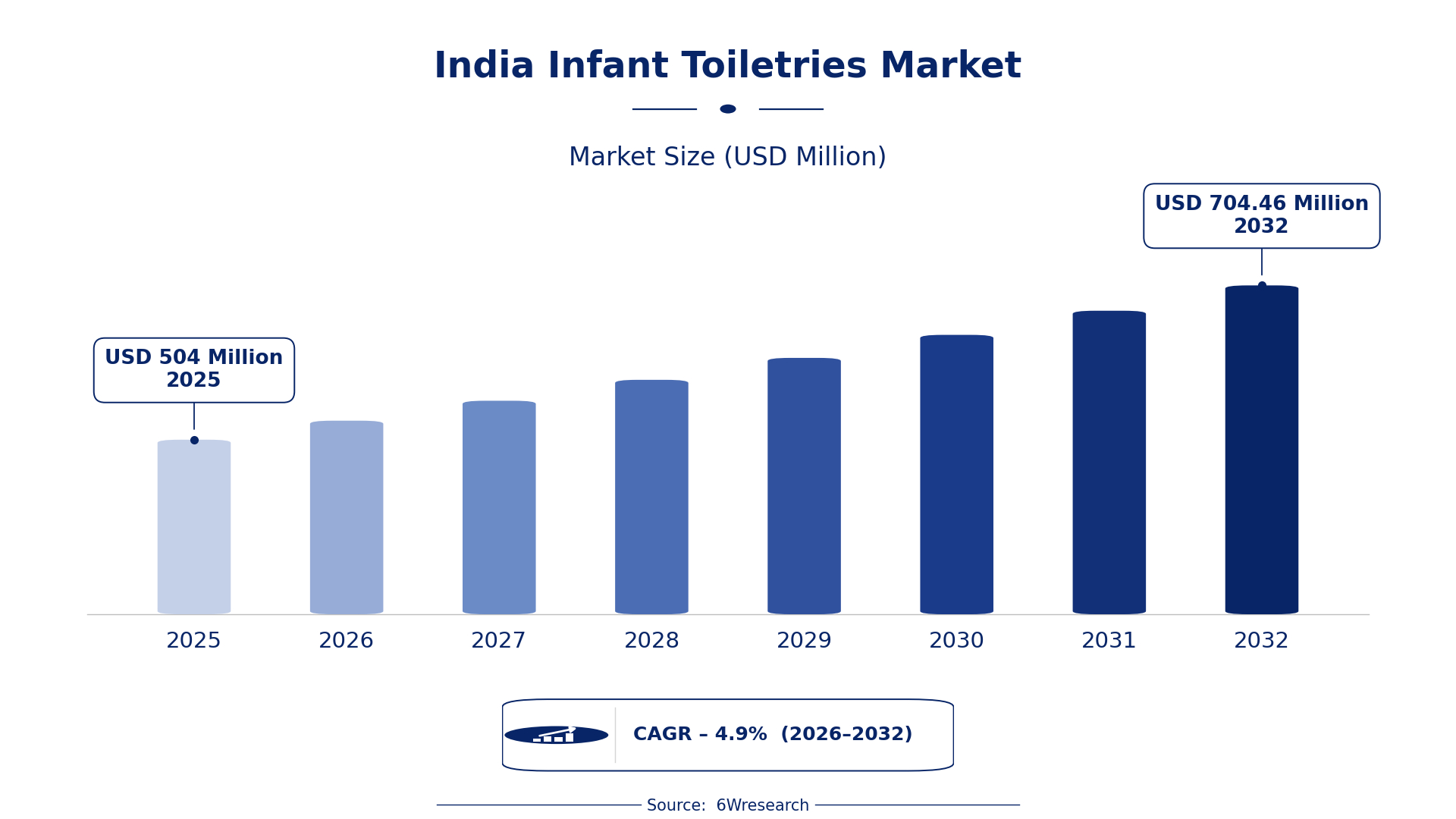
According to 6Wresearch internal database and industry insights, the India Infant Toiletries Market was valued at USD 504.0 million in 2025 and is projected to reach USD 704.46 million by 2032, growing at a CAGR of approximately 4.9% during 2026–2032.
India Infant Toiletries Market Highlights
| Report Metric | Details |
| Report Name | India Infant Toiletries Market |
| Market Size 2025 | USD 504.0 million |
| Market Size 2032 | USD 704.46 million |
| Absolute Growth 2025–2032 | USD 200.46 million |
| CAGR 2026–2032 | 4.9% |
| Peak Annual Growth | 7.2% in 2027 |
| Forecast Period | 2026–2032 |
| Historical Data | 2022–2025 |
| Base Year | 2025 |
| Leading Infant Toiletries, 2025 | Baby Shampoos (48% share) |
| Leading Product Type, 2025 | Tear-Free Formula (50% share) |
| Leading Formula Type, 2025 | pH Balanced (50% share) |
| Leading Packaging Style, 2025 | Plastic Bottles (41% share) |
| Leading Distribution Channel, 2025 | Pharmacies (37% share) |
| Fastest-Growing Infant Toiletries | Diaper Rash Creams (6.7% CAGR) |
| Fastest-Growing Product Type | Ayurvedic/Herbal (7.2% CAGR) |
| Fastest-Growing Formula Type | Hypoallergenic (6.5% CAGR) |
| Fastest-Growing Distribution Channel | Online Retail (6.0% CAGR) |
| Growing Sector | Online Retail |
| Key End Users | Pharmacies, Retail Chains, Online Retail, General Stores |
India Infant Toiletries Market Year-wise Growth Rate and Key Drivers (2022–2032)
This graph illustrates the annual growth rates of the market from 2022 to 2032, highlighting a steady upward trajectory and projected market expansion over the forecast period.
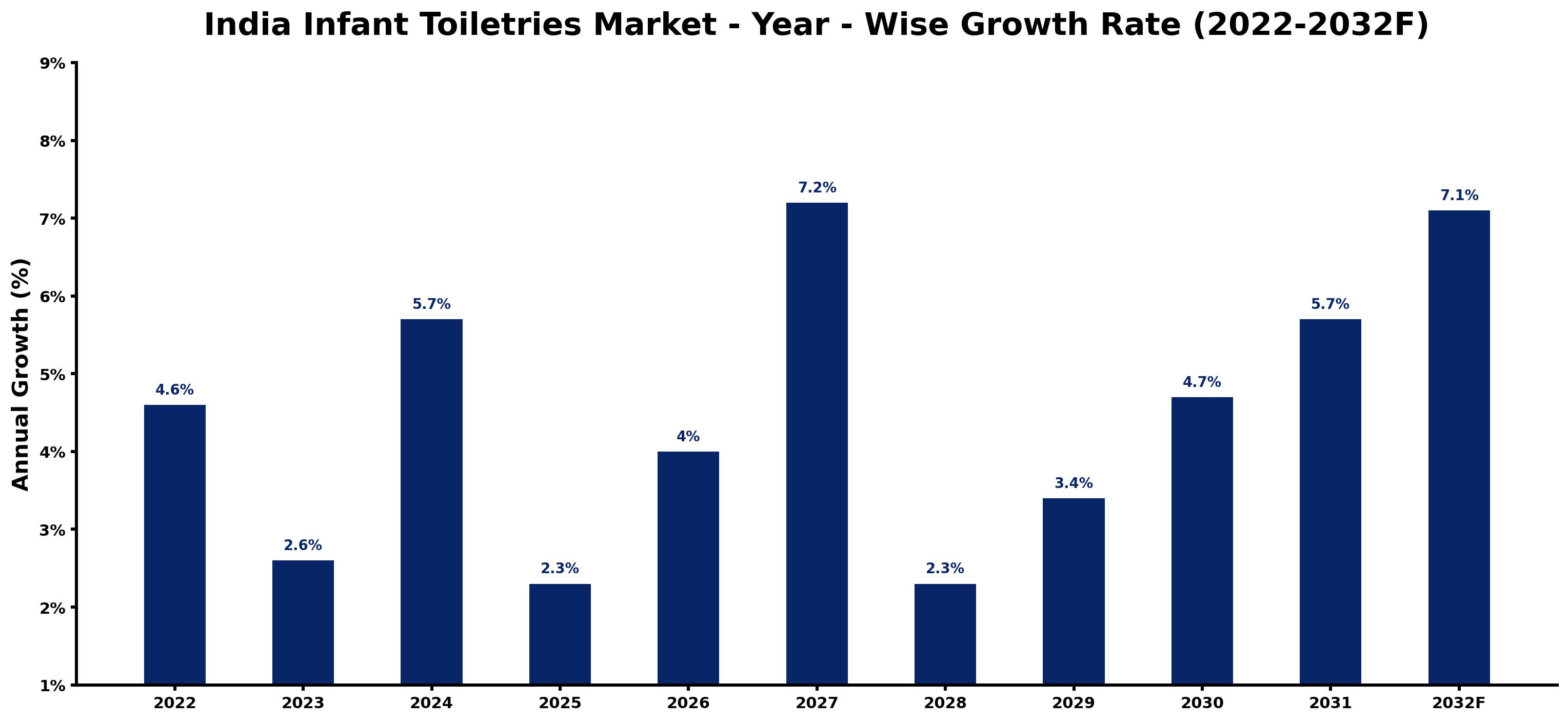
Each row of the following table gives one year's estimated growth and the event or demand shift that explains it.
| Year | Estimated Annual Growth (%) | Market Rationale |
| 2022 | 4.6 | The market experienced steady growth, driven by the 'National Health Mission' promoting safe infant care practices. |
| 2023 | 2.6 | Growth slowed due to a temporary dip in consumer spending amid economic uncertainties affecting purchasing behaviour. |
| 2024 | 5.7 | Demand surged as parents prioritised quality products following recommendations from pediatricians. |
| 2025 | 2.3 | Growth slowed again as consumers adjusted to spending patterns after economic shifts. |
| 2026 | 4.0 | An increase in online retail options is expected to boost market demand as convenience rises. |
| 2027 | 7.2 | The market is projected to peak as consumer interest in safe and natural products surges, particularly in urban areas. |
| 2028 | 2.3 | Growth is expected to slow as market saturation begins to take effect in urban regions. |
| 2029 | 3.4 | A slight rebound is anticipated as demand for organic options gains traction among parents in Maharashtra. |
| 2030 | 4.7 | The market will continue to grow as awareness of infant hygiene and care expands through educational campaigns. |
| 2031 | 5.7 | Growth is expected to accelerate again due to rising disposable incomes and urban population trends. |
| 2032 | 7.1 | The market is projected to grow as more parents seek high-quality infant care solutions, driven by evolving consumer preferences. |
Note: Market size estimations and growth projections presented in this report are based on 6Wresearch's proprietary forecasting methodology, utilizing the latest available industry data, government publications, and primary research inputs.
India Infant Toiletries Market Synopsis
Infant Toiletries in India include a variety of personal care products tailored for babies, such as shampoos, creams, oils, and soaps. These items are crafted with gentle ingredients to ensure they are safe for delicate skin. The India Infant Toiletries Market is expanding due to increasing demand from urban households focused on baby care, along with a surge in online retail sales expected to reach 30% of total sales by 2025. The average household spends approximately INR 1,500 annually on infant toiletries, indicating a strong commitment to quality care.
Market Dynamics Impact Analysis (2026–2032)
| Factor | Type | Impact | Primary Segment Affected |
| Growing interest in Ayurvedic formulations | Driver | High | Ayurvedic/Herbal |
| Rising demand for hypoallergenic products | Driver | High | Hypoallergenic |
| Increase in online retail channels | Opportunity | High | Online Retail |
| Growing urban population in Maharashtra | Opportunity | High | Baby Shampoos |
| Regulatory compliance costs for manufacturers | Restraint | Medium | Diaper Rash Creams |
| Limited awareness in rural areas about infant hygiene | Restraint | Medium | Baby Oils |
| Competition from unregulated local brands | Challenge | High | Baby Shampoos |
| Challenges in maintaining product safety standards | Challenge | Medium | Baby Soaps |
Evaluation of Drivers in India Infant Toiletries Market (2026–2032)
The table below links each growth driver to the segment it affects and the evidence for it.
| Drivers | Primary Segment Affected | Why It Matters (Evidence) |
| Urban households prioritising baby care | Baby Shampoos | This demographic drives demand as they seek quality products for daily infant hygiene, focusing on safety and efficacy. |
| Increased interest in natural ingredients | Ayurvedic/Herbal | The 25% rise in consumer interest reflects a shift towards organic options, leading to more purchases of herbal products in urban markets. |
| Growth in e-commerce platforms | Online Retail | Projected online sales growth to 30% by 2025 encourages parents to purchase infant toiletries conveniently through digital channels. |
| Recommendations from pediatricians | Diaper Rash Creams | Widespread endorsement of zinc oxide-based creams by healthcare professionals boosts consumer trust and sales, especially among new parents. |
| Rising disposable incomes | Baby Shampoos | As disposable incomes increase, households are willing to spend more on premium infant care products, enhancing market growth. |
Market growth for Infant Toiletries in India is underpinned by rising demand from urban households prioritising baby care, alongside an increase in e-commerce platforms. The average household expenditure on these products is estimated at INR 1,500 annually, driving more purchases. The growing interest in Ayurvedic formulations has resulted in a notable rise in consumer interest, encouraging parents to opt for natural ingredients. Recommendations from pediatricians for zinc oxide-based diaper rash creams further build consumer trust, increasing sales. As disposable incomes rise, families are more inclined to invest in high-quality infant care products, fuelling market expansion.
Evaluation of Restraints in India Infant Toiletries Market
The main factors holding the market back are set out below.
| Market Restraint | Primary Segment Affected | Why It Matters (Evidence) |
| High compliance costs for safety standards | Diaper Rash Creams | Manufacturers face increased expenses to meet updated safety regulations, impacting pricing strategies by up to 20%. |
| Limited awareness about infant hygiene in rural areas | Baby Oils | This lack of knowledge restricts market growth in less urbanised regions, affecting overall sales and consumer trust. |
| Competition from unregulated local brands | Baby Shampoos | Such brands often offer lower prices, making it challenging for regulated products to compete effectively in price-sensitive markets. |
| Challenges in maintaining product safety standards | Baby Soaps | Manufacturers must invest in rigorous testing and compliance, which can delay product launches and increase costs. |
| Sustainability concerns regarding packaging materials | Plastic Bottles | Growing consumer demand for eco-friendly packaging increases costs for manufacturers transitioning to sustainable options. |
India Infant Toiletries Market Challenges
The India Infant Toiletries Market encounters several practical issues, starting with a shortage of skilled professionals in manufacturing. This gap arises from limited vocational training programs, causing delays in production timelines for suppliers. Buyers face rising costs, as the average household expenditure on infant toiletries is estimated at INR 1,500 annually, putting pressure on family budgets. Compliance with safety regulations established by the Bureau of Indian Standards complicates operations for smaller producers, increasing retail prices by up to 20%. Technology adoption remains slow; many manufacturers continue to rely on outdated processes, limiting innovation in product development.
Trends in the India Infant Toiletries Market
Several trends are reshaping the India Infant Toiletries Market; the most important are set out below.
- Shift Towards Ayurvedic Products: A notable trend is the shift towards Ayurvedic infant toiletries, with a 25% rise in interest in 2023. This change is prompting brands to introduce more herbal options to meet consumer preferences.
- Rise of Online Retail: The 'Digital India' initiative is driving a shift towards online sales, projected to reach 30% of total infant toiletries sales by 2025. This change is making products more accessible to urban consumers.
- Focus on Hypoallergenic Products: The demand for hypoallergenic infant toiletries is rising, with a 15% increase noted in 2023. This trend is pushing brands to develop more products that cater to sensitive skin.
- Sustainability in Packaging: There is a growing emphasis on eco-friendly packaging among infant toiletries manufacturers. This shift is evident as more brands adopt sustainable materials to align with consumer preferences.
Investment Opportunities in the India Infant Toiletries Market
Some of the investment opportunities in the India Infant Toiletries Market are mentioned below.
- Investment in Ayurvedic Formulations: With a 25% increase in consumer interest, there is a strong opportunity to develop Ayurvedic infant toiletries. Targeting urban households in Maharashtra could yield substantial returns.
- Expansion of Online Retail Channels: As online sales are projected to reach 30% by 2025, investing in e-commerce platforms presents a lucrative opportunity for suppliers. Collaborating with local online retailers can facilitate market entry.
- Development of Hypoallergenic Products: The rising demand for hypoallergenic infant toiletries presents an opportunity for manufacturers to innovate. Focusing on urban markets where awareness is growing can enhance market penetration.
- Sustainable Packaging Solutions: With increasing consumer preference for eco-friendly packaging, investing in sustainable materials can differentiate brands. Targeting urban areas where sustainability is a priority can attract environmentally conscious buyers.
Government Initiatives in the India Infant Toiletries Market
The 'Bureau of Indian Standards' updated safety standards for infant toiletries in 2021, requiring manufacturers to adhere to strict guidelines that ensure product safety. Compliance with these standards is essential for market access and builds consumer trust, as parents increasingly seek reliable products for their children. The 'National Health Mission', launched in 2020, promotes safe infant care practices, including the use of approved toiletries, further reinforcing the importance of quality in this market. The 'Ministry of Women and Child Development' plays a vital role in promoting awareness about safe infant hygiene products, ensuring that parents are informed about the best options for their children.
The 'Ministry of Women and Child Development' plays a vital role in promoting awareness about safe infant hygiene products. Their campaigns support the adoption of approved toiletries, ensuring that parents are informed about the best options for their children. Additionally, the 'Ayush' ministry has been active in promoting Ayurvedic formulations for infant care, providing guidelines that encourage manufacturers to develop natural products. These initiatives collectively enhance the market's credibility and encourage consumer confidence in infant toiletries. The 'Make in India' initiative continues to support local manufacturing, with updated policies in 2022 to strengthen domestic production capabilities.
Future Insight of the India Infant Toiletries Market
The India Infant Toiletries Market is set for notable changes by 2032, driven by several forward-looking factors. The 'Make in India' initiative will strengthen local production capabilities, allowing suppliers to better meet consumer demands. By 2025, online retail sales are projected to reach 30% of total sales, transforming how buyers access products. Campaigns promoting safe and natural baby care products will enhance consumer confidence. The rising demand for eco-friendly packaging will attract environmentally conscious parents, further supporting market expansion.
Market Segmentation Analysis
Each segment group is reviewed below, with the leader by share and the fastest grower by CAGR.
By Infant Toiletries – Baby Shampoos Dominated, Diaper Rash Creams Expected to Grow Fastest
According to Shubham Deep, Research Manager at 6Wresearch, Baby Shampoos accounted for a 48% market share by infant toiletries in 2025. Baby shampoos command the largest share in the India Infant Toiletries Market as they are indispensable for daily hair care, especially among urban households that prioritise baby care. With India's infant population at approximately 160 million, the consistent demand for these products is evident. Diaper Rash Creams are projected to grow fastest, at a CAGR of 6.7% during 2026–2032. Diaper rash creams are experiencing rapid growth as parents increasingly seek effective solutions for diaper rashes, with recommendations from pediatricians driving this trend. The heightened awareness of infant hygiene is prompting parents to invest more in quality products for their babies. Suppliers should focus on product innovation in both baby shampoos and diaper rash creams to capture the expanding market share.
By Product Type – Tear-Free Formula Dominated, Ayurvedic/Herbal Expected to Grow Fastest
Tear-Free Formula took a 50% share of product type in 2025, more than any other category. Tear-free formula products lead the market due to their essential role in preventing eye irritation during washing, making them a preferred choice for parents. This focus on gentle formulations aligns with the growing consumer awareness regarding infant safety and comfort. The quickest growth will come from Ayurvedic/Herbal, forecast to expand at a CAGR of 7.2% between 2026 and 2032. Ayurvedic and herbal infant toiletries are witnessing the fastest growth as consumers increasingly prefer natural ingredients, reflecting a broader trend towards health and wellness. This segment's rise indicates a shift in consumer preferences towards safer, plant-based alternatives. Suppliers should consider expanding their product lines to include Ayurvedic and herbal options to meet the rising demand for natural infant toiletries.
By Formula Type – pH Balanced Dominated, Hypoallergenic Expected to Grow Fastest
The largest formula type category in 2025 was pH Balanced, with a 50% share of total revenue. pH balanced products are the leading choice in the market as they are crucial for maintaining skin health, particularly for sensitive infant skin. The emphasis on skin-friendly formulations resonates with parents seeking safe and effective options for their children. Hypoallergenic is set to record the highest CAGR in this split, 6.5% over 2026–2032. Hypoallergenic products are experiencing the fastest growth due to the increasing prevalence of allergies among infants, prompting parents to seek safer alternatives. This trend highlights a growing awareness of skin sensitivities and the need for tailored products. Suppliers should enhance their offerings of hypoallergenic infant toiletries to cater to the rising demand for allergy-friendly options.
By Packaging Style – Plastic Bottles Dominated and Is Expected to Record the Fastest Growth
In 2025, Plastic Bottles led the packaging style split with a 41% share. Plastic bottles are the predominant packaging style in the market, as they are widely used for liquid products, ensuring convenience and safety for consumers. Their lightweight and durable nature makes them a preferred choice for infant toiletries, appealing to parents seeking practicality. Plastic Bottles are also forecast to expand faster than any other category, at a CAGR of 6.3% over 2026–2032. Plastic bottles are also the fastest-growing packaging style, as they align with consumer preferences for convenience and ease of use, particularly in online retail settings. This trend is likely to continue as the market shifts towards more sustainable packaging solutions. Suppliers should focus on sustainable packaging innovations while maintaining the use of plastic bottles to meet consumer expectations.
By Distribution Channel – Pharmacies Dominated, Online Retail Expected to Grow Fastest
With a 37% revenue share in 2025, Pharmacies was the largest distribution channel category. Pharmacies are the leading distribution channel for infant toiletries, accounting for a substantial share of sales in urban areas. Their trusted status as sources for health-related products ensures that parents can access quality infant care items conveniently. Online Retail is projected to grow fastest, at a CAGR of 6.0% during 2026–2032. Online retail is the fastest-growing distribution channel, driven by the convenience it offers to consumers. The projected increase in online sales reflects changing shopping habits, especially among tech-savvy parents looking for ease in purchasing infant toiletries. Suppliers should strengthen their online presence to capitalise on the increasing trend towards online retail in the infant toiletries market.
Key Attractiveness of the Report
- 10 Years of Market Numbers
- Historical Data Starting from 2022 to 2025
- Base Year 2025
- Forecast Data until 2032
- Key Performance Indicators Impacting the Market
- Major Upcoming Developments and Projects
Key Highlights of the Report:
- India Infant Toiletries Market Outlook
- Market Size of India Infant Toiletries Market, 2025
- Forecast of India Infant Toiletries Market, 2032
- Historical Data and Forecast of India Infant Toiletries Revenues & Volume for the Period 2022 - 2032F
- India Infant Toiletries Market Trend Evolution
- India Infant Toiletries Market Drivers and Challenges
- India Infant Toiletries Price Trends
- India Infant Toiletries Porter's Five Forces
- India Infant Toiletries Industry Life Cycle
- Historical Data and Forecast of India Infant Toiletries Market Revenues & Volume By Infant Toiletries for the Period 2022 - 2032F
- Historical Data and Forecast of India Infant Toiletries Market Revenues & Volume By Baby Shampoos for the Period 2022 - 2032F
- Historical Data and Forecast of India Infant Toiletries Market Revenues & Volume By Diaper Rash Creams for the Period 2022 - 2032F
- Historical Data and Forecast of India Infant Toiletries Market Revenues & Volume By Baby Oils for the Period 2022 - 2032F
- Historical Data and Forecast of India Infant Toiletries Market Revenues & Volume By Baby Soaps for the Period 2022 - 2032F
- Historical Data and Forecast of India Infant Toiletries Market Revenues & Volume By Product Type for the Period 2022 - 2032F
- Historical Data and Forecast of India Infant Toiletries Market Revenues & Volume By Tear-Free Formula for the Period 2022 - 2032F
- Historical Data and Forecast of India Infant Toiletries Market Revenues & Volume By Zinc Oxide Based for the Period 2022 - 2032F
- Historical Data and Forecast of India Infant Toiletries Market Revenues & Volume By Ayurvedic/Herbal for the Period 2022 - 2032F
- Historical Data and Forecast of India Infant Toiletries Market Revenues & Volume By Glycerin Base for the Period 2022 - 2032F
- Historical Data and Forecast of India Infant Toiletries Market Revenues & Volume By Formula Type for the Period 2022 - 2032F
- Historical Data and Forecast of India Infant Toiletries Market Revenues & Volume By pH Balanced for the Period 2022 - 2032F
- Historical Data and Forecast of India Infant Toiletries Market Revenues & Volume By Hypoallergenic for the Period 2022 - 2032F
- Historical Data and Forecast of India Infant Toiletries Market Revenues & Volume By Fragrance-Free for the Period 2022 - 2032F
- Historical Data and Forecast of India Infant Toiletries Market Revenues & Volume By Moisturizing for the Period 2022 - 2032F
- Historical Data and Forecast of India Infant Toiletries Market Revenues & Volume By Packaging Style for the Period 2022 - 2032F
- Historical Data and Forecast of India Infant Toiletries Market Revenues & Volume By Flip Cap Bottles for the Period 2022 - 2032F
- Historical Data and Forecast of India Infant Toiletries Market Revenues & Volume By Tubes for the Period 2022 - 2032F
- Historical Data and Forecast of India Infant Toiletries Market Revenues & Volume By Plastic Bottles for the Period 2022 - 2032F
- Historical Data and Forecast of India Infant Toiletries Market Revenues & Volume By Paper Wrapped for the Period 2022 - 2032F
- Historical Data and Forecast of India Infant Toiletries Market Revenues & Volume By Distribution Channel for the Period 2022 - 2032F
- Historical Data and Forecast of India Infant Toiletries Market Revenues & Volume By Pharmacies for the Period 2022 - 2032F
- Historical Data and Forecast of India Infant Toiletries Market Revenues & Volume By Retail Chains for the Period 2022 - 2032F
- Historical Data and Forecast of India Infant Toiletries Market Revenues & Volume By Online Retail for the Period 2022 - 2032F
- Historical Data and Forecast of India Infant Toiletries Market Revenues & Volume By General Stores for the Period 2022 - 2032F
- India Infant Toiletries Import Export Trade Statistics
- Market Opportunity Assessment By Infant Toiletries
- Market Opportunity Assessment By Product Type
- Market Opportunity Assessment By Formula Type
- Market Opportunity Assessment By Packaging Style
- Market Opportunity Assessment By Distribution Channel
- India Infant Toiletries Top Companies Market Share
- India Infant Toiletries Competitive Benchmarking By Technical and Operational Parameters
- India Infant Toiletries Company Profiles
- India Infant Toiletries Key Strategic Recommendations
Market Covered
Segments analysed in this report are listed below.
By Infant Toiletries
- Baby Shampoos
- Diaper Rash Creams
- Baby Oils
- Baby Soaps
By Product Type
- Tear-Free Formula
- Zinc Oxide Based
- Ayurvedic/Herbal
- Glycerin Base
By Formula Type
- pH Balanced
- Hypoallergenic
- Fragrance-Free
- Moisturizing
By Packaging Style
- Flip Cap Bottles
- Tubes
- Plastic Bottles
- Paper Wrapped
By Distribution Channel
- Pharmacies
- Retail Chains
- Online Retail
- General Stores































